
Industrial Microwave Heating Equipment Market Snapshot

Key Players

  • Muegge GmbH (Germany)
  • Fujitsu General (Japan)
  • Hitachi Power Solutions Co. Ltd. (Japan)
  • Richardson Electronics (United States)
  • Toshiba International Corporation (United States)
  • Thermex-Thermatron Systems (United States)
  • MIP Limited (United Kingdom)
  • Teledyne e2v (United Kingdom)
  • CommScope Holding Company Inc. (United States)
  • Cober Electronics (Canada)

Market Size

Base Year 2024
$1.47 Bn
CAGR
6.3%
Forecast 2034
$2.71 Bn

Market Segments

By Type
Batch, Continuous
By Component
Microwave Generation Source, Waveguides, Control Systems, Others
By Power
Up to 25 kW, 25 kW - 100 kW, Above 100 kW
By End-use Industry
Pharmaceutical, Food & Beverage, Plastics & Rubber, Chemicals, Paper, Others

Market Dynamics

Drivers
  • Rising demand for energy-efficient appliances
  • Increased industrial automation trends
Restraints
  • High initial installation cost
  • Limited industrial application reach
Opportunities
  • Growing industrialization rates
  • Technological advancements in microwave heating

Market Size

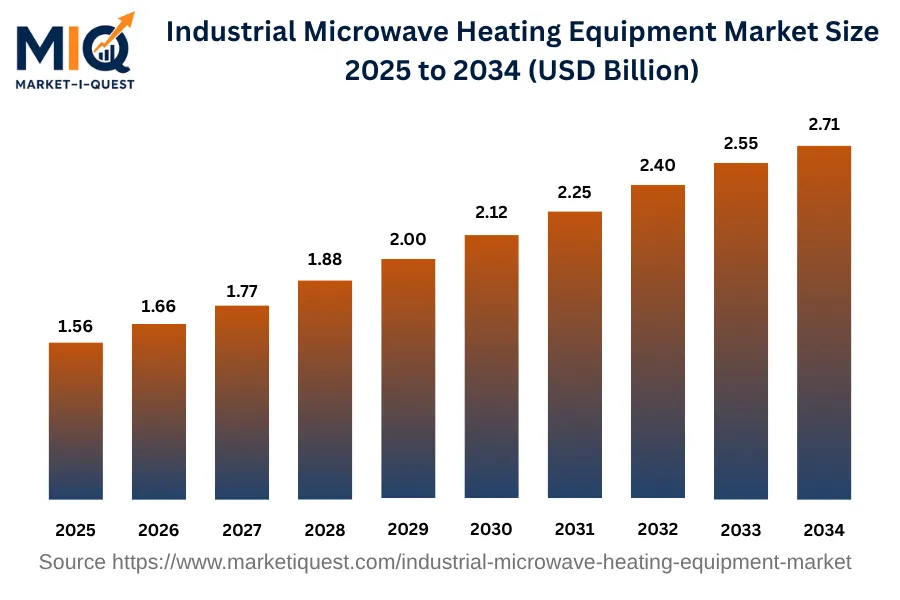
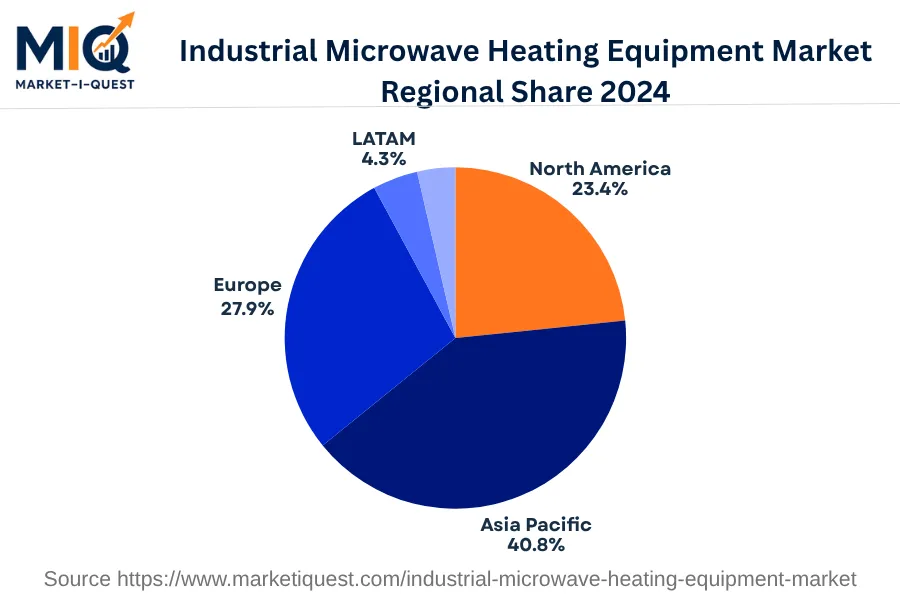
The Industrial Microwave Heating Equipment Market, valued at $1.56 billion in 2025, is projected to grow to $2.71 billion by 2034, demonstrating a compound annual growth rate (CAGR) of 6.3%. Growth trajectory sees market value climbing from its 2024 baseline of $1.47 billion, indicating that this increase is gradual yet steady over the course of a decade. This steady expansion is fueled by evolving industrial needs and continuous technological advancements, enhancing efficiency and effectiveness of microwave heating equipment. The geographical distribution of market share in 2024 shows that Asia Pacific led with a 40.8% stake, followed by Europe at 27.9%. North America constituted a substantial 23.4% of market, whereas Latin America, Middle East and Africa held minor shares of 4.3% and 3.6% respectively.

Key Takeaways

  • By Type - Batch segment led Industrial Microwave Heating Equipment Market contributing significant share in 2024.
  • By Component - Microwave Generation Source held leading position in 2024.
  • By Power - 25kW-100kW registered largest share growth in 2024.
  • By End-use - Chemicals subsegment expanded robustly holding a noteworthy share in 2024.
industrial-microwave-heating-equipment-market market size

Key Driving Factors

Stringent Environmental Regulations

An escalating drive towards minimizing industrial carbon footprints has resulted in stringent environmental policies across different regions. Many industrial operations are looking for cleaner, more energy-efficient alternatives to traditional heating methods. Industrial microwave heating equipment emerges as sustainable solution due to its inherent thermal efficiency which significantly reduces carbon emissions. Regulatory bodies like Environmental Protection Agency (EPA) in U.S., and European Environment Agency (EEA) in Europe, have laid down mandates to lower greenhouse gas emissions. As these authorities tighten their regulations, industries are compelled to adopt cleaner technologies to comply, making microwave heating an increasingly attractive option. This adherence to environmental regulations is a major driving factor for growth of industrial microwave heating equipment market.
Increased Emphasis on Process Efficiency

Many industries are placing higher emphasis on process efficiency to achieve cost reductions and operational improvements. Compared with traditional thermal systems, industrial microwave heating equipment provides rapid, uniform heating which can enhance production efficiency and product quality. This speed of heating is pivotal in operations where time is critically important, like food and beverage sector, or in pharmaceutical production. The microwave heating process does less damage to materials during heating, preserving substance integrity in critical applications like material science and metallurgy. Drive to improve overall process efficiency and maintain high quality in different industrial sectors is thus fueling demand for advanced heating solutions provided by industrial microwave heating equipment.

Market Evolution by Timeline

2019-2023
During this period, primary buyers of industrial microwave heating equipment were in food and chemicals industries, largely concentrated in US, China, and India, aiming to improve production efficiency. Notable providers like Muegge GmbH shipped systems with increased power ranges, though integration with existing production lines was a typical challenge. Regulatory standards from authorities like FDA influenced design and safety measures, leading to heightened process safety. Equipment contracts often favored leasing models due to high upfront costs. High energy consumption rates, entailing increased operational costs, posed a risk to adoption. Manufacturers responded by incorporating energy-efficient design features.
2024
In 2024, the demand for industrial microwave heating equipment spread to textile and pharmaceutical sectors, particularly in European countries, for process improvements. Firms like Cober Muegge and Panasonic shipped equipment with better heat distribution and controlled emission to mitigate harmful radiation. Industry-specific standards, like EU's RED Directive, influenced the product adoption. The transaction model shifted more towards purchasing, facilitated by funding options from financial institutions. But space requirement for large equipment installations became a bottleneck, which equipment providers tried to mitigate through compact and modular designs.
2025-2029
This period saw an increased demand in emerging markets like Brazil and South Africa due to expanding industrial sectors. The supply was marked by introduction of IOT-enabled devices from manufacturers like Hitachi, facilitating predictive maintenance. Regulations tightened on emissions from World Health Organization, encouraging use of environmentally friendly microwave heating systems. Cost-per-use pricing models began to take hold, encouraging more businesses to use these systems. The complexity of IoT-enabled devices raised concerns about their accessibility and posed a barrier to their adoption. But improvements were steadily made to user interfaces and system operation training.
2030-2034
The trend of customization of industrial microwave heating systems suited to specific industrial needs became prominent in this period, catering to varied range of sectors globally. 'Smart' systems were introduced by companies like Toshiba, improving efficiency and operation visibility. ISO standards for safety and interoperability came into effect, influencing product design. This period saw introduction of long-term maintenance contracts bundled with equipment sales, improving lifetime value for customers. Growing intricacy of smart systems created knowledge gap, which suppliers responded to by creating comprehensive user guides and increasing client training.

Future Market Outlook

Future Opportunities

Future opportunities within industrial microwave heating equipment market are closely tied to current developments and anticipated industrial needs. Rise of circular economy concept, which was formally emphasized in European Commission's Green Deal of 2019, may lead manufacturers to prioritize design of microwave systems that minimize waste and energy usage. This shift is pushing several players, like GEA Group, to explore microwave technology's applicability in sustainable food processing methods. Moreover, increasing focus on renewable energy sources, highlighted by initiatives like Germany's Energiewende policy since 2010, prompts industries to seek energy-efficient solutions; microwave heating’s capacity for reducing energy consumption during manufacturing could fulfill this requirement. In pharma sector, collaborations involving firms like Siemens and research institutions have demonstrated that microwave heating can expedite drug formulation processes, showcasing potential for rapid scale-up of production. As smart manufacturing trends emerge, companies can leverage IOT-driven systems for real-time monitoring and control of microwave heating, capitalizing on insights from Industrial Internet Consortium's frameworks released in 2021. Finally, stringent food safety regulations being implemented globally are encouraging food manufacturers to invest in microwave systems capable of precise temperature control, paving the way for enhanced quality assurance in food preparation processes.

Segmentation Analysis

By Type

The market is divided into subsegments including Batch and Continuous. The Batch subsegment accounted for the largest revenue share while the Continuous subsegment is expected to grow at the fastest CAGR during the forecast period.

Largest Revenue Share

Batch

Market Share Leader

Given its established market presence and widespread adoption, the Batch segment currently dominates with the largest revenue share. This process format caters to fixed production runs which enables manufacturers to enhance production quality through greater control over individual batches. The Batch model remains attractive in industries where customization is key or where product specifications vary frequently. Additionally, its straightforwardness in setup and operation makes it desirable for sectors where rapid product switching is crucial. This segment is also favored by smaller businesses due to its relative affordability and flexibility compared to Continuous manufacturing. Furthermore, regulations and standards across various industries orient towards this segment. However, it's important to note that this assumption stems from a general market structure, and the exact figures might diverge based on specific market conditions.

Fastest CAGR

Continuous

Forecast Period Growth Leader

While the Continuous subsegment currently holds a smaller market share, it's poised to grow at the fastest rate. The primary driver behind this acceleration is the increasing demand for consistent, high-volume production. Continuous manufacturing allows for streamlined operations, reduction of downtime, and increased productivity. Technological advancements and automation are also acting as significant catalysts, making the Continuous process increasingly efficient, accurate, and scalable. However, there are barriers to adoption, primarily high initial capital expenditure and the need for significant technical expertise. Despite these hurdles, the potential for improved quality control, yield enhancement, cost reduction, and shorter time-to-market make it a promising segment for future growth. Considering these factors, the Continuous segment is set to increase its market share over the forecast period. Please note that these inferences are drawn applying typical industry logic and actual market dynamics may differ.

By Component

The market is divided into subsegments including Microwave Generation Source, Waveguides, Control Systems, and Others. Amongst these, Microwave Generation Source accounted for the largest revenue share while Control Systems is expected to grow at the fastest CAGR during the forecast period.

Largest Revenue Share

Microwave Generation Source

Market Share Leader

Industry trends indicate that the Microwave Generation Source subsegment leads in terms of revenue. This is primarily driven by the globally increasing demand for higher capacity microwave communications in Industries such as defense, aerospace, chemistry and medical to name a few. Geographic regions such as the Asia-Pacific and Europe show considerable revenue contribution due to the growing adoption of upgraded technology. Regulation in developed markets have been supportive in facilitating wider application range of microwave communications, contributing to revenue growth. Customer preference lies largely with the subsegment due to its integral, fundamental role in the overall system function, leading to higher purchasing priority. Furthermore, the limited supply coupled with complex procurement process further adding to the pricing structure. Consequently, the switching cost to alternatives can be substantial.

Fastest CAGR

Control Systems

Forecast Period Growth Leader

While Microwave Generation Source leads in terms of revenue, Control Systems is the fastest growing subsegment. Rapid advancements in technology have been crucial in propelling the growth of this subsegment. Increasing automation in various industry sectors, capital investments in technology upgrades, and strategic partnerships among leading players to develop superior and cost-effective control systems have catalyzed this growth. Government policies encouraging digitization and the adoption of IoT technology across industries can be listed as a key growth driver. However, there are potential near-term risks. Adoption barriers such as high initial setup cost and the need for skilled professionals for system handling might impede growth rates. Therefore, vendors are focusing on producing user-friendly designs and encouraging staff training, to broaden adoption.

By Power

The market is divided into subsegments including 'Up to 25 kW', '25 kW - 100 kW', and 'Above 100 kW'. In the base year 2024, the '25 kW - 100 kW' subsegment accounted for the largest revenue share while 'Above 100 kW' is expected to grow at the fastest CAGR during the forecast period.

Largest Revenue Share

25 kW - 100 kW

Market Share Leader

The '25 kW - 100 kW' subsegment dominated revenue generation in 2024, likely driven by the versatility of products available in this range and the broad applicability across various industries. This bandwidth tends to fulfill the typical power requirements for mid-sized commercial and industrial operations, thus having more customer base. Moreover, the tighter regulations around energy efficiency place more emphasis on moderate power solutions, and customers are generally willing to pay for improved power yield and diversified usage. High switching costs to other power bands could have also locked in many customers to this segment. Additionally, manufacturers often prioritize this segment as the product tends to have lower production costs and higher profit margins. Stable supply chains and widespread distribution channels also contribute to the high revenues of this subsegment.

Fastest CAGR

Above 100 kW

Forecast Period Growth Leader

In contrast, the 'Above 100 kW' subsegment is expected to grow at the fastest pace. The key growth drivers for this segment are technological advancements and increased demand for high power output in large-scale industries. As economies scale up and industrialization grows, the requirement for compact, high-powered equipment has been rising. While a higher initial investment is an adoption barrier, the long-term cost benefits from efficient power utilization might tip the scales in favor. On the policy front, stricter emission norms are encouraging adoption of high-power, energy-efficient models. However, potential risks could come from significant capex requirements and availability of skilled labor to handle these high-powered systems. Despite these challenges, collaborations between manufacturers and users, technological leaps, and the push towards improvement in productivity make a strong case for the fastest growth of this subsegment.

By End-use Industry

The market is divided into subsegments including Pharmaceutical, Food & Beverage, Plastics & Rubber, Chemicals, Paper and Others. In the base year 2024, the Chemicals subsegment accounted for the largest revenue share, while the Pharmaceutical subsegment is expected to grow at the fastest Compound Annual Growth Rate (CAGR) during the forecast period.

Largest Revenue Share

Chemicals

Market Share Leader

The Chemicals subsegment tops the revenue charts due to a myriad of factors. From large-scale industrial processes to small-scale laboratory operations, chemicals are the backbone of many industries, hence their demand never ceases. They are widely used across multiple applications such as automobile, construction, agriculture, and detergent production, to name a few. Apart from this, chemicals are a cornerstone in the production of consumer goods, contributing significantly to its revenue growth. Additionally, chemicals are instrumental in sustainability initiatives — they play a key role in recycling processes, renewable energy production, and in the manufacturing of eco-friendly and energy-efficient products. Geographically speaking, Asia Pacific, especially China, with its booming industrial sector and mammoth population, drives a substantial portion of the chemical demand. Citing these reasons, the Chemicals subsegment emerges as the highest revenue earner.

Fastest CAGR

Pharmaceutical

Forecast Period Growth Leader

While the Chemicals subsegment has the largest revenue, the Pharmaceutical subsegment shows the fastest CAGR. The reasons behind this growth are multifaceted. A major factor is the continuous rise in both chronic and infectious diseases worldwide, which has inflated the demand for pharmaceuticals. Additionally, the acceleration in biopharmaceuticals and personalized medicine has given this subsegment an extra boost. Heightened investments in research and development has unleashed new treatments and therapies that demand a higher price, thus driving revenue growth. A key catalyst for growth could be the strategic partnerships being established between pharmaceutical companies and technology firms that are enabling cutting-edge automation and analytics in drug discovery and development. A potential barrier to growth includes regulatory scrutiny around drug pricing and approval, which can limit profitability. Nonetheless, the subsegment's growth outlook remains highly positive.

Competitive Analysis

Key Market Players

Manufacturers / OEMs

Muegge GmbH
Germany
L3 Technologies Inc.
US
Hitachi Power Solutions Co., Ltd.
Japan

Key Suppliers & Raw Materials

MACOM
US
Richardson Electronics, Ltd.
US
Thales Group
France

Distributors, Integrators & Channel Partners

MTI Corporation
US
MKS Instruments, Inc.
US
COMET Group
Switzerland

Porter’s Five Forces Analysis

This analysis explores the competitive forces in the industrial microwave heating equipment market.

Supplier Bargaining Power

Medium

Sourced components are generic, but precision requirements limit supplier options.

Buyer Bargaining Power

Low

High switching costs and lack of alternatives reduce buyer bargaining power.

Threat of Substitutes

Low

Few substitutes for industrial microwave heating due to superior efficiency.

Threat of New Entrants

Medium

High capital investment hinders entry, though demand and profitability attract players.

Competitive Rivalry

High

Industry is mature, with numerous established players leading to intense competition.

Regional Analysis

Geographic market dynamics and growth opportunities across key regions

Global Market Outlook

industrial-microwave-heating-equipment-market market regional share

North America

In 2024, the North American market for industrial microwave heating equipment exhibited robust growth driven by several key factors. Increased demand from industries like healthcare, retail, and manufacturing significantly influenced this surge. Technological advancements prompted adoption of these systems due to their energy efficiency and processing speed. Investment in research and development, particularly in United States and Canada, facilitated innovations in the sector. Stringent environmental regulations across North America also favored microwave heating over conventional methods due to its lower carbon footprint.

Trend-wise, the market was characterized by a shift towards automated and digitized operations. Manufacturers focused on integrating microwave heating systems with Internet of Things (IoT) to enhance operational efficiency. This shift was particularly noticeable within manufacturing sector. In Canada, increased enforcement of energy conservation policies led to adoption of these technologies, contributing to overall market growth. Channel dynamic shifts were witnessed in Mexico, where there was rising trend of acquiring microwave heating equipment via e-commerce platforms. Despite an absence of substantial M&A activities, strategic partnerships, particularly in U.S., drove forward the development and distribution of these systems. This fostered market expansion within the country, boosting the overall North American market stature.

Asia Pacific

In 2024, Industrial Microwave Heating Equipment Market in Asia Pacific displayed robust growth due to various catalysts. Increased demand for energy-efficient heating solutions in manufacturing sector propelled the market, particularly in China and India, known for their exponential industrial growth. There was a notable surge in Australia's food processing sector investing in these technologies for improved efficiency. Governments across the region, notably Japan and key ASEAN markets, promoted energy conservation norms boosting adoption of such high-efficiency equipment. Pricing dynamics in South Korea favoured manufacturing of cost-effective microwave heating equipment, stimulating market.

Significant trends shaping the market included a shift towards eco-friendly heating solutions in the utilities and manufacturing sectors, with Chinese enterprises leading the way. Technological innovations in India's robust pharmaceutical sector involved the widespread adoption of microwave heating. Channel dynamics evolved in Japan, with an increase in online sales of industrial equipment, reflecting changed buyer behaviours. Key partnerships and mergers, such as those in Australia's mining sector, standardized the usage of industrial microwave heating equipment. Strict enforcement of energy efficiency policies in ASEAN countries heightened the demand for these appliances, particularly in the government and energy/utility sectors. Overall, 2024 witnessed substantial stimuli and trends in the Industrial Microwave Heating Equipment Market in the Asia Pacific.

Europe

In 2024, the European Industrial Microwave Heating Equipment market emerged as a dynamic sector driven by contemporary manufacturing processes.

Driver factors included regulatory initiatives like WEEE and RoHS directives, which prompted industries to adopt greener technology, leading to increased investment in microwave heating equipment. The rapid adoption of Industry 4.0 technologies in Germany and the United Kingdom stimulated demand for precision-based microwave heating equipment. Meanwhile, in Southern Europe, Spain specifically, economic recovery led to an uptick in local manufacturing activities, driving equipment demand. Additionally, an increase in the prices of traditional heating fuels like natural gas induced a shift towards more economical microwave heating.

Among trends, buyers exhibited a preference for energy-efficient and compact equipment, primarily in the highly cost-driven sectors like manufacturing and retail. The product landscape shifted towards newly emerging IoT-based microwave heating technologies in technologically advanced regions such as Benelux and the Nordics. Partnerships between equipment manufacturers and power companies were witnessed to ensure optimized power supply, especially in Italy where grid stability has been a concern. Lastly, strict policy enforcement by regulators, particularly in Central & Eastern Europe, propelled sectors such as utilities and healthcare to comply, driving the market in the process.

Latin America

In 2024, the Latin American market for industrial microwave heating equipment experienced substantial growth due to several key demand factors. A surge in local manufacturing industries, particularly food processing in Brazil and Argentina, and ceramic manufacturing in Mexico and Peru, increased the demand for efficient heating solutions. Significant investments were made in upgrading existing industrial facilities to incorporate advanced technology. New regulatory standards in Colombia and Chile promoting energy-efficient practices also heightened the demand for such equipment.

Trends in the industrial microwave heating equipment market showed a shift towards highly efficient and compact systems. A noticeable uptake in automation technology in Argentina's automotive industry led to the adoption of smart microwave heating systems. In Mexico, the expansion of the electronic manufacturing sector engendered novel opportunities for partnerships and mergers & acquisitions, facilitating the integration of advanced heating solutions. In Brazil, increased policy enforcement around environmental sustainability boosted the adoption of eco-friendly industrial microwave heating systems.

While the manufacturing sector was the largest consumer of industrial microwave heating equipment, other sectors including healthcare in Brazil and Colombia, and utilities in Argentina and Chile also showed notable adoption rates. The retail sector in Mexico and Peru explored innovative applications of microwave heating equipment, driving the further growth of the market in 2024.

Middle East & Africa

In 2024, the Industrial Microwave Heating Equipment market in the Middle East and Africa displayed a unique landscape built around market demand and regulatory frameworks. Rising demand, driven by the growth in manufacturing, healthcare, oil and gas, and telecom sectors, coupled with favorable government policies in countries such as Saudi Arabia, United Arab Emirates, and Israel, amplified the need for such equipment. Investments surged in Egypt, Nigeria, and Kenya, facilitated by the adoption of cutting-edge technology and cost-effective supply dynamics.

Significant trends shaping the market included an observable shift in buyer behaviour towards eco-friendly and energy-efficient products, particularly in South Africa and Qatar. There was an increasing inclination towards partnerships and strategic M&A, especially in telecom and oil and gas sectors, to leverage technology advancements and consolidate market positions. There was noticeable enforcement of rigorous standards to assure quality and safety across the region. Technological upgradation was evident, with the adoption of smart and AI-powered heating equipment taking precedence.

Across sectors, there was a steadfast emphasis on sustainability, with innovation centered on manufacturing energy-efficient and environmentally friendly products. For instance, the Israeli government's policy backing for renewable energy technologies influenced market trends. Moreover, in the retail and financial services sectors of the UAE and Saudi Arabia, there was a marked increase in demand for sophisticated heating solutions.

Recent Industry Developments

Latest market innovations, product launches, and strategic initiatives

December 2024

Researchers validated the scaling of microwave technology for the industrial transformation of glycerol, demonstrating that modern microwave field generators have finally overcome the high capital costs that previously restricted the market. This explicitly paves the way for replacing conventional thermal heat carriers with microwave energy in chemical production facilities.

September 2024

A numerical and experimental validation of a Microwave Plasma Pencil (MPP) was published, advancing the equipment used for atmospheric surface treatment. This equipment refinement allows for high electron densities while keeping bulk gas temperatures low, expanding the market for microwave treatment of heat-sensitive industrial materials.

May 2024

Engineering researchers validated a microwave heating-assisted chemical looping system for the dry reforming of methane. This development demonstrates how industrial microwave equipment can be integrated into high-temperature catalytic processes, significantly reducing energy costs compared to traditional thermal reactors.

Frequently Asked Questions