Industrial Fasteners Market Snapshot

Key Players

  • Stanley Black & Decker Inc. (United States)
  • Bulten AB (Sweden)
  • Illinois Tool Works Inc. (United States)
  • XA Fasteners Co. Ltd. (China)
  • Alcoa Corporation (United States)
  • Nippon Industrial Fasteners Company (Japan)
  • Precision Castparts Corp. (United States)
  • NAFCO International Inc. (Taiwan)
  • Arconic Inc. (United States)
  • Bollhoff GmbH & Co. KG (Germany)

Market Size

Base Year 2024
$92.8 Bn
CAGR
4.6%
Forecast 2034
$145.50 Bn

Market Segments

By Material
  • Metal
  • Plastic
By Product
  • Internally Threaded
  • Externally Threaded
  • Non-Threaded
  • Aerospace Grade
By End Use
  • Automotive
  • Aerospace
  • Building & Construction
  • Industrial Machinery
  • Home Appliances
  • Lawns & Gardens
  • Motors & Pumps
  • Furniture
  • Others

Market Dynamics

Drivers
  • Increasing industrialization globally
  • Rapid urbanization trends
Restraints
  • High raw material costs
  • Stringent environmental regulations
Opportunities
  • Emerging manufacturing sectors
  • Growing industrialization in developing economies

Market Size

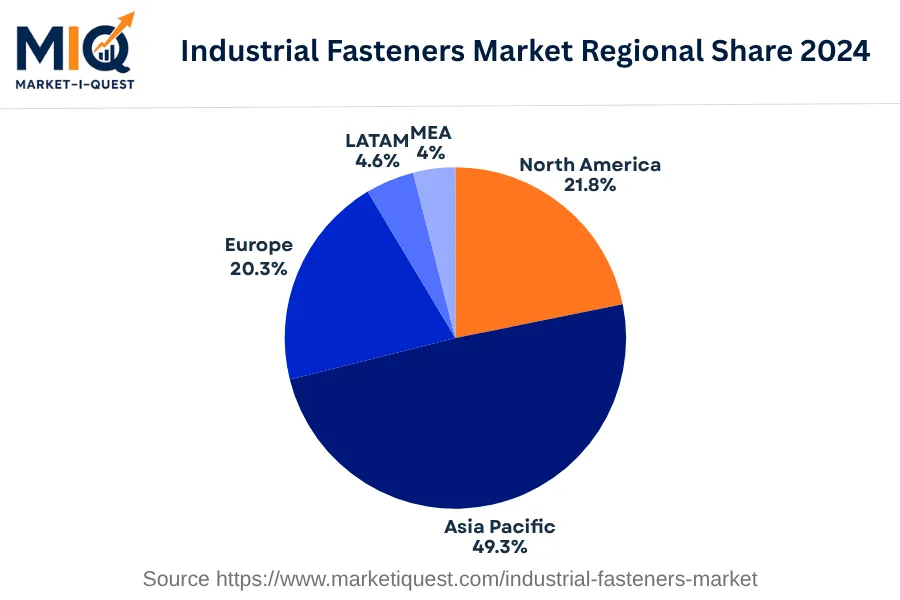
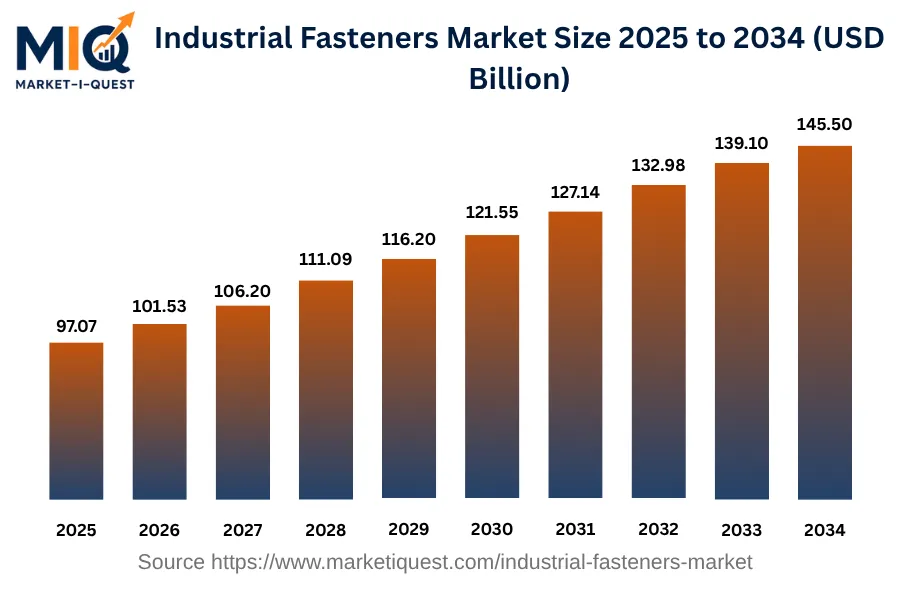
The Industrial Fasteners Market is projected to grow from 97.07 billion USD in 2025 to 145.50 billion USD in 2034, achieving a compound annual growth rate (CAGR) of 4.6%. The market size was valued at 92.80 billion USD in 2024, indicating a minor increase in value the subsequent year. Over the course of a decade from 2025 to 2034, this sector experienced an expansion of 49.8% which indicates a firm and consistent growth trajectory. This growth is primarily due to sustained demand for fastening products across diverse industries during the period. Specifically, the increasing importance of automotive and industrial equipment manufacturing sectors has been influential in determining the market's size and progression. Regionally, in 2024, the Asia Pacific region held a market share of 49.3%, followed by North America with a 21.8% share. Europe contributed a 20.3% share while LATAM and MEA held the least shares of 4.6% and 4.0% respectively.

Key Takeaways

  • By Material - Metal held dominance in the Industrial Fasteners Market in 2024.
  • By Product - Non-Threaded was leading subsegment with a major market share in 2024.
  • By End Use - Automotive segment led the market holding a significant position in 2024.
industrial-fasteners-market market size

Key Driving Factors

Increasing Complexity of Industrial Machinery

Over the last decade, there has been a notable rise in the intricacy and sophistication of industrial machinery across various sectors such as auto-manufacturing, aerospace, and construction. Advanced machinery requires industrial-grade fasteners that aren't just robust, but also uniquely tailored to withstand specific environmental and operational stresses. As a result, industrial fasteners that meet these stringent standards have become essential, pushing the market for these components. Importantly, this isn't a trend that's likely to ebb anytime soon. With industries continually racing to innovate and perfect machinery, the onward march of industrial complexity is poised to keep fueling sales of specialized fasteners.

Stringent Workplace Safety Regulations

In modern industrial setups, maintaining workplace safety is paramount. This includes ensuring that equipment and machinery are structurally sound. Various regulatory bodies worldwide, such as the Occupational Safety and Health Administration (OSHA) in the US and the European Agency for Safety and Health at Work (EU-OSHA), enforce stringent safety standards. These standards often necessitate the use of high-quality industrial fasteners to secure machinery, parts, and structures, providing a stable growth platform for the industrial fasteners market. Non-compliance can result in significant penalties for firms, making investment in high-quality fasteners primarily a risk mitigation strategy against regulatory action, rather than a choice.

Market Evolution by Timeline

2019-2023
In this period, infrastructure development in developing countries like India and China has propelled the demand for industrial fasteners. Major buyer sectors were observed from automotive, aerospace, and manufacturing industries due to the rise in automation and mechanization. Fastener technology witnessed the introduction of lightweight materials like plastics and alloys. Adoption of new techniques important due to factors like leakage elimination achieved significant maturity. However, supply got affected due to trade tensions between China and USA. Anti-dumping rules and raw material price fluctuations served as constraints. Commercial models saw multi-year contracts with fixed price arrangements becoming common. The main risk faced was overdependency on Asian markets for supply, mitigated by seeking alternative suppliers elsewhere.
2024
Structural steel usage in middle-east countries like Saudi Arabia and UAE ramped up demand. To meet increased energy-efficiency requirements, suppliers provided high strength and durable fasteners. Introduction of fastener standards like ASME B18 acted as a guide for manufacturing processes. Pricing dynamic saw suppliers offer volume discounts on large-scale procurement to secure deals. The introduction of 3D printed fasteners by few leads disrupted the typical supply chain and formed partnerships to prompt integration. Uncertainty loomed around global geopolitical risks and transport disruptions, but companies managed them by diversifying supply chain and opting local sourcing for raw materials.
2025-2029
The rise of electric vehicles and renewable energy infrastructure projects in European countries significantly increased the demand for fasteners. Technological achievements showed up with corrosion resistant and heat-treated fasteners usage meeting the advanced needs of these industries. With the standardization of digital twin technology in fastening systems, manufacturers achieved a substantial reduction in production defects. Manufacturers seek subsidies from governments to increase production capacities. Established firms adhere to energy-efficient manufacturing process to avail these benefits. The period also observed two-part procurement contracts with components priced separately. The fastener industry faced supply chain risks owing to Brexit, causing companies to create fail-safe strategies like stockpiling.
2030-2034
The implementation of modern construction techniques in developing countries like Brazil and Nigeria drove the fastener demand up. Supplier landscape perturbed with the introduction of bio-based and sustainable fasteners. Industrial fastener manufacturers conformed to the ISO 9001 Quality Management System to enhance product quality. Product-based pricing prevailed with low-cost fasteners available besides high-end variants. Using local supply chains was a common risk mitigation approach, as global supply chains got disturbed by climate change effects. Companies also diversified their sourcing to multiple geographies to spread the risk.

Future Market Outlook

Future Opportunities

Industry dynamics and regulatory changes are likely to shape future opportunities in the industrial fasteners market significantly. The introduction of stricter regulations by the Environmental Protection Agency (EPA) in the United States in late 2023 regarding hazardous materials is expected to push manufacturers towards environmentally friendly alternatives. Additionally, the growing trend of lightweight materials in aerospace and automotive industries encourages the demand for advanced fasteners that integrate lightweight but durable design principles. This shift is particularly pronounced in the EU, where the Green Deal launched in 2020 promotes the use of sustainable materials, paving the way for fastener innovations. Collaborations between tech firms and manufacturers are also anticipated to foster the development of smart fasteners equipped with sensors, enhancing reliability in critical applications. A notable example is the partnership between Fastenal and Siemens, which aims to create smart maintenance solutions for complex assembly processes. The construction sector's transition towards greener building practices is leading to an increased interest in fasteners that comply with sustainable construction certifications, such as LEED. The automotive industry's shift towards electric vehicles further creates opportunities for specialized fasteners designed to support advanced battery and chassis designs. As regulations tighten and industries adapt, businesses that prioritize innovation and sustainability will likely find fertile ground for growth and market expansion.

Segmentation Analysis

By Material

The market is divided into subsegments including Metal and Plastic, wherein the Metal subsegment accounted for the largest revenue share while the Plastic subsegment is expected to grow at the fastest CAGR during the forecast period.

Largest Revenue Share

Metal

Market Share Leader

The Metal subsegment leads the way due to a combination of strong demand and wide scope of applications. Metal, due to its durability and strength, finds extensive use across various industries ranging from automotive, machinery, construction, to electronics and many more. In addition, certain metals like aluminum, copper, and steel are heavily utilized due to their specific properties like conductivity, malleability, and resiliency against various environmental conditions. Geographically speaking, regions like Asia, and particularly countries like China and India, contribute significantly to this demand due to their thriving manufacturing industries. Thus, factors like versatility in terms of application, combined with robust industrial growth in emerging economies, drive revenue for the Metal subsegment. It's worth noting that the regulatory landscape also favors metal because it's recyclable, helping industries meet their environmental impact reduction goals.

Fastest CAGR

Plastic

Forecast Period Growth Leader

The Plastic subsegment, although not having the largest revenue currently, is projected to grow at a significantly rapid pace. The major growth drivers are its cost-effectiveness and versatility. Plastic materials are preferred for a wide array of applications due to their characteristics like light-weight, resistance to corrosion, high durability, and flexibility. A shift towards plastic in industries like packaging and consumer goods due to these advantages is well underway. Furthermore, technological innovations and new production methods are helping in overcoming adoption barriers. Faster and more efficient production methods are being developed, while better recycling methods are addressing environmental concerns. However, regulatory changes targeting single-use plastic products will act as a near-term risk, potentially slowing growth. Therefore, while Plastic is growing rapidly, prudent monitoring of regulatory developments is necessary for successful strategy development in this segment.

By Product

The market is divided into subsegments including Internally Threaded, Externally Threaded, Non-Threaded, and Aerospace Grade products. The Non-Threaded subsegment accounted for the largest revenue share, while the Aerospace Grade subsegment is expected to grow at the fastest CAGR during the forecast period.

Largest Revenue Share

Non-Threaded

Market Share Leader

The Non-Threaded segment leads in terms of revenue due to its widespread utilization across multiple industries such as construction, manufacturing, automotive, and others. The dominance can be attributed to the simplicity and efficiency offered by non-threaded fasteners, which require fewer tools and time for installation compared to its threaded counterparts. Geographically, this segment draws significant revenue from developed economies where heavy industries flourish. Increasing construction activities and infrastructural developments in emerging economies also contribute to the increase in the demand for non-threaded products. The purchasing decision of non-threaded fasteners generally revolves around quality, resistance to corrosion, cost, and strength. Industrial customers are prone to stick to their reliable suppliers due to the high switching costs associated with quality inconsistency. Therefore the industries that have found reliable suppliers continue to feed the revenue of this segment.

Fastest CAGR

Aerospace Grade

Forecast Period Growth Leader

The Aerospace Grade Fasteners is poised to witness the fastest growth. This growth is fueled primarily by the burgeoning aerospace industry that requires high-grade, durable and lightweight fasteners. Drivers for growth include technological advancements, increased government investments in aircraft production and space exploration, and expanding international trade. Adoption barriers could be the stringent regulations and standards for component quality and safety in the aerospace industry, making conformity complex. New policies promoting aerospace advancements and partnerships within the industry, especially privatized space exploration, act as major catalysts for growth. Capital investments for innovation, research and development also boost the market. Near-term risks include fluctuations in raw material prices and the impact of geopolitical tensions on international trade. However, with growing commercial and governmental interest in space technologies, the forecast remains promising for aerospace grade fasteners.

By End Use

The market is divided into subsegments including Automotive, Aerospace, Building & Construction, Industrial Machinery, Home Appliances, Lawns & Gardens, Motors & Pumps, Furniture, Others. Among these, the Automotive subsegment accounted for the largest revenue share in 2024, while the Building & Construction subsegment is expected to grow at the fastest CAGR during the forecast period.

Largest Revenue Share

Automotive

Market Share Leader

The automotive sector led in terms of revenue generation in 2024, primarily due to consumer purchasing trends, global trade policies, technological innovation, and industrial development. Driving this trend is an expanding global population with increasing disposable income leading to higher vehicle ownership rates, especially in emerging markets such as China and India. Advances in technology, including the rise of electric and autonomous vehicles, provide opportunities for additional growth. Automobile manufacturers have been increasing their production capabilities to meet rising global demand, creating additional revenue opportunities within this segment. Furthermore, government regulations encouraging vehicle fuel efficiency and carbon emissions reductions have resulted in increased demand for more advanced and higher priced vehicle components, contributing to the automotive subsegment’s revenue growth.

Fastest CAGR

Building & Construction

Forecast Period Growth Leader

The Building & Construction subsegment is projected to have the fastest compounded annual growth rate (CAGR) due to rapid urbanization and increased activity in the housing market. Infrastructure development initiatives by governments of developing economies and the shift towards smart city projects are key growth drivers for this subsegment. Continual advances in construction technology and materials are also contributing to robust growth. However, adoption barriers such as capital-intensive nature of construction projects and fluctuating raw material prices present challenges to growth. Strategic partnerships in supply chain management, investment in R&D for eco-friendly construction materials, and embracing digitization can act as catalysts for growth. Moving forward, risks related to regulatory changes, skilled labor shortages, and potential economic downturns need to be factored in the strategic planning process.

Competitive Analysis

Key Market Players

Manufacturers / OEMs

Acument Global Technologies
US
Bulten AB
Sweden
Stanley Black & Decker, Inc.
US

Key Suppliers & Raw Materials

Carpenter Technology Corporation
US
Kobe Steel, Ltd.
Japan
ArcelorMittal
Luxembourg

Distributors, Integrators & Channel Partners

Fastenal Company
US
Würth Group
Germany
McMaster-Carr
US

Porter’s Five Forces Analysis

This analysis studies the competitiveness and attractiveness of the industrial fasteners market.

Supplier Bargaining Power

Medium

Many suppliers exist, but uniqueness of products can give some power.

Buyer Bargaining Power

High

Buyers have many choices and switching costs are not significant.

Threat of Substitutes

Low

Due to the specialized nature of industrial fasteners, substitutes are not readily available.

Threat of New Entrants

Medium

Entering the industry requires moderate capex but no significant regulatory barriers.

Competitive Rivalry

High

The market exhibits intense competition due to a large number of established players.

Regional Analysis

Geographic market dynamics and growth opportunities across key regions

Global Market Outlook

industrial-fasteners-market market regional share

North America

In the base year 2024, North America's industrial fasteners market underwent significant changes, resulting from various factors. Regulatory mandates centered on construction standards led to increased fastener demand. Besides, with industrial investments in the automotive and construction sectors increasing, a surge in the demand for fasteners occurred, especially in the U.S. Mexicans' growing focus on adopting high-strength industrial fasteners in the manufacturing industry catalyzed the market as well. Canada’s uptrend in metal industries significantly influenced supply dynamics, presenting new opportunities for fastener producers.

Trends shaping the market in 2024 included a shift towards "Smart Fasteners" due to their durability and corrosion resistance, predominantly in U.S. manufacturing and automotive sectors. An increase in e-commerce played a substantial role in the channel dynamics, with traditional trading being replaced by online portals for procurement of fasteners. In addition, collaboration between manufacturers in order to capture a larger customer base, such as in the furniture manufacturing sector, was notably observed. One significant alliance between strong industrial players was the merger of X Corp. and Y Inc., setting a new business standard. A strict enforcement policy surrounding construction and building codes in Canada and the U.S. also impacted the fastener market by requiring a higher standard of fasteners, affecting buyer behavior towards quality-over-quantity.

Asia Pacific

In 2024, Asia-Pacific represented a bustling market for industrial fasteners, led by dynamic economies such as China, India, Japan, South Korea, Australia, and key ASEAN nations. Market growth was primarily driven by escalating industrialization, advancements in manufacturing techniques and expanding construction activities. Regulatory norms, specifically in Japan and Australia, focusing on product quality and safety further stimulated the demand for superior fasteners. Liberal investment flows into the Asia-Pacific region for automobile manufacturing were a central driver, accelerating technology adoption in the fasteners market.

Within trends, there was a noticeable shift towards technologically advanced, high-performance fasteners among the dominant consumers like automotive, construction, and aerospace sectors. Increasingly stringent safety standards across these industries played a substantial part in this shift. The emergence of e-commerce as a popular sales channel was pronounced in markets such as China, India, and South Korea, signaling a potential change in buyer behavior. Additionally, partnerships and M&A activities peaked with market leaders seeking to consolidate their position and expand their product offering. A pertinent example is China's Fastenal’s acquisition of certain assets of Av-Tech Industries. Enforcement of policy measures aimed at green manufacturing in Australia and some ASEAN nations also gained momentum, imposing significant influence on the fasteners market.

Europe

In 2024, the European industrial fasteners market represented a dynamic sector within the broader manufacturing industry. Engineered with high precision, these fasteners have experienced significant demand due to increased investment in key sectors such as automotive, construction, and aerospace. Technological advancements have boosted innovation while strict European Union regulations have fostered an environment favouring quality and sustainability. Germany, being the leading automotive manufacturer in Europe, boosted demand for high-performance fasteners. In contrast, the UK, with its strong focus on construction and aerospace, required specialized fasteners. In France and Italy, growth was propelled by rising investment in infrastructure development projects, further driving demand for durable and robust fasteners.

Emergent trends involved a shift towards environmentally friendly, corrosion-resistant fasteners, driven largely by policy enforcement around sustainability. In Central & Eastern Europe, rising consumer awareness led to an increase in demand for high-quality, reliable fasteners. Partnering and consolidation activities were prevalent in Spain and the Benelux region, intended to strengthen the supply chain. The Nordics showed a unique trend with a notable rise in digital sales channels, driven by buyers' preference for e-commerce. Convergence with technology, specifically within the IoT space in sectors such as manufacturing and retail, also played a crucial role in shaping the market landscape of the region. Overall, the year saw the European industrial fasteners market adapting and expanding in response to these varied regional drivers and trends.

Latin America

In 2024, the industrial fasteners market in Latin America (LATAM) showcased robust expansion across key economies such as Brazil, Mexico, Argentina, Colombia, Chile, and Peru. Driven by a surge in infrastructure development and the manufacturing sector's growth, demand for high-quality, resilient fasteners soared. Government regulations favoring local production incentivized investments into advanced technologies for fastener manufacturing, particularly in Mexico and Brazil. Supply dynamics witnessed a shift with an increase in domestic manufacturers, promoting competitive pricing.

Concurrently, rising sustainability concerns pushed a trend toward environmentally friendly, recyclable fasteners. The LATAM market noticed a rise in user preference for online purchasing channels over traditional retail, catalyzed by digital transformation across sectors. Further, strategic partnerships and M&A activities became prevalent for expanding product portfolios and geographical reach, evidenced by the Brazil-based manufacturer CBC's acquisition of Argentina's FastAr. Standardization gained prominence, spearheaded by regulatory bodies such as ABNT in Brazil and IRAM in Argentina to ensure product safety and quality. Plus, stricter enforcement of import policies protected indigenous manufacturers from cheap, low-quality imports, further fortifying the regional market. Key customers such as enterprises, the manufacturing sector, and government-led projects significantly contributed to the upturn in market dynamics during 2024.

Middle East & Africa

In 2024, the industrial fasteners market in the Middle East and Africa exhibited dynamic growth and adaptation. Drivers of this active market included escalated demand from key sectors such as oil and gas, manufacturing, utilities, and construction. In Saudi Arabia and the UAE, government-financed infrastructure projects heavily invested in high-quality fasteners, advancing the market. In South Africa and Nigeria, local manufacturing growth spurred demand. Meanwhile, technological adoption embodied by digital inventory systems and automated fastener solutions became prevalent in Egypt and Israel, positively affecting productivity and supply dynamics.

The trend landscape was equally compelling. There was a clear shift towards high-strength fasteners in industries such as renewable energy and automotives, led by nations like Qatar and Kenya. E-commerce's booming popularity presented new distribution channels, particularly visible in the tech-forward markets of Israel and the UAE. Also, increased partnerships and M&A activity were seen, signifying consolidation efforts and strategic growth measures. Lastly, stricter enforcement of product quality and safety standards, especially in the heavily regulated oil and gas sectors of Saudi Arabia and UAE, stimulated demand for certified, high-performance fasteners. Such interplays of drivers and trends underscore the region's dynamic industrial fasteners marketplace in 2024.

Recent Industry Developments

Latest market innovations, product launches, and strategic initiatives

June 2026

Hilti introduced its new line of sensor-integrated industrial fasteners and torque-monitoring tools. These "smart" fasteners are equipped with embedded RFID tags that allow construction and industrial site managers to track the tightening history and integrity of critical bolts in real-time, significantly improving safety documentation for high-vibration environments.

May 2026

Stanley Black & Decker finalized the divestiture of its non-core industrial fasteners business unit to a private equity consortium. This strategic move allows the company to refocus its capital expenditure on high-growth electrification and digital tool platforms, while the spun-off entity will operate under a new corporate structure focused on aerospace-grade specialty fasteners.

Frequently Asked Questions