
Industrial Ethanol Market Snapshot

Key Players

  • Archer Daniels Midland Company (United States)
  • Cargill Incorporated (United States)
  • Green Plains Inc. (United States)
  • Poet LLC (United States)
  • MGP Ingredients Inc. (United States)
  • Pacific Ethanol Inc. (United States)
  • Flint Hills Resources (United States)
  • Valero Energy Corporation (United States)
  • Abengoa Bioenergy (Spain)
  • Raízen Energia (Brazil)

Market Size

Base Year 2024
$105.94 Bn
CAGR
6.3%
Forecast 2034
$195.16 Bn

Market Segments

By Raw material
  • Bio Based
  • Synthetic
By Type
  • Absolute Ethanol
  • Ethanol 95%
  • Denatured Ethanol
  • Others
By End Use
  • Paints and Coatings
  • Pharmaceutical
  • Food & Beverages
  • Printing Ink
  • Agricultural
  • Household and Industrial Cleaning Solutions
  • Cosmetics and Personal Care
  • Adhesives
  • Others

Market Dynamics

Drivers
  • Rising biofuel demand
  • Increasing industrial applications
Restraints
  • Stringent environmental regulations
  • Volatile raw material prices
Opportunities
  • Emerging biofuel demand
  • Global industrialization growth

Market Size

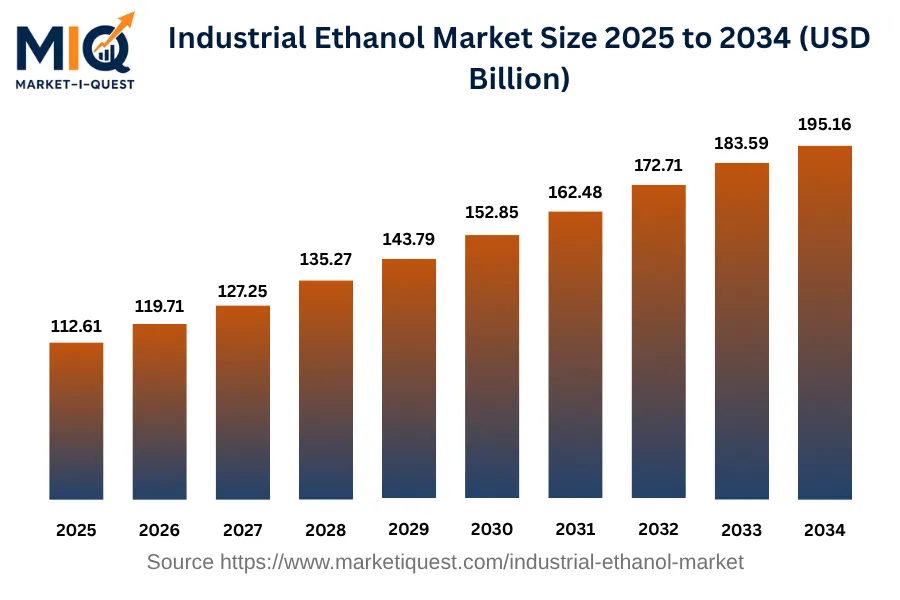
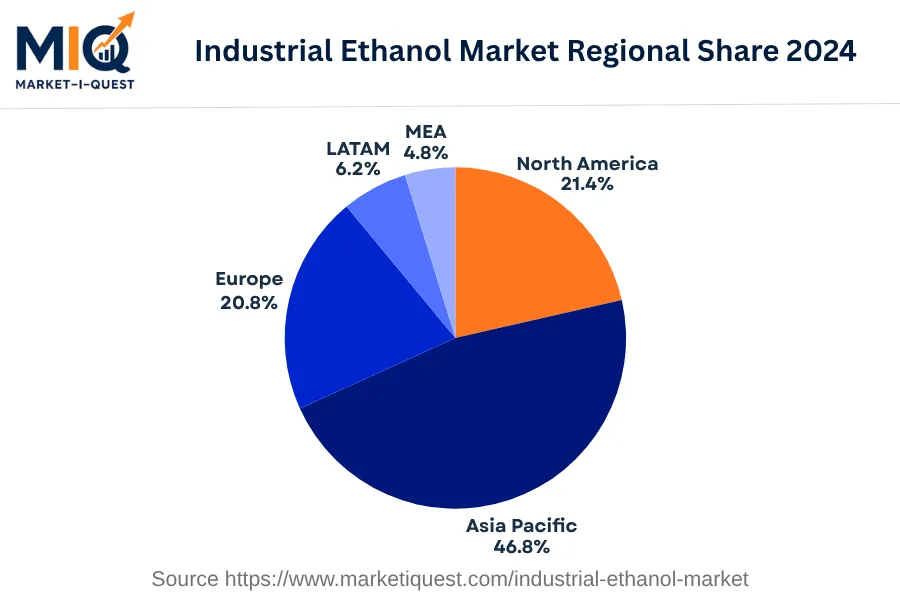
The Industrial Ethanol Market valued at USD 112.61 Billion in 2025, demonstrating an increase from the USD 105.94 Billion documented in 2024. By 2034, the market value is projected to ascend to USD 195.16 Billion, growing at a CAGR of 6.3% during the forecast period from 2025 to 2034. This substantial market growth is mainly attributable to rising demand in the industrial sector, boosting the global market size each year. Compared to other regions in 2024, the Asia Pacific occupied a significant market share of 46.81%, followed by North America with a share of 21.42%, Europe with 20.76%, Latin America with a share of 6.24% and the Middle East and Africa with a share of 4.77%. These percentages portray the predominance of the Asia Pacific region in the Industrial Ethanol Market.

Key Takeaways

  • By Raw material - Synthetic led the industrial ethanol market accounting for a significant share in 2024.
  • By Type - Ethanol 95% emerged as the market leader commanding a considerable share in 2024.
  • By End Use - Pharmaceutical segment held a dominant position in the 2024 market.
industrial-ethanol-market market size

Key Driving Factors

Environmental Regulations for Cleaner Fuels

Regulatory bodies such as the Environmental Protection Agency (EPA) in the United States and the European Environment Agency (EEA) in Europe are increasingly imposing stringent environmental regulations compelling the use of cleaner fuels. This is specifically driving the industrial ethanol market as ethanol is considered a cleaner-burning fuel that releases fewer greenhouse gases into the atmosphere compared to traditional fossil fuels. Ethanol-friendly policies under these regulations are motivating fuel makers to increase the inclusion of ethanol in their products, pushing up its demand and in turn driving the expansion of the industrial ethanol market. Companies who fail to comply with these regulations face penalties, making it more cost-effective to use ethanol-based fuels.
Bioethanol Production from Waste Biomass

The industrial ethanol market is experiencing growth due to the rise in bioethanol production from waste biomass. Industries generating large amounts of organic waste such as the food and beverage sector or agriculture industry, are transforming their waste into bioethanol, a type of industrial ethanol. This is made possible through a process called second-generation ethanol production. The process offers a double benefit of efficient waste management, and the creation of a value-added product in the form of bioethanol. With waste biomass being a cost-effective and sustainable source of raw material, its exploitation for bioethanol production is driving the development of the industrial ethanol market.

Market Evolution by Timeline

2019-2023
During this period, key buyers of industrial ethanol were pharmaceuticals, paints, and the fuel industry, with the latter primarily representing North America's market. Second-generation biofuel technology debuted, producing ethanol from waste biomass, which came with high capital costs. A critical policy shift affecting market operations was the U.S. Renewable Fuel Standard, encouraging ethanol production. Typical contracts entailed projected quantity purchase agreements for cost reliability. This period faced several challenges including by suppliers was the fluctuation in feedstock prices, with strategic procurement and contracts being a significant response.
2024
The year 2024 marked a beginning of Europe's regulatory shift, with RED II policy dictating greater deployment of advanced biofuels like ethanol. For suppliers, concerns over raw materials' availability persisted, thus necessitating partnerships with agricultural sectors for steady supply. Meanwhile, the packaging industry surfaced as a primary buyer segment, primarily in Asia-Pacific. Advances in catalytic technology declared 2024 as a year of production optimization. In terms of commercial transactions, secure supply agreements dominated. Despite new production dynamics, suppliers were wary of overcapacity.
2025-2029
From 2025 to 2029, a surge in the industrial ethanol market will likely be fuelled by sustainable packaging initiatives, particularly in China and India. Integrated biorefineries might become more commonplace, reducing production-associated adversities. The Biofuels Directive in Europe will likely continue to bolster ethanol usage under its climate action framework. Many suppliers might lean towards long-term contracts for mitigating risks linked to unpredictable feedstock prices. However, the over-dependence on certain crops for ethanol production are expected to raise concerns over food security.
2030-2034
During 2030–2034, the demand for industrial ethanol likely increase from clean energy advocates, particularly in the EU. Despite promising advancements in lignocellulosic ethanol production technology, the issue of high capital investment might align with it remained constant. Regulatory interventions are expected to become frequent with greenhouse gas monitoring regulations, notably in the U.S. Experimentation with novel commercial models might surface with suppliers seeking to hedge against feedstock pricing by integrating farming activities. Continued concerns around food vs fuel debate may act as a risk to the industry's public perception.

Future Market Outlook

Future Opportunities

The ongoing commitment to renewable energy policies presents a multitude of opportunities for growth within the global industrial ethanol market. For instance, the U.S. government’s Biofuel Infrastructure Partnership, aims to improve infrastructure for biofuels, thus fostering increased demand for industrial ethanol across various sectors. In Europe, the 2022 revision of the biofuel strategy has set ambitious targets for greenhouse gas emissions reduction, which could spur investments in new industrial ethanol projects. Companies in the Asia-Pacific region are beginning to explore collaborations for ethanol production, with nations like India announcing plans to blend ethanol into fuel to achieve energy security and reduce import dependence. Thailand’s ethanol production was supported by government initiatives to use food waste as feedstock, demonstrating an innovative approach to sustainable sourcing. Additionally, as electric vehicle adoption continues to surge, traditional fuel suppliers may pivot towards blending ethanol to meet regulatory requirements. The growing emphasis on circular economy principles provides opportunities for ethanol producers to develop sustainable supply chains. The carbon credit trading initiatives introduced in various regions, including Australia’s Emissions Reduction Fund, could create financial incentives for ethanol production facilities that implement greener practices.

Segmentation Analysis

By Raw material

The market is divided into subsegments including Bio Based and Synthetic raw materials. Among these, the Synthetic segment accounted for the largest revenue share, while Bio Based materials are expected to grow at the fastest Compound Annual Growth Rate (CAGR) during the forecast period.

Largest Revenue Share

Synthetic

Market Share Leader

The Synthetic subsegment stands as a leader by commanding the highest revenue share. This can be attributed to several key factors driving its large-scale adoption. Firstly, synthetic materials often offer more durability and, in many applications, superior performance characteristics compared to their bio-based counterparts. This has led to their preferred choice in numerous industries such as construction, automotive, and packaging, among others. Moreover, synthetic materials have been in the market for a longer period, leading to established manufacturing processes and wide-scale acceptance among the end-users. The product innovation and continuous development in synthetic materials also contribute to maintaining its leading position. Additionally, the availability of several types of synthetic materials gives customers a wide range of choices depending on their specific needs. Despite environmental concerns and stringent regulations, the strength, resistance, and versatile nature of synthetics contribute largely to their market dominance. It is important to mention that this analysis assumes typical industry dynamics and there can be variations based on specific market conditions.

Fastest CAGR

Bio Based

Forecast Period Growth Leader

Despite the currently smaller market share, the Bio Based raw material subsegment is expected to grow at the fastest rate in the coming years. The high growth potential is mainly due to increasing environmental concerns among consumers, businesses, and regulators. Bio Based materials are typically derived from renewable resources and produce less greenhouse gas emissions, providing a more sustainable alternative to synthetic materials. This changing consumer preference for eco-friendly products is a significant factor propelling the growth of the Bio Based subsegment. Moreover, improvements in technology are expected to reduce the cost of producing Bio Based materials and enhance their performance characteristics. These technological advancements, coupled with government policies promoting the use of green materials, are anticipated to fuel the growth of this segment. However, market adoption faces hurdles such as high initial capital expenditure and the existence of efficient synthetic material production lines. But with increasing partnerships between players keen on exploring Bio Based materials and policy support, these barriers are expected to soften over time. Please note that these growth projections rely on our understanding of common market trends and dynamics.

By Type

The market is divided into subsegments including Absolute Ethanol, Ethanol 95%, Denatured Ethanol, and Others. Ethanol 95% accounted for the largest revenue share while Denatured Ethanol is expected to grow at the fastest CAGR during the forecast period.

Largest Revenue Share

Ethanol 95%

Market Share Leader

Ethanol 95% leads the market in terms of revenue owing to its broad applications and high demand in various industries. It plays a significant role in the pharmaceutical industry, where it's used in various medicinal formulations, offering an advantage over ethanol types with lower percentages. Its high alcohol content also makes it popular in food and beverage manufacturing, as well as industrial production. Additionally, Ethanol 95% is often utilized in fuel and chemical industries, contributing to a consistent demand, and in turn, large revenue share. Widespread use across geographies, coupled with regulatory norms favoring its usage due to its environmentally friendly nature, also propel the demand. It's worth noting that the high purchasing power of these industries and the switching costs associated with moving to another type of ethanol also discourage change, contributing to the stable demand for this subsegment.

Fastest CAGR

Denatured Ethanol

Forecast Period Growth Leader

Denatured Ethanol shows promising growth prospects, predicting it as the fastest-growing subsegment. The growth of this type is mainly driven by its reduced environmental impact and economical prices. It serves as a popular choice in the fuel industry, where it offers a greener alternative to traditional fuels due to its biodegradable nature and reduced carbon emissions. The growth of the renewable energy sector and the heightened focus on sustainability are thereby key drivers. Government policies and initiatives promoting the use of eco-friendly fuels act as catalysts, expediting adoption rates. Moreover, increased investments in research and development programs offer potential for improved product features, enhancing market penetration. However, potential risks include a change in regulatory landscapes, fluctuating raw material prices, and emerging alternatives that could pose clean energy competition.

By End Use

The market is divided into subsegments including Paints and Coatings, Pharmaceutical, Food & Beverages, Printing Ink, Agricultural, Household and Industrial Cleaning Solutions, Cosmetics and Personal Care, Adhesives, and others. In 2024, the Pharmaceutical subsegment accounted for the largest revenue share while the Cosmetics and Personal Care subsegment is expected to grow at the fastest CAGR during the forecast period.

Largest Revenue Share

Pharmaceutical

Market Share Leader

The Pharmaceutical subsegment dominated the market in 2024 as the need for drug formulations, healthcare products, and pharmaceutical supplies continues to rise. Regulations and policies strongly support and promote research and development in the pharmaceutical industry, creating higher purchase criteria and stricter quality checks. Besides, as global health concerns and medicine’s significance become more apparent, potential for expansion grows. The necessary shift towards advanced healthcare infrastructure, especially in growing economies, has also propelled segment growth. Geographically, Asia-Pacific and North America were significant contributors due to a high rate of pharmaceutical manufacturing and consumption. The significant purchasing power of healthcare providers and hospitals has made the pharmaceuticals segment a major revenue generator within the market.

Fastest CAGR

Cosmetics and Personal Care

Forecast Period Growth Leader

While the Pharmaceutical subsegment may lead in revenue, Cosmetics and Personal Care has shown the fastest Compounded Annual Growth Rate (CAGR). This is predominately due to the exponential growth in demand for personal care products driven by rising consumer consciousness about personal grooming and appearance. Technological advancements in product manufacturing, coupled with the proliferation of effective distribution channels and e-commerce, are among the factors propelling this subsegment’s growth. However, potential risks lie in the increased scrutiny from regulatory bodies over ingredients and claims made by these products, which could impact the rate of adoption. Strategic partnerships between manufacturers for shared technology development, and the capitalization of emerging markets can significantly enhance this subsegment’s growth prospects over the forecast period.

Competitive Analysis

Key Market Players

Manufacturers / OEMs

Archer Daniels Midland Company
US
Cargill, Inc.
US
Raízen SA
Brazil

Key Suppliers & Raw Materials

DuPont
US
Novozymes A/S
Denmark
DSM
Netherlands

Distributors, Integrators & Channel Partners

BP
UK
POET, LLC
US
Green Plains Inc.
US

Porter’s Five Forces Analysis

An in-depth analysis of the competitive forces impacting the Industrial Ethanol Market.

Supplier Bargaining Power

Medium

Driven by a balanced number of suppliers with varying degrees of production capacity and raw material access.

Buyer Bargaining Power

High

Stemming from the abundance of suppliers and availability of quality substitutes with little switching cost.

Threat of Substitutes

Medium

Moderated by availability of cheaper alternatives, offset by regulatory barriers and performance differences.

Threat of New Entrants

Low

Limited by high capital expenditure, strict regulations, and long-term contracts with customers.

Competitive Rivalry

High

Fueled by several major players with vast resources and little product differentiation.

Regional Analysis

Geographic market dynamics and growth opportunities across key regions

Global Market Outlook

industrial-ethanol-market market regional share

North America

In the base year of 2024, the Industrial Ethanol Market in North America is witnessing significant activity across several sectors. Drivers of this dynamic include stringent environmental regulations, particularly in the U.S. and Canada, incentivizing industry players to adopt sustainable ethanol-based solutions. Increased investment in biofuel technologies, such as cellulosic ethanol, is enhancing the production efficiency while reducing dependence on food crops. Supply dynamics are also significant with the U.S., the leading producer globally, further stimulating the market growth through competitive pricing.

Trending observations in 2024 showcase an evolving market landscape. Consumers, particularly in manufacturing and utilities sectors, are increasingly procuring cleaner, ethyl acetate for their processes, gravitating towards suppliers who can assure sustainability. Technological advancements have enabled a shift towards more eco-friendly production methods, encouraging large scale adoption. Additionally, market consolidation through strategic partnerships and mergers are becoming increasingly common, with key players aiming for enhanced market share and expanded geographical reach. Implementation of the Renewable Fuel Standard (RFS) policy in the U.S. is enforcing a higher incorporation of ethanol in transportation fuels, dramatically reshaping the market dynamics. From comprehensive regulations and technology adoption to notable market trends, the Industrial Ethanol Market in North America in 2024 is drawing strong interest from sectors such as manufacturing, utilities, and transportation.

Asia Pacific

In 2024, the Industrial Ethanol Market in the Asia Pacific experienced substantial activity. Demand, primarily driven by China and India, surged owing to robust growth in chemical and pharmaceutical industries. Regulations, such as China's Implementation of Cleaner Production Promotion Law, spurred the manufacturing sector's adoption of bio-ethanol technology while substantial government investments in biotechnology research bolstered supply dynamics. Market trends revealed a notable shift towards green and sustainable products. On the demand side, major industrial users such as pharmaceuticals and chemicals sought ethanol-based derivatives given their eco-conscious operational mandates. Concurrently, manufacturers accelerated technological innovations, aimed at increasing production efficiency while reducing environmental impacts, leading to partnerships and M&A. Japan led in this aspect with corporations like Mitsubishi Chemical Holdings driving change. High standardization has been observed through strict enforcement of ISO standards related to ethanol production.

In terms of pricing, cost-effectiveness enticed large customers, especially in the healthcare and utilities sectors, to shift towards ethanol-based solutions. Rapid industrial growth in key ASEAN markets, notably Indonesia and Thailand, further amplified demand. Overall, the Asia Pacific industrial, ethanol market in 2024 was characterized by regulatory impetus, cost-benefit attractiveness, technological innovation, and a strong movement towards sustainability.

Europe

In 2024, the industrial ethanol market in Europe was primarily driven by chemical and pharmaceutical industries, supported by robust demand and stringent regulations. Rising environmental concerns fuelled increased biofuel adoption, seen prominently in Germany and France. They prioritized ethanol-based fuels due to its renewable nature and minimal carbon emissions. Consumer demand for ethanol-based sanitizers, boosted during recent health crises, was another significant factor; UK and Italy seeing their manufacturing sectors rise to meet this need. The renewables sector attracted significant investment, notably in Nordics and Benelux, stimulating sustainable ethanol production and distribution.

Consumer preferences shifted towards green products, causing most manufacturers and retailers to adopt ethanol-based solutions. This also encouraged new technological advancements in ethanol production from agricultural waste. Meanwhile, partnerships became common in Central & Eastern Europe as businesses united to capitalize on the ethanol market. A key trend was the enforcement of European renewable energy standards, pushing industries to include ethanol in their energy portfolios. Thus, in 2024, the European Industrial Ethanol Market was mainly influenced by increased demand from key industries—chemicals, pharmaceuticals, and manufacturing—combined with intensified environmental regulations, advancements in technology, and evolving consumer preferences towards sustainable products. Aggressive policy enforcement further incentivized ethanol adoption across different sectors.

Latin America

In 2024, the Latin American Industrial Ethanol Market revolved around the increasing need for sustainable and bio-based products, along with a push from government mandates. Investors were drawn in by Brazil, Mexico, and Argentina's expanding biofuel sectors, particularly ethanol, driven by their large agriculture-based economies. Acceleration within technological adoption, particularly in Brazil's sugarcane ethanol production, created a surge in supply dynamics. Meanwhile, competitive pricing on ethanol compared to fossil fuels spurred increased demand across LATAM region.

Key trends included a shift towards cleaner, renewable energy sources, with countries like Chile and Peru showing substantial demand for ethanol in their energy sectors. Further, the enforcement of pro-ethanol policies like Brazil’s RenovaBio increased market traction. The increase in mergers and acquisitions, notably in Brazil and Argentina's ethanol market, created an increasingly consolidated marketplace. The rising preference for ethanol-blended fuels in public and corporate transportation sectors was another noticeable trend. Consumer behavior leaned towards environmentally friendly choices, with sectors such as retail, manufacturing, and utilities displaying a higher dependency on bio-ethanol. The rapid adoption of ethanol in the healthcare sector, particularly for sanitization purposes, marked a significant development in Latin America's Industrial Ethanol Market in 2024. The transformation in user behavior, paired with supportive government initiatives, characterized the state of the market this year.

Middle East & Africa

In 2024, the industrial ethanol market in the Middle East and Africa was shaped by strong demand from various sectors and regulatory changes. Fueling the market were initiatives from governments like Saudi Arabia and UAE, promoting the use of biofuels in industries such as utilities and manufacturing. Increased investment in biofuel technology across the region, especially in Israel and Nigeria, accelerated market growth. Supply dynamics, led by Kenya and South Africa, significantly impacted pricing, with increased local production reducing dependence on imports. Egypt's new regulations promoting local bioethanol production catalyzed market expansion, while Qatar's commitment to sustainable energy resulted in increased industrial ethanol adoption.

Consumer behavior was a notable trend; for instance, financial organizations in UAE and South Africa highlighted a shift towards sustainable investments, indirectly boosting the industrial ethanol market. Technological advancements enabled more efficient production and use of ethanol, as exemplified by Israel's robust biofuel technology sector. Biofuel partnerships proliferated, notably in Saudi Arabia's oil and gas sector, with M&A activity peaking in 2024. The enforcement of sustainability standards in production and usage played a significant role in shaping the market, particularly in Egypt and Nigeria. Meanwhile, governments in the region intensified their focus on reducing dependence on fossil fuels, underpinning substantial growth in the industrial ethanol market in the base year.

Recent Industry Developments

Latest market innovations, product launches, and strategic initiatives

March 2026

The All India Distillers' Association (AIDA) solidified a multi-sectoral platform connecting distillery companies with research institutions (such as TERI and ARAI) and industrial partners (e.g., Mawana Sugars). This alliance is designed to synchronize industrial ethanol production capabilities with evolving fuel standards, sustainability research, and automotive technology requirements.

April 2026

The Indian government introduced the "Sugarcane (Control) Order, 2026," which formally integrates ethanol production into the legal framework of the sugar industry. Key provisions include linking the Fair and Remunerative Price (FRP) of sugarcane to ethanol production metrics, mandatory real-time digital reporting via API for distilleries, and strict regulations regarding the transfer of Industrial Entrepreneur Memorandums (IEMs) to prevent market speculation.

Frequently Asked Questions