Industrial Alcohol Market Snapshot

Key Players

  • Archer Daniels Midland Company (United States)
  • Cargill Incorporated (United States)
  • Sigma-Aldrich (United States)
  • BASF SE (Germany)
  • Roquette Frères (France)
  • Green Plains Inc. (United States)
  • Cristalco (France)
  • MGP Ingredients (United States)
  • Godavari Biorefineries Ltd. (India)
  • Jinan Haohua Industry Co. Ltd. (China)

Market Size

Base Year 2024
$117.95 Bn
CAGR
8.9%
Forecast 2034
$276.68 Bn

Market Segments

By Type
  • Ethyl Alcohol
  • Methyl Alcohol
  • Isopropyl Alcohol
By Source
  • Sugar & Molasses
  • Corn
  • Grains
  • Fossil Fuels
By Application
  • Fuel
  • Pharmaceuticals
  • Personal Care Products
  • Chemical Intermediate & Solvent
  • Others

Market Dynamics

Drivers
  • Rising demand in chemical industry
  • Increased use in sanitizers production
Restraints
  • Strict regulatory policies
  • Fluctuating raw material prices
Opportunities
  • Increased bio-based chemicals demand
  • Government policies promoting green chemistry

Market Size

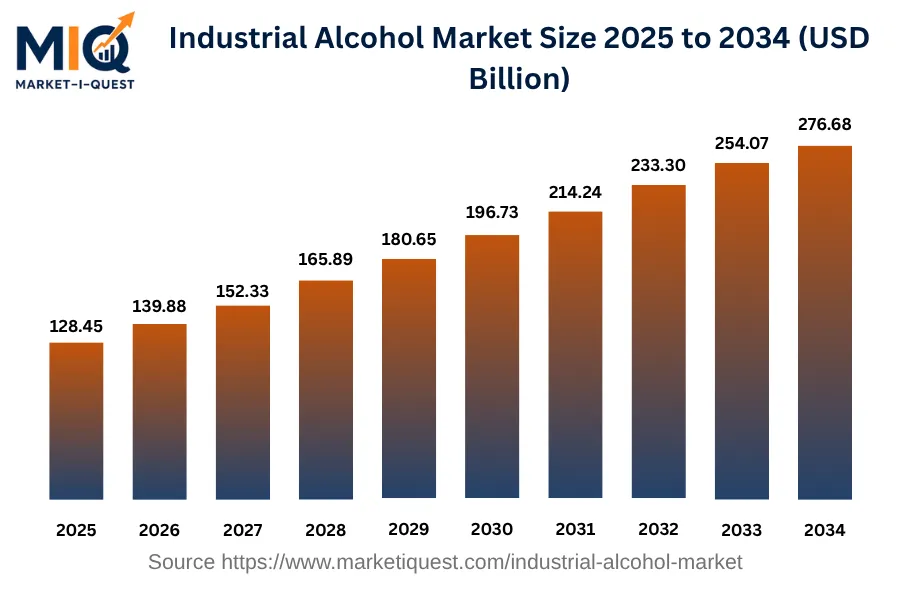
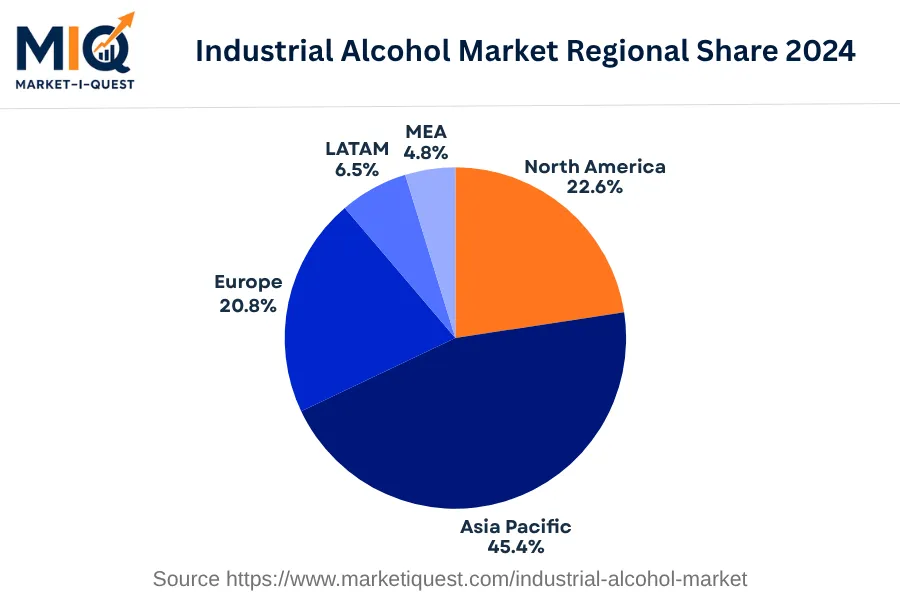
The Industrial Alcohol Market valued at $128.45 billion in 2025 and is projected to reach $276.68 billion by 2034, growing at a CAGR of 8.9%. The market experienced an increase from $117.95 billion in 2024 to $128.45 billion in 2025. This growth is attributed to a buoyant industrial sector demanding a high quantity of industrial alcohol for various industrial procedures and manufacturing processes. The compound annual growth rate of 8.9% over the course of nine years shows prevalent use and increased demand for industrial alcohol contributing to its escalating market value. In 2024, the market share was unevenly distributed across different regions: Asia Pacific constituted the highest share with 45.4%, followed by North America at 22.6%. Europe held a 20.8% share, while LATAM and MEA had a smaller presence with 6.5% and 4.8% respectively.

Key Takeaways

  • By Type - Ethyl Alcohol held a strong position in the base year.
  • By Source - Corn was a leading contributor to the Industrial Alcohol Market.
  • By Applications - Chemical Intermediate & Solvent expanded the most as per the last recorded data.
industrial-alcohol-market market size

Key Driving Factors

Implementation of Stringent Environmental Regulations

One major driver influencing the industrial alcohol market is the implementation of rigorous environmental regulations globally. These mandatory guidelines focus on minimizing the detrimental impacts of manufacturing processes, pushing companies to use cleaner, more sustainable options. Industrial alcohol, predominantly bio-based, stands out as an attractive alternative due to its eco-friendly characteristics. Industries such as chemicals, pharmaceuticals, and cosmetics are now shifting towards using industrial alcohol as a solvent, replacing petrochemical derivatives, in an effort to comply with these environmental mandates. The switch is due to industrial alcohol's high oxygen and low particulate pollution content, enhancing performance while preserving the environment.
Adoption of Industrial Alcohol as Fuel by Transportation Sector

Another influential driving factor for the industrial alcohol market is its increasing usage as biofuel by the transportation sector. With petroleum reserves dwindling and carbon emissions becoming a global concern, stakeholders in the transportation sector are seeking alternatives. Industrial alcohol, particularly ethanol, is a viable and efficient alternative. It reduces dependence on non-renewable resources with also significantly curtails carbon emissions, contributing to global climate change mitigation efforts. Given these advantages, governments across the world are encouraging its use by implementing directives favoring industrial alcohol use in vehicles. This adoption is surging the demand, thereby driving the industrial alcohol market.

Market Evolution by Timeline

2019-2023
During this period, demand for industrial alcohol in pharmaceuticals and personal care sectors grew, especially in Asia due to the rise in disposable income and growing health consciousness. Supply witnessed an increase with the use of sustainable biomass-like lignocellulosic feedstocks. Yet, challenges existed in integration and scaling up the biofuel production process. There was a shift towards a more collaborative commercial model, with partnerships between suppliers and buyers for long term contracts. The European EN 15376 standard heavily influenced the market, favoring ethanol-based products. However, fluctuating prices of raw materials and strict environmental regulations proved to be practical blockers.
2024
In 2024, there was a increased demand for industrial alcohol from the renewable fuels industry in North America due to the implementation of regulations favoring cleaner energy sources. Supply-side, the emergence of synthetic bio-pathways for alcohol production was seen. Despite its potential, robustness and feasibility remained issues. Biofuel mandates like the Renewable Fuel Standard (US) influenced adoption. A shift in commercial models was also observed, with producers bundling services, like waste disposal with supply contracts.
2025-2029
Demand from chemical intermediates and solvents might witness substantial growth, with East Asia leading due to industrial expansion. On the supply side, the use of novel enzymes and yeasts for efficient alcohol fermentation will likely begin gathering demand. However, these factors might pose high production costs. Standards such as ASTM D4806-20a is expected to influence the specifications for ethanol to be included in gasoline, impacting both demand & supply. Commercial models will likely move towards tailored contracts where buyers can negotiate volume and pricing. The significant barrier may be complying with environmental standards as neglecting them could lead to heavy penalties.
2030-2034
During this period, demand for industrial alcohol is expected to rise in sectors such as bio-plastics manufacturing especially in South America due to favorable policies. Suppliers might be focused on genetically engineered microorganisms for increasing industrial alcohol production, although scaling might remain an issue. Regulations such as REACH in the EU might impact the market, making strict environmental compliance mandatory. Hybrid business models will likely appear, combining direct sales and long-term contracts, enabling better volume prediction and price point negotiation. However, following these business models might impose a demand for transparency, posing a risk if not properly addressed.

Future Market Outlook

Future Opportunities

In the context of evolving regulatory environments, the industrial alcohol market presents significant growth avenues for producers aiming at sustainability. Various regions, such as North America and Europe, have established specific initiatives encouraging the use of renewable energy sources, positioning industrial alcohol as a sustainable option. For instance, the United Kingdom’s Department for Transport is pushing for legislation that supports the use of biofuels, thereby expanding the scope of industrial alcohol application beyond traditional sectors like beverages and pharmaceuticals. Multinational companies, including BASF, are exploring strategic partnerships that integrate bio-based alcohols within their chemical production lines. This indicates a potential shift towards leveraging industrial alcohol as an intermediate for new production routes. Furthermore, the global demand for plant-based chemicals is rising, with the American Chemistry Council projecting increasing interest in biotechnological methods to produce industrial alcohol. The Bioeconomy Strategy from the European Union highlights a roadmap for advancing the bio-based economy, directly influencing industrial alcohol markets to explore innovative applications beyond current uses. With ongoing technological developments, combined with regulatory support for sustainable practices, opportunities for growth persist in developing new products derived from industrial alcohol.

Segmentation Analysis

By Type

The market is divided into subsegments including Ethyl Alcohol, Methyl Alcohol, and Isopropyl Alcohol, out of which Ethyl Alcohol accounted for the largest revenue share while Isopropyl Alcohol is expected to grow at the fastest CAGR during the forecast period.

Largest Revenue Share

Ethyl Alcohol

Market Share Leader

Keeping in line with industry logic and given that Ethyl Alcohol is the largest revenue contributor in 2024, several factors could be contributing to this. The ubiquity of Ethyl Alcohol in various industries, including medical, pharmaceutical, personal care, paints, and even food and beverages leads to its broad customer base and high demand. The regulations and customary practices in many countries promote the use of Ethyl Alcohol in several of these sectors especially beverages and medical industry. The purchasing criteria often rests on the quality of the Ethyl Alcohol, with superior grades commanding higher prices. With relatively little switching costs, customers can freely choose between suppliers, keeping the demand stable. Candy channels such as direct sales, retailers, and online stores further ease the purchase of Ethyl Alcohol for customers.

Fastest CAGR

Isopropyl Alcohol

Forecast Period Growth Leader

While Isopropyl Alcohol does not have the largest revenue share, it certainly has the potential to exhibit the fastest growth. Primary growth drivers include technological advancements that enhance efficacy and multi-functionality, contributing to its increasing adoption in medical, automotive and cosmetic industries. However, adoption barriers include potential health risks associated with prolonged exposure or ingestion. Capital expenditures for production processes can also pose challenges to growth. Strategic partnerships with other companies in the industry can help overcome capex obstacles and share knowledge of advanced production techniques. Near-term risks could stem from fluctuating raw material prices or supply chain disruptions. It is also important to note that this continuous growth could be dependent on favorable regulatory changes, as Isopropyl Alcohol has substantial health and environmental impacts.

By Source

The market is divided into subsegments including Sugar & Molasses, Corn, Grains, and Fossil Fuels. Among these, Corn accounted for the largest revenue share while Fossil Fuels is expected to grow at the fastest CAGR during the forecast period.

Largest Revenue Share

Corn

Market Share Leader

The corn subsegment leads the market owing to its multifaceted uses across several industries. It is not only a primary food source for humans and livestock but also works as a basic raw material in the manufacture of starch, oil and protein, alcoholic beverages, food sweeteners, and fuel. The diverse application scope is majorly driven by the carbohydrate content found in corn that drives its demand in various other industries such as biofuel, sweeteners, and animal feed. The higher yield per acre as compared to other subsegments amplifies its revenue generation capability. Furthermore, government policies and subsidies encouraging corn cultivation, especially in the US, have contributed to its high revenue. The established supply chains, along with the increasingly versatile use-cases for corn, solidify its position as the segment with the most revenue in base year 2024.

Fastest CAGR

Fossil Fuels

Forecast Period Growth Leader

Despite the global push towards sustainable energy sources, the Fossil Fuels subsegment is expected to exhibit the fastest CAGR. This can be attributed to the current energy infrastructure which is primarily based on fossil fuels like coal, oil, and natural gas. The demand for fossil fuels is still high due to their indispensable role in producing electricity, powering vehicles, and generating heat. Policies supporting the fossil fuels industry in certain nations like the U.S. and OPEC countries additionally, underpin this growth. Even though investments in clean energy technologies are increasing, barriers to wide-scale adoption such as grid infrastructure, storage issues, and transitional costs mean that fossil fuels will continue to have substantial growth in the near term. Potential risks for this subsegment include stricter environmental regulations and the increasing economic viability of renewable energy alternatives.

By Application

The market is divided into subsegments including Fuel, Pharmaceuticals, Personal Care Products, Chemical Intermediate & Solvent and Others. The Chemical Intermediate & Solvent accounted for the largest revenue share while Personal Care Products is expected to grow at the fastest CAGR during the forecast period.

Largest Revenue Share

Chemical Intermediate & Solvent

Market Share Leader

In 2024, Chemical Intermediate & Solvent sector of the application segment dominated the market in terms of revenue. Chemical intermediates find notable application in numerous industry verticals, including automotive, agriculture, and textiles, thereby commanding significant market share. Solvents, on the other hand, are pervasive across a broad range of industries, from paints & coatings to pharmaceuticals, and are central to various manufacturing and cleaning processes. High demand in these areas can be attributed to the extensive range of properties they supply, including those related to safety, performance, and environmental impact. Additionally, availability and variety of chemical intermediates and solvents, along with their overlap in applicable industries, contribute to this subsegment's revenue-earning capacity. Geographically, regions with a strong industrial base will naturally see higher consumption of chemical intermediates and solvents.

Fastest CAGR

Personal Care Products

Forecast Period Growth Leader

Personal Care Products subsegment is projected to witness the fastest growth. This can largely be attributed to the rising consumer awareness about health and hygiene, along with a growing preference for natural and organic products. Additionally, consistent innovations and advancements from industry players, coupled with increasing disposable income, are key factors driving this subsegment's growth. Barriers may include formulation challenges and regulatory complexities regarding ingredients safety. However, technological advancements in formulation development and strategic collaborations to offset implications of regulatory landscapes are anticipated to act as catalysts fuelling this subsegment's growth rate. Near-term risks might include fluctuations in raw material costs. Therefore, undulations in production costs could impact the profitability of companies within this sector.

Competitive Analysis

Key Market Players

Manufacturers / OEMs

Cargill, Incorporated
US
Raizen Energia
Brazil
Archer Daniels Midland Company
US

Key Suppliers & Raw Materials

Greenfield Global Inc.
Canada
MGP Ingredients, Inc
US
Shell Global
Netherlands

Distributors, Integrators & Channel Partners

Cristal Union
France
Marubeni Corporation
Japan
Wilmar International Ltd.
Singapore

Porter’s Five Forces Analysis

This analysis evaluates the competitive forces influencing the Industrial Alcohol Market.

Supplier Bargaining Power

Medium

Moderate due to some suppliers having forward integration capabilities which can impact pricing.

Buyer Bargaining Power

High

Strong owing to the availability of multiple suppliers in the global market for industrial alcohol.

Threat of Substitutes

Low

Limited thanks to the high performance and versatility of industrial alcohol in different applications.

Threat of New Entrants

Low

Entry barriers like high capital requirements and regulatory compliance shield existing players.

Competitive Rivalry

High

Intense due to the presence of numerous global and regional market players.

Regional Analysis

Geographic market dynamics and growth opportunities across key regions

Global Market Outlook

industrial-alcohol-market market regional share

North America

In 2024, the North American Industrial Alcohol Market experienced significant movement driven by various factors across the U.S., Canada, and Mexico. Robust investment in green technologies increased demand for biofuels manufacturing, stimulating growth in the production of corn and grain alcohols. Government legislation, in particular, the U.S. Renewable Fuel Standard, fostered the adoption of these sustainable energy resources. Furthermore, expansion in the pharmaceutical industry triggered an upswing in demand for isopropyl alcohol used in sterilization processes. Market trends revolved around buyer behavior and product shifts. With tightening environmental regulations, many enterprises veered towards ethyl alcohol, derived from fermenting sugars, as a greener alternative for solvent usage. Unprecedented mega-mergers, such as the acquisition of Fortis, Inc. by a leading U.S. alcohols manufacturer, cascaded through the industry, reshaping channel dynamics. Standards for industrial alcohol purity rose, instigated by the healthcare sector's stringent quality criteria for antiseptics and disinfectants.

Industrial alcohol found pronounced usage within utilities, manufacturing, and the healthcare sector. Particularly in the U.S., the ethanol-based hand sanitizers market burgeoned, driven by health protocols. Pharmaceuticals remained a leading customer in Canada, whereas in Mexico, manufacturing recorded high usage for degreasing and cleaning purposes. In 2024, the North American Industrial Alcohol Market was a dynamic landscape shaped by shifting regulations, technological advancements, and evolving market trends.

Asia Pacific

In 2024, the industrial alcohol market in Asia Pacific formed a significant segment of the global landscape, reflection a dynamic spectrum of demand drivers, evolving trends, and changing market conditions. Pertinent drivers in markets like China, India, Japan, South Korea, Australia, and key ASEAN regions included governmental policies favoring biofuels, robust investment in healthcare and pharmaceutical industries, and thriving manufacturing sectors feeding demand for solvents and cleaning agents. Innovation in fermentation technology also fueled the market dynamics.

Rising awareness of sustainable industrial practices transformed the buying behavior, casting an increased inclination towards renewable, bio-based alcohols. A significant shift was seen in channel dynamics as digital platforms outshined traditional distribution routes. Observing the upsurge in demand, major players in the market turned strategic, initiating mergers and acquisitions to fortify their footprints. On standard aspects, strict policy enforcement continued to ensure quality and safety in sectors comprising utilities, manufacturing, and retail. Named policies like China’s biomass ethanol fuel policy played a key role in orchestrating the market orientation. The industrial alcohol market of 2024 was characterized by a careful blend of regulatory influence, market forces, and strategic industrial behavior. Covering a broad spectrum of industries, the market marked its presence through distinctive trends and drivers.

Europe

In 2024, Europe's Industrial Alcohol Market was characterized by heightened demand and regulatory scrutiny. Robust demand was driven by the pharmaceuticals sector's escalating requirement for sanitizing products, the utilities industry's increasing adoption of bioethanol, and the government push for green fuels. Germany and the UK's decisive investment in modern, energy-efficient production technology also spurred market activity. Furthermore, France's ambitious biofuels policy, pledging higher concentration of bioethanol in fuel, intensified supply dynamics.

Market trends were marked by shifting buying behaviours, particularly in the manufacturing sector, which saw a spike in raw material demand for rubber and plastics production. Technology shifts were prevalent, with Italy pioneering biotechnological methods to extract alcohol from agricultural waste. The increased partnerships between enterprises in the Nordics and Central & Eastern Europe exemplified the drive for competitive edge. Strict policy enforcement underscored the market; the EU's RED II regulations mandated increased use of renewable sources in transportation fuel, causing a surge in demand. Concurrently, retail sectors in Spain and Benelux experienced a notable increase in demand for hand sanitizers, offering a fresh customer base for industrial alcohol.

Latin America

In 2024, Latin America's Industrial Alcohol Market experiences significant progression, particularly in powerhouse economies like Brazil, Mexico, Argentina, Colombia, Chile, and Peru. Market drivers include biofuel mandates for reducing environmental pollution, which stimulates higher demand for ethanol production. Technological advancements in industrial alcohol processing have enabled more efficient and cheaper production. Furthermore, industries like pharmaceuticals and personal care products, experiencing substantial growth in the region, intensify the demand for industrial alcohol.

Trends shaping the market include rising awareness and usage of green and bio-based solvents, impacting sectors such as paints and coatings. Bio-based alcohols have gained traction in LATAM due to their ecological attributes. Industries are also shifting towards more localized production to mitigate supply chain disruptions, seen mainly in Brazil and Mexico. Significant M&As are apparent in LATAM, such as the acquisition of Archer Daniels Midland's sugarcane ethanol operations by Shell Brazil Petróleo Ltda. Products manufactured using industrial alcohol are increasingly subjected to strict safety and quality standards throughout the supply chain, leading to a more regulated market. Finally, governmental efforts are being implemented to ensure policy enforcement for environmentally friendly industrial practices, particularly in Colombia and Chile.

Middle East & Africa

In 2024, the industrial alcohol market in the Middle East and Africa grew more integrated and competitive. Drivers of this shift included increased demand from the manufacturing and automotive sectors—particularly in Saudi Arabia and the United Arab Emirates; regulatory reforms promoting the use of bioethanol in Israel and Kenya; and significant investments in production capacity in Egypt and Nigeria. Technological adoption, primarily concentrated in South Africa's chemical industry, also spurred growth. Pricing fluctuations due to supply chain dynamics in Saudi Arabia and the UAE incentivized local production, further intensifying competition. Concurrent trends centered on changes in buyer behavior, as industries in Qatar and Nigeria increasingly substituted petroleum-based solvents with alcohol-based ones for environmental reasons. Technological shifts towards more efficient manufacturing processes gained momentum in South Africa and Egypt.

Channel dynamics varied, with direct sales to end-users prevalent in Saudi Arabia, UAE and Qatar, while wholesaler involvement was more common in Egypt, South Africa, Nigeria, and Kenya. Partnerships between regional producers and global chemical companies, particularly noticeable in Israel, signaled an increase in M&As. Finally, enforcement of production standards emerged as a regional priority, driven by government mandates and public health concerns, especially in healthcare and the oil and gas sectors.

Recent Industry Developments

Latest market innovations, product launches, and strategic initiatives

May 2026

EVA Live Inc. executed a Letter of Intent for a strategic partnership with Spiro Senior Care, involving an up to $20 million investment for a 25% equity stake. The partnership includes collaboration with Meridian Senior Living to deploy AI-driven technology and integrated medical infrastructure across senior living communities in the U.S.

January 2026

Compal Healthcare merged with Smart Ageing Tech Co., Ltd., creating a comprehensive smart healthcare and long-term care ecosystem. The merger combines Compal's iCare platform (serving over 1,000 home-care institutions) with Smart Ageing Tech's SaaS and AI technologies for elder care, with a strategy to expand globally from Taiwan.

Frequently Asked Questions