Industrial Agitators Market Snapshot

Key Players

  • Xylem Inc. (United States)
  • Sulzer Ltd. (Switzerland)
  • Philadelphia Mixing Solutions Ltd. (United States)
  • KSB SE & Co. KGaA (Germany)
  • SPX Flow Inc. (United States)
  • Eirich Machines Inc. (Germany)
  • Mixel Company. (France)
  • Dynamix Agitators Inc. (Canada)
  • Mitsubishi Kakoki Kaisha Ltd. (Japan)
  • INOXPA S.A. (Spain)

Market Size

Base Year 2024
$3.06 Bn
CAGR
5.4%
Forecast 2034
$5.18 Bn

Market Segments

By Type
  • Mechanical Agitators
  • Magnetic Agitators
  • Hydraulic Agitators
  • Pneumatic Agitators
By Application
  • Chemical Processing
  • Water Treatment
  • Pharmaceuticals
  • Food and Beverage
  • Mining and Minerals
By End Use Industry
  • Oil and Gas
  • Agriculture
  • Cosmetics
  • Construction
  • Energy

Market Dynamics

Drivers
  • Rising industrialization globally
  • Increasing demand in chemical industry
Restraints
  • High Maintenance Costs
  • Technological Complexity
Opportunities
  • Rising industrialization globally
  • Increased demand for customized agitators

Market Size

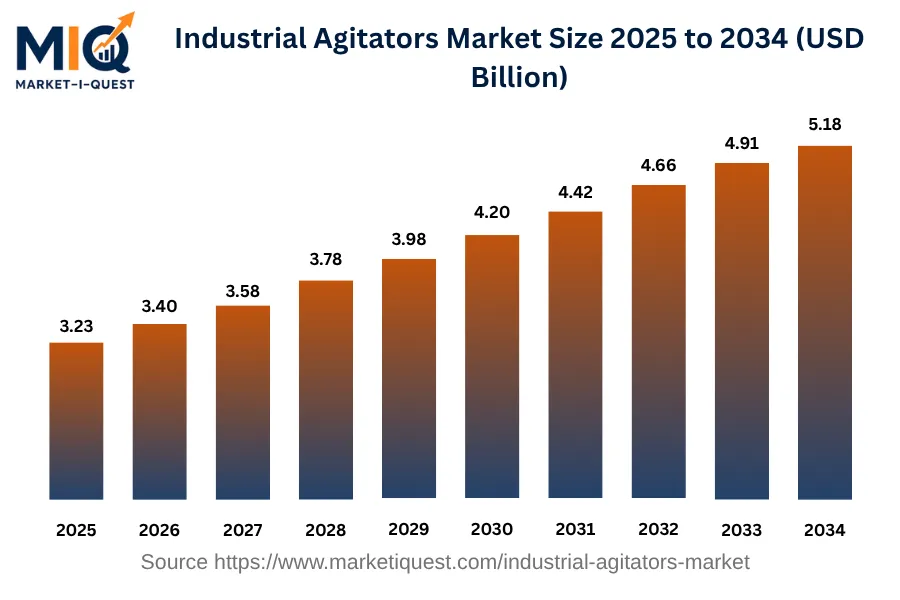
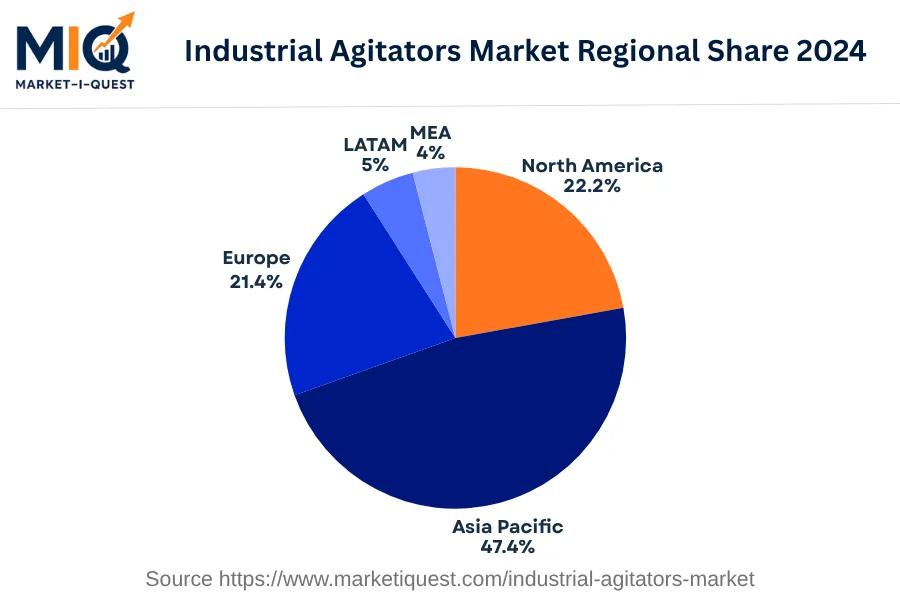
The Industrial Agitators Market was valued at USD 3.23 billion in 2025 and is predicted to reach USD 5.18 billion by 2034, recording a Compound Annual Growth Rate (CAGR) of 5.4%. The increase in value over nine years denotes a sustained rise in market size, reflecting the persistent expansion and diversification of the industry across the globe. The growth is attributed to the constant advancement in industrial technologies and a positive shift in the adoption of high-performance industrial agitators. At the regional level, the market distribution in 2024 evidences the largest share in the Asia Pacific at 47.41%, followed by North America at 22.16%, Europe at 21.38%, Latin America at 5.02%, and the Middle East and Africa at 4.03%. This regional share data adds a significant detail to the understanding of the global Industrial Agitators Market size.

Key Takeaways

  • By Type - Mechanical Agitators led the pack holding the largest market share in 2024.
  • By Application segment - Chemical Processing was the dominant sub-segment in 2024.
  • By End-use Industry - Oil and Gas held significant position in the industrial Agitators market landscape in 2024.
industrial-agitators-market market size

Key Driving Factors

Strict Government Regulations on Water Treatment

Government regulations around the world are becoming increasingly stringent on clean water emission standards for industries. To meet these standards, industries are investing in high-quality industrial agitators that ensure optimal mixing performance in water treatment processes. These machines are crucial for evenly dispersing chemicals that treat polluted water, reducing suspended solids, and helping industries comply with emission standards. For instance, the US Clean Water Act and the European Union's Urban Waste Water Treatment Directive mandate particular criteria for waste water discharge. Failure to comply can result in hefty fines or legal penalties for industrial units. Thus, the need to ensure compliance with such regulations is directly fostering a more robust demand for industrial agitators in the water treatment sector.
Increased Production in Pharmaceutical & Biotech Industries

The swift expansion of pharmaceutical and biotechnology industries globally is fostering the growth of the industrial agitators market. The production of drugs, vaccines and biotech products often involve complex, multi-step mixing processes for which industrial agitators are essential. They ensure the homogeneous mixing of raw materials, improve heat transfer efficiencies, and control chemical reactions. The current surge in the production of COVID-19 vaccines and medicines particularly highlight the critical role of these machines, as they contribute significantly to meeting high-volume production and stringent quality standards. Industrial agitators also play a key role in maintaining hygienic conditions in biopharmaceutical manufacturing, reducing the risk of batch contamination. This increased production and need for ensuring high-quality output in the pharmaceutical and biotech industry is thus driving the industrial agitators market.

Market Evolution by Timeline

2019-2023
The industrial agitators market started seeing a boost in demand particularly in pharmaceuticals and wastewater sectors across the US and Europe during this period. Suppliers, including companies like Alfa Laval and EKATO, progressively improved their products to offer agitators with enhanced efficiency and durability. This period posed certain constraints, such as fluctuating raw material prices, impacting the cost of production. On policy front, the EU's Industrial Emissions Directive spurred more use of agitators in the wastewater industry. A common commercial model involved long-term contracts with manufacturers, complemented by after-sales service agreements. However, inherent risks of operational failure triggered suppliers to invest in research and development for more reliable models.
2024
In 2024, there was a notable demand from the food and beverage industry and chemical processing units in both developed and emerging economies like China, India, and Brazil. The technology witnessed a shift towards the inclusion of smart features, such as IoT-enabled agitators, to monitor performance and preventative maintenance, yet the integration was still in its nascent stage. Policies by local governments encouraged manufacturing units in Asia-Pacific region to adhere to strict effluent norms, increasing agitators demand. Contractual relations typically included maintenance services to ensure continuous service. The risk of inconsistency in product quality prevailed.
2025-2029
Throughout 2025-2029, demand flourished in the oil & gas sector, mostly in the Middle-East and Africa, focusing on crude oil processing. Enhanced next-gen agitators with sophisticated control features and predictive failure detection became popular, though high setup costs were a significant barrier for many organizations. Standards like ISO 21413 guided the design of agitators, strengthening user confidence. Partnerships between suppliers and buyers were common to customize products to suit specific needs. Price volatility remained a risk, potentially affecting the production cost, thus the market price.
2030-2034
From 2030-2034, the North American market, particularly in the paint and coatings industry, witnessed a surge in demand for industrial agitators. Technological progression led to more energy-efficient and noise-less agitators, though implementation issues restricted wide-scale adoption. Government regulations such as the US Clean Water Act increased agitators use in effluent treatment applications. Flat-rate pricing models for agitator units became common, and suppliers entered into strategic alliances for better market reach. Risk of high energy consumption by traditional agitators stimulated demand for efficient models.

Future Market Outlook

Future Opportunities

The potential for future growth in the industrial agitators market is significant, driven by several ongoing initiatives and regulatory changes. The increasing emphasis on sustainable manufacturing processes is prompting companies to invest in agitators that minimize waste and energy consumption, as seen in initiatives by companies like GE and BASF that focus on green chemistry principles. Regions such as Asia-Pacific, specifically China and India, are expected to cultivate the market due to rapid urbanization and industrial expansion, which is reflected in policies aimed at improving industrial efficiency. The pharmaceutical industry is undergoing a shift towards more customized production processes, prompting a need for specialized agitators designed for precise mixing applications, which is evident in partnerships, such as those between major manufacturers and biotech firms. In 2021, the U.S. FDA released guidelines that encourage more rigorous standards for the manufacturing processes of pharmaceutical products, driving demand for high-performance agitators. Additionally, emerging sectors like renewable energy, particularly biofuels, present untapped markets for agitators tailored to the unique requirements of mixing and blending. This growing focus on regulation adherence and innovative mixing solutions indicates a clear path for product development and technology enhancements, solidifying the future potential of the industrial agitators market in alignment with prevailing industry needs.

Segmentation Analysis

By Type

The market is divided into subsegments including Mechanical Agitators, Magnetic Agitators, Hydraulic Agitators, and Pneumatic Agitators. The Mechanical Agitators accounted for the largest revenue share while the Hydraulic Agitators is expected to grow at the fastest CAGR during the forecast period.

Largest Revenue Share

Mechanical Agitators

Market Share Leader

Mechanical Agitators have maintained a significant revenue share compared to other types of Agitators. Given the extensive applicability and relative affordability of these devices, they are broadly used in numerous industrial sectors such as mining, food & beverages, and pharmaceuticals, among others. Mechanical Agitators offer robustness and longevity, attributes favored by various industries, especially in developing markets where upfront capital investment is a concern. They are also preferred for their ease of maintenance and versatility in handling different mise-en-scene since they can operate in a variety of conditions and in high viscosity applications. Consequently, their demand remains consistently high, resulting in high revenue generation for this segment. This dominance is likely to continue due to the consistent demand from diverse industries and the versatility of these agitators.

Fastest CAGR

Hydraulic Agitators

Forecast Period Growth Leader

The fastest growing subsegment in the forecast period is projected to be Hydraulic Agitators. Despite their smaller revenue share currently, they are seeing rapid adoption due to their efficiency and effectiveness over different applications. Among the drivers for this trend is a shift toward energy-efficient solutions, as Hydraulic Agitators offer substantial energy savings compared to traditional types, a significant factor in industries looking to cut operational costs. A surge in infrastructure and industrial development, particularly in the emerging economies, is another dynamic promoting their growth. Hydraulic Agitators are getting traction because they have lower maintenance requirements and less susceptibility to damage from overload conditions. These factors are likely to fuel the faster CAGR for the Hydraulic Agitators sub-segment in the forthcoming years. Nevertheless, the high installation cost could pose a barrier to faster adoption in cost-sensitive markets.

By Application

The market is divided into subsegments including Chemical Processing, Water Treatment, Pharmaceuticals, Food and Beverage, Mining and Minerals. Chemical Processing accounted for the largest revenue share while Pharmaceuticals is expected to grow at the fastest CAGR during the forecast period.

Largest Revenue Share

Chemical Processing

Market Share Leader

Chemical Processing emerges as the subsegment with the most revenue in this market. This can be largely attributed to the global reliance on chemical industries for various sectors including aviation, automotive, medical - among others. The base chemicals produced in this subsegment serve as building blocks for numerous other products, further enhancing its revenue streams. It is also capital-intensive, enabling large corporations to dominate, capturing significant market share and hence, high revenues. Geographically, the Asia-Pacific region could have the highest contribution to this subsegment’s revenues due to rapid industrialization, particularly in countries like China and India. Regulatory standards, while strict, have been well established over the years, minimizing compliance-related uncertainties. The purchasing criteria largely revolve around product quality and supplier reliability.

Fastest CAGR

Pharmaceuticals

Forecast Period Growth Leader

The Pharmaceuticals subsegment shows the fastest CAGR outlook. This rapid growth is driven by global health crises, increasing investment in research and development by major pharmaceutical companies and an aging global population. Additional impetus comes from technological advancements in drug discovery and development, and significant capital expenditure in the pharma sector by both private and public entities. However, it's important to note that this subsegment faces certain barriers to adoption, such as stringent regulatory norms and a long, rigorous approval process for new drugs. Partnerships in terms of merger and acquisitions among big players and with biotech firms are common and may serve as a pivotal catalyst for future growth. Near-term risks include potential IP rights challenges and public sentiment surrounding the cost of pharmaceuticals.

By End Use Industry

The market is divided into subsegments including Oil and Gas, Agriculture, Cosmetics, Construction, and Energy. In 2024, the Oil and Gas segment accounted for the largest revenue share while the cosmetics subsegment is expected to grow at the fastest CAGR during the forecast period.

Largest Revenue Share

Oil and Gas

Market Share Leader

The Oil and Gas subsegment emerged as the largest revenue generator and has a strong presence in this market due to the immense demand for energy and fuel. This industry serves as a crucial backbone for many economies, which depend on it for their energy requirements. It pushes the upstream activities involving exploration, drilling, and extraction of oil and gas products, thereby driving massive revenue. Geographically speaking, regions rich in fossil fuel reserves such as the Middle East, North America, and some parts of Asia-Pacific contribute significantly to the revenue, backed by high production and export activities. In addition, strong government support and favorable regulations in these regions further bolster market progression. Another key driver is the growth in industrialization and urbanization which pushes the demand for energy, thus augmenting the sector's revenue. Also, there is a high switching cost involved in shifting to other energy sources, rendering the oil and gas sector irreplaceable in the near future.

Fastest CAGR

Cosmetics

Forecast Period Growth Leader

Contrary to the Oil and Gas sector, the Cosmetics subsegment is projected to be the fastest-growing sector. The primary driver behind this growth is changing consumer preference and increasing disposable income, which are pushing the demand for cosmetic products. The rise in awareness regarding personal grooming and appearance among both genders is also catalyzing the growth of this subsegment. Technology plays a significant role in driving growth, with advancements in formulation and manufacturing processes, and product innovation catering to a broad spectrum of consumer needs. Adoption barriers would be the prevailing strong competition in the market, high manufacturing cost, and stringent regulatory landscape that can delay the launch of new products. However, collaborations and partnerships with beauty salons and influencers are expected to present significant growth opportunities. Near-term risks include fluctuating raw material prices and potential backlash from increasing environmental concerns associated with cosmetic manufacturing.

Competitive Analysis

Key Market Players

Manufacturers / OEMs

SPX Flow Inc.
US
Alfa Laval AB
Sweden
Südmo Valve Technology
Germany

Key Suppliers & Raw Materials

Jiangsu Sunkaier Industrial Technology Co., LTD
China
Prochem
Australia
Philadelphia Mixing Solutions
US

Distributors, Integrators & Channel Partners

Flowserve Corporation
US
National Oilwell Varco, Inc.
US
Napier-Reid Ltd.
Canada

Porter’s Five Forces Analysis

This analysis provides a detailed understanding of the competitive forces in the Industrial Agitators Market.

Supplier Bargaining Power

Medium

Significant dependence on raw material suppliers impacts the supplier power in the market.

Buyer Bargaining Power

High

Large number of vendors and easy switching between them increases the buyers' bargaining power.

Threat of Substitutes

Low

The functionality of industrial agitators is specific, resulting in a low threat from substitutes.

Threat of New Entrants

Medium

Technological understanding and high capital costs pose as barriers for new entrants.

Competitive Rivalry

High

The Agitators Market faces high competitive rivalry due to presence of numerous international and regional vendors.

Regional Analysis

Geographic market dynamics and growth opportunities across key regions

Global Market Outlook

industrial-agitators-market market regional share

North America

In 2024, the industrial agitators market in North America, comprising United States, Canada and Mexico, witnessed steady growth, stimulated by demand and technological advancements. Increased consumption from sectors such as pharmaceutical, mining and chemicals drove the market. Regulatory protocols like FDA and EPA's safety and compliance requirements for these industries instigated the need for high-quality agitators. Investment in R&D aimed at enhancing agitator efficiency played a significant role in bolstering the market. Rapid adoption of technologically advanced automated agitators, especially in the US and Canada, also contributed to the market dynamics.

Market trends showed a shift toward smart agitators capable of achieving better mixing efficiency and energy savings. Buyers demonstrated increased preference for custom-designed agitators to meet specific industry requirements. There was a noticeable rise in partnerships and M&A, as companies sought to expand their product portfolios and cater to diverse industrial needs. The enforcement of stricter energy efficiency standards and environmental regulations influenced industry behavior, prompting a move toward environmentally friendly and energy-efficient products. Sales channels witnessed a shift towards online platforms, catalyzed by the ongoing digital transformation. Predominant customers included sectors like chemical manufacturing, food and beverages, pharmaceuticals and wastewater treatment facilities.

Asia Pacific

In 2024, the Industrial Agitator Market in the Asia Pacific was characterized by burgeoning industrialization and a growing focus on efficient manufacturing processes. Drivers of this market included key investment in industrial automation sectors in China and India, favorable government initiatives like "Make in India", which fuelled the manufacturing sector, and technological adoption of advanced agitators in pharmaceutical and chemical industries in Japan and South Korea. Another critical driver is the impressive supply dynamics in Australia and ASEAN countries, affirmed by steady raw material availability and cost-effective production of agitators.

Shifting trends were also observable in the market. Smart factory implementation became increasingly prevalent, especially in China's manufacturing sector, integrating industrial agitator systems into their operations. South Korea and Australia were marked by a substantial rise in the adoption of customizable industrial agitators, attuned to precise market requirements. Collaborations and partnerships, especially in India's industrial sector, saw an upward trend, as businesses aimed for enhanced market reach and product diversification. B2B online channels emerged as a significant market platform, making agitator acquisition easier and more efficient across the region. Lastly, stringent quality control regulations and policies forced a shift towards high-quality, durable industrial agitators in Japan and the leading ASEAN markets.

Europe

In 2024, Europe's Industrial Agitators Market was predicated on diversified industrial needs, and higher efficiency processing technologies. The market was propelled by sustainability regulations, prompting companies to update their production systems. Examples include Germany's drive for renewable energy systems, which encouraged manufacturers to invest in agitators for biofuel production. Technological adoption also played a role, as enterprises across the UK and France increasingly utilised cloud-based automation systems for production efficiency. Meanwhile, fluctuating steel prices across Europe affected the manufacturing and pricing strategies of agitator suppliers.

Knowledge on product longevity and operational efficiency drove the buying behaviour of customers across various sectors such as healthcare, utilities and manufacturing. Digital transformation in the industry necessitated the integration of smart technologies, with an uptake in IoT-enabled agitators in Italy, Spain and the Nordics. In France, enforcement of the EU's energy-efficient directives saw companies relocating towards low-energy-consuming agitators. Corporate partnerships evidenced in Central & Eastern Europe facilitated market expansion, while merger and acquisition activity, particularly in the Benelux region, reinforced the market's already robust nature.

Latin America

The Latin American industrial agitators market in 2024 experienced noteworthy dynamism largely marked by technological advancements and policy regulations. Drivers mainly included substantial growth in adoption of advanced agitation equipment across sectors such as utilities, manufacturing, and healthcare due to increasing industrialization, particularly in Brazil and Mexico. Regulatory environments in Argentina and Chile towards increased safety standards fostered demand. With investments in technology and supply dynamics favoring lower operational costs, energy-efficient agitators emerged as preferred choices amongst enterprise customers.

On the trends front, a notable shift towards customization of industrial agitators was observed to accommodate specific enterprise needs, especially in petroleum and growing biotechnologies sectors. The Colombian market was also quick to embrace digitalized agitators for enhanced precision. This catalyzed notable partnerships between manufacturers and tech-firms, for instance in Peru, driving innovation in the industry. In Brazil, policy enforcement around waste management saw a lean towards agitators equipped with efficient solid-liquid separation. This marked a significant tech shift in the market. Additionally, direct-to-customer online channels were increasingly leveraged for sales in Mexico and Chile, altering traditional distribution and purchase patterns. Overall, the LATAM industrial agitators market in 2024 was influenced by technological adoption, regulatory changes, and a drive towards efficiency and customization.

Middle East & Africa

In 2024, the Industrial Agitators Market in the Middle East and Africa experienced considerable growth, driven by several key factors and marked by distinct trends. Significant shifts in demand came from the oil and gas industry with heavy investment in machinery upgrades, particularly in Saudi Arabia, Qatar, and the United Arab Emirates. This trend followed regulatory changes and tightening environmental policies that echoed across sectors, including utility and manufacturing industries in Egypt and Israel. Emerging technological advancements drew significant attention in the market, as integration of smart sensors and automation became increasingly prevalent. This adoption surged in response to booming sectors such as telecom and healthcare, majorly in South Africa, Nigeria, and Kenya.

Buyer behavior was marked by an increased prioritization of efficiency and durability. The aspiration for cost-effectiveness resulted in growing partnerships and collaborations between agitator manufacturers and other companies in the supply chain. Product innovation became the crux of these alliances, along with mutual support in managing price stability amidst fluctuating raw material costs. Concurrently, the region witnessed vigorous enforcement of industry standards and product certification requirements, noticeably in countries like Saudi Arabia and Israel, aligning with the rising quality consciousness among end-consumers. These factors all combined to shape the state of the Industrial Agitators market in the Middle East and Africa during the year 2024.

Recent Industry Developments

Latest market innovations, product launches, and strategic initiatives

September 2026

The Bureau of Indian Standards (BIS) has set a hard enforcement deadline of September 1, 2026, for "Scheme-X," an omnibus regulatory framework governing industrial machinery and electrical gear. Agitator manufacturers and importers must ensure their products—specifically the motor and control assemblies—are fully certified. Equipment failing to carry the required ISI mark will be barred from legal sale or import into India, forcing many regional suppliers to fast-track their certification and factory audit processes.

March 2026

TT Inc. completed the acquisition of SPX FLOW for $4.775 billion. This acquisition is a major consolidation move, significantly strengthening ITT’s portfolio in engineered process technologies, specifically mixing, fluid handling, and thermal solutions. The integration creates a robust platform for high-margin industrial applications and expands ITT’s global manufacturing and service footprint.

Frequently Asked Questions