In-Memory Computing Market Snapshot

Key Players

  • SAP SE (Germany)
  • Oracle Corporation (US)
  • Microsoft Corporation (US)
  • IBM Corporation (US)
  • Altibase Corporation (South Korea)
  • GigaSpaces Technologies Inc. (US)
  • TIBCO Software Inc. (US)
  • Hazelcast Inc. (US)
  • Red Hat Inc. (US)
  • Aerospike Inc. (US)

Market Size

Base Year 2024
$18.89 Bn
CAGR
16.85%
Forecast 2034
$89.64 Bn

Market Segments

By Technology
  • Database Systems
  • Data Grid Systems
  • Stream Processing
  • Machine Learning
By Deployment Model
  • On-Premises
  • Cloud-Based
  • Hybrid
By Application
  • Data Analytics
  • Real-Time Data Processing
  • Financial Services
  • E-Commerce
  • Telecommunications
  • Others

Market Dynamics

Drivers
  • Increasing big data processing needs
  • Emergence of advanced AI applications
Restraints
  • High Implementation Costs
  • Lack of Skilled Professionals
Opportunities
  • Rising demand for faster processing
  • Increasing cloud-based solutions adoption

Market Size

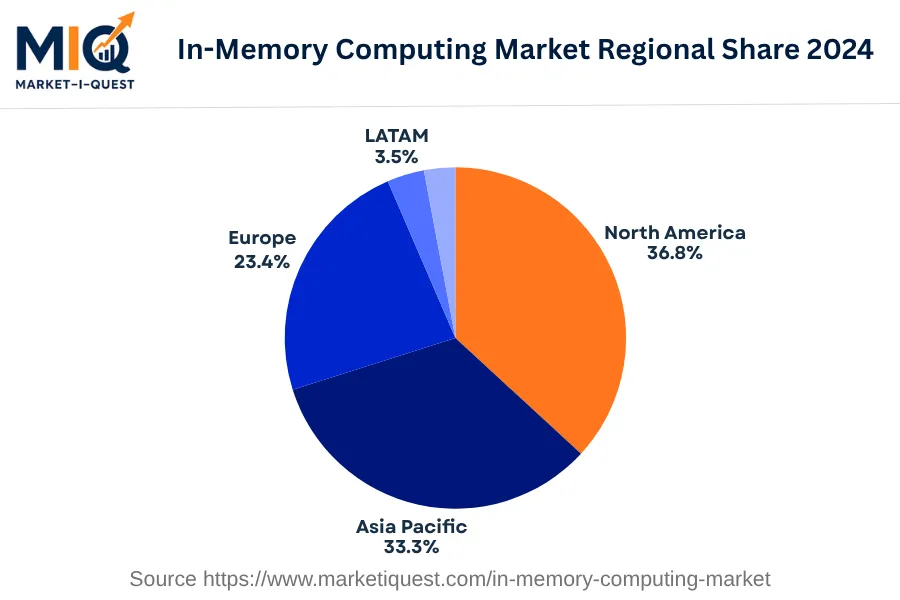
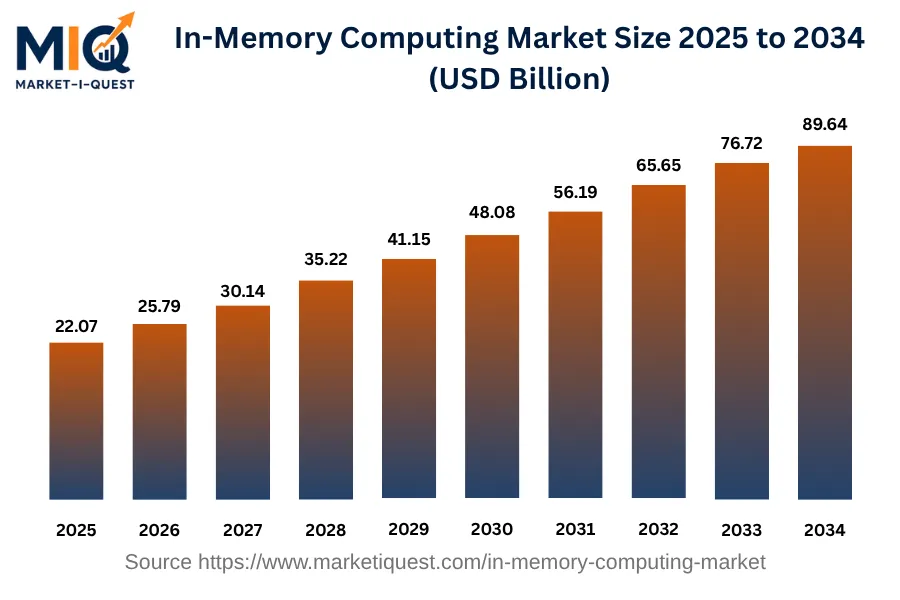
The In-Memory Computing Market was valued at $22.07 billion in 2025. Which was $18.89 billion in 2024. The market expansion reaches a size of $89.64 billion by 2034. Notably growth was there with a CAGR of 16.85%. This expansion was primarily due to the increase in demand. Advanced and faster real-time data analytics and the rising adoption of in-memory computing solutions demand was high across various industrial verticals. Moreover, market growth was driven by enhancements in technology and the ever-growing expectations for high-speed data processing. In 2024, the market shares were distributed regionally as follows: North America held a 40.82% share, followed by Asia Pacific with 31.46%, Europe at 21.24%, LATAM holding 3.04%, and MEA contributing 3.44%.

Key Takeaways

  • By Technology - Database Systems led the market accounting for a significant portion of the market in 2024.
  • By Deployment Model - Cloud-Based held the major share in 2024.
  • By Application - E-Commerce grew fastest in the In-Memory Computing Market during 2024.
in-memory-computing-market market size

Key Driving Factors

Implementation of Real-Time Analytics

The In-Memory Computing Market is seeing a significant push from the growing need for real-time analytics among businesses across industries. As companies seek to make quicker, data-driven decisions, the superior speed and efficiency of in-memory computing technology prove to be vital. In-memory computing allows businesses to process and analyze large volumes of data. This process is real-time, where traditional disk-based storage systems struggle with due to latency issues. This instant data processing and analysis capability is especially crucial in industries. Sectors like finance, healthcare, and retail, where real-time data-driven insights can be transformative in terms of decision making.

Shift to Cloud-Based Solutions

Another key driver for the In-Memory Computing Market is the ongoing shift from on-premise solutions to cloud-based systems. Businesses are increasingly adopting in-memory computing as part of their cloud migration strategies. As cloud-based in-memory computing solutions offer scalability, flexibility, and cost-effectiveness unmatched by traditional storage technologies. Especially for small and medium-sized enterprises, cloud-based solutions eliminate the need for heavy capital investments in IT infrastructure. These businesses can now leverage in-memory computing through Software as a Service (SaaS) models. This allows efficient data processing and analysis without significant upfront costs. This economic viability of in-memory computing on the cloud is a strong driving factor for market growth.

Market Evolution by Timeline

2019-2023
During this period, the demand for in-memory computing (IMC) notably increased. In various sectors like financial service providers and the healthcare sector in North America and Asia-Pacific regions. These sectors sought IMC solutions for real-time data processing and analytics, contributing to improved decision-making and operational efficiencies. The supply side saw a high degree of integration maturity as vendors like Oracle, IBM, and SAP delivered ready-to-implement entities. However, data security and privacy concerns emerged as significant constraints, affected by the General Data Protection Regulation (GDPR). People started using internet services that were based on monthly subscription. However, people were worried about data privacy. Companies that provided these services and their customer had to spend huge amount of money on security. The new internet services, such as SaaS-based IMC were popular. So the companies that provided SaaS-based IMC services had to invest a significant money in cybersecurity to protect themselves from data breaches.
2024
By 2024, the demand for IMC solutions was diversified across various sectors. Specially in telecom industry and retail sector, majorly in Western Europe and the Middle East. Development of hybrid transactional/analytical processing (HTAP) was significant technological improvement. This innovation enables simultaneous transactional and analytical processing. Yet, the evolving complexity of IMC technologies posed challenges for vendors. Contract partnerships between big tech companies and small to medium businesses were common. Enhanced data security measures were necessary to reduce potential breaches.
2025-2029
Demand for IMC will further amplified during this period. Shift towards faster data processing solutions will be seen due to increasing digital transformation. Advancements in in-memory technology will make Cloud-based IMC a viable and popular option. North America will retain its leading regional position via significant adoption in the manufacturing and energy sectors. Meanwhile, a supportive regulatory landscape will benefit quick adoption, facilitated by the Open Compute Project. Subscription-based licensing will be more popular, providing predictable expenses for customers and regular revenue for providers. Concerns around IMC's energy consumption will emerge as a new risk area.
2030-2034
From 2030 to 2034, the global IMC market will witness robust demand from sectors undergoing digital transformation across Latin America and Africa. In-memory database with next-gen analytical solutions will be a core offering by major vendors. Though integration maturity will peak, infrastructural suitability across different sectors seemed challenging. Policy-wise, the US Federal Risk and Authorization Management Program (FedRAMP) will prove a driving factor for secure, regulated procurement of IMC solutions. As commercial models will evolve, procurement will shift to usage-based pricing for cloud-based IMC.

Future Market Outlook

Future Opportunities

Opportunities in the in-memory computing market are expanding as organizations recognize the potential of real-time data analytics. In 2023, enterprises like Uber began utilizing in-memory solutions to optimize ride-sharing algorithms, demonstrating the impact of immediate data processing on operational efficiency. The ongoing digitization of finance, specifically in regions like North America and Europe, is prompting banks to adopt in-memory computing to enhance transaction speed and improve customer experiences. Additionally, industries focusing on supply chain optimization are implementing in-memory analytics to react swiftly to market changes, with Amazon being a key player investing heavily in this area. Partnerships between technology firms and academic institutions are also on the rise; for instance, IBM collaborates with universities to advance the research of in-memory computing applications. Notably, the development of 5G technology is further propelling demand for in-memory solutions as organizations seek to exploit the low latency and high-speed connectivity offered by 5G networks. Moreover, sectors such as healthcare are exploring in-memory computing to facilitate real-time patient data processing, which is essential for timely decision-making. As organizations prioritize data-driven strategies, the integration of in-memory computing with machine learning algorithms is becoming increasingly prevalent, evidenced by Google’s TensorFlow enhancements. The alignment of regulatory requirements and technological advancements signifies a fertile ground for companies invested in in-memory computing technologies to explore innovative applications.

Segmentation Analysis

By Technology

The market is divided into subsegments including Database Systems, Data Grid Systems, Stream Processing, and Machine Learning. Database Systems accounted for the largest revenue share while Stream Processing is expected to grow at the fastest CAGR during the forecast period.

Largest Revenue Share

Database Systems

Market Share Leader

Analysis indicates that Database Systems are leading in terms of revenue generation. Multiple factors contribute to this subsegment's dominant position. Database Systems are fundamental components of technology infrastructure across various industries, from finance to healthcare. They provide critical functionality by organizing, storing, and retrieving large volumes of data accurately. Their universal utility and high adoption rates in business operations are key contributor to their revenue figures. At the time businesses are getting huge amount of new data all the time. This is putting pressure on them to make their database infrastructure better. This is making businesses want to get Database Systems. There are rules to handle data especially when it comes to data privacy. These rules are pushing businesses to get Database Systems which are secure. Businesses are looking for Database Systems that're advanced and safe. Geographically, the wide usage of Database Systems in developed markets with mature IT infrastructures, such as the US and Europe, drive this subsegment's leading revenue share.

Fastest CAGR

Stream Processing

Forecast Period Growth Leader

While Database Systems represent the largest revenue generator, Stream Processing is predicted to be the fastest-growing subsegment. Stream Processing is useful as it allows us to look at and work with data streams in real time. This is especially playing crucial role when everything is going digital. The main reasons Stream Processing is becoming popular as we have huge data to deal with and businesses need to make decisions. Stream Processing is being used widely in areas like finance and surveillance and e-commerce where looking at data in time can give companies an edge over others. Stream Processing is supporting in these areas because it lets them make decisions. Only a few adoption barriers remain, primarily in terms of understanding and utilizing the technology effectively. Partnerships between vendors and end-users and continuous innovations by leading companies to simplify the adoption of Stream Processing facilitate its growth. However, concerns on data privacy, security, and the need for significant initial investments represent near-term risks. Innovations aimed at addressing such concerns are expected to boost the growth trajectory of the Stream Processing subsegment.

By Deployment Model

The market by deployment model is segmented into On-Premises, Cloud-Based, and Hybrid, with the Cloud-Based model generating the largest revenue, while the Hybrid model is projected to witness the fastest growth during the forecast period.

Largest Revenue Share

Cloud-Based

Market Share Leader

In the base year of 2024, the cloud-based model of deployment is contributing the largest share to revenue, driven by key factors such as accessibility, scalability, cost-effectiveness, and security. Businesses prefer Cloud-Based model as it allows work from anywhere and it makes things efficient when people are in remote location. The Cloud-Based model is also cheaper than the way of doing things, where everything is stored on computers. With the Cloud-Based model businesses can easily get bigger or smaller without having to spend a money on equipment. The big Cloud-Based companies also have high security, which helps keep everything safe. This is another reason why businesses want to use the Cloud-Based model. The Cloud-Based model is especially popular with companies like telecommunications, finance, healthcare and retail because these companies have a huge data to store and process and the Cloud-Based model is good, at handling this. However, the dominance of the Cloud-Based model can also be attributed to lower switching costs, habitual purchasing patterns, and the globally dispersed supply chain of cloud services.

Fastest CAGR

Hybrid

Forecast Period Growth Leader

The Hybrid deployment model, which combines the feature-sets of On-Premises and Cloud-Based models, is staged to grow at the fastest CAGR. While Cloud-Based solutions provide scalability and cost benefits, On-Premises solutions offer control and security. The Hybrid model is excellent as it lets businesses keep information in their own offices. At the time it lets them use the cloud to make things bigger and economical. This is helpful because a lot of people are getting worried about keeping their data private and safe from cyber threats. New technology is making it easier for businesses to use the Hybrid model. Tech companies can help businesses make the change to the Hybrid model. The Hybrid model is a choice, for businesses because it helps them with data privacy and cyber threats. Near-term risks include data integration challenges and the potential for increased complexity in IT infrastructure. But with strategic planning, these risks can be managed effectively.

By Application

The market is segmented by application, including Data Analytics, Real-Time Data Processing, Financial Services, E-Commerce, Telecommunications, and Others. Among these, Financial Services accounted for the largest revenue share while E-Commerce is expected to grow at the fastest CAGR during the forecast period.

Largest Revenue Share

Financial Services

Market Share Leader

Financial Services have proven to be a substantial revenue generator in the application segment. The financial industry is changing because it needs to be able to process and look at data in time. Financial institutions such as banks and insurance companies are using technologies to understand what people are managing risks. They also want to make their operations more efficient. In some parts of the world, like North America and Europe the financial industry is strong. So these places are making huge amount money from this as they started using technologies early. The government is forcing institutions to use digital technologies and be more transparent. This is another reason why financial institutions are using real-time data processing and analytics. The financial industry is looking at real-time data processing and analytics to make things better. With respect to customer acquisition, established channels have benefited the sector in reaching potential customers, and the high switching costs involved with financial systems reinforce customer loyalty.

Fastest CAGR

E-Commerce

Forecast Period Growth Leader

In the scenario of rapid digital transformation, E-Commerce has been identified as the fastest-growing segment. Driven largely by technological innovations and changing consumer behavior, e-commerce platforms require robust and scalable data processing capabilities to manage the surge in data generated from online transactions, user behavior tracking, inventory management, and more. Adoption barriers, such as concerns about data security and privacy, are being addressed with policy interventions and secure, encrypted solutions. Near-term risks in the e-commerce industry include competition from conventional retail channels, alterations in consumer spending patterns, and global economic conditions. Nonetheless, continued enhancements, investments in infrastructure, and strategic partnerships within the sector are expected to propel the growth rate over the forecast period.

Competitive Analysis

Key Market Players

Manufacturers / OEMs

Microsoft
US
Oracle
US
IBM
US

Key Suppliers & Raw Materials

Intel
US
Micron Technology
US
Samsung Electronics
South Korea

Distributors, Integrators & Channel Partners

Dell EMC
US
Cisco
US
SAP SE
Germany

Porter’s Five Forces Analysis

Analysis of the competitive forces in the In-Memory Computing Market.

Supplier Bargaining Power

Medium

Limited number of quality hardware suppliers can dictate terms.

Buyer Bargaining Power

Low

High switching costs and complexity of data handling reduce buyer power.

Threat of Substitutes

Low

Unique benefits and lack of direct substitutes prevent mobility.

Threat of New Entrants

Low

High barrier to entry due to technical expertise and capital requirements.

Competitive Rivalry

High

Intensified competition among established tech giants for market share.

Regional Analysis

Geographic market dynamics and growth opportunities across key regions

Global Market Outlook

in-memory-computing-market market regional share

North America

In 2024, the in-memory computing market in North America saw a stable yet robust growth, chiefly driven by increased adoption of advanced data processing technologies. The rise in demand stemmed from businesses' increasing complexity and volume of data that necessitated speedier analytics and transaction processing. Regulatory standards on data security, such as GDPR, significantly influenced the technology's acceptance within enterprises and governmental organizations. Investments in digital transformation initiatives across domains like healthcare, retail, and manufacturing further propelled the market. Dominant trends in 2024 included high-performance computing applications in the US and Canada, enhanced by partnerships and mergers. The need for real-time decision-making data in sectors like utilities and e-commerce drove the shift toward in-memory computing systems. In contrast, we noticed a greater dependency on traditional disk-based storages in Mexico. However, there was a palpable shift toward cloud-based solutions, owing to their affordability and scalability.

Some other notable developments were the adoption of in-memory computing by telecommunication companies for network function virtualization. North American financial services firms invested significantly in these technologies, leveraging faster data processing to boost fraud detection and risk management. Overall, the North American In-Memory computing market in 2024 was characterized by informed, strategic technology adoption aimed at harnessing faster and efficient data processing capabilities.

Asia Pacific

In 2024, the in-memory computing market in Asia Pacific displayed significant proliferation, driven by several key factors. Noteworthy demand arose from burgeoning fintech and e-commerce sectors in China and India, craving for real-time data processing and analytics capabilities. Government policies, such as China's New Infrastructure initiative and India's Digital India campaign, spurred the market by boosting tech-infrastructure investments. Also, advancements in technology enabled cheaper and efficient in-memory computing solutions, enhancing market penetration in countries like Japan and South Korea. Emerging trends spotlighted the shifting focus towards hybrid transactional analytical processing (HTAP), particularly in Australia and ASEAN markets, to seamlessly integrate transactional and analytical workloads in real-time.

Concurrently, strategic partnerships and M&A activities within in-memory computing providers were prevalent to gain competitive market edge, such as the notable business alliance between T-Systems and SAP in Japan. Also, regulatory bodies started emphasizing on data privacy compliance, forwarding encrypted in-memory computing as a growing trend. Sectors such as manufacturing and retail in China, and healthcare in India, sought these solutions for optimizing logistics and managing large data volumes. This trend served as a testament to the growing reliance of diverse industry verticals on in-memory computing solutions in the Asia Pacific region during 2024.

Europe

In 2024, the In-Memory Computing (IMC) Market in Europe flourished, ensuring faster operations and real-time analytics across multiple sectors. Drivers for the market included growing demand for rapid data processing and analysis in sectors such as healthcare, retail, government and utilities. IMC adoption saw a dramatic increase in Germany and the United Kingdom, fueled by large-scale investments in digital transformation. Implementation of stringent data privacy regulations such as the EU's General Data Protection Regulation (GDPR) indirectly boosted the market, as IMC allowed for streamlined compliance and enhanced data security.

In terms of trends, there was a notable shift towards cloud-based IMC solutions, particularly in the Nordics, for better scalability and cost-efficiency. Corporate partnerships and M&A activity proliferated, as observed in the case between SAP, a German software company, and Azure, aiming to combine their products for greater market reach. Increased adoption of AI and machine learning technologies, particularly in France and Italy, necessitated the use of IMC for rapid, efficient data processing. Interestingly, the market also saw higher uptake in the manufacturing sector in Central & Eastern Europe, driven by the need for real-time operational insights to boost productivity. Overall, these factors greatly contributed to the IMC landscape in Europe in 2024.

Latin America

In the base year of 2024, the In-Memory Computing (IMC) market in Latin America exhibited significant dynamism, powered by various drivers and characterized by notable trends. Key drivers included increased demand for real-time analytics by enterprises across sectors, underscored by Brazil's manufacturing industry and Mexico's robust retail sector. Enhanced governmental regulations promoting digital transformation, such as Argentina's 'Digital Argentina' policy, further propelled the adoption of IMC. Additionally, escalating private investments into technological enhancements, most notably in Chile's burgeoning startup ecosystem, augmented the supply dynamics in the region.

On the trends front, enterprises demonstrated a shift towards cloud-based IMC solutions to leverage scalability and cost-efficiency, notably in Colombia's government sector. Adoption of innovative products, such as SAP HANA embraced by Peru's utilities sector, marked significant technological shifts. Partnerships and M&A activities flourished, with global players targeting local service providers to strengthen their LATAM portfolio. Lastly, adherence to data protection standards, shaped by Brazil's General Data Protection Law, influenced policy enforcement and buyer behavior in the sector. The IMC market in LATAM in 2024 was thus shaped by an intricate interplay of regulatory directives, investment climate, enterprise demand, and technology adoption.

Middle East & Africa

In 2024, the in-memory computing (IMC) market in the Middle East and Africa showed substantial growth. Demand drivers included an increased adoption of digitization across various sectors like government, oil and gas, utilities, telecom, health care, manufacturing, retail, and financial services. Rapid technological innovations and heavy investments in IT infrastructure, particularly in technologically advanced regions like Saudi Arabia, United Arab Emirates, Israel, and Egypt, were primary stimulants. Regulations aimed at data protection and secure transactions also bolstered IMC market expansion. Notable market trends included the rise in cloud-based solutions and Big Data analytics, both heavily reliant on IMC for superior performance. Embracing of new influential technology in South Africa, Nigeria, and Kenya also shaped the market. Business enterprises showed a shift towards real-time processing applications, bringing in-memory computing into the mainstream. Partnerships and M&A among tech giants were commonplace, aimed at consolidating their regional market presence.

The telecom and financial sectors were prime consumers, leveraging IMC to deliver prompt services and information processing. Manufacturing and retail industries used IMC to enhance supply chain efficiencies. In the healthcare sector, IMC was prominent in handling large volumes of data for instant results. Overall, this region witnessed a dynamic IMC market influenced by various industry demands, technological advancements, and regulatory norms.

Recent Industry Developments

Latest market innovations, product launches, and strategic initiatives

June 2026

TetraMem and SK hynix published a joint research paper on “A Memristor-based In-Memory Computing SoC with Efficient Depthwise Convolution” in Advanced Intelligent Systems, demonstrating the successful integration of emerging memory devices, circuit design, and AI architecture. The collaboration brought together SK hynix’s advanced memory technologies and TetraMem’s Analog In-Memory Computing platform.

January 2025

BTQ Technologies acquired Cimtech Technology Co.’s advanced computing-in-memory (CIM) intellectual property, enhancing its capabilities in post-quantum cryptography and quantum-secure communication technologies.

Frequently Asked Questions