In-Flight Entertainment and Connectivity Market Snapshot

Key Players

  • Panasonic Avionics Corporation (US)
  • Global Eagle Entertainment Inc. (US)
  • Thales Group (France)
  • Gogo LLC (US)
  • Inmarsat plc (UK)
  • Zodiac Inflight Innovations (US)
  • Rockwell Collins (US)
  • Honeywell International Inc. (US)

Market Size

Base Year 2024
$7.53 Bn
CAGR
9.74%
Forecast 2034
$19.07 Bn

Market Segments

By Component
  • Hardware
  • Connectivity
  • Content
By Offering Type
  • In-Flight Entertainment (IFE)
  • In-Flight Connectivity (IFC)
By Aircraft Type
  • Narrow-Body Aircraft (NBA)
  • Wide-Body Aircraft (WBA)
  • Very Large Aircraft (VLA)

Market Dynamics

Drivers
  • Increasing demand for live streaming
  • Advanced cabin interior systems
Restraints
  • High installation costs
  • Limited bandwidth availability
Opportunities
  • Emerging wireless technologies
  • Untapped regional markets

Market Size

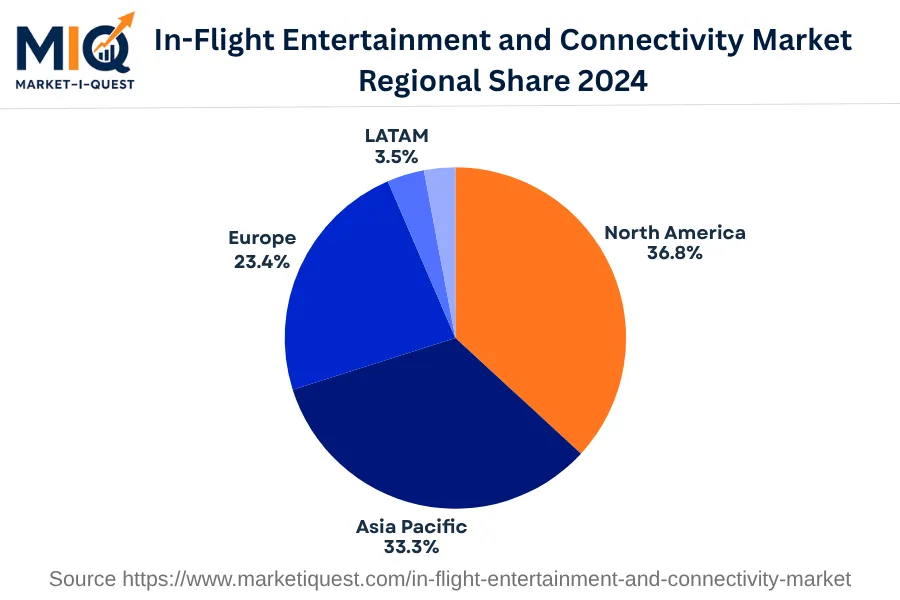
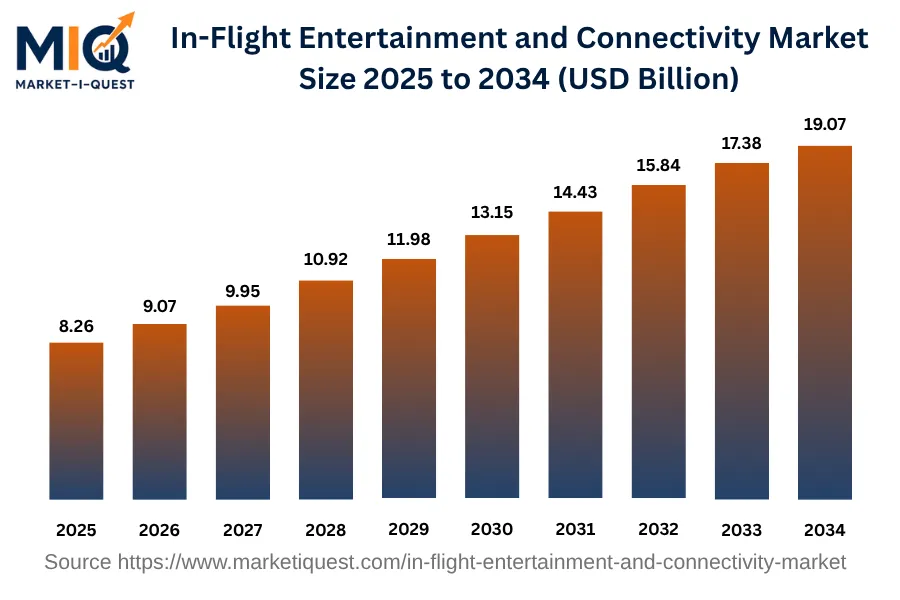
The In-Flight Entertainment and Connectivity Market was worth USD 8.26 billion in 2025 and is projected to grow to USD 19.07 billion by 2034, a CAGR of 9.74%. The growth trajectory indicates a steady increase over the course of this period, with every passing year seeing a consistent increase in market value. This suggests a growing demand for in-flight entertainment and connectivity services in the global airline industry. Factors such as advancements in technology and the increasing expectation of passengers for seamless connectivity and entertainment during flights contribute to this growing market value. In 2024, the market shares were distributed among different regions with Asia Pacific holding the highest share at 35.84%, followed by North America at 33.42%, Europe at 23.16%, MEA at 4.1%, and LATAM at 3.48%.

Key Takeaways

  • By Component - Hardware held the largest market share in 2024.
  • By Offering Type - In-Flight Entertainment (IFE) led the market accounting for a significant portion in 2024.
  • By Aircraft Type - Narrow-Body Aircraft (NBA) dominated the sector with the most considerable share in 2024.
in-flight-entertainment-and-connectivity-market market size

Key Driving Factors

Integration of Personal Electronic Devices

The adoption of Bring Your Own Device (BYOD) policy in the aviation industry is significantly driving the In-Flight Entertainment and Connectivity Market. Passengers increasingly prefer to use their own devices such as smartphones, tablets or laptops during flights rather than relying on seat-back systems provided by the airlines. This increase in demand for using personal electronic devices for in-flight entertainment pursues airlines and in-flight connectivity providers to optimize their services and systems to support BYOD. Furthermore, accommodating this trend also allows airline companies to reduce on-board weight and save on maintenance costs related to seat-back systems, which further stimulates its implementation.

Introduction of High-Speed Satellite Systems

The transition from ground-based systems to advanced high-speed satellite systems plays a critical role in driving the In-Flight Entertainment and Connectivity Market. The conventional ground-based systems often led to low-speed connectivity and interruptions due to their limited range and bandwidth. With the introduction of high-speed satellite systems like Ka-band and Ku-band satellite technologies, in-flight connectivity providers have been able to offer high-speed and constant connectivity throughout the flight duration. These satellite technologies ensure uninterrupted in-flight entertainment services and allow passengers to enjoy live television, real-time data streaming, and other forms of high-quality audio and video content. Hence, airlines have actively been upgrading their connectivity systems which directly boosts the In-Flight Entertainment and Connectivity Market.

Market Evolution by Timeline

2019-2023
In this period, airlines and their supplying Original Equipment Manufacturers (OEMs) focused on enhancing passenger experience primarily on long-haul flights. Internet connectivity emerged as a crucial in-flight service. Regions with high airline traffic, such as North America and Europe, led in putting Wi-Fi equipped aircraft into service. Suppliers witnessed increasing integration of systems, especially between seatback screens and personal devices of passengers. However, challenges arose in bandwidth availability, due to existing satellite communication infrastructure. On the regulatory front, local aviation bodies worked towards defining standards for in-flight connectivity. Costing models were predominantly content or time-based structures. Risks evolved around privacy and cybersecurity issues due to increase in connectivity services.
2024
In 2024, the chase for superior passenger experience created opportunities for personalized content and AR/VR-based In-Flight Entertainment. Asia saw an increase in demand as domestic and business travel increased, particularly in India and China. OEMs started shipping systems capable of streaming to personal devices, decreasing the need for expensive seatback screens. The lack of universal standards for in-flight connectivity surfaced as a hurdle in enabling seamless global network coverage. Service providers experimented with tiered pricing models. Potential risks included unresolved concerns about the impact of wireless signals on aircraft systems.
2025-2029
Airlines shifted from traditional model of in-flight entertainment to wireless streaming due to passengers' preference for using personal devices. Countries in the Middle East upped their game in the connectivity market due to increased air travel. On the supply side, a more versatile range of satellite support was seen to support the increased connectivity demand. Besides, developments were observed in innovative onboard power solutions to prevent device batter drain. The pricing model transitioned from per-flight to subscription-based, probably due to frequent fliers. The main risk during this period remained connected to bandwidth constraint and associated cybersecurity issues.
2030-2034
In 2030-34, the advent of AI and advanced predictive analytics provided tailored content recommendations, enhancing passenger entertainment experience. Demand growth was observed in emerging markets, such as Africa. On technology front, suppliers introduced solutions with faster and more reliable connectivity, while onboard servers saw significant capacity enhancements. The complexity of international regulations challenged universal adoption. Bundling internet connectivity with other in-flight services became a typical commercial practice. Airline and IT sector partnerships increased to tackle the risk of cyber threats, ensuring continuous service and data protection enforcement in line with GDPR and other regional regulations.

Future Market Outlook

Future Opportunities

The current landscape of the in-flight entertainment and connectivity market indicates numerous future opportunities driven by technological evolution and changing consumer preferences. The collaboration of major technology firms with airlines to develop immersive entertainment experiences is likely to escalate. In early 2023, Disney and American Airlines partnered to incorporate Disney+ content into the airline's entertainment offerings, showcasing a trend towards diverse content collaborations. As airlines seek to differentiate their services, the integration of virtual reality (VR) experiences during flights is gaining traction, with several companies piloting VR applications aimed at passenger engagement. Additionally, the emphasis on personalization is evident as airlines, such as JetBlue, invest in data analytics to tailor content recommendations based on passenger preferences. Enhanced connectivity and cloud solutions, currently being refined by firms like Honeywell and Sabre, present avenues for future innovations in service delivery and operational efficiency. Furthermore, as travelers increasingly demand connectivity for various devices, airlines will likely expand offering Wi-Fi access throughout cabin classes. The growing emphasis on health and safety in the post-COVID-19 travel landscape will continue to shape expectations around in-flight services, prompting further adaptation in entertainment offerings. Airlines that proactively invest in sustainable technology advancements—such as green inflight equipment—will likely gain a competitive edge in meeting the evolving demands of environmentally-conscious consumers while navigating regulatory landscapes effectively.

Segmentation Analysis

By Component

The market is divided into subsegments including hardware, connectivity, and content. The hardware segment accounted for the largest revenue share, while the content segment is expected to grow at the fastest CAGR during the forecast period.

Largest Revenue Share

Hardware

Market Share Leader

The Hardware segment holds the most substantial portion of the market's revenue. This dominance can be attributed to various factors. Primarily, hardware acts as the backbone for any technological solutions, rendering other segments such as connectivity and content useless without the necessary hardware foundations. There is an immense, consistent demand for hardware components due to the accelerated technological evolution and the imperative need to keep up with the advancing tech ecosystem. The customer base spans across different sectors such as telecom, healthcare, hospitality, construction, retail, and many more. The geographies contributing the most to the segment's revenue are developed economies with high technological adoption such as North America and Western Europe. Regulations and supply chain aspects also favor this subsegment due to the continuous efforts towards digital transformation. The purchasing criteria are mostly controlled by quality, technological advancement, and pricing, and switching costs can be high due to the need for compatible and superior hardware components. The primary sales channels are direct to businesses, retail, and e-commerce.

Fastest CAGR

Content

Forecast Period Growth Leader

Content is expected to be the fastest-growing subsegment during the forecast period. The digital transformation wave has led to an increased need for high-quality, diverse, and personalized content. A major catalyst to this growth is the evolution of technology, particularly artificial intelligence, augmented reality, and virtual reality, offering newer ways to create and consume content. Adoption barriers primarily include a lack of infrastructure, particularly in emerging markets, and potential risks around security, which are expected to be overcome with progressive developments. Capex is relatively low compared to hardware and connectivity, which makes promising growth potential. Partnerships across many industries are also prevalent, allowing for a wider scope and market penetration. Amidst the rise of big data, content creation and management have taken center stage, commanding hefty investments and yielding substantial returns, mostly driven by growing demand and evolving consumer behavior.

By Offering Type

The market is divided into subsegments including In-Flight Entertainment (IFE) and In-Flight Connectivity (IFC). In-Flight Entertainment (IFE) accounted for the largest revenue share while In-Flight Connectivity (IFC) is expected to grow at the fastest CAGR during the forecast period.

Largest Revenue Share

In-Flight Entertainment (IFE)

Market Share Leader

In-Flight Entertainment (IFE) is a key driver of revenue within the in-flight offerings market. The prevalence and appeal of this subsegment stem from several factors. The ability to provide entertainment during a flight significantly enhances passenger satisfaction and provides an additional stream of income for airlines. It has essentially become an expected part of the air travel experience for many passengers. Major factors contributing to its dominance include the availability of a wide range of content options such as films, music, and games, ease of use and customization, and the convenience of personal device integration. An increase in long-haul flights, which augment the need for in-flight entertainment options, also boosts this subsegment. The relatively higher pricing of IFE services as compared to IFC services contributes significantly to its larger revenue share. Geographically, regions with a higher frequency of long-haul flights are major contributors to this subsegment. It can also be assumed that regulations favoring passenger comfort and safety would support the growth of this subsegment.

Fastest CAGR

In-Flight Connectivity (IFC)

Forecast Period Growth Leader

In-Flight Connectivity (IFC) is projected to be the fastest growing subsegment in the coming years. The rapid growth of the digital era has increased the need for constant connectivity, even while in flight. A significant driver is the rising trend of 'connected flights' as passengers demand uninterrupted access to internet services. While previously a luxury, IFC is becoming an essential service as travelers value staying connected for business, social, or leisure activities during their journey. Accessibility to live news updates, social media, and continuous email connectivity are primary factors fuelifying its growth. Other aspects include the advent of new technologies, increasing partnerships between airlines and connectivity providers, and the rising availability of low-cost satellite connectivity solutions. However, there remain barriers to adoption such as heavy capex requirements and complex regulatory challenges. Overall, the trend towards hyperconnectivity, the evolving consumer demands, and technological advancements are expected to be the primary catalysts for IFC becoming the fastest growing subsegment.

By Aircraft Type

The market is divided into subsegments including Narrow-Body Aircraft (NBA), Wide-Body Aircraft (WBA), and Very Large Aircraft (VLA). In 2024, the Narrow-Body Aircraft accounted for the largest revenue share while the Very Large Aircraft is expected to grow at the fastest CAGR during the forecast period.

Largest Revenue Share

Narrow-Body Aircraft (NBA)

Market Share Leader

The Narrow-Body Aircraft subsegment leads in terms of revenue because of its versatile market applicability. The demand is largely driven by the growing middle-class population and the corresponding increase in air travel for both business and leisure. These aircraft are the preferred choice for short to medium-haul flights due to their cost-effectiveness, efficiency, and convenience – factors that airlines consider as key purchasing criteria. Geographically, high revenue generation is seen in fast-growing regions such as Asia-Pacific, where the adoption of NBA is increasing due to a burgeoning travel industry. Regulatory norms also favor the use of NBA, as they are designed for efficiency and have lower emission levels compared to their counterparts. In addition, switching costs are also lower, making this segment a popular choice among airlines.

Fastest CAGR

Very Large Aircraft (VLA)

Forecast Period Growth Leader

The Very Large Aircraft subsegment is showing the fastest growth in terms of Compound Annual Growth Rate (CAGR). Growth in this segment is mainly driven by the increasing need for long-haul air travel and the rapid growth of the global aviation sector. Flight carriers are keen on investing in VLAs due to their high passenger capacity and fuel efficiency on long-haul flights, acting as a catalyst for their adoption. Additionally, technology advancements in aviation, policy support for fleet expansion, and airline partnerships are further fostering the growth of this subsegment. However, high capital expenditure and operational costs remain hurdles in this fast-growing segment. Despite these barriers, the potential for return on investment remains high, underlining the strong growth outlook for Very Large Aircraft in the market.

Competitive Analysis

Key Market Players

Manufacturers / OEMs

Panasonic Avionics Corporation
US
Thales Group
France
Viasat Inc.
US

Key Suppliers & Raw Materials

Honeywell International Inc.
US
Zodiac Aerospace
France
Lufthansa Systems
Germany

Distributors, Integrators & Channel Partners

Gogo LLC
US
Inmarsat plc
UK
Global Eagle Entertainment Inc.
US

Porter’s Five Forces Analysis

An assessment of the in-flight entertainment and connectivity market's competitive dynamics and attractiveness.

Supplier Bargaining Power

High

Due to specialized knowledge and patent rights, suppliers wield significant power.

Buyer Bargaining Power

Low

Lack of alternative suppliers keeps buyer power relatively low.

Threat of Substitutes

Medium

Portable devices and downloaded content present a moderate substitute threat.

Threat of New Entrants

Low

Entry barriers such as high capital requirement and technical prerequisites limit new competitors.

Competitive Rivalry

High

Strong competition among established providers fuels an intense industry rivalry.

Regional Analysis

Geographic market dynamics and growth opportunities across key regions

Global Market Outlook

in-flight-entertainment-and-connectivity-market market regional share

North America

In 2024, the North American In-Flight Entertainment and Connectivity (IFEC) market underscored a significant role in enhancing passenger experience in the aviation industry. Key driving factors included increased investment into advanced ecosystem development that facilitated seamless in-flight connectivity and entertainment. Regulatory support from bodies like Federal Communications Commission (FCC) pushing for mandatory high-speed internet availability on flights complimented the growth. The region's strong adoption of cutting-edge technology for supply dynamics marked an equally important driver. Finally, competitive pricing strategies were continually shaping the market.

In terms of market trends, there was notable consumer preference for premium service offerings such as on-demand entertainment and internet access. A visible shift towards satellite technology to improve WiFi connection speeds was evident, with major players investing in next-generation satellite technology like the KU and KA bands. Major airlines in the U.S., Canada, and Mexico were exploring collaborations and M&As with IFEC providers to refurbish their systems, indicating a strategic trend for proprietary technology acquisition. Enforcement of policies such as the FAA's in-flight safety measures saw airlines enhancing their in-flight entertainment systems to provide safety videos and real-time flight information. Key customer sectors included commercial aviation enterprises, with growth also observed in government and business jet sectors.

Asia Pacific

In 2024, the In-Flight Entertainment and Connectivity Market in Asia Pacific regions exhibited substantial growth, driven primarily by increased passenger demand, technological adoption and competitive pricing. Upgrades in in-flight connectivity infrastructure fueled by increased investment in the aviation sector, particularly in China and India, drove market expansion. Regulation changes in Japan allowed for wider adoption of in-flight Wi-Fi services, enhancing passenger experience and expanding market scope. Competitive pricing strategies in ASEAN markets, including Indonesia and Malaysia, contributed to an increase in overall customer base.

Emerging trends in 2024 included the rise in on-demand in-flight entertainment services, driven by changes in passenger behavior and technological advancements. Collaboration between airlines and content providers heightened, as observed in Qantas's partnership with Stan, an Australian streaming service. The implementation of high-speed connectivity solutions, such as Gogo's 2Ku technology adapted by Korean Air, also became a prominent trend. Simultaneously, the standardization of in-flight connectivity services across different airlines became a focus, particularly within ASEAN policy frameworks. These factors have contributed towards a thriving in-flight entertainment and connectivity market in the Asia Pacific region in 2024, affecting sectors including enterprise and retail, with airlines and inflight service providers as key customers.

Europe

In 2024, the In-Flight Entertainment and Connectivity (IFEC) market in Europe has been invigorated by a mixture of demand factors and technological adoption. The proliferation of personal electronic devices has fueled passenger expectations for seamless, high-speed connectivity while flying, acting as a key demand driver. Airlines, responding to this demand, have upped investments in onboard Wi-Fi systems, contributing to the supply dynamic. Further, updated regulations in several countries such as the UK and France now allow in-flight use of portable electronic devices, shaping the market’s regulatory landscape.

A significant trend affecting the IFEC market is a growing preference for personalized content, with airlines like Lufthansa and British Airways offering tailored entertainment options. The adoption of new technologies, such as virtual reality to enhance passenger experience, has also been on the rise. In terms of partnerships and M&A, notable transactions include Germany's FLYNET and Global Eagle Entertainment (GEE) enhancing entertainment provision while expanding network coverage. Policies are being actively enforced at the national level to ensure passenger safety and data protection within this market. The primary customers of IFEC offerings are the airline sector. The retail sector also assists in advertising partnerships within the IFEC systems, providing a holistic experience to the airline customers by integrating shopping into their in-flight experience.

Latin America

In 2024, the in-flight entertainment and connectivity (IFEC) market in Latin America remained a key area of concentration for airlines aiming to heighten customer experience. An uptick in air travel passenger traffic in Latin American countries, like Brazil, Mexico, and Argentina, ignited a surge in demand for in-flight connectivity, predominantly driven by rising consumer expectations of uninterrupted digital content access during air travel. Innovation-friendly regulations in places like Chile eased the implementation of advanced IFEC systems, fostering technology adoption across LATAM-region airlines. Expanded investment from airlines in these countries further propelled this market.

The trend of buying behavior commenced to shift towards high-quality, personalized entertainment experiences, pushing airlines to revamp their IFEC offerings, thus, fueling the market growth. In technological aspects, the penetration of advancement such as wireless in-flight entertainment solutions was noticeable, backed by increased integration with passenger's personal devices. Partnerships flourished as airlines and telecommunications firms cooperated to offer secure and seamless in-flight connectivity. While the majority of demand emanated from commercial airlines, the demand from government and business charters equally played a significant role in driving the market. Overall, improving air connectivity, coupled with growing customer demand for in-flight entertainment and connectivity services, shaped the LATAM IFEC market landscape in 2024.

Middle East & Africa

In 2024, the Middle East and Africa In-Flight Entertainment and Connectivity Market flourished due to an amalgamation of factors and evolving trends. Drivers included the increase in long-haul flights leading to higher demand for in-flight connectivity services; UAE, Saudi Arabia, and Qatar being key contributors due to their large aviation sector. Regulatory support from governments across the region encouraged investment in the sector, with Israel leading tech adoption. Surging smartphone ownership in nations like Kenya, Egypt, and South Africa accelerated the market expansion.

Trends saw a shift towards personal electronic devices for entertainment, leading airlines to enhance Wi-Fi service. In Egypt and Nigeria, partnerships were formed between airlines and entertainment providers to diversify the entertainment options. In terms of sectors, telecom played a significant role: In South Africa, telecom firms partnered with airlines to offer data for passengers. Airlines also collaborated with streaming giants, particularly prominent in Saudi Arabia and the United Arab Emirates, leading to the enforcement of new policies around these services. Financial service providers were also engaged, offering in-flight shopping experiences in the United Arab Emirates and Israel.

Recent Industry Developments

Latest market innovations, product launches, and strategic initiatives

May 2026

Eutelsat and Anuvu entered into a multi-year agreement for capacity on the EUTELSAT 10B satellite, strengthening their collaboration in the IFC market. The capacity will support connectivity services for a major global airline. EUTELSAT 10B features multi-beam high-throughput Ku-band payloads and a fifth-generation digital transparent processor for flexible capacity allocation.

November 2025

flydubai signed an agreement with SpaceX to introduce Starlink satellite connectivity across its Boeing 737 fleet, with installation for 100 aircraft to be rolled out in 2026. The service will deliver high-speed, low-latency broadband internet supporting streaming, online gaming, and video calls. The announcement was made at the Dubai Airshow 2025.

Frequently Asked Questions