Immunity Boosting Food Products Market Snapshot

Key Players

  • Dabur India Ltd. (India)
  • Nestlé S.A. (Switzerland)
  • Pfizer Inc. (United States)
  • Amway (United States)
  • Bayer AG (Germany)
  • Herbalife Nutrition Ltd. (United States)
  • GNC Holdings Inc. (United States)
  • BioGaia AB (Sweden)
  • Blackmores Ltd. (Australia)

Market Size

Base Year 2024
$23.75 Bn
CAGR
7.55%
Forecast 2034
$49.18 Bn

Market Segments

By Product Type
  • Herbs & Spices
  • Nuts & Seeds
  • Fruits & Vegetables
  • Dairy-Based Products
  • Probiotics & Prebiotics
By Distribution Channel
  • Store-Based
  • Non-Store-Based

Market Dynamics

Drivers
  • Growing health consciousness
  • COVID-19 pandemic fears
Restraints
  • High production costs
  • Consumer misinformation
Opportunities
  • Growing health-conscious population
  • Increase in lifestyle diseases

Market Size

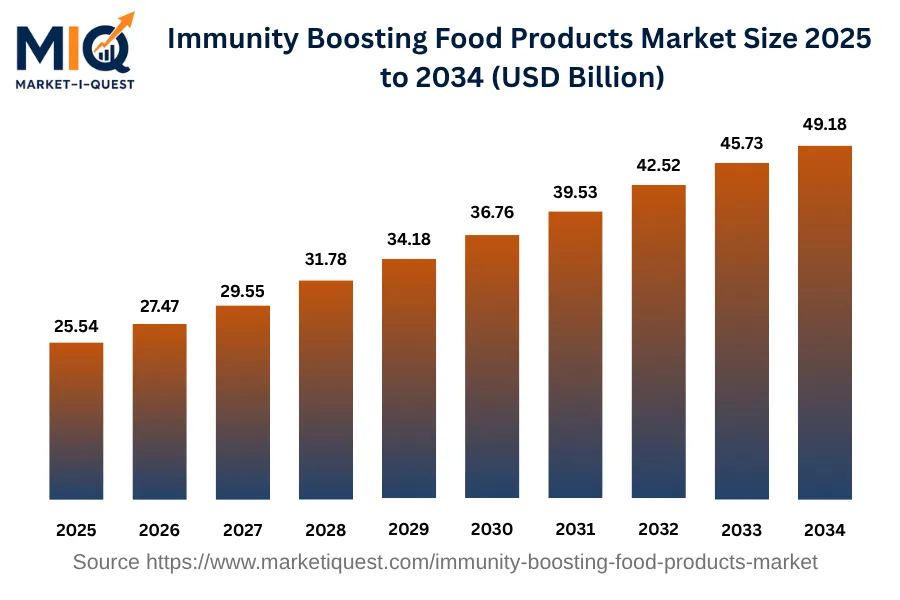
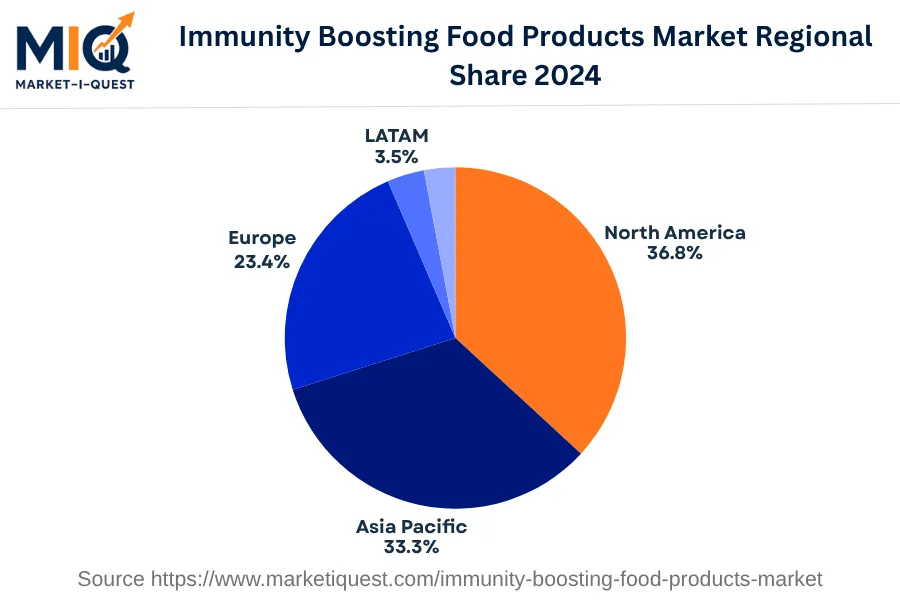
The Immunity Boosting Food Products Market was valued at $25.54 billion in 2025 and is expected to grow to $49.18 billion by 2034, with a compound annual growth rate (CAGR) of 7.55%. This growth follows a pathway set in 2024 when the market size was $23.75 billion, indicating a consistent expansion trend. Several factors can explain this growth trajectory. The main catalysts include the consumer impulses toward health consciousness, targeted nutrition for disease prevention, and increasing awareness of dietary habits' impact on the immune system. The market's spread in 2024 provides additional insight: the Asia Pacific region held the largest share at 39.46%, while North America followed closely with a 30.84% share. Europe contributed 21.68% to the market, while Latin America and the Middle East & Africa recorded lesser shares of 4.12% and 3.9% respectively.

Key Takeaways

  • By Product Type - Dairy Based Products held the highest market share in the Immunity Boosting Food Products Market.
  • By Distribution Channel - Store-Based outlets led the market accounting for the largest market share.
immunity-boosting-food-products-market market size

Key Driving Factors

Increased Awareness on Preventive Healthcare

In recent years, there's been a growing surge in the knowledge and understanding of preventive healthcare among consumers around the world. This trend is particularly influencing the Immunity Boosting Food Products Market. People are prioritizing their health and adopting lifestyles that promote wellbeing to impede the occurrence of diseases. As part of this preventive approach, there's a marked interest in the consumption of immunity-boosting food products. They are considered as an easy integration into daily diet routines to strengthen the immune system, hence keeping potential illnesses at bay. Consequently, manufacturers in the food and beverage industry are capitalizing on this trend by developing and marketing food products with immunity-boosting claims.

Corresponding Shifts in Dietary Preferences

Immunity boosting food products market is also being driven by a seminal shift in dietary preferences, particularly towards plant-based and natural foods. The rising market of conscious consumers who prefer organic, non-GMO, sustainable, and vegetarian or vegan food options is influencing this shift. They perceive these food choices, many of which are rich in antioxidants, vitamins, and minerals, as beneficial for immunity-boosting. Moreover, research showing the links between diet, immunity, and health outcomes further corroborates these consumer beliefs. Consequently, more and more food manufacturers are exploring this space by investing their resources to offer a broad spectrum of natural and plant-based food products that claim to bolster immunity.

Market Evolution by Timeline

2019-2023
During this period, the demand for immunity boosting foods increased notably in the Asia Pacific region. Consumers primarily drove demand due to increased awareness of health and wellness. Manufacturers sought vitamins and probiotics naturally present in foods. The trend of 'clean-labeling' started due to new regulation standards initiated by the FDA. Commercially, sellers began offering customization in products with price premiums, catering to individual nutritional needs. Typical contracts were supply agreements between manufacturers and retailers. Risks that emerged were primarily around sourcing and supply chain disruptions due to climate change that impacted pricing and availability of key ingredients.
2024
The U.S. witnessed a peak in demand for immunity boosting food products in 2024. The primary reasons were adherence to fitness lifestyles and awareness campaigns. Companies started using new extraction technologies for obtaining essential nutrients. FDA's regulatory standards drove 'non-GMO' and 'all-natural' labeling. Pricing dynamics shifted towards premiumization, with consumers willing to pay extra for perceived health benefits. Procurement models adapted to include direct sourcing from farmers to ensure supply chain transparency. The risk of counterfeit immunity boosting foods emerging in the market increased, leading to stricter regulation enforcements.
2025-2029
In this period, there was a strong demand in Europe for plants and herbs known to boost immunity. The demand was largely due to the vegan movement and greater preference for plant-based diets. The technological advancements paved the way for hydroponic farming to ensure a constant supply of essential herbs and plants. EU's Organic Standards became the norm. Sellers started offering subscription models with flexible pricing structures, allowing consumers to have regular supplies. The primary risk was a public skepticism towards synthetically prepared immunity boosters, leading suppliers to rely on authentic organic products.
2030-2034
The demand continued to grow in emerging economies such as India and Brazil during this period. Local dietary traditions using immune-boosting foods were popularized globally, powered by globalization and digital platforms. Packaging developments focused on improving the shelf-life of organically procured products. Country-specific export-import norms influenced trade. Customized product bundles at competitive pricing emerged as a key commercial model. With the rise of personal health monitoring devices, there was a risk of data exploitation for targeted marketing, drawing new guidelines around consumer data privacy and personal nutrition data security.

Future Market Outlook

Future Opportunities

The landscape of immunity-boosting food products presents multiple opportunities for growth and innovation based on current market dynamics. With the increasing prevalence of lifestyle-related health issues, such as obesity and chronic inflammation, food manufactures are likely to respond by developing novel products designed to target these conditions. A notable opportunity lies in the ongoing research funded by the National Institutes of Health, which aims to explore more natural compounds that enhance immune function, signaling a potential growth area for product diversification. Furthermore, the trend of plant-based diets has surged, with reports from the Plant Based Foods Association indicating heightened consumer interest; companies can capitalize by incorporating plant-derived immunity enhancers. The launch of targeted initiatives in 2023 by institutions like the European Food Safety Authority has encouraged food producers to seek approval for health claims around immunity-boosting benefits. Additionally, consumer awareness campaigns surrounding the COVID-19 pandemic have led to sustained interest in immune health supplements and foods. As such, collaboration among food manufacturers, healthcare entities, and regulatory bodies can facilitate the formulation of products that meet evolving consumer preferences while ensuring compliance with international regulations, such as those from the Codex Alimentarius Commission. By aligning with these trends and opportunities, companies can enhance their product portfolios and address the growing demand for effective immunity support solutions worldwide.

Segmentation Analysis

By Product Type

The market is divided into subsegments including Herbs & Spices, Nuts & Seeds, Fruits & Vegetables, Dairy-Based Products, and Probiotics & Prebiotics. Among these, Dairy-Based Products accounted for the largest revenue share, while Probiotics & Prebiotics are expected to grow at the fastest CAGR during the forecast period.

Largest Revenue Share

Dairy-Based Products

Market Share Leader

Industry observations suggest that Dairy-Based Products hold the largest revenue share within the market. This dominance can chiefly be attributed to the continual consumption of daily products in the global market. Taking into consideration the component of heavy household usage, milk, cheese, and butter, among others, find themselves as staples in varying types of cuisine globally, thus supporting the segment's revenue generation. In addition, the success of dairy products can be linked to distribution channels such as supermarkets and convenience stores, which make them accessible to a vast customer base. Furthermore, regulations in many parts of the world require fortification of certain dairy products with essential nutrients, increasing their appeal to health-conscious consumers. Dairy products also benefit from a well-established supply chain, from farms to supermarkets, which helps ensure consistent supply and variety for consumers. Notwithstanding increasing preferences for plant-based alternatives, the dairy industry's sheer scale and reach underpin its revenue leadership.

Fastest CAGR

Probiotics & Prebiotics

Forecast Period Growth Leader

The Probiotics & Prebiotics subsegment shows the highest rate of growth within this market. Primary drivers for this trend include increasing awareness about the importance of gut health, the prevalence of digestive disorders, and a growing number of health-conscious consumers adopting healthier diets. Additional factors include technological advancements that improve the stability and efficacy of probiotic and prebiotic products, enhancing their appeal to consumers. However, some barriers to adoption persist such as regulatory hurdles and lack of standardization in dosage and implementation. Partnering with healthcare organizations to increase consumer education can be an effective catalyst for overcoming these barriers. Additionally, substantial capital investments are needed to ramp up product development and marketing efforts. Despite the promising outlook, potential risks such as safety concerns and unresolved issues regarding health claims associated with these products can pose near-term growth challenges. Notwithstanding these factors, the segment's potential benefits and its alignment with prevailing health and wellness trends underscore its growth prospects.

By Distribution Channel

The market is divided into subsegments including Store-Based and Non-Store-Based. In 2024, the Store-Based distribution channel accounted for the largest revenue share while the Non-Store-Based segment is expected to grow at the fastest CAGR during the forecast period.

Largest Revenue Share

Store-Based

Market Share Leader

The store-based distribution channel historically accounts for the largest share of the market's revenue. This is driven by various factors including well-established supply chains, the advantage of immediate product availability, and the shopper's ability to physically view and evaluate products prior to purchase. Customers typically appreciate the traditional store-based shopping experience as it offers immediate satisfaction as well as tactile evaluation of products. Moreover, some product categories necessitate this try-before-you-buy approach. In many geographies, particularly in emerging nations, the brick-and-mortar store infrastructure is more developed and more accepted by customers, further bolstering the success of this subsegment. Its dominance in the market comprehends the role of regulation and availability of supply management. Although e-commerce is growing, for many consumers in different parts of the world, the trend is to go to the store and purchase the goods they need.

Fastest CAGR

Non-Store-Based

Forecast Period Growth Leader

In contrast, the Non-Store-Based distribution channel is forecasted to enjoy the fastest growth. Advancements in technology, increasing internet penetration, and the rise of e-commerce are revolutionizing the retail landscape. The improvement in logistics and supply chain management has enabled companies to offer a variety of products with short delivery times, which appeals to modern customers seeking convenience. Despite the barriers including the inability to experience the product before purchasing and concerns about the security of online payments, this sector is seeing potential growth catalysts in the form of policy support and increased investment in tech infrastructure. However, risks such as the intense competition and need for constant technological innovation persist. Therefore, the coming years are forecasted to witness the rapid expansion of non-store-based selling, fueled by evolving consumer behavior and technological innovations.

Immunity Boosting Food Products Market Competitive Analysis

Key Market Players

Manufacturers / OEMs

Nestle SA
Switzerland
Danone
France
Unilever
UK

Key Suppliers & Raw Materials

Döhler
Germany
Dairy Farmers of America
US
Archer Daniels Midland Company
US

Distributors, Integrators & Channel Partners

Sysco Corporation
US
Whole Foods Market Inc.
US
McLane Company
US

Porter’s Five Forces Analysis

This analysis evaluates the competitive forces impacting the Immunity Boosting Food Products Market.

Supplier Bargaining Power

Medium

Diverse supply chain, but specialized ingredients can give certain suppliers an edge.

Buyer Bargaining Power

High

Numerous product options and information availability empowers consumers.

Threat of Substitutes

Medium

Alternative health supplements and traditional foods pose substitution threats.

Threat of New Entrants

Low

High regulatory barriers and reputation importance limit new entrants.

Competitive Rivalry

High

Fragmented market with prolific brands competing on product effectiveness and branding.

Regional Analysis

Geographic market dynamics and growth opportunities across key regions

Global Market Outlook

immunity-boosting-food-products-market market regional share

North America

In 2024, the North American Market for Immunity Boosting Food Products experienced significant growth due to several key drivers. Greater public health awareness, fueled by the lingering impact of the COVID-19 pandemic, increased demand for products promising immune support. Investments in research and development by major food manufacturers, particularly in the U.S., brought new, innovative products to market while government regulations around labeling requirements in Canada led to increased transparency, enhancing consumers' trust. Advancements in supply chain technology, especially in Mexico, improved access to these products, further driving up demand. Pricing remained competitive across the region, making these food products accessible to a broad range of consumers.

Noticeable trends in 2024 included a shift in buyer behavior towards natural and organic products, driven by increased consciousness about health and wellness. The popularity of direct-to-consumer sales channels also grew, stimulated by the persistent preference for online shopping established during the pandemic years. The retail sector saw a surge in partnerships between conventional retailers and specialty health food stores, providing a larger platform for immunity-boosting food products. Policy enforcement regarding health claims by food manufacturers became stricter, particularly in the US and Canada. These changes in the operating environment led to a dynamic and booming Immunity Boosting Food Products Market in North America in 2024.

Asia Pacific

In 2024, the market for immunity-boosting food products in the Asia Pacific region expanded, driven by heightened consumer awareness about health and wellness. The COVID-19 pandemic led to an intensified focus on immunity, with markets such as China, India, Japan, South Korea, Australia, and ASEAN countries reflecting strong demand for such products. Government-initiated health campaigns, particularly in India and Australia, amplified public cognizance about proactive health care, giving impetus to the market. E-commerce platforms, including Alibaba and Flipkart, reported an uptick in the sale of immune-boosting supplements and functional foods. Meanwhile, technology adoption in precision nutrition, such as the WeChat Health Program in China, facilitated personalized dietary recommendations, strengthening consumer engagement. The trend of incorporating traditional herbs into everyday foods, a prevalent practice in China and India, found acceptance across other markets, with brands launching 'fusion' products. Furthermore, partnerships between food manufacturing and pharmaceutical companies, like in Japan and South Korea, saw an influx of immunity products in the retail sector.

However, regulatory enforcement for product labeling and health claim substantiation had a positive influence, guiding consumer choices towards scientifically validated products. In ASEAN markets, the focus was on the development of indigenous immunity-boosting products, leveraging local ingredients and traditional wisdom. The corporate sector in these regions also showed an increasing inclination towards such products as part of their employee wellness programs.

Overall, the region saw a surge in demand, coupled with robust supply dynamics, making the immunity-boosting food products market a vital segment in the Asia Pacific in 2024.

Europe

In 2024, the market for immunity-boosting food products in Europe surged as consumers focused on health optimization amidst continuing global health concerns. Drivers of this demand included an increasing consumer awareness about the role of nutrition in immune health, reinforced by educational campaigns from health organizations across Germany, the UK, France, Italy, Spain, the Nordics, Benelux and Central & Eastern Europe. Additionally, investments in product development and marketing from key industry players, coupled with the adoption of technologies enhancing product quality and supply chain efficiency contributed to market growth. Favorable regulatory framework encouraging marketing of products with immunity benefits also played a role.

Trends observed within this market included a shift in buyer behavior towards plant-based and organic ingredients, reflecting a broader consumer trend in health and sustainability. There was an observable uptake of ecommerce channels as purchase platforms, driven by the convenience of online shopping and wide product selection. Significant partnerships and M&A activities occurred, with established food and beverage companies entering the sector through strategic alliances and acquisitions of specialty firms. Policy enforcement regarding claims on food product labels became a key focus, governing how companies positioned immunity-boosting food products in the market. Sectors notably engaged in adopting these foods include healthcare, retail as well as manufacturing.

Latin America

In 2024, the demand for immunity-boosting food products in LATAM surged, driven by increased health consciousness among the population. This market saw significant influence by the dietary choices made by consumers from Brazil, Mexico, Argentina, Colombia, Chile, Peru, who are amongst the largest contributors to LATAM’s population. The market growth is driven by increased disposable income in middle-class households, an enhanced focus on wellness and disease prevention, and the rise of e-commerce channels offering convenient access to a range of new health-based food options. Heightened health awareness concerning the COVID-19 pandemic has drawn consumers and companies alike towards foods that boost immunity.

Consumer trends gravitate towards natural, organic, plant-based foods and beverages, evident through the increasing sales of superfruits like Acerola and Acai in Brazil and Mexico. The technological shift towards the use of wearable devices that monitor health metrics has also affected buying decisions. Manufacturers like Nestlé and Danone have capitalized on this trend, investing in R&D to develop innovative products that cater to this need, while pharmaceutical enterprises also dabbled in creating nutraceutical offerings. Furthermore, stricter implementation of nutrition labeling policies has made it easier for consumers to choose healthier options, creating a favorable environment for the immunity-boosting food sector to thrive. Government initiatives supporting local food production also stimulated the market, ensuring a prolific supply of vitamin and mineral-rich, locally sourced food products.

Middle East & Africa

In 2024, the immunity-boosting food products market flourished in the Middle East and Africa due to an increased health consciousness among consumers. Drivers of this growth included demand forces like a growing middle class in countries such as Nigeria and South Africa leading to lifestyle changes and higher disposable income for health foods. Meanwhile, government regulations promoting nutritional food in Saudi Arabia, and ongoing investment in the food sector in the United Arab Emirates contributed to the market's expansion. Furthermore, the rising technology adoption in the supply chain, especially in Kenya and Israel, improved product accessibility, thereby boosting sales.

Market trends reflecting these drivers involved shifts in buyer behavior towards more organic foods and supplements rich in vitamins and minerals. Particularly in Saudi Arabia and Qatar, there was increased demand for natural immune-boosting foods like honey, dates, and ginger. Additionally, the direct-to-consumer sales channels gained momentum in Egypt due to the widespread usage of eCommerce. Meanwhile, new partnerships appeared between food manufacturers and healthcare providers in the United Arab Emirates, prompting the creation of immune-boosters tailored to specific age groups. Lastly, the enforcement of stricter food safety standards across the region, driven by policy changes, resulted in more reliable and high-quality products.

Recent Industry Developments

Latest market innovations, product launches, and strategic initiatives

June 2026

Berocca Australia launched Berocca Immune Lemongrass & Ginger, an effervescent product that can be consumed both hot and cold—the first of its kind in the Australian market. The product contains vitamins C and D and zinc to support the body’s natural defenses. According to Bayer, 60% of consumers are concerned about their immune health, and 67% are actively seeking products that support immunity.

January 2026

A “no proof, no claim” requirement for health and functional claims came into effect in India. An independent 2026 assessment revealed that 33.6% of food labelling claims in India are non-compliant or unverified

Frequently Asked Questions