Immersive Virtual Reality Market Snapshot

Key Players

  • Facebook Technologies LLC (United States)
  • Sony Interactive Entertainment (Japan)
  • HTC Corporation (Taiwan)
  • Samsung Electronics (South Korea)
  • Google LLC (United States)
  • Microsoft Corporation (United States)
  • Unity Technologies (United States)
  • Magic Leap (United States)
  • Starbreeze Studios (Sweden)

Market Size

Base Year 2024
$12.74 Bn
CAGR
27.63%
Forecast 2034
$146.12 Bn

Market Segments

By Component
Hardware, Software, Services
By Technology
Non-Immersive, Semi-Immersive, Fully Immersive
By Device
Head Mounted Display, Gesture Tracking Device, Projectors & Display Wall
By End Use
Aerospace & Defence, Manufacturing, Automotive, Education, Media & Entertainment, Gaming, Healthcare, Retail & E-commerce, Others

Market Dynamics

Drivers
  • Growing technology adoption
  • Increased demand for immersive experiences
Restraints
  • High product costs
  • Limited hardware accessibility
Opportunities
  • Expanded gaming applications
  • Advancements in VR technology

Market Size

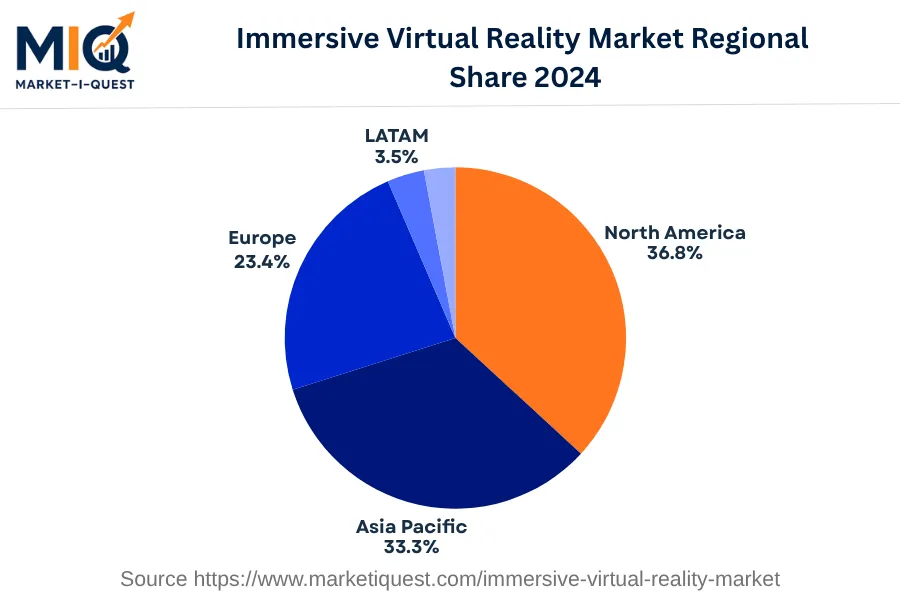
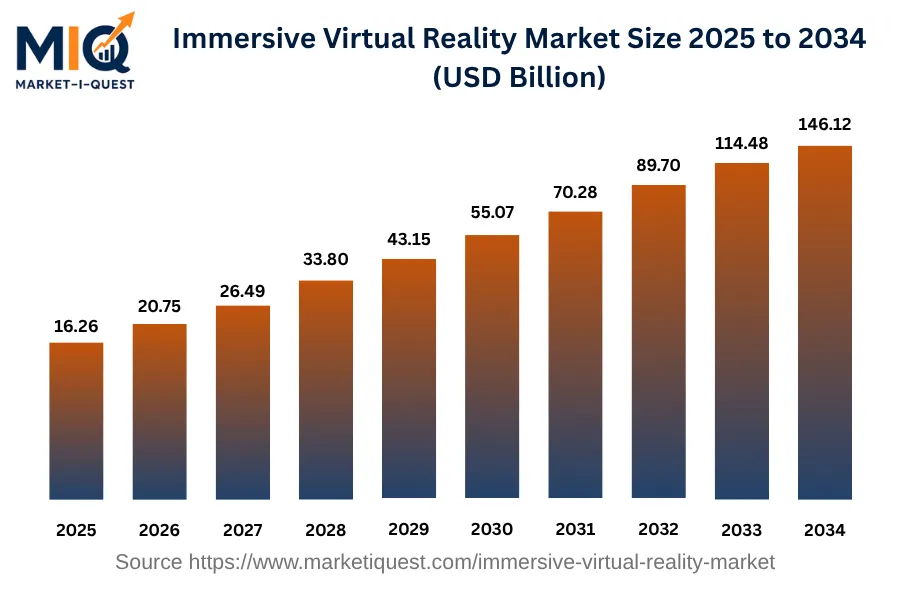
The Immersive Virtual Reality Market in 2025 is valued at USD 16.26 billion, having grown from USD 12.74 billion in 2024. By 2034, the market size is projected to reach USD 146.12 billion, experiencing a compound annual growth rate (CAGR) of 27.63%. The expansion over these years follows a trajectory of consistent, sizeable growth in the market. The distribution of the market share in 2024 shows a multi-regional focus on adoption of immersive virtual reality. North America held the most significant share at 38.74%, followed by Asia Pacific with a respectable 34.16% share. Europe accounted for a little over a fifth of the total market share, at 20.42%. Meanwhile, the relatively less developed virtual reality markets of Latin America and the Middle East and Africa held 3.14% and 3.54% of the total market share respectively.

Key Takeaways

  • By Component - Services held the leading position in terms of market share in 2024.
  • By Technology - Semi-Immersive was the fastest growing subsegment showing a promising CAGR in market.
  • By Device - Head Mounted Display accounted for the most significant market share as of 2024.
  • By End Use - Automotive led the market with its dominant presence in 2024.
immersive-virtual-reality-market market size

Key Driving Factors

Integration in the Gaming Industry

The infusion of Immersive Virtual Reality (IVR) within the gaming industry stands as a significant driving factor for the market. In a bid to provide players with an enhanced, lifelike gaming experience, developers are systematically incorporating IVR technology into their designs. The goal of this integration is to immerse the player entirely into the virtual world, allowing them to interact with the gaming environment in a realistic manner. Notably, games built with IVR capabilities often surpass traditional games in terms of user engagement and revenue generation, prompting more developers to adopt this technology.

Adoption in Education and Training Frameworks

Another noteworthy driving factor for the Immersive Virtual Reality market is its increasing adoption in education and vocational training spaces. Instructors view IVR as an effective way to engage students and trainees via interactive learning experiences. For instance, medical schools are adopting IVR simulations to allow students to practice surgeries and diagnoses in a controlled and risk-free environment. Similarly, corporations use IVR for employee training, as it allows them to mimic real-life scenarios that employees may encounter. This practical, hands-on experience enhances their ability to retain knowledge and apply it in real-world situations.

Market Evolution by Timeline

2019-2023
During 2019–2023, the Immersive Virtual Reality market witnessed increased demand from gamers and educational institutions, especially in North America and Europe. The technology capabilities matured with Oculus, Sony, and HTC shipping Advanced VR Headset with high-resolution display and better haptic feedback. However, high cost and space constraints remained an issue. The ITU-R established transmission standards allowing for better streamlining of VR content. Many businesses adopted licensing models for revenue. Configuration-based pricing was widely observed, with companies forming partnerships, such as Oculus with Samsung, for better market reach. The primary risk was the potential for VR addiction and resultant regulatory backlash, with some schools banning VR used for home study.
2024
In 2024, there was marked demand growth from the healthcare sector for simulation-based training. The technology advanced with the piloting of AI-integrated VR systems. United States, with its push for tech savvy healthcare, was a principal market. The Federal Trade Commission set regulations to protect consumer privacy in VR. Subscription-based models started to emerge, with lightweight VR attachments seeing a price drop due to wide-scale adoption and manufacturing gains. Partnerships between tech and healthcare companies, such as Google's deal with Ascension, gained popularity. However, concerns over eye strains and motion sickness posed risk to the growing market.
2025-2029
From 2025 to 2029, commercial real estate, especially in developing regions like Asia, was a prime buyer of VR for virtual tours. Tech giants launched VR systems with holography for more real-world feel. However, content creation was a challenge due to lack of standardized tools. The OpenXR standard, aimed at streamlining VR content development, was widely adopted. A shift was noted from hardware to software pricing, with app-based monetizing becoming dominant. Greater collaboration was observed between hardware makers and content creators, such as HTC's alliance with Unity Technologies. The unstoppable rise of VR addiction was a significant concern and saw many companies invest in addiction management programs.
2030-2034
During the 2030–2034 period, a higher demand for immersive VR was driven by the tourism industry, predominantly in developed markets. Immersive VR was deployed to offer virtual travel experiences. Tech companies supplied fully-immersive, 360-degree visual systems, though network latency remained a challenge. Governments implemented stringent regulatory requirements for energy-efficient VR systems, like the EU's 2032 mandate. A growing pattern of freemium-based models was largely seen, with VR content being distributed through established channels like PlayStation Network. Partnerships extended to travel agencies and tech firms, like Expedia's tie-up with Microsoft. However, the high energy consumption and carbon footprint of VR systems faced severe criticism, leading to brands adopting more sustainable production processes.

Future Market Outlook

Future Opportunities

As the immersive virtual reality market continues to develop, numerous future opportunities are anticipated, especially in the realms of education and training. In 2022, Google Cloud and Strivr partnered to provide VR-based employee training solutions, showcasing the demand for effective workforce development tools. The need for immersive applications in educational institutions has risen, as evidenced by several universities, such as Stanford, integrating VR for medical training and simulations since 2020. This focus on skill development is expected to expand, driven by the advantages of experiential learning environments. Additionally, the healthcare sector shows potential for VR applications, which have been explored by researchers at the University of California, San Francisco, since 2021, as a means to address pain management and mental health therapies. Crafting shared virtual environments could revolutionize remote work and collaboration. Organizations like Microsoft are already incorporating VR within applications such as Microsoft Teams, promoting virtual meetings in immersive formats. Creative industries are also harnessing VR experiences; for example, the 2023 Sundance Film Festival showcased multiple VR films, emphasizing storytelling strategies. As the world navigates a post-pandemic setting, solutions facilitating remote interaction and engagement present new opportunities for developers. Moreover, the rise of 5G networks is expected to enhance the distribution of high-quality VR content globally, further facilitating user adoption and experience diversity.

Segmentation Analysis

By Component

The market is divided into subsegments including Hardware, Software and Services. Services accounted for the largest revenue share while Software is expected to grow at the fastest CAGR during the forecast period.

Largest Revenue Share

Services

Market Share Leader

The 'Services' subsegment leads in revenue generation due to several factors. With the growing complexity of technology implementation and maintenance, companies often prefer to outsource these responsibilities to service providers, driving demand in the services segment. These services can range from initial installation and system integration to training and post-sales support, making this subsegment essential to every stage of product life-cycle. Geographically, high demand is often seen in regions with robust industrial sectors that frequent use of these technologies. In terms of regulation and supply, the services sector often has more lenient standards as compared to hardware or software development, potentially encouraging more entrants and competition, further driving growth. As for purchasers, choosing service providers can often lead to reduced sunk costs and improved efficiency. Lastly, the services sector is regularly distributed through various channels, including direct-to-consumer, business-to-business, and through partnerships, broadening its potential market reach.

Fastest CAGR

Software

Forecast Period Growth Leader

The 'Software' subsegment is forecasted to grow at the fastest rate over the upcoming period. Several growth drivers underpin this projection. Aspects such as the increasing digitization of industries, growing need for data analysis, scalability, and the rise of advanced technologies such as AI and cloud computing have catalyzed software market growth. Nevertheless, adoption barriers do exist. These include high installation costs, difficulties in migrating from traditional platforms, and potential cybersecurity risks. Regulatory policies can also influence growth, with favorable initiatives promoting digital transformation expected to serve as substantial growth catalysts. Looking ahead, capital expenditure on digital infrastructure, technology partnerships, and advancements in software development methodologies, such as Agile and DevOps, could further spur growth. Conversely, near-term risks may include increased competition and rapidly evolving technology standards that may outpace the capability of existing software. Despite this, the software subsegment is poised for rapid expansion over the forecast period.

By Technology

The market is divided into subsegments including Non-Immersive, Semi-Immersive, and Fully Immersive technologies. Among these, the Fully Immersive subsegment accounted for the largest revenue share, while Semi-Immersive is expected to grow at the fastest CAGR during the forecast period.

Largest Revenue Share

Fully Immersive

Market Share Leader

The Fully Immersive technology subsegment demands a premium due to its advanced capability which allows users to have a fully engaging and interactive experience. The high-immersion level of this technology provides an experience that is close to reality, making it a preferred choice for various industries like gaming, real estate, and entertainment where user engagement is crucial. The technology's widespread adoption is further driven by the improving affordability of Virtual Reality (VR) and Augmented Reality (AR) devices, which makes it possible for a larger consumer base to access fully immersive experiences. The regulatory scenario concerning data privacy and security in AR/VR services is relatively lax, allowing for expanded market penetration in this segment. Geographic regions with a high concentration of tech-savvy consumers strategically present avenues of growth for this subsegment.

Fastest CAGR

Semi-Immersive

Forecast Period Growth Leader

The Semi-Immersive technology sector is projected to grow the quickest, pivoting on several catalysts. This technology offers an adequate immersive experience at a comparatively lower cost than Fully Immersive technology, making it attractive to a broader consumer base. This segment's growth is determined by advances in tech and capex, such as more affordable, semi-immersive VR/AR devices and investments in tech infrastructure that supports high-quality, semi-immersive experiences. The widespread adoption of Semi-Immersive technologies across various industries and its integration into everyday consumer applications acts as a growth driver. However, near-term risks in areas like data security, privacy concerns, and the potential for disorientation and discomfort posed by Semi-Immersive technology can slightly hinder the pace of its adoption.

By Device

The market for devices is divided into sub-segments including Head Mounted Display, Gesture Tracking Device, and Projectors & Display Wall. Among them, the Head Mounted Display accounted for the largest revenue share while the Gesture Tracking Device is expected to grow at the fastest CAGR during the forecast period.

Largest Revenue Share

Head Mounted Display

Market Share Leader

Head Mounted Display (HMD) being the most prominent sub-segment within the device market holds the largest revenue share in 2024. This can be attributed to growing consumer demand for immersive virtual and augmented reality experiences. HMDs offer unparalleled experience by providing users the benefit of 3D technology and enabling interaction with 3D worlds. It is popular across a wide range of sectors from gaming, entertainment to medical, military and education. Innovation in the HMD space is enhancing user experience further driving consumer adoption. Furthermore, significant advancements in technology and falling prices have made it more accessible to the larger mass, thereby sustaining its strong revenue growth. The market for HMDs is also buoyant at a global level with a particular emphasis on regions like North America and Asia Pacific where technologically savvy consumers are keen to adopt these devices.

Fastest CAGR

Gesture Tracking Device

Forecast Period Growth Leader

The Gesture Tracking Devices is the fastest growing sub-segment and is anticipated to register the highest CAGR during the forecast period. The growth can be attributed to its increased use in gaming and entertainment industry where hands-free control provides a unique and interactive user experience. The rise of smart homes where appliances can be controlled with gestures has a significant contribution to its demand. Tech giants like Google, Apple and Microsoft are heavily investing in this area, underpinning the potential for further growth. Partnerships between gesture tracking tech companies and consumer electronics manufacturers have been catalytic in widespread adoption. Potential near-term risks could involve cost control and user adjustment to gestural interaction. However, with continuous advancements and cost reduction, gesture tracking devices are poised for significant growth.

By End Use

The market is divided into subsegments including Aerospace & Defence, Manufacturing, Automotive, Education, Media & Entertainment, Gaming, Healthcare, Retail & E-commerce, and Others. Among these, the Automotive subsegment accounted for the largest revenue share, while the Retail & E-commerce subsegment is expected to grow at the fastest CAGR during the forecast period.

Largest Revenue Share

Automotive

Market Share Leader

The Automotive subsegment has emerged as the major revenue generator in the base year 2024. This dominance is due to a host of factors. On one hand, the rise in car ownership globally has surged the demand for advanced automotive technological solutions. The increased interest in electric vehicles and demand for connectivity solutions in vehicles is driving the growth in this area. Technological breakthroughs in automation, IoT, AI and the rise of connected vehicles have also contributed to the financial growth of this subsegment. In addition, governments worldwide have been implementing stringent standards regarding safety and emissions, which has pushed the industry to invest more in research and development and subsequently drive the revenues. Lastly, the heavy investment in infrastructural developments and high switching costs for the companies signifies a strong entry barrier and thus a steady revenue stream.

Fastest CAGR

Retail & E-commerce

Forecast Period Growth Leader

The Retail & E-commerce segment is poised for the fastest growth during the forecast period. Rapid digitalization, increased internet penetration, and widespread adoption of smartphones has been propelling the growth of the e-commerce industry exponentially. Additionally, the trend of online shopping has seen a dramatic boost due to the pandemic induced lockdowns and restrictions, abruptly changing consumer buying behaviours. Advanced technological advancements, such as AI, Machine Learning and Big Data, have transformed the e-commerce landscape, enabling personalised and predictive shopping experiences - a catalyst for its rapid growth. Despite promising growth, there are near-term risks such as data security and regulatory challenges. But continuous technological innovations, potential strategic partnerships and investments in cyber security make the Retail & E-commerce subsegment equipped to navigate these risks, thus presenting a thriving growth outlook.

Competitive Analysis

Key Market Players

Manufacturers / OEMs

Oculus VR
US
Sony
Japan
HTC
Taiwan

Key Suppliers & Raw Materials

Samsung
South Korea
Qualcomm
US
Texas Instruments
US

Distributors, Integrators & Channel Partners

Best Buy
US
Amazon
US
JD.com
China

Porter’s Five Forces Analysis

This analysis discusses the competitive forces impacting the Immersive Virtual Reality Market.

Supplier Bargaining Power

Medium

Limited suppliers with specialized technology increase their bargaining power.

Buyer Bargaining Power

Low

High end-user demand and limited substitutes decrease buyer bargaining power.

Threat of Substitutes

Low

Unique VR experiences make substitutes less attractive, reducing threat.

Threat of New Entrants

Medium

High capital investment poses a barrier, but increasing market attractiveness inspires new entrants.

Competitive Rivalry

High

Technological advancements and broad market scope lead to intense competitive rivalry.

Regional Analysis

Geographic market dynamics and growth opportunities across key regions

Global Market Outlook

immersive-virtual-reality-market market regional share

North America

In 2024, the North American immersive virtual reality (VR) market was bolstered by key drivers and dominated by transformative trends. Enhanced processing power and greater bandwidth capabilities drove enterprise adoption rates higher, particularly in sectors like healthcare, manufacturing, and retail. Regulatory shifts such as Canada's Digital Charter Implementation Act fostered trust in data privacy, spurring the market. Further, strategic investment in immersive VR by major tech companies like Facebook and Google highlighted market confidence.

On the trends front, consumer behavior shifted significantly with the rise of remote work and digital entertainment, thereby boosting demand for VR technology. Technological advancements witnessed a move toward standalone VR headsets, ones not reliant on computers or consoles, resulting in a user-friendly and accessible experience. In terms of channel dynamics, an uptick in partnerships and mergers positioned retail channels as the primary distributors. Two notable occurrences were the partnerships between Oculus and Best Buy in the U.S., and HTC and Telcel in Mexico. Enforcement of stringent quality standards by U.S. Federal Trade Commission (FTC), along with an increased emphasis on user safety, shaped the market's public perception positively, contributing to its growth in the base year.

Asia Pacific

In 2024, the Asia Pacific Immersive Virtual Reality Market experienced significant growth. Key drivers of this rise are initiatives by government bodies in China and India, which have promoted VR technology adoption in sectors such as education, healthcare, and real estate. Additionally, significant investments in VR startups in South Korea and Australia, coupled with increased technology adoption provided a boost to the market. On the supply side, the drop in VR device prices in Japan and key ASEAN markets have increased consumer accessibility, whilst partnerships and mergers amongst major tech companies have consolidated VR offerings. China’s compulsory VR standards also supplemented market maturation.

Shifting trends in the sector are visible in changing buyer behaviours. There's an increased appetite for VR in experiential retail, along with the rise of VR-based remote working models in enterprise sectors due to pandemic-induced lockdowns. Moreover, technology shifts towards stand-alone VR headsets are evident in Australia and Japan, offering users untethered, high-quality VR experiences. Regulatory enforcement of VR content standards in South Korea and China reflect governments' recognition of VR’s influence in shaping consumer experiences. These factors point to the continued evolution of immersive VR in APAC, certainly an exciting space.

Europe

In 2024, the immersive Virtual Reality (VR) market in Europe witnessed significant growth driven by technology adoption, investment, and evolving consumer demand. Demand factors included a growing interest in engaging VR experiences in sectors such as enterprise, government, healthcare, retail and manufacturing. For instance, healthcare increasingly utilized immersive VR for training and therapeutic purposes. Additionally, regulations in Europe prioritizing digitalization across sectors spurred VR adoption. Investment in VR technology surged, particularly in key markets like Germany, UK, France, and the Nordics, fueling the market expansion.

Furthermore, market trends indicated shifts in buyer behavior and product development. Users demonstrated an increased preference for high-quality, realistic VR experiences, compelling companies to innovate. This drove a shift toward more sophisticated VR hardware and software, becoming notably evident in Italy and Spain. Partnership and mergers and acquisitions activities increased among VR firms and traditional companies, chiefly in Central & Eastern Europe and Benelux region, aiming to integrate VR into existing services or to launch new VR-focused ventures. Policy enforcement around data privacy shaped the manufacturing standards, especially in the UK and Germany, ensuring the safeguarding of user data in the VR space. These drivers and trends marked the landscape of the immersive VR market in Europe in 2024.

Latin America

In the base year of 2024, the Immersive Virtual Reality (IVR) market in Latin America (LATAM) is experiencing rapid growth, led by Brazil, Mexico, Argentina, Colombia, Chile, and Peru. This expansion is primarily driven by increased technology adoption in various sectors, favourable regulatory frameworks fostering digital innovation, and substantial investments toward developing cutting-edge IVR solutions. The deployment of 5G connectivity is a critical factor, serving as the foundation for smooth, low-latency IVR experiences across multiple industries, including healthcare, retail, and manufacturing. Moreover, government initiatives, like Brazil's Digital Transformation Strategy, have strengthened the digital infrastructure, accelerating IVR adoption.

Market trends in 2024 are characterized by shifts in buyer behavior, technological advancements, and unique market collaborations. The escalating demand for more immersive, interactive experiences has led consumers and businesses to increasingly opt for IVR solutions. Technological breakthroughs, such as the integration of haptic feedback in IVR systems, have enhanced user engagement and propelled market growth. The rise of strategic partnerships and M&As is also apparent as businesses strive to extend their market reach and capabilities; Samsung and Pico Interactive's collaboration in Mexico being a prime example. These partnerships, with their emphasis on product development and market share expansion, are reshaping the regional IVR landscape considerably.

Middle East & Africa

In 2024, the immersive Virtual Reality (VR) market in the Middle East and Africa experienced accelerated growth, spearheaded by countries like Saudi Arabia, United Arab Emirates, Qatar, Egypt, South Africa, Nigeria, Kenya, and Israel. This development was primarily driven by significant investments in high-tech infrastructure, an expanding digital consumer base, and favorable government support oriented towards technology adoption. For example, Saudi Arabia’s Vision 2030 program prioritized VR technology in education and healthcare, stimulating supply dynamics and pricing within the respective sectors.

Market trends in 2024 revealed a shift in buyer behavior, particularly within telecommunications, retail, and financial services sectors. A growing preference for immersive consumer experiences prompted these sectors to integrate VR technology into their operations. Notably, South Africa's ABSA bank launched a series of VR-enabled customer service centers across the country. Another significant trend was the rise of strategic partnerships aimed at the spread and normalization of VR technologies. One such example was UAE-based telecom giant, Etisalat, partnering with American VR firm, EON Reality, for broadening their VR applications. Policy enforcement favoring digitalization, especially in Israel, further boosted the VR market within the region. Consequently, 2024 was a transformative year for the adoption and application of VR technologies in the Middle East and Africa.

Recent Industry Developments

Latest market innovations, product launches, and strategic initiatives

October 2025

Pure Harvest Corporate Group signed a Letter of Intent to acquire Mixie IP Holdings and Mixie Labs, advancing its entry into AI-driven video, 3D data visualization, and immersive media technologies. The acquisition established an IP foundation for AI-enabled and immersive workflows across multiple end markets, including interactive training labs, remote assist, and VR-native experiences.

January 2025

SynthesisVR acquired SpringboardVR, a software provider for VR arcade management and the largest content marketplace for location-based entertainment (LBE). The merger united two innovative platforms to drive growth and success for VR arcades worldwide.

Frequently Asked Questions