Hyperspectral Imaging Systems Market Snapshot

Key Players

  • Headwall Photonics (US)
  • Specim (Finland)
  • Telops (Canada)
  • Norsk Elektro Optikk AS (Norway)
  • Surface Optics (US)
  • Corning Incorporated (US)
  • ChemImage Corporation (US)
  • Resonon (US)
  • BaySpec (US)
  • Applied Spectral Imaging (Israel)

Market Size

Base Year 2024
$21.76 Bn
CAGR
9.4%
Forecast 2034
$53.44 Bn

Market Segments

By Product
  • Camera
  • Accessories
By Technology
  • Spatial Scanning
  • Spectral Scanning
  • Non-Scanning
  • Spatiospectral Scanning
By Application
  • Military
  • Remote Sensing
  • Medical Diagnostics
  • Machine Vision & Optical Sorting
  • Others

Market Dynamics

Drivers
  • Advancements in imaging technology
  • Increasing demand in healthcare sector
Restraints
  • High implementation costs
  • Lack of skilled professionals
Opportunities
  • Advancements in imaging technology
  • Integration in industrial processes

Market Size

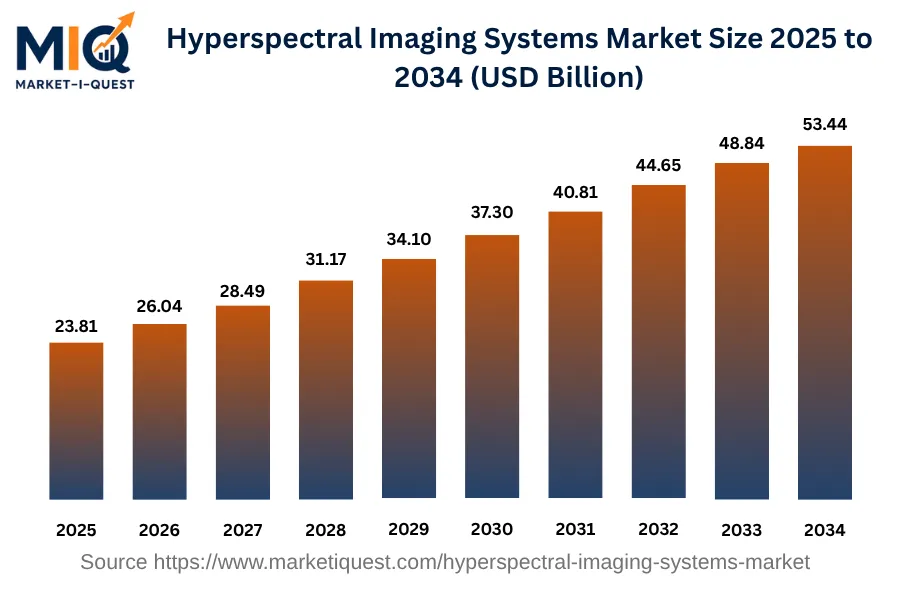
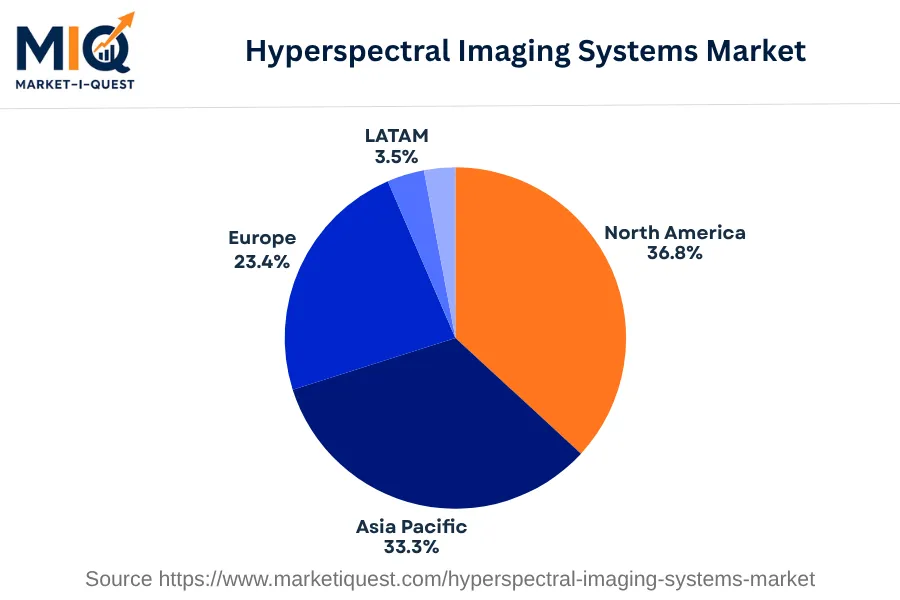
The Hyperspectral Imaging Systems Market stood at USD 21.76 billion in 2024, and it increased to USD 23.80 billion in 2025. By 2034, this market grew substantially, reaching USD 53.44 billion, demonstrating a CAGR of 9.4%. This steady rise over the decade can be attributed to technological advances in hyperspectral imaging systems, their increased adoption across various industries, and the continuous product innovation in the sector. The geographical distribution of the market in 2024 was as follows: North America occupied the largest share, with 36.8%; closely followed by the Asia Pacific with a 33.3% share. Europe held the third spot with a market share of 23.4%. The remaining market was held by Latin America and Middle East & Africa, accounting for 3.5% and 2.96%, respectively.

Key Takeaways

  • By Product - Cameras lead accounting for the highest market share in the period.
  • By Technology - Spatial Scanning grew the fastest dominating the technology-based market segmentation.
  • By Application - Military was the top-ranking segment holding a major share in this market.
hyperspectral-imaging-systems-market market size

Key Driving Factors

Legislation for Food Safety

Stricter food safety laws globally are a significant factor driving the growth of the Hyperspectral Imaging Systems Market. Regulatory bodies across the world, such as the U.S. Food and Drug Administration (FDA), and European Food Safety Authority (EFSA), have enforced stringent regulations for maintaining high standards of food quality and safety. Hyperspectral imaging systems have thus been adopted widely in the food industry as these systems offer detailed and accurate inspection of food items to detect contaminants and ensure quality control. This increased usage for maintaining regulatory compliance is propelling market growth.

Adoption in the Health Sector for Disease Diagnosis

The utilization of hyperspectral imaging systems in healthcare for diagnosing diseases is another crucial factor influencing market expansion. Specifically, these systems are gaining traction in areas such as cancer detection and ophthalmology. Hyperspectral imaging allows medical practitioners to detect variations in tissues, aiding in the precise location and diagnosis of disease and other anomalies. The inherent advantage of non-invasive, real-time identification and classification of diseases is prompting healthcare facilities to adopt this technology. Therefore, the increasing need for advanced diagnostic tools in the healthcare industry is bolstering the market growth of hyperspectral imaging systems.

Market Evolution by Timeline

2019-2023
Demand for hyperspectral imaging systems escalated in domains like agriculture, earth sciences, and defense sectors during this period, majorly from North American regions. Particularly, defense organizations like the United States Department of Defense used hyperspectral imaging for surveillance. On the supply end, key providers included Resonon, Headwall, and Applied Spectral Imaging. Owing to technological constraints, integration within systems remained partial. Regarding policy, regulations primarily guided spectrometer standard usage and data accuracy. Commercially, contracts were largely project-based, with pricing dependent on system integration extent and solution complexity. A potential risk at this juncture was the bottleneck in supply due to increasing demand and lack of manufacturing efficiency.
2024
In this year, demand surged from industries such as medical diagnostics, food processing, and pharmaceuticals that sought to leverage hyperspectral imaging for nondestructive testing. Demand was predominantly from the Asia-Pacific regions like China and Japan. On the supply front, players like Specim and Telops had a significant presence. Technological improvement resulted in smaller and more efficient sensors, but their integration within different verticals was still an open challenge. The European Union's GDPR had an implication on the data privacy of hyperspectral imagery. Prices largely remained stable. One of the main risks this year was data security issues due to expansive data collection.
2025-2029
Demand this term saw a rise from environmental monitoring and sustainability organizations besides ongoing industrial applications. On supply and technology, solutions started incorporating AI to interpret complex data, still, integration complexities lingered in certain uses. In terms of policy, burgeoning carbon-tracking initiatives endorsed hyperspectral imaging to monitor environmental shifts. Pricing exhibited a slight decreasing trend due to competition and enhanced manufacturing processes. However, potential macroeconomic shifts and trade tensions posed as risks, potentially disrupting supply chains.
2030-2034
During this period, demand from smart city initiatives and urban planning sectors increased. On the supply side, integration became more streamlined due to improved technology, offering more user-friendly hyperspectral imaging systems. In terms regulation, robust policies for data protection were developed, as hyperspectral data use became more prevalent. The commercial model saw a shift towards a service model, with companies leasing hyperspectral imaging systems. The risk during this period revolved around achieving optimal ROI due to integration complexities and data overload.

Future Market Outlook

Future Opportunities

With current advancements in hyperspectral imaging, several future opportunities are emerging across various sectors. The agriculture industry is projected to benefit greatly as precision farming practices gain traction, especially given the rising global population and food security concerns. By leveraging hyperspectral data analytics, farmers can enhance crop yield optimization, as evidenced by initiatives like the European Union's Horizon 2020 program launched in 2014, which promotes the use of advanced technologies in farming. In environmental monitoring, new policies and regulations mandating sustainable practices, such as the European Green Deal initiated in 2019, could drive demand for hyperspectral imaging to monitor ecosystem changes accurately. Moreover, industries such as pharmaceuticals may explore hyperspectral imaging for real-time quality control in drug manufacturing, akin to ongoing work by Roche since 2020. The growing interest in space applications, including Earth observation from satellites by SpaceX and Planet Labs, presents further expansion avenues. Likewise, collaboration between technology companies and government agencies to develop hyperspectral instruments for defense and security applications might materialize, with countries like the United States actively investing in advanced surveillance technologies. Furthermore, the continuous push for automation across various sectors signals opportunities for integrating hyperspectral imaging into robotic systems for enhanced operational efficiency. Together, these factors indicate a burgeoning landscape for hyperspectral imaging systems, fueled by current needs and regulatory frameworks.

Segmentation Analysis

By Product

The market is divided into subsegments including Cameras and Accessories, where Cameras accounted for the largest revenue share while Accessories are expected to grow at the fastest CAGR during the forecast period.

Largest Revenue Share

Camera

Market Share Leader

The Camera segment holds the largest market share mainly due to its broad application across various sectors. Cameras are a fundamental part of personal, commercial and industrial segments. They are used in smartphones, laptops, tablets, mostly all consumer electronics. Moreover, they are increasingly being used in sectors such as surveillance & security, sports, and in the booming entertainment industry for content creation. While the demand for high-resolution cameras used in professional photography and film-making also keeps the revenue up. As geographic borders fade in the digital world, North America holds the largest share mainly due to high disposable income and the presence of giant tech companies, followed by Europe and Asia-Pacific. Practicality, quality, price, and latest technological advancements dominate the purchasing criteria. The regulation/supply is consistent, and the switching costs for consumers are quite high, considering the associated technical learnings and brand comfort, thus ensuring steady revenue inflow. The sales predominantly occur via reseller channels, and online channels have gained significant prominence in recent years.

Fastest CAGR

Accessories

Forecast Period Growth Leader

Although the camera segment leads the market in terms of revenue, the Accessories segment is poised to grow at a faster rate. This can primarily be attributed to the extensive diversification of product range and constant technological innovation. For instance, different types of lenses, bags, protective cases, stands, straps, and so on cater to specific customer needs and preferences, thereby broadening the consumer base. The adoption of these accessories is often catalyst by technological advancements in related fields. For example, the advent of superior lens technology, advanced software applications, and drone photography has driven significant growth in the accessory market. However, barriers do exist, such as higher cost factors and low levels of awareness in certain geographies. Strategic partnerships with prominent camera manufacturers and significant investment in R&D could potentially offset these challenges, providing the much-needed impetus for growth. However, near-term risks like global economic slowdown, potentially disrupted supply chains, and alteration in consumer behavior due to emerging tech trends might hinder the expected growth rate.

By Technology

The technology market is divided into Spatial Scanning, Spectral Scanning, Non-Scanning, and Spatiospectral Scanning subsegments. Among these, Spatial Scanning accounted for the largest revenue share in 2024, while Spectral Scanning is expected to grow at the fastest CAGR during the forecast period.

Largest Revenue Share

Spatial Scanning

Market Share Leader

Spatial Scanning, owing to its broad range of applications, holds the largest revenue share in 2024. The substantial utilization of this method in remote sensing and geographical data collection contributes to its dominant position. It is used for high-resolution imaging and allows for simultaneous scanning of large areas, making it popular in military surveillance and weather monitoring. Further, it caters to the growing need for precision in fields like topographic mapping and infrastructure planning. Environmental mapping is another revenue-generating area with significant adoption, given the rising focus on climate change and sustainable resource management. Customer trends also favor Spatial Scanning, thanks to the increasing popularity of geospatial technology in both developed and emerging economies. The improvements in data quality and speed due to technological advancements act as key purchasing criteria, making Spatial Scanning the top choice for many institutions and businesses.

Fastest CAGR

Spectral Scanning

Forecast Period Growth Leader

Spectral Scanning, despite not holding the largest revenue in 2024, shows promising growth potential with the highest projected CAGR. The key driver for this is its deep analysis capabilities across different wavelengths, which provides insights unattainable by traditional scanning methods. This feature is particularly beneficial in biomedical, chemical, and geological research, where intricate details are crucial. It represents a cost-effective solution for these industries, reducing capital expenditure. Furthermore, strategic partnerships are being made to exploit the untapped potential of spectral scanning technology in various sectors. However, there are certain adoption barriers primarily related to legacy systems and compatibility issues. Technological advancements anticipated in the near future are likely to address these challenges, thereby accelerating adoption. The only significant near-term risk could be regulatory restrictions related to privacy issues, as spectral scanning is capable of deep-level data extraction.

By Application

The market is divided into subsegments including Military, Remote Sensing, Medical Diagnostics, Machine Vision & Optical Sorting and Others. In 2024, the Military application accounted for the largest revenue share while Machine Vision & Optical Sorting is expected to grow at the fastest CAGR during the forecast period.

Largest Revenue Share

Military

Market Share Leader

The Military subsegment leads in terms of revenue in 2024. The military sector's dominance can be attributed mainly to the worldwide defense budget's upsurge as nations continually modernize and upgrade their defense strategies. Over the years, there has been a surge of innovation and technological advances made in tools and equipment used for defense purposes, driving the demand in the market. Additionally, geopolitical tensions and the need to maintain a robust defense infrastructure have also contributed to an increase in military expenditure globally. The purchasing criteria for these applications continue to be stringent with emphasis on reliability, durability, and precision, further driving up costs, and thereby revenues for industry players. The regulatory framework in most nations also supports domestic procurement for defense-related equipment, adding a layer of rigidity to the market, therefore explaining the significant revenue share.

Fastest CAGR

Machine Vision & Optical Sorting

Forecast Period Growth Leader

The subsegment with the fastest expected CAGR is Machine Vision & Optical Sorting. The growth in this subsegment can be attributed to the rapid advancement in automation and digitization across multiple industries. Machine Vision and Optical Sorting technologies are increasingly being integrated into various applications such as manufacturing, packaging, and quality control, driving demand and adoption rates. Government policies encouraging the use of automation and Industry 4.0, along with the increase in capital expenditure in upgrading traditional manufacturing infrastructure, play a pivotal role in shaping this trend. The only caution to this growth trajectory is the high initial investment required and the complexity in integrating these systems into existing processes, which could pose potential adoption barriers. However, in the long run, the operational efficiency and cost savings these systems bring have the potential to provide considerable RoI, making it a promising subsegment for growth.

Competitive Analysis

Key Market Players

Manufacturers / OEMs

Headwall Photonics
US
Resonon
US
Specim
Finland

Key Suppliers & Raw Materials

Pixelteq
US
Andor Technology
UK
BASF
Germany

Distributors, Integrators & Channel Partners

Ocean Insight
US
BaySpec
US
Norsk Elektro Optikk
Norway

Porter’s Five Forces Analysis

A comprehensive analysis of the components determining the competitiveness and attractiveness of the Hyperspectral Imaging Systems Market.

Supplier Bargaining Power

Low

Presence of numerous component providers reduces suppliers' negotiation power.

Buyer Bargaining Power

Medium

Differentiation of hyperspectral imaging systems curbs buyer’s bargaining power.

Threat of Substitutes

Low

Technical capabilities of hyperspectral systems limit the threat from substitutes.

Threat of New Entrants

High

Increasing demands in various sectors and lower entry barriers increase the risk of new entrants.

Competitive Rivalry

Medium

Competition is moderate due to mix of established players and new entrants.

Regional Analysis

Geographic market dynamics and growth opportunities across key regions

Global Market Outlook

hyperspectral-imaging-systems-market market regional share

North America

In 2024, the North American market for Hyperspectral Imaging Systems (HIS) was predominantly driven by technological advancements, adaptation in healthcare, and increased strategic investments. In terms of technology, the integration of AI and machine learning propelled HIS adoption by enhancing resolution, processing ability, and efficiency. Stringent healthcare regulations necessitated advanced diagnostic tools leading to increased demand for HIS in medical imaging and diagnostics. The market also witnessed a surge in strategic investments by key players, such as Google and Microsoft, in hyperspectral technology and machine vision.

Trending on the demand side, the implementation of HIS in agriculture and environmental monitoring marked a shift in buyer behavior, with industries recognizing HIS's ability to provide rich spectral resolution for precision farming and pollution control. Furthermore, there was an uptick in collaborations and M&A activities for technology sharing and market expansion. For instance, Headwall and Ocean Insight announced a strategic partnership aimed at expanding their technological capabilities and market reach. Lastly, enforcement of standards by government bodies like FDA and USDA, particularly in food safety and agriculture, was closely aligned with the increased uptake of HIS technologies among these sectors. Renowned for its interdisciplinary applications, HIS technology catered to various sectors like healthcare, manufacturing, agriculture, and government in the base year 2024.

Asia Pacific

In the base year 2024, the Hyperspectral Imaging Systems Market in the Asia Pacific exhibited significant expansion. The primary drivers include increased investment in modernizing the healthcare sector in countries such as India and China, the adoption of cutting-edge technology like Hyperspectral Imaging systems in the agriculture industry for crop monitoring in Japan and South Korea, and the implementation of hyperspectral imaging in the mining sector in Australia which keeps track of the natural resources efficiently. Greater prevalence in supply dynamics and competitive pricing influenced uptake in the region.

The prevailing trends include the shift to digital imaging, driven by the need for precise detection and processing in sectors such as manufacturing and healthcare. Due to AI integration in hyperspectral imaging, buyer behavior is leaning towards advanced products that offer more detailed results. Channel dynamics in the market saw a promising surge in online platforms, marking a shift from traditional sales channels.

In response to growing cybersecurity threats, governments across the region enforced stringent data security standards, shaping the hyperspectral imaging systems market landscape. Remarkably, there were several partnerships and mergers among key market players in 2024, which solidified regional market shares and created more comprehensive product portfolios to cater to the diversified needs of industries such as retail, government, utilities, and enterprise.

Europe

In 2024, the European hyperspectral imaging systems market exhibited significant growth due to various determinants and ongoing trends. Primarily, the escalated demand from healthcare and agriculture sectors, government regulations encouraging technologically advanced screening methods, and increased investments in R&D facilitated market expansion. Specifically, the adoption of technology in Germany and the United Kingdom was primarily propelled by robust healthcare infrastructure and government backing.

Profound trends marking the market included user-preference towards compact hyperspectral imaging systems, the emergence of cloud-based solutions, and the confluence of hyperspectral and LiDAR technologies. For instance, Spain and Italy embraced the fusion of these technologies in their agricultural sector for precision farming. Moreover, a surge in partnerships and M&A activities was observed amongst market players, especially in the Benelux region.

Furthermore, the healthcare sector, predominantly in France and Central & Eastern Europe, leveraged hyperspectral imaging systems for early diagnosis and surgical guidance, thereby strengthening the market scope. Advanced product development by major firms to meet the escalating demand for high-resolution imaging in the manufacturing sector, specifically in the Nordics, further underscored the market dynamics. Notably, government agencies, retail firms, and utility companies across Europe also demonstrated increased adoption of these systems for inspection and quality control, signifying a broadened market landscape.

Latin America

In 2024, the Hyperspectral Imaging Systems Market in Latin America (LATAM) evidenced significant growth dynamics. Key drivers included an accelerated technological adoption rate instigated by increased investments in R&D by nations such as Brazil and Argentina, leading to enhanced awareness of system capabilities. Furthermore, improving regulatory frameworks benefited the market expansion, particularly in Mexico and Chile where policies focused on strengthening the health sector and manufacturing industries. Additionally, a reduction in system costs, owing to the supply-side efficiency and large-scale production, stimulated demand for advanced imaging solutions.

Emergent trends signified a continual shift from traditional systems to more sophisticated hyperspectral imaging technologies with particular preference in healthcare, utilities, and manufacturing sectors. In Colombia, developing public-private partnerships drove this shift as the focus leaned towards improved diagnostic techniques in healthcare. Simultaneously, in Brazil and Peru, applications in precision farming were on the rise, signaling a shift in product use. Further, higher standards for product quality and safety checks across industries, particularly in food and retail, were enforced in Argentina, favoring the adoption of hyperspectral imaging. Lastly, channels for technology delivery diversified as local distributors partnered with international hyperspectral imaging system manufacturers, augmenting the market penetration.

Middle East & Africa

In 2024, Hyperspectral Imaging Systems Market in the Middle East and Africa experienced ample growth due to several contributing factors. An increase in investment in mining and geological surveying, particularly in Saudi Arabia and South Africa, drove demand for advanced imaging solutions. Technological adoption accelerated in healthcare sectors of Israel and the United Arab Emirates, bolstered by policies encouraging digitalization of medical imaging.

Changes in local regulations positively impacted the market, with examples seen in Egypt and Qatar through their data sharing policies enabling closer collaboration between government and private entities. A shift in buyer behavior played a pivotal role as utilities, telecom, and oil & gas sectors across the region demanded hyperspectral imaging systems to ensure precision in their operations and analyses.

Trends in the market highlighted a growing uptake of these systems for environmental monitoring in Nigeria and Kenya, in response to climate change concerns. In the financial services and retail sectors, predominantly in Saudi Arabia and United Arab Emirates, hyperspectral imaging was adopted as an anti-fraud solution, reinforcing its role in diverse applications. The base year also saw partnerships blossom, notably between Israeli tech firms and African companies, strengthening their offering in hyperspectral imaging solutions within the region.

Recent Industry Developments

Latest market innovations, product launches, and strategic initiatives

May 2026

Teledyne DALSA unveiled the Kaleido camera system at an industry conference. Built for industrial automation, this camera focuses on speeding up waste recycling and food safety inspections by making the equipment less expensive and simpler for facility managers to install.

February 2026

Specim launched the FX19, a new camera built specifically for high-speed manufacturing lines. This system allows factories to automatically scan and sort physical materials like separating different types of plastics for recycling or inspecting pills in pharmaceutical plants as they move quickly down a conveyor belt.

Frequently Asked Questions