
Hyper-Converged Infrastructure Market Snapshot

Key Players

  • Cisco Systems (US)
  • Dell EMC (US)
  • Hewlett Packard Enterprise (US)
  • NetApp (US)
  • Nutanix (US)
  • Lenovo (China)
  • Huawei (China)
  • Fujitsu (Japan)
  • Hitachi Vantara (Japan)
  • Pivot3 (US)

Market Size

Base Year 2024
$16.83 Bn
CAGR
22.75%
Forecast 2034
$130.71 Bn

Market Segments

By Hypervisor Type
  • VMware
  • KVM
  • Hyper-V
By Application
  • Virtual Desktop Infrastructure
  • Server Virtualization
  • Data Protection
  • Remote Office
  • Cloud

Market Dynamics

Drivers
  • Rapid data center modernization
  • Rising demand for virtualization
Restraints
  • High Implementation Costs
  • Complexity in Data Management
Opportunities
  • Rising data center complications
  • Growth in virtualization technologies

Market Size

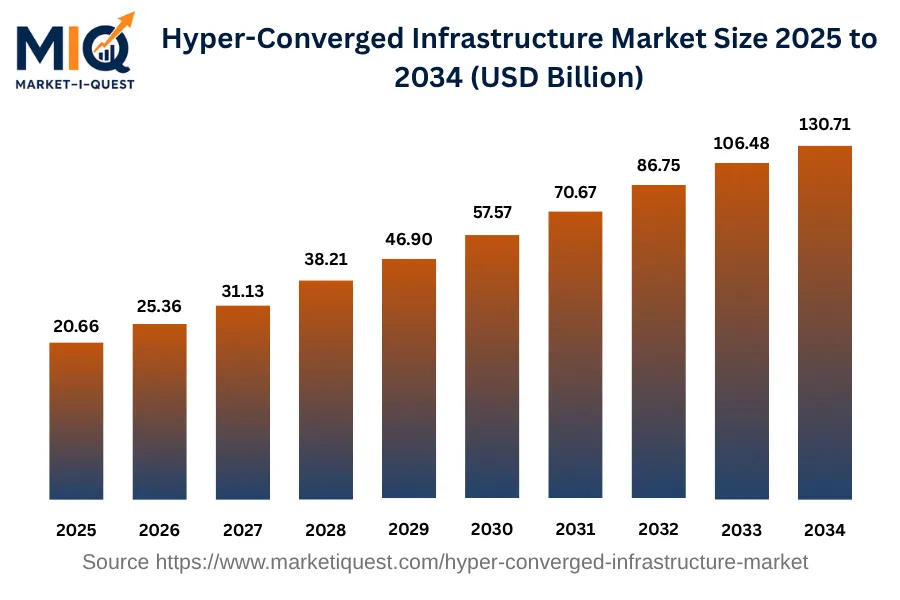
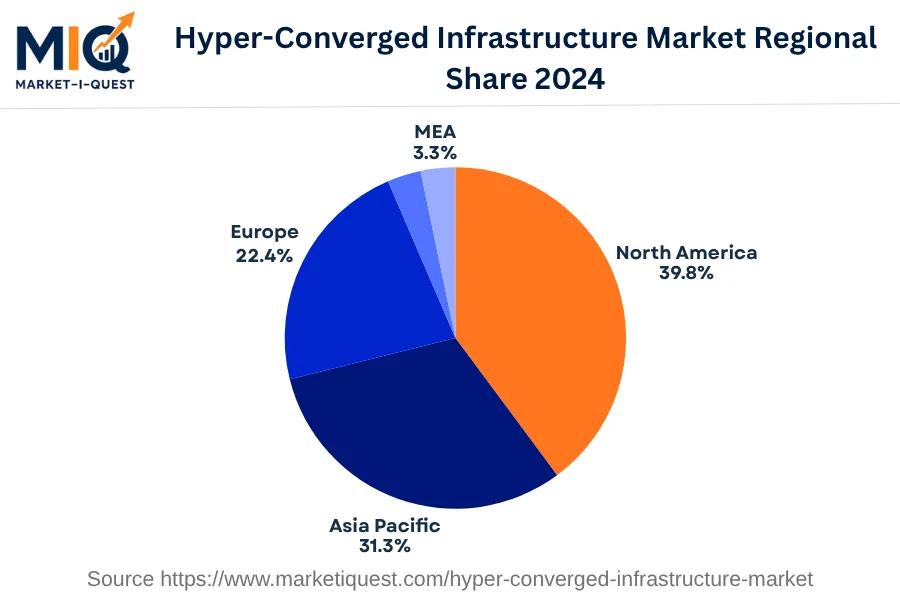
The Hyper-Converged Infrastructure Market is projected to expand from USD 20.66 billion in 2025 to USD 130.71 billion by 2034, growing at a compound annual growth rate (CAGR) of 22.75%. This significant growth can be attributed to the rapid advancements and adoption of technology across different sectors. The demand for efficient data storage and retrieval systems is on the rise due to the increasing amount of data being generated. Moreover, numerous enterprises are transitioning to cloud-based services and platforms, adding an upward thrust to the market. In 2024, the regional share of the Hyper-Converged Infrastructure Market was dispersed with North America accounting for 39.8%, followed by the Asia Pacific at 31.27%, Europe at 22.43%, and the remaining 6.46% was split between LATAM and MEA.

Key Takeaways

  • By Hypervisor Type - VMware held a dominant presence in the market.
  • By Application - Virtual Desktop Infrastructure is the fastest-growing at a commendable rate during the forecast period.
hyper-converged-infrastructure-market market size

Key Driving Factors

Shift to Remote Work Environments

In response to the COVID-19 pandemic, companies around the world shifted to remote work environments, which accelerated their need for scalable and efficient IT systems. Hyper-converged infrastructures, with their streamlined deployment and simplicity in managing workloads remotely, offered an advantageous solution. As businesses adapt to what is increasingly seen as the 'new normal,' the necessity of maintaining a well-equipped remote workforce continues to drive changes in IT solutions, making hyper-converged infrastructure an appealing option. In essence, the major transition to remote work has prompted enterprises to reconsider their IT infrastructure's adequacy in supporting a dispersed workforce, hence adopting solutions like Hyper-Converged Infrastructure.
Increased Emphasis on Disaster Recovery and Data Protection

Companies these days are highly cognizant of the potential risks associated with data loss – whether due to cyber-attacks, human errors, or natural disasters. As a result, there's an intensified focus on data protection and disaster recovery in their IT strategy. Hyper-converged infrastructure, with its integrated backup, recovery, and replication functionalities, provides a significant advantage in ensuring data resilience. It simplifies the management, reduces recovery time, and minimizes downtime, which are key considerations for any business in a digital economy. Consequently, the increasing need for comprehensive disaster recovery solutions and effective data protection strategies is a major force propelling the Hyper-Converged Infrastructure Market.

Market Evolution by Timeline

2019-2023
In the period 2019-2023, a shift in buyer preference towards cloud-based solutions was observed as more enterprises saw the benefit of utilizing hyper-converged infrastructure for datacenter modernization. Large-scale industries, including BFSI and IT services, became primary consumers mainly from North America and Europe due to the prevalence of advanced infrastructure. Manufacturers released converged and hyper-converged systems that were more closely integrated to address performance issues. During this time, VMware's vSAN became a notable solution in the market. Pricing models remained subscription-based influencing contract terms. Regulatory standards like EU's GDPR had implications for data management, driving vendors to create GDPR-compliant solutions. Supply constraint was significant as the technology was still in development.
2024
In 2024, Asia-Pacific region started showing promising growth in the hyper-converged infrastructure market, largely motivated by digital transformation initiatives across businesses. Consumer base expanded beyond large-scale industries to small and medium-sized businesses, spearheaded by countries like China and India. Vendors such as Nutanix and SimpliVity emerged as strong competitors in the market offering comprehensive solutions. However, cybersecurity issues pose a risk, prompting vendors to focus on security features integration. The pricing strategy shifted towards pay-per-use and per-application to provide flexibility for varying enterprise requirements. Strict regulatory laws in various countries promoted the need for compliance-aware features.
2025-2029
From 2025 to 2029, market demand primarily came from sectors like education, healthcare and government. Use cases expanded to IoT, AI, and machine learning applications hence intensifying integration necessity. Cities like Singapore and Tokyo, known for their strong tech ecosystem, significantly contributed to increased demand. Companies like HPE Greenlake and Cisco HyperFlex pushed the envelope for technological innovation. The market faced supply chain disruptions, forcing a closer look at manufacturing reliance. Contract models evolved with the integration of Service Level Agreements (SLAs) assuring performance guarantees. Global data privacy regulations like California's CCPA and Brazil's LGPD warranted the incorporation of privacy-compliant features.
2030-2034
Between 2030 and 2034, demand for hyper-converged infrastructure rose in the developing markets of Middle East and Africa. The buyer segment widened to include AI and IoT startups. Complications surrounding data localization laws in countries like Russia and China proved challenging. Market leaders were observed to cultivate strategic partnerships to meet local data management requirements. On the supply end, AI-enabled hyper-converged infrastructure became a key focus for technology improvement. With emerging pricing dynamics, output-based payments started gaining traction. The key risk factor involved high reliance on a single vendor for integrated solutions and was addressed by adopting a multi-vendor approach.

Future Market Outlook

Future Opportunities

As hyper-converged infrastructure continues to evolve, opportunities in the market are expected to expand significantly. The rise of Artificial Intelligence and machine learning is creating new avenues for hyper-converged infrastructure providers to integrate these technologies into their solutions. For example, VMware announced plans in late 2022 to incorporate AI-driven analytics into its management platforms, enabling more efficient resource allocation and workload optimization. Additionally, regulatory frameworks such as the EU’s General Data Protection Regulation (GDPR) are driving organizations to adopt hyper-converged solutions that enhance data compliance and security. This presents an opportunity for firms like Dell Technologies to develop specialized offerings that assist clients in navigating complex regulatory environments. The increasing need for scalable solutions to support remote work and the hybrid workplace trend indicates a growing market appetite for hyper-converged infrastructure that can adapt to fluctuating demands. In the healthcare sector, a pilot initiated by Kaiser Permanente in 2023 aimed at deploying hyper-converged infrastructure to improve patient record management has highlighted demand for tailored solutions in specialized industries. Furthermore, as edge computing becomes a necessity for real-time data processing, companies are poised to create hyper-converged offerings that support edge deployments. Partnerships between software vendors and hardware manufacturers, demonstrated by Lenovo and its strategic alliances in 2021, will likely facilitate more holistic solutions, catering to industry-specific needs across diverse geographies.

Segmentation Analysis

By Hypervisor Type

The market is divided into subsegments including VMware, KVM, and Hyper-V. VMware accounted for the largest revenue share while Hyper-V is expected to grow at the fastest CAGR during the forecast period.

Largest Revenue Share

VMware

Market Share Leader

VMware continues to hold the title as the subsegment with the highest revenue. This can be attributed to its industry-leading solutions and significant customer base. VMware's comprehensive solution suite caters to a broad spectrum of customers and sectors, including data centers, cloud environments, and end-user computing. In many industry verticals, the efficiency, adaptability, and security offered by VMware have been key purchasing criteria, thus bolstering its revenue growth. Geographically, VMware has widespread penetration, especially in developed markets. Switching costs also play a crucial role as organizations that have integrated VMware into their infrastructures are less likely to switch due to the high costs associated with such a move. They also provide excellent support channels, which increases customer loyalty and reduces churn. Assuming the current market structure remains constant, these reasons will allow VMware to maintain its revenue leadership in the foreseeable future.

Fastest CAGR

Hyper-V

Forecast Period Growth Leader

Though VMware may have claimed the largest revenue share, Hyper-V shows promise as the fastest-growing subsegment. Its growth can be attributed to various factors. Foremost amongst these are the tech advancements in Microsoft's ecosystem. Hyper-V benefits immensely from being deeply integrated with Windows Server and other Microsoft technologies, which encourages a large number of businesses running Microsoft-centric IT to adopt Hyper-V. A reduction in capital expenditure is also driving growth, as Hyper-V allows businesses to consolidate servers and save substantially on hardware and maintenance costs. Regulatory changes also play a part, given the increasing emphasis on data security and privacy in many jurisdictions. While Hyper-V's growth is expected to be substantial, potential risks such as compatibility issues with non-Windows technologies and the fierce competition should not be disregarded. Nevertheless, Hyper-V's association with Microsoft and the continuous improvements in the platform suggest a strong growth trajectory.

By Application

The market is divided into subsegments, including Virtual Desktop Infrastructure, Server Virtualization, Data Protection, Remote Office, and Cloud. Server Virtualization accounts for the most substantial revenue share, while Virtual Desktop Infrastructure is projected to grow at the fastest CAGR during the forecast period.

Largest Revenue Share

Server Virtualization

Market Share Leader

Server Virtualization is leading the market in terms of revenue generated. This dominance is attributed to a variety of factors. Key among them includes the increasing demand for more efficient data center operations, cost reduction objectives, and the growing necessity for better disaster recovery solutions. The drive for server consolidation and increased server utilization also acts as the pillars for server virtualization revenue growth. Server virtualization also reduces energy consumption, thereby appealing to companies with a strong emphasis on sustainability. Geographically, high-tech regions such as North America and Asia-Pacific significantly contribute to this subsegment’s revenue due to the concentration of large corporations and technology-centric companies that heavily utilize server virtualization. Overall, the efficiency and cost-saving features of server virtualization are propelling its adoption, consequently increasing its market revenue.

Fastest CAGR

Virtual Desktop Infrastructure

Forecast Period Growth Leader

While Server Virtualization may corner the most significant revenue share, Virtual Desktop Infrastructure (VDI) is the fastest-growing subsegment. Several reasons account for this robust growth rate. The key driver is the growing need for remote access to desktop services, primarily propelled by the global shift towards work from home arrangements due to the COVID-19 pandemic. Technology advancements and the increasing adoption of cloud computing for providing flexible, scalable, and secure VDI solutions accelerate this growth trend. Additionally, the introduction of AI and machine learning technologies in VDI delivers improved data security, convenience, and productivity, effectively encouraging more organizations to adopt this solution. However, there exist adoption barriers, including the upfront costs and complexity associated with the deployment of VDI. Nevertheless, strategic partnerships and advancements in technology are expected to overcome these hurdles, and hence continue to drive the accelerated growth pace of this subsegment.

Competitive Analysis

Key Market Players

Manufacturers / OEMs

Dell Technologies Inc.
US
Nutanix, Inc.
US
Cisco Systems, Inc.
US

Key Suppliers & Raw Materials

Intel Corporation
US
Samsung Electronics Co., Ltd.
South Korea
Micron Technology, Inc.
US

Distributors, Integrators & Channel Partners

CDW Corporation
US
SHI International Corp.
US
Ingram Micro Inc.
US

Porter’s Five Forces Analysis

Identifying the competitive intensity and attractiveness within the Hyper-Converged Infrastructure Market.

Supplier Bargaining Power

Medium

Hardware and Software suppliers influence pricing and delivery schedule.

Buyer Bargaining Power

High

Numerous HCI providers enable buyers to negotiate for better deals.

Threat of Substitutes

Low

Few substitutes exist due to the unique capabilities of HCI technology.

Threat of New Entrants

Medium

Switching costs and technical expertise limit new entrants.

Competitive Rivalry

High

Multiple established companies, like VMware and Nutanix, fiercely compete in the market.

Regional Analysis

Geographic market dynamics and growth opportunities across key regions

Global Market Outlook

hyper-converged-infrastructure-market market regional share

North America

In 2024, the Hyper-Converged Infrastructure (HCI) market in North America demonstrated a robust proliferation. Accelerating digital transformation across enterprise, healthcare, and retail sectors fueled an uptick in demand for HCI solutions. Government regulations advocating for data protection and data center consolidation further propelled the HCI market. Rising capital investments in advanced technologies in the US, Canada, and Mexico indicated a bustling supply dynamic.

Emerging trends reflected the evolving market landscape. A notable shift towards HCI solutions replaced traditional data centers, driven primarily by cost-effectiveness, scalability, and ease of management. Low latency applications, AI, and machine learning technologies further spurred HCI adoption across businesses. There was an increased predilection for subscription-based HCI solutions over legacy systems, pointing to a change in buyer behavior. In Canada, M&A activities rose in tech companies, enhancing the HCI value chain. An increased thrust on standardizing ICT infrastructure was seen in government bodies across North America. From a customer sector perspective, an increased uptake was seen in enterprise and healthcare industries pursuing high-performance virtualization technologies. Manufacturing industries in Mexico showed a keen interest in HCI technologies to optimize industrial processes. Meanwhile, broad emphasis was given to employing such solutions in the US retail sector for better data management and accessibility.

Asia Pacific

In 2024, the Hyper-Converged Infrastructure (HCI) Market in the Asia Pacific sphere was marked by expansive digitalization efforts across multiple sectors. The prime drivers sustaining this evolution included escalating data load management needs within enterprise environments, especially within sectors such as healthcare, e-commerce, and manufacturing, owing to the adoption of Internet of Things (IoT), Artificial Intelligence (AI), and Machine Learning (ML) technologies. Moreover, Chinese government's policy encouragement for tech innovation consumption spurred significant HCI investments. Additionally, competitive pricing introduced by key market players like Huawei and Nutanix Inc. to consolidate presence set a favorable tone for market growth.

Trends that shaped the market landscape comprised the sustained adoption of Virtual Desktop Infrastructure (VDI) in Australia as businesses moved towards flexible working models. In sectors such as retail and utilities, implementation of HCI improved data center efficiency and reduced operational costs. In the ASEAN zones, partnerships between tech-giants and local IT firms for enhanced digital infrastructures heralded notable shifts. India presented a dynamic shifting preference to adopting cloud-native HCIs for better scalability, fuelled by government policies like "Digital India". Growing emphasis on data privacy and security regulations across Japan and South Korea were also pivotal in influencing the HCI market proliferation.

Europe

In 2024, the Hyper-Converged Infrastructure (HCI) Market in Europe displayed a solid performance driven by factors such as increasing digitization efforts, warmed regulatory landscape, and enhanced investment into improving ICT structure. The push from governments across the continent, particularly in the UK, Germany, France, and the Nordic region, for digital transformation in public services spurred demand for HCI solutions. Moreover, the growing adoption of cloud-based solutions in the enterprise sector, notable in the retail and manufacturing industries, also contributed to increased demand for HCI.

Market trends reflected a shift towards software-centric solutions, offering flexibility and scalability, particularly for businesses in the Benelux and Nordic regions. A surge in partnerships between native ICT businesses and multi-national corporations, notably in Spain and Italy, enhanced the distribution channels for HCI solutions. The application spectrum reflected significant use of HCI in healthcare and utilities sectors primarily in Central and Eastern Europe, driven by the ongoing digital overhaul in these sectors.

In terms of policy enforcement, the influence of General Data Protection Regulation (GDPR) bore heavily on the market, pushing for HCI solutions that were compliant with data protection and privacy standards, especially in the UK and France. The implementation of these policies dictated the market dynamics in 2024, cementing HCI as an integral part of Europe's digital landscape.

Latin America

In 2024, Hyper-Converged Infrastructure (HCI) marked a decisive disruption in Latin America’s IT landscape, orchestrating a shift towards a streamlined, software-defined data center architecture. Driving the market adaptation was a host of factors. The increasing demands for operational efficiency in industries like retail, manufacturing, and government birthed a surge in HCI integration in Brazil and Chile. Supply dynamics reflected the accelerated adoption of HCI, principally in Argentina, with key providers expanding their offerings. Investments in cloud technologies escalated in Peru while Mexico observed comprehensive regulatory compliance augmenting the HCI traction.

Conversely, market trends bore witness to a series of transformative shifts. Primarily, enterprise sectors in Mexico and Colombia revealed a preference for on-premise HCI solutions, affirming data security concerns. Consumer behavior in Brazil and Chile gravitated towards HCI owing to its centralized management capabilities. Standardization in Argentina fostered to HCI adoption, while policy enforcement in Colombia was reinforcing cloud infrastructure utilization. Furthermore, a surge in strategic partnerships and M&A was observed across sectors, as companies sought to bolster their service capabilities. Notably, healthcare in Chile and utilities in Peru exhibited an uptick in their utilization of HCI, seeking better patient care delivery and streamlined energy management respectively. Invariably, with the undeniability of market drivers and prevailing trends, HCI took a pivotal role in LATAM's digital transformation journey by 2024.

Middle East & Africa

In the base year of 2024, the hyper-converged infrastructure (HCI) market in the Middle East and Africa saw significant expansion, fueled by vital drivers such as increasing demand, substantial investments, technological adoptions, and complex supply dynamics. The adoption of digitalization and cloud-based services, particularly in sectors like oil and gas, telecom, healthcare, and government operations in countries like Saudi Arabia, United Arab Emirates, and Qatar, amplified the demand for HCI solutions. Regulatory directives in Nigeria and South Africa to enhance data security encouraged technology adoption. Infrastructure investments in Saudi Arabia and Israel stimulated supply dynamics, resulting in competitive pricing.

Simultaneously, the market experienced crucial trends impacting HCI adoption. Buyers prioritized integrated solutions providing ease of management, scalability, and enhanced data protection, prompting technological shifts towards all-in-one HCI solutions. Channel dynamics saw a substantial move towards online platforms, influenced predominantly by the pandemic. Strategic partnerships and mergers were prolific, especially in Kenya's burgeoning tech industry. Standard policy enforcement was critical in Egypt's healthcare sector to maintain data privacy, ensuing a pronounced demand for secure HCI. As the Middle East and Africa continue to accelerate their digital trajectories, these drivers and trends underscore the significant strides in the HCI market across these geographies in 2024.

Recent Industry Developments

Latest market innovations, product launches, and strategic initiatives

September 2025

JPMorgan Chase finalized a widespread infrastructure modernization track, shifting over 1,200 branch operating frameworks to an integrated hybrid environment. Moving legacy workflows onto integrated clusters allowed the firm to reduce localized maintenance overhead by $18 million annually while ensuring seamless, real-time fallback connectivity to public cloud networks.

Frequently Asked Questions