Hydroxypropyl Cellulose Market Snapshot

Key Players

  • Ashland Global Holdings Inc. (United States)
  • LOTTE Fine Chemical (South Korea)
  • Shin-Etsu Chemical Co. Ltd. (Japan)
  • 3M Company (United States)
  • Dow Inc. (United States)
  • NIPPON Soda Co. Ltd. (Japan)
  • Shandong Head Co. Ltd. (China)
  • BASF SE (Germany)
  • Mitsubishi Chemical Corporation (Japan)
  • TOKYO CHEMICAL INDUSTRY CO. LTD. (Japan)

Market Size

Base Year 2024
$1.78 Bn
CAGR
6.3%
Forecast 2034
$3.28 Bn

Market Segments

By Degree of Substitution
Low Degree of Substitution, Medium Degree of Substitution, High Degree of Substitution
By Molecular Weight
Low Molecular Weight, Medium Molecular Weight, High Molecular Weight
By Grade
Low Viscosity, Medium Viscosity, High Viscosity
By End Use
Construction, Paper and Packaging, Food and Beverage, Pharmaceuticals, Personal Care, Cosmetics, Others

Market Dynamics

Drivers
  • Rising pharmaceutical industry demand
  • Increasing utilization in food sector
Restraints
  • Strict regulatory policies
  • High production cost
Opportunities
  • Emerging pharmaceutical applications
  • Increasing cosmetic industry demand

Market Size

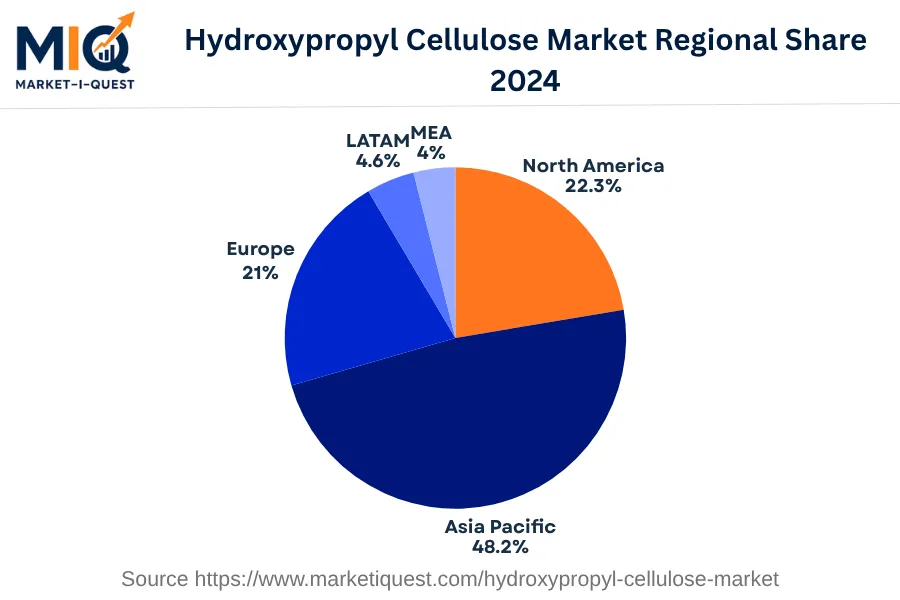
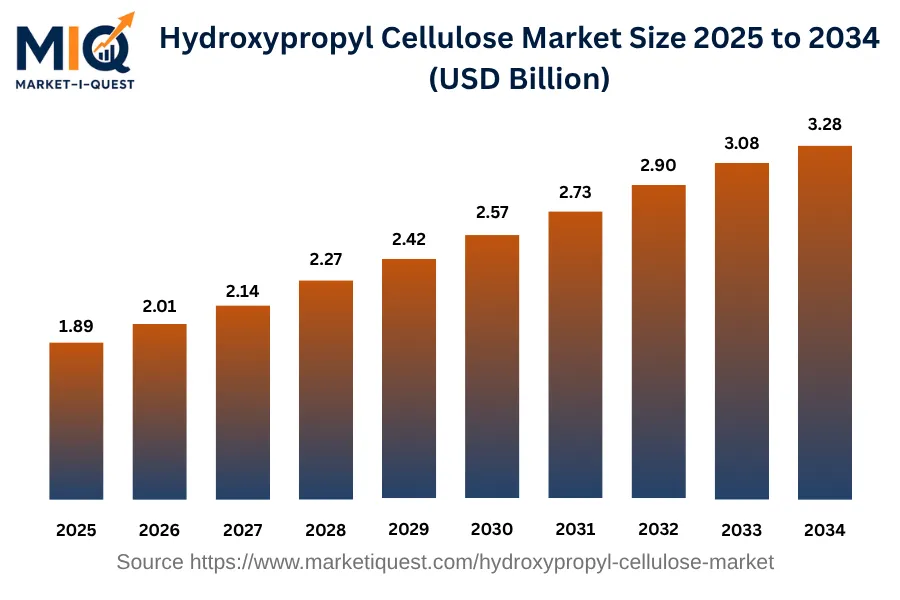
The Hydroxypropyl Cellulose Market was valued at $1.78 billion in 2024 and slightly increased to $1.89 billion in 2025. By the end of 2034, the market size is projected to more than double, reaching $3.28 billion, reflecting a Compound Annual Growth Rate (CAGR) of 6.3%. This increase in market size from 2025 to 2034 is indicative of steady growth throughout this period. The regional share in 2024 was distributed as follows: Asia Pacific held the biggest share at 48.2%, North America was second with a 22.3% share, followed by Europe with a 20.9% share. The shares of Latin America and the Middle East & Africa were comparatively small, at 4.6% and 3.9%, respectively. This delineation of market share points to the markets in the Asia Pacific, North America, and Europe as the key regions in the Hydroxypropyl Cellulose Market.

Key Takeaways

  • By Degree of Substitution - High Degree of Substitution expanded the fastest leading the segment in the forecast period.
  • By Molecular Weight - High Molecular Weight held the significant share taking the first spot in the market segment in the base year.
  • By Grade - High Viscosity led growth becoming the largest subsegment in the recent past.
  • By End Use - Construction led accounting for a largest share of this market segment.
hydroxypropyl-cellulose-market market size

Key Driving Factors

Incorporation in Food and Beverage Industry

Hydroxypropyl cellulose is being increasingly incorporated in the food & beverage industry as a thickening and emulsifying agent. The expanding food processing sector, as well as the diversification of processed foods due to changing consumer preferences, prompts this increased adoption. Hydroxypropyl cellulose enhances the texture and appearance of such processed foods, thus improving the product appeal to consumers. Moreover, the ongoing trend of reduced fat and calorie content in food products supports the use of hydroxypropyl cellulose, aiding its market growth.

Application in Pharmaceutical Industry

Hydroxypropyl cellulose is extensively used in the pharmaceutical industry as an excipient in drug formulation. It's incorporated in multiple dosage forms including tablets, capsules, and liquid syrups due to its valuable properties such as film-forming, thickening, and binding. Further, it's used in controlled-release tablets due to its ability to modify drug release. Revenue in this segment is driven by the ongoing drug developments and an increased number of FDA (US Food and Drug Administration) approvals for new medications. The sustained growth of the global pharmaceutical industry is a critical factor propelling the demand for the hydroxypropyl cellulose market.

Market Evolution by Timeline

2019-2023
During these years, major buyers of Hydroxypropyl Cellulose (HPC) were from the pharmaceutical and food and beverage industries, largely due to HPC's use as an emulsifier and coating agent. Regions with high demand included APAC and North America. Suppliers struggled with raw material volatility, impacting pricing. This often led to contract pricing to control costs. HPC's blend in local medications was regulated by stringent policies across European nations, influencing market behavior. Risks included supply chain disruptions due to geopolitical tensions, which some firms mitigated by regional sourcing.
2024
In 2024, demand for HPC from the cosmetic industry started to rise, particularly in countries like South Korea and France, due to trend for clean beauty products. Suppliers responded by increasing production and performing pilot tests with cosmetic-focused formulations. Commercially, long-term supply contracts gained popularity, offsetting raw material cost volatility. UK's MHRA (Medicines and Healthcare products Regulatory Agency) introduced new restrictions on cellulose derivatives, once again impacting European market dynamics. Potential risk involved reliance on agricultural raw materials which is susceptible to climate change effects.
2025-2029
Pharmaceuticals continued to drive HPC demand, but with increased interest from developing countries with growing healthcare sectors like India. HPC suppliers made technology improvements to reduce dependency on climate-sensitive raw materials. Environmental regulations fueled this drive. A common commercial model involved bulk purchasing and vertical integration, achieving economies of scale and supply chain stability. Risks appeared in the form of potential patent cliffs that affect the profitability of pharmaceuticals, hence effecting HPC usage in drug formulation.
2030-2034
The period saw a rising demand from sustainable textile industry in regions like Europe and North America, involving HPC's in textile coating. HPC suppliers responded by diversifying production lines to include HPC grades suitable for textile applications. Commercially, evident shift towards green procurement models was seen, favoring suppliers with sustainable approaches. Regulatory environment mostly focused on sustainability benchmarks, affecting supply side. However, risks emerged in possible oversupply as manufacturers overcompensated for potential demand, the pivot to sustainable raw materials continued to present challenges, mitigated by investments in agricultural R&D.

Future Market Outlook

Future Opportunities

The hydroxypropyl cellulose market presents robust opportunities driven by evolving regulations and consumer preferences. The growing emphasis on sustainable and biodegradable materials is set to influence manufacturers across North America and Europe, where environmental regulations such as the European Commission’s Green Deal are active. Companies like Solvay are actively researching bio-based alternatives to hydroxypropyl cellulose, which aligns with the demand for sustainable ingredients. In emerging markets, the increasing population and rising disposable income in regions such as Southeast Asia are expected to drive demand for consumer products incorporating hydroxypropyl cellulose. The expansion of e-commerce platforms in countries like India and Indonesia also offers new distribution channels for companies to reach consumers with hydroxypropyl cellulose-based products. Additionally, as regulatory frameworks tighten around the safety of food and pharmaceutical products, companies can leverage hydroxypropyl cellulose as a compliant ingredient that fulfills strict safety standards. The demand for personalized medicine and tailored formulations, particularly in the United States, presents another opportunity for innovation. Research collaborations between universities and industry leaders, like the partnership between the University of California and tech startups, aim to explore novel applications of hydroxypropyl cellulose in drug delivery systems. These developments indicate a fertile landscape for advancement in various sectors employing hydroxypropyl cellulose in the coming years.

Segmentation Analysis

By Degree of Substitution

The market is divided into subsegments including a Low Degree of Substitution, Medium Degree of Substitution, and High Degree of Substitution. Among these, the High Degree of Substitution subsegment accounted for the largest revenue share, while the Low Degree of Substitution is expected to grow at the fastest CAGR during the forecast period.

Largest Revenue Share

High Degree of Substitution

Market Share Leader

The High Degree of Substitution subsegment commands the largest portion of the market revenue, which can be attributed to several factors. Demand for high-degree substitute products typically stands strong owing to their superiority in mimicking the characteristics, performance, and application of the original product. This is particularly important in industries where the primary material is scarce, expensive, or environmentally unfriendly. Furthermore, regulatory policies favoring the use of substitutes can also drive this segment, as companies and consumers alike comply with environmental and sustainability standards. Functionally, high-degree substitutes can be near-identical to the original product with minimal switching costs, a feature greatly appreciated by industries looking to maintain quality while reducing overhead costs. Lastly, this segment's demand is further fortified by diverse distribution channels that simplify access and uptake for consumers across different market geographies.

Fastest CAGR

Low Degree of Substitution

Forecast Period Growth Leader

The Low Degree of Substitution subsegment is projected to manifest the fastest growth rate. A few key reasons are driving this uptick in market growth. To start, innovations in manufacturing and development technologies are catalyzing the increased production capacity of low-substitute materials. When dealing with consumer markets with specific needs or taste preferences, a low degree of substitution can be seen as a unique selling point, promoting brand uniqueness and delivering personal customer experiences. A shift toward more diversified portfolios in many industries supports the demand for low-degree substitute products. Additionally, constructive policies and partnerships are paving the way for growth in this segment, particularly encouraging startups and small businesses venturing into the specialty product markets. However, market participants must remain vigilant of potential near-term risks, including volatile raw material prices and fragile supply chains that could impact the scalability and profitability of low substitute products.

By Molecular Weight

The market is divided into subsegments including Low Molecular Weight, Medium Molecular Weight, and High Molecular Weight. Of these, the High Molecular Weight segment accounted for the largest revenue share, while the Low Molecular Weight segment is expected to grow at the fastest CAGR during the forecast period.

Largest Revenue Share

High Molecular Weight

Market Share Leader

The High Molecular Weight segment leads the revenue charts majorly due to its wide applicability and significant demand in sectors such as healthcare, agriculture, and manufacturing. These molecules have large masses and tend to be more stable, which makes them highly desirable for various large-scale industrial applications. Their usage in manufacturing drugs, especially for chronic conditions, contributes significantly to their market share. Various geographies, notably developed economies with strong healthcare and industrial sectors, register high demand for these molecules, further driving this segment's growth. Additionally, stringent regulations pertaining to health and safety uphold the use of high molecular weight molecules, confirming their leading position in terms of revenue. Customers prioritize purchasing criteria like effectiveness, reliability, and regulatory compliance, which are comfortably met by high molecular weight molecules. The switching cost to alternative products is high due to lack of equally effective alternatives, ensuring a stable customer base for this segment.

Fastest CAGR

Low Molecular Weight

Forecast Period Growth Leader

The Low Molecular Weight segment, though not leading in revenue, presents a striking growth outlook. The trend can be attributed to evolutionary shifts in technological advancements and emerging research priorities. Increased investment in research and development, in particular, plays a pivotal role in shaping the future of this segment. Lower molecular weight molecules are more diffusion-friendly and have high reactivity, making them ideal candidates for applications in drug delivery systems, precision agriculture, and cosmetics. However, adoption barriers, primarily high research and development cost, pose a challenge. In contrast, strategic partnerships and collaborations could offset these costs and encourage faster adoption. Capex in advanced technologies and equipment to manufacture low molecular weight molecules could accelerate growth. The downside risks include regulatory changes and potential disruptions caused by geopolitical issues or resource scarcity. As it gathers pace, this segment could open up new possibilities and opportunities in the market.

By Grade

The market is divided into subsegments including low viscosity, medium viscosity, and high viscosity grades. In 2024, the high viscosity segment accounted for the largest revenue share while the low viscosity segment is expected to grow at the fastest CAGR during the forecast period.

Largest Revenue Share

High Viscosity

Market Share Leader

In the base year of 2024, the high viscosity grade segment was the leading revenue generator in the market. This can be ascribed to its extensive application in industries that require robust adhesive properties in their operations such as automotive, construction, and packaging among others. The high viscosity grade forms a strong bond that withstands harsh conditions including high temperatures and resist fast wear and tear. Therefore, industries value its durable performance and are willing to pay a premium for it. Geographically, regions with mature industrial sectors such as North America and Europe dominated the consumption. Regulatory changes and standards that mandate the use of safe and high performance materials further strengthen its demand. Market channels including direct sales from manufacturers to industries and distribution through wholesalers and retailers also play a crucial role in its widespread availability and hence large revenue share.

Fastest CAGR

Low Viscosity

Forecast Period Growth Leader

The low viscosity grade segment, while not the largest revenue contributor, is projected to grow at the fastest rate in the forecast period. Its rapid growth can be linked to the increasing application in emerging manufacturing processes and technologies that require quick and seamless adhesion. The lower viscosity allows for easier application and quicker drying times, thereby optimizing operational efficiency. Key industries driving this growth include electronics, medical devices, and lightweight transportation. As these sectors continue to expand and evolve, the demand for low viscosity materials is expected to increase. However, possible risks to this growth outlook include any potential regulatory changes that limit the use or application of these materials and technological advancements that could render these materials obsolete or less efficient. To ensure continued growth, players in this segment must monitor the regulatory environment, invest in product development, and forge strategic partnerships.

By End Use

The market is divided into subsegments including Construction, Paper and Packaging, Food and Beverage, Pharmaceuticals, Personal Care, Cosmetics, and Others. Among these, the Construction subsegment accounted for the largest revenue share while the Pharmaceuticals subsegment is expected to grow at the fastest CAGR during the forecast period.

Largest Revenue Share

Construction

Market Share Leader

The Construction subsegment holds the largest market share due to its sheer volume and integral application in various end-use industries. Features such as durability, cost-effectiveness, and versatility make construction materials in demand, driving its revenue growth. Additionally, rising infrastructure development activities worldwide, specifically in booming economies such as India and China, contribute significantly to its revenue generation. Furthermore, favorable government policies and investments in public infrastructure, residential, and commercial projects spur the segment's growth. Strict regulation standards in developed nations stimulate market players to provide high-quality and compliant construction materials, adding to the revenue. The significant purchasing criteria for these materials include quality, price, and supplier reputation. Most purchases occur through direct channels, enhancing the relationship between manufacturers and buyers.

Fastest CAGR

Pharmaceuticals

Forecast Period Growth Leader

The Pharmaceuticals subsegment is projected to grow at the fastest rate. Numerous factors, including a growing aging population, rapid technological advancements, and increased healthcare expenditure, are primarily driving this growth. As the demand for innovative and effective drugs continues to rise, companies are set to increase their capital investments to enhance their product pipelines. Moreover, emerging partnerships between pharmaceutical companies and contract research organizations accelerate this subsegment's growth rate by enabling more efficient drug development processes. Bio-similar and genetics, specifically, are significant growth catalysts considering their cost-effectiveness in developing countries. Near-term risks include stringent regulatory hurdles and potential supply chain disruptions. However, the overall outlook remains optimistic owing to the segment's critical role in healthcare and improving life expectancy globally.

Competitive Analysis

Key Market Players

Manufacturers / OEMs

Shin-Etsu Chemical
Japan
Ashland
US
Sigmapharm Laboratories
US

Key Suppliers & Raw Materials

Dow
US
BASF
Germany
Lotte Fine Chemical
South Korea

Distributors, Integrators & Channel Partners

Univar Solutions
US
Brenntag North America
US
Nexeo Solutions
US

Porter’s Five Forces Analysis

An assessment of the competitive dynamics within the Hydroxypropyl Cellulose Market.

Supplier Bargaining Power

Medium

Limited number of suppliers, with Raw material price fluctuations impacting bargaining power.

Buyer Bargaining Power

High

Numerous buyers, high product knowledge, and alternative suppliers increase buyer bargaining power.

Threat of Substitutes

Low

Lack of easily available or effective substitute products keeps this threat low.

Threat of New Entrants

Low

High investment cost, complex production process, and regulatory requirements hinder new entrants.

Competitive Rivalry

High

Intense competition due to presence of many key players, and product differentiation based on quality.

Regional Analysis

Geographic market dynamics and growth opportunities across key regions

Global Market Outlook

hydroxypropyl-cellulose-market market regional share

North America

In 2024, the Hydroxypropyl Cellulose (HPC) market in North America was shaped by multiple drivers and trends, with a particular emphasis on healthcare and manufacturing sectors. Progressive regulations around drug development increased the demand for HPC due to its primary use as an excipient in pharmaceuticals, effectively driving market growth. Strong investment in technological adoption in the healthcare sector further spurred the expansion of the HPC market, especially in the United States and Canada. Despite this, limited supply dynamics and high pricing of HPC in Mexico posed a unique challenge.

Market trends showed a shift in buyer behavior towards the preference for bio-based products, necessitating the usage of hydroxypropyl cellulose. Meanwhile, technological shifts towards advanced drug delivery systems, like HPC based nanofibers, were instrumental in maximizing the effectiveness of pharmaceutical products. The market also witnessed strategic partnerships and Mergers and Acquisitions which aided in market growth, particularly in the United States. Canada, however, showed stringent policy enforcement towards the regulated use of HPC, influencing its market trends significantly that year. Although the healthcare sector dominated the demand for HPC, its use in the manufacturing of nonwoven fabrics for industries like retail also became increasingly apparent. Overall, the North American Hydroxypropyl Cellulose market of 2024 was a dynamic landscape, driven by progressive sectors like healthcare and manufacturing.

Asia Pacific

In 2024, the Hydroxypropyl Cellulose (HPC) market in the Asia Pacific presented significant development. Key drivers for growth included increasing demand for HPC in the pharmaceutical sector, a booming textile industry calling for sustainable solutions like HPC, and governments like China, India, and Japan aggressively pushing for greener manufacturing alternatives. Technological advancements within the region led to elevated supply dynamics and attracted considerable investment, contributing to market expansion.

A significant trend was the growing buyer preference for eco-friendly products, increasing the demand for HPC in industries such as retail and manufacturing. Shifts towards online channels in markets like South Korea and Australia resulted in an expanded reach for HPC prodcuts. Major players in the market were seen forming strategic partnerships, such as mergers and acquisitions in the ASEAN region, to ensure supply chain efficiency. Formalized standards and increased policy enforcement by governments, particularly in sectors such as utilities and healthcare, were observed, which put a premium on products conforming to sustainable, green manufacturing standards. The enterprise sector, notably in China and India, played a crucial role in market development, focusing investment on HPC inclusion in their products, thereby fostering further growth in the Asia Pacific HPC market in 2024.

Europe

In 2024, the Hydroxypropyl Cellulose Market in Europe exhibited robust dynamics primarily due to high demand in industries like pharmaceuticals and manufacturing. Enhanced regulations by the European Medicine Agency around pharmaceutical excipients fostered this demand, especially in nations like Germany and the UK. Significant investment in research and development in France and Italy also stimulated the market, as companies sought innovative strategies to leverage this compound. Technology adoption in Spain and the Nordics significantly contributed to the supply dynamics of the market, with major production plants resorting to automated stacking and advanced processing techniques. Tastelessness and non-toxicity of the compound led to pricing stability, with hygienic food packaging industries particularly benefitting.

As observed, buyers increasingly preferred companies implementing collaborative production methods. There was a noticeable shift towards eco-friendly extraction techniques across Italy, Benelux, and Central & Eastern Europe, with firms prioritizing sustainability. Policy enforcement specifically centered on hydroxypropyl cellulose safety standards amplified enterprise-level partnership deals and M&A activities in the pharmaceutical sector. Telecom, utilities, and retail sectors, notably in France and Germany, also heavily incorporated these regulatory adaptations - reorienting their business strategies around transparent, compliant practices. Overall, the European Hydroxypropyl Cellulose Market in 2024 was driven by a potent combination of enhanced regulations, adoption of advanced technologies, stable pricing, and a growing emphasis on sustainability.

Latin America

In 2024, the Hydroxypropyl Cellulose market in Latin America showed impressive dynamism, driven by multiple factors. Industrial development in Brazil led to increased demand for pharmaceutical and food processing applications of Hydroxypropyl Cellulose. Mexico, with its rising investment in manufacturing, fostered a conducive setting for its use in coatings and construction materials. More stringent environmental regulations in Argentina stimulated demand for eco-friendly alternatives like Hydroxypropyl Cellulose in textile and paper industries. Customer behavior in the region gravitated towards health-conscious choices, increasing the preference for Hydroxypropyl Cellulose in food & beverages for its dietary fibre properties. A noticeable tech shift involved the adoption of bioderived additives, which boosted the demand in industries ranging from healthcare to paints and coatings. Chile, with its policy for sustainable manufacturing, strengthened this trend.

In the pharmaceutical sector, rising research activities in Colombia and Peru involved Hydroxypropyl Cellulose due to its excipient properties. Partnerships between local manufacturers and international pharmaceutical companies became common, boosting the market's growth. Enforcement of GMP (Good Manufacturing Practices) standards in the pharmaceutical and food industries across LATAM impacted the demand and use of Hydroxypropyl Cellulose positively. As such, the Hydroxypropyl Cellulose market in LATAM in 2024 was characterized by increasing industrial applications, an eco-conscious regulatory framework, and shifts towards healthier and sustainable choices.

Middle East & Africa

In 2024, the Hydroxypropyl Cellulose market in the Middle East and Africa experienced noticeable growth due to a range of factors. Increased health awareness and regulations in countries like Saudi Arabia and South Africa raised demand for pharmaceutical products, driving production in the Hydroxypropyl Cellulose industry. The trend of technological adoption, particularly in the UAE and Israel, also enhanced the production efficiencies. In Egypt and Nigeria, significant investments in the chemical industry sector encouraged supply dynamics.

On the consumer side, there was a shift towards environmentally friendly, sustainable products, prompting manufacturers in Kenya and Qatar to leverage Hydroxypropyl Cellulose in production due to its biodegradable nature. Changing policy enforcement in South Africa witnessed the chemical sector becoming more regulatory-compliant, affecting the Hydroxypropyl Cellulose market positively. Israel saw an increased number of partnerships and mergers in the healthcare and manufacturing industries, leading to an increased demand for Hydroxypropyl Cellulose. One of the main customer sectors for Hydroxypropyl Cellulose in these regions included manufacturing, healthcare, and retail, with pharmaceutical companies in Saudi Arabia and utilities in UAE being key customers. This resulted in a vibrant and dynamic market environment in 2024, with Hydroxypropyl Cellulose's demand high across multiple industry sectors.

Recent Industry Developments

Latest market innovations, product launches, and strategic initiatives

January 2026

The EEA Joint Committee incorporated EU Regulation 2025/666 into the EEA Agreement (Decision 206/2025, published January 15, 2026), updating technical specifications for hydroxypropyl cellulose (E 463) alongside other cellulose derivatives for food applications.

January 2025

The European Union authorized the use of hydroxypropyl cellulose (E 463) and several other cellulose derivatives as feed additives for all animal species under Commission Implementing Regulation (EU) 2025/157, effective February 19, 2025. The substances were reauthorized in the category of technological additives (emulsifiers, stabilizers, thickeners, gelling agents, and binders) following a positive safety assessment by the European Food Safety Authority.

Frequently Asked Questions