
Healthcare Satellite Connectivity Market Snapshot

Key Players

  • SES S.A. (Luxembourg)
  • Inmarsat plc (US)
  • Intelsat S.A. (US)
  • Gilat Satellite Networks (Israel)
  • EchoStar Corporation (US)
  • Eutelsat Communications (France)
  • Thuraya Telecommunications Company (United Arab Emirates)
  • Telesat Holdings (Canada)
  • Communications & Power Industries (US)
  • Viasat Inc. (US)

Market Size

Base Year 2024
$7.84 Bn
CAGR
9.43%
Forecast 2034
$19.31 Bn

Market Segments

By Type of Connection
VSAT (Very Small Aperture Terminal), MSS (Mobile Satellite Service), LEO (Low Earth Orbit), GEO (Geostationary Orbit)
By Service Type
Bandwidth-on-Demand, Managed Services, Professional Services, Equipment Sales
By Frequency Band
Ku-band, Ka-band, C-band, X-band
By Application
Telemedicine, Remote Patient Monitoring, Disaster Response & Emergency Communication, Asset Tracking & Supply Chain Management, Tele-education, Others
By End User
Hospitals & Clinics, Government Agencies, Non-profit Organizations, Medical Transportation Providers, Patients & Consumers

Market Dynamics

Drivers
  • Rising healthcare telecommunication needs
  • Technological advancements in satellite connectivity
Restraints
  • High initial setup cost
  • Regulatory compliance challenges
Opportunities
  • Rural healthcare connectivity expansion
  • Technological advancements in satellite communication

Market Size

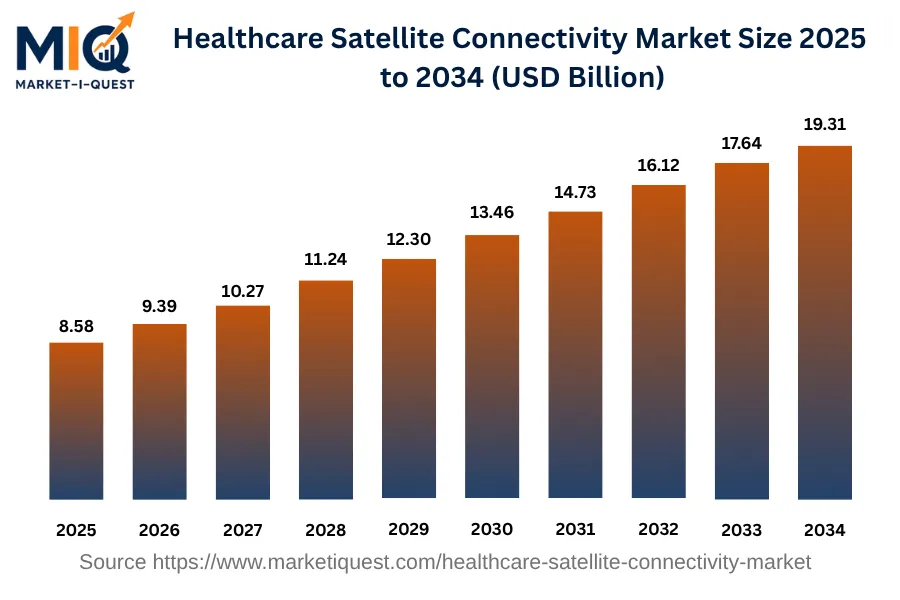
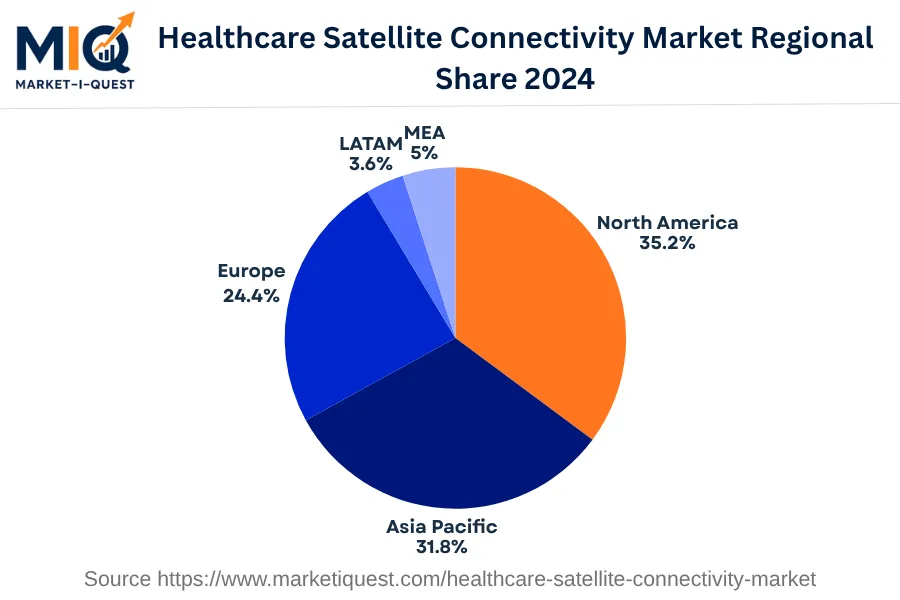
The Healthcare Satellite Connectivity Market size in 2025 stood at $8.58 billion, continuing to grow from a size of $7.84 billion in 2024. By 2034, the market is projected to further expand to $19.31 billion, demonstrating a Compound Annual Growth Rate (CAGR) of 9.4%. This growth trajectory is majorly due to the rising need for better healthcare connectivity solutions, particularly in remote areas. The application of satellite connectivity in healthcare is effective in enhancing communication, thereby improving patient care and treatment outcomes. As per the regional market share in 2024, North America held a substantial share of 35.2%, closely followed by Asia Pacific at 31.8%. Europe formed 24.4% of the market share, while the contributions from Latin America and the Middle East & Africa were relatively lower at 3.6% and 5% respectively.

Key Takeaways

  • By Type of Connection - GEO led the Healthcare Satellite Connectivity Market dominating with a significant market share.
  • By Service Type - Managed Services emerged as a leader holding the highest market share in the base year.
  • By Frequency Band - C-band held a major role accounting for a remarkable market share in the base year.
  • By Application - Telemedicine saw the fastest growth indicating promising expansion during the forecast period.
  • By End User - Hospitals & Clinics were the leading segment having a considerable market share in the base year.
healthcare-satellite-connectivity-market market size

Key Driving Factors

Implementation of Telemedicine

A significant driver in the Healthcare Satellite Connectivity Market is the current adoption and expansion of telemedicine. With healthcare providers increasingly turning to digital platforms to offer remote patient care, reliable and robust connectivity becomes essential. Satellite connectivity provides a dependable solution, particularly in remote, underserved communities that lack fiber-optic infrastructure. It ensures the smooth, real-time, and secure transmission of patient data such as medical records, scans, personal vitals, which is crucial for remote diagnosis and treatment planning. Also, during crisis situations like natural disasters when ground-based communications may be disrupted, only satellite-enabled services remain operational, providing vital clinician-to-clinician connections and patient care. This need for uninterrupted, quality healthcare services at a distance is driving the demand in the healthcare satellite connectivity market.
Regulatory Compliance for Electronic Health Records

Another driving factor for the Healthcare Satellite Connectivity Market is the regulatory requirement for maintaining Electronic Health Records (EHRs). Governments across the globe, especially in developed markets such as the United States and European Union, are mandating healthcare providers to switch from paper to electronic records. This transition to EHRs necessitates secure, always-on internet connectivity for data storage, retrieval, and exchange across health information systems. Satellite connectivity, with its promise of ubiquity and reliability, proves ideal for this task, especially in rural and remote areas that traditional cable networks can't adequately cover. Thus, the legal compulsion to maintain EHRs and the subsequent requirement of dependable connectivity, is stimulating growth in the healthcare satellite connectivity market.

Market Evolution by Timeline

2019-2023
In the period, the Healthcare Satellite Connectivity Market saw primary demand from remote regions, particularly in Africa and Asia, where terrestrial connectivity wasn't reliable. This included NGOs and government initiatives targeting remote healthcare provisions. Key suppliers during this period included Hughes Network Systems and Gilat Satellite Networks, big proponents of integrating satellite connectivity in telemedicine. Regulatory frameworks like the FCC's Connected Care Pilot Program in the US had a significant influence in promoting the adoption of these technologies. Contracts largely relied on subscription-based models, with flexible plans depending on usage rates and data needs. Primary risks involved infrastructure constraints and spectrum availability. Slow processing or non-availability of licenses in some regions also affected the market's growth potential.
2024
In 2024, the demand shifted significantly towards established healthcare systems in developed regions, like North America and Europe. The reason was the growing application of satellite communication in telehealth, especially due to the ongoing COVID-19 pandemic's remote care necessity. Companies like Inmarsat and Viasat increased their offerings for healthcare solutions. The regulatory environment continued to evolve. In the EU, for instance, the European Space Agency launched an initiative promoting the use of satellite communications in healthcare. Supply challenges mostly centered around enhancing cybersecurity measures for protecting patient data. Commercial models started to incorporate pay-as-you-go and usage-based pricing options.
2025-2029
From 2025–2029, there was a surge in demand from emergency medical services and disaster management organizations who required real-time data transmission. Key global events including natural disasters likely contributed to this shift. Providers like SES Networks and Eutelsat increased their focus on offering connectivity even in geographically challenging areas, perhaps due to the versatility, and global reach of satellite technology. Interestingly, procurement models saw a shift towards long-term staggered contracts, to ensure uninterrupted services. Risks during this period included the availability of frequency spectrum, and potential orbital debris from retired satellites.
2030-2034
The 2030–2034 landscape saw a diversification of demand sources. Beyond traditional healthcare providers, we saw demand rising from remote education initiatives, and health startups. Providers such as Starlink and OneWeb even started developing their own vertically integrated systems. This period also saw standardization efforts, for instance, the International Telecommunication Union's (ITU) initiative to standardize the frequency band allocation for healthcare services. The major challenge providers faced was maintaining the quality of service as demand increased, right alongside the need to maintain acceptable latency levels for real-time applications. Contracts became more dynamic, often involving multiple smaller providers coming together to offer bundled services.

Future Market Outlook

Future Opportunities

Given current trends, the healthcare satellite connectivity market presents numerous future opportunities driven by evolving user needs and regulatory frameworks. In 2023, the World Health Organization plans to launch an initiative aimed at enhancing telemedicine capabilities in rural areas through satellite technology, particularly in Africa and Southeast Asia. Organizations can explore partnerships to develop solutions that address the distinct challenges faced by these regions. For instance, advancements in satellite-based remote monitoring technologies, such as those being tested by NASA in collaboration with health organizations, are poised to enable real-time tracking of patient conditions in isolated areas. Additionally, the expansion of 5G networks could further enhance satellite communications, facilitating more comprehensive telemetry and remote care applications internationally. The integration of artificial intelligence and machine learning with satellite systems is also expected to improve data analytics capabilities, allowing healthcare institutions to make better-informed decisions. Furthermore, the ongoing developments in regulatory frameworks, like the European Commission’s Digital Services Act, will likely provide enhanced protections for data transmission in healthcare settings, fostering more trust in satellite solutions. As satellite connectivity becomes increasingly essential in enabling effective healthcare delivery, stakeholders, including technology vendors and healthcare providers, are likely to find ample opportunities to innovate and monetize around these advancements. These factors collectively indicate a promising horizon for the healthcare satellite connectivity market in the coming years.

Segmentation Analysis

By Type of Connection

The market is divided into subsegments including VSAT (Very Small Aperture Terminal), MSS (Mobile Satellite Service), LEO (Low Earth Orbit), GEO (Geostationary Orbit). GEO accounts for the largest revenue share while LEO is expected to grow at the fastest CAGR during the forecast period.

Largest Revenue Share

GEO

Market Share Leader

Geostationary Orbit (GEO) has the highest revenue share in the market. A significant driver for this subsegment is its ability to offer consistent and reliable service. Since GEO satellites maintain a fixed position relative to the earth's surface, they deliver uninterrupted service, which benefits many industries including telecommunications, weather monitoring, and broadcasting. Their fixed positions also eliminate the need for tracking systems on the ground, reducing equipment and maintenance costs. Key customers for GEO services are organizations that require stable communication channels, such as government agencies, weather departments, and large-scale corporations. Another reason for GEO's leading revenue share is the higher switching costs. Clients who have invested in dedicated ground infrastructure tailored to GEO satellites are likely to stick to this connection type. These factors, coupled with regulatory support in several geographies such as North America, make GEO the highest revenue generating subsegment.

Fastest CAGR

LEO

Forecast Period Growth Leader

Low Earth Orbit (LEO) is projected to grow at the fastest rate in the market. LEO's growth is driven by several factors such as shorter delay in signal transmission due to proximity to earth, affordability, and ability to provide internet connectivity in remote areas. These factors make LEO an attractive option for developing countries aiming to increase their internet penetration. Barriers to adoption include the significant initial capital expenditure required by service providers, but partnerships, especially with large tech companies, have been a catalyst in overcoming this. The advent of cost-effective launch services has also helped in the growth of this segment. Near-term risks include the increase in space debris, posing a threat to satellite constellations. This subsegment's growth can be impacted by regulatory decisions on orbit usage and debris mitigation. Despite these challenges, advancements in technology and increased demand for broadband services from remote locations sustain LEO's growth prospect.

By Service Type

The market is divided into subsegments including Bandwidth-on-Demand, Managed Services, Professional Services, and Equipment Sales. In 2024, Managed Services accounted for the largest revenue share, while Bandwidth-on-Demand is expected to grow at the fastest CAGR during the forecast period.

Largest Revenue Share

Managed Services

Market Share Leader

Managed Services emerged as the most revenue generating segment in 2024 due to the growing demands of organizations for outsourcing their IT operations. Businesses strive for operational efficiency, cost savings, and improved focus on core competencies, thereby increasingly adopting managed services. They offer enhanced reliability and security which is crucial in maintaining the business continuity in an organization. They also help in minimizing the downtime and provide businesses with up-to-date technology, which leads to increased profitability and competitiveness. Geographically, North America is a dominant region due to the high adoption of advanced technologies and presence of key market players. However, the demand for Managed Services is also growing at a significant pace in the Asia-Pacific and Europe due to increasing digitization and evolving business landscape. Regulatory environments are also encouraging the adoption of managed services to maintain data privacy and security.

Fastest CAGR

Bandwidth-on-Demand

Forecast Period Growth Leader

Projected to register the highest growth, Bandwidth-on-Demand is driven by the escalating demand for high-speed internet and increased digital content. As the world becomes more digitized and interconnected, having control of bandwidth becomes critical for businesses. Bandwidth-on-Demand allows businesses to manage their network capacity in real-time in accordance with their changing needs, thereby maximizing efficiency and minimizing bandwidth wastage. This flexibility offers a distinct competitive advantage, acting as a major catalyst for market growth. However, infrastructure limitations and high initial setup cost may pose a barrier to its widespread adoption. Technological advancements, favourable government policies, and strategic partnerships are expected to boost the market growth in the near future. However, cybersecurity risks associated with bandwidth management could throttle growth to some level.

By Frequency Band

The market is divided into subsegments including the Ku-band, Ka-band, C-band, and X-band. In 2024, the C-band accounted for the largest revenue share, while the Ka-band is expected to grow at the fastest CAGR during the forecast period.

Largest Revenue Share

C-band

Market Share Leader

The C-band segment dominated the market in terms of revenue in 2024. This can be attributed to its widespread usage across various industries, primarily in satellite communication systems and weather radar systems. The large bandwidth of the C-band allows for a greater amount of information to be transmitted. This has made it a preferred choice for broadcasters, allowing multiple channels to be transmitted simultaneously on a single frequency band. Another reason for its extensive usage is the global regulation policies favoring the C-band because of its lower interference with terrestrial microwave links. Furthermore, the extensive coverage offered by the C-band compared to other frequency bands is favored in geographically challenging regions, contributing to its sizeable revenue share.

Fastest CAGR

Ka-band

Forecast Period Growth Leader

Although C-band holds the highest revenue share, the Ka-band is projected to witness the fastest growth during the future forecast period. An increasing need for high-capacity communication systems and demand for high-speed data transfer are acting as key catalysts for the growth of the Ka-band segment. Unlike other frequency bands, the Ka-band allows for smaller antenna sizes due to its higher frequency, thereby reducing installation costs and increasing usability. Additionally, as technologies advance, increasing partnerships between satellite operators and service providers will facilitate the wider adoption of the Ka-band. However, susceptibility to weather conditions and regulatory policies may pose near-term risks to growth in this segment.

By Application

The market is divided into subsegments such as Telemedicine, Remote Patient Monitoring, Disaster Response & Emergency Communication, Asset Tracking & Supply Chain Management, Tele-education, and Others. Amongst them, Telemedicine accounted for the largest revenue share whereas Asset Tracking & Supply Chain Management is foreseen to grow at the quickest CAGR during the prediction period.

Largest Revenue Share

Telemedicine

Market Share Leader

The Telemedicine subsegment dominates the revenue shares in the base year 2024, primarily due to the booming digital health space catalyzed by the global pandemic. Telemedicine has become an essential solution to facilitate healthcare delivery while minimizing hospital visits, a necessary precaution in the face of contagious diseases. It provides patients access to medical aid instantaneously and remotely, fuelling its adoption. Furthermore, the telemedicine model is supported by favorable governmental policies and regulations that promote remote consultations, thus propelling its growth. This model is also highly scalable, as it easily breaks geographical barriers, allowing healthcare organizations to reach broader populations, leading to increased revenue. The growing smartphone penetration and internet access have also played a crucial role in the widespread use of telemedicine services.

Fastest CAGR

Asset Tracking & Supply Chain Management

Forecast Period Growth Leader

While Telemedicine stands as the subsegment with the highest revenues, Asset Tracking & Supply Chain Management is projected to be the fastest-growing subsegment. The acceleration of its growth can be attributed to the rise in technological innovations, specifically within IoT, analytics, and automation domains. Increasing complexity in managing supply chains due to globalization has led to higher demand for asset tracking solutions across industries, wherein healthcare is no exception. Accurate and up-to-date data provided by these solutions enables improved decision-making in resource allocation and inventory management, reducing costs and improving efficiency. The current market trend leans towards partnerships with technology providers to integrate advanced asset tracking systems. The sector may face short-term challenges such as high capital costs and complexities of implementation; however, the long-term outlook remains positive with continuous advancements and decreasing costs of related technologies.

By End User

The market is divided into subsegments including Hospitals & Clinics, Government Agencies, Non-profit Organizations, Medical Transportation Providers, and Patients & Consumers. Hospitals & Clinics accounted for the largest revenue share while Medical Transportation Providers are expected to grow at the fastest CAGR during the forecast period.

Largest Revenue Share

Hospitals & Clinics

Market Share Leader

Hospitals and Clinics are at the forefront of the healthcare industry and constitute a major portion of the market's revenue. The role of these institutions in healthcare delivery cannot be overemphasized as they remain the primary contact for disease diagnosis, treatment, and continued care. The revenue garnered in these establishments emanate from diverse avenues, chiefly involving patient fees, government funding, and private investments. High patient turnover, advancements in medical equipment and technology, and the subsequent need for these establishments to keep abreast with these changes also drive revenue. Additionally, developed regions with established healthcare infrastructures and emerging regions with significant investments in healthcare facilities substantially contribute to the revenue stream. Furthermore, regulatory frameworks favoring the advancement of healthcare facilities, coupled with the increasing patient readiness to pay for advanced treatments, are also reasons for this large revenue share of Hospitals and Clinics.

Fastest CAGR

Medical Transportation Providers

Forecast Period Growth Leader

The sub-segment of Medical Transportation Providers is anticipated to witness the fastest growth. While not traditionally at the forefront of healthcare delivery, this sector's role is becoming increasingly pivotal in ensuring accessibility and continuity of care. Growth is underpinned by several factors including the aging population, increase in chronic disease prevalence, advancement in medical transportation technology, and the expansion of healthcare services to rural and underprivileged areas. Apart from that, increasing private sector investments and public-private partnerships in healthcare transportation are accelerating the expansion of this sector. The migration of treatment from acute care settings to alternative and home care is opening up new markets. Having said that, potential risks include regulatory changes, increased fuel costs, and potential adverse events during patient transport. Despite these obstacles, Medical Transportation Providers' role in the healthcare value chain is set to increase, reflecting the growing necessity for services offered by this sector.

Competitive Analysis

Key Market Players

Manufacturers / OEMs

Inmarsat plc
UK
Globalstar
US
SES S.A.
Luxembourg

Key Suppliers & Raw Materials

Mitsubishi Electric Corporation
Japan
Thales Group
France
Airbus Defence and Space
Germany

Distributors, Integrators & Channel Partners

Hughes Network Systems
US
Eutelsat Communications
France
Viasat Inc.
US

Porter’s Five Forces Analysis

This comprises an analysis of competition dynamics within the Healthcare Satellite Connectivity Market.

Supplier Bargaining Power

High

Suppliers dominate due to high-quality satellite components and the complex nature of satellite technology.

Buyer Bargaining Power

Low

Customers are dependent on a few specialized suppliers, and switching costs are high.

Threat of Substitutes

Medium

Alternative technologies like fiber optics and terrestrial wireless are prevalent but have geographical limitations.

Threat of New Entrants

Low

High barriers to entry due to heavy capex, technical expertise, and regulatory compliance.

Competitive Rivalry

Medium

Few key players dominate but competition is intensified by technological innovations.

Regional Analysis

Geographic market dynamics and growth opportunities across key regions

Global Market Outlook

healthcare-satellite-connectivity-market market regional share

North America

In 2024, the North American Healthcare Satellite Connectivity Market experienced noteworthy maturation. The market growth was majorly driven by factors such as the rising demand for seamless connectivity in remote healthcare delivery, regulatory pressure for improving the quality of patient care, and increased investments in telemedicine infrastructure particularly across the United States, Canada, and Mexico. Tele-health adoption upsurge was seen due to the widespread acceptance and implementation of digital health records in major healthcare facilities. Notably, novel technologies ensuring improved connectivity for remote patient monitoring were on the rise. Expansion in the tele-health sector had a direct influence on market supply dynamics, leading to improved services and pricing strategies.

Market trends were characterized by a shift towards integrated solutions with multi-platform compatibility. The necessary utilization of interoperable systems in healthcare delivery led to embracing satellite connectivity to ensure seamless, uninterrupted services. Consequently, key players were seen forming strategic partnerships aimed at expanding their market dominance. Furthermore, stricter policy enforcement around data security led to standardization of connectivity solutions, assuring better protection of sensitive patient data. The increasingly digital healthcare sector, in both public and private domains, had strong implications on the satellite connectivity market, leading to heightened demand and widespread acceptance of these services.

Asia Pacific

In 2024, the Asia Pacific Healthcare Satellite Connectivity Market observed significant growth. Drivers of this advancement were both supply and demand dynamics in the region. Consumer demand surged due to increasing rural healthcare provisions in countries like China and India, leading to the reliance on satellite connectivity for remote patient care. Further, rapid technological adoption, specifically in Japan and South Korea, buttressed market development. Also, government initiatives, such as India's Digital India program, incentivized satellite connectivity investments, enhancing healthcare operations.

Several trends emerged in this sphere. A transition towards digitization of health data was prominent, with South Korea and Australia pioneering the shift. Product innovation was visible, with the wider adoption of technologies like Cloud computing in healthcare, majorly in China and key ASEAN markets. Partnerships and Mergers & Acquisitions were apparent, primarily in Japan, where businesses amalgamated to boost market reach. Regulatory enforcement strengthened, like China's regulations on data security, shaping the market compliance landscape. Telemedicine usage spiked, with India recording significant growth in remote consultations. Leading sectors partaking in these dynamics were healthcare, technology, and government. Market leaders including healthcare facilities, software enterprises, and public organizations played a pivotal role in steering this growth saga.

Europe

In 2024, the Healthcare Satellite Connectivity Market in Europe witnessed substantial development, stimulated by a myriad of factors. Improved funding in satellite technology, national policies supporting enhanced healthcare accessibility, and heightened demand for remote diagnosing and monitoring in countries like Germany, France, and the United Kingdom drove market growth. The adoption of advanced technology was also prevalent in Italy and Spain due to increased investment in the healthcare sector. Moreover, significant trends were observed with buyer behaviour leaning more towards integrated and holistic healthcare data solutions. Shifts in technologies and the use of internet of things (IoT) devices for patient monitoring were seen in Germany and the Nordics with increased participation of both enterprise and government sectors. Satellite connectivity was widely used in rural areas in Central and Eastern Europe, catering to healthcare utilities largely due to policy enforcement ensuring healthcare accessibility.

Partnerships and M&A activities were prominent, with Benelux companies leveraging these to expand their coverage. Standardization of satellite communication in the healthcare sector was a critical trend, necessitating cohesion among service providers in the region, led by France and the UK. In conclusion, in 2024, the Healthcare Satellite Connectivity Market in Europe underwent influential changes moulded by strategic partnerships, innovative technologies, and extensive support from government regulations.

Latin America

In 2024, the Healthcare Satellite Connectivity Market in Latin America (LATAM) experienced significant growth due to various drivers and trends. Key drivers included increasing remote healthcare demand in countries like Brazil and Mexico, catalyzed by broader internet access and the pressures of urban healthcare congestion. In Peru and Colombia, rising investments in satellite technology by local and international firms, coupled with a regulatory environment supportive of digital health ecosystem expansion, fueled growth in this sector. Additionally, Argentina and Chile experienced robust growth in telemedicine adoption among healthcare providers, motivated by the cost savings, and efficient patient management offers of satellite connectivity solutions.

Shifting trends reshaped the market landscape. Notably, there was substantial shifts towards integrated healthcare systems in Brazil and Mexico, which resulted in greater satellite connectivity uptake. In Colombia and Peru, government policies promoting digital inclusivity acted as a catalyst, triggering demand for satellite-based digital health solutions, even in remote areas. Finally, the pervasive growth of strategic partnerships between satellite service providers and healthcare technology firms, such as those observed in Argentina and Chile, helped create a more cohesive, efficient healthcare delivery system. With the strong support of government, enterprise, and healthcare sectors, the LATAM Healthcare Satellite Connectivity Market in 2024 demonstrated robust development while promising to deliver accessible, high-quality healthcare services region-wide.

Middle East & Africa

In 2024, the Healthcare Satellite Connectivity Market was a prominent facet of the digital health infrastructure in the Middle East and Africa. Strong demand was driven by increased investment in telehealth and remote patient monitoring in countries like Saudi Arabia, United Arab Emirates, and Qatar. This was underpinned by regulatory reforms promoting digital healthcare and technology adoption, particularly in South Africa, Nigeria, and Kenya. Fluctuating supply dynamics due to satellite launch costs also affected the market. Trends during this period witnessed behavioral shifts among buyers. Beyond government and healthcare sectors, financial services companies and telecom operators also leveraged satellite connectivity for remote healthcare services. In Israel, innovative startups were instrumental in product shifts towards compact, more efficient connectivity solutions.

Significant partnerships also shaped the 2024 landscape, for instance, the merger of prominent UAE and Saudi satellite operators, creating synergies to enhance healthcare connectivity offerings. A crucial trend was the widespread enforcement of data privacy and security standards across the region, making satellite connectivity a sought-after solution for safe and reliable healthcare data transmission. Overall, satellite connectivity in 2024 emerged as a key ingredient in the complex matrix of healthcare digitization efforts across the Middle East and Africa.

Recent Industry Developments

Latest market innovations, product launches, and strategic initiatives

July 2026

Experity acquired Exdion Healthcare, an AI-driven revenue cycle management company. The deal folds Exdion's automated coding, billing and compliance software into Experity's platform, which serves nearly half of all urgent care clinics in the U.S. . The acquisition targets the patient chart-to-cash cycle, automating claims coding, denial management and reimbursement tracking.

December 2025

Healthcare investment firm Patient Square Capital closed its $2.6 billion acquisition of Premier Inc., a healthcare improvement company. The deal represented one of the largest health data & analytics M&A transactions completed in the year.

Frequently Asked Questions