Healthcare Payer BPO Market Snapshot

Key Players

  • Accenture (Ireland)
  • Cognizant (United States)
  • IBM (United States)
  • Genpact (Bermuda)
  • Xerox Corporation (United States)
  • HCL Technologies (India)
  • Wipro (India)
  • Infosys (India)
  • TCS (India)
  • EXL Service (United States)

Market Size

Base Year 2024
$38.64 Bn
CAGR
8.42%
Forecast 2034
$86.72 Bn

Market Segments

By Device Type
Smartphones, Tablets, Wearable Devices, Laptops
By Technology
Cloud Computing, Mobile Applications, Wireless Communication, Internet of Things (IoT)
By Application
Remote Patient Monitoring, Telemedicine, Healthcare Workflow Management, Medication Management, Others
By End Use
Hospitals, Home Care, Healthcare Providers, Pharmacies

Market Dynamics

Drivers
  • Rising healthcare costs
  • Increasing regulatory compliance requirements
Restraints
  • Privacy concerns
  • Regulatory challenges
Opportunities
  • Increasing healthcare expenditures
  • Rising need for cost savings

Market Size

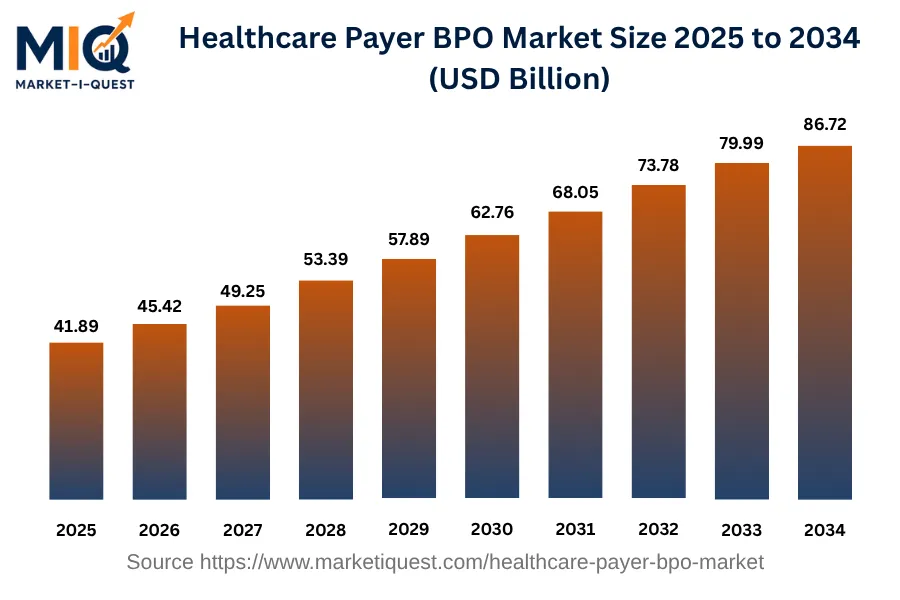
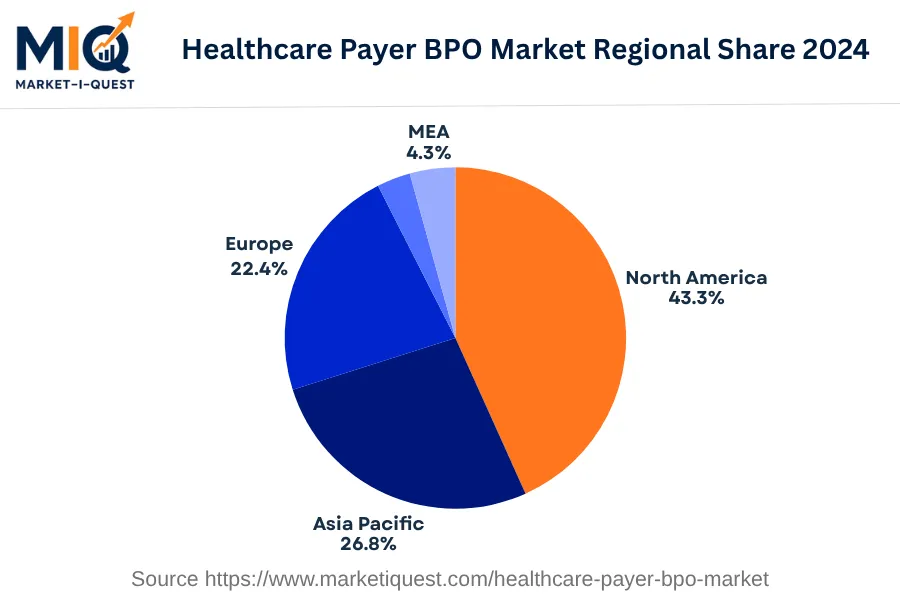
The Healthcare Payer BPO Market measured at USD 38.64 billion in 2024, is set to advance to USD 41.89 billion in 2025. By the end of 2034, the market value will have grown substantially to USD 86.72 billion. This represents a compound annual growth rate of 8.42% from 2025 to 2034. The solid growth trajectory over this period is due to the increasing need for cost-effective operations in healthcare payer processes and the rising demand for specialist services to manage claims and accounts. In 2024, the regional share mix was highlighted by North America commanding a 43.26% market share, followed by Asia Pacific with 26.84%. Europe was close behind with a market share of 22.41%. The remaining regions, LATAM and MEA, accounted for 3.18% and 4.31% of the market, respectively.

Key Takeaways

  • By Device Type - Smartphones held the dominant position in the Healthcare Payer BPO Market.
  • By Technology - Mobile Applications led in the market stakes for 2025.
  • By Application - Telemedicine maintained its leading role within the market for the base year.
  • By End Use - Hospitals accounted for the largest share in the Healthcare Payer BPO Market in the base year.
healthcare-payer-bpo-market market size

Key Driving Factors

Increased Regulatory Compliance Pressure

One major force driving the healthcare payer BPO market is the increasing regulatory pressure on healthcare payers. Regulations such as the Affordable Care Act (ACA) in the United States have intensified the need for healthcare payers to ensure accurate and timely claims processing, fraud detection, and efficient member management. Achieving these requirements mandates substantial resources and expertise, leading many healthcare payers to outsource these tasks to BPO providers specializing in healthcare services. These companies offer advanced data management and processing capabilities, enabling compliance with regulatory norms without significant investment in technology infrastructure or staff training.
Operational Cost Reduction Need

The necessity for operational cost reduction is another key driving factor for the healthcare payer BPO market. The healthcare sector is characterized by high operational costs owing to complex administration processes, which include tasks such as claims processing, member services, HR management, finance and accounts. Outsourcing these non-core functions to BPO service providers can significantly reduce expenditures, offering organizations financial flexibility, improving their bottom line. Moreover, it allows healthcare payers to concentrate on their core competencies like patient care, further improving the quality of services and consequently, patient satisfaction levels.

Market Evolution by Timeline

2019-2023
During this period, there was steady demand from traditional buyers such as hospitals and clinics, primarily in North America and Europe. On the supply side, there was an expansion of services from key BPO players, including the delivery of integrated claims management and member services. Regulatory compliance, such as adoption to the Health Insurance Portability and Accountability Act (HIPAA), was a crucial focus. Commercially, the standard model was mostly long-term contracts with a fixed pricing model. One primary risk was data security due to high sensitivity around personal health information.
2024
In 2024, there was a shift in buyer segments, with increased demand from smaller healthcare providers and payers, especially in Asia-Pacific countries like India and South Korea. On the technology front, the market experienced the introduction of AI and machine learning applications for automated processing. HIPAA continued to be the primary governing regulation, but cybersecurity requirements tightened further. The subscription-based model gained popularity in commercial terms. Data security and privacy remained the biggest concern.
2025-2029
Throughout these years, the use of BPO services expanded beyond traditional healthcare to include wellness and fitness firms. Digital solutions became more prevalent, enhancing services such as medical invoice processing. Policies followed suit; for example, the EU introduced General Data Protection Regulation (GDPR) compliance for protection of personal health data. Contractual terms moved towards a revenue share model, particularly in new market entrants. New risks came from rapid technological advancement, causing a potential gap in staff training and up-skilling.
2030-2034
From 2030 to 2034, the leveraging of blockchain technology became typical in the pursuit of secure and transparent data management in this sector. Demand grew from markets like Africa and Latin America. However, regulatory hurdles increased, with stringent data management and interoperability standards being implemented globally. Commercial agreements started incorporating shared-risk models to counter the risks. The main challenges revolved around managing the complexities of new technologies and complying with globally diverse regulations.

Future Market Outlook

Future Opportunities

The future of the healthcare payer BPO market is increasingly aligned with personalized patient care initiatives, suggesting significant growth potential. In 2021, the American Medical Association advocated for personalized medicine as a means to improve treatment outcomes, directly influencing payer strategies. Regulatory frameworks, such as the Affordable Care Act, are pushing payers to broaden their service offerings, creating opportunities for BPO providers to offer customized healthcare solutions. Notably, the growth in telehealth services, which surged during the pandemic, presents an emerging niche for payer BPOs to support healthcare providers with integrated claims processing. Additionally, the push for value-based care is driving payers to partner with BPO firms to enhance care coordination and population health management. For instance, in late 2022, UnitedHealthcare expanded its partnership with a BPO provider to develop value-based programs tailored to specific demographics, highlighting an avenue for future collaboration. Another crucial area lies in improving member experience, as evidenced by Humana's ongoing focus on user-friendly digital platforms. The recent advancements in data security compliance, such as adherence to ISO/IEC 27001 standards, also open opportunities for BPOs to enhance trust and reliability within their service offerings. In conclusion, aligning with contemporary regulatory demands and technological shifts positions the payer BPO market to capitalize on growing needs for personalized healthcare solutions and compliance-driven services.

Segmentation Analysis

By Device Type

The market is divided into subsegments including Smartphones, Tablets, Wearable Devices, and Laptops. Smartphones accounted for the largest revenue share while Wearable Devices is expected to grow at the fastest CAGR during the forecast period.

Largest Revenue Share

Smartphones

Market Share Leader

In the modern digital age, smartphones have become a necessity for most people around the globe. Their multi-functionality has led to an increase in dependency for professional and personal use, thus driving a strong market. Powerful processors, larger memory storage, and advanced camera capabilities are among the core attributes that make them attractive to consumers. The rise of social media platforms and mobile apps also fuel the demand. Geographically, massive markets like Asia, with its emergent middle-class population, are significant contributors to the revenue. Regulatory supply has been largely consistent, and the purchasing criteria often revolve around the brand's reputation, device features, pricing, and after-sale services. Switching costs are relatively high due to technological advancements and OS ecosystems, leading to customer loyalty towards a brand or OS. The distribution channels range from physical retail stores to websites and apps for online purchasing, making accessibility easier for consumers.

Fastest CAGR

Wearable Devices

Forecast Period Growth Leader

The fastest-growing subsegment is Wearable Devices. We anticipate this due to the increasing health awareness among consumers and the convenience of having one's health vitals tracked and analyzed in real-time. Companies' continuous investment in R&D for technologically advanced gadgets creates more user-friendly, feature-rich devices that further drive adoption. Barriers include people's hesitance towards adopting new technology and the fear of data privacy breaches. Innovative technologies like AI and IoT are acting as catalysts, enhancing the device's capabilities in tracking health and offering customized suggestions. Policymakers' focus on health and fitness can also bolster the growth of this subsegment. However, high capital expenditure and the need for strategic partnerships may pose as challenges. Near-term risks could include the competition with smartphones offering similar features and the market saturation risk in developed regions.

By Technology

The technology market is sub-segmented into cloud computing, mobile applications, wireless communication, and the Internet of Things (IoT), with mobile applications securing the largest revenue share and cloud computing projected to grow at the fastest CAGR during the forecast period.

Largest Revenue Share

Mobile Applications

Market Share Leader

Mobile applications secured the top position for revenue in 2024, primarily due to their widespread usage, flexibility, and ease of access. As smartphone penetration globally skyrockets at a phenomenal pace, mobile applications have become integral components in various sectors, ranging from entertainment, finance, health, to e-commerce. Major geographies contributing to this boom include North America, and Asia, particularly China and India, where app download rates are soaring. In addition, advancements in technology have expanded app functionalities, leading to a surge in demand. Stringent regulations regarding data security and user privacy further propels the demand for secure and reliable apps. High switching costs are also a factor as users invest time and data to customise their applications, making them less likely to switch. Hence, the growth of the mobile application market is driven by a combination of factors that enhance customer experience and satisfaction.

Fastest CAGR

Cloud Computing

Forecast Period Growth Leader

Cloud computing is anticipated to grow at the fastest CAGR during the forecast period. This growth is propelled by drivers such as the increasing adoption of digital business strategies, advancements in internet infrastructure, and the demand for scalable, flexible and cost-effective solutions for businesses. Possibly acting as barriers are concerns regarding data privacy and security. However, ongoing improvements in cloud security and regulatory policies are countering these concerns. Increased capital expenditure on IT services and strategic partnerships between cloud providers and enterprises operating across various sectors are acting as catalysts for cloud computing growth. However, near-term risks may include stringent regulatory changes and the possibility of data breaches. As enterprises accelerate their digital transformation agendas, the adoption of cloud computing is set to rapidly grow.

By Application

The market is divided into subsegments including Remote Patient Monitoring, Telemedicine, Healthcare Workflow Management, Medication Management, and Others. Of these, Telemedicine accounted for the largest revenue share, whereas Healthcare Workflow Management is expected to grow at the fastest CAGR during the forecast period.

Largest Revenue Share

Telemedicine

Market Share Leader

The Telemedicine subsegment leads the market primarily due to its immense potential in extending the outreach of healthcare services to remote locations. Telemedicine has powered healthcare providers with the ability to offer their services to patients irrespective of their geographical presence. The mounting healthcare costs in developed regions have played a critical role in driving the need for affordable treatment options like telemedicine. Furthermore, the prevalence of chronic diseases requiring regular monitoring has propelled the usage of telemedicine services. Additionally, the expedited need for remote healthcare during crisis situations like the ongoing pandemic has further supplemented the growth of the Telemedicine segment. Governments worldwide are realizing the potential benefits of telemedicine and are implementing favorable policies to encourage its adoption, which is further enlarging its revenue share in the market.

Fastest CAGR

Healthcare Workflow Management

Forecast Period Growth Leader

The Healthcare Workflow Management segment is expected to grow at the fastest pace, as hospitals and clinics increasingly leverage digital solutions to streamline their operations and improve patient care. The rise of Big Data and AI technologies is pushing the healthcare industry to harness its data generating capabilities and generate valuable insights for enhanced decision making. Healthcare Workflow Management tools assist medical professionals in reducing manual labor, managing patient data efficiently and minimizing errors, which consequently drives the patient care quality upwards. However, high implementation costs and lack of skilled professionals may hinder the growth of this segment. Partnerships between healthcare institutions and technology firms are likely to act as a significant catalyst for the growth in this segment, as it will assist in overcoming the barriers to adoption.

By End Use

The market is divided into subsegments including hospitals, home care, healthcare providers, and pharmacies. Hospitals accounted for the largest revenue share while home care is expected to grow at the fastest CAGR during the forecast period.

Largest Revenue Share

Hospitals

Market Share Leader

Hospitals in the base year of 2024 commanded the most significant revenue share among all subsegments. The reasons can be attributed to multiple factors. Higher patient footfall, various health-related services, and specialized medical care are predominantly driving the revenue. Hospitals, being a frontline healthcare service provider, are most often the first contact point for the patients. The presence of experienced professionals, well-equipped infrastructure, and an extensive range of healthcare services ensure hospitals' primacy in the healthcare industry. Furthermore, larger budgets and government funding are usually granted to hospitals due to their multifaceted role in healthcare. Hospitals also have higher purchasing power and require comprehensive services, products, and healthcare solutions, which results in more earning potential than other segments.

Fastest CAGR

Home Care

Forecast Period Growth Leader

Home care is identified as the subsegment with the fastest CAGR outlook in the forecast period. This growth is fueled by the growing trend towards ageing in place and the expansion of technology-enabled home health care services. Also, the worldwide shift in preference towards home care due to cost-effectiveness and the familiarity of the home environment plays a crucial role in accelerating the CAGR in the home care segment. Technological innovation is a significant driver, with the development of telehealth, wearable health tech, and health apps enabling better and more convenient care delivery. However, inhibitors like unwillingness to adopt new technology or a lack of infrastructure in developing countries may pose short-term growth risks. Nevertheless, policy changes, partnerships, and capital investments can drive rapid adoption and facilitate home care services' growth.

Competitive Analysis

Key Market Players

Manufacturers / OEMs

Cognizant Technology Solutions Corporation
US
Xerox Corporation
US
Accenture PLC
Ireland

Key Suppliers & Raw Materials

IBM Corporation
US
Infosys BPO Ltd.
India
Wipro Limited
India

Distributors, Integrators & Channel Partners

EXLService Holdings, Inc.
US
Genpact Limited
Bermuda
Hinduja Global Solutions Ltd.
India

Porter’s Five Forces Analysis

Analysis of the competitive forces affecting the healthcare payer BPO market.

Supplier Bargaining Power

Low

High number of suppliers leads to lower bargaining power in the BPO sector.

Buyer Bargaining Power

Medium

Buyers exhibit moderate power due to the availability of multiple BPO service providers.

Threat of Substitutes

Low

Limited available substitutes for comprehensive BPO services limits threat level.

Threat of New Entrants

Medium

Capex requirements and operational complexities balance startup threat in this market.

Competitive Rivalry

High

High rivalry due to presence of multiple established providers in the BPO landscape.

Regional Analysis

Geographic market dynamics and growth opportunities across key regions

Global Market Outlook

healthcare-payer-bpo-market market regional share

North America

In 2024, the North American Healthcare Payer BPO Market was in an active state with significant developments. Key drivers included the ongoing migration towards digitization, spurred by the increasing demand for streamlined healthcare services and the normalization of virtual consultations in the U.S., Mexico, and Canada. The need to reduce operational costs and improve efficiency was another significant driver as healthcare providers sought to outsource non-core operations. Further, regulatory changes, like the U.S. Affordable Care Act, pushed providers towards third-party experts, driving market growth. The year witnessed notable trends such as a rising emphasis on data security amidst increasing instances of cybercrimes targeting healthcare data. This led to widespread adoption of high-security BPO services. In addition, the shift in customer relationship management towards personalization indicated a move towards BPO vendors offering diverse, customer-centric solutions.

In terms of sectors and customers, government organizations outsourced non-core operations to focus on core competencies and improve service delivery efficiency. Enterprise players also sought services to manage growing healthcare data. The impact was significant across the retail sector, with especially big-box retailers increasingly outsourcing to manage personnel health benefits efficiently. Overall, the healthcare payer BPO market in North America in 2024 saw significant growth, driven by demand, digital adoption, regulatory changes, and the quest for improved efficiency and data security.

Asia Pacific

In 2024, the Healthcare Payer BPO Market in Asia Pacific showcased a surge in demand, driven mainly by factors such as increased expenditure on healthcare, growing population needs, and digital acceleration. Specifically, in China and India, large public investments into healthcare infrastructure and a growing patient base due to aging populations instigated an increased demand for efficient BPO services. Japan and South Korea showed tremendous growth in the adoption of advanced technologies such as AI, producing a larger demand for BPO services with technological integration.

Several trends notably shaped the market in 2024. Digital transformation, particularly in Australia and key ASEAN markets, allowed the health BPO space to rapidly evolve, focusing on data analytics and machine learning to improve efficiency. In addition, there was an apparent shift towards national health policies prioritizing optimized insurance claim management, like in India's Pradhan Mantri Jan Arogya Yojana. This policy change led to a rise in partnerships and M&A, making comprehensive BPO service provision a defining characteristic of the market. Additionally, in response to the ongoing COVID-19 pandemic, many governments in the region had invested more into healthcare systems, resulting in expanded roles and heightened expectations for healthcare BPO providers.

Europe

In 2024, the European Healthcare Payer BPO market experienced solid expansion amid a rising demand in various sectors. The prevalent digitization in healthcare payer operations, along with regulatory compliance requirements, significantly adhoc in Germany and the United Kingdom, catapulted the market. Investment in technologically advanced solutions like AI and big data for more efficient administrative processes also proliferated the market across France, Spain, and Italy. Additionally, pricing schemes geared towards affordability in the Nordics and Benelux served as leverage.

The market witnessed noteworthy trends, including a rise in consumer preference for personalized, digitized services and growing partnerships among leading stakeholders. For example, multiple privately held enterprises and government entities across Central and Eastern Europe formed alliances to enhance the supply of technology-driven BPO services for healthcare payers. Changing policy enforcements also influenced the market as numerous healthcare systems within various sectors, including retail, shifted focus towards customer-centricity and transparency. The market leaned towards evolved standardization processes aiming to fortify data security, particulalrly within government and healthcare sectors—a move widely accepted and endorsed among existing and potential customers across Europe.

Latin America

The Healthcare Payer BPO Market in LATAM experienced heightened progression in 2024, primarily driven by factors such as the increasing need for cost-efficiency in healthcare operations, strong governmental support, and technology adoption. With healthcare costs rising in countries like Brazil, Mexico, Argentina, Colombia, Chile, and Peru, public and private sector players turned to BPO services to streamline their operations and reduce administrative expenses. Strict national healthcare regulations also provoked firms to seek BPO services for compliance, particularly in Mexico and Brazil's stringent regulatory environments. Investment inflow, especially in Brazil and Chile, further strengthened the healthcare BPO market, while the integration of advanced technologies like AI and machine learning compelled more BPO adoption.

Significant trends witnessed during the year included a pronounced shift towards digitization and the cloud-based delivery model, primarily driven by their cost and scalability efficiency. Non-traditional collaborations and M&A activity were high, as healthcare entities looked to expand capabilities and gain an edge in a fiercely competitive market — most notable being the partnership between Brazil's Hospital Sírio-Libanês and a leading BPO provider. Enforcement of Brazil's LGPD and Mexico's Federal Law on Protection of Personal Data had a substantial impact, with companies favoring BPO providers that ensured compliance with such regulations. Vaccine distribution complexities due to COVID-19 notably led governments to engage BPOs, reinforcing the sector's importance in Latin America's healthcare machinery.

Middle East & Africa

In 2024, the healthcare payer BPO (Business Process Outsourcing) market in the Middle East and Africa experienced considerable growth and transformation. Driving factors included increased demand for quality healthcare, growing regulatory pressures, technology advancements, and significant investments in healthcare infrastructure, notably in Saudi Arabia, UAE, and South Africa. In particular, the digitization of health services in the UAE and South Africa accelerated the adoption of BPO services. Nazaha and Simap procurement and project management reforms in Saudi Arabia further catalyzed BPO adoption. The market conveyed pricing dynamics sensitive to oil revenues, given the economies' significant dependences - especially apparent in Nigeria, Qatar, and UAE.

Trends shaping the market included a shift towards customer-centric services, as seen in Egypt and Kenya's private healthcare sectors. The penetration of AI and machine learning in health insurance verification processes gained traction in Israel, renowned for its tech-driven economy. New joint ventures and partnerships became prevalent across the region, marking a strategic shift in the BPO market, as companies sought to leverage external expertise to enhance operational efficiency. Lastly, robust policy enforcement was observable, particularly in the UAE and South Africa, driven predominantly by efforts to enhance transparency, reduce process redundancies, and improve service delivery in their largely government-run health sectors.

Recent Industry Developments

Latest market innovations, product launches, and strategic initiatives

April 2026

Carenet Health announced the acquisition of South Africa-based Response BPO, significantly expanding its international footprint. The combination brought together Carenet’s clinical expertise and AI-powered engagement platform with Response’s South Africa-based operations, establishing a major delivery hub in one of the fastest-growing global BPO markets. The integration expanded geographic coverage across the U.S., Caribbean, Latin America, the Philippines, and South Africa.

August 2025

Firstsource Solutions announced a strategic partnership with Guidehealth to accelerate AI-enabled value-based care innovation for health plans. Firstsource’s AI-first approach—recognized as a ‘Front-Runner’ in Generative AI for Healthcare Payers by Everest Group—combined deep domain expertise with its proprietary relAI™ suite and UnBPO™ transformation model. Guidehealth brought proven value-based care capabilities, helping payers and providers shift to models that reward quality, efficiency, and improved patient outcomes.

Frequently Asked Questions