
Healthcare CRM Market Snapshot

Key Players

  • Salesforce (United States)
  • Microsoft (United States)
  • SAP (Germany)
  • Oracle (United States)
  • Accenture (Ireland)
  • Cerner Corporation (United States)
  • AllScripts Healthcare Solutions (United States)
  • Netsuite (United States)
  • Healthgrades (United States)
  • Siemens Healthineers (Germany)

Market Size

Base Year 2024
$21.84 Bn
CAGR
11.75%
Forecast 2034
$66.33 Bn

Market Segments

By Type
Operational CRM, Analytical CRM, Collaborative CRM
By Component
Software, Services
By Deployment Model
Cloud-Based, On-Premise
By Application
Patient Management, Sales Management, Marketing Automation, Reporting & Analytics, Customer Service, Patient Management & Support, Marketing & Digital Marketing, Sales & Task Management & Reporting, Others
By End User
Healthcare Providers, Insurance Companies, Life Sciences Companies

Market Dynamics

Drivers
  • Increasing emphasis on patient engagement
  • Technological advancements in healthcare CRM
Restraints
  • High implementation costs
  • Data security concerns
Opportunities
  • Rising patient awareness
  • Growing healthcare digitization

Market Size

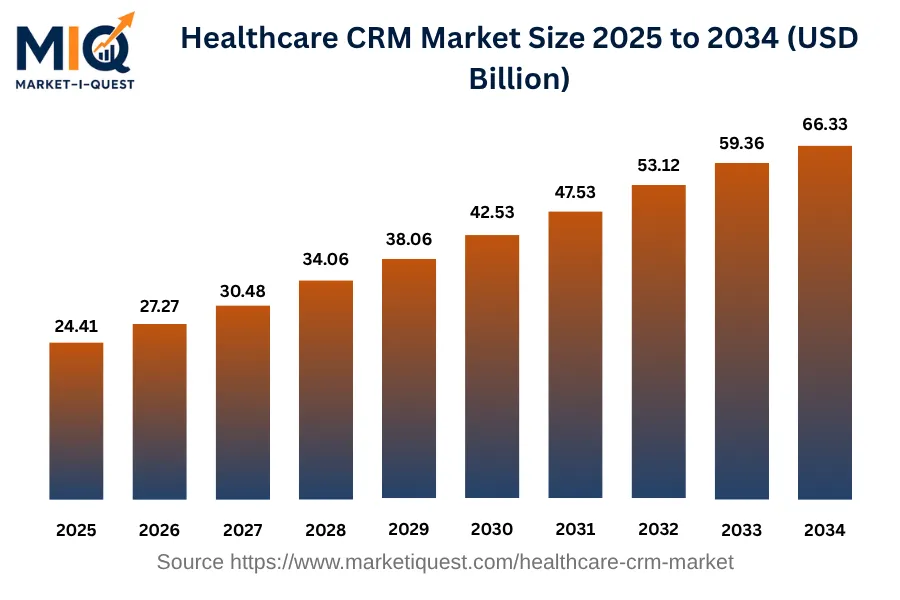
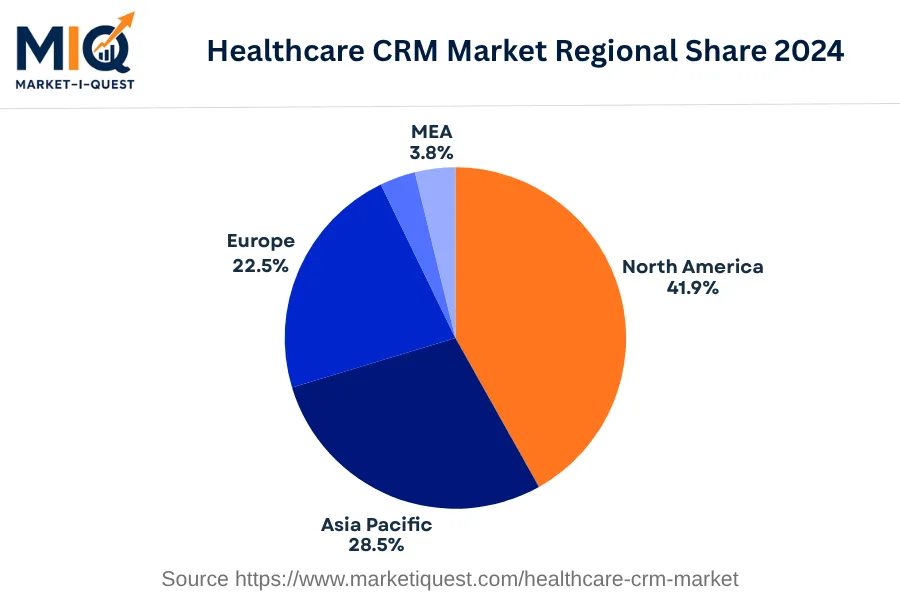
The Healthcare CRM Market, valued at 24.41 billion USD in 2025, is projected to reach 66.33 billion USD by 2034, exhibiting a CAGR of 11.75%. The market's growth path suggests steady expansion, with significant progression evident between the anchor years of 2025 and 2034. The primary reasons for this increase primarily include industry innovation and the adoption of more advanced CRM solutions by healthcare organizations, which optimize patient management and communication. Another contributing factor to the growth is the heightened focus on personalized patient care inspired by customer relationship management practices from other sectors. As of 2024, the regional share of this market is dispersed as follows: North America holds 41.9%, Asia Pacific commands 28.5%, Europe retains a 22.5% share, while LATAM and MEA constitute 3.4% and 3.8% respectively.

Key Takeaways

  • By Type - Operational CRM led accounting for the highest market share in 2024.
  • By Component - Software held the major segment contributing significantly to the market in 2024.
  • By Deployment Model - Cloud-Based model grew fastest showing remarkable expansion in 2024.
  • By Application - Reporting & Analytics led the market showing significant dominance in 2024.
healthcare-crm-market market size

Key Driving Factors

Implementation of Patient-Centric Care Model

Driven by a considerable shift in the healthcare delivery model from provider-centric to patient-centric, healthcare organizations are leveraging CRM tools to improve the patient experience. As healthcare shifts towards personalized and value-based care, CRM tools help organizations interact with patients beyond clinical settings, enabling them to manage relationships and communication effectively. Patient-centric care demands comprehensive and continuous interaction channels, such as email, text messages, and phone calls, which is a core offering of CRM systems. It enables healthcare providers to maintain regular touchpoints and follow-ups, which facilitates trust and patient satisfaction. This demand for a seamless, personalized patient communication platform is driving adoption.
The Need for Integrating Healthcare Data

The proliferation of data in healthcare, from electronic health records (EHR), public health records, to wearables and genomics data, poses a significant challenge in terms of integration, leading to an increased adoption of Healthcare CRM systems. These systems can link disparate data sources, providing a single and holistic patient view, thereby improving decision-making, predictability, and coordinating care more efficiently. Public and private healthcare organizations are actively seeking solutions to manage this growing data landscape, driving the demand for CRM systems that contribute to easing data integration. By simplifying access to integrated data, CRM systems offer providers an opportunity to refine their service delivery, thus leading to substantial market growth.

Market Evolution by Timeline

2019-2023
During this period, buyers mainly consisted of hospitals and healthcare institutions in North America integrating CRM solutions into their systems to improve patient management and outreach. Technology-wise, multichannel marketing automation was commonly adopted while integration with legacy systems remained a challenge. HIPAA compliance became essential, impacting the adoption of CRM systems. In terms of commercial model, suppliers typically offered yearly subscription pricing with discounts for longer commitments. Partnerships between CRM vendors and healthcare organizations were common. Data privacy concerns posed a risk, requiring organizations to implement stringent security measures.
2024
This year saw a shift in demand to European regions, driven by the growing need for relationship management with the ageing population. Artificial Intelligence (AI) technology was nascent, with pilot projects being launched for predictive analytics. The General Data Protection Regulation (GDPR) additional requirements affected adoption, frustrating efforts to grow end-user bases. Commercial models started to focus on value-based pricing, shifting away from set subscriptions. Data breaches, particularly in AI pilot projects, were a significant risk, leading to calls for enhanced cybersecurity measures.
2025-2029
During this span, demand extended to Asian countries buoyed by the rise of digital health start-ups requiring CRM solutions. The supply side was marked by full integration of AI functionality and the adoption of cloud solutions, enhancing accessibility and scalability. However, inconsistent regional data privacy regulations posed challenges. Vendors began offering more flexible, usage-based pricing models. Notably, cross-industry collaborations between technology and healthcare firms emerged. With increased cloud adoption came risk exposure to data breaches, necessitating advanced security periods.
2030-2034
Throughout these years, developing countries in Africa and Latin America emerged as new demand regions, largely due to increasing healthcare digitization efforts. On the supply side, vendors offered advanced CRM solutions with Machine Learning capabilities and interoperability with multiple healthcare systems. Establishment of international data privacy policies made adoption more streamlined. Commercially, vendors moved to outcome-based pricing models leveraging Machine Learning insights. Increased system interoperability heightened the risk of security breaches, causing organizations to implement stricter access controls and encryption protocols.

Future Market Outlook

Future Opportunities

As healthcare organizations increasingly prioritize patient-centric care models, the demand for advanced CRM solutions is expected to grow significantly. In 2024, healthcare providers are likely to seek CRM systems that can incorporate telemedicine functionalities, building on the explosive growth of virtual consultations seen during the recent pandemic. With wearables becoming commonplace, as demonstrated by the rise of devices like Apple Watch and Fitbit, integrating patient data from these devices into CRM systems will offer enhanced insights into health trends and patient behavior. Partnerships between technology firms and healthcare providers, like the collaboration between Google Cloud and HCA Healthcare announced in 2023, highlight the move towards leveraging data analytics for improved decision-making. Additionally, the increasing regulatory emphasis on healthcare data privacy, as illustrated by the implementation of GDPR in Europe, will create opportunities for CRM systems that prioritize compliance and security. Moreover, the shift towards value-based care, as outlined in the Centers for Medicare & Medicaid Services initiatives in the United States, compels healthcare providers to utilize CRMs that track outcomes and optimize resource allocation. Advanced AI algorithms facilitating predictive analytics are anticipated to play a key role in this transition, enabling providers to identify at-risk patients more effectively. In light of these developments, the future landscape of healthcare CRM is poised for transformation, with an emphasis on integrating advanced technology to support holistic patient care strategies.

Segmentation Analysis

By Type

The market is divided into subsegments including Operational CRM, Analytical CRM, and Collaborative CRM. Out of these, Analytical CRM accounted for the largest revenue share while Operational CRM is expected to grow at the fastest CAGR during the forecast period.

Largest Revenue Share

Analytical CRM

Market Share Leader

Analytical CRM has emerged as the subsegment with the most significant revenue share. This is attributed to its inherent ability to collect and analyze customer data, providing enterprises with valuable insights into consumer behavior. A number of factors are driving this trend, key among them being the growing emphasis on personalized marketing and targeted campaigns. By identifying patterns and trends in vast consumer datasets, analytical CRM allows companies to fine-tune their marketing efforts, often leading to increased customer loyalty and improved bottom lines. Furthermore, there is an increased adoption of this technology among the technology, finance, healthcare, and retail sectors, primarily in developed regions such as North America and Europe, owing to their technological prowess and large customer bases. Additionally, regulation in many markets, which encourages the adoption of solutions that bolster data privacy and customer-centric practices, has been a significant revenue driver. In terms of switching costs and purchasing criteria, the robustness of analytics provided and the user-friendliness of the platform tend to be the significant considerations.

Fastest CAGR

Operational CRM

Forecast Period Growth Leader

Operational CRM is forecasted to grow at the fastest pace among the subsegments. Its projected robust growth can be attributed to its crucial role in streamlining day-to-day operations of customer-facing departments like marketing, sales, and services. Operational CRM software's ability to automate processes such as campaign management, transaction processing, and employee performance analysis eliminates operational inefficiencies and reduces costs. High anticipated capital expenditure in CRM software, driven by organizations' need to modernize their customer service functions, could catalyze Operational CRM's uptake. Acceptance of digital tools in emerging markets and strong partnership strategies by leading CRM vendors to expand their global footprint are also likely to bolster growth. However, on the downside, potential adoption barriers might include the high initial investment and the need for ongoing training to keep up with software updates and usage. In the near term, risks could emanate from data security and privacy concerns, underscored by stringent regulatory norms.

By Component

The market is segmented into Software and Services components. In 2024, the Software segment held the largest revenue share, however, Services subsegment is poised to exhibit the fastest compound annual growth rate in the forthcoming period.

Largest Revenue Share

Software

Market Share Leader

The Software component of the market accounted for the bulk of revenues in 2024, and there are multiple factors that have contributed to this situation. Firms across industries are constantly on the lookout for more efficient ways to conduct their operations, cut down costs, drive productivity, and gain a competitive edge. Business software provides a solution to these requirements, thus leading to its widespread adoption. Software enables automation of laborious tasks, simplified data management, enhanced connectivity and communication, which are highly favored by corporations. Furthermore, the technological advances and digital transformation trends across the globe have necessitated businesses to rely heavily on software tools. Regulatory compliance requirements have also necessitated the adoption of certain specific software. Given the crucial role software plays in modern businesses, it positions itself as an indispensable tool, thereby ensuring sustained demand and revenue generation.

Fastest CAGR

Services

Forecast Period Growth Leader

While the Software segment claims the largest revenue share, it is the Services subsegment that is projected to grow at the fastest rate. This growth can be attributed to several factors. First off, the constant evolution in the field of software technologies necessitates regular updates and maintenance services. Many businesses lack the technical expertise required to manage these operations, thereby outsourcing it to service providers. Such needs drive the demand for services associated with software. Furthermore, the increasing trend of software as a service (SaaS), provides businesses with the flexibility of accessing different software functionalities without worrying about its management, which further fuels this segment. Nonetheless, factors such as data security concerns, strict regulatory compliances and high dependency on service providers might pose challenges to growth. Partnerships, capital expenditures and policy changes are other potential catalysts that could tip the scales either way.

By Deployment Model

The market is divided into subsegments including Cloud-Based and On-Premise deployment models. In 2024, the On-Premise model accounted for the largest revenue share, while the Cloud-Based model is expected to grow at the fastest CAGR during the forecast period.

Largest Revenue Share

On-Premise

Market Share Leader

The On-Premise model leads in terms of revenue generation, driven by its inherent benefits and widespread acceptance. This deployment model offers increased control, customization, security, and compliance to the user, making it a favorable choice, especially for large enterprises handling sensitive data. The requirement for hardware investment doesn't detract from its popularity, as organizations perceive the benefits to outweigh the costs. Geographically, the model has a strong footprint, with adoption across different sectors globally, owing to its direct integration with existing systems. The regulatory environment in some sectors, such as banking and healthcare which require data to be stored on-premise due to stringent data security regulations, also contributes to its large revenue share. Meanwhile, purchasing criteria often revolve around data control, system compatibility, and long-term cost-effectiveness, keeping the On-Premise model in demand.

Fastest CAGR

Cloud-Based

Forecast Period Growth Leader

Despite the On-Premise model holding the largest market share, the Cloud-Based model is set for the fastest growth. This is mainly driven by its scalability, cost-effectiveness, and ease of deployment. The elimination of CapEx on hardware and reduced operational expenditure offer significant advantages to SMEs, spurring the adoption of cloud-based solutions. Technological advancements are also catalyzing the shift towards cloud, with efficient data management systems and improved security measures easing concerns about data breaches. However, concerns over data privacy and regulatory compliance act as adoption barriers, posing near-term risks to the growth trajectory. Strategic partnerships with cloud service providers and manifold increase in remote working due to global situations like the COVID-19 pandemic could help overcome these barriers, fueling growth in the segment.

By Application

The market is divided into subsegments including Patient Management, Sales Management, Marketing Automation, Reporting & Analytics, Customer Service, Patient Management & Support, Marketing & Digital Marketing, Sales & Task Management & Reporting, and Others. Reporting & Analytics accounted for the largest revenue share while Patient Management is expected to grow at the fastest CAGR during the forecast period.

Largest Revenue Share

Reporting & Analytics

Market Share Leader

Reporting & Analytics subsegment leads the market revenue in the base year 2024. This predominance is driven by the increasing demand for data-driven decision-making processes across various industries. Businesses today are dealing with an enormous amount of data that needs to be effectively managed and used for predictive analysis and customer understanding. The surge in demand is also due to the introduction of innovative tools that enhance the ability of businesses in forecasting and strategizing their future growth. Additionally, regulatory bodies are imposing stringent policies for data management and privacy, which further fosters the demand for sophisticated reporting and analytics services. Another significant growth driver is the rapidly expanding customer base in developing countries where companies noted a high demand for robust data analysis to increase their market share. The higher purchasing criteria and switching costs in this subsegment also contribute to its revenue growth.

Fastest CAGR

Patient Management

Forecast Period Growth Leader

The Patient Management subsegment is projected to grow at the fastest CAGR due to several factors. The leading growth driver is the rising concern for better healthcare and a surge in chronic diseases that necessitate efficient patient management solutions. This demand is supplemented by advancements in technologies like Artificial Intelligence and Machine Learning, which assist in analyzing patient data for better management and treatment. Also, the increasing partnerships between healthcare providers and tech companies are fostering the development of innovative solutions that make patient management more efficient and user-friendly. Despite the promising growth, this subsegment faces adoption barriers, such as data security concerns and high implementation costs. However, continuous investment in healthcare digitization and favorable policies for healthcare IT are likely to overcome these hurdles, paving the way for the speedy growth of the Patient Management subsegment.

By End User

The market is divided into subsegments including Healthcare Providers, Insurance Companies, and Life Sciences Companies. Healthcare Providers accounted for the largest revenue share while Life Sciences Companies are expected to grow at the fastest CAGR during the forecast period.

Largest Revenue Share

Healthcare Providers

Market Share Leader

Given the pivotal role of Healthcare Providers, it should be no surprise that they generate the lion's share of revenue in this segment. Their position is underpinned by the essentials; they are the primary providers of direct care to patients and, as such, have an immediate and substantive need for the myriad services and products the market offers. This demand, coupled with the size of this subsegment, drives spending. Furthermore, the regulations and guidelines that govern healthcare provision further necessitate significant investment. Geographically, developed regions with higher healthcare spending and robust infrastructures significantly contribute to this subsegment's revenue. The purchasing criteria include effectiveness, regulatory compliance, and cost-efficiency, which remarkably favors established providers. The switching costs for healthcare providers are usually high, discouraging movement away from tried-and-true solutions and further entrenching these providers as the primary source of revenue.

Fastest CAGR

Life Sciences Companies

Forecast Period Growth Leader

Life Sciences Companies are projected to grow at the fastest rate within the forecast period. The primary catalysts for such growth include technological advancements, rising investment in R&D, and increasing partnerships within the industry. Technology, particularly AI and Machine Learning, is acting as a significant mover, enabling these companies to enhance their research capabilities and operations. Additionally, these companies are benefiting from regulatory bodies' efforts to reduce the time to market for innovative products, which acts as a significant growth driver. However, there are some near-term risks. Adoption barriers such as the high costs involved, lack of skilled workforce, and the need for a comprehensive legal and regulatory framework pose challenges. Therefore, continued growth will depend on these companies’ capability to overcome these hurdles while leveraging opportunities.

Competitive Analysis

Key Market Players

Manufacturers / OEMs

Microsoft
US
Salesforce
US
Oracle
US

Key Suppliers & Raw Materials

Siemens Healthineers
Germany
GE Healthcare
US
Philips Healthcare
Netherlands

Distributors, Integrators & Channel Partners

IBM Watson Health
US
Capgemini
France
Accenture
Ireland

Porter’s Five Forces Analysis

This analysis studies the competitive landscape of the Healthcare CRM Market.

Supplier Bargaining Power

Medium

Power influenced by the criticality and differentiation of the providers' services and softwares in the market.

Buyer Bargaining Power

Low

Low due to lack of alternatives and high switching cost, largely determined by the complex nature of Healthcare CRM systems.

Threat of Substitutes

Low

Limited by the need for specialized software meeting regulatory and privacy requirements in healthcare sector.

Threat of New Entrants

Medium

Emerging technologies and remote healthcare practices may encourage new entries, while barriers include deep industry knowledge and high capital investment.

Competitive Rivalry

High

Highly competitive due to international players, frequent technology advancements, and varying customer preferences.

Regional Analysis

Geographic market dynamics and growth opportunities across key regions

Global Market Outlook

healthcare-crm-market market regional share

North America

In 2024, North America's Healthcare CRM (Customer Relationship Management) market witnessed significant expansion due to growing digitalization, heightened healthcare awareness, and demand for efficient patient management. Drivers included the escalating necessity for structured healthcare data in the U.S., especially due to mounting regulatory compliance. Canada experienced a surge in CRM adoption with government-funded healthcare sector's technology investments, focusing on personalized patient care. In Mexico, price affordability played a pivotal role in the CRM market's growth, encouraging small-to-medium-sized healthcare institutions to incorporate CRM systems.

Emerging trends played a significant role, as telehealth became prevalent in North America, necessitating CRM systems' integration for effective patient communication. The shift toward cloud-based CRM solutions, particularly in the U.S and Canada's enterprise sector, seeking data security and ease of access was notable. The U.S. saw an upswing in partnerships between leading CRM system providers and healthcare entities to improve service provision, enhancing competition and fostering innovation in the market. Meanwhile, policy enforcement around data privacy and patient rights in Canada demanded higher standards from CRM providers. Drive for personalized healthcare services in Mexico led to an increase in use of CRM systems within healthcare retail.

Asia Pacific

In 2024, the Healthcare CRM market in Asia Pacific was growing steadily due to technological adoption and healthcare reforms in major economies like China, India, Japan, South Korea, and Australia. Firstly, demand factors played a significant role: increasing patient populations necessitated better management tools, enhancing Healthcare CRM adoption. Regulatory reforms including China's healthcare policy changes and India’s National Digital Health Mission accelerated the market growth fortifying interoperability standards. Investments poured into healthcare technology, with Japan's commitment towards advanced healthcare technologies increasing the market's vitality.

Simultaneously, key trends shaped the market landscape. Driven by the necessity of better healthcare management, large enterprise buyers preferred integrated CRM solutions, forcing providers to enhance interoperability. Digital healthcare transformation led to an influx of data, prompting the adoption of cloud-based CRM solutions especially in Australia and Singapore. Mergers and acquisitions had become more frequent, with partnerships between CRM providers and healthcare institutions becoming common. Finally, addressable privacy concerns compelled industry standards and regulatory tightening, particularly seen in South Korea and Japan's reinforced data protection laws. These factors contributed to making the Asia Pacific healthcare CRM market more dynamic and competitive in 2024, catering primarily to healthcare providers and large enterprise customers while upholding user data privacy and security provisions.

Europe

In the base year 2024, Europe’s Healthcare CRM market was primarily driven by digitalization, an aging population, and changing regulations. Advancements in technology impelled extensive adoption of CRM solutions among healthcare providers, such as clinics, hospitals, and care homes, streamlining operations and improving patient outcomes. In countries such as Germany and the UK, the soaring aging population led to increased demand for efficient healthcare services, catalyzing adoption of Healthcare CRM for better patient management. Subsequently, changes in European healthcare regulations enforced data protection and patient privacy, mandating evolutionary measures in healthcare CRM systems for compliance.

Trends that stood out included a significant shift towards cloud-based CRM systems, especially in technologically advanced regions like the Nordics and Benelux enabling cost-effectiveness and scalability. The market observed intensifying strategic partnerships and mergers & acquisitions involving key CRM solution providers to strengthen their market positions. For instance, in Central & Eastern Europe, businesses partnered with local CRM providers to cater to the specific needs of the regional healthcare sector. Furthermore, strict policy enforcement around data security in France, Spain, and Italy steered a tangible tilt towards CRM solutions featuring robust encryption and security measures. This market landscape in 2024 was predominantly shaped by enterprise and healthcare sector customers.

Latin America

The Latin American Healthcare Customer Relationship Management (CRM) market in 2024 demonstrated noticeable advances, shaped by key drivers and trends. Fundamentally, the market was driven by increased investment in healthcare technology by regional governments and private entities aiming to enhance service delivery and patient engagement. Regulatory acceptance of digital health technologies in countries such as Brazil and Mexico further bolstered this growth. Additionally, the widespread adoption of cloud-based CRM solutions due to their cost-effectiveness and scalability powered market dynamics.

The market's movement was characterized by several identifiable trends. The growing need for patient-centered care led to increased utilization of CRM in the healthcare sector across all targeted countries including Argentina, Chile, and Peru. Technological advancements with the introduction of AI and machine learning in CRM became the new staple, delivering predictive analytics for personalized care. Consolidation remained prevalent, with several significant partnerships and M&A activities observed to expand product offerings and market footprint. Enforcement of data privacy regulations, primarily Brazil's LGPD and Mexico's Federal Law on Protection of Personal Data Held by Private Parties, underlined the importance of security features in CRM solutions. In summary, the Latin American Healthcare CRM market in 2024 was characterized by efforts towards improved patient engagement, influenced by a mix of investment, regulation, technology adoption, and market trends.

Middle East & Africa

In 2024, the Healthcare CRM market in the Middle East and Africa experienced a surge due to increased digitalization and investment in healthcare infrastructure. Market drivers included extensive investment in healthcare technologies from oil-rich nations like Saudi Arabia, United Arab Emirates, and Qatar. Widespread adoption of cloud-based CRM systems, driven by ease-of-use and high scalability, particularly shaped the supply dynamics. Regulatory policies promoting data interoperability in Egypt and South Africa further stimulated market expansion. The market witnessed a trend for bespoke CRM solutions tailored to specific healthcare domains, such as clinical trial management and patient engagement. As the digitization push continued, technology integrations with artificial intelligence and machine learning became increasingly prevalent. Key partnerships and M&A activity were noted, including Saudi Arabia's Ministry of Health joining hands with leading CRM providers to enhance patient services. In Israel, a significant uptick in the adoption of CRM was observed in both governmental and private healthcare settings.

Understanding patient behavior emerged as a critical focus area, reshaping channel dynamics to increase engagement using methods such as smart messaging and AI bots. Standards for data security and privacy were meticulously enforced, particularly in countries such as the United Arab Emirates and South Africa, boosting trust in CRM systems among healthcare consumers and providers.

Recent Industry Developments

Latest market innovations, product launches, and strategic initiatives

December 2025

The SEC's Regulation S-P, significantly amended in 2024, required larger firms to comply by December 3, 2025, establishing comprehensive requirements for protecting customer information, with implications for healthcare CRM systems.

September 2025

Close-Up International, a global leader in AI-powered CRM and business intelligence solutions for the pharmaceutical industry, acquired MobileDotRep, a life sciences CRM solution provider based in Thousand Oaks, California. The acquisition positioned Close-Up to compete with Veeva and Salesforce in the U.S. pharma CRM market.

Frequently Asked Questions