
Handheld Surgical Devices Market Snapshot

Key Players

  • Medtronic (Ireland)
  • Johnson & Johnson (United States)
  • B. Braun Melsungen AG (Germany)
  • Stryker Corporation (United States)
  • Olympus Corporation (Japan)
  • Conmed Corporation (United States)
  • Intuitive Surgical (United States)
  • Ethicon Inc. (United States)

Market Size

Base Year 2024
$6.3 Bn
CAGR
6.8%
Forecast 2034
$12.16 Bn

Market Segments

By Product
  • Forceps
  • Retractors
  • Dilators
By Application
  • Orthopedic Surgery
  • Cardiology
  • Ophthalmology
  • Others

Market Dynamics

Drivers
  • Technological advancements
  • Rising surgical procedures
Restraints
  • High device procurement costs
  • Strict regulatory compliance requirements
Opportunities
  • Advanced technology integration
  • Emerging economies growth

Market Size

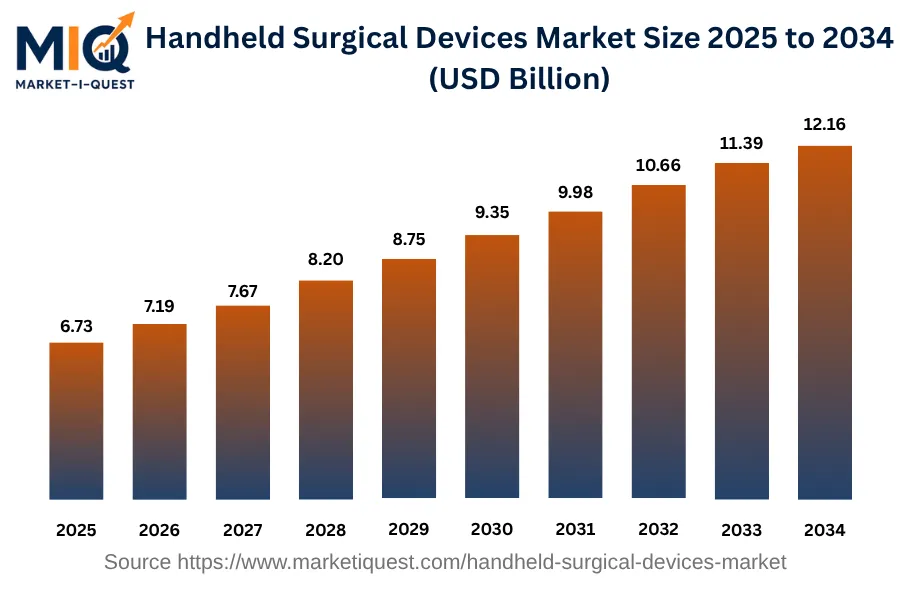
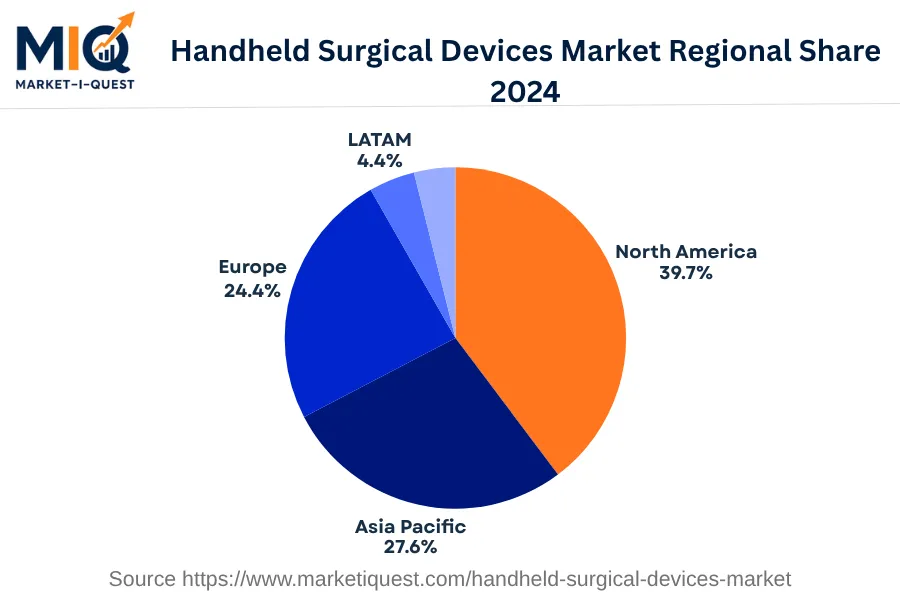
The Handheld Surgical Devices market valued USD 6.73 billion in 2025 and is projected to grow to USD 12.16 billion by 2034 at a CAGR of 6.8%. The market highlighted a rise between 2024 when it held a value of USD 6.3 billion, and 2025, with an increase in value to USD 6.73 billion. Over the period of nine years from 2025 to 2034, the market nearly doubles in size indicating the considerable growth in this period. The expansion is driven due to several factors driving the demand for these devices. The regional share in 2024 was dominated by North America with 39.7%, followed by Asia Pacific and Europe, holding 27.6% and 24.4% respectively. Latin America and the Middle East and Africa made up the remaining share at 4.4% and 3.9% respectively.

Key Takeaways

  • By Product - Forceps led the pack accounting for the highest usage in 2024.
  • By Application - Cardiology Surgery dominated the market by holding the largest share.
handheld-surgical-devices-market market size

Key Driving Factors

Integration of Artificial Intelligence and Robotics

The handheld surgical devices market saw a growing trend of integrating artificial intelligence (AI) and robotics in their devices. Medical device companies increasingly recognized that AI can enhance the surgical precision and efficiency of handheld instruments. For instance, robotic assistance is capable for eliminating hand tremors during critical procedures, providing surgeons with enhanced stability. Moreover, AI can offer data analysis for guiding surgeons towards the safest, most efficient route to the target area, reducing operative time and potential surgical complications. With the development and implementation, these integrations have attracted substantial interest from surgeons and healthcare facilities globally due to the improved patient outcomes and overall efficiency
Shift towards Minimally Invasive Surgeries

There is an noticeable shift in the global healthcare sector towards minimally invasive surgeries (MIS). MIS involves smaller surgical incisions, notably used for reducing tissue damage and offering quicker recovery times. These procedures are therefore considered as more patient-friendly, driving a rise in demand among healthcare consumers. Handheld surgical devices are essential to these procedures as they facilitate enhanced visibility and precision during operations. Consequently, the production of more advanced handheld devices optimized for minimally invasive surgery is considerably boosting the market's growth.

Market Evolution by Timeline

2019-2023
This period saw the introduction of smarter handheld surgical devices, notably enabled by IoT. Major buyers included public and private hospitals in developed regions, particularly North America and Europe, which seek for enhancing surgical outcomes and efficiency. Regulatory frameworks like the FDA's 510(k) premarket notification were addressed by vendors for selling these devices. Pricing models often favoured combined contract scenarios or pay-per-procedure approaches.
2024
In 2024, it became evident that handheld surgical devices gained acceptance in emerging countries like India, China. The need to support large populations and the aim to improvise surgical methods drove purchase decisions. Local standards similar to Europe's Medical Device Regulation (MDR) came into effect in various countries, influencing the adoption of these devices. Commercially, long-term leasing became a popular model.
2025-2029
A projected increase in demand will likely be witnessed from private clinics and telemedicine providers, driven by the increasing adoption of remote surgery. However in terms of policy, projected rise in cyber-security standards will significantly shape the technology adoption. Procurement will increasingly shift towards Performance-based contracts, which will subsequently create a direct link between payment and surgical outcomes.
2030-2034
During this period, global health bodies will likely initiate massive drives for introducing handheld surgical devices into under-resourced health systems. Private sector hospitals will also commonly seek these devices due to the rise in minimally invasive surgeries. Manufacturers will likely address escalating raw material costs but made headway with generational advancements in battery life and precision control. Regulatory focus on device disposal and recycling will likely impact production preferences. Procurement will likely witness a shift towards comprehensive service contracts, inclusive of maintenance and upgrading.

Future Market Outlook

Future Opportunities

Currently, the market reflects a pressing demand for improved accessibility to advanced surgical tools, particularly in emerging economies such as India and Brazil. The World Health Organization initiated programs aimed at enhancing surgical care in low-resource settings, indicating a potential opportunity for the deployment of portable surgical devices in these regions. Partnerships between companies like Stryker and governmental health organizations focusing on providing surgical training and equipment in underserved areas can shape future market dynamics. In addition, advancements in telemedicine technologies are likely to create avenues for remote surgical assistance and training, allowing surgeons to utilize handheld tools with connectivity features. Regulatory bodies such as the FDA are also paving the way for novel handheld devices that comply with newly defined safety standards, which can open doors for market growth. Furthermore, the trend of personalized medicine is fostering the development of handheld surgical devices specifically designed for individual patient needs. Academic collaborations, like those between universities and medical device firms, are likely to result in breakthrough designs and functionalities that meet growing demands. As the demand for outpatient surgeries increases, companies investing in adaptable surgical solutions will find growth opportunities.

Segmentation Analysis

By Product

The market is divided into subsegments including Forceps, Retractors, and Dilators, with Forceps accounting for the largest revenue share and Dilators expected to grow at the fastest CAGR during the forecast period.

Largest Revenue Share

Forceps

Market Share Leader

Forceps are the primary subsegment contributing to the majority of the revenue in this market. This dominance is majorly caused due to the essential nature of forceps as a tool in a vast range of surgical procedures across specialties. Specifically, in dental surgeries and routine medical procedures. Their effectiveness, ease of use, and low-cost production contribute significantly to their increased consumption. However, the availability across a broad geographical spread, which includes not only established markets but also developing markets. The implementation of regulations ensuring the mandatory sterilization or replacement of forceps after use also acts as a significant driver of sales volume.

Fastest CAGR

Dilators

Forecast Period Growth Leader

Dilators are projected to grow at the fastest CAGR within this market. This subsegment's growth can be attributed to technology's rapid advancements and the increasing frequency of conditions necessitating the use of dilators, such as atresia, stenosis and constipation. The role of dilators is also expanding for including diagnostic and preparatory procedures, notably in healthcare sectors including cardiology and gynecology. While dilators are well-established in developed markets, they are being rapidly adopted in developing regions due to improved healthcare infrastructure and awareness. Ongoing research and training initiatives for medical professionals are working to address these barriers, promising sustained growth for the subsegment.

By Application

The market is divided into subsegments including Orthopedic Surgery, Cardiology, Ophthalmology, and others. With a substantial share of the market, Cardiology accounted for the largest revenue in 2024 while Ophthalmology is expected to grow at the fastest CAGR during the forecast period.

Largest Revenue Share

Cardiology

Market Share Leader

Cardiology is the most revenue-generating subsegment in this market, majorly driven by the high prevalence of cardiovascular diseases worldwide. The usage of advanced technology in cardiac treatments and surgeries also contributes to its high revenue share. High purchasing power of patients in developed regions such as North America and Europe along with strong healthcare infrastructure ensures steady demand. Furthermore, the presence of favorable governmental policies and reimbursement schemes drives the market growth. The key buying criteria include effectiveness, safety profile and cost-effectiveness of the cardiovascular treatments.

Fastest CAGR

Ophthalmology

Forecast Period Growth Leader

Ophthalmology is anticipated to witness the fastest growth during the forecast period. Factors driving this growth include a rise in aging population, an increase in vision impairment and eye disorders and the consequent surge in demand for eye care treatments. Additionally, technological advancements in eye surgeries and the development of innovative products such as smart lenses and digital vision correction solutions boosts the potential of this subsegment. Reducing factors include policy reforms aimed at health inclusion, investments in eye-care tech-startups, and strategic alliances to reach untapped markets. As the market evolves, making eye-care affordable and accessible will be the key determinants for growth in the coming years.

Competitive Analysis

Key Market Players

Manufacturers / OEMs

Johnson & Johnson
US
Medtronic
Ireland
Stryker
US

Key Suppliers & Raw Materials

Becton, Dickinson and Company
US
Intuitive Surgical
US
Smith & Nephew
UK

Distributors, Integrators & Channel Partners

Henry Schein
US
Patterson Companies
US
Dentsply Sirona
US

Porter’s Five Forces Analysis

An analysis of the competitive forces shaping the handheld surgical devices market.

Supplier Bargaining Power

Medium

Power is moderated by multiple suppliers but high development and material costs exist.

Buyer Bargaining Power

Low

Limited by high switching costs and the critical nature of surgical devices.

Threat of Substitutes

Low

Constrained by the specificity and regulatory approval of surgical devices.

Threat of New Entrants

Low

Barriers include high capital investment, patent protection, and intensive certification processes.

Competitive Rivalry

High

Intense competition driven by technological advancements and diversified product portfolios.

Regional Analysis

Geographic market dynamics and growth opportunities across key regions

Global Market Outlook

handheld-surgical-devices-market market regional share

North America

In the base year of 2024, the market witnessed significant growth in North America particularly in the U.S., Canada and Mexico. This expansion was primarily driven by increasing investments in healthcare infrastructure and advancements in surgical technologies. The widespread adoption of minimally invasive surgeries supported for driving the demand for handheld surgical devices throughout hospitals and clinics. Additionally, government regulations encouraging the safe usage of these devices contributed to the market's growth.

The notable trends within the market included healthcare providers with growing preference for technologically advanced handheld surgical devices. The shift in user preference also drove innovative partnerships and acquisitions among top companies in an effort to consolidate market shares. Furthermore, the rising enforcement of stringent safety standards enforced the manufacturing of high-quality and reliable surgical instruments. The demand for handheld surgical devices predominantly arised from hospitals, ambulatory surgical centers and specialty clinics due to their heavy reliance on equipment for daily operations. Additionally, retail pharmacies witnessed an increase in the sales of these devices due to their high necessity in emergency care situations.

Asia Pacific

In 2024, the Handheld Surgical Devices market in the Asia Pacific region demonstrated significant growth and vitality. Drivers of this trend included increased investment in healthcare infrastructure, particularly in China and India. Regulatory changes in Japan and South Korea also supported market expansion, with stringent yet supportive frameworks facilitating increased technology adoption. Furthermore, competitive pricing dynamics spurred by local manufacturers in key ASEAN markets broadened device accessibility and market reach.

Parallel to these drivers, several trends emerged in 2024. Distinct shifts in buyer behaviour were observed, with increased preference for minimally invasive surgical procedures. This shift was mirrored in technology changes, with novel products like robotic surgical devices gaining traction in Australia. Additionally, channel dynamics underwent significant transformation, as digital platforms began to dominate procurement processes in China and India. Partnership and M&A activities were rife, especially in Japan’s corporate sector. Enforcement of the Asia-Pacific Economic Cooperation (APEC) standards on medical devices became a norm, enforcing stringent quality controls across the region. These drivers and trends were particularly influential in sectors like healthcare, manufacturing, and retail.

Europe

In 2024, the European market exhibited increased dynamism, resulting from enabling regulations, sustained investment, varied supply dynamics, and technology adoption patterns across countries. Drivers fuelling this segment included increased funding in healthcare technologies, notably in regions such as Germany and the United Kingdom majorly due to initiatives supported advancements by government in minimally invasive surgery applications. Demand rose particularly in France and Italy, with aging populations required an rise in surgical procedures. In regions such as Central & Eastern Europe, easier regulatory paths boosted the market presence of advanced surgical tools.

A shift towards digitization saw adoption of Internet of Things (IoT) based tracking systems in handheld surgical devices, primarily in the Nordics and Benelux, enhancing patient safety and operational efficiency. Interoperability standards witnessed stricter enforcement in the health insurance funds, driving market evolution towards unified digital solutions. The M&A climate remained active, mainly in Spain and Italy, caused by the intention of achieving scale, expanding offerings, and competitive positioning. Overall, customer segments notably influenced by these drivers and trends included healthcare providers, enterprises in medical technology manufacturing, government-related healthcare schemes, and distribution channels in retail for medical devices.

Latin America

In 2024, the Handheld Surgical Devices Market in Latin America (LATAM) demonstrated robust growth due to several key drivers and trends. Increased healthcare investment from governments in nations such as Brazil, Mexico, and Argentina was instrumental in driving demand, bolstering resources for surgeries requiring these precision tools. Further demand was prompted due to the growing adoption of minimally invasive surgeries within the healthcare sector, a popular preference among healthcare professionals in Colombia, Chile, and Peru. Supply dynamics were influenced by price competitiveness, with affordable options from local manufacturers emerging prominently.

Consumer trends revealed a preference for innovative, technologically advanced surgical devices in the healthcare field. The rise of telehealth and digital health services in LATAM countries led by Argentina and Chile saw adoption of software-based handheld surgical devices, setting a new course for product development. Regarding channel dynamics, healthcare providers increasingly favored direct purchases from manufacturers. Noticeably in Brazil and Mexico, partnerships and mergers among medical device manufacturers became common, fostering innovation and resource integration. Healthcare sector remained the key customer base, with hospitals, clinics, and specialty surgical centers as primary end-users of handheld surgical devices.

Middle East & Africa

In 2024, the Middle East and Africa's handheld surgical devices sector remained dynamic, driven predominantly by rising investments, advanced technology adoption, and evolving healthcare infrastructure. Countries like Saudi Arabia, United Arab Emirates, Qatar, and Egypt demonstrated increasing demand, largely catapulted by their governments' investment in health advancements and the unrelenting drive for modern surgical technique assimilation. Furthermore, government policies in South Africa, Nigeria, and Kenya support a conducive environment for the sector's growth.

The industry’s prevailing trends centered around buying behavior transformations, with a noticeable pivot towards digitized surgical tools, translating into significant changes in product preferences. Robust partnerships in the health-tech realm and subsequent M&A activities, particularly apparent in Israel. Technology shifts to minimally invasive musculoskeletal and laparoscopic surgery devices were observable across the region. The medical standards enforcement, such as South Africa's National Norms and Standards for Sterile Usage Medical Devices, heightened the pressure on manufacturers to improve product safety and quality. Together, these controllers triggered substantial market adjustments, shaped the buyer behavior, and underpinned the year's market performance.

Recent Industry Developments

Latest market innovations, product launches, and strategic initiatives

December 2025

The organization received FDA clearance for its NanoWrist Scissors and Forceps. These are highly flexible, tiny handheld instruments that plug directly into a robotic system, allowing surgeons to perform extremely delicate work on small blood vessels without hand tremors.

April 2025

B. Braun expanded its manufacturing operations for surgical instruments specifically to meet the surging demand from same-day surgery centers. This move adapts to the broader industry trend of surgical procedures moving out of traditional, large-scale hospitals.

Frequently Asked Questions