Hand Dryer Market Snapshot

Key Players

  • Dyson Ltd (United Kingdom)
  • Excel Dryer Inc (United States)
  • Mitsubishi Electric Corporation (Japan)
  • World Dryer Corporation (United States)
  • American Dryer Inc (United States)
  • Palmer Fixture (United States)
  • Bio JetDrier (China)
  • Saniflow Corporation (Spain)
  • JVD SAS (France)
  • Stiebel Eltron (Germany)

Market Size

Base Year 2024
$1.42 Bn
CAGR
8.6%
Forecast 2034
$3.24 Bn

Market Segments

By Product Type
Jet Air, Hot Air
By Activation Type
Automatic Hand Dryers, Push-Button Hand Dryers, Wave Sensor Hand Dryers
By Installation Type
Wall-Mounted Hand Dryers, Floor-Mounted Hand Dryers, Recessed Hand Dryers
By End Use
Public Restrooms, Commercial Buildings, Hospitals and Healthcare Facilities, Educational Institutions, Transportation Hubs

Market Dynamics

Drivers
  • Rising hygiene awareness
  • Environment sustainability push
Restraints
  • High installation costs
  • Preference for paper towels
Opportunities
  • Increasing hygiene awareness
  • Growth in hospitality industry

Market Size

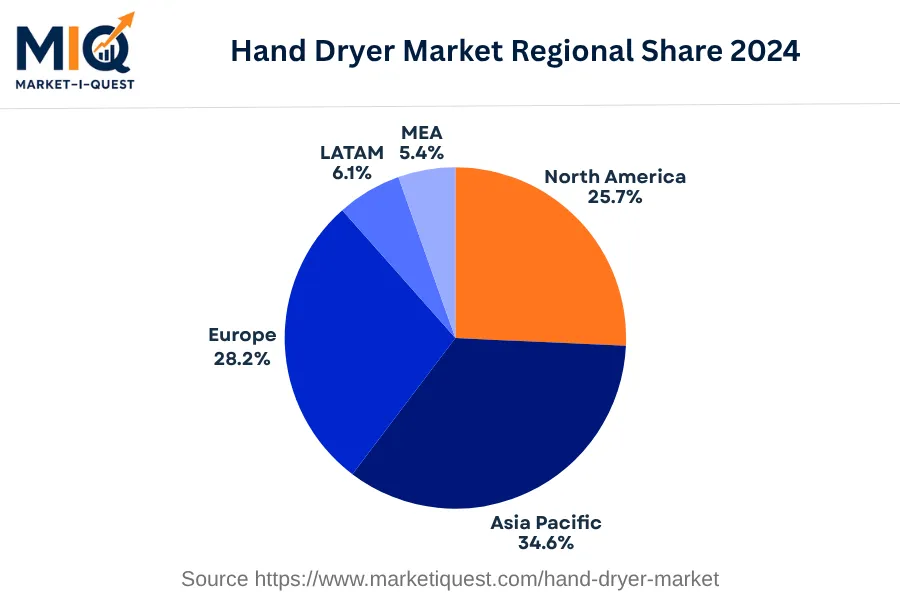
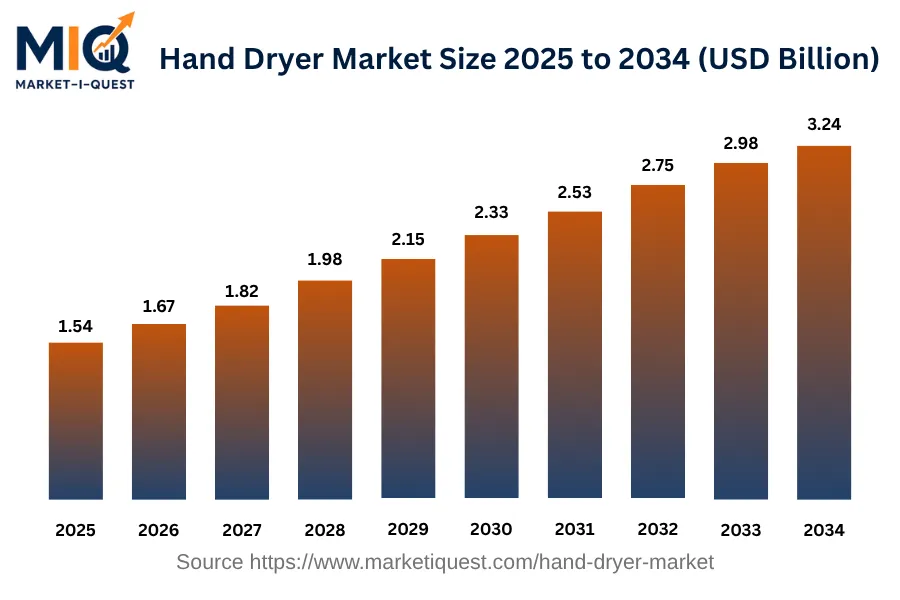
The Hand Dryer market grew at 1.42 billion dollars in 2024 towards at a increasing value of 1.54 billion dollars in 2025 and projected to reach 3.24 billion dollars by 2034, growing at a CAGR of 8.6%. With increasing value over the forecasted period indicating consistent growth in market. Whereas, regional distribution in 2024 of the hand dryer market where Asia Pacific held the largest share at 34.58%, followed by Europe at 28.16% and North America at 25.73%. Latin America with 6.11% and Middle East and Africa with 5.42%. Indicating a global widespread of the market.

Key Takeaways

  • By Product - Jet Air held a leading position.
  • By Activation Type - The Automatic Hand Dryers category stood out.
  • By Installation Type - Wall-Mounted Hand Dryers were dominant.
  • By End Use - Public Restrooms held the majority share.
hand-dryer-market market size

Key Driving Factors

Increased Emphasis on Water Conservation

A significant driver in the growth of hand dryer market highlights global water conservation. Governments, regulatory bodies and environmental organizations are driving the market for strategies to reduce water usage, while hand dryers offer sustainable alternative to paper towels. Industries like hospitality and commercial establishments, including malls and public facilities are shifting to hand dryers, promoting the market growth. This shift plays a major role for having eco-friendly profile as per corporate social responsibility standards. Furthermore, consumers are becoming more environmentally aware thus, contributing to increased adoption of hand dryers.

Minimal Operating Cost & Low Maintenance

Whereas, another key driver is cost-effectiveness of hand dryers in comparison with paper towels. Hand dryers have minimal operating expenses with requirement for low maintenance than other alternatives. For owners of commercial properties like restaurants, gyms and theaters, these cost savings are significant due leading towards reductions in expenses. Reduced need for restocking and disposal of paper towels reduces the amount of labor, lowering overall operations cost. Thus, long-term cost savings and convenience factor provided by hand dryers make businesses prefer them over paper towels resulting in driving the market demand.

Market Evolution by Timeline

2019-2023
Within this period, hand dryer sales proliferated in North America and Europe as more businesses and institutions sought to reduce paper towel waste. Eco-friendly models were most preferred, especially those compatible with LEED certification. Major suppliers like Dyson and Excel kept improving their high-speed, energy-efficient designs. Airblade technology became mainstream, taking to recurring issues with excessive noise in public restrooms. Several states in U.S. enacted noise code standards for public bathrooms which increase adoption of quieter, brushless motor models. Hand dryer prices remained steady with contracts focused on bulk purchases for large facilities. Despite rising demand, supply faced disruptions due to U.S.-China trade tensions which threatened sourcing of essential parts.
2024
In 2024, hand dryer market saw a shift in demand from developed countries to fast-growing economies in Asia. China, India, Japan became key buyers due to construction boom and an increased interest in hygiene props in their burgeoning commercial sectors. Eco Fast, a dryer that uses 85% less energy, became widely accepted while fulfilling United Nation's Sustainable Energy For All initiative (SEFA). But costly investments in advanced technologies kept pricing high. This led to strategic partnerships between manufacturers and wholesale suppliers to mitigate risks. But certain regions faced technical hurdles regarding their power backbones, which restricted the product's usage.
2025-2029
During this period, hand dryers became more common in sectors like hospitality, corporate offices and transport hubs across Latin America and Middle East. Cities like Dubai, Rio de Janeiro saw widespread installation. This period also saw introduction of more compact models from manufacturers with enhanced energy and space dynamics. Cutthroat competition among manufacturers led to a soft decline in prices amidst differentiated pricing models. Partnerships with local distributors were common to navigate varied regional regulations, like Brazil's Inmetro requirements and UAE's ESMA standards. But inconsistent power infrastructures in these regions posed intermittent supply challenges.
2030-2034
Low energy and thinner models gained traction as cities worldwide became more compact and conservation conscious. Hand Dryers became standard amenity in all public and commercial spaces, increasing demand in regions like Africa and South Asia. Cities like Lagos and Karachi saw spike in demand of these new models. New entries into market from electronics companies spiced competition, leading to aggressive pricing tactics. Companies handed over installation and maintenance to third parties to focus more on core manufacturing. More nations adopted stricter regulations regarding power use and waste management, increasing adoption of green models. Yet, supply faced challenges due to raw material price fluctuations and shipping disruptions amid climate concerns.

Future Market Outlook

Future Opportunities

As hand dryer market evolves, future opportunities emerge due to regulatory shifts and growing environmental awareness. The American National Standards Institute is currently working on standards that may emphasize energy efficiency for commercial hand dryers, likely impacting product development and adoption. Increasing demand for environmentally sustainable products is prompting manufacturers like World Dryer to explore use of biodegradable materials in their designs. Adoption of stricter hygiene standards in public spaces, driven by Centers for Disease Control and Prevention, is likely to push more facilities towards touchless hand dryer installations. In Europe, the European Commission's Green Deal emphasizes reduced carbon footprints, urging businesses to favor energy-saving hand dryers, enhancing market potentials for eco-conscious brands. Additionally, addressing consumer preferences for noise reduction represents a significant opportunity, particularly in sectors like healthcare and hospitality, where noise can be disruptive. Partnerships between hand dryer manufacturers and facility management companies are on rise, creating synergies aimed at improving user experience and operational efficiency. As sustainability becomes core value for many organizations, collaboration with environmental agencies can enhance product credibility, further driving customer choice. These trends indicate market leaning toward innovative yet sustainable solutions, which will likely shape product offerings and consumer expectations for years to come.

Segmentation Analysis

By Product Type

The market is divided into subsegments including Jet Air and Hot Air. Jet Air accounted for the largest revenue share while Hot Air is expected to grow at the fastest CAGR during the forecast period.

Largest Revenue Share

Jet Air

Market Share Leader

Jet Air holds the largest revenue share in the segment, driven by a set of interrelated factors. On the customer side, the high demand in major geographies like US and China underpins its leadership. These regions host a significant number of air travel companies and also have rising middle-class populations who can afford air travel frequently. Meanwhile, industries, particularly e-commerce and logistics, heavily rely on jet air for transporting goods, further driving demand. From a supply standpoint, the long-standing existence of jet air has led to a mature market with significant manufacturing capacities and broad distribution networks making it easier for customers to access. Moreover, the industry has been stringently regulated, favoring traditional and proven methods like Jet Air over newer alternatives due to perceived risk and safety concerns. Lastly, the cost of switching from jet fuel to alternatives can be prohibitively high which helps in maintaining its dominant position.

Fastest CAGR

Hot Air

Forecast Period Growth Leader

Though Jet Air holds majority of market share, Hot Air is projected to be the fastest-growing subsegment. This newly emerging technology's impressive growth is attributed to catalysts such as innovative technology, supportive policy, and inspiring partnership models. The innovation in designing more energy-efficient hot air systems has created significant interest and adoption, projecting future growth. From a policy perspective, increasing environmental regulations are favoring cleaner modes of transportation like Hot Air. In terms of capital expenditure, while high upfront costs can be prohibitive, Hot Air systems' long-term cost benefits appeal to financially shrewd customers and businesses. In addition, partnerships among manufacturers, tech providers, and end-user industries are aiding market penetration, while risk of technology incompatibility and uncertain regulatory environment represent near-term hurdles to growth.

By Activation Type

The market is divided into subsegments including Automatic Hand Dryers, Push-Button Hand Dryers, and Wave Sensor Hand Dryers. In 2024, Automatic Hand Dryers accounted for the largest revenue share while Wave Sensor Hand Dryers are anticipated to grow at the fastest CAGR during the forecast period.

Largest Revenue Share

Automatic Hand Dryers

Market Share Leader

Automatic hand dryers have been leading the market in terms of revenue due to various factors. One of the key drivers is their increasing adoption in various high-traffic facilities like airports, malls, and restaurants due to their hygiene benefits. They are touchless and thus prevent cross-contamination. Additionally, they provide significant cost savings as they eliminate the need for paper towels, their disposal, and frequent servicing. Another driver is the growing awareness about environmental sustainability. Unlike paper towels, automatic hand dryers eliminate paper waste, contributing to environmental conservation efforts. Regulatory bodies in several regions are encouraging businesses to adopt sustainable practices, further driving adoption of these dryers. Their sales are majorly through direct channels manufacturers to businesses, and to a lesser extent through retail.

Fastest CAGR

Wave Sensor Hand Dryers

Forecast Period Growth Leader

Wave sensor hand dryers are expected to demonstrate highest growth rate in the foreseeable future. This growth can be attributed to their advanced technology which provides enhanced convenience and hygiene. These dryers are activated by a simple wave of the hand, minimizing contact and thus reducing risk of bacteria spread. The ongoing pandemic has underscored the importance of hygiene, catalyzing the adoption of these wave sensor dryers across different sectors. Additionally, their energy-efficient operation lowers long-term costs, making them an appealing choice for many businesses. While high upfront costs might pose as a barrier, potential savings in the long run are likely to drive their adoption. Partnerships with facilities management companies could open new avenues for their expansion. However, near-term risks include potential supply chain disruptions due to geopolitical tensions or unprecedented situations such as pandemics.

By Installation Type

The hand dryer market is segmented by installation type, including Wall-Mounted Hand Dryers, Floor-Mounted Hand Dryers, and Recessed Hand Dryers. Wall-Mounted Hand Dryers accounted for the largest revenue share while Recessed Hand Dryers is expected to grow at the fastest CAGR during the forecast period.

Largest Revenue Share

Wall-Mounted Hand Dryers

Market Share Leader

The Wall-Mounted Hand Dryers subsegment dominates the hand dryer market due to several reasons. They are considerably popular due to the ease of installation, cost-effectiveness compared to other types, and space-saving attributes, making them suitable for facilities with limited floor space. These dryers save space and offer efficient power usage, offering cost savings on a longer run, which results in higher adoption by commercial establishments like restaurants, hotels, and offices. This type of hand dryer also remains a preferred choice due to lower maintenance requirements, further driving its market penetration. The other consideration is that wall-mounted hand dryers can be installed at different heights, making them accessible to all users, enhancing user experience, and hence demand.

Fastest CAGR

Recessed Hand Dryers

Forecast Period Growth Leader

Despite their smaller revenue share, Recessed Hand Dryers are forecasted to witness the fastest growth. This is because they provide a modern aesthetic appeal blended with practical utility. They are often incorporated during the construction phase itself, perfectly fitting into bathroom decor. This gives neater appearance and reduces the protrusion in the room, minimizing risk of damage or vandalism that is often associated with wall-mounted units. The Recessed Hand Dryers offer more hygienic solution, as they are equipped with trays to contain water droplets, reducing the spread of bacteria. But the high installation cost and need for significant renovation might act as a barrier to their large-scale adoption. Partnerships with construction firms and policy incentives towards eco-friendly hand drying solutions could be potential catalysts for their growth. The adoption rate and market growth and regulatory norms related to hygiene and sustainability are some potential risks that need monitoring.

By End Use

The market is divided into subsegments including Public Restrooms, Commercial Buildings, Hospitals and Healthcare Facilities, Educational Institutions, and Transportation Hubs. Hospitals and Healthcare Facilities have accounted for the largest revenue share whereas Transportation Hubs are expected to grow at the fastest CAGR during the forecast period.

Largest Revenue Share

Hospitals and Healthcare Facilities

Market Share Leader

Hospitals and Healthcare facilities accounted for the largest share of market in 2024. This dominance can be attributed to the imperative need of these facilities for sanitary and hygiene solutions. Hospitals and healthcare facilities, given their nature, require rigorous hygiene protocols not only for patient care but also for safety of healthcare workers. The ever-present concern regarding hospital-associated infections (HAIs), which can be mitigated through improved cleanliness standards, is a major driver contributing to the size of this segment. Other factors like stringent regulatory guidelines, the dire consequences of non-compliance, and the constant need for updating or replacing existing sanitary ware, also tip the scale in favor of this subsegment. This subsegment's size is further driven by purchases from developing regions where infrastructural and healthcare developments are on high gear.

Fastest CAGR

Transportation Hubs

Forecast Period Growth Leader

Transportation Hubs present the fastest growing subsegment in the market, and this robust growth is forecasted due to a multitude of factors. Large volumes of people pass through transportation hubs like airports, train stations and bus depots on a daily basis, increasing the need for sanitary solutions to maintain hygiene standards. Further, significant investments in transport infrastructure globally have spurred demand for advanced sanitary solutions in these settings. Moreover, development of smart cities and heightened awareness about public cleanliness standards have led to an uptick in the adoption rate. But the growth momentum can be impacted in short run due to economic slowdowns and reduced travel owing to global situations like the ongoing COVID-19 pandemic. In the long run, the focus on hygiene and sanitation will likely override these temporary obstructions and ensure a steady growth trajectory.

Competitive Analysis

Key Market Players

Manufacturers / OEMs

Excel Dryer
US
World Dryer
US
Dyson
UK

Key Suppliers & Raw Materials

Hubbell
US
Bobrick
US
Aplab
India

Distributors, Integrators & Channel Partners

ProDryers
US
Alpha Tekniko
UK
American Dryer
US

Porter’s Five Forces Analysis

This analysis explores the competitive dynamics within the hand dryer market.

Supplier Bargaining Power

Medium

Relatively moderate as key components are broadly available but innovation in technology can influence power.

Buyer Bargaining Power

High

Increased awareness and demand for environmentally friendly products gives buyers significant bargaining power.

Threat of Substitutes

High

Paper towels and jet air dryers pose a significant threat to traditional hand dryers.

Threat of New Entrants

Medium

New entrants must overcome barriers such as brand recognition and capital costs for production facilities.

Competitive Rivalry

High

Strong competition exists among established brands, driving innovation and performance.

Regional Analysis

Geographic market dynamics and growth opportunities across key regions

Global Market Outlook

hand-dryer-market market regional share

North America

In 2024, North American hand dryer market confirmed its steady expansion, signaling a shift towards hygienic, energy-efficient alternatives to traditional paper solutions in public restrooms. Key drivers included increased environmental awareness supporting adoption of eco-friendly hand drying technologies, high investments in smart home appliances, and stringent regulations emphasizing sanitation in commercial spaces across U.S., Canada, and Mexico. Technology adoption was catalyzed predominantly by hospitality sector, as cutting-edge, quieter models became available, driving demand further.

On the trend front, a reliance on touchless, automatic hand dryers became evident in both high-traffic areas and corporate environments, driven by clear preference for improved hygiene and reduced maintenance. Integration of hand dryers with intelligent, IoT-enabled systems marked a notable product development trend, allowing facilities management teams in various sectors, including healthcare and manufacturing, to monitor the device remotely for predictive maintenance and energy use. To help facilitate broad-based adoption, manufacturers found success offering leasing options, especially for smaller enterprises and retail outlets aiming for cost-effectiveness.

Meanwhile, significant M&A activity, with larger appliance manufacturers acquiring hand dryer start-ups, signaled clear intent to consolidate the market and intensify competition. Regulatory compliance particularly concerning noise levels and energy consumption remained strictly enforced, adding to consumer assurance of hand dryer usage efficiency. Overall, the focus was on improving user experience and meeting sustainability goals, outlining the direction of the North American hand dryer market in 2024.

Asia Pacific

In 2024, the hand dryer market in the Asia Pacific region displayed significant growth, driven by various key factors. Increased hygiene awareness, particularly amidst China and India's urban population, has spurred demand for hand dryers. Government initiatives like India's Swachh Bharat Abhiyan and similar laws in ASEAN countries promoting cleanliness in public premises, boosted adoption rate. Investments in facility-upgradation in sectors like healthcare, utilities, and retail further fueled the market surge.

Among key trends, preference for energy-efficient, low-noise hand dryers was notable in markets like Japan. There was an incline towards eco-friendly dryers, resulting from stringent policy enforcement on waste management in South Korea and China. Technology adoption saw an upswing with the increasing popularity of automatic and touch-free dryers, predominantly in high-traffic public places such like malls and airports. The dynamics of distribution channels shifted, marking a growing online sales trend, supported by strong logistics and delivery systems, especially in urban areas.

The healthcare sector epitomized the highest usage of hand dryers commensurate with its hygiene standards. However, the market also found traction due to growing acceptance in the enterprise sector and government institutions, underlining the wider customer base of the hand dryer market in the region.

Europe

In 2024, the hand dryer market in Europe displayed robust growth due to various driving factors. Increasing hygiene awareness across public facilities fueled the demand for hand dryers. European Union's stringent regulations on waste management propelled the shift from paper towels to hand dryers, further propelling adoption. Infrastructure investment from sectors like healthcare, retail, and manufacturing was instrumental in stimulating the demand. Tech-centric societies like Germany and the Nordics saw more technology adoption with energy-efficient hand dryers.

A nexus of trends significantly shaped the market landscape in 2024. Buyers increasingly favouring touchless hand dryers to maximize hygiene was a significant trend that heavily influenced the market, particularly in the UK, France and Spain. There was a noticeable shift towards the use of high-speed hand dryers across Europe, driven by efforts to cut down on electricity costs. Channel dynamics saw a surge in online sales, a trend particularly prominent in Benelux and Central & Eastern Europe. Furthermore, notable partnerships were observed in Italy between hand dryer manufacturers and utility service providers to optimize the energy efficiency of these machines. Lastly, in compliance with EU policies, recycling schemes for old or broken dryers were effectively enforced across the region.

Latin America

In 2024, the Latin American (LATAM) hand dryer market experienced a surge in demand, driven by various factors and characterized by certain trends. The push for more environmentally friendly practices in establishments like restaurants, hotels, offices, and hospitals across Brazil, Mexico, Argentina, Colombia, Chile, and Peru triggered an increased acceptance and adoption of hand dryers over paper towels. Government regulations, promoting energy efficiency and waste reduction, also fueled the market. Additionally, technological advancements in the hand dryer industry that enhance energy efficiency and reduce noise levels were a key determinant of the market expansion.

The buying behavior in 2024 gravitated towards eco-friendly and energy-efficient products. A shift to automated, touch-free hand dryers in line with hygiene concerns was the major product trend observed. The distribution channel experienced significant growth in online sales, basically due to enhanced customer convenience and strong e-commerce infrastructure in the region. Key players in the LATAM market also pursued strategic partnerships to expand their distribution networks and market reach. While government policy enforcement around energy-efficiency standards affected product development and customer preferences, the hospitality and healthcare sectors were prominent consumers of hand dryers, thanks to rising awareness of their long-term cost and environmental benefits.

Middle East & Africa

In 2024, the Hand Dryer Market in Middle East and Africa experienced significant activity driven by factors such as technology adoption, environmental regulations, and changing consumer behaviour. The increasing concern for hygiene and cleanliness in sectors like healthcare and hospitality spurred demand for more advanced, energy-efficient hand dryers, especially in Saudi Arabia, UAE, and Qatar. Rising environmental awareness also drove several governments, including Egypt and South Africa, to implement eco-friendly policies promoting hand dryers over paper towels, further boosting market growth.

Simultaneously, key trends emerged within the market. In response to rising demand, manufacturers in countries like Israel and Kenya began to innovate, launching more compact and less noisy hand dryers. Another major trend observed was the strategic partnerships between hand dryer vendors and retail and hospitality chains in UAE and Saudi Arabia, aiming to capture a larger market share. Meanwhile, consumer behavior saw a major shift in Nigeria, where people showed a clear preference for hand dryers over paper towels due to increasing environmental consciousness. Lastly, stringent policy enforcement related to hygiene standards across sectors, primarily healthcare and food handling businesses like restaurants and catering services, particularly in Egypt and South Africa, reinforced the hand dryer market's solid position in 2024.

Recent Industry Developments

Latest market innovations, product launches, and strategic initiatives

June 2026

Excel Dryer secured a critical victory when the U.S. International Trade Commission (ITC) formally ruled that imitation XLERATOR hand dryers are illegal to import or sell in the United States. This effectively clears the North American market of cheap, low-efficiency knockoffs that were previously undercutting premium manufacturers and cannibalizing market share.

April 2025

Velair Group confirmed massive market expansion driven by their Terra4 Docking Station, alongside the financial integration of their Enviro-Save acquisition. The Terra4 is the industry's first "Plug & Play" platform, allowing facility managers to replace, service, or upgrade hand dryers in seconds without paying for skilled electrical labor.

February 2025

Vent-Axia launched the Tempest SmartDry, a next-generation high-speed commercial hand dryer. This product launch heavily targets the tightening energy-efficiency regulations in Europe, giving commercial properties a way to drastically reduce the electrical load and carbon footprint previously required by traditional hot-air models.

Frequently Asked Questions