
Glass Scintillator Market Snapshot

Key Players

  • Saint-Gobain (France)
  • Rexon Components (USA)
  • Hamamatsu Photonics (Japan)
  • Toshiba (Japan)
  • Radiation Monitoring Devices (USA)
  • Nuvia Ltd. (UK)
  • Amcrys (Ukraine)
  • Scintacor Ltd. (UK)
  • Mirion Technologies (USA)

Market Size

Base Year 2024
$0.036 Bn
CAGR
4.58%
Forecast 2034
$0.056 Bn

Market Segments

By Product
  • Natural Lithium
  • Depleted Lithium
  • Enriched Lithium
By Application
  • Oil & Gas
  • Nuclear Power Plants

Market Dynamics

Drivers
  • Increased demand in healthcare industry
  • Advancements in radiation detection technologies
Restraints
  • High production cost
  • Strict regulatory environment
Opportunities
  • Rising demand in medical imaging
  • Increasing nuclear power generation

Market Size

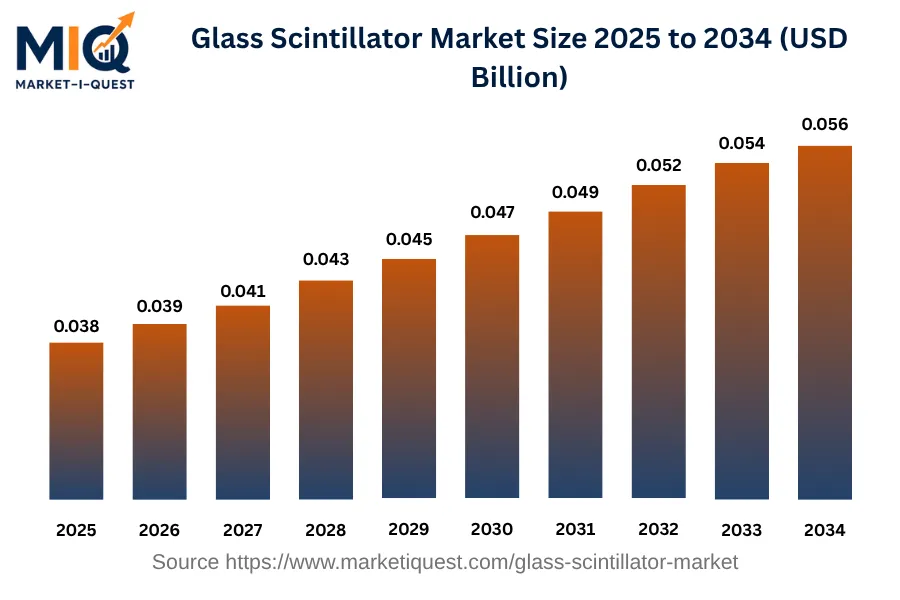
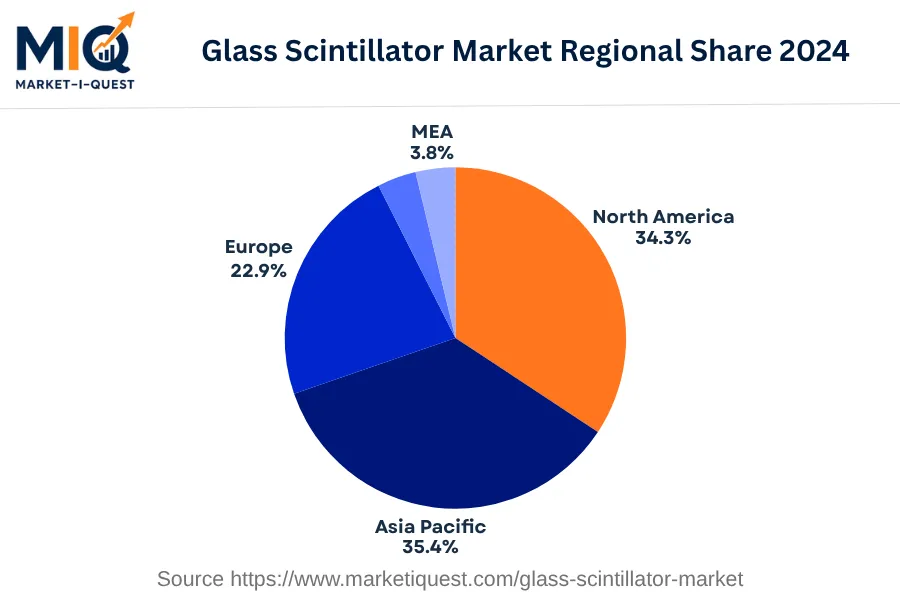
The Glass Scintillator Market stood at USD 0.04 Billion in 2025, and is projected to reach USD 0.06 Billion by 2034, registering a compound annual growth rate (CAGR) of 4.6%. This progression follows a steady growth pattern - the market size had hovered around USD 0.04 Billion in 2024. The increment over the decade is attributed to consistent technological advancements and increasing demands in industries that utilize scintillators for detection and measurement purposes. As of the base year 2024, the regional share of the market was divided as follows: North America held 34.3%, closely followed by the Asia Pacific region with 35.4% of the market share. Europe had a piece of the pie as well, amounting to 22.9%. Latin America (LATAM) and Middle East & Africa (MEA) regions were marginally involved in the market, with shares of 3.7% and 3.8% respectively.

Key Takeaways

  • By Product - Natural Lithium held the dominant market share in the base year.
  • By Application - Oil & Gas led the market accounting for a significant share.
glass-scintillator-market market size

Key Driving Factors

Regulation of Radiation Safety in Medical and Industrial Applications

The exponential growth in sectors such as healthcare and manufacturing has led to an increased use of radiation technology. With this, regulatory bodies across nations have stepped up enforcement of safety standards to prevent harmful exposure to radiation. Glass scintillators play a key role in maintaining these standards as they detect and measure radiation levels accurately. For instance, in medical imaging, many countries demand stringent adherence to safety norms to protect both physicians and patients from unnecessary exposure. In industrial contexts, radiation safety is crucial in ensuring worker health, necessitating constant monitoring of the environment. This regulatory vigilance compels companies to invest in reliable radiation detection solutions such as glass scintillators, driving market growth.
Emerging Need for Advanced Security Screening

Current geopolitical instabilities have led to a heightened need for advanced security and threat detection systems at sensitive facilities such as airports, border checkpoints, and nuclear power plants. Glass scintillators are renowned for their high detection efficiency and are increasingly integrated into these systems to detect radioactive materials that could pose a threat. Government agencies seeking to fortify national security are pushing for the adoption of the most precise detection technologies. With countries worldwide focusing on their domestic security plans, the demand for efficient and reliable radiation detectors – glass scintillators, implicitly – is expected to surge in the years ahead, thereby propelling the market.

Market Evolution by Timeline

2019-2023
In this period, the primary buyers of glass scintillators were from the medical imaging sector, specifically in Europe and North America, resulting from an increasing prevalence of chronic diseases prompting necessity for early diagnosis. China began industrial scale production of glass scintillators, although with limited integration. EU regulated RoHS 2 revised directive incorporating flexibility for medical devices presented ease in glass scintillator adoption in imaging equipment. Bulk purchase contracts were the prevalent commercial model at competitive price points due to high market competition. The launch of high-performance advanced glass scintillators was a rigorous task due to stringent product qualification and validation protocols.
2024
In 2024, heightened demand arose from nuclear power plant operators and radiation detection device manufacturers, primarily in Asia owing to an expanding nuclear industry in China and India. Finland's ISOLDE facility upgraded their detectors to glass scintillators, marking a new industry standard. Production faced difficulty due to uranium glass shortage affecting supply in Europe; however, there was production growth in US from several nuclear material manufacturers. Price saw a significant hike due to demand and supply dynamics. Procurement involved both long-term contracts and spot purchases. The risk of supply inconsistencies required strategic stocking and alternate sourcing.
2025-2029
This period observed a surge in demand from research institutions and universities for scientific studies, primarily in the US and Canada. Notably, organic glass scintillators featured in the majority of new devices. 'The New Scintillator Discoveries Act' passed in US encouraged innovation in scintillator technology and secured funding for research activities. Licensing model with technology transfer agreements became prevalent with multiple start-ups entering the market. However, high research and development costs posed a financial risk for smaller firms, necessitating collaborative research endeavors or venture capitalist funds to mitigate monetary risks.
2030-2034
During this period, the expansion of space exploration programs in countries like the US, China, and Russia increased the need for radiation detecting glass scintillators. Stirling Engine-based Nuclear Batteries using glass scintillators were introduced into the market, with ISO 21441 space technology standard influencing production. The glass scintillator market saw a scarcity with the depletion of key raw materials like lithium and cerium. Unit pricing was premium due to low supply. The market adapted to form partnerships with mining companies for assured raw material supply but faced risk of escalating raw material prices.

Future Market Outlook

Future Opportunities

The evolution of the glass scintillator market presents numerous future opportunities, particularly in emerging sectors like medical imaging and radiation monitoring. For instance, the FDA's guidance published in May 2023 encourages the adoption of advanced imaging technologies, which can incorporate glass scintillators due to their superior clarity and precision. Partnerships between sensor manufacturers and healthcare providers are on the rise, aiming to leverage glass scintillators in devices such as positron emission tomography (PET) scanners. As governments implement stricter radiation safety protocols, countries like Japan and Germany are increasingly investing in robust radiation detection systems that utilize glass scintillators to enhance public safety measures. The enhancement of glass properties for improved light yield could see applications expand into areas such as environmental monitoring, supporting regulations by bodies like the Environmental Protection Agency (EPA) established in 1970. Furthermore, the evolving landscape of quantum technologies is likely to foster collaborations between material scientists and quantum physicists, exploring the integration of glass scintillators into new detection applications. The ongoing research funded by the National Institutes of Health (NIH) into next-generation imaging solutions emphasizes the potential of glass scintillators to advance diagnostic capabilities. Overall, a combination of regulatory support, industry collaborations, and technological advancements position the glass scintillator market to capitalize on emerging applications in the coming years.

Segmentation Analysis

By Product

The market is divided into subsegments including Natural Lithium, Depleted Lithium, and Enriched Lithium. Natural Lithium accounted for the largest revenue share while Enriched Lithium is expected to grow at the fastest CAGR during the forecast period.

Largest Revenue Share

Natural Lithium

Market Share Leader

Natural Lithium holds the lion's share of the market revenue owing to its wide array of applications and abundant availability. The extensive use of Natural Lithium in the production of batteries, particularly for electric vehicles (EVs), has significantly bolstered its demand. Robust growth in the EV industry, driven by governmental policies and consumer preference towards sustainable mobility, has directly fuelled the growth of the Natural Lithium market. Geographical concentration of lithium reserves in countries like Australia, China, and Chile also contributes to the segment's dominance, due to established extraction and production infrastructure. Furthermore, lenient regulations governing lithium extraction in these geographies provide a favorable environment for market players. Lower barriers to switching, coupled with a well-distributed supply chain, keep the cost of Natural Lithium comparative, strengthening its position as a market leader.

Fastest CAGR

Enriched Lithium

Forecast Period Growth Leader

The Enriched Lithium segment is touted to witness the fastest growth during the forecast period. This impressive growth trajectory is largely attributed to advancements in nuclear technologies and the escalating trend of renewable sources. Enriched Lithium finds vital application in the nuclear industry as a coolant and in neutron capture shields, reasons for its rapid adoption. Strict safety protocols and regulations in the nuclear industry have also driven the demand for high-grade lithium like Enriched Lithium. Future growth is likely to be spurred by increased investments in research and development to expand potential application areas. However, high capital expenditure associated with the enrichment process and stringent regulation in nuclear-related activities present near-term risks. Given these factors, swift partnerships with lithium producers and nuclear power companies could serve as a catalyst for accelerated adoption.

By Application

The market is divided into the subsegments including Oil & Gas and Nuclear Power Plants. The Oil & Gas subsegment accounted for the largest revenue share while the Nuclear Power Plants subsegment is expected to grow at the fastest CAGR during the forecast period.

Largest Revenue Share

Oil & Gas

Market Share Leader

In the base year of 2024, the Oil & Gas subsegment generates the largest revenue primarily driven by increasing energy demands worldwide and obsolete infrastructure that requires significant maintenance and renovations. The application of the market segment is deeply ingrained in exploration, drilling, and extraction processes of the oil and gas sector. It enjoys a broader customer base including major petroleum companies, oilfield operators, and even national-level oil corporations worldwide. Key oil producing geographies such as the Middle-East, North America, and parts of Africa contribute significantly to the revenues. Regulation also plays a part as stringent policies for safe and efficient operations compel companies to apply the market's offerings more. Furthermore, due to the technical and operational knowledge required to switch between technology platforms, the sector experiences high switching costs, adding to the oil and gas subsegment's robust revenue stream.

Fastest CAGR

Nuclear Power Plants

Forecast Period Growth Leader

The Nuclear Power Plants subsegment, though a smaller revenue generator than Oil & Gas, is expected to exhibit the fastest growth. The primary growth drivers include the increasing global demand for sustainable and clean energy, heightened investment in nuclear energy by various governments to reduce dependency on fossil fuels, and the use of advanced technologies to ensure safe nuclear power plant operations. Adoption barriers include the high initial capital expenditure required and the significant regulatory scrutiny. However, technological advancement and ongoing research in economical and secure reactor designs, coupled with strategic partnerships for knowledge and capability sharing, act as catalysts for growth. Yet, near-term risks such as instances of nuclear plant accidents and associated public perception may impede this speedy growth, but the underlined trend is upward.

Competitive Analysis

Key Market Players

Manufacturers / OEMs

Saint-Gobain Crystals
France
Hamamatsu Photonics
Japan
Scintacor Limited
UK

Key Suppliers & Raw Materials

Corning Incorporated
US
Schott AG
Germany
Nippon Electric Glass Co., Ltd.
Japan

Distributors, Integrators & Channel Partners

Thorlabs, Inc.
US
Edmund Optics
US
Newport Corporation
US

Porter’s Five Forces Analysis

This analysis provides a detailed examination of the competitive dynamics within the Glass Scintillator Market.

Supplier Bargaining Power

Medium

Power is moderated by the availability of alternative raw material suppliers and the unique properties of certain materials.

Buyer Bargaining Power

High

Buyers, large corporates and research institutions, have strong negotiating leverage due to the competitive market.

Threat of Substitutes

Low

Threat is low due to the unique properties of glass scintillators that are hard to substitute.

Threat of New Entrants

Medium

Entry is moderated by initial investment costs, regulatory approvals, and technological know-how.

Competitive Rivalry

High

High rivalry driven by competitors' focus on product innovation, price, and customer service standards.

Regional Analysis

Geographic market dynamics and growth opportunities across key regions

Global Market Outlook

glass-scintillator-market market regional share

North America

In the base year of 2024, the North American glass scintillator market exhibited substantial development driven by a combination of demand factors, regulatory advancements, and technology adoption. A primary driver of growth was increasing demand from key sectors including healthcare, military, and utilities, buoyed by product adoption for radiation detection and nuclear waste management. Enhanced investments in technological innovation spurred growth, with companies leveraging advanced manufacturing processes to improve scintillator efficiency and lifespan. Stricter regulatory compliance standards concerning radiation monitoring also impacted the market dynamics positively, prompting a surge in sales. Simultaneously, important trends began to shape the sector. Consumer behavior leaned towards technologically proficient scintillators with enhanced resolution, triggering a shift in product development focus.

Competitive dynamics led to a rise in strategic partnerships and acquisitions, as businesses sought to broaden their product portfolio and reinforce their market position. Regulatory policies' strict enforcement became crucial, influencing companies to prioritize compliance in their operations. Across the United States, Canada, and Mexico, unique market dynamics reflected regional differences. For example, the US sector was primarily propelled by healthcare and military applications. In contrast, the Canadian and Mexican markets were largely driven by utility sector needs, pointing to the nuanced variations within the North American glass scintillator industry.

Asia Pacific

In 2024, the Asia Pacific glass scintillator market experienced a surge in demand largely driven by the expansion of nuclear facilities in China, India, and Japan and the growing need for radiation detection across various industries such as healthcare, military defense, and environmental monitoring. Regulatory support, particularly in China and South Korea, expedited the industry's growth by implementing rules and guidelines on radioactive monitoring to protect public health and safety. The increasing adoption of scintillation as a preferred method for radiation detection in scientific research and oil exploration also played a key role in solidifying the market's stronghold. Additionally, robust investments in R&D by key market players in Japan and Australia contributed to market progression.

In terms of trends, a greater emphasis on safety standards and quality control was observed across all sectors. This led to the rise of partnerships between glass scintillator manufacturers and government agencies in countries like India, aiming to fulfill these standards. Furthermore, technological advancements spurred the integration of advanced glass scintillator applications in healthcare imaging and nuclear waste management, resonating with the industry's shift toward digital transformation. Moreover, policy enforcement encouraged customers, particularly those within the manufacturing and utilities sectors, to comply with increasingly stringent radiation safety regulations. This stipulation translated into an amplified demand for glass scintillators across the region. Hence, the Asia Pacific glass scintillator market in 2024 demonstrated solid growth influenced by prevailing regulatory landscape and rising digital adoption trends.

Europe

In the base year of 2024, the Glass Scintillator Market in Europe has experienced considerable growth due to various drivers and trends. Investment in radiation detection technologies, particularly in the healthcare and defence sectors across Germany, France, and United Kingdom, has strengthened the market. Regulatory policies favouring nuclear safety, like the EU's Nuclear Safety Directive in member countries, have also increased demand. Additionally, the adoption of technologically advanced scintillation detectors in the research sector, particularly in Nordic universities, has amplified market momentum.

Market trends demonstrate a shift towards strategic partnerships and M&As, particularly in the Central and Eastern Europe region, to expand product range and geographic reach. There's a growing preference for high-resolution and efficient glass scintillators in Italy and Spain. The rise of digital marketplaces in the Benelux region has influenced channel dynamics, signaling a shift from traditional sales methods to online procurement. In the enterprise sector, companies are embracing glass scintillators for enhanced industrial radiography applications. Strong emphasis on policy enforcement, especially in France and Germany, is encouraging adherence to safety protocols across all sectors, further bolstering the market's robust standing.

Latin America

In 2024, the Latin American Glass Scintillator Market evolved, shaped by distinct drivers and trends. Demand surged, led by increased investment in healthcare and nuclear industries, particularly in Brazil and Mexico where establishment of new facilities necessitated hi-tech radiation detection equipment. Regulatory landscape too stimulated growth as governments, especially Colombia's, sought to upgrade their nuclear safety standards, mandating use of effective radiation detection systems. Technological advancements in Argentina fueled market expansion as providers adopted efficient production processes to offer competitively priced, higher-quality products.

Market trends displayed a shift in buyer preferences, as enterprises, utilities and manufacturers, primarily in Chile and Peru, leaned towards customizable and multifunctional Glass Scintillators. Technological shift was apparent as the industry began replacing traditional materials with Glass Scintillators due to their superior properties. Channel dynamics shifted towards online platforms for sales and customer service. The market witnessed a few significant mergers and acquisitions, particularly in Brazil and Argentina, to increase market reach. The year was marked by stricter policy enforcement for nuclear safety across Latin America, upraising the Glass Scintillator standard. Hence, in 2024, both internal and external factors spurred sustaining growth in the Latin American Glass Scintillator Market.

Middle East & Africa

In 2024, the Glass Scintillator Market in the Middle East and Africa displayed considerable activity. Several factors drove this, including increased investments in healthcare sectors, particularly in Saudi Arabia and UAE, where the demand for radiation detection devices was growing. Additionally, favorable government policies in Israel and South Africa towards sustainable energy solutions supported expansion in the scintillation detector market. Lastly, advancements in production technology, such as the adoption of multicomponent glass scintillators in Nigeria and Kenya, led to escalated supply and declining price dynamics.

Trends within the market were equally influential. Customers were more inclined towards high-resolution scintillators for improved radiation detection, particularly in Egyptian research institutes and South African utilities sector. There was a shift towards collaborative partnerships in regional markets, like the joint venture in Saudi's oil and gas sector toward enhanced radiological safety. Another trend observed was the growing demand for compact handheld scintillators in the medical sector across UAE and Qatar, as part of the increasing focus on portable medical equipment. Israel, being technologically advanced, saw a policy enforcement favoring the use of next-generation scintillators with advanced materials. In tandem, these drivers and trends defined the Glass Scintillator Market landscape in the Middle East and Africa for 2024.

Recent Industry Developments

Latest market innovations, product launches, and strategic initiatives

May 2026

Fortune Business Insights estimated the global glass scintillator market at USD 26.75 million in 2025, projecting growth to USD 27.94 million in 2026 and USD 39.62 million by 2034, at a 4.46% CAGR. The report highlighted North America’s dominant 34% market share and Asia-Pacific’s 29% share, with China accounting for 13% of the亚太 market.

March 2025

The UK government pre-qualified wearable, handheld, and portal radiation detection systems under its Radiological Nuclear Detection Framework, directly expanding procurement channels for lithium-glass scintillator assemblies used in border security and nuclear forensics. Lithium-glass detectors utilizing Li-6’s 940-barn thermal-neutron cross-section are positioned to capture a significant portion of this demand.

Frequently Asked Questions