Glass Additives Market Snapshot

Key Players

  • Solvay SA (Belgium)
  • Torrecid Group (Spain)
  • Ferro Corporation (US)
  • Nippon Electric Glass (Japan)
  • Lanxess AG (Germany)
  • Arkema SA (France)
  • Potters Industries LLC (US)
  • Lumina Glass GmbH (Germany)
  • STOKO Additives (China)

Market Size

Base Year 2024
$1.92 Bn
CAGR
5.84%
Forecast 2034
$3.39 Bn

Market Segments

By Product
  • Metal Oxide
  • Nanoparticles
  • Polymers & Rare Earth Metals
By Application
  • Building & Construction
  • Packaging
  • Automotive & Transportation
  • Electronics & Appliances
  • Others

Market Dynamics

Drivers
  • Increasing urbanization
  • Rapid industrialization
Restraints
  • High production costs
  • Strict environmental regulations
Opportunities
  • Emerging construction sector trends
  • Rising demand in automotive industry

Market Size

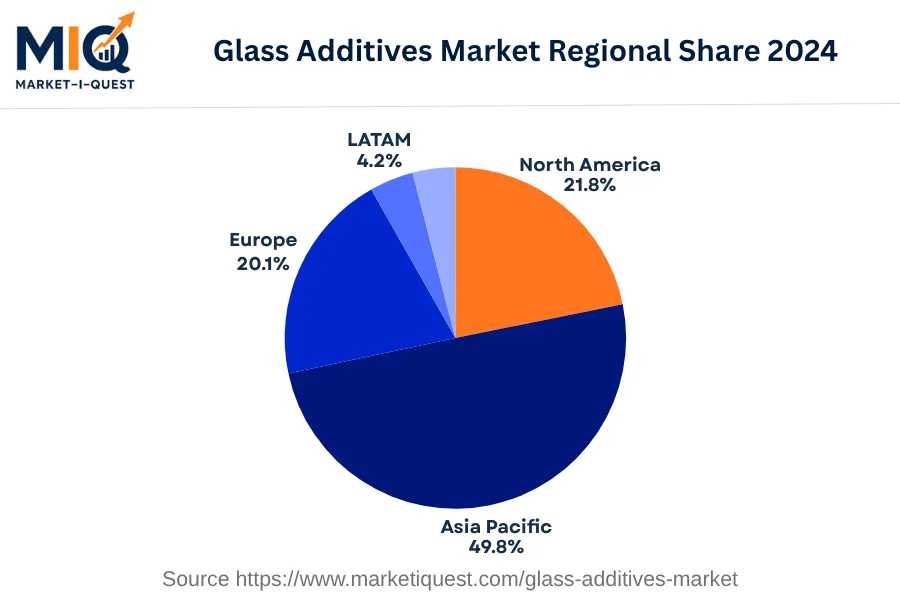
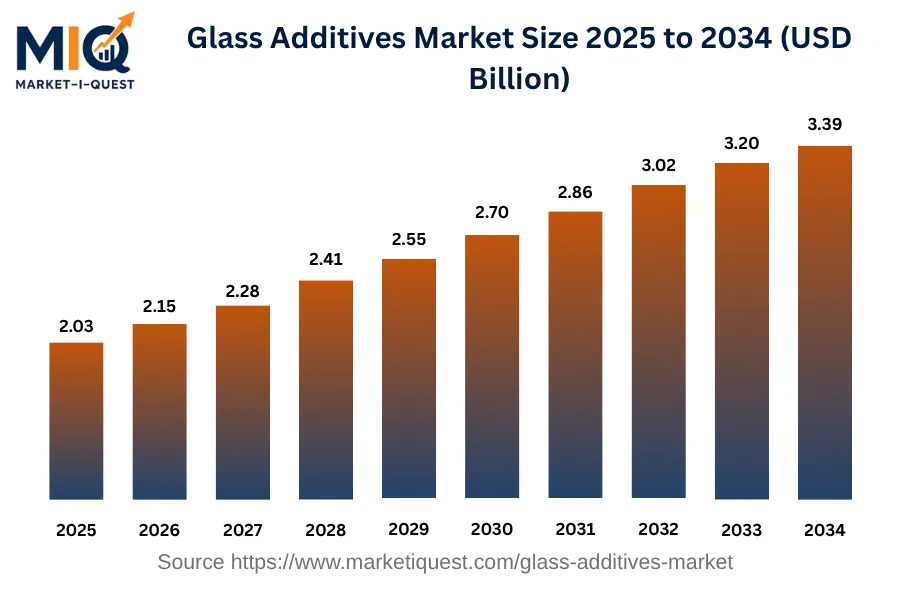
The Glass Additives Market size in 2025 is projected to be $2.03 billion, up from $1.92 billion in 2024, and it is estimated to reach $3.39 billion by 2034, indicating a CAGR of 5.84% over the period. This growth trajectory suggests a constant expansion of the market throughout the specified years due to developments and increasing demands in various sectors. As per the regional market share in 2024, Asia Pacific held the dominant position with 49.8%, followed by North America and Europe with shares of 21.8% and 20.1% respectively. The LATAM and MEA regions held more modest shares, with 4.2% and 4.0% respectively demonstrating the scope for market growth in these areas.

Key Takeaways

  • By Product - Metal Oxide led the Glass Additives Market accounting for significant share in 2024.
  • By Application segment - Building & Construction held the leading position in the base year.
glass-additives-market market size

Key Driving Factors

Implementation of Stringent Environmental Regulations

One major driver pushing for the adoption and spend in the glass additives market is the implementation of rigorous environmental regulations worldwide. These rules and guidelines, such as the Control Techniques Guidelines by the EPA in the USA, compel manufacturers to reduce their carbon emissions drastically. The usage of certain glass additives can help in decreasing these emissions during the manufacturing process, thereby helping companies to comply with the regulations. The regulations' direct emphasis on reducing environmental impact is causing manufacturers, particularly in developed countries, to prefer these eco-friendly options.

Increasing Preference for Lightweight and Durable Materials in Automotive Industry

Another driving factor for the glass additives market is the rising preference for light and durable materials in the automotive industry. The automotive manufacturers' focus on improving fuel efficiency and reducing vehicle weight has led them to seek materials that can help achieve these goals. As a result, there has been an increased use of glass additives in producing lightweight and durable glass components like windshields and windows for cars. This trend is prevalent mainly in regions with thriving automotive industries, like Europe and Asia-Pacific.

Market Evolution by Timeline

2019-2023
In this period, the central buyers were from the construction and automotive industries with APAC, especially China, leading in consumption. The advancements in nanoadditive technology led to higher product quality, but higher costs too. Environmental regulations (ISO 14001:2015) led to increased demand for eco-friendly, recycled glass. Contract-based pricing was prominent due to input uncertainty and heavy competition. Risks were linked with high raw material costs that could impact profitability.
2024
For 2024, the typical buyers remained the construction and automotive industries. However, new interest came from India as urbanisation increased. Advances in Iron and Litharge additives lead to improved color and durability in finished products, respectively. The shift towards green building standards (LEED) increased demand for high-efficiency glass augmented by additives. Pricing was impacted by increased cost of iron owing to mining regulations. The core risk was seen around supply-chain disruption due to stringent environmental laws.
2025-2029
Moving into this period, consumer electronics makers took over as key buyers aiming to improve touch-sensitivity and durability. Europe, with Germany at the forefront, showed heightened interest due to increasing electronic production. Recycled glass policy (EU Directive 2008/98/EC) continued to impact market rates and demand. Licensing agreements between additive and glass manufacturers began, instigating a shift in the commercial model. The risk was typically depletion of certain raw materials such as selenium.
2030-2034
During this tine, energy applications such as solar cells turned to glass additives to increase efficiency. There was a spike in glass additive demand in Middle East, driven by massive solar projects. Demand was boosted by clean energy directives and carbon neutrality programs. Pricing was increasingly based on long term contracts to ensure steady supply. Control over material sources became crucial as competition increased, threatening a potential disruption in the supply chain.

Future Market Outlook

Future Opportunities

Current regulatory frameworks and consumer preferences indicate substantial future opportunities in the glass additives market. The building and construction sector is experiencing an uptick in demand for energy-efficient materials, driven by global initiatives such as the 2030 Agenda for Sustainable Development adopted by UN member states. As a result, there is an increasing need for glass additives that enhance energy performance and reduce carbon footprints. In 2023, the U.S. Green Building Council updated its LEED certification standards, which further encourages architects to specify the use of advanced glass materials in construction projects. Companies like Eastman Chemical have responded by developing innovative additives that improve insulation properties, aligning with these industry shifts. Moreover, in automotive applications, regulations focusing on lightweight materials are prompting manufacturers to explore glass additives that enhance glass strength while reducing weight. A partnership in 2023 between PPG Industries and various automotive manufacturers aims to develop lightweight, high-performance glazing solutions. As environmental considerations become central to consumer preferences, glass additive manufacturers are likely to invest more in R&D for sustainable products. The ongoing trend towards digitalization and smart technologies in housing and vehicles also presents new opportunities for smart glass applications that utilize specialized additives, promising to drive growth in this segment moving forward.

Segmentation Analysis

By Product

The market is divided into subsegments including Metal Oxide, Nanoparticles, Polymers & Rare Earth Metals. Of these, the Metal Oxide subsegment accounted for the largest revenue share, while the Polymers segment is expected to grow at the fastest CAGR during the forecast period.

Largest Revenue Share

Metal Oxide

Market Share Leader

Metal Oxide leads the segment in terms of revenue generation for multiple reasons, considering the wide range of industries in which they find use. From use in solar cells and ceramics to paints, batteries, and even medical applications, the requirements for metal oxides are universal and extensive. Another contributing facet to the revenue strength of this subsegment is the geographic distribution of key consumers, primarily in developing regions with booming infrastructure and tech industries such as the Asia-Pacific region. The purchasing criteria for this subsegment often revolve around its chemical stability and high performance in various applications which further solidifies its dominance in revenue generation. Regulatory factors, while influencing the sourcing of metals from which these oxides are derived, have been generally supportive of industry advancement. Switching costs are often high given the performance characteristics of metal oxides, discouraging users from exploring alternative products. Lastly, robust distribution and supply chain networks ensure steady demand fulfillment, thereby maintaining revenue growth within this subsegment.

Fastest CAGR

Polymers

Forecast Period Growth Leader

The Polymers subsegment, while not leading in terms of revenue, has shown the most promising growth rates. Multiple growth drivers contribute to this trend, including rapid technological advancements in the production and application of polymers. An increasing trend in its use is observed in industries such as packaging, automotive, and electronics. Furthermore, its adoption is increasingly being supported by environmental regulations favoring materials that are both high-performing and eco-friendly. However, barriers to adoption include its comparative novelty and lack of standardization in some regions. Strategic partnerships and the establishment of dedicated manufacturing plants with significant capital expenditure hint at the promising future for the growth of this subsegment. Risks include potential barriers to entry, including the need for significant technological know-how and regulatory compliance. The increased demand for lightweight, durable, and versatile materials, however, suggests a strong growth trajectory for the polymers subsegment.

By Application

The market is divided into subsegments including Building & Construction, Packaging, Automotive & Transportation, Electronics & Appliances, and Others. The Building & Construction subsegment accounted for the largest revenue share, while the Electronics & Appliances segment is projected to experience the fastest Compound Annual Growth Rate during the forecast period.

Largest Revenue Share

Building & Construction

Market Share Leader

In the base year of 2024, the Building & Construction subsegment dominated the market in terms of revenue. Several factors are contributing to this dominance. A key driver to the significant revenue figure is the increased demand in residential and commercial infrastructure globally. The growing behemoth of urbanization tasks a constant demand for construction materials. Additionally, due to building regulation standards, eco-efficiency, performance, and durability, which are crucial criteria in the construction industry, are also driving forces for high adoption rates. There's also a robust switching cost associated with shifting to alternative materials in building and construction. This cost, coupled with an established supply chain and distribution channels, has cemented the place of the Building & Construction sub-segment in the market.

Fastest CAGR

Electronics & Appliances

Forecast Period Growth Leader

While the Building & Construction holds the largest market share, the Electronics & Appliances subsegment is expected to grow at the fastest rate. The forecasted high growth can be attributed to the continuous innovations in consumer electronics and home appliances. The rising disposable income and changing lifestyle in emerging economies have increased the demand for the modern gadget, thus driving growth in this sector. With the advent of IoT, AI, and smart homes, the adoption rate of advanced appliances and electronics is on the rise. However, several barriers could affect this growth. These include the outset cost of adopting the latest technology, which could be high for some consumers, and the shift towards green products that, although beneficial, require higher capital expenditure. There's also the potential risk of product recalls due to malfunctions or safety issues, which can impact near-term growth.

Competitive Analysis

Key Market Players

Manufacturers / OEMs

Saint-Gobain
France
Ardagh Group
Ireland
NSG Group
Japan

Key Suppliers & Raw Materials

DuPont
US
Milliken & Company
US
Huber Engineered Materials
US

Distributors, Integrators & Channel Partners

Univar Solutions Inc.
US
Brenntag AG
Germany
Avantor Inc.
US

Porter’s Five Forces Analysis

Analysis of the competitive forces shaping the Glass Additives Market landscape.

Supplier Bargaining Power

Medium

Suppliers' power moderated by the number of available glass additive manufacturers and raw material sources.

Buyer Bargaining Power

High

Buyers can switch easily due to a variety of equal-quality additives at competitive prices.

Threat of Substitutes

Low

Limited substitutes for specific glass additives, high switching costs due to quality and performance factors.

Threat of New Entrants

Medium

Regulatory requirements and high capital costs pose entry barriers, while growing demand attracts new entrants.

Competitive Rivalry

High

Intense rivalry due to multiple established players and similar product offerings.

Regional Analysis

Geographic market dynamics and growth opportunities across key regions

Global Market Outlook

glass-additives-market market regional share

North America

In 2024, the North American glass additives market experienced notable development, driven by diverse factors like demand dynamics, regulatory context, and tech adoption. Increased demand for high-performance glass in architecture and automotive sectors steered market growth. Regulatory policies advocating for energy efficiency favored additive-enriched glass products, boosting the market. Accelerated adoption of nanotechnology in glass manufacturing also fueled growth. Trends shaping the sector included a shift towards eco-friendly glass products, driven by heightened consumer environmental consciousness. Another significant trend was online sales proliferation, fueled by the digitization of retail channels, making purchasing more convenient.

Integration of AR/VR technologies in online retail gave buyers a holistic product outlook, influencing purchase decisions positively. M&A activity was robust as companies pursued expansion and diversification. An example was PPG Industries' acquisition of Whitford Worldwide, intensifying competition and fostering product innovation. Strict adherence to ASTM International standards in production and marketing practices ensured product quality and trust. Glass additives found extensive use in industries like healthcare, especially in the production of borosilicate glassware. The utility sector preferred the heat-resistant and UV-blocking properties of additive-laden glass for power line insulators. The manufacturing and retail sectors used them for their aesthetic appeal and durability, respectively.

Asia Pacific

In 2024, the Asian Pacific market for glass additives experienced significant dynamics spurred by various factors. Drivers included increasing urbanization which amplified architectural glass demand particularly in China and India. Moreover, the growing consumer electronics industry led to escalated demand for high-quality display glass, primarily in Japan and South Korea. Regulatory pressures for efficient and environmental-friendly glass in the automotive and construction sectors across Australia and key ASEAN markets fueled market growth. Trends in this space included the shift towards nanotechnology in glass production, predominantly in China and India. Innovative partnerships, such as Japan-based AGC Inc.'s collaboration with Taiwanese company Industrial Technology Research Institute, further helped optimize processes.

Customer sentiments veered toward energy-saving glass, especially within the automotive and construction sectors across Australia, leading to a rise in the manufacture of low emissivity glass. In South Korea, the enforcement of stricter safety standards in the automotive sector compelled manufacturers to produce reinforced glass with additives. Lastly, expansion of e-commerce channels in key ASEAN markets significantly impacted the distribution and sales patterns of glass additives. Thus, the glass additives market in the Asia-Pacific region saw an uptick in 2024, driven by increasing demand, regulatory mandates, technological advancements, and changing market trends.

Europe

In 2024, the European Glass Additives market was characterized by increasing demand, expanding applications, and various technological advancements. Drivers for this market growth can be attributed to robust economic upturn in the region with particular strength shown in Germany, the UK, France, and the Nordics. This led to more intensive investments in infrastructure adaptations requiring glass with specialized additives. An upsurge in architectural refurbishments and stringent energy efficiency regulations also stimulated demand. Furthermore, the adoption of Nanocomposite technology, a key innovation in glass additive manufacturing, expanded the application areas significantly.

Trends shaping the market during 2024 focused on changing consumer preferences and shifts in the direct sales channel. Buyers were increasingly prioritizing sustainable and recycling-friendly glass production, influencing manufacturers across Italy, Spain, Benelux and Central & Eastern Europe. There was a pivot toward channels such as direct-to-customer online portals due to their ability to provide customized solutions. The market also noted strategic alliances and mergers among major players, such as the Nordics' firm Målerås Glasbruk and Germany's Schott AG, with a strong focus on enhancing production capacity and expanding product portfolios. Enforcement of stringent environmental standards also played a critical role, pushing companies to decrease their carbon footprint and uphold sustainable practices in their operations.

Latin America

In 2024, the Latin American Glass Additives Market was strongly defined by an intensive pursuit of enhanced product performance and sustainability. High demand from burgeoning construction and automotive sectors drove the market, with countries like Brazil and Mexico leading the way due to rapid urbanization and industrial growth. Competitive pricing and increased foreign direct investment in Argentina and Colombia further fueled market expansion. In tandem, there was wider adoption of nano-additives technology in the manufacturing of quality glass, reflecting shifting supply dynamics. On the trends side, consumer preferences for energy-efficient and lightweight glasses significantly shaped the market, particularly in the automotive and construction industries as a response to stringent emission policies.

Shifts in channels were also apparent, with growing e-commerce penetration leading to an increase in online sales of glass additives. Noticeably, strategic partnerships and acquisitions were emerging among firms in Chile and Peru, aiming to consolidate market position and diversify product portfolios. Increased legislation enforcement around safety standards in the packaging industry also played into the market dynamics, as did widespread demand from the healthcare sector across the whole of LATAM for pharmaceutical packaging solutions. Hence, the glass additives market in LATAM was marked by an intersection of technological innovation and a push for enhanced sustainability and performance.

Middle East & Africa

In 2024, the Glass Additives Market in the Middle East and Africa showed signs of robust growth, bolstered by several factors. Economic expansion in Saudi Arabia, United Arab Emirates, and Qatar fostered by the oil and gas industry saw an increased demand for glass additives for drilling applications. The technology adoption push in these countries also stimulated demand in the automotive and telecom sectors, with lightweight, durable glass being preferred. South Africa's and Nigeria's booming construction industries were driven by government-funded infrastructure projects, contributing to an increased need for specialist glasses. Changing trends played a significant role in shaping the market. The need for sustainable products among consumers across the region, notably in Israel and Kenya, led to the growth of eco-friendly glass additives. The shift towards digitalization in Egypt's rapidly growing retail sector pushed the demand for smart glass featuring additives.

The healthcare sector in these countries was adopting advanced pharmaceutical glass packaging, emphasizing safety and preserving medicinal properties. At the corporate level, multiple partnerships and mergers between local and international companies invigorated the market, ensuring stable supply and penetration of high-performance products across sectors including manufacturing and financial services. With the stringent regulatory environment in the Middle East and Africa, manufacturers adhered to the principles of resource conservation and waste reduction, driving innovation and the selection of specific additives for glass production.

Recent Industry Developments

Latest market innovations, product launches, and strategic initiatives

February 2026

India's Union Budget 2026 removed the basic customs duty on sodium antimonate (sodium pyroantimonate), a specialized chemical used as a fining and clarifying agent in photovoltaic glass manufacturing. The duty was reduced from 7.5% to nil. Sodium antimonate helps remove bubbles, convert unwanted iron states that tint glass, and improve optical clarity and yield for high-end glass, including the low-iron, high-transparency glass used for PV modules. The tariff cut provides cost relief and competitiveness gains for solar glass manufacturers, easing input costs for PV glass producers and supporting domestic manufacturing competitiveness. India primarily imports sodium antimonate from Belgium and Italy.

May 2025

In China, regulatory enforcement on glass furnace emissions tightened further, compelling producers to adopt cleaner additive systems that support lower-temperature melting and reduced volatilization. This reinforced demand for technically advanced additives rather than commodity inputs.

Frequently Asked Questions