Geotextiles Market Snapshot

Key Players

  • Terram Geosynthetics (UK)
  • Koninklijke TenCate B.V. (Netherlands)
  • NAUE GmbH & Co. KG (Germany)
  • Officine Maccaferri S.p.A. (Italy)
  • Layfield Group (Canada)
  • Fibertex Nonwovens A/S (Denmark)
  • Propex Operating Company LLC (US)
  • TechFab India Industries Ltd (India)

Market Size

Base Year 2024
$8.68 Bn
CAGR
6.32%
Forecast 2034
$16.02 Bn

Market Segments

By Material
  • Synthetic Fibers
  • Natural Fibers
By Product Type
  • Non-Woven
  • Woven
  • Knitted
  • Others
By End Use
  • Transportation
  • Environment
  • Energy & Water Resources
  • Building Site Infrastructure
  • Agriculture
  • Others

Market Dynamics

Drivers
  • Increasing infrastructure development projects
  • Growing erosion control applications
Restraints
  • High competition from substitutes
  • Regulatory constraints
Opportunities
  • Growing infrastructure projects
  • Increasing environmental concerns

Market Size

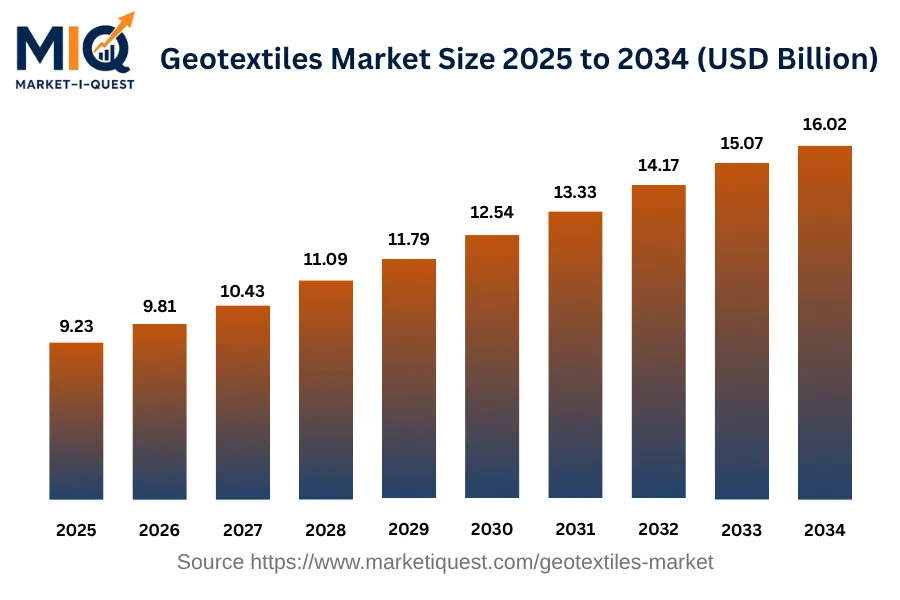
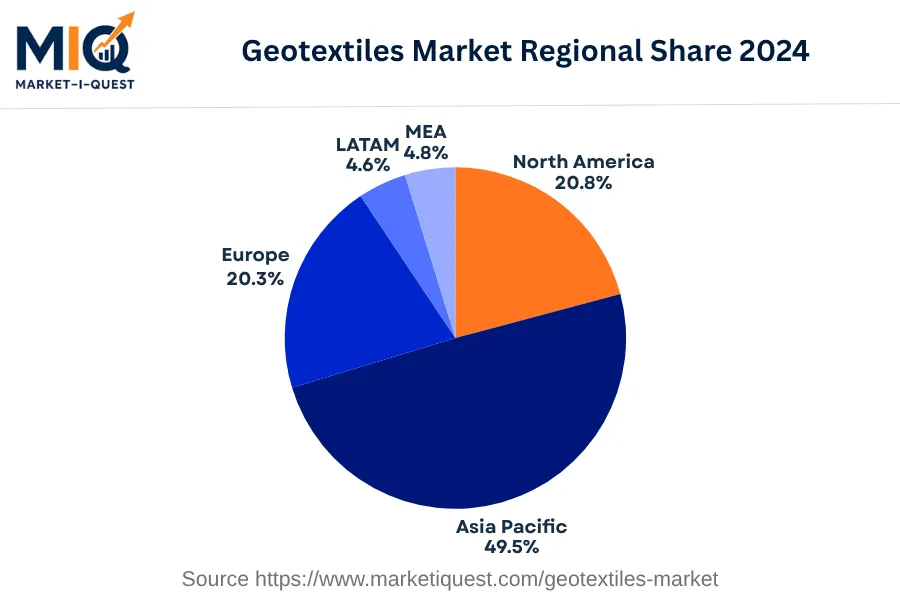
The Geotextiles market size was 9.23 billion USD in 2025 and escalated to 16.02 billion USD in 2034, growing at a compound annual growth rate (CAGR) of 6.32%. Over this nine-year period, there was a consistent increase in the value of the market. In the early point of the timeline, the market size in 2024 stood at 8.68 billion USD, lower than the values observed in subsequent years. This growth trajectory is driven by undisclosed factors present in the data. The regional market share in 2024 was diversified, with the Asia Pacific holding 49.5%, North America controlling 20.8%, and Europe governing 20.3% of the market. The remaining parts of the market were broken up between the Middle East and Africa (MEA) and Latin America (LATAM), each accounting for approximately 4.6% and 4.7% shares, respectively.

Key Takeaways

  • By Material - Synthetic Fibers led the Geotextiles Market accounting for the highest share in 2025.
  • By Product Type - Woven Geotextiles expanded and held the largest market share in 2025.
  • By End Use - Energy & Water Resources sector held a notable position in the Geotextiles Market in 2025.
geotextiles-market market size

Key Driving Factors

Implementation of Erosion Control Regulations

Increasingly strict policies and regulations concerning soil erosion control are a key factor in driving the geotextiles market. As local and national governments focus on environmental protection, strategies that mitigate soil erosion gain priority. Geotextiles offer an efficient solution as they have the ability to stabilize the soil, preventing erosion caused by water and wind. Infrastructure projects, particularly road construction and water drainage systems, have to abide by these regulations which usually necessitate the use of geotextiles. This regulatory environment expressly encourages the purchase and usage of geotextiles as a preventive measure against soil erosion.

Escalating Need for Water Management

The intensifying need for water management solutions is another considerable factor driving the geotextiles market. Climate change leads to unpredictably severe weather conditions, presenting a consistently high demand for effective water management solutions. Geotextiles, with their ability to filter, separate and control water flow, are heavily utilized in the development of such initiatives. In addition, geotextiles are used in processes that require runoff management and sediment control. The construction industry widely employs geotextiles in numerous projects, from laying pipelines to building reservoirs, in part due to these water management capabilities. In the face of climate change, this need for effective water control mechanisms likely remains, supporting aggressive growth within the geotextiles market.

Market Evolution by Timeline

2019-2023
During this period, geotextiles were mainly used in road construction and erosion control projects, with strong demand from countries including India, China, and the USA due to rapid infrastructure growth. Many companies, such as GSE Environmental and Koninklijke TenCate NV, manufactured synthetic geotextiles, facing constraints in raw material supply due to environmental regulations. Indian regulation, IS 14202:2013, influenced adoption by standardizing geotextiles for specific applications. Pricing was mostly project-based, with long-term supply contracts dominating the commercial model. However, concerns over the environmental impact of synthetic geotextiles posed a risk, leading to higher investment in developing biodegradable alternatives.
2024
In 2024, in response to increasing global focus on sustainability, the demand for eco-friendly geotextiles saw a sharp increase, particularly from European countries such as the UK, Germany, and France. Innovative green technologies, such as coir geotextiles, were introduced by companies including V. Geosynthetics Pvt Ltd. While regulations like the European standard EN ISO 10320:1999 encouraged adoption, material sourcing issues persisted due to the nascent state of some green supply chains. Partnerships between manufacturers and agricultural producers emerged as a common commercial model. The lack of full scale integration between supply and production chains remained a significant risk, causing fluctuations in availability and pricing.
2025-2029
Over these five years, addressing climate change became a crucial driving factor for geotextiles market. Countries prone to climate change effects, such as the Netherlands and Bangladesh, were major buyers to prevent flooding and soil erosion. Terram Geosynthetics and Typar Geosynthetics shipped geotextiles made from recycled materials, but faced issues due to variable quality of recycled inputs. The Climate Change Act 2008 in the UK influenced product adoption by emphasizing sustainable infrastructure. Commercially, increased competition drove a shift towards value-added services, like installation support. The inconsistent quality of recycled materials posed a risk, prompting a focus on tighter quality control.
2030-2034
In this phase, demand for geotextiles expanded into new areas like coastal defense and waste management projects, particularly in coastal countries like Australia and New Zealand. The technological focus shifted towards smart geotextiles with real-time monitoring capabilities. Regulation like Australia's 'Coastal Management Standard 2032' facilitated this change by promoting sustainable coastal defense solutions. Fixed price contracts became prominent, centering transparency and predictability in commercial relations. The main risk involved the integration of sensor technologies into geotextiles, with potential to disrupt supply chains if not managed skilfully. To mitigate this, alliances between geotextile manufacturers and technology companies emerged.

Future Market Outlook

Future Opportunities

The geotextiles market presents multiple growth opportunities linked to government investments and environmental mandates. In 2023, the Federal Highway Administration in the United States allocated significant funding for infrastructure projects emphasizing the incorporation of innovative materials like geotextiles to enhance soil stability and extend asset longevity. This federal push is echoed by similar initiatives across Asia, where countries such as India are ramping up infrastructure development and increasingly utilizing geotextiles in road and drainage systems. Furthermore, the growing emphasis on sustainable construction practices is driving demand for recycled and biodegradable geotextiles. In 2022, SGS, a leading testing company based in Switzerland, validated the environmental performance of alternative materials for geotextiles, stimulating interest among manufacturers. The expanding use of geomembranes coupled with geotextiles in waste management projects also reflects market adaptability in response to regulatory changes. Additionally, emerging economies in Africa are showing increased adoption of geotextiles for agricultural applications, particularly in erosion control. Collaborative projects are on the rise, with firms like Golder Associates engaging in partnerships to explore innovative uses of geotextiles in sustainable urban drainage systems. Together, these factors create an optimistic outlook for geotextile applications across different industry sectors, reinforcing their importance in global construction and environmental sustainability strategies.

Segmentation Analysis

By Material

The market, by material, is divided into subsegments including Synthetic Fibers and Natural Fibers, with Synthetic Fibers accounting for the largest revenue share, while Natural Fibers is expected to grow at the fastest CAGR during the forecast period.

Largest Revenue Share

Synthetic Fibers

Market Share Leader

In terms of revenue, Synthetic Fibers lead the market, accounting for the largest share. The dominance of synthetic fibers can be attributed to several factors. Primarily, synthetic fibers offer high durability and versatility, which make them suitable for a wide array of applications ranging from clothing to home furnishings, and industrial uses. They are preferred for their resistance to environmental conditions and chemicals, which ensures longevity. Furthermore, synthetic fibers, being a product of the petrochemical industry, have a well-established supply chain, which guarantees a steady supply. Additionally, these fibers can be easily manipulated for desired properties, such as high tensile strength or elasticity, making them a more attractive choice for manufacturers. Lastly, the cost of producing synthetic fibers is relatively lower compared to natural fibers, making them an economical choice for mass production. The dominance of synthetic fibers is therefore grounded on the combination of practical advantages, established supply chains, and cost-effectiveness.

Fastest CAGR

Natural Fibers

Forecast Period Growth Leader

Despite Synthetic Fibers' revenue dominance, Natural Fibers is anticipated to exhibit the fastest growth. There's a growing trend towards sustainability, and natural fibers—being renewable and biodegradable—align well with eco-friendly initiatives. Consumers today are increasingly aware and environmentally conscious, causing a significant shift towards products that have a low environmental impact. In addition, technological advancements in processing natural fibers have enhanced their quality and suitability for various applications. Recent trends in partnerships between companies to generate organic clothing lines are also providing the necessary catalyst for the growth of natural fibers. However, there are challenges such as inconsistency in quality and supply, and higher costs of production compared to synthetic counterparts. Regulation is another critical factor that may influence the growth, with potential for policies favoring eco-friendly materials to act as a catalyst for the fast-growing Natural Fibers' subsegment.

By Product Type

The product type segment in the market is categorized into Non-Woven, Woven, Knitted, and Others with Woven types accounting for the largest revenue share, while Knitted subsegment is expected to grow at the fastest CAGR during the forecast period.

Largest Revenue Share

Woven

Market Share Leader

The Woven subsegment contributes the largest revenue share in the market. This is attributed to their wide usage in various industries owing to their excellent strength, durability, and versatility. With different types of weaving techniques, manufacturers can control the thickness, permeability, and other properties of woven materials, leading to their high demand. Furthermore, the long-established tradition of using woven materials in industries, such as textiles, apparel, home furnishings, and automotive, ensure their continuing dominance in the market. Geographically, regions with strong textile and manufacturing industries provide significant demand for woven products. Regulations and supply factors don't pose major barriers as the raw materials for woven products are readily available globally, and there are no significant regulatory challenges restricting the use of woven materials. The purchasing criteria revolve around material quality, durability, and customized product characteristics. Switching costs can be high due to the investments in machine setups and the need for specific machinery tailored for woven materials.

Fastest CAGR

Knitted

Forecast Period Growth Leader

The Knitted subsegment is expected to grow at the fastest CAGR during the forecast period. This growth is fueled by increasing demand for products with better elasticity, softness, and comfort, such as clothing and home textiles. Additionally, advancements in knitting technology, such as computerized knitting machines, allow for faster production and more intricate designs, which further enhances the attractiveness of knitted materials. However, adoption still faces barriers due to the higher level of skill and investment needed for knitting machinery and operations, compared to more traditional production methods. Near-term risks include volatile raw material prices and the impacts of economic fluctuations on discretionary consumer spending. Catalysts for growth, besides technology advancements, include the increasing preference for knitted materials in the fashion industry and potential partnerships among key players in the supply chain to ensure seamless production and distribution.

By End Use

The market is divided into subsegments including Transportation, Environment, Energy & Water Resources, Building Site Infrastructure, Agriculture, and Others. Energy & Water Resources accounted for the largest revenue share while Environment is expected to grow at the fastest CAGR during the forecast period.

Largest Revenue Share

Energy & Water Resources

Market Share Leader

In the given market, Energy & Water Resources is the segment that generated the largest revenue in 2024. This is primarily attributed to the growing demand for energy and clean water resources globally. Governments across the world are heavily investing in renewable energy projects and water treatment facilities, leading to increased expenditure in this sector. Additionally, regulatory frameworks aiming at preserving water resources and promoting sustainable energy use further stimulate the growth. This sector also benefits from the heightened interests from private corporations investing in energy efficiency measures and water conservation efforts. Along with that, technological advances within renewable energies such as solar, wind, and hydroelectricity have lowered costs and increased the adoption rate, making it a lucrative segment. Despite the substantial initial investment for energy projects and water resources management, cost savings in the long term and environmental benefits ensure its continuous growth.

Fastest CAGR

Environment

Forecast Period Growth Leader

Despite not having led the revenue in 2024, the Environment subsegment is projected to register the highest CAGR during the forecast period. This anticipated surge is majorly propelled by increasing environmental protection regulations and policies worldwide, stimulating public and private spending on environment-related projects. Moreover, rising awareness of climate change and the urgent need for its mitigation are driving demand for environmental consulting services, carbon footprint analysis, waste management, and recycling. This sector is also seeing a higher adoption rate due to technological advancements that have made environment management solutions more efficient and cost-effective. However, unpredictable regulatory landscapes and the need for high initial investments present considerable risks to market players. Strategic partnerships and collaborations could provide opportunities for overcoming these barriers and achieving growth in this subsegment.

Competitive Analysis

Key Market Players

Manufacturers / OEMs

TenCate Geosynthetics
US
Low & Bonar PLC
UK
Skaps Industries
US

Key Suppliers & Raw Materials

Fibertex Nonwovens A/S
Denmark
GSE Environmental
US
Thrace Group
Greece

Distributors, Integrators & Channel Partners

TDP Limited
UK
Terram Geosynthetics
UK
Geosynthetics Limited
UK

Porter’s Five Forces Analysis

This analysis reflects the competitive forces impacting the Geotextiles market.

Supplier Bargaining Power

Medium

Availability of raw materials affects supplier power, a few players control the key resources.

Buyer Bargaining Power

High

Large-scale infrastructure projects provide buyers with significant negotiation power.

Threat of Substitutes

Low

Few substitutes exist for geotextiles due to its unique characteristics and specific applications.

Threat of New Entrants

Medium

Relatively high capital requirement and technical skills form barriers to new entrants.

Competitive Rivalry

High

Market is mature with several established players aiming for market share, resulting in intense competition.

Regional Analysis

Geographic market dynamics and growth opportunities across key regions

Global Market Outlook

geotextiles-market market regional share

North America

In 2024, the North American geotextiles market experienced steady growth due to increasing demand, technology adoption, and favorable regulations. Demand surged due to infrastructure development, particularly in the U.S. where government-lead initiatives prioritized sustainable construction materials. In Canada, investment in environmental protection led to a rising adoption of geotextiles in erosion control. Moreover, Mexico's commitment to urbanization required significant use of geotextiles in road constructions. Technology played a pivotal role in the market, with innovations improving geotextile properties, therefore driving their demand in industries such as utilities and manufacturing. Regulatory bodies advocated the use of geotextiles to address soil erosion and land degradation, imparting a positive impact on the market.

Buyer behavior leaned towards sustainable and quality products, endorsing manufacturers to innovate and improve their offerings. Adoption of digital sales channels grew but traditional supply chains remained dominant. Partnerships became common, with companies seeking to combine resources for better market penetration. Examples of this include M&A between major players in manufacturing. Compliance with established environmental standards gained importance among both producers and consumers of geotextiles. Policy enforcement around sustainable infrastructure development was stringent, catalyzing the market growth. Overall, the geotextiles industry in North America expanded significantly in 2024 due to a combination of technological advancement, demand increase, and regulatory support.

Asia Pacific

In 2024, the Geotextiles Market in the Asia Pacific witnessed significant growth due to a multitude of factors. The rise in demand emerged primarily in infrastructure sectors spread across China, India, Japan, South Korea, Australia, and key ASEAN markets. Increases in government investment, particularly in China and India's infrastructural development, and adoption of advanced technologies in Japan and South Korea spurred market expansion. Further, strict environmental policies resulted in a surge of geotextiles in land and water conservation projects that notably enhanced supply dynamics. Additionally, competitive pricing strategies set by major market players positively influenced market demand.

Market trends in 2024 bore a distinct leaning towards environmentally-friendly geotextiles. Preference for bio-based materials drove a shift in production processes in Australia and ASEAN markets. In terms of channel dynamics, the rise of ecommerce impacted the marketing and sales approaches of enterprises, influencing buyer behavior towards online purchases. Partnership and M&A activities witnessed a spike, most notably with international manufacturers seeking increased market penetration in the Asia Pacific. The uptake of geotextiles was especially apparent in public sector infrastructure, and private sectors including utilities, manufacturing, and retail, which utilized these materials for drainage and erosion control measures. Consequently, the Geotextiles market in the Asia Pacific in 2024 outstripped expectations due to strong growth factors and trends.

Europe

In 2024, the European Geotextiles Market was characterized by robust demands in the construction, agriculture and environmental sectors. Regulatory guidelines for soil erosion control and waste management in countries like Germany, the UK and France amplified the uptake. Investments in infrastructure development, particularly in Germany and the UK, propagated technological adoption, fueling the need for advanced, durable geotextile solutions. Dynamic supply scenarios driven by Central and Eastern Europe further influenced the market, pushing competitive pricing patterns. Consumer preferences for sustainable and eco-friendly materials in Spain and Italy marked a significant trend. This saw the rise of biodegradable geotextiles. Digital transformation accelerated in the Nordics, leading to the integration of advanced manufacturing technologies for geotextile production.

Market consolidation was evident, with strategic mergers and acquisitions prevalent across the Benelux countries, aimed at expanding regional footprint and enhancing product portfolios. Policies like the EU's Circular Economy Action Plan enforced sustainable product standards, causing a shift towards recycling and reusing geotextiles. Enterprises, particularly those in the construction and agricultural sectors, were key customers, prompted by stringent environmental regulations. Additionally, government investments in infrastructure bolstered the market. Sectors such as utilities and manufacturing also recorded considerable demand, while retail usage was stimulated due to growing consumer awareness around sustainability. Overall, the European market in 2024 reflected a blend of regulatory directives, technological advancements and sustainability issues.

Latin America

In the base year of 2024, the Latin American Geotextiles market witnessed significant growth and dynamism. Drivers for this advancement encompassed infrastructure expansion in countries like Brazil and Mexico, which required geotextiles for soil stabilization and erosion control. Furthermore, favourable regulations in Argentina, promoting the use of eco-friendly materials in construction and infrastructural projects, bolstered the market. Colombia's increasing investment in transportation infrastructure heralded an uptick in demand. In Chile, technological advancement geared towards non-woven geotextiles drove supply dynamics, while in Peru, lucrative pricing contributed to heightened market activity.

As for the market trends, there was a discernible shift in buyer behavior in Brazil and Mexico towards synthetic geotextiles over natural variants, credited to their durability and resistance to biological and chemical elements. In tandem, a technological shift was observed, where nano-enhanced geotextiles gained popularity due to their improved filtration and strength characteristics. Partnerships and mergers between local and international manufacturers were abundant, aiming to capture a larger market share. Stricter enforcement of environmental regulations in Argentina encouraged the adoption of bio-based geotextiles. The primary market sectors were infrastructure and construction, with an increasing use observed in environmental applications like landfill and erosion control, especially in governmental projects.

Middle East & Africa

In 2024, the Geotextiles market in the Middle East and Africa showcased significant activity, propelled by diverse drivers and trends. Key drivers included stringent environmental regulations, particularly in Saudi Arabia and South Africa, which necessitated soil erosion control and waste management, thereby thriving geotextiles demand. Infrastructure development in countries such as the United Arab Emirates and Qatar saw governments prioritizing geotextiles adoption for ground stabilization and drainage systems. Technological advancements in non-woven geotextiles also gained momentum, enhancing their adoption in various sectors including oil and gas, utilities, and construction.

Trends observed in 2024 encompassed shifts in buyer behavior, particularly in Kenya and Nigeria, with increased preference for bio-based geotextiles due to their ecological and economic benefits. In terms of product shifts, woven geotextiles gained preference for their high load-bearing capacity, essential for the roads and railways developments witnessed in Egypt and Israel. Channel dynamics showcased a surge in online sales due to the influence of digital transformation. Regarding partnerships, a significant merger between leading textile manufacturers in Saudi Arabia and the UAE emphasized the strategic consolidation trend. The geotextiles market in the Middle East and Africa in 2024, therefore, exhibited growth, led by regulatory, infrastructural, and technological drivers, coupled with behavioral, product, channel, and strategic market trends.

Recent Industry Developments

Latest market innovations, product launches, and strategic initiatives

April 2026

French President Emmanuel Macron attended the groundbreaking ceremony for the Occitanie Géotex bio-based geotextile production facility in Laroque-d'Olmes, Ariège, France, as part of a visit focused on reindustrialization and French industrial sovereignty. The facility aims to replace petroleum-based products in the geotextile sector.

October 2025

Industry consolidation continued with multiple acquisitions, including Hanes Geo Components buying Terrafix® Geosynthetics and Nilex Inc.; Ferguson buying GeoSolutions; and Core & Main Inc. acquiring Earthsavers Erosion Control LLC, L&M Bag & Supply Co. Inc., and ACF West Inc. Among geosynthetic manufacturers, consolidation included Solmax bringing in TenCate and Propex, and Berry Global Group joining with Glatfelter to become Magnera.

April 2026 — French President Emmanuel Macron attended the groundbreaking ceremony for the Occitanie Géotex bio-based geotextile production facility in Laroque-d'Olmes, Ariège, France, as part of a visit focused on reindustrialization and French industrial sovereignty. The facility aims to replace petroleum-based products in the geotextile sector.

Frequently Asked Questions