
Geosynthetic Clay Liner Market Snapshot

Key Players

  • GSE Environmental (US)
  • Solinea (Slovenia)
  • Texel Industries Limited (India)
  • CETCO (US)
  • Terrafix Geosynthetics Inc. (Canada)
  • Atarfil (Spain)
  • Wall Tag Pte Ltd (Singapore)
  • Nilex Inc. (Canada)
  • Geofabrics Australasia (Australia)
  • Koninklijke TenCate (Netherlands)

Market Size

Base Year 2024
$0.478 Bn
CAGR
5.94%
Forecast 2034
$0.851 Bn

Market Segments

By Product Type
  • Composite Geosynthetic Clay Liners
  • Non-Woven Geosynthetic Clay Liners
  • Woven Geosynthetic Clay Liners
By Material Type
  • Sodium Bentonite
  • Calcium Bentonite
  • Polymer-Modified
By End Use
  • Commercial
  • Industrial
  • Residential

Market Dynamics

Drivers
  • Increasing environmental regulations
  • Growing waste management industry
Restraints
  • High installation costs
  • Closed recycling loops
Opportunities
  • Rising environmental concerns
  • Increased spending in infrastructure development

Market Size

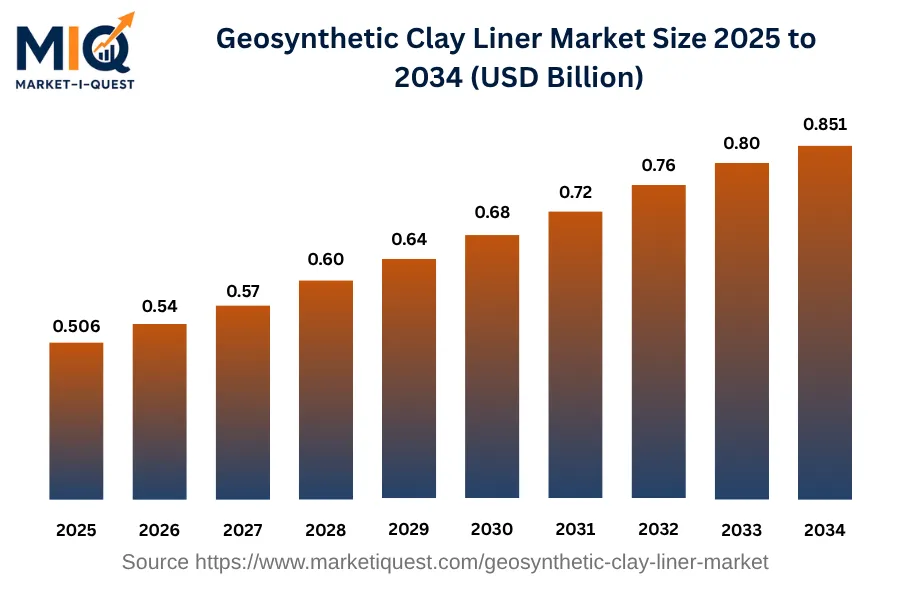
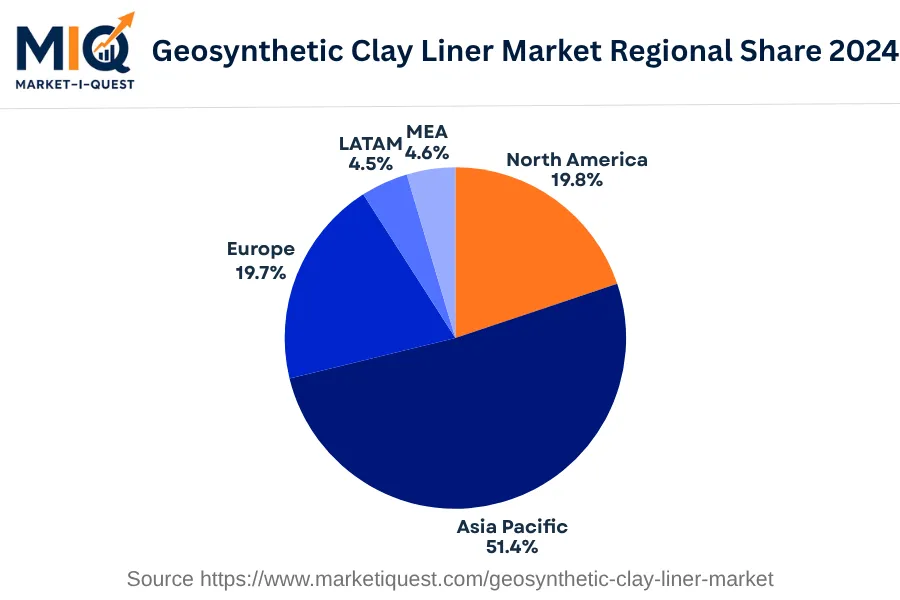
The Geosynthetic Clay Liner Market was sized at 0.51 billion USD in 2025 and is projected to reach an estimated 0.85 billion USD by 2034, advancing at a compound annual growth rate (CAGR) of 5.94%. The market experienced marginal growth between 2024, when it was valued at 0.48 billion USD, and 2025. As the market continued to mature, the period from 2025 to 2034 indicated an upward trend driven by an annual growth rate of 5.94%. In terms of regional share in 2024, the mixture was as follows: the Asia Pacific region held a dominant share of 51.4%. North America and Europe were nearly neck to neck, each contributing to a considerable fraction of the total, with shares of 19.8% and 19.7% respectively. Exercising a minor influence was the LATAM region and MEA region each with shares of 4.5% and 4.6% respectively.

Key Takeaways

  • By Product Type - Composite Geosynthetic Clay Liners held the majority market share in 2024.
  • By Material Type - Sodium Bentonite led the segment accounting for a substantial market share in 2024.
  • By End Use - Industrial segment held a dominant position in 2024.
geosynthetic-clay-liner-market market size

Key Driving Factors

Stringent Environmental Regulations

One significant driver in the geosynthetic clay liner market is the increasing strictness of environmental regulations worldwide. Countries are enforcing stronger laws around waste management and containment. For example, the US Environmental Protection Agency has implemented regulations like the Resource Conservation and Recovery Act (RCRA) spanning landfills, industrial sites, and hazardous material handling. This in turn necessitates the use of materials like geosynthetic clay liners, which offer excellent containment characteristics and hence minimize environmental contamination risks. Industries such as landfill, mining and construction are key sectors where such liners are extensively used ensuring compliance with the regulations thereby driving market growth.
Shift towards Infrastructure Expansion in Developing Countries

The second key driving factor in the geosynthetic clay liner market can be linked directly to extensive infrastructure expansion projects in developing countries. As urban populations in countries like India, China, and parts of Southeast Asia grow, there is a parallel increase in the construction of commercial and residential complexes, highways, and other infrastructural developments. Geosynthetic clay liners provide value in these projects owing to their durability, water resistance, and ease of installation. For instance, they are used as barrier systems in roadways and roofing in buildings to guard against moisture. This increasing infrastructure construction in developing nations significantly propels the demand and subsequent market growth of geosynthetic clay liners.

Market Evolution by Timeline

2019-2023
During this period, the geosynthetic clay liner market saw elevated demand from waste management and mining industries, particularly in developing economies like India and China. As landfills increased, the need for containment solutions led to the increased use of geosynthetic clay liners. Challenges in supply included high raw material costs and limited product availability in certain regions. The adoption of ASTM D5889 and ISO 10318 standards for geosynthetic clay liners contributed to quality assurance, impacting market expansion positively. The primary commercial model involved bulk purchases with long-term contracts. Risks were primarily connected with fluctuating raw material prices and potential climate-related disruptions.
2024
By 2024, major players in the geosynthetic clay liner market started focusing on research and development to enhance product efficiency. The use of nanocomposites provided improved sealing properties, thereby increasing product demand in the containment solutions sector. The adoption of stricter environmental regulations reinforced the market growth. However, potential supply chain disruption was a risk due to increasing global geopolitical uncertainties. Commercially, partnerships between suppliers and end-users emerged as a common model, aimed at ensuring consistent supplies and dealing with price volatility.
2025-2029
In this period, focus shifted to sustainability and reusability within the geosynthetic clay liner market. The proliferation of recycling programs involving geosynthetic materials increased, with regions like Europe leading the way. On the supply side, technological improvements yielded liners with enhanced durability and lifespans. The launch of the EU Circular Economy Action Plan validated recycling efforts. In terms of commercial models, the move towards 'service-based' contracts, including liner installation and maintenance, became commonplace. The main risks involved were alternate containment technologies posing competition and resource scarcity increasing production costs.
2030-2034
The geosynthetic clay liner market is expected to mature by this period. Rapid urbanization worldwide is likely to lead to an increased need for waste and water management infrastructures, further propelling market growth. Supply is anticipated to be driven mainly by sustainable technologies and the integration of artificial intelligence for quality control. The implementation of stricter global waste management guidelines is expected to support market expansion. The commercial model might shift towards scalable and customizable solutions. Risks could include rising operational costs and issues related to liner disposal and recycling.

Future Market Outlook

Future Opportunities

The future of the geosynthetic clay liner market is poised for growth as regulatory pressures and technological advancements converge. With the European Union introducing the Circular Economy Action Plan in 2020, there is a heightened emphasis on sustainable resource management, which could drive demand for GCL applications in municipal solid waste management. In North America, the implementation of stricter landfill cover requirements by the EPA in 2021 creates an opportunity for GCL suppliers to enhance market penetration. Moreover, as water scarcity becomes a pressing concern, countries like Australia are exploring the use of GCLs in enhancing water retention in agricultural applications, acknowledging the success of trials from 2019 showing significant moisture conservation. In Asia, the burgeoning construction sector, particularly in India, is likely to adopt GCL technology for erosion control and soil stabilization, aligning with the government's initiatives on infrastructure development and pollution control initiated in 2020. Furthermore, emerging markets in Africa are beginning to recognize the benefits of GCLs in waste containment, as evidenced by growing investments in infrastructure projects noted in 2022 by the African Development Bank. This traction indicates potential partnerships among local authorities, suppliers, and NGOs focused on sustainable development goals, thereby expanding the application range and increasing awareness of GCL benefits in various sectors.

Segmentation Analysis

By Product Type

The market is divided into subsegments including Composite Geosynthetic Clay Liners, Non-Woven Geosynthetic Clay Liners, and Woven Geosynthetic Clay Liners. Composite Geosynthetic Clay Liners accounted for the largest revenue share while Non-Woven Geosynthetic Clay Liners are expected to grow at the fastest CAGR during the forecast period.

Largest Revenue Share

Composite Geosynthetic Clay Liners

Market Share Leader

Composite Geosynthetic Clay Liners is a dominant subsegment due to its multifaceted applications, customer preference, and incremental benefits over its alternatives. A key driver in this sector is the high efficiency and reliability the product demonstrates in controlling fluid or gas migration in landfill projects, mining and construction industries, and also in environmental protection processes. Its increasing demand is significantly driven by its superior attributes that include high shear strength, low permeability, and excellent chemical resistance that differentiates it from other product types. Predominantly, its usage is far-reaching across numerous geographies due to its robust functionality and regulation compliance that enhances its demand among industrial consumers. Besides, purchasing criteria lean towards quality, cost-efficiency, and sustainability which this product meets efficiently. Furthermore, extensive distribution channels and the marginal switching cost also make it an ideal choice for the majority.

Fastest CAGR

Non-Woven Geosynthetic Clay Liners

Forecast Period Growth Leader

Non-Woven Geosynthetic Clay Liners is the fastest-growing subsegment, signifying substantial potential in the future. Primary drivers of growth for Non-Woven Geosynthetic Clay Liners are found in its strong suits such as easy installation, durability, and cost-efficiency. Its increasing adoption is accelerated by flexible usage across different industries such as landfill, mining and constructions. Meanwhile, some barriers to adoption include the need for stringent quality checks, as flaws in manufacturing or installation could potentially compromise its efficacy. Notably, technological advancements and research & development activities in geocomposites are acting as a catalyst increasing its adoption. Furthermore, strategic alliances, partnerships, and diversified sales channels could further boost its growth. It's important to monitor near-term risks such as fluctuating raw material costs and strict environmental regulations, as these could impact growth trends in this subsegment.

By Material Type

The market is divided into subsegments including Sodium Bentonite, Calcium Bentonite, and Polymer-Modified Bentonite. Calcium Bentonite accounted for the largest revenue share while Polymer-Modified Bentonite is expected to grow at the fastest CAGR during the forecast period.

Largest Revenue Share

Calcium Bentonite

Market Share Leader

Calcium Bentonite, one of the primary types of Bentonite, accounted for the largest material type market share in 2024. Wide adoption of Calcium Bentonite across various sectors like drilling, construction and environmental attributive to its exceptional characteristics – high swelling, absorption and viscosity - is the primary driver for the prominent status of this subsegment. Calcium Bentonite's high absorption property is particularly valued as it captures impurities from fluids, making it preferred in water treatment and purification. Additionally, the significant usage in the construction segment specifically in geotechnical and foundation engineering adds to the substantial demand for this material. The rising global emphasis on environmental safety and water purification sectors in recent years has further augmented the demand for Calcium Bentonite. Moreover, its availability and easy extraction as compared to the other types, facilitate its dominating market position.

Fastest CAGR

Polymer-Modified Bentonite

Forecast Period Growth Leader

Although Calcium Bentonite currently holds the largest market share, Polymer-Modified Bentonite is projected to grow at the most rapid pace in the forecast period. This is driven by its increased adoption across sectors due to its enhanced performance characteristics compared to natural Bentonite. The infusion of polymer modification enhances the sealant properties of the Bentonite, making it highly sought after for applications in sealing and lining of landfills, lagoons and canals. Its superior performance under severe conditions including a wide range of temperatures and pH levels is another factor promoting its rapid adoption. That said, the high cost associated with the modification process serves as an adoption barrier. However, the increasing partnerships and research focus on the cost-effective production of Polymer-Modified Bentonite are expected to mitigate this concern, providing a promising outlook for its market growth.

By End Use

The market is divided into subsegments including Commercial, Industrial, and Residential end uses. In 2024, the Industrial end use accounted for the largest revenue share while the Commercial segment is expected to grow at the fastest CAGR during the forecast period.

Largest Revenue Share

Industrial

Market Share Leader

The Industrial subsegment contributes the largest share in terms of revenue in 2024 due to several factors. Industries tend to have larger operational scope and more intensive usage patterns, which drive higher revenues. The demand for goods and services within this segment also remains relatively stable, further sustaining its market share. The heavy usage of machinery and infrastructure presents a constant demand for maintenance, replacements, and upgrades that contribute to revenue generation. Geographically, industrially dense regions contribute intensely to this revenue during the base year due to their high production capacities and resource usage. Moreover, strict regulations and compliance standards in certain industries necessitate regular spending in this subsegment, thereby propelling its revenue generation. Key purchasing criteria within the industrial segment include cost-effectiveness, durability, and regulatory compliance, especially in environmentally sensitive industries. High switching costs also limit industries' flexibility to shift providers or products, solidifying the revenue stream.

Fastest CAGR

Commercial

Forecast Period Growth Leader

The Commercial subsegment is projected to grow at the fastest CAGR through the forecast period. An uptick in the number of commercial spaces arising from urbanization and economic growth is a major driver for this subsegment's performance. The rise in consumerism and improvements in living standards have also led to more commerce, driving demand in the commercial sector. Technological advancements like smart buildings and sustainable construction methods are gaining adoption, leading to increased capital expenditure on commercial infrastructure. However, challenges remain such as fluctuating real estate market dynamics and changing economic policies that potentially introduce near-term risks. Partnerships with technology providers and green building consultants can accelerate growth and overcome adoption barriers. This segment's growth is further catalyzed by favorable governmental policies promoting infrastructure development and sustainability. The increased focus on creating energy-efficient and smart buildings is a significant catalyst propelling the commercial end use segment's growth trajectory.

Competitive Analysis for Geosynthetic Clay Liner Market

Key Market Players

Manufacturers / OEMs

GSE Environmental, LLC
US
Sodium Bentonite Inc
US
Solmax
Canada

Key Suppliers & Raw Materials

CETCO
US
Bentonite Performance Minerals LLC
US
Minerals Technologies Inc
US

Distributors, Integrators & Channel Partners

Terrafix Geosynthetics Inc
Canada
NAUE GmbH & Co. KG
Germany
Titan Environmental Containment Ltd
Canada

Porter’s Five Forces Analysis

This analysis provides an overview of various forces influencing the Geosynthetic Clay Liner Market.

Supplier Bargaining Power

Medium

Supplier influence dictated by limited number of manufacturers and material availability.

Buyer Bargaining Power

High

High choice availability and low switching costs drive significant buyer power.

Threat of Substitutes

Low

Few alternative products and high performance of geosynthetic clay liners limit substitute threat.

Threat of New Entrants

Medium

Capital investment and technical knowledge present barriers, but growth potential attract new entrants.

Competitive Rivalry

High

Intense competition due to presence of numerous global and regional players.

Regional Analysis

Geographic market dynamics and growth opportunities across key regions

Global Market Outlook

geosynthetic-clay-liner-market market regional share

North America

In 2024, the North American market for Geosynthetic Clay Liners (GCLs) gained momentum due to increased demand, regulatory stipulations and technological enhancements. Drivers of this growth included higher infrastructure activities, particularly in the United States, demanding a robust supply of GCLs. Canada's stringent environmental regulations fostered the market as industries gravitated toward GCLs for waste containment and management. In Mexico, escalating mining activities catalyzed investments in GCL technologies to minimize negative environmental impacts. A shifting trend toward sustainable practices influenced buyer behavior, with more industries adopting GCLs to reduce carbon footprint. Technology advances packaging GCLs as eco-friendly, while meeting regulatory and performance standards, redefining product preferences. Businesses showed increased interest in mutually beneficial partnerships, exemplified by the Golder-Tencate alliance designed to expand GCL supply and distribution in North America.

Substantial use of GCLs was observed across sectors that prioritized sustainability, regulatory compliance and performance efficacy. Construction and mining industries, government bodies for infrastructure projects, and waste-management companies were predominant customers. A recent policy enforcement – the US EPA's Subtitle-D regulation – needed landfill owners to install a composite liner system, amplifying GCL usage across the waste management sector. Overall, GCL market growth in 2024 emerged firmly rooted in a nexus of demand, supply, compliances, technological advances and eco-consciousness.

Asia Pacific

In the base year of 2024, the Asia Pacific Geosynthetic Clay Liner (GCL) market experienced significant growth, largely driven by infrastructure development and tightening environmental regulations. Increasing investments in infrastructure projects - specifically for waste management facilities across the major economies of China, India, and Japan - led to an upsurge in demand for GCLs. Concurrently, the stricter enforcement of environmental policies, such as China’s Solid Waste Law 2024, amplified this market expansion by necessitating the use of GCLs to prevent groundwater contamination. Additionally, rapid tech adoption notably affected the market, with the rise of smart geosynthetics improving functionality and prompting higher utilization of GCLs in construction.

Several trends emerged within the market. The shift towards non-woven fabric GCL material, driven by its superior fluid resistance and stress capacity, gained traction among industry professionals, especially in South Korea and India's construction sectors. Both consumers and manufacturers also displayed a marked preference for partnerships and co-operations, illustrated by the notable collaboration between Australia’s GSE Environmental and India’s Offshore Canvas Company to expand distribution channels and increase market reach. This burgeoning trend toward strategic collaborations seemed to be an adaptation to swiftly-evolving policy environments and the demand for enhanced product performance across major sectors, such as government infrastructure projects, retail, and utilities. In sum, 2024 yielded significant growth and change within the Asia Pacific GCL market driven by diverse factors ranging from regulatory commitments to cooperative business strategies.

Europe

In 2024, the European geosynthetic clay liner (GCL) market experienced noteworthy dynamism. Key drivers concerning demand included adoption of GCLs for waste management in countries such as Germany, the United Kingdom, and Italy due to stricter environmental regulations. High infrastructure investment especially in Central & Eastern Europe, propelled enhanced use of GCLs in civil engineering. Furthermore, technological leaps in Spain and the Nordics facilitated new GCL applications, boosting supply dynamics. Moreover, price competitiveness of GCLs compared to conventional liners favored their uptake across the region.

Trends showed a marked shift towards GCL in environmental protection applications, as entities like utilities and manufacturing sectors switched to more eco-conscious measures. In retail, the channel dynamics discernibly expanded, with increasing online sale of GCL marking a shift in buyer behavior. Notable were partnerships among industry players in France and the Benelux region, optimizing the market’s value chain. Reinforced GCL emerged as a leading product type due to enforcement of stricter building standards, particularly in Germany and the UK. Broader policy enforcement in waste management, notably landfills, underpinned the GCL market's shift towards sustainable practices in Europe.

Latin America

In 2024, the Geosynthetic Clay Liner market in Latin America was a growth driver in environmental management and waste containment projects. Increasing demand came as the region confronted escalating environmental concerns, as governments in Brazil, Mexico, Argentina, Colombia, Chile, and Peru implemented stricter regulations around industrial waste disposal and containment strategies. These policies, coupled with substantial investment in public and private infrastructures, necessitated the implementation of these liners to ensure effective and secure containment, thus driving market growth. Additionally, the trend toward adopting advanced and eco-friendly technology in waste containment practices influenced the sector's product dynamics. As a response to this demand, manufacturers focused on the innovation of cost-effective and environment-friendly liners. Moreover, partnerships and acquisitions within the market significantly increased with companies seeking to expand their geographical reach. The implementation of stringent waste management policies accelerated the technology shift in the market toward more effective products.

Major customers for these liners included utilities and manufacturing industries striving to meet set waste containment guidelines. The construction and mining sectors, particularly in countries like Brazil and Peru, also extensively used these liners due to the increase in environmental awareness and regulations within these sectors. Thus, the market in 2024 witnessed notable growth driven by increased regulation, investment, technology shifts, and the increasing environmental consciousness across different sectors.

Middle East & Africa

In 2024, the geosynthetic clay liner (GCL) market in the Middle East and Africa was defined by significant demand arising from the construction and infrastructure sectors, specifically in Saudi Arabia, United Arab Emirates, and Qatar where robust investment in infrastructure development occurred. Regulatory norms promoted the use of environmentally friendly and sustainable materials like GCL in construction projects, boosting the market further. Technological adoption was visible in this market with superior quality GCL being procured for mega projects in Egypt and South Africa. Furthermore, the consolidating oil and gas industry in Nigeria enhanced the demand for GCL for containment purposes. Despite abundance in raw materials, issues related to supply dynamics persisted as local production capacities were unable to meet demands.

Buyer behavior trended towards high-quality GCL with greater performance and long shelf-life, with a majority of the demand emanating from government and utilities sectors in Kenya and Israel. There was a noticeable product shift towards custom-made GCL catering to the varied requirements of different projects. Numerous partnerships evolved, with local manufacturers entering strategic collaborations with foreign companies. Compliance to international standards in GCL manufacturing gained prominence, triggering an upswing in policy enforcement especially in the oil and gas and manufacturing sectors.

Recent Industry Developments

Latest market innovations, product launches, and strategic initiatives

February 2026

French waterproofing group Soprema inaugurated a new state-of-the-art geosynthetics manufacturing facility in Ahmedabad, Gujarat. Spanning over 11,000 square meters, the plant features an automated production line for Geosynthetic Clay Liners (GCL) and Geosynthetic Cementitious Composite Mats (GCCM), with an annual capacity of six million square meters. The facility can produce rolls up to 5.9 meters wide, reducing seams and leak points in large-scale installations. Strategically located near Mundra and Nhava Sheva ports, the plant positions India as a regional export hub for Europe, Asia, and the Middle East.

September 2025

ASTM International published ASTM D6243/D6243M:2025, the updated standard test method for determining internal and interface shear strength of geosynthetic clay liners (GCLs) by the direct shear method. The standard also saw a REDLINE edition in September 2025. Additionally, ASTM D5890:2025 was published for the swell index of clay mineral components in GCLs.

Frequently Asked Questions