
Geogrid Market Snapshot

Key Players

  • Huesker Synthetics GmbH (Germany)
  • Maccaferri S.p.A. (Italy)
  • NAUE GmbH & Co. KG (Germany)
  • TenCate Geosynthetics (Netherlands)
  • Strata Systems Inc. (US)
  • Geosynthetic Systems (Canada)
  • Propex Operating Company LLC (US)
  • Secugrid Geosynthetics (India)

Market Size

Base Year 2024
$1.84 Bn
CAGR
6.58%
Forecast 2034
$3.48 Bn

Market Segments

By Material Type
Polymer, Metallic, Fiberglass, Geotextile
By Manufacturing Process
Extrusion, Weaving, Welding, Casting
By Application
Road Construction, Railway Construction, Slope Protection, Retaining Walls, Others
By End Use
Infrastructure, Environmental, Transportation, Mining, Others

Market Dynamics

Drivers
  • Increased infrastructure development
  • Technological advancements in geogrid production
Restraints
  • High installation cost
  • Strict environmental regulations
Opportunities
  • Infrastructure development growth
  • Increasing sustainability concerns

Market Size

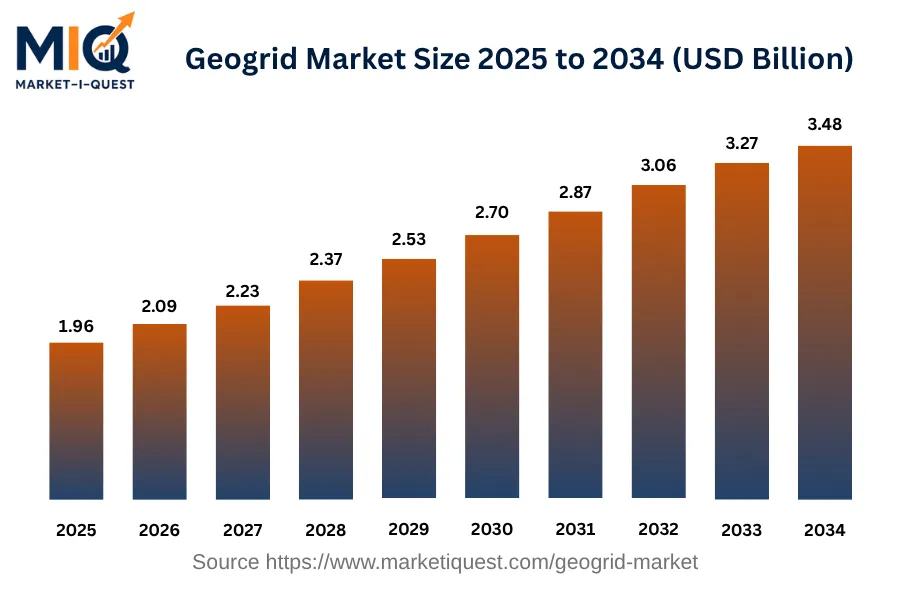
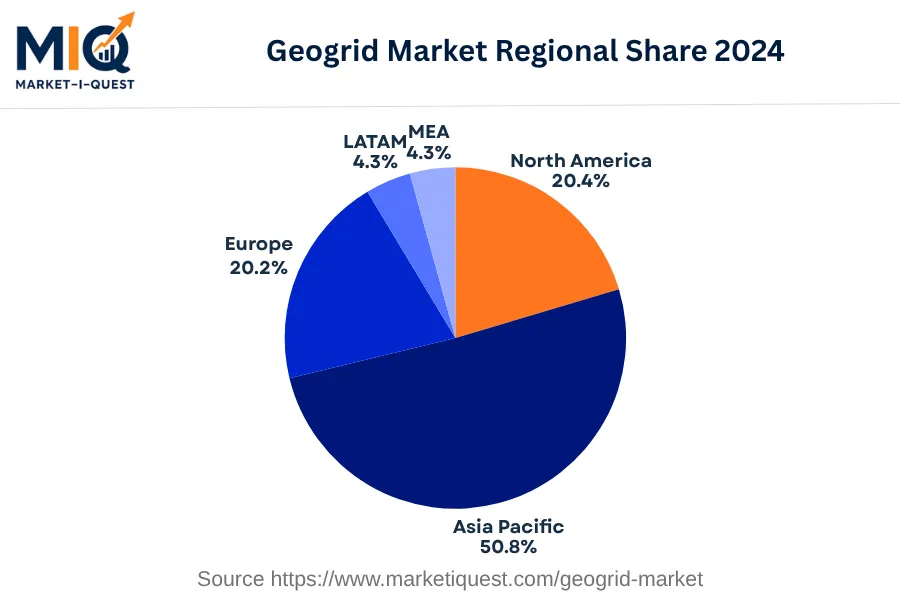
The Geogrid market was valued at USD 1.96 billion in 2025, and it is expected to reach USD 3.48 billion by 2034, with a CAGR of 6.58%. The growth path has been steady from an initial value of USD 1.84 billion in 2024. The steady growth in the market size is mainly because of continuously increasing demand in regions around the world. As per the share mixture in 2024, the Asia Pacific holds a substantial 50.8% of the market, followed by North America and Europe with 20.4% and 20.2%, respectively. Meanwhile, Latin America and the Middle East and Africa each held a comparatively smaller share of the market, each accounting for 4.3%.

Key Takeaways

  • By Material Type - Metallic held the top position in 2024 accounting for significant market share.
  • By Manufacturing Process - Castingled the segment enjoying 46.2% market share in 2024.
  • By Application - Road Construction emerged as the dominant subsegment accounting for 52.4% share in 2024.
  • By End Use - Infrastructure was the leading area holding 48.7% of the market in 2024.
geogrid-market market size

Key Driving Factors

Implementation of Government Infrastructural Development Projects

One of the major driving factors for the Geogrid Market is the ongoing implementation of government-sponsored infrastructural development projects. Geogrids, predominantly used for soil reinforcement in the construction of roads, bridges, and railways, experience increased demand when governments initiate new infrastructure projects. For instance, China's Belt and Road Initiative and India's 'Bharatmala Pariyojana' road and highways project provide an impetus to the geogrid market. The key sectors are in the developing countries where infrastructure is undergoing rapid expansion and modernization, such as Southeast Asia, Africa, and South America. These regions are witnessing an intense surge in the usage of geogrid materials, thus stimulating the market growth.
Emphasis on Sustainable and Eco-efficient Construction Practices

Another crucial driving factor for the Geogrid Market is the growing emphasis on sustainable and eco-efficient construction practices across the globe. As the construction industry seeks to reduce its carbon footprint, geogrids have emerged as a popular choice. These geosynthetic materials help minimize natural resource usage by enhancing the performance and longevity of constructed facilities. Geogrids increase the stability of roads, pavements, and similar structures, reducing the need for frequent reconstruction and the associated material waste and energy costs. This factor is particularly influential in European countries that have stringent environmental regulations, including the European Commission's Green Public Procurement criteria for road construction and civil engineering works.

Market Evolution by Timeline

2019-2023
The geogrid market saw significant demand growth in Asia, mainly due to infrastructure enhancement projects in cities like Shanghai and Mumbai. European construction companies also used geogrid for railway reinforcement projects. Supply-wise, companies such as Huesker and Maccaferri released high-performance polyester geogrids. They faced a constraint with a high manufacturing cost of these geogrids, which made their integration in cost-sensitive projects challenging. Regulations like the European Union's EN 13250 standard for geosynthetics increased awareness and obligatory usage of geogrids. In terms of commercial models, one-off purchases were popular, minimizing the risk of price fluctuations. The primary risk was the uncertainty about geogrid's long-term performance in large fracking sites.
2024
In 2024, North America's civil engineering sector saw increased use of geogrids. The prime motivator was road construction and soil stabilization projects in states like Texas and California. A rise in construction activities in these states led to a shift in supply patterns to meet localized demand. Major geogrid manufacturers, such as Tensar, introduced biodegradable geogrids. The use of these new grids was upheld by the American Society for Testing and Materials' D6706 standard. The commercial model favored was partnerships with local distributors. Key contract elements included negotiated prices and delivery responsibility. The risk was associated with the new biodegradable geogrids weather resistance, with potential worsening under fluctuating weather in southern states.
2025-2029
During this period, potash mining in Saskatchewan led to a surge of geogrid implementation in Canada. Key regions of demand also include India and Australia, for their roadway development projects. Companies such as Tencate Geosynthetics started shipping their fiberglass geogrids to these regions. The integration of geogrid in mining applications remained tricky due to the unpredictability of underground conditions. Pertinent regulations during this time included the Mining Association of Canada's Tailings management program insisting on geogrid use for stability. The commercial model underwent a shift to long-term contracts, with pricing often linked to inflation rates. The consistent uncertainty was the unpredictability of raw material prices, notably polyester and polypropylene, which affect geogrid manufacturing costs.
2030-2034
Post 2030, geogrid usage spiked in Middle Eastern regions, predominantly for water retention projects. There was an increased demand in the African market, mostly for infrastructure developments in South Africa and Nigeria. Supply-wise, companies like Naue and Strata shipped their biaxial geogrids for these projects. However, there were continuing challenges integrating geogrid within water problematic project environments. Standards like International Standards Organisation's (ISO) 10318 and 10722 governed geosynthetic utilization. On the commercial aspect, companies pivoted to direct to customer-based models, evading distributor margins. The unpredictable exchange rate fluctuation was the primary risk, significantly affecting project costs, especially in developing regions.

Future Market Outlook

Future Opportunities

The evolving landscape of infrastructure investment presents various opportunities for the geogrid market, particularly in emerging economies. In 2023, notable projects like India’s Bharatmala Pariyojana plan highlight an ambitious national highway project that will significantly leverage geogrid technology for efficient soil stabilization. Additionally, the European Green Deal announced in late 2019 emphasizes sustainable construction practices, creating demand for geogrids that can help reduce the carbon footprint of civil projects. Manufacturers will likely focus on developing geogrid products tailored to meet specific regional requirements, aligning with local soil types and environmental conditions. Collaborations among companies, such as the partnership between TenCate Geosynthetics and Geosynthetic Institute in June 2023 to improve geogrid efficiency and testing standards, can lead to enhanced performance and broadened applications. As urbanization continues to rise in cities across Africa and Southeast Asia, there is an opportunity to introduce more robust geogrid solutions for urban infrastructure projects. Companies may also invest in R&D for biodegradable and recycled geogrid materials, tapping into the increasing consumer preference for sustainable products. The growth of smart cities and associated infrastructure demands presents another frontier where geogrids can integrate with IoT and monitoring technologies. Therefore, stakeholders in the geogrid market that anticipate these changes may capitalize on the emerging needs of various sectors.

Segmentation Analysis

By Material Type

The market is divided into subsegments including Polymer, Metallic, Fiberglass, and Geotextile. Metallic accounted for the largest revenue share while Geotextile is expected to grow at the fastest CAGR during the forecast period.

Largest Revenue Share

Metallic

Market Share Leader

Metallic materials dominate the market, largely because of their durability and versatility across a range of applications. It is used extensively in several sectors due to its robustness and ability to withstand extreme temperatures and pressure, factors often seen in heavy industry and construction environments. The high purchasing power in the construction and manufacturing industries, backed by rapid urbanization and industrialisation, particularly in fast growing economies like China and India, has buoyed the demand for metallic materials. Furthermore, regulation around safety standards in several industries, which puts a premium on the use of resilient materials, favors the adoption of metallic above other materials. Additionally, the supply of metals has been relatively steady, further cementing metallic's lead in the market. The inability of customers to switch to cheaper alternatives due to application-specific requirements contributes to the revenue of this subsegment.

Fastest CAGR

Geotextile

Forecast Period Growth Leader

Geotextile is expected to experience the fastest growth rate for the foreseeable future. This prediction stems from the product's increasing adoption in civil engineering and construction projects due to its beneficial properties such as high tensile strength, durability, permeability, and resistance to corrosion. However, the high initial capital investment required for the manufacture of geotextile fabric posed as barrier that limited its growth in the past, but improvements in manufacturing technologies should lower costs and stimulate growth. In addition, policy initiatives promoting environmental sustainability and the increased capex investment into infrastructure development, particularly in emerging economies, are expected to serve as catalysts for growth. Partnerships with construction and engineering firms will likely boost the distribution and uptake of geotextile materials. However, risks lie in the volatility of raw material prices and the competition from substitute products.

By Manufacturing Process

The market is divided into subsegments including Extrusion, Weaving, Welding, and Casting. The Casting subsegment accounted for the largest revenue share in 2024, while the Extrusion subsegment is expected to grow at the fastest CAGR during the forecast period.

Largest Revenue Share

Casting

Market Share Leader

The Casting subsegment leads amongst others in terms of revenue generation, due to a variety of factors. This manufacturing process allows for the production of components with intricate designs and high dimensional accuracy, giving it an unparalleled advantage over other processes in industries like automotive, aerospace, and machinery. Additionally, casting enables mass production, allowing manufacturers to cater to the increasing demand efficiently. Geographical demand too plays a role - regions with heavy industrial activities, like North America and Asia-Pacific, majorly contribute to this subsegment's revenue. Regulatory norms advocating sustainable and efficient manufacturing processes also favor casting due to its low energy consumption. Given high switching costs due to the costs of retooling and retraining associated with different manufacturing processes, businesses are likely to stick with casting, further solidifying its lead in the market.

Fastest CAGR

Extrusion

Forecast Period Growth Leader

The Extrusion subsegment is projected to grow at the fastest pace due to several growth drivers. This process is increasingly adopted for its ability to produce long, straight metal parts with uniform cross-sections. As industries such as construction, automobile, and electrical move towards higher standards of precision and quality, the demand for extrusion is set to increase. Policy changes that promote energy-efficient manufacturing methods bode well for extrusion due to its relatively lower energy requirement. In terms of catalysts, technological advances have improved the efficiency and cost-effectiveness of extrusion machines, encouraging its adoption. However, the higher initial capex and operational complexities pose potential barriers. Furthermore, novel partnerships across the supply chain advertise improved material throughput and waste reduction, amplifying the trend towards extrusion. Near-term risks include supply chain disruptions due to geopolitical tensions and potential changes in trade policies.

By Application

This market is divided into subsegments including Road Construction, Railway Construction, Slope Protection, Retaining Walls, and Others. In 2024, Road Construction accounted for the largest revenue share while Railway Construction is expected to grow at the fastest CAGR during the forecast period.

Largest Revenue Share

Road Construction

Market Share Leader

Road construction has been the largest contributor to the market share in our base year 2024. This can be attributed to the massive infrastructure projects that have been launched globally. Governments around the world have been investing heavily in infrastructure development, and roads are a key part of the plan. These road construction projects are crucial for economic growth and development as they connect cities and make transport more efficient. Furthermore, with increasing urbanization and expansion of cities, the need for new roads and maintenance of existing ones remains high. International agencies like World Bank are also pouring funding into road construction projects in developing nations, further driving this segment. Adoption of advanced construction technologies and sustainable construction materials have also escalated investments. Moreover, greater focus on improving road safety by the inclusion of dedicated lanes for pedestrians and cyclists also fuels the growth in this segment.

Fastest CAGR

Railway Construction

Forecast Period Growth Leader

Railway Construction is poised to grow at the fastest CAGR in the coming years. A few key factors are contributing to this growth. Firstly, the adoption of high-speed rail networks is rapidly increasing especially in regions like Europe and Asia. These projects are substantial and expensive, leading to high growth rates. High-speed trains offer economic, environmental, and time-saving benefits which has intensified the demand for these services. Governments worldwide are increasingly focusing on reducing dependency on road transport to limit emissions, consequently boosting the railway construction sector. Furthermore, advancements in rail technology including automated trains and smart tracking systems have heightened the capex in railway construction. There are, however, some challenges such as high initial investments and complex regulatory structures. Despite these hurdles, the emphasis on efficient and green transportation methods, backed by government policies, will contribute to the growth of railway construction.

By End Use

The market is divided into subsegments including Infrastructure, Environmental, Transportation, Mining, and Others. In the base year 2024, Infrastructure accounted for the largest revenue share while Transportation is expected to grow at the fastest CAGR during the forecast period.

Largest Revenue Share

Infrastructure

Market Share Leader

The Infrastructure subsegment remained dominant in the market in terms of revenue generation in the base year 2024, due to several factors. As per typical industry logic, markets directly tied to population growth and urbanization, like Infrastructure, usually experience steady income streams. These ongoing macro-trends drive constant demand for investment in housing, utilities, and public facilities. Furthermore, infrastructure is often regulated, guaranteeing a certain level of spending and introducing barriers to entry for competition. The purchasing criteria within this subsegment are typically dictated by large public and private sector clients, further stabilizing the revenue. Infrastructure's growth can also be attributed to the channels that are used, which often involve long-term contracts and stable relationships with clients, reducing the risk of sudden revenue fluctuations. The durability of this subsegment is reflected in its persistent revenue lead.

Fastest CAGR

Transportation

Forecast Period Growth Leader

The Transportation subsegment, although not leading in terms of revenue, is expected to record the fastest CAGR in the forthcoming years. Several growth drivers contribute to this outlook. The demand for more efficient and sustainable transport networks is increasing rapidly owing to growing urbanization and societal pressure to reduce carbon footprint. This is leading to significant capital expenditure in new transportation technologies and infrastructure like electric buses and optic-fiber-enabled traffic management systems. Partnerships between governments and private organizations are also catalyzing growth within the segment. However, there are barriers and risks including the huge initial investment, technology adoption rate and regulatory changes that could potentially slow down its growth. It's also worth considering the impact of global events, such as pandemics, which could either halt or accelerate initiatives depending on policy responses.

Competitive Analysis

Key Market Players

Manufacturers / OEMs

Tensar International Corporation
US
Koninklijke Ten Cate NV
Netherlands
Maccaferri S.p.A.
Italy

Key Suppliers & Raw Materials

JX Nippon Oil & Energy Corporation
Japan
Eastman Chemical Company
US
Huntsman Corporation
US

Distributors, Integrators & Channel Partners

Nilex Inc.
Canada
Geosynthetics Limited
UK
Terram Geosynthetics Pvt Ltd.
India

Porter’s Five Forces Analysis

This analysis provides a detailed scrutiny of competitive forces within the geogrid market.

Supplier Bargaining Power

Medium

Geogrid suppliers are largely influenced by fluctuations in raw material prices and availability.

Buyer Bargaining Power

High

Numerous suppliers and different types of geogrids enhance the bargaining power of buyers.

Threat of Substitutes

Low

Unique characteristics and applications of geogrids decrease the threat of substitute products.

Threat of New Entrants

Medium

High initial investment but growing market demand moderates the threat of new entrants.

Competitive Rivalry

High

Global presence of numerous competitors and lack of product differentiation result in intense competitive rivalry.

Regional Analysis

Geographic market dynamics and growth opportunities across key regions

Global Market Outlook

geogrid-market market regional share

North America

In 2024, the North American Geogrid Market experienced significant growth, particularly within the United States, Canada, and Mexico. The primary drivers for this uptick were increased government investments in infrastructure projects, a growing demand for advanced geotechnical systems, and the proliferation of technology adoption in construction sectors. Additionally, enhanced regulatory frameworks in the U.S. led to an increase in sustainable and environment-friendly construction activities, stimulating the adoption of geogrids. In terms of market trends, the base year saw a surge in strategic partnerships and mergers and acquisitions, strengthening market consolidation. Moreover, there was a noticeable shift in customer preference towards high-strength polyester geogrids due to their increased durability and longevity.

Another significant trend was the enforcement of environmental policies that mandated the use of geogrids in construction projects to minimize soil erosion. This primarily affected sectors such as government, utilities, and manufacturing where high levels of construction activity were prevalent. Lastly, with the increased digitalization of the retail sector, there was a discernible increase in online sales of geogrid related products, effectively expanding their market reach. Throughout the base year, these factors synergistically energized the North American Geogrid Market, leading to substantial growth and development.

Asia Pacific

In 2024, the Geogrid market in the Asia Pacific shaped by widespread adoption in infrastructure development and environmental stabilization. Robust demand was fueled by China and India's rapid urbanization, mandating investment in sustainable construction technologies. Japan's stringent disaster management regulations propelled Geogrid use in soil stability and erosion control applications. Technological embrace, especially by South Korea and Australia, further boosted market dynamics, witnessing a significant surge in the supply of advanced polymeric Geogrids. A transformative buying habit was observed in enterprises and government sectors, inclining towards environmentally friendly and cost-effective solutions like geosynthetic products. Product innovation became evident in the Asia Pacific market, marked by the increasing popularity of biaxial and triaxial Geogrids in construction and transportation industries. Channel dynamics evolved significantly, with digital platforms providing robust sales and distribution networks, facilitating market penetration in key ASEAN markets. In terms of partnerships, China's retail giants allied with major Geogrid manufacturers, strengthening the supply chain.

The manufacturing sector's compliance with environmental standards further influenced product utilization, particularly regarding recyclability and reduced carbon emissions. Policy enforcements around environment-friendly infrastructural enhancements, particularly in Australia and Japan, endorsed Geogrid application. Thus, 2024 reflected an impactful year for the Geogrid market in the Asia Pacific, largely driven by consumer shift towards sustainable technologies, favorable regulations, and digital transformation.

Europe

In 2024, the Geogrid Market in Europe showcased a dynamic landscape marked by substantial growth and development, primarily in Germany, the United Kingdom, France, Italy, Spain, the Nordics, Benelux, and Central & Eastern Europe. Drivers behind this growth featured increased demand from construction and infrastructure development sectors, as well as from the transportation industry. In particular, the adoption of new technologies in these sectors alongside the implementation of stricter environmental regulations across the region accelerated the use of geogrids due to their eco-friendly nature. Additionally, investment in research and development to improve geogrid quality and operational efficiency also contributed to the market upside.

Trends in 2024 revolved around shifts in buyer behaviour, characterized by increased interest in sustainable and durable construction materials, bolstering demand for geogrid products. From a technological perspective, a profound shift towards digitisation and automation was evident, reshaping the production and supply-chain-management of geogrids. Industry players increasingly collaborated to leverage combined strengths, leading to a surge in partnerships and M&A activities. Lastly, policy enforcement, particularly concerning environmental protection and sustainable growth in construction and transportation sectors, aided the market's development. Ultimately, sectors such as manufacturing, utilities, and governments became prominent consumers of geogrids in 2024, principally for construction and infrastructure.

Latin America

In 2024, the Latin American geogrid market was primarily ruled by the need for more durable infrastructure. Driver one was the escalating demand for cost-effective and sustainable construction solutions, particularly in Brazil and Mexico, forcing industries to adopt geogrid technologies for enhanced soil reinforcement. In addition, governmental regulations in countries like Argentina and Chile promoting eco-friendly construction materials significantly boosted market growth. Another driver was increased investment in infrastructure projects in Columbia and Peru, propelling the demand for geogrid products. Technological adoption was continually developing throughout the region due to their benefits in road construction and erosion control efforts. Supply chain dynamics were also influential, with enhanced availability of high-quality geogrids leading to competitive pricing across the market.

As for trends, buyer behavior favored businesses supplying geogrids made from recyclable materials, aligning with the general trend towards sustainability across Latin America. Technological shifts were evident, with manufacturers focusing on R&D to produce high-strength geogrids. Channel dynamics highlighted the increased adoption of online platforms for purchasing construction materials. Acquisition of small local firms by global leaders was seen as a strategic move to expand their reach and product portfolio. Lastly, government policies enforced the use of geogrids in public works projects more strictly, particularly in manufacturing and utilities industries across the region.

Middle East & Africa

In 2024, the geogrid market in the Middle East and Africa experienced significant growth spurred by increased infrastructure developments. A surge in demand was primarily driven by urbanization and construction activities, especially in Saudi Arabia, South Africa, and the UAE, where investment in civil infrastructure was high. Moreover, wide acceptance of modern geosynthetic solutions led to an uptick in technology adoption. In the oil and gas industry in Qatar, geogrids were extensively utilized, underpinning supply dynamics. Trends shaping the geogrid market in this year included a noticeable shift towards environmentally friendly materials, with synthetic geogrids gaining acceptance due to their durability and effectiveness. In Egypt and Nigeria, the enforcement of stringent environmental standards influenced this trend. Israel saw increased collaboration between local and international players, boosting the geogrid market's growth.

Furthermore, there was a significant trend for the deployment of a digital sales channel in Kenya, where buyers sought cost-effective and efficient geosynthetic solutions. Customers for geogrid solutions included the regional governments, urban developers, the telecom industry, and companies in the oil and gas sector. In particular, robust telecommunications infrastructure growth in Nigeria and the UAE spurred demand for geogrids. Thus, the geogrid market dynamics in the Middle East and Africa in 2024 were characterized by booming industries adapting to an eco-friendly mandate.

Recent Industry Developments

Latest market innovations, product launches, and strategic initiatives

June 2026

Geoquest signed an agreement to acquire the geosynthetics division of Grupo TDM, a leader in ground technologies for infrastructure projects in Latin America. The acquisition, subject to regulatory approval, is expected to be completed by the end of 2026.

December 2025

TechFab India announced that its TechGrid Geogrid (Design Data Sheet No. RF 4/2025) was officially featured on the website of the Civil Engineering and Development Department (CEDD) in Hong Kong. The recognition marks a significant milestone in the company's global outreach and validates its product quality for international infrastructure projects.

Frequently Asked Questions