
GCC Protective Relay Market Snapshot

Key Players

  • ABB Ltd. (Switzerland)
  • Schneider Electric SE (France)
  • General Electric Company (USA)
  • Mitsubishi Electric Corporation (Japan)
  • Siemens AG (Germany)
  • Eaton Corporation Plc (Ireland)
  • Rheinmetall AG (Germany)
  • Schweitzer Engineering Laboratories (USA)
  • Powell Industries Inc (USA)
  • Basler Electric (USA)

Market Size

Base Year 2024
$3.45 Bn
CAGR
5.3%
Forecast 2034
$5.78 Bn

Market Segments

By Voltage Range
  • Low Voltage (0-1kV)
  • Medium Voltage (1-35kV)
  • High Voltage (Above 35kV)
By Application
  • Generator Protection
  • Transformer Protection
  • Motor Protection
  • Feeder Protection
  • Others
By End User Industry
  • Oil & Gas
  • Industrial Manufacturing
  • Utilities
  • Defense
  • Others

Market Dynamics

Drivers
  • Rising electricity demand
  • Increased infrastructure development
Restraints
  • High installation & maintenance costs
  • Limited skilled workforce
Opportunities
  • Growing industrial sector
  • Rising infrastructure projects

Market Size

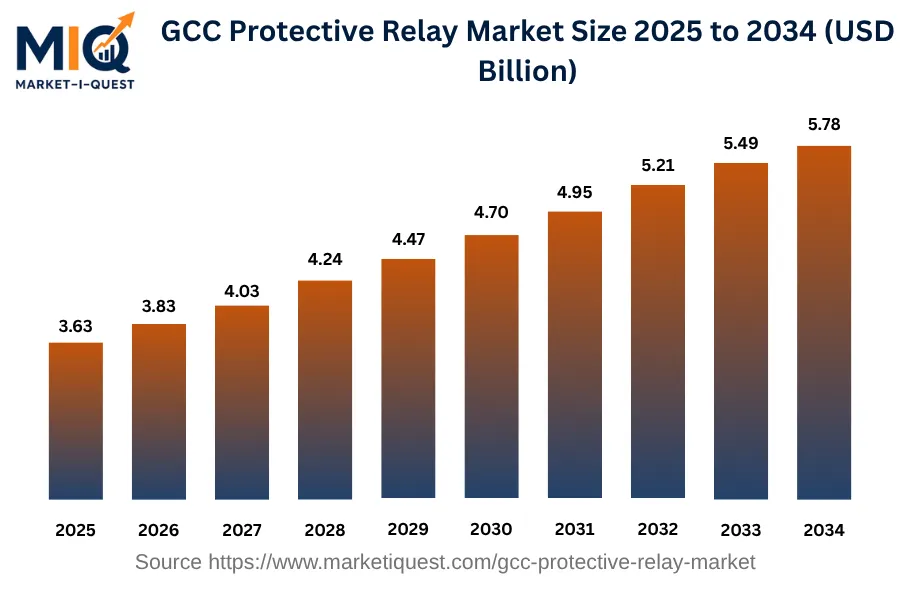
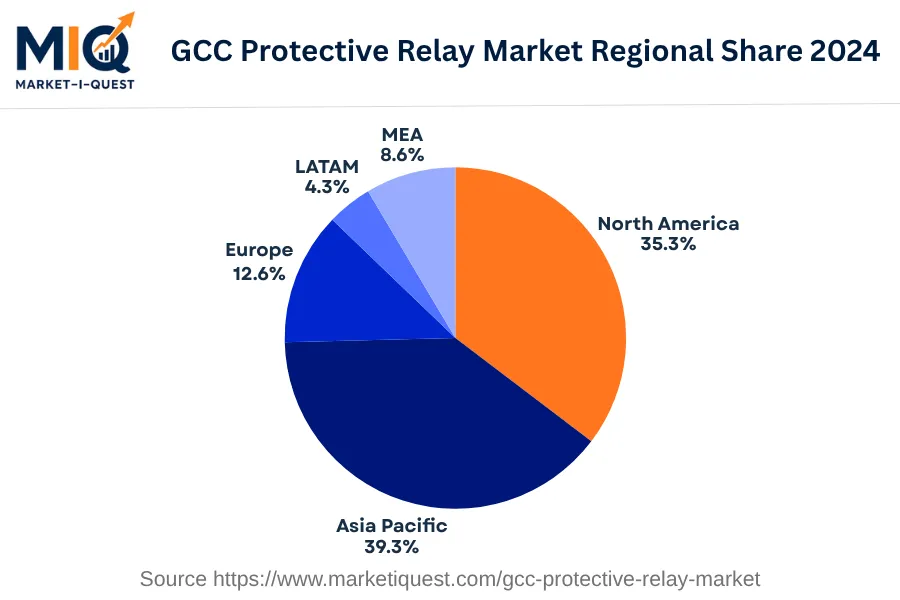
The GCC Protective Relay Market was worth USD 3.63 billion in 2025 and is projected to grow to USD 5.78 billion by 2034, with a CAGR of 5.3%. In essence, this signifies that market is set to increase by approximately USD 2.15 billion over this period. The growth journey from 2025 to 2034 will be marked by a steady incremental upsurge driven by CAGR, as stated above. In terms of regional distribution, in 2024, market shares for the GCC Protective Relay Market were distributed as follows: North America had lion's share at 35.3%, closely trailed by Asia Pacific at 39.3%. Europe accounted for smaller portion at 12.6%, with remaining divided between LATAM at 4.3% and MEA at 8.5%. These percentages denote the share each region had in the market during that specified year.

Key Takeaways

  • By Voltage Range - Medium Voltage (Above 35kV) segment held a significant dominance accounting for a substantial share in the base year.
  • By Application - Transformer Protection led the market covering a prominent proportion in the reference year.
  • By End User Industry - Oil & Gas sector led the market standings holding a robust position in the base year.
gcc-protective-relay-market market size

Key Driving Factors

Stringent Power Industry Regulations

Growth of the GCC Protective Relay Market is strongly influenced by stringent power industry regulations enacted by local governments in Gulf region. Specifically, Gulf Cooperation Council mandates power companies to provide seamless, uninterrupted power supply to residents and businesses alike. To comply with this directive, power companies need to invest in systems that ensure power supply reliability. Protective relays play central role in this scenario, protecting electrical circuits from faults and preventing prolonged power outages. Thus, strict regulatory demand to maintain optimal electricity provision to consumers is a concrete driver for adoption of protective relays around Gulf.
Threat of Harsh Environmental Factors

The GCC Protective Relay Market is also driven by unique environmental climate of Gulf region. Extreme temperature fluctuations, from intense heat to sudden cold, along with recurrent sandstorms, present constant threat to smooth operation of power infrastructures. These harsh conditions can cause severe damage to electrical circuits, triggering defaults and leading to large-scale blackouts. Power companies, therefore, have pressing need for protective systems, like protective relays, that can shield these essential infrastructures. The critical function these systems play in operating under such adverse environmental conditions, thus ensuring consistent power supply, is pushing their adoption in the GCC region.

Market Evolution by Timeline

2019-2023
During this period, GCC Protective Relay Market primarily catered to industrial and utility applications. Core buyer segment saw pattern of purchase from industries utilizing large-scale heavy machinery. UAE was the leading region by demand. Supply predominantly came from Siemens and ABB, with their protective relay models becoming highly integrated. Region-Specific regulations with names like 'GCC Grid Code' and 'GCC Unified Technical Regulation' emerged with focus on ensuring proper installation and operation of protective relays. Contract types broadly followed B2B direct sales model, with units priced based on their voltage and current ratings. The main risk was volatile oil prices, which constrained capital expenditure in large scale industries.
2024
In 2024, there was distinct shift in demand pattern for GCC Protective Relay Market. Significant buyer segments started emerging from renewable energy sectors, particularly solar and wind, largely led by Saudi Arabia. Schneider Electric's Advanced Protection Relays gained significant traction. Integration of Protective Relay Systems with IoT matured, enabling real-time monitoring and fault localization. The 'GCC Renewable Energy Framework' policy encouraged adoption of protective relays in renewable energy projects. Price competition became pronounced, leading suppliers to forge strategic partnerships for cost optimization. Supply chain disruption risk due to Covid-19 was a key concern.
2025-2029
From 2025 to 2029, building automation and intelligent transportation systems became significant buyer segments with demand spread across GCC Region. Honeywell's Protective Relay solution, designed for buildings, emerged with substantial market share. Digital Protective Relay systems continued their integration with IOT, evolving towards Predictive Maintenance. With introduction of 'GCC Clean Energy Policy', eco-friendly, energy-saving protective relays were in demand. A subscription-based procurement model started to gain acceptance. Cybersecurity became significant risk, resulting in suppliers investing in cyber-secure protective relay systems.
2030-2034
During 2030-2034, the residential sector, particularly smart homes, became a new buyer segment in the GCC Protective Relay Market. Demand for smaller, modular, and Internet-connected protective relays increased. Eaton launched IoT-enabled Miniature Protective Relays for home applications. Integration of protective relay systems with AI saw them offer intelligent fault prediction and automated switching functions. The 'GCC Residential Energy Efficiency Standards' mandated use of protective relays in new residential builds. Customizable protective relays offered under 'pay-as-you-grow' model saw upward trend. A key risk became potential incompatibility issues between protective relay systems and home automation systems.

Future Market Outlook

Future Opportunities

Future opportunities in the GCC Protective Relay market are largely influenced by regional regulatory frameworks and increasing demand for advanced electrical safety technologies. Notable initiatives, like Saudi Arabia's Vision 2030, emphasize the upgrading of electrical infrastructures, presenting growth avenues for protective relay suppliers. In March 2022, the UAE government announced investments in smart grid technologies, which further fuels need for sophisticated protective relay systems capable of handling complexities of modern energy distribution. Ongoing global push for sustainability, as outlined in Paris Agreement of 2015, also creates openings for manufacturers who can produce relays that support renewable integration, evidenced by projects like Dubai's Solar Park, which commenced in 2013. Partnerships between traditional utility companies and tech firms are likely to expand; for instance, in mid-2023, a collaboration between Qatar Electricity and Water Company and leading technology provider was formed to enhance grid reliability using next-generation protective relays. Additionally, emphasis on digital solutions related to Industry 4.0 is driving demand for relays that support automated processes and data analytics, as shown by recent product releases from companies like Eaton. Expansion of smart city initiatives in region will encourage adoption of state-of-the-art protective devices across urban infrastructures, further enhancing growth landscape for protective relay market.

Segmentation Analysis

By Voltage Range

The market segmented by voltage range includes Low Voltage (0-1kV), Medium Voltage (1-35kV), and High Voltage (Above 35kV). Medium Voltage range takes the largest revenue share while High Voltage range is projected to grow at the fastest CAGR during the forecast period.

Largest Revenue Share

Medium Voltage (1-35kV)

Market Share Leader

The dominance of the Medium Voltage subsegment in terms of revenue generation can primarily be attributed to its wide scope of applications across various industries. A significant portion of this demand arises from the power distribution sectors, especially in urban and semi-urban regions. This range is ideal for most industrial and commercial applications as it provides the right balance between power capacity and safety to manage the cause of accidents. Further, the vast existing infrastructure of medium voltage lines in developed as well as developing countries underpins its leading share. Moreover, this voltage range is typically used in the electrification of public spaces such as schools, hospitals, corporate buildings which drives its demand. Regulatory support and favorable policies in many regions for enhancing power distribution networks also contribute to medium voltage segment's key position in the market.

Fastest CAGR

High Voltage (Above 35kV)

Forecast Period Growth Leader

The high voltage subsegment is anticipated to see the highest growth rate mainly due to the increasing requirements for high power transmission over long distances. The rapid increase in urbanization and industrialization in emerging economies is driving the demand for effective power transmission solutions, leading to the expansion of high voltage infrastructure. Besides, the push towards renewable energy resources like wind and solar also serves as a catalyst since these energy farms are often located in remote areas which necessitate high voltage transmission lines for efficient power delivery. High-voltage DC transmission technology is gaining momentum in the face of the urgent need for grid interconnections and high capacity undersea power links. However, the complexities associated with the installation and maintenance of these high voltage systems posed as adoption barriers can possibly slow down the market's growth in the short term.

By Application

The market is divided into subsegments including Generator Protection, Transformer Protection, Motor Protection, Feeder Protection, and Others. The Transformer Protection subsegment accounted for the largest revenue share while the Motor Protection subsegment is expected to grow at the fastest CAGR during the forecast period.

Largest Revenue Share

Transformer Protection

Market Share Leader

The Transformer Protection subsegment accounted for the largest revenue share in 2024. This can be attributed to the indispensability of transformers in electrical power systems and the enormous cost of these assets, prompting businesses to prioritize their protection. Transformer protection systems ensure the longevity of transformers, reduce downtime, and prevent catastrophic failures. These are vital factors for businesses that heavily rely on continuous power supply. Moreover, regulation plays a key role, with governments worldwide enforcing strict protection standards to ensure grid stability. Geographically, regions with a high density of industrial and commercial establishments like North America and Asia Pacific generate significant demand for transformer protection systems. Industry-standard purchasing criteria such as reliability, interoperability, and integration with existing systems further drive the purchase of these systems. Channels such as service companies and direct sales have also facilitated the sales reach, contributing to the revenue of this subsegment.

Fastest CAGR

Motor Protection

Forecast Period Growth Leader

Set to experience the highest growth in the coming years is the Motor Protection subsegment. An increasing trend towards automation in both developed and emerging economies has resulted in a rapid surge of demand for electric motors. However, these motors are vulnerable to several threats such as overload, phase loss, and other electrical inconsistencies that can compromise their efficiency and lifespan, thus necessitating robust protection systems. The adoption potential is further reinforced with continuous advancements in technologies like Internet of Things and Artificial Intelligence that improve the accuracy and reliability of motor protection systems. However, high upfront costs may pose as a barrier to adoption in cost-sensitive markets. Vigorous implementation of energy efficiency policies worldwide act as a catalyst for growth, as these policies often mandate or incentivize companies to protect their power systems. Near-term risks include a potential stagnation in market growth due to the ongoing Covid-19 pandemic and related supply chain disruptions.

By End User Industry

The market is divided into subsegments including Oil & Gas, Industrial Manufacturing, Utilities, Defense, and Others. In 2024, the Oil & Gas subsegment accounted for the largest revenue share while Industrial Manufacturing is expected to grow at the fastest CAGR during the forecast period.

Largest Revenue Share

Oil & Gas

Market Share Leader

For 2024, the Oil & Gas sector is projected to be the leading revenue contributor among the end user industries. A range of factors may explain this. First and foremost, the Oil & Gas industry commands a vast and mature market with considerable infrastructure and capital investment. Secondly, it has a large customer base, which includes countries, utility companies and other industries, underlying its significant demand. Additionally, the geographical spread of the Oil & Gas industry is vast, covering every continent, with hotspots in regions like the Middle East, North America, and Russia. This ensures a steady revenue stream from diverse sources. Regulatory landscapes and supply mechanisms have been established over the years, reflecting the industry's maturity. Another key aspect is the high switching costs associated with the infrastructure and equipment involved, which constructs a clear barrier to exit and preserves its revenue capacity. Lastly, the industry benefits from various distribution channels, which include both direct and indirect sales.

Fastest CAGR

Industrial Manufacturing

Forecast Period Growth Leader

While the Oil & Gas subsegment currently leads in revenue, Industrial Manufacturing is anticipated to register the most rapid growth in the coming years. The drivers of this growth are manifold and include the increasing demand for automation and efficient production technologies, which are transforming the industrial manufacturing landscape. As technology continues to evolve, barriers to adoption such as high upfront capital expenditure and lack of skilled workers are gradually being mitigated. Partnerships with technology providers are likely to pave the way for digitization and automation of manufacturing operations. Furthermore, government policies supporting industrial growth and technological innovation act as catalysts propelling this fast growth. However, near-term risks such as volatility in material prices and trade uncertainties should not be disregarded. Despite these, the subsegment’s strong growth trajectory indicates it is well-positioned for expansion in the coming years.

Competitive Analysis

Key Market Players

Manufacturers / OEMs

ABB
Switzerland
Schneider Electric
France
Siemens
Germany

Key Suppliers & Raw Materials

General Electric
US
Eaton Corporation
US
Mitsubishi Electric Corporation
Japan

Distributors, Integrators & Channel Partners

Al Alamiah Technology Group
Saudi Arabia
Oasis Office Equipment
UAE
Bahri & Mazroei Trading Company
UAE

Porter’s Five Forces Analysis

This analysis offers insights into the competitive dynamics within the GCC Protective Relay Market.

Supplier Bargaining Power

Medium

Suppliers have moderate power due to the technical expertise and capex needed in product manufacturing.

Buyer Bargaining Power

High

Buyers, including power utilities and industrial plants, have high negotiating power due to various supplying options.

Threat of Substitutes

Low

Low threat as protective relays play a crucial and specific role in power systems, with no clear substitutes.

Threat of New Entrants

Medium

Reasonable entry barriers due to required technical know-how and high capital investments, but opportunities exist.

Competitive Rivalry

High

Intense competition with numerous established multinational players and OEMs.

Regional Analysis

Geographic market dynamics and growth opportunities across key regions

Global Market Outlook

gcc-protective-relay-market market regional share

North America

In 2024, North America’s GCC Protective Relay Market experienced considerable interest structured by key factors. Stringent regulatory policies mandated reliable power distribution, pushing companies towards adoption of GCC protective relays. This technology gained ground in industries like utilities and manufacturing, where minimal power disruption is critical. Investments in infrastructure development, particularly in U.S., facilitated enhanced demand. Furthermore, the technology's falling prices stimulated its accessibility across sectors, reinforcing market dynamism.

Consumer preferences evolved in 2024, gravitating towards smart grid technology, which boosted the market for intelligent electronic devices (IEDs), like GCC protective relays. Partnerships and M&As became increasingly commonplace, with companies like ABB and Siemens consolidating their positions within market. Shifts towards digitization in utilities and industrial dimensions saw rising demand for real-time control and monitoring of power systems. The trend, notably in Mexico's burgeoning industrial sector, centred around integration of communication-enabled protective relays. Heightened policy enforcement, especially in Canada, towards reducing carbon footprints, favoured GCC protective relays’ deployment for efficient power utilization. Thus, 2024 recorded diverse market drivers and trends influencing North American GCC Protective Relay Market's trajectory.

Asia Pacific

In 2024, the GCC Protective Relay Market in Asia Pacific recorded significant growth, principally driven by an accelerated rate of industrialization, stringent safety regulations and increasing investments in power infrastructure. Key economies like China and India saw demand rise due to their expansive industrial sectors, while Japan and South Korea pushed technology adoption forward, particularly favoring digital and multilayer protective relays. In Australia and ASEAN markets, supply dynamics and competitive pricing strategies played influential roles in expanding market.

Noticeably, there was shift in buyer behavior with utilities and manufacturing sectors showing high inclination towards eco-friendly and energy-efficient protective relays. China enforced stringent policy for this in its large grid-dependent sectors. Technological advancements also sparked shift towards IOT-enabled relays, with India leading in utility sectors adoption. Relays incorporating artificial intelligence made noteworthy penetration in Japan's and South Korea's advanced production industries. Furthermore, significant M&A activities were observed across region, particularly in Australia, where key players aimed to heighten their market presence. These emerging trends, complemented by stringent policy implementations in energy sector, principally in China and key ASEAN markets, substantiated growth momentum of GCC Protective Relay Market in Asia Pacific in 2024.

Europe

In 2024, protective relay market in Europe, including Germany, UK, France, Italy, Spain, the Nordics, Benelux, and Central and Eastern Europe, demonstrated solid performance driven by surge in investment in renewable energy infrastructure. An uptick in regulatory compliances and growing use of smart grids played vital role in underlying market dynamics. Furthermore, rising demand for electricity in industries like manufacturing and utilities called for an increased adoption of protective relay technology throughout Europe.

Market witnessed significant trends in buyer behavior marked by preference towards technologically advanced, energy-efficient protective relays. Upswing in smart grid technology nourished greater emphasis on real-time power system management, steering market towards integration of digital relays. Increased collaboration among manufacturers to deliver quality and customized solutions became prime trend in 2024. Regulatory policies like EU's 'Clean Energy for all Europeans' package were stringently enforced to ensure customer safety and reduce carbon emissions.

In conclusion, the European protective relay market in 2024 was driven by increased industrial demand coupled with regulatory compliance and renewable energy investments. The market navigated its way through the year embracing technological improvements and policy enforcement.

Latin America

In 2024, LATAM market for GCC protective relay experienced substantial growth, primarily propelled by growing energy demands, technology adoption, and infrastructure investments. Increased acceptance of smart grid technology by Brazil and Mexico fostered vast supply dynamics shift. Likewise, Argentina's rigorous energy regulations stimulated demand, while expansion of renewable energy resources in Colombia prompted technology adoption. Increases in electricity prices significantly influenced the market, notably in Chile and Peru, inducing utilities to adopt GCC protective relays to manage power system instability and enact cost-effective solutions.
Distinctive trend observed was rise in partnerships and M&As, especially among utilities, retail, and manufacturing sectors, with Brazil taking lead. This trend underscored increased trust in productivity and efficacy of GCC protective relay systems. Technology shifts in Colombia and Peru, opting for digitized and network-connected relays, significantly redefined buyer behavior. Shift in channel dynamics in Argentina bolstered growth of online sales platforms, strengthening reach of GCC protective relays. Mexico's enforcement of stringent power safety standards encouraged increased adoption of GCC protective relays amongst enterprises and the government sector, thereby enhancing the market's growth in 2024.

Middle East & Africa

In 2024, the GCC Protective Relay Market, concentrated in the Middle East and Africa, exhibited notable dynamism. Saudi Arabia and the United Arab Emirates witnessed substantial demand due to the expansion of their power grid infrastructure, driven by both government and private sector investments. In Qatar and Egypt, stringent safety standards and regulations necessitated the use of upgraded protective relay systems in oil and gas and utility sectors, boosting market growth.

A significant increase in technology adoption was observed, especially in South Africa and Nigeria, influenced by growing sustainability concerns within their manufacturing and telecom sectors. For instance, digital and multifunctional relays saw enhanced uptake owing to their energy efficiency and cost-effectiveness.

Market trends were primarily defined by shifts in buyer behavior and product development. In Kenya and Israel, a preference for advanced sensing technologies emerged among key customers such as retail and financial services sectors, encompassing both domestic and industrial protective relays. Concurrently, an increase in partnerships and mergers and acquisitions across the region highlighted the aim to capitalize on the potential for smart grid applications, specifically in government projects. Lastly, enforced policy for regular inspection and maintenance of protective relay systems to ensure operational safety underscored the sustained commitment of these regions to ensure power system stability.

Recent Industry Developments

Latest market innovations, product launches, and strategic initiatives

May 2026

France-headquartered Cegelec won an EPC contract from the GCCIA to heavily expand the Salwa 400kV substation. This expansion directly fuels the protective relay market as it requires the immediate installation of upgraded 400kV switchgear, circuit breakers, and the corresponding numerical relay schemes to secure the expanded network.

February 2026

Implementation officially began on the $700 million direct power grid interconnection between Oman and the UAE. The project requires building two massive 400kV power transmission substations. This forces grid contractors to deploy advanced transmission line protection relays, specifically differential and distance protection systems, across 530 kilometers of new high-voltage lines.

July 2025

The Abu Dhabi Fund for Development formalized and signed a $205.5 million financing agreement to fund the 400kV interconnection upgrade between the UAE and Saudi Arabia. Securing this liquidity triggered the procurement phase for critical substation protection equipment, allowing regional utilities to source the advanced digital relays necessary to increase cross-border transmission capacity from 2,400 MW to 3,500 MW safely.

Frequently Asked Questions