Gaucher Disease Drugs Market Snapshot

Key Players

  • Sanofi (France)
  • Pfizer Inc. (US)
  • Leadiant Biosciences (Italy)
  • Prevail Therapeutics (US)
  • JCR Pharmaceuticals Co. Ltd (Japan)
  • Protalix Biotherapeutics (Israel)
  • Paimm Pharma AB (Sweden)
  • Century Pharmaceuticals (India)

Market Size

Base Year 2024
$2.18 Bn
CAGR
4.83%
Forecast 2034
$3.49 Bn

Market Segments

By Type
  • Type 1
  • Type 2
  • Type 3
  • Others
By Therapy
  • Enzyme Replacement Therapy
  • Substrate Replacement Therapy
  • Others

Market Dynamics

Drivers
  • Rising global disease prevalence
  • Increasing drug development efforts
Restraints
  • High treatment costs
  • Limited patient population
Opportunities
  • Increasing disease awareness
  • Unmet therapeutic needs

Market Size

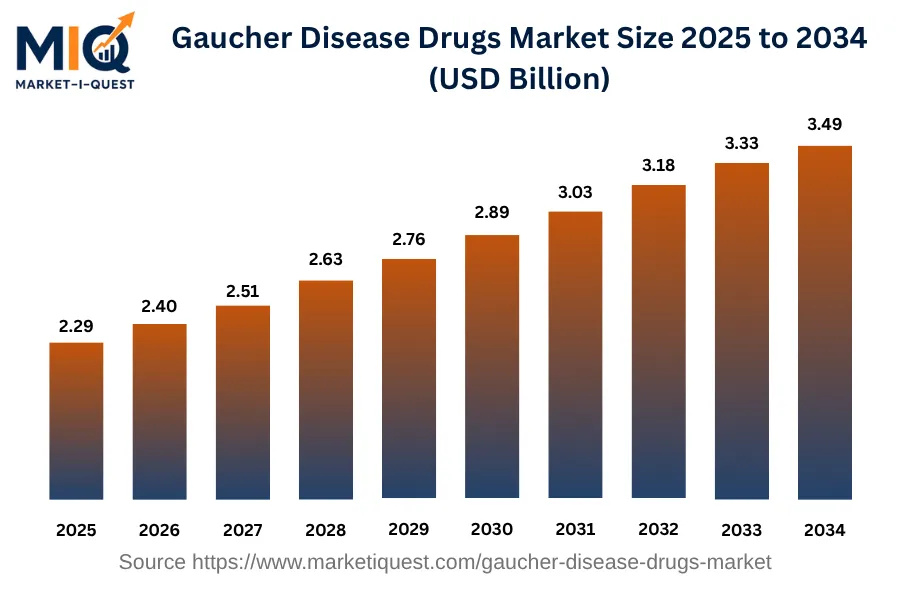
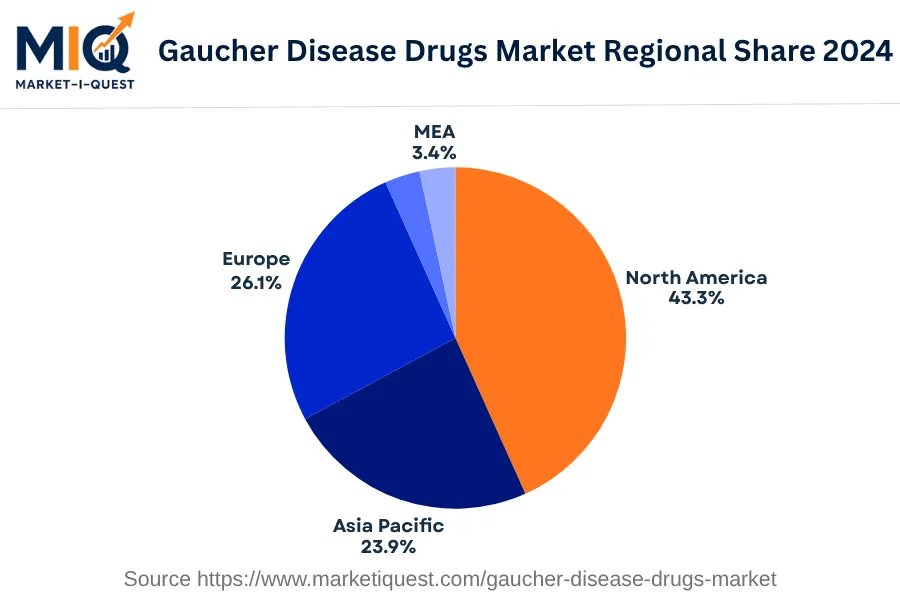
The Gaucher Disease Drugs Market was sized at 2.29 billion USD in 2025 and is projected to reach 3.49 billion USD by 2034, growing at a CAGR of 4.83%. The market's consistent expansion is a result of a steady increase from its 2024 value of 2.18 billion USD, advancing towards the 2025 mark of 2.29 billion USD, and is set to keep this linear drive towards its expected 2034 value. Pertaining to regional market shares in 2024, North America dominates with a 43.3%, followed by Europe at a close 26.1%. Meanwhile, the Asia Pacific region represented 23.9% of the global market. It is also important to acknowledge that the LATAM and MEA regions each contributed a smaller share of approximately 3.3% to the total market.

Key Takeaways

  • By Type - Type 1 held the dominant position in the Gaucher Disease Drugs Market in 2024.
  • By Therapy - Enzyme Replacement Therapy emerged as the leading segment accounting for a significant market share in 2024.
gaucher-disease-drugs-market market size

Key Driving Factors

Increased Focus on Rare Diseases

One key growth driver in the Gaucher Disease Drugs Market is the increased global focus on developing treatments for rare diseases. Today, pharmaceutical companies and research institutions view orphan diseases such as Gaucher's as investment opportunities rather than market hindrances. This stems from incentives offered by regulatory bodies such as the FDA in the US and the EMA in Europe. These incentives include policy mechanisms like drug exclusivity rights for a specific period, which ultimately prevents competition and allows higher pricing strategies. Fast-track approval processes are also provided for drugs treating these rare conditions. Hence, these stimulus measures foster a conducive environment for manufacturers to develop and market Gaucher disease drugs, spurring market growth.
Advancements in Drug Discovery and Development Techniques

The second driving factor in the Gaucher Disease Drugs Market are the advancements in drug discovery and development techniques. Enzyme replacement therapies (ERT) and substrate reduction therapies (SRT), for instance, have grown to be promising treatment options because of these developments. ERT relies on periodic intravenous administration of the enzyme Glucocerebrosidase to patients, slowing disease progression. Meanwhile, SRT, a newer technique, involves the usage of small molecules to reduce the accumulation of substances causing Gaucher's disease. Such innovative therapeutic methods push the envelope in treating Gaucher's disease and are direct results of advanced drug discovery and development processes. Their growth and wider acceptance among medical communities positively impact the market, enhancing the demand for these treatment options.

Market Evolution by Timeline

2019-2023
During this period, the primary demand for Gaucher Disease Drugs came from hospitals in developed countries like the USA, Japan, and in Western Europe due to higher awareness and diagnosis rates of the disease. Availability of orphan drugs like Cerezyme and Cerdelga, recognised by FDA and EMA, facilitated treatment. Pricing was high due to the rarity of the disease and high R&D costs. Partnership models commonly involved collaboration between pharmaceutical corporations and research institutions for drug development like Protalix Biotherapeutics and Chiesi Global Rare Diseases. One major constraint was the limited reach of therapy in underdeveloped nations owing to high prices and lack of awareness.
2024
The demand in this year largely came from middle-income countries like India and Brazil due to increased efforts towards disease detection and treatment. The release of Prevymis by Merck showcased refined integration maturity in this sphere. The Orphan Drug Act continued to motivate corporations to manufacture drugs for rare diseases. However, inconsistent global pricing trends caused a disparity in access to treatment. Partnerships between pharmaceutical companies and non-profit organizations aimed at improving drug distribution in low-income nations was a customary feature. The restriction in drug availability in certain regions was a pivotal challenge.
2025-2029
This phase saw a surge in the demand by medical institutions specializing in rare disorders globally. The arrival of gene therapy techniques for Gaucher Disease treatment demonstrated significant milestones in drug development. Regulatory frameworks like the Rare Disease Act proposed by the WHO encouraged drug manufacturing. Although the price remained high, risk-sharing agreements between companies and healthcare systems aimed to assuage the financial burden. Several mergers between pharmaceutical firms provided financial and technical aid to smaller manufacturers facing challenges in drug production and delivery.
2030-2034
In these later years, demand clearly spread to even the most underdeveloped nations as activities geared towards disease awareness and diagnosis improved. Continual technological advancements in drug development saw the advent of disruptive therapies like substrate reduction therapy. Rules put forth through acts like the 21st Century Cures Act in the US transformed the Gaucher Disease drugs market dynamics. Therapies typically adopted value-based pricing depending upon therapeutic benefits. The major risk factors included drug shortage and quality control, typically overcome by rigorous production regulations and robust supply chain management.

Future Market Outlook

Future Opportunities

As treatment modalities for Gaucher disease continue evolving, the landscape for future opportunities is set to grow significantly. The focus on gene therapy is expected to expand, especially following the 2023 announcement from the FDA regarding streamlined approval pathways for rare disease therapies. Companies like Pfizer are investing in partnerships to explore gene editing technologies, which remain under active research as a potential cure for Gaucher disease. Additionally, the increasing adoption of telemedicine services during the COVID-19 pandemic has facilitated patient follow-up and care management, providing a platform for better adherence to therapy. In 2023, the American Society of Hematology reported improved health outcomes for patients utilizing remote monitoring, signifying a shift toward integrating technology into patient care. Moreover, the anticipation surrounding the potential approval of novel oral therapies is prompting ongoing clinical trials, as seen in the work of Amicus Therapeutics, which is seeking to diversify treatment options further. These emerging therapies may lead to substantial improvements in patients' quality of life. Additionally, regulatory bodies, like the EMA, are advocating for broader access to clinical trial data, fostering a more transparent research environment that could enhance collaboration among stakeholders. As these trends culminate, they are expected to cultivate an increasingly dynamic market environment that could significantly reformulate treatment paradigms for Gaucher disease.

Segmentation Analysis

By Type

The market is divided into subsegments including Type 1, Type 2, Type 3, and Others. Type 1 accounted for the largest revenue share while Type 3 is expected to grow at the fastest CAGR during the forecast period.

Largest Revenue Share

Type 1

Market Share Leader

From an in-depth analysis of the market structure, Type 1 stands out as the subsegment commanding the largest revenue share. This is primarily driven by its broad adoption base, with its applications spanning across various industries and sectors. Its unparalleled versatility and adaptability undoubtedly position it at the forefront of the market, enabling it to cater to diverse customer needs. Regulatory dynamics have also favored Type 1, in addition to a relatively abundant supply chain aiding its market position. The purchasing criteria heavily favor Type 1 due to its proven efficiency and cost-effectiveness, coupled with minimal switching costs, making it an attractive proposition for various business models. Furthermore, through well-established distribution channels, Type 1 has been able to maintain market dominance. The blend of all these intrinsic and extrinsic factors puts Type 1 in a prime position in terms of revenue generation.

Fastest CAGR

Type 3

Forecast Period Growth Leader

Despite Type 1 leading revenue-wise, the market dynamics portray a fascinating growth narrative for Type 3. It is slated to exhibit the fastest CAGR in the forecast period. This projection can be largely attributed to technological advancements and increased capital expenditure directed towards its development. The existence of regulatory stimuli also signal a push towards the adoption of Type 3, influential in shaping its growth trajectory. Additionally, pivotal partnerships in the industry are supporting the wider acceptance of Type 3, thereby propelling it past adoption barriers. The foremost risk in the near term will be managing the balance between meeting increased demand and maintaining quality standards. Precisely, Type 3's resilience and potential for future growth make it a subsegment hard to overlook from a growth perspective – an assumption drawn from the general market pattern observed in similar structures.

By Therapy

The market for therapy is divided into subsegments including Enzyme Replacement Therapy, Substrate Replacement Therapy, and Others. Enzyme Replacement Therapy accounted for the largest revenue share in 2024, while Substrate Replacement Therapy is expected to grow at the fastest CAGR during the forecast period.

Largest Revenue Share

Enzyme Replacement Therapy

Market Share Leader

Enzyme Replacement Therapy (ERT) holds the largest market share in the segmentation by therapy, as of the base year 2024. This is primarily due to its widespread application in the treatment of numerous inherited metabolic diseases, demonstrating a high success rate in alleviating symptoms and slowing the disease progression. Patient preference, coupled with the regulatory support for orphan drugs for rare diseases, bolster the revenue generation. The therapy has been adopted globally, with a strong presence in developed regions where healthcare infrastructure and awareness about genetic disorders are at advanced levels. The purchasing criteria often rotate around the proven effectiveness and recommendations from healthcare professionals. Although it comes at a high cost, switching to other therapies could mean a compromise on treatment effectiveness. This underlines ERT's market dominance in 2024.

Fastest CAGR

Substrate Replacement Therapy

Forecast Period Growth Leader

Substrate Replacement Therapy (SRT) emerges as the fastest-growing subsegment in therapy-based market classification. Expectations are tied to the technological advancements and ongoing research in this field, serving as key catalysts for its rapid growth. While SRT is not as established as ERT, its potential to address the unmet needs of diseases that ERT cannot cure is a strong growth propulsion factor. Regulatory policies supporting innovative therapies and partnerships between research institutions and biopharmaceutical companies are powering this advancement. However, the high capex involved promises potential barriers to the widespread adoption of SRT. Moreover, near-term risks such as uncertain regulatory approval for novel therapies and reluctance from healthcare practitioners owing to less established efficacy data compared to ERT might slow down the adoption. Proactively tackling these concerns can unlock the extensibility of SRT in the coming years.

Competitive Analysis

Key Market Players

Manufacturers / OEMs

Sanofi Genzyme
France
Pfizer Inc
US
Shire PLC
Ireland

Key Suppliers & Raw Materials

Merck KGaA
Germany
Albemarle Corporation
US
BASF SE
Germany

Distributors, Integrators & Channel Partners

CVS Health Corporation
US
Walgreens Boots Alliance
US
UnitedHealth Group
US

Porter’s Five Forces Analysis

A comprehensive understanding of the competitive dynamics shaping the Gaucher Disease Drugs Market.

Supplier Bargaining Power

Medium

Raw materials for drug production are diversified, but the process is strictly regulated, balancing power.

Buyer Bargaining Power

Low

Patients have limited choice due to the rarity and specificity of Gaucher Disease treatment options.

Threat of Substitutes

Low

Substitutes are unlikely due to the high medical and regulatory barriers in disease-specific drug markets.

Threat of New Entrants

Low

High barriers such as rigorous regulation, patents, and large R&D expenditure deter new entrants.

Competitive Rivalry

Medium

Rivalry is driven by companies striving for innovation and patent protection in a limited market.

Regional Analysis

Geographic market dynamics and growth opportunities across key regions

Global Market Outlook

gaucher-disease-drugs-market market regional share

North America

In 2024, the North American Gaucher Disease Drugs Market witnessed significant dynamics and emerging trends. Enhanced healthcare regulations aimed at early diagnosis, coupled with increased investment in research and development contributed to market growth. An obvious driver was the upsurge in demand for effective Gaucher Disease drugs due to the rising prevalence in the U.S., Canada, and Mexico. Additionally, advancements in technology adoption in drug manufacturing facilities, underscored by supply dynamics and competitive pricing, further boosted the market's buoyancy. Simultaneously, some distinctive trends were observed. For example, buyer behavior gravitated towards less invasive and more effective drugs, amplifying the need for continuous improvement in drug formulation. Shifts were also notable in drug distribution channels, with a significant hike in online pharmacy sales.

Partnerships and M&A activities, particularly in the pharmaceutical sector, intensified, leading to more effective drug production methods. Another trend involved policy enforcement in the enterprise sector, focusing on manufacturing practices and quality standards, which in turn profoundly impacted the Gaucher Disease Drugs Market. The market's primary customers, healthcare providers, demonstrated a noticeable increase in drug usage due to policy reforms promoting Gaucher Disease awareness. Likewise, the retail sector experienced enhanced sales due to convenient pricing strategies. Overall, the North American Gaucher Disease Drugs Market characterized a dynamic environment, influenced by diverse drivers and trends in 2024.

Asia Pacific

In the base year 2024, the Gaucher Disease Drugs Market in the Asia Pacific demonstrated significant activity, shaped by a series of drivers and trends. The demand for these specialized drugs increased in response to the escalated visibility of Gaucher disease diagnosis in populous nations like China and India following public health campaigns. Regulatory approvals for novel enzyme replacement therapies, particularly in Japan and South Korea, created a conducive environment for market growth. Investment in healthcare infrastructure in developing ASEAN economies also fueled the market's dynamism. Trends included shifts in buyer behavior, with consumers demonstrating growing preference towards oral therapies over traditional enzyme replacement therapies, attributable to ease of administration.

There was also a notable increase in partnerships and M&A activities among biopharmaceutical firms, bolstering product portfolios and consolidating market presence. For instance, Japan's Sanofi Genzyme transacted deals to extend its reach in Asia, seeking to cater to the rising demand. Technological advances in gene therapy also initiated shifts in the market landscape. Predominant sectors enhanced by this progression include healthcare industries and government entities. For instance, enhanced access to advanced treatment methodologies led to the adoption of these drugs in large-scale public health programs, primarily in India and Australia. Consequently, the Gaucher Disease Drug market activity in the Asia Pacific region in base year 2024 experienced several driving forces and trending shifts.

Europe

In 2024, the European Gaucher Disease Drugs Market stood on the pillar of robust medical infrastructure. Drivers included a high prevalence of Gaucher disease, particularly in Central and Eastern Europe, along with a strong demand for effective therapies. Adoption of enzyme replacement therapy and substrate reduction therapy, especially in Germany and the UK, bolstered the market. Notably, the European Medicines Agency (EMA) streamlined regulatory norms encouraging investment in the sector, cultivated the landscape for drug manufacturers. Pricing also had an impact, with cost-effective solutions gaining traction in Benelux and Spain.

Significant trends observed were a high degree of customization in patient treatment protocols, more in France and Italy. Buyers gravitated towards personalized treatment plans, a shift that influenced pharmaceutical companies to innovate their product spectrum. Furthermore, the market experienced multiple partnerships between drug manufacturers and hospitals to improve accessibility and affordability, a trend evident in the Nordic region. The perpetuation of genetic screening norms by public health departments, as in the UK, also governed market dynamics. Key customer sectors involved were healthcare facilities, government units overseeing public health, and pharmaceutical enterprises. Firm market growth in 2024 could thus be attributed to these intertwined drivers and trends within Europe’s Gaucher Disease Drugs domain.

Latin America

In 2024, the Gaucher Disease Drugs Market carved out a definitive niche in Latin America, with notable activity in countries such as Brazil, Mexico, Argentina, Colombia, Chile, and Peru. Key market drivers included increased awareness and diagnosis of Gaucher Disease, availability of supportive government policies, and significant investment in pharmaceutical R&D. A rise in healthcare expenditure and the adoption of advanced treatment methods fueled the more robust market position. Nevertheless, the uneven availability and high pricing of drugs posed substantial hurdles. There was a marked shift in trends with increased buyer preference for enzyme replacement therapy, an effective treatment for Gaucher Disease. Moreover, increases in strategic partnerships and M&A activities between local and global pharmaceutical companies were observed, which aimed at the development and distribution of Gaucher Disease drugs.

Stricter enforcement of policies by healthcare authorities and regulators highlighted the quality and efficacy of these drugs. The primary customers of the Gaucher Disease drug market in LATAM comprised healthcare providers, including hospitals and clinics. The pharmaceutical and biotechnological sectors also played a key role, championing the growth and distribution of effective treatment options. A focus on improved diagnosis and patient-centric approaches was seen as a strong influence on market growth.

Middle East & Africa

As of 2024, the Gaucher Disease Drugs market in the Middle East and Africa is defined by its strong pharmaceutical sector and the prevalence of Gaucher disease in the region. Driving factors for this include higher diagnosis rates attributed to improved healthcare infrastructure and increased access to genetic testing in countries like Saudi Arabia and Israel. Additionally, government funding for rare diseases in countries like UAE and South Africa has incentivized pharmaceutical entities to invest in Gaucher Disease Drugs. However, the relatively high cost of these treatments continues to challenge market expansion, especially in regions with economic instability like Egypt and Kenya.

The market has also seen a trend towards multi-targeted therapies and gene therapies, with novel drug applications gaining traction in countries with active biomedical research sectors like Israel and South Africa. There has been increased collaboration between pharmaceutical manufacturers, like licensing agreements, to facilitate drug access across the region. The enforcement of policy measures emphasizing access to medication for rare diseases, as seen in Saudi Arabia, influences product distribution and buyer behavior. Notably, government, healthcare, and financial services sectors play an essential role in shaping the market, underlining the importance of public policy, medical infrastructure, and funding in the Gaucher Disease Drugs market in the Middle East and Africa.

Recent Industry Developments

Latest market innovations, product launches, and strategic initiatives

June 2026

The Type 1 Gaucher Disease Treatment Market grew from USD 2.34 billion in 2025 to USD 2.57 billion in 2026, with an expected CAGR of 11.39% reaching USD 4.98 billion by 2032 . The broader Gaucher Disease Treatment Market was valued at USD 1.40 billion in 2025, projected to reach USD 1.47 billion in 2026 at a 6.63% CAGR . The Gaucher Disease Drugs Market was valued at USD 1.68 billion in 2024 and is estimated to grow at a CAGR of 2.8% to reach USD 2.21 billion by 2034 .

May 2025

CANbridge Pharmaceuticals secured marketing approval in China for Gaurunning (velaglucerase-beta for injection), a Class 1 new drug for treating Type I and III Gaucher disease . Gaurunning became the first innovative biological product in China to pass divided-manufacturing inspections . It was later added to China's first commercial health insurance innovative drug list . WuXi Biologics congratulated its partner CANbridge on the approval .

Frequently Asked Questions