Gaskets and Seals Market Snapshot

Key Players

  • SKF (Sweden)
  • Freudenberg Sealing Technologies (Germany)
  • Dana Incorporated (United States)
  • Flowserve Corporation (United States)
  • ElringKlinger AG (Germany)
  • Trelleborg AB (Sweden)
  • Parker Hannifin Corp (United States)
  • NOK Corporation (Japan)
  • Flexitallic (United Kingdom)
  • EnPro Industries (United States)

Market Size

Base Year 2024
$84.93 Bn
CAGR
5.28%
Forecast 2034
$142.08 Bn

Market Segments

By Product
Seals, Gaskets
By Material
Metals, Rubber, Fiber, Graphite, Others
By Sales Channel
OEM, Aftermarket
By Application
Oil & Gas, Automotive OEM, Aerospace & Defense, Chemical Processing, Power Generation, Others

Market Dynamics

Drivers
  • Increasing industrialization
  • Rising automotive production
Restraints
  • Stringent environmental regulations
  • High production cost
Opportunities
  • Growing industrialization worldwide
  • Advancements in seal technology

Market Size

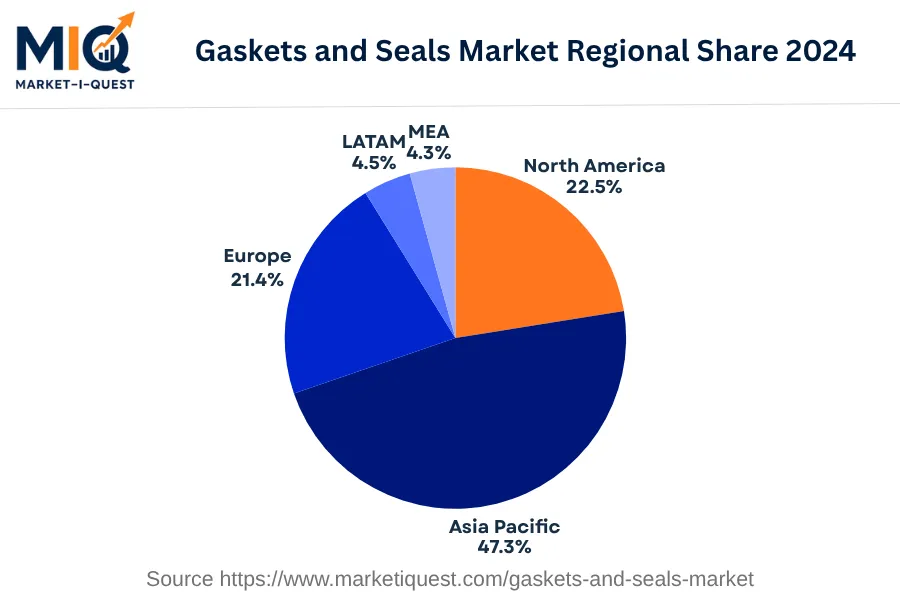
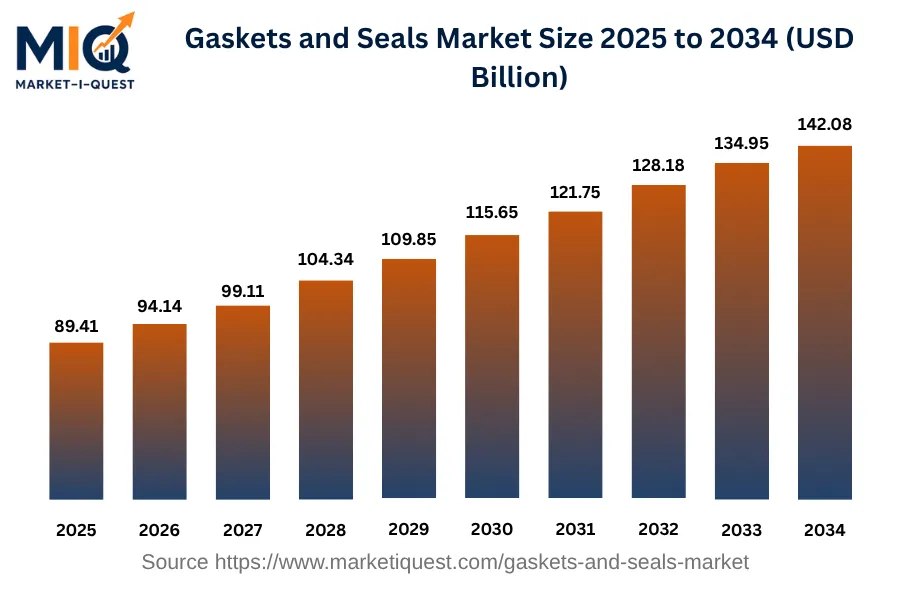
The Gaskets and Seals Market is valued at 89.41 Billion USD in 2025 and expands to 142.08 Billion USD by the end of 2034, growing at a Compound Annual Growth Rate (CAGR) of 5.28%. The years between 2025 and 2034 show steady growth, climbing from a value of 89.41 Billion USD to 142.08 Billion USD. This substantial growth over a span of nine years reflects an increased demand for gaskets and seals across various industries. Regionally, the market exhibits diverse distribution in 2024: the Asia Pacific region comprises the largest share of 47.3%, followed by North America with 22.5%. Europe holds a share of 21.4%, while Latin America and the Middle East and Africa account for the smaller portions with 4.5% and 4.3%, respectively.

Key Takeaways

  • By Product - Seals segment led the Gaskets and Seals market holding a significant share in the base year.
  • By Material - Metals segment dominated accounting for a high market share.
  • By Sales Channel - OEM emerged as the leading segment in the market.
  • By Application - Oil & Gas sector notably led marking an influential position in the Gaskets and Seals Market.
gaskets-and-seals-market market size

Key Driving Factors

Increasing Implementation of Industrial Internet of Things (IIOT)

A significant driver in the gaskets and seals market is the rapidly growing implementation of the Industrial Internet of Things (IIOT) in manufacturing processes. This technology includes smart seals and sensors that provide real-time data about the condition of critical components, such as seal health, temperature, and pressure, decreasing the risk of unexpected system failures. For example, in global industrial sectors such as automotive manufacturing and oil and gas, proactive maintenance of equipment has become crucial. Here, gaskets and seals equipped with IIOT technologies provide invaluable information to decision-makers, reducing downtime and improving production efficiency. Thus, the demand for these smart gaskets and seals is poised to drive the market in the near term.

Stringent Environmental Regulations

The increasing imposition of stringent environmental regulations globally, particularly focusing on the reduction of emissions in industrial operations, is another pivotal driving factor for the gaskets and seals market. Such regulations necessitate the use of advanced sealing technologies to prevent leakages and control emissions, thus compelling industries to adopt high-quality and reliable gaskets and seals. For instance, the US Environmental Protection Agency (EPA) imposes regulations on VOC emissions from equipment leaks, promoting the use of robust gaskets and seals in the chemical and oil & gas industries in particular. Therefore, these increasingly strict environmental regulations are key in propelling growth in the gaskets and seals market.

Market Evolution by Timeline

2019-2023
Throughout this period, Asian countries, especially China and India, noticed a growth in the automotive sector, primarily fueling the demand for gaskets and seals. On the opposite side, manufacturers based in Europe and America introduced new production technology to enhance product durability, quality, and meet environmental norms. The regulatory pressure on minimizing CO2 emission in European Union countries led to a switch towards EPDM (Ethylene Propylene Diene Monomer) gaskets for better heat resistance. Supply contracts were typically long-term, factoring in raw material price fluctuation risks. Issues like quality disparity across suppliers and counterfeit products surfaced frequently.
2024
By this time, the maritime industry became a significant buyer due to a spike in shipbuilding activities in South Korea and Japan. Advances in polymer technology led to the use of highly resistant materials in harsh marine environments. Oddly, due to the global silicon shortage, seal manufacturers faced challenges in sourcing silicon-based rubber. Governments in different regions took the initiative to enforce stringent counterfeiting laws to combat the fake products issue. Commercially, the rise in raw material prices led to increased product costing, influencing a hike in B2B pricing structures. Counterfeiting persisted as a considerable business risk.
2025-2029
Later, the adoption of gaskets and seals in wind turbines became prevalent as the renewable energy sector saw global expansion, specifically in Brazil and the Middle East. Technological developments allowed the integration of sensor technology with seals for proactive maintenance. However, both adoption and production were constrained by the high costs of these smart gaskets. With energy transition policies in major economies, the need for enhanced material standards arose, enforced by authorities like the American Society of Mechanical Engineers (ASME). Risk-sharing contracts became more common to mitigate the risk of volatile raw material prices.
2030-2034
Finally, the gaskets and seals market started catering to the advanced space industry in countries such as the United States, Russia, and China. A shift towards using 3D printing techniques to manufacture custom gaskets was observed. Despite advances, accessing raw materials in conflict zones posed a key supply chain issue. New regulations mandated ecolabeling on products in the European Union to validate environmental impact. Furthermore, partnership models with additive manufacturers gained prominence to meet specific project requirements. Evolving geopolitical conflicts, particularly in the Middle-East, posed the risk of disrupting supply timelines – a factor most manufacturers had to account for in their strategic planning.

Future Market Outlook

Future Opportunities

The ongoing digital transformation across various industries presents numerous opportunities for the global gaskets and seals market. In 2022, the European Union implemented the Green Deal, aimed at achieving climate neutrality by 2050, which could significantly increase demand for energy-efficient sealing solutions in automotive and construction sectors. Companies like Trelleborg are already positioning themselves to address this demand by developing products that enhance energy efficiency and reduce emissions. The growth of renewable energy sectors, particularly wind and solar, is also creating horizons for gaskets and seals that can withstand harsh environmental conditions; organizations like the Global Wind Energy Council are advocating for improved reliability in such applications. Furthermore, the rise of Industry 4.0 technologies such as the Internet of Things (IoT) is expected to influence gasket design and management, with initiatives like smart monitoring systems being tested by companies such as SKF and their partners. With the increasing complexity of machinery and the need for maintenance, digital twins of gaskets are being created, driven by advancements in simulation software. Moreover, the trend towards globally standardized gasket sizes, influenced by bodies like ASTM International, is creating opportunities for mass customization while lowering production costs. As regulatory influences and technological advancements intertwine, the gaskets and seals market is positioned to adapt and thrive in response to evolving industrial needs while focusing on sustainability.

Segmentation Analysis

By Product

The product based market is bifurcated into seals and gaskets with seals securing the largest revenue share, while gaskets is anticipated to register the fastest CAGR during the predicted period.

Largest Revenue Share

Seals

Market Share Leader

The seals subsegment has emerged as leading revenue generator due to several driving factors. The primary factor is the critical role seals play in preventing leakage and enhancing the shelf life of packaged products across different industries such as food & beverages, pharma, and automotive. Geographically, regions with strong manufacturing sectors like Asia Pacific, particularly China, have reported substantial consumption of seals, therefore contributing to revenue growth. The high demand from these industries is largely due to stringent regulations concerning leakage and spillage of products, and seals are best at ensuring compliance with these regulations. Customers in these industries primarily look for durability, material compatibility, and regulation conformity when purchasing seals. Additionally, seals are well-established in the market and customers' switching cost from seals to alternatives is substantial due to potential compromise on leakage protection. The sales channels for seals are vast and well-distributed, making them readily available for customers across different industries.

Fastest CAGR

Gaskets

Forecast Period Growth Leader

Despite not being the leading revenue generator, the gaskets subsegment is expected to grow at a notably faster pace. This rapid growth projection can be attributed to the increasing technological advancements and greater capital expenditure in sectors like manufacturing, oil & gas, and automotive. Technology has enabled the production of highly durable and efficient gaskets, which are swiftly gaining traction in the market. The barrier towards the adoption is traditionally the higher initial cost, but long-term benefits, such as enhanced product lifespan and decreased maintenance costs, make it a worthwhile investment. Given the emerging nature of advanced gaskets, forming strategic partnerships with OEMs could serve as a catalyst for rapid expansion. Near-term risks include fluctuating raw material prices and potential supply chain disruptions due to geopolitical factors. Nevertheless, it is anticipated that the steady technological progress and the associated benefits are likely to overshadow these risks in the long run.

By Material

The market is divided into subsegments including Metals, Rubber, Fiber, Graphite, and Others. Metals accounted for the largest revenue share while Fiber is expected to grow at the fastest CAGR during the forecast period.

Largest Revenue Share

Metals

Market Share Leader

The subsegment Metals has dominated the market, generating the most significant share of the revenue in 2024. This dominance is primarily driven by the wide application range of metals across various industries such as manufacturing, construction, automotive, and electronics. The underlying strength of metals as a material, including their durability, tensile strength, and resistivity to heat and pressure, positions them with a competitive edge against other materials. Additionally, significant investments in research and development have led to the invention of more advanced metal alloys, further boosting market growth. Developed economies with robust industrial sectors including the USA, China, and Germany, have also fueled the demand for metals, further supporting this subsegment's strong revenue position. There's also a consistent demand from emerging economies that are currently witnessing massive industrial growth. Moreover, global regulatory environments have been reasonably stable this base year, ensuring no significant impediment to the metals market.

Fastest CAGR

Fiber

Forecast Period Growth Leader

While Metals may lead in revenue, Fiber is projected to experience the most considerable growth rate. The primary drivers of the accelerating growth of fiber as a material can be attributed to its increasing adoption in industries such as textile, automotive, consumer goods, and construction. The rise of eco-conscious consumer behavior has forced industries to seek sustainable, recyclable, and lightweight materials, leading to an increase in the demand for fiber. Alongside this, ongoing technological advancements and innovations in fiber manufacturing, like the development of high-strength synthetic fibers, have fueled its adoption. Despite the momentum, it’s important to note potential barriers such as the high cost of producing certain types of fiber and regulatory policies concerned with environmental impact. However, strategic collaborations and a shift towards green manufacturing provide a positive outlook for future capital investments.

By Sales Channel

The market is divided into sub-segments, in particular, the OEM and Aftermarket. In the year 2024, the OEM subsegment accounted for the largest share of the market revenue while the Aftermarket subsegment is expected to grow at the fastest CAGR during the forecast period.

Largest Revenue Share

OEM

Market Share Leader

The OEM (Original Equipment Manufacturer) sales channel held the most revenue in 2024. This dominance can be attributed to several factors. Firstly, many consumers prefer purchasing original products directly from the manufacturer attributing it to guaranteed quality, product authenticity, and aftersales services. OEMs usually have stringent quality control checks ensuring high product quality which allures many customers. Secondly, purchasing from the OEMs comes with a sense of trust and assurance where customers feel confident about the legitimacy of the product they’re buying. Lastly, the growth and assimilation of e-commerce into peoples' daily lives have further propelled the revenue of OEMs. More manufacturer's are now directly selling their products online, enabling them to reach a vast consumer base. OEMs also associate with different e-commerce platforms accelerating their reach and market presence. Based on these factors, it can be expected that the OEM segment will continue its dominance in the market.

Fastest CAGR

Aftermarket

Forecast Period Growth Leader

The Aftermarket sector is projected to grow at the most rapid pace, despite not being the largest revenue contributor. This growth can be tied to several factors. The main growth driver being that aftermarket parts are usually cheaper than their OEM counterparts. As such, cost-sensitive customers who do not mind using non-original parts prefer purchasing aftermarket products to save costs. Furthermore, the availability of aftermarket parts is higher. With multiple providers in the market, customers have the liberty to shop around and choose from a variety of options, further driving the growth of this segment. Additionally, advancements in manufacturing and quality control have led to an improvement in the quality of aftermarket parts making them an appealing choice for many customers. However, there are risks associated with counterfeit parts in the aftermarket sector. Ensuring the quality and the legitimacy of the parts is a challenge that may hamper the growth to some extent.

By Application

The market is divided into subsegments including Oil & Gas, Automotive OEM, Aerospace & Defense, Chemical Processing, Power Generation, and Others. The Oil & Gas subsegment accounted for the largest revenue share while the Power Generation subsegment is expected to grow at the fastest CAGR during the forecast period.

Largest Revenue Share

Oil & Gas

Market Share Leader

The Oil & Gas sector leads the revenue generation in this market due to its significant global presence and the continuous demand for energy resources. This sector's essential role in fueling industries and heating homes contributes to its superior revenue share in the market. Technological advancements such as the development of more efficient extraction and processing methods, along with the discovery of new reserves, have increased oil and gas production rates, driving market revenue. Notably, the growth of emerging economies like China and India has further boosted global energy demand, leading to greater sales in the oil and gas segment. The industry also benefits from stable regulations that favor production and, by extension, the adoption of market products. Lastly, high switching costs for alternative energy sources underscore the strong market position of oil and gas.

Fastest CAGR

Power Generation

Forecast Period Growth Leader

The Power Generation sector is expected to grow at the fastest pace during the forecast period. The primary drivers for this growth include increasing demand for electricity in developing regions, technological advancements in power generation equipment, and legislative policies that favor renewable power generation projects. Rapid urbanization and industrialization, chiefly in Asia, Africa, and South America, are elevating electricity demand and thus, adoption of power generation solutions. Technology advancement, especially in renewable energy technologies like wind and solar, is paving the way for massive investments in power generation projects. Governments worldwide are introducing favorable policies to accelerate renewable energy adoption, further stimulating growth in this subsegment. However, near-term risks such as geopolitical tensions and financial hurdles could potentially slow down this growth. Despite these obstacles, the long-term outlook for the Power Generation subsegment remains positive, primarily due to the global push towards cleaner, renewable energy.

Competitive Analysis for Gaskets and Seals Market

Key Market Players

Manufacturers / OEMs

Freudenberg Group
Germany
SKF
Sweden
Parker Hannifin
US

Key Suppliers & Raw Materials

Sumitomo Riko
Japan
Trelleborg
Sweden
Federal-Mogul
US

Distributors, Integrators & Channel Partners

Grainger Industrial Supply
US
MSC Industrial Supply
US
Eriks
Netherlands

Porter’s Five Forces Analysis

This analysis studies the competitive landscape of the Gaskets and Seals Market.

Supplier Bargaining Power

Medium

Limited suppliers increase bargaining power, while competition mitigates it.

Buyer Bargaining Power

High

Many alternatives and low switching costs elevate buyer power.

Threat of Substitutes

Medium

Alternative sealing solutions exist, but performance varies.

Threat of New Entrants

Low

High capex and technical knowledge barriers restrict new entrants.

Competitive Rivalry

High

Numerous players and low differentiation intensify competition.

Regional Analysis

Geographic market dynamics and growth opportunities across key regions

Global Market Outlook

gaskets-and-seals-market market regional share

North America

In 2024, the North American gaskets and seals market exhibited a substantial growth due to diverse demands, infrastructural developments, and technological innovations. Drivers of this expansion included increased demand from the automotive and manufacturing industries, strict emissions and leakage regulations that required improved gasket and seal quality, and substantial investment in the regional oil and gas sector. Additionally, the adoption of new technologies for seal production and increased seal longevity significantly influenced market dynamics and facilitated competitive pricing. Simultaneously, several trends were notable. Enhanced awareness of the environmental impact of leaks led to buyers prioritizing high-quality, long-lasting products, fostering the development of advanced, durable materials in the sector.

To meet the growing demand, manufacturers were increasingly utilizing digital channels for sales and marketing. Furthermore, a growing interest in mergers and acquisitions was observed as companies aimed to broaden their market share and innovation capacities. Lastly, stringent policy enforcement in the environmental and safety domains shaped the standards and norms for product quality across the region. Key sectors consuming gaskets and seals included automotive, utilities, manufacturing, and oil and gas. Boosted by these growth drivers and trends, North America’s gaskets and seals market registered significant growth and transformation in 2024.

Asia Pacific

In 2024, the Asia Pacific Gaskets and Seals market saw a dynamic shift influenced by specific market drivers and trends. Demand surged due to increased industrialisation and the booming automotive sector in countries like India, China, and South Korea. Regulatory push in Japan and Australia towards energy efficiency and reduced emissions further drove the need for high-quality gaskets and seals in utilities and manufacturing industries. Technological adoption also escalated, particularly in China with the rising penetration of the internet and technologies like AI and robotics. Besides, aggressive infrastructure investment across key ASEAN markets pushed the market positively.

Trends seen during the year included a shift in buyer behaviour towards more eco-friendly and durable products, driven by stringent standards and policy enforcement. Increasing M&A activities indicated a consolidation trend in the market, with significant partnerships formed between Chinese and Indian manufacturers. There was also a noticeable shift towards online sales channels, particularly in Japan and South Korea. Moreover, Asia Pacific manufacturers strived for innovation and cost-reduction, evidenced by their increased adoption of lean production methods and automation. This intense competition accelerated the need for high-quality sealing solutions in sectors like energy, manufacturing, and automotive across the region in 2024. Overall, the market exhibited robust growth driven by several macroeconomic factors.

Europe

In 2024, Europe's Gaskets and Seals market witnessed significant growth due to increased demand across various sectors. The market was driven by high-end technological adoptions in the manufacturing sector, specifically in Germany and the United Kingdom, following a surge in investments focused on efficiency and sustainability. Regulatory pressure for carbon neutral operations in France and Italy further stimulated the market, bolstering demand for high-performance, energy-efficient seals. The competitive pricing strategy adopted by suppliers, particularly in Central and Eastern Europe, also played a pivotal role in expanding the market.

Buyer behavior showed clear shifts towards advanced materials in gaskets and seals. The nuptial between technology and product innovation manifested itself in the form of graphene-based gaskets, primarily in the automotive manufacturing sector of Spain and the Benelux region. Partnerships and M&A activity were aggressively pursued by players to ensure regional penetration, mainly in the Nordics. Stricter policy enforcement by the EU on industry standard EN 1514-1 Oxygen significantly influenced the market, ensuring industry-wide compliance. In terms of clientele, the government enterprises, utilities, and retail sectors showed substantial interest in the use of gaskets and seals, mainly due to their proven benefits in cost reduction and sustainability.

Latin America

In 2024, the Gaskets and Seals market in Latin America experienced a surge in demand, mainly driven by key industries such as automotive, manufacturing, and oil & gas. Rapid industrialization in Mexico and Brazil led to an increased need for high-quality gaskets and seals to ensure machinery performance and prevent leaks. Stringent environmental regulations across LATAM, especially Argentina, necessitated the use of these products in industrial applications to mitigate pollution risks. Meanwhile, significant infrastructure investments in Colombia and Peru provided a boost to the construction sector, which indirectly propelled the gaskets and seals market.

Buyer behavior shifted noticeably in Chile, where customers showed a preference for customized seal solutions tailored to their specific industrial applications. Technological advancements enabled local manufacturers to meet this demand effectively. In Brazil, the distribution landscape evolved, with online sales channels gaining prominence, allowing companies to reach wider customer segments. Collaboration between companies intensified across LATAM as they sought to expand their product ranges and strengthen market positions. Furthermore, stricter policy enforcement, particularly in Mexico, saw industrial players purchasing certified and compliant gaskets and seals, reinforcing product standards and driving market growth. In effect, these trends underpinned the market dynamism in the gasket and seal industry in LATAM in 2024.

Middle East & Africa

In the year 2024, the Gaskets and Seals market in the Middle East and Africa (MEA) experienced a significant upturn in demand. Increase in industrialization within Saudi Arabia, United Arab Emirates, Qatar, and Nigeria drove the demand for gaskets and seals used in a variety of sectors including oil and gas, utilities, and manufacturing. Technological adoption also played a role in shaping the market dynamics, with Israel spearheading advancements in gasket and seal production processes. High investments from Egypt's and South Africa's government nurtured local manufacturing capabilities, consequently adding to the competitive landscape and the supply dynamics.

Shifting buying behaviors as observed in Kenya were indicative of an increased preference towards durable and efficient products, prompting suppliers to innovate their offerings. Partnerships and mergers, especially within the telecom sector in the UAE, fostered the growth of gasket and seal applications. In terms of product shifts, there was an observable trend towards the use of metal gaskets in high-pressure and high-temperature environments within the oil and gas industry. Lastly, stricter enforcement of safety standards across all sectors in Saudi Arabia underscored the essential role that high-quality gaskets and seals held, further contributing to market growth in the MEA region.

Recent Industry Developments

Latest market innovations, product launches, and strategic initiatives

January 2026

Trelleborg Group completed the acquisition of Nexus Elastomer Molds GmbH, enhancing its capabilities in liquid silicone rubber processing and automated tooling. This development was particularly important for medical and electronics applications where precision, consistency, and rapid product development cycles are critical.

June 2025 — Talbros Automotive Components Limited and its joint ventures secured multi-year orders worth approximately ₹580 crores (US$70 million) from domestic and international OEMs. Of this, orders worth ₹260 crores were from its sealing business covering gaskets and heat shield components, with ₹150 crores directed toward export markets.

Frequently Asked Questions