Gas Insulated Substation Market Snapshot

Key Players

  • Hitachi Ltd. (Japan)
  • Siemens AG (Germany)
  • ABB Ltd. (Switzerland)
  • General Electric (United States)
  • Schneider Electric (France)
  • Toshiba Corp. (Japan)
  • Hyundai Heavy Industries Co. (South Korea)
  • Fujian Power Supply Company (China)
  • Phoebus Energy Ltd. (Israel)

Market Size

Base Year 2024
$27.65 Bn
CAGR
8.56%
Forecast 2034
$62.86 Bn

Market Segments

By Voltage
  • Medium
  • High
  • Extra-High
  • Ultra-High
By Installation
  • Indoor
  • Outdoor
By End User
  • Power Distribution
  • Transmission
  • Generation
  • Infrastructure
  • Others

Market Dynamics

Drivers
  • Rising urbanization growth
  • Increased government electrification projects
Restraints
  • High Installation Costs
  • Stringent Environmental Regulations
Opportunities
  • Rising power consumption globally
  • Increased demand for compact substations

Market Size

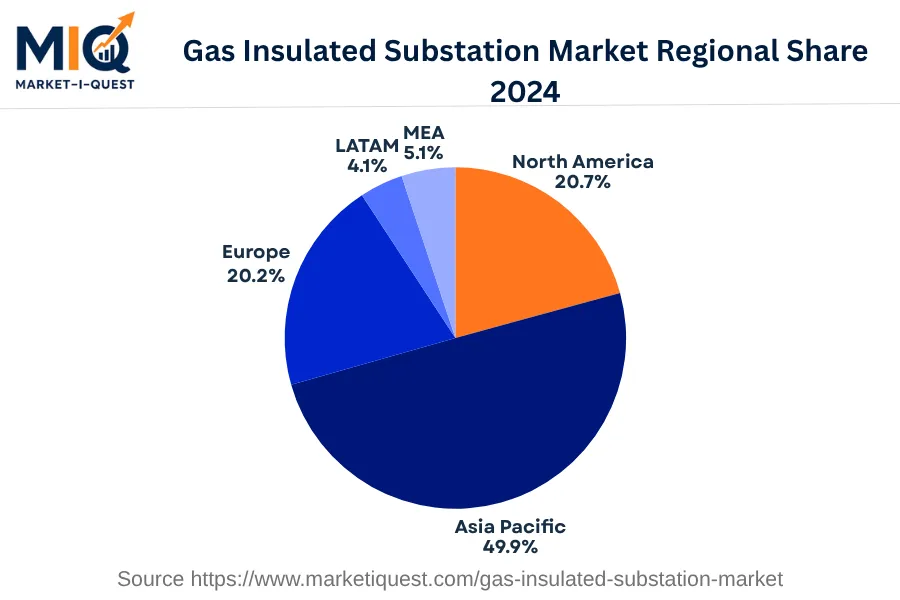
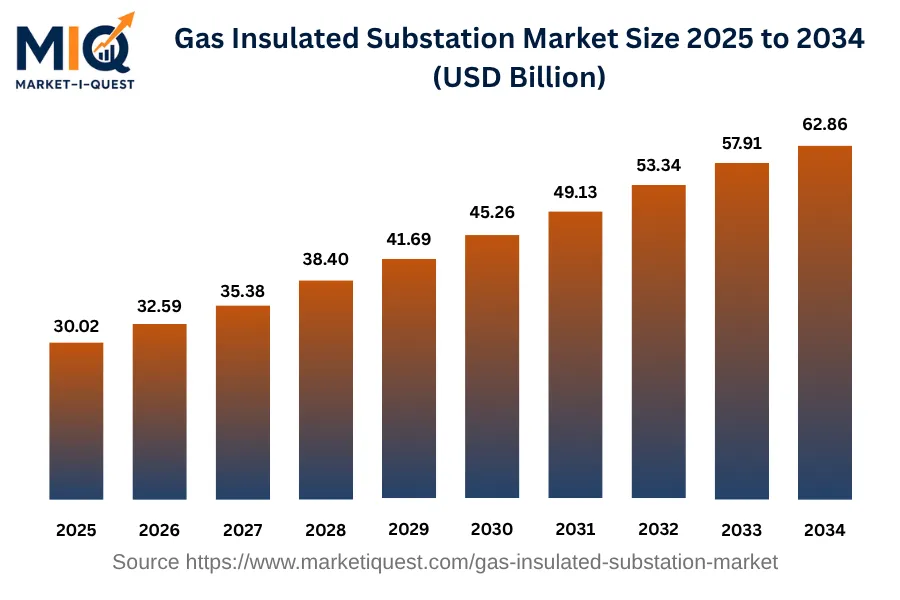
The Gas Insulated Substation market size stood at USD 30.02 billion in 2025 and is expected to grow to USD 62.86 billion by 2034, registering a CAGR of 8.56%. The market experienced stable growth from the value of USD 27.65 billion in 2024, escalating at a steady rate over the decade. The growth was driven by increased demand and implementation of gas insulated substations in various regions globally due to their advantages like enhanced reliability, reduced space requirements, and lower maintenance domains over traditional substations. In terms of regional market share in 2024, Asia Pacific accounted for the highest at 49.9%, followed by North America at 20.7%, and Europe at 20.2%. The remaining market share was distributed between LATAM at 4.1% and MEA at 5.1%.

Key Takeaways

  • By Voltage - High Voltage emerged as the frontrunner achieving the most significant market share in 2025.
  • By Installation - Indoor setups held a dominant position in the market in 2025.
  • By End User - Power Distribution led the segment accounting for the highest market share in 2025.
gas-insulated-substation-market market size

Key Driving Factors

Implementation of Strict Environmental Regulations

A primary driving factor for the gas insulated substation market is the enforcement of stringent environmental regulations. These guidelines aim to limit the emissions and the ecological footprint of energy production systems. Gas insulated substations (GIS) prove highly advantageous in this context due to their enclosed design, which ensures a majority of the harmful gases are retained within the system. Thus, the increased emphasis on environmental conservation across various countries, like the U.S and countries in Europe, has seen utilities and energy providers opting for GIS over traditional air-insulated substations, thereby contributing to an increased market demand for GIS.

Urbanization and Space Constraints

A secondary, yet significant, catalyst for the gas insulated substation market is the rapid pace of urbanization combined with the increasing land constraints. As cities continue to grow and space becomes a premium, gas insulated substations are being recognized as an effective solution due to their compact size and higher power density compared to traditional substations. They can be installed in constrained spaces, including underground and indoor settings, making them suitable for urban areas. This makes GIS an attractive option in densely populated cities and industrialized regions around the globe where space is limited.

Market Evolution by Timeline

2019-2023
During this period, the demand for Gas Insulated Substations (GIS) was predominantly from power utility companies in developed regions such as North America and Europe. These regions saw significant investments centered around infrastructure upgrades, which drove the need for compact, reliable, and efficient power transmission systems. The maturity of GIS technology was evidenced in its wide adoption, but the high installation cost was a barrier for many potential buyers. The focus on cleaner energy technologies also pushed for stricter emission standards, which indirectly promoted GIS given its minimal environmental impact. The commercial models mostly involved long-term contracts with strong post-sale services and guarantees. Industrial safety norms and regulations played a crucial role in mitigating the risk of gas leaks.
2024
By 2024, the market landscape was characterized by an increasing adoption of GIS in emerging economies such as India and China. These countries were heavily investing in their power infrastructure and seeing a rapid urbanization, thereby driving GIS demand. Modular GIS solutions, offering high flexibility and scalability, became popular. There was a renewed push towards standardizing GIS specifications, led by the International Electrotechnical Commission (IEC). Given the growing market, partnerships between GIS manufacturers and local distributors amplified, enabling a smoother delivery and installation.
2025-2029
Increased demand for GIS was observed across multiple sectors, such as transportation, mining, and renewable energy, during this period. The technology matured further by integrating with digital sensors for better monitoring and maintenance. Supply constraints arose due to global geopolitical tensions, affecting raw material prices. Policymakers began stressing on international interoperability standards for high-voltage GIS. Past lessons from early market phases led to more stress on strong installation and maintenance contracts, coupled with performance-based pricing models. Potential risks included system failures or leaks in aging installations.
2030-2034
The need for GIS in distributed energy generation systems grew by 2030–2034. Advanced GIS setups now facilitated seamless integration with grid technologies, thereby reducing constraints. Emphasis on eco-friendly materials led to some changes in raw material supply dynamics. The UN New Urban Agenda increasingly influenced domestic policies towards GIS installation in new buildings. A shift towards a one-stop service model was observed in commercial contracts. Risks were centered around a need for specialized skills for installation and maintenance.

Future Market Outlook

Future Opportunities

The GIS market presents numerous opportunities driven by infrastructural and regulatory developments around the globe. Within the context of the 2022 U.S. Infrastructure Investment and Jobs Act, there are significant federal investments in energy infrastructure, including renewable energy integration, which are expected to boost the adoption of GIS technologies. As countries like India aim for electricity access for all by 2023, GIS offers a compact solution ideal for urban areas with limited space. In 2021, the United Nations outlined the necessity to modernize energy systems to accommodate high renewable penetration, which aligns with a rising adoption of GIS. The growth of renewable energy projects in regions like the Middle East, specifically the UAE's efforts to add solar capacity, represents a potential boost for GIS application in managing distributed energy resources. Additionally, the rising need for reliable electricity in emerging markets fosters opportunities for regional players, such as Bharat Heavy Electricals Limited in India. Partnerships and collaborations are crucial; for instance, Mitsubishi Electric has partnered with various energy operators to pilot smart GIS systems, enabling enhanced grid resilience. Moreover, the increasing focus on offshore wind farms in Europe necessitates robust infrastructure solutions, further opening avenues for GIS implementation. These developments indicate that a range of sectors, from utilities to renewables, provide fertile ground for future GIS market expansion.

Segmentation Analysis

By Voltage

The market is divided into subsegments including Medium, High, Extra-High, and Ultra-High voltage categories. The High voltage category accounted for the largest revenue share while the Ultra-High voltage segment is expected to grow at the fastest CAGR during the forecast period.

Largest Revenue Share

High

Market Share Leader

The High voltage category is the leading revenue generator in the voltage-based market, primarily because of its widespread usage across various major industries and utilities. It is the preferred choice for power transmission over long distances, significantly used by power plants, and large-scale manufacturers. These sectors have high-power requirements that high voltage cables are ideal to satisfy, thereby contributing substantially to its revenue generation. Another driving factor for this dominance is the presence of stringent regulations regarding the adoption of high voltage systems to reduce power losses during transmission, which further encourages its use. High voltage systems also provide more reliability and efficiency, essential purchasing criteria for end-consumers, resulting in substantial switching costs. This dominance is projected to persist as industries continue to require efficient power transmission solutions that can handle significant electricity loads.

Fastest CAGR

Ultra-High

Forecast Period Growth Leader

Anticipated to have the highest growth rate is the Ultra-High voltage segment. This growth is driven by the increasing demand for reliable and efficient power transmission systems that can cater to the rising global energy consumption. Technology advancements are playing a crucial role in overcoming the constraints related to distance and power loss, allowing for the long-distance transmission of electricity at an ultra-high voltage. This is increasing its appeal, especially in densely populated regions with high energy requirements. A significant amount of capital expenditure is currently being invested in upgrading existing infrastructure and building new ones to accommodate this high capacity transmission. These trends suggest that while there may be potential near-term risks due to high initial costs and complex designs, the Ultra-High voltage segment will likely experience significant growth in the coming years.

By Installation

The market is divided into subsegments which include indoor and outdoor installations. The indoor installations accounted for the largest revenue share, while the outdoor installations are expected to grow at the fastest CAGR during the forecast period.

Largest Revenue Share

Indoor

Market Share Leader

The indoor installation subsegment leads the market in terms of revenue due to several key factors. Indoor installations are more common across a range of residential, commercial, and industrial applications, leading to higher demand and sales volume. Consumers often prefer indoor installations for reasons of accessibility, aesthetics, and protection from the elements, leading to a sustained high level of demand. Indoor installations are often more complicated and cost-intensive, with requirements for ventilation, insulation, and other adjustments, contributing to higher average revenue per unit. Some geographical markets with high disposal income and dense population are also significant contributors to the revenue of indoor installations. Moreover, regulatory frameworks in many regions favor or even mandate indoor installations in many contexts, further driving their dominance in revenues. The purchasing decision for these installations often hinges on factors such as quality, integrability with existing systems, and providers' after-sales service capacity.

Fastest CAGR

Outdoor

Forecast Period Growth Leader

The outdoor installation subsegment, while not currently accounting for the highest revenue, is projected to grow at the fastest CAGR in the foreseeable future. The growth in outdoor installations can be attributed to several key drivers. Technological advancements are reducing the cost and increasing the durability and efficiency of outdoor installation equipment. In addition, changing lifestyle trends and increasing focus on outdoor living and entertainment spaces is driving consumer interest in outdoor installations. Moreover, shifting regulatory landscapes are encouraging outdoor installations, particularly in certain sectors like renewable energy and telecommunications which are experiencing booming growth. However, barriers to adoption still exist, primarily around the longevity and resistance of these systems to weather conditions. Key risks in the near term include the potential for swing in weather patterns and financial downturns which can cause a slowdown in market growth.

By End User

The market within the end-user segment is segmented into Power Distribution, Transmission, Generation, Infrastructure, and Others. Among these, the Power Distribution subsegment had the largest revenue share in the base year of 2024, while the Infrastructure subsegment is projected to grow at the fastest CAGR in the forthcoming periods.

Largest Revenue Share

Power Distribution

Market Share Leader

The Power Distribution subsegment emerged as the largest revenue generator in 2024 due to a variety of factors. The growing global population and rising urbanization have consistently driven up the demand for electricity, positioning power distribution as a critical component of the energy industry. As more residences and businesses alike come online, the need for efficient, reliable power distribution networks has grown significantly. Furthermore, regulations and initiatives promoting power sector reforms across developing and developed economies have supported investments and advancements in this space. Digitalization and the advent of smart grids have further revolutionized the power distribution sector, enabling optimized load management, better power quality, and improved reliability, all of which have been instrumental in driving revenue growth. However, it's important to consider supply chain fragility and the high costs of infrastructure efficacy as potential limiting factors.

Fastest CAGR

Infrastructure

Forecast Period Growth Leader

In contrast, the Infrastructure subsegment is expected to witness the fastest growth rate. This growth can primarily be attributed to the widespread need for modern, efficient power system infrastructure to support growing electrification demands and grid stability. As countries around the world continue to prioritize the modernization of their aged power systems infrastructure and invest heavily in integrating more renewable energy sources into their grids, the demand for advanced infrastructure solutions is set to rise. Rapid technological developments designed to improve efficiency and reliability, such as smart management systems and digital substation technologies, are also promising growth catalysts. Future growth of this subsegment could be influenced, however, by factors such as the availability of capital expenditure for infrastructure improvements and potential policy changes.

Competitive Analysis

Key Market Players

Manufacturers/OEMs

Siemens AG
Germany
Alstom SA
France
ABB
Switzerland

Key Suppliers & Raw Materials

HICO America
US
NKT Cables
Denmark
Prysmian Group
Italy

Distributors, Integrators & Channel Partners

Pfisterer
Germany
JiangSu HuaPeng Transformer Co., Ltd
China
Mitsubishi Electric Corporation
Japan

Porter’s Five Forces Analysis

A detailed analysis of the competitive scenario within Gas Insulated Substation Market using Porter's five forces framework.

Supplier Bargaining Power

Medium

Limited number of suppliers due to high technological and capital requirements.

Buyer Bargaining Power

Low

Buyers have less flexibility due to lack of alternatives and intricate specifications of gas insulated substations.

Threat of Substitutes

Low

Alternative technologies are less efficient, costlier, and occupy more space.

Threat of New Entrants

Low

High entry barriers due to need for technological expertise, regulatory standards, and substantial capital investment.

Competitive Rivalry

High

Market is characterized by intense competition among a few established players.

Regional Analysis

Geographic market dynamics and growth opportunities across key regions

Global Market Outlook

gas-insulated-substation-market market regional share

North America

In 2024, the North American Gas Insulated Substation (GIS) market was characterized by robust demand due to rapid urbanization and the increasing need for space-saving power infrastructure solutions. Renewable energy projects, stringent regulatory frameworks favoring environmentally-friendly designs, and significant public-private investments propelled the market. The adoption of advanced GIS technologies, improved supply of GIS components, and moderate price transformations marked key drivers in this period. Industry trends showed utilities, manufacturing sectors, and city governments prioritizing compact, secure GIS over conventional substations, particularly in densely populated urban centers in the U.S., Canada, and Mexico. The trend towards lightweight, high-performance GIS equipment, increased viability of public-private partnerships, and consolidation of regional providers were noteworthy. For instance, the adoption of U.S. Federal Energy Regulatory Standards for energy efficiency prompted a rise in compact GIS systems across multiple sectors.

Customers shifting towards digital transformations led to an increased demand for GIS capable of handling variable load demands and ensuring uninterrupted power supply. Furthermore, a mounting emphasis on policy implementation, such as Mexico's National Infrastructure Program that promoted advanced, compact energy infrastructure, influenced structural shifts to GIS in the power distribution spectrum. These factors made 2024 a significant year for the GIS market in North America.

Asia Pacific

In 2024, the Gas Insulated Substation (GIS) market in the Asia Pacific underwent significant growth due to notable drivers. Energy demand escalation in populous nations like India and China spurred investment in smarter, compact GIS systems that optimize space usage and efficiency. Regions like Australia and Japan saw swift GIS adoption due to rigorous environmental regulations, stimulating technology shift towards more compact and eco-friendly electrical infrastructure. Additionally, intense industrialization led to supply dynamics shift, with South Korea and key ASEAN markets displaying robust manufacturing capacities to cater to local and international GIS demand. Noteworthy trends emerged concurrent to these drivers. With utilities sector as major users, a visible shift was noticed towards GIS technology - due to its minimal maintenance requirement and operational safety. Transformative partnerships and M&A, specifically in India and China, marked the sector's consolidation, geared towards cost-effectiveness and innovation efficiency. Accompanying these, the implementation of stringent electrical standards fostered a swift transition to GIS technology in countries like Japan.

Government sector users, particularly in Australia, heightened their reliance on GIS for sustainable creation and distribution of power - an initiative enhancing national green credentials. Retail and manufacturing sectors too, eyeing energy reliability and space-saving benefits, solidified their GIS engagement, particularly in densely populated urban environments. The GIS market direction in Asia Pacific in 2024 evidenced a pivotal technology switch, spurred by environmental and operational efficiency drivers.

Europe

In 2024, the Gas Insulated Substation (GIS) market in Europe demonstrated robust dynamism, backed by multiple distinct drivers and trends. Infrastructure modernization in countries such as the United Kingdom, Germany, and France necessitated the use of GIS owing to its compact, efficient, and reliable design. Stringent environmental regulations across the region, for example, the EU's 'Green Deal', propelled demand, as GIS systems notably minimise greenhouse gas emissions compared to traditional substations. Significant investments in renewable energy projects, especially in Spain and Italy, further stimulated GIS adoption, attributing to its high efficiency in connecting renewable power plants to the grid.

Notably, a trend towards digitisation of the energy sector emerged distinctly in Benelux and the Nordics, fostering GIS augmentation with advanced communication capabilities. Contemporaneously, buyer preference shifted towards modular GIS due to ease of expansion and maintenance flexibility, particularly visible in the utility and manufacturing sectors. Partnerships and acquisitions flourished, such as the ABB and Hitachi joint venture in GIS technology, indicating a strategic push for market share and innovation. Stringent enforcement of EU standards on energy efficiency and reliability enhanced the credibility and adoption of advanced GIS across sectors, including government and healthcare. Amid these dynamics, the GIS market in Europe in 2024 demonstrated resilience and vibrancy.

Latin America

In 2024, Latin America's Gas Insulated Substation (GIS) Market is influenced by various drivers and trends. Major factors propelling market growth include increased demand for safe power transmission systems, stringent regulatory norms for environmental protection in countries like Brazil and Mexico, and significant investments in the energy sector in the region. Argentina's successful adoption of advanced GIS technology to improve power supply reliability also plays a role, while the steady pricing of gas insulated switchgear forces increased supplier competition in the Chilean and Peruvian markets.

Concurrently, several trends are shaping the LATAM GIS market. These include a growing preference for long-lasting and compact power systems among utilities and enterprises in Colombia and other countries. There's a shift toward environment-friendly GIS, prompted by policy enforcement in Argentina and Chile, to reduce Sulphur Hexafluoride emissions. The LATAM market sees heightened interest in public-private partnerships and mergers & acquisitions for infrastructure development, especially within Brazil and Mexico’s government sectors. Additionally, new standards and quality benchmarks are being implemented to ensure system efficacy and safety, particularly within the utilities sector. Thus, 2024 presents a context of extensive growth and development within the Latin American GIS market.

Middle East & Africa

In 2024, the Gas Insulated Substation (GIS) market manifested considerable growth in the Middle East and Africa, driven by increasing energy needs primarily in countries like Saudi Arabia, United Arab Emirates, South Africa, Nigeria, and Israel. The acceleration in infrastructure development, particularly in the utility and oil & gas sectors, fueled demand for reliable power solutions, elevating GIS adoption. The emergence of greenfield projects and government regulations emphasizing sustainable energy systems intensified investment in advanced, compact and efficient GIS technology.

Customer preferences shifted towards GIS due to its resilience in extreme weather conditions and higher reliability, critical in desert and volatile climates of the Middle East and Africa. The escalating adoption of digital technology in the utilities sector bolstered the demand for smart grid solutions, fostering the transformation from traditional to digital GIS. Governments in Saudi Arabia and the UAE initiated stringent energy policies favoring GIS adoption, and several multinational corporations initiated partnerships for technology transfer and localized manufacturing of GIS equipment, predominantly seen in Egypt and South Africa. Therefore, the 2024 scenery of the GIS market in the Middle East and Africa depicted a momentous progression fueled by rapid technology adoption, favorable government policies, and changing customer preferences.

Recent Industry Developments

Latest market innovations, product launches, and strategic initiatives

June 2026

China's power industry's first 252kV vacuum interrupter with clean air insulation environmentally friendly GIS equipment was successfully commissioned at the Fuyong substation in Baotou, Inner Mongolia. The equipment was jointly developed by Inner Mongolia Power Group, Mingyang Electric, and Xi'an Jiaotong University. It uses clean air as the insulating medium combined with vacuum switching technology, completely replacing SF₆ at the source.

November 2025

Toshiba Transmission & Distribution Systems (India) delivered the country's first indigenously manufactured 220kV mobile gas-insulated switchgear (m-GIS) system to Power Grid Corporation of India. The m-GIS system is designed for fast deployment, temporary power evacuation, and substation augmentation.

Frequently Asked Questions