Gamma Knife Market Snapshot

Key Players

  • Elekta AB (Sweden)
  • Varian Medical Systems Inc. (US)
  • Mitsubishi Electric Corporation (Japan)
  • Masep Infini Global Inc. (US)
  • Huiheng Medical Inc. (China)
  • Cyber Medical Corporation Limited (China)
  • BeiJing ZKSK Technology Co. Ltd (China)
  • Medtronic Inc. (Ireland)

Market Size

Base Year 2024
$0.785 Bn
CAGR
7.25%
Forecast 2034
$1.58 Bn

Market Segments

By Anatomy
  • Head
  • Neck
  • Others
By Disease Indication
  • Brain Metastasis
  • Cancer
  • Arteriovenous Malformation
  • Trigeminal Neuralgia
  • Others

Market Dynamics

Drivers
  • Rising brain cancer cases
  • Advancements in Radiosurgery technology
Restraints
  • High treatment costs
  • Stringent regulations
Opportunities
  • Expanding neurological disorder cases
  • Healthcare technology advancements

Market Size

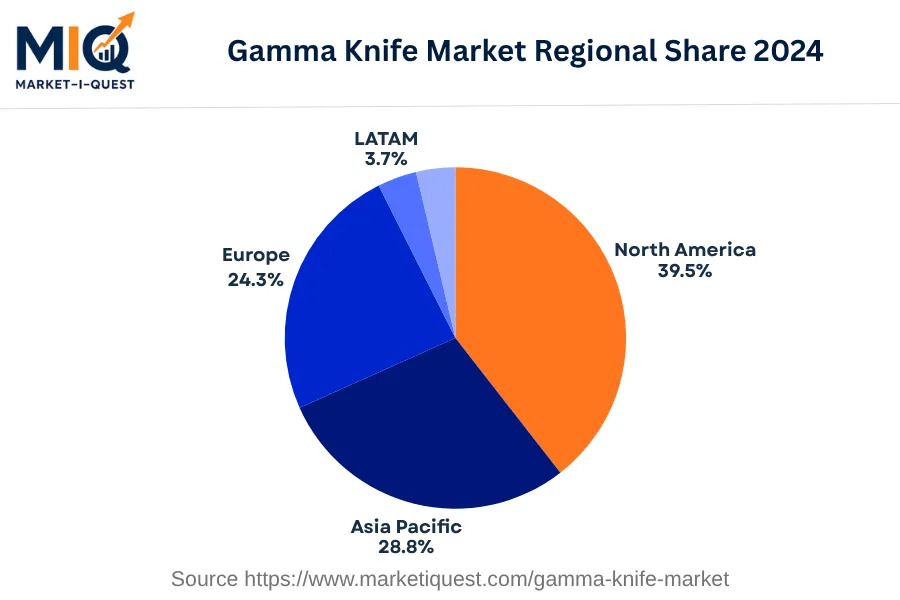
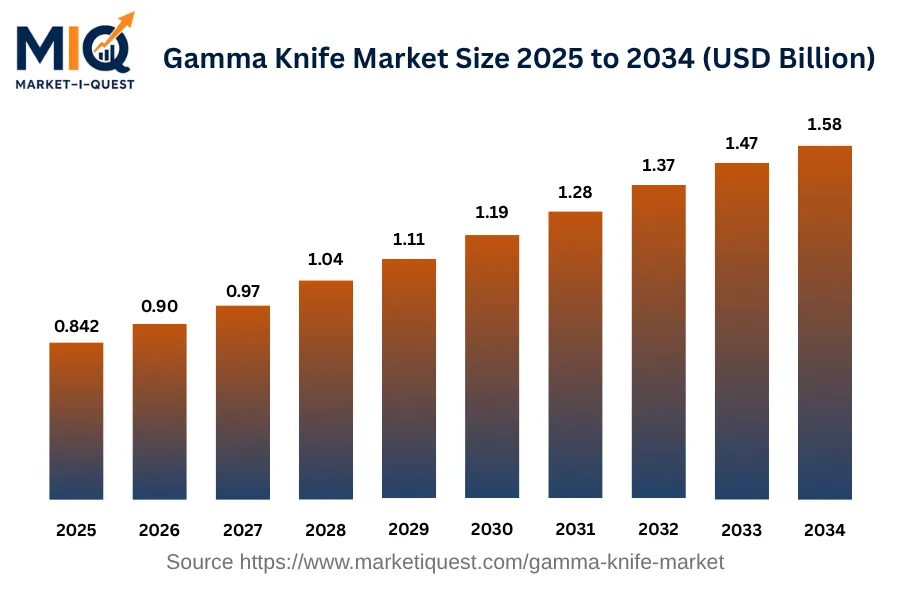
The Gamma Knife Market stood at USD 0.84 billion as of 2025, and is forecasted to achieve USD 1.58 billion by 2034 with a CAGR of 7.25% over the period. The market has shown consistent expansion since its size of USD 0.79 billion in 2024, indicating a steady rate of growth. This growth pattern can be attributed to the increasing adoption of gamma knife technology for neurosurgical procedures, demonstrating the market's progressive trend until 2034. North America held the largest regional share of the market in 2024, accounting for 39.5% of the total. Meanwhile, the Asia Pacific and Europe followed with market shares of 28.8% and 24.3% respectively. The remaining shares were represented by the LATAM and MEA regions with an equivalent share of 3.7% each in the Gamma Knife Market.

Key Takeaways

  • By Anatomy - Head segment led in terms of Gamma Knife usage holding a significant share in the base year.
  • By Disease Indication - Cancer held the top position in the market during the year 2024.
gamma-knife-market market size

Key Driving Factors

Increasing Incidence of Brain Tumors

The Gamma Knife Market is experiencing growth as a direct consequence of increasing global incidences of brain tumors. Gamma Knife therapy is a form of radiosurgery particularly effective in treating brain tumors. It's a preferred treatment method due to its non-invasive nature and high precision. Diagnosis of brain tumor triggers procurement of Gamma Knife technology in healthcare institutions. Geographically, the prevalence of brain tumors is particularly high in developed regions such as North America and Europe, driving demand for Gamma Knife technology there. Thus, the increasing incidence of brain tumors worldwide is acting as a subsidiary driver for the Gamma Knife market.

Acceptance of Minimally Invasive Surgeries

Another factor driving the Gamma Knife market is the growing acceptance of minimally invasive surgeries by both patients and healthcare professionals. Unlike traditional open surgeries, minimally invasive procedures, like Gamma Knife radiosurgery, result in less physical trauma, reduced hospital stays, and faster recovery periods. This appeals to patients seeking treatments with lower risks and fewer post-surgical complications. Hospitals and surgical centers are actively implementing Gamma Knife technologies to offer advanced surgeries to patients, promoting better patient experiences and outcomes. This trend, particularly visible in the healthcare sectors of developed countries, is providing a significant boost to the Gamma Knife market.

Market Evolution by Timeline

2019-2023
During this period, the main buyers of gamma knives were hospitals in developed countries, notably the U.S and Japan due to the increasing incidence of brain tumors; and a preference for non-invasive surgeries. The technology improved, with Elekta, a leading manufacturer, launching its upgraded gamma knife system, Icon. Supply constraints predominantly resided in developing countries where the high costs of these systems limited procurement. There were no significant shifts in pricing during this time, although standard contracts typically involved comprehensive after-sales service and periodic maintenance. The major risk factor was the high cost of implementing and maintaining the Gamma Knife system, which many healthcare providers found prohibitive.
2024
In 2024, the primary buyers remained hospitals, but adoption in private radiation therapy clinics increased because these clinics began recognizing the potential for profit due to high procedure costs. The supply remained stable, though there was a minor shortage due to increased production times for some components. Regulations remained favorable, and there were no major shifts in regulations or policies. Pricing remained stable with contracts often including maintenance and service clauses. The risk of high capital investment continued, with some clinics finding workarounds in shared ownership or leasing models to procure the equipment.
2025-2029
Demand was increasingly coming from emerging markets, including India and China, as access to healthcare improved and there was a higher incidence of brain disorders. Economic growth and increase in healthcare investment boosted procurement of these units. Shortages in skilled personnel to operate these systems became more apparent in these emerging markets leading to firms providing training as part of deal structures. Regulations such as the China's National Medical Product Administration's (NMPA) approval of Elekta's Gamma Knife assisted in adoption. Cost remained an implementation barrier.
2030-2034
Higher global demand, precipitated by an increased prevalence of brain tumors and desire for non-invasive treatments, saw the Gamma Knife market expand. Gamma Knife Perfexion, launched by Elekta, offered gold standard radiation surgery and was widely adopted. Despite shortages of trained personnel, suppliers offered comprehensive training programs. Regulatory approvals from the Indian Ministry of Health and Family Welfare for certain systems stimulated market growth. Pricing models now tended to include training and support to address the skills gap. A risk continued to be the affordability of equipment, mitigated in part by leasing options and pay-per-use models.

Future Market Outlook

Future Opportunities

The future of the Gamma Knife market appears promising as ongoing advancements in clinical practices and the introduction of new technologies create avenues for growth. In 2023, many healthcare institutions are exploring hybrid models that combine Gamma Knife therapy with other treatment options, such as immunotherapy, which could enhance therapeutic outcomes for patients suffering from complex conditions. The World Health Organization's ongoing emphasis on expanding accessibility to advanced healthcare technologies plays a significant role in the increasing utilization of Gamma Knife systems in low- and middle-income countries, especially in Asia-Pacific regions where market penetration is currently limited. Strategic collaborations and partnerships are emerging between hospitals and technology providers, as seen in 2023 when a clinical trial was initiated to assess the combination of Gamma Knife therapy and targeted drug delivery systems. Additionally, training initiatives led by established health organizations are addressing the shortage of skilled personnel, thereby facilitating smoother integration of these technologies into treatment regimens. Regulatory developments, such as the European Medicines Agency’s updated guidelines on radiosurgery in 2022, are facilitating new approvals, which could enhance the variety of indications for Gamma Knife treatments. As research continues to unveil additional indications, the focus on patient-specific therapies presents a compelling opportunity for market players to diversify their offerings and cater to a broader patient demographic, ultimately driving further acceptance and usage in mainstream medical protocols.

Segmentation Analysis

By Anatomy

The market is divided into subsegments including Head, Neck, and Others. The Head subsegment accounted for the largest revenue share while Others is expected to grow at the fastest CAGR during the forecast period.

Largest Revenue Share

Head

Market Share Leader

The Head subsegment has been leading in revenue generation for various reasons. In line with typical industry logic, one of the primary drivers is the high frequency of head-related disorders, including traumas, migraines and neurological issues, leading to a growing demand for specialized products or services allowing to diagnose, monitor or treat these conditions. Moreover, the nature of the products - being often high-tech and complex - and procedures required here usually have higher pricing, leading to substantial revenues. Additionally, the customer base is wide-ranging, covering hospitals, ambulatory surgical centers, research institutes, and individual purchasers including constant demand from established emergency clinics and trauma centers globally. Regulatory factors also contribute to the high revenue, as stringent safety standards often demand regular equipment upgrades and training. The purchasing criteria often hinge on accuracy, reliability, and technology, further pushing the vendors to deliver advanced, and often expensive, solutions. In terms of channels, most of these products are sold through direct sales channels or specialized distributors, which can command higher price points due to their niche expertise.

Fastest CAGR

Others

Forecast Period Growth Leader

The subsegment titled 'Others' is projected to grow at the fastest rate during the forecast period. Catalysts for this growth include technological advancements, changing policies, investment in research and development, and strategic partnerships. Technological advancements in the healthcare sector have seen the introduction of innovative tools and technologies that are not specific to the head or neck, favoring a faster growth of the 'Others' anatomy segment. Policies geared towards inclusion and diversity in medical treatments also serves as a significant driver for growth in this area. Startups and established companies alike are investing heavily into R&D, driving innovation in treatments and equipments categorized under 'Others'. The presence of strategic partnerships across the industry also fuels the growth in this area, with companies collaborating to broaden their product offerings and improve their services outside the scope of the 'Head' and 'Neck'. However, barriers to adoption of this segment include factors such as cost, accessibility, and lack of awareness about these options among providers and consumers. Nonetheless, the overall outlook projects a higher growth trajectory for this segment.

By Disease Indication

The market by disease indication is partitioned into sub-segments including Brain Metastasis, Cancer, Arteriovenous Malformation, Trigeminal Neuralgia, and others. In 2024, the Cancer sub-segment brought in the largest revenues while Brain Metastasis is projected to be the fastest growing sub-segment in the years ahead.

Largest Revenue Share

Cancer

Market Share Leader

Cancer, as a sub-segment in the disease indication market, holds the highest revenue due to several driving factors. The escalation in global cancer incidence, especially in aging populations, contributes a significant portion of the revenue. Rapid technological advancements in cancer research technologies and treatment alternatives also drive its revenue. The geographies with large cancer patient populations – particularly the regions with affluent healthcare sectors – have been prime contributors towards the global revenue. Regulatory bodies worldwide have catalyzed market growth by expediting the approval processes for cancer medications. The purchasing criteria for the end users – both patients and healthcare providers, prioritize effective treatments backed by substantial scientific evidence. This ensures the steady revenue generation from established cancer treatments. The buying process is highly regulated, which creates switching costs for the end-users. Finally, both direct and indirect channels – hospitals, clinics, pharmacies, and e-commerce platforms have effectively facilitated the distribution process, thus bolstering the segment's revenue.

Fastest CAGR

Brain Metastasis

Forecast Period Growth Leader

Brain Metastasis is predicted to exhibit the fastest growth rate, driven by increased R&D investments, and upsurging patient populace with neurological complications. Conventional treatment modalities have encountered barrières in managing brain metastasis, prompting the medical science community to innovate more efficient therapies. This subsegment's growth can be facilitated by technological advancements in the diagnostic and treatment methods, and the influx of capital expenditure into research initiatives. The role of strategic partnerships across pharmaceutical firms, research organizations, and healthcare providers is becoming increasingly crucial in intensifying the overall market growth. However, potential near-term risks such as regulatory obstacles in drug approval processes, and high treatment costs may able to affect the projected growth trajectory. It’s essential for stakeholders to navigate these challenges to truly capitalize on the potential this rapidly growing sub-segment has to offer.

Gamma Knife Market Competitive Analysis

Key Market Players

Manufacturers / OEMs

Elekta AB
Sweden
Varian Medical Systems
US
Huiheng Medical, Inc.
China

Key Suppliers & Raw Materials

Nordion Inc.
Canada
Polysciences, Inc.
US
IsoRay, Inc.
US

Distributors, Integrators & Channel Partners

GE Healthcare
US
Siemens Healthineers
Germany
Philips Healthcare
Netherlands

Porter’s Five Forces Analysis

This analysis provides a comprehensive overview of the competitive landscape within the Gamma Knife market.

Supplier Bargaining Power

High

Exclusive technology and limited suppliers significantly enhance supplier bargaining power.

Buyer Bargaining Power

Low

Expensive and unique technology like Gamma Knife reduces the bargaining power of buyers.

Threat of Substitutes

Medium

Existence of competing radiosurgery procedures poses a moderate threat of substitutes.

Threat of New Entrants

Low

High setup costs and difficult certification prerequisites limit threat of new entrants.

Competitive Rivalry

High

Intense competition between existing providers, with rapidly evolving technology, drives high competitive rivalry.

Regional Analysis

Geographic market dynamics and growth opportunities across key regions

Global Market Outlook

gamma-knife-market market regional share

North America

In the base year 2024, the Gamma Knife Market in North America exhibited a robust performative stride dictated by technology advancement, regulatory changes, and shifting demands in health procedures. Primarily, the increased prevalence of brain tumors and chronic diseases led to a surge in demand for gamma knife procedures in the healthcare sector, specifically within neurological departments in the U.S., Canada, and Mexico. Technological advancement embracing precision therapeutics fueled acceptance of this non-invasive alternative to traditional brain surgery. Regulatory approval from the Food and Drug Administration and Health Canada enhanced the market growth and broadened market access for key players.

In terms of trends, the Gamma Knife market saw a pivot towards preference in outpatient settings, driven by the cost-effectiveness and convenience for patients. Ongoing collaborative efforts of major players like Elekta and Varian leading to use-enhanced gamma knife systems saw wider adoption across hospitals and cancer research institutes. Lastly, an enforced policy standard for operational safety of gamma radiation equipment by the American National Standards Institute and the Canadian Nuclear Safety Commission led to weaponized quality control measures, ensuring the reliability and safety of the gamma knives in use. Overall, the Gamma Knife Market bore witness to a period of substantial growth and restructuring, shaping the architecture of neurosurgical interventions in North America.

Asia Pacific

In 2024, the Asia Pacific's Gamma Knife Markets augmented its significance with notable ascension due to a growing affinity towards non-invasive treatments in China, South Korea, Japan, India, Australia, and key ASEAN markets. Rising incidence of brain tumors, increasing adoption of advanced radiation therapies, and supportive government policies in countries like China and India proved pivotal growth drivers. Firstly, escalating demand emerged due to the proliferation of brain tumor cases across the region. Secondly, policy changes led by governments, particularly China and India, lowered regulatory barriers, drawing investments into the market. Thirdly, advanced technology adoption, spearheaded by Japan and South Korea, resulted in improved supply dynamics, with hospitals increasingly equipped with gamma knife devices.

Conversely, by 2024, specific trends reshaped the market landscape. Patient preference towards non-invasive treatments boosted gamma knife procedure adoption. Technological advancements led to a shift in product offerings, with manufacturers introducing sophisticated devices offering high precision. Furthermore, M&A activities flourished, with Medtronic’s purchase of Beijing-based Changjiang Medtech being a notable example. Lastly, policy enforcement on radiation therapy standards underscored best practices, reflecting in improved patient outcomes across the healthcare sector. Overall, the Gamma Knife Market in the Asia Pacific exhibited robust growth and evolution throughout 2024, primarily driven by rising health concerns, protective government policies, technological advancements, and trends favoring non-invasive treatment options.
Europe

In 2024, the Gamma Knife market in Europe exhibited a significant growth mainly fueled by technological advancement, increased investments, and evolving healthcare needs. For instance, mounting healthcare demands in countries like Germany and the United Kingdom, due to larger aging populations, drove the surge in the adoption of Gamma Knife radiosurgery. Furthermore, profound investment in healthcare technology from both government and private sectors, particularly in France and Italy, facilitated the expansion of this market. Moreover, regulatory support for advanced medical treatments in the Nordics and Benelux regions significantly bolstered the supply dynamics of Gamma Knife.

Market trends in 2024 highlighted a shift in buyer behavior towards minimally invasive procedures like Gamma Knife surgery, particularly evident in healthcare sectors across Spain, Central, and Eastern Europe. Technological advancements further propelled this shift by improving the precision and effectiveness of the treatment. Industry players also showed a strong inclination towards partnerships and mergers & acquisitions, leveraging shared resources to expedite innovations and technology integration. A notable instance was the enforcement of health and safety standards for radiation equipment, prominently recognized across Europe, which catalyzed manufacturers to achieve superior product quality. This commitment served as a testament of Europe’s stringent policy enforcement in ensuring patient safety and setting extraordinarily high medical standards.

Latin America

In the base year 2024, the Gamma Knife market in Latin America (LATAM) observed notable developments driven by several factors and trends. Enhanced healthcare infrastructure investments in countries like Brazil and Mexico played a pivotal role in expanding Gamma Knife accessibility. In addition, rigorous LATAM-wide policies for proficient cancer management encouraged technology adoption on a wider scale. Furthermore, due to the growing demand for non-invasive surgery,
manufacturers accelerated their production, thereby stabilizing supply dynamics and competitive pricing. Varied trends shaped the Gamma Knife market across Brazil, Mexico, Argentina, Colombia, Chile, and Peru. Consumer preference leaned towards advanced and safer cancer treatment options, prompting a transition in healthcare practices towards this technology. Within the healthcare sector, an enhanced focus on partnership and M&A activities were noticeable, aiming at market expansion.

Strict product standard compliance and policy enforcement became inherent aspects of business models, ensuring optimal utilization and performance of Gamma Knife equipment, contributing to market solidity. Moreover, high economic growth in LATAM led numerous hospitals and medical organizations to invest in Gamma Knife technology, boosting adoption. Consequently, Gamma Knife emerged as a principal choice in the healthcare sector for treating various neurological conditions, altering the landscape of the neurosurgery market in 2024.

Middle East & Africa

In 2024, the Gamma Knife market in the Middle East and Africa was primarily driven by increasing healthcare expenditure and the prevalence of brain disorders. The incentivization of innovative medical technologies in Saudi Arabia and the United Arab Emirates encouraged the adoption of Gamma Knife procedures. Additionally, government initiatives focusing on healthcare infrastructure in countries like South Africa and Kenya bolstered the demand. However, high equipment costs posed a major barrier in less economically developed regions like Nigeria. Among the observed trends, a shift towards non-invasive surgeries was evident, especially in the well-developed healthcare systems in regions like Israel and Qatar.

This transition was mirrored by a growing demand for Gamma Knife procedures in treating brain tumors and neurological conditions. A notable trend was the collaboration between healthcare and technology providers, exemplified by partnerships between manufacturers of Gamma Knife equipment and hospitals. These partnerships aimed at integrating advanced technology into existing healthcare frameworks, particularly in the high-income economies of Saudi Arabia and the UAE. The enforcement of rigorous safety standards for medical procedures also played a significant role in shaping the market. Despite the high cost, there seemed to be a prevalent acceptance of Gamma Knife procedures within the government, healthcare, and finance sectors due to its precision and favorable patient outcomes.

Recent Industry Developments

Latest market innovations, product launches, and strategic initiatives

February 2026

Elekta issued a Field Safety Notice for affected Gamma Knife and Elekta Esprit devices, with the Instructions for Use updated to include a new warning regarding a quality assurance procedure issue where the adapter was not properly locked to the patient positioning system.

July 2025

Elekta received U.S. FDA 510(k) clearance for its Leksell Gamma Knife® radiosurgery system to include refractory, intractable mesial temporal lobe epilepsy (MTLE) in adults as a new indication. The system uses 192 focused beams of gamma radiation to precisely target the brain region responsible for epileptic seizures, offering a non-invasive alternative to open brain surgery for drug-resistant epilepsy patients.

Frequently Asked Questions