Untitled Report Snapshot

Key Players

  • Xaar Plc (United Kingdom)
  • Heidelberg Druckmaschinen AG (Germany)
  • DuPont (United States)
  • Hitachi Industrial Equipment Systems Co. Ltd. (Japan)
  • Tonejet Ltd. (United Kingdom)
  • Electro Scientific Industries Inc. (United States)
  • DisaSolar (France)
  • Ceradrop (France)
  • E Ink Holdings (Taiwan)
  • Agfa-Gevaert Group (Belgium)

Market Size

Base Year 2024
$32.87 Bn
CAGR
20.9%
Forecast 2034
$219.31 Bn

Market Segments

By Material
  • Substrate
  • Inks
By Technology
  • Inkjet Printing
  • Gravure Printing
  • Screen Printing
  • Flexographic Printing
  • Others
By Application
  • Displays
  • Sensors
  • Photovoltaics
  • Lighting
  • Batteries
  • RFID Tags
  • Others

Market Dynamics

Drivers
  • Rising consumer electronics demand
  • Advancement in printing technology
Restraints
  • High production costs
  • Limited material availability
Opportunities
  • Rise in smart packaging demands
  • Emerging technologies proliferation

Market Size

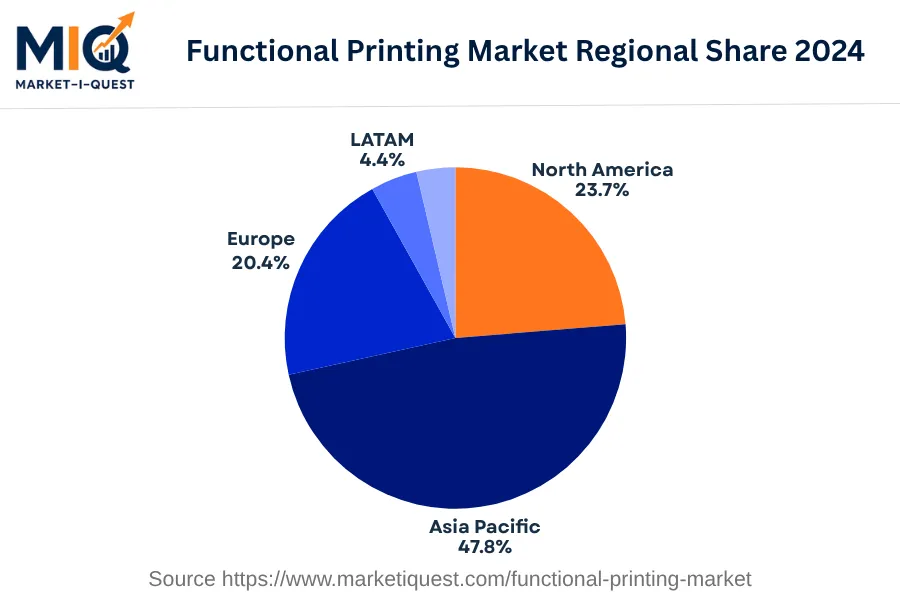
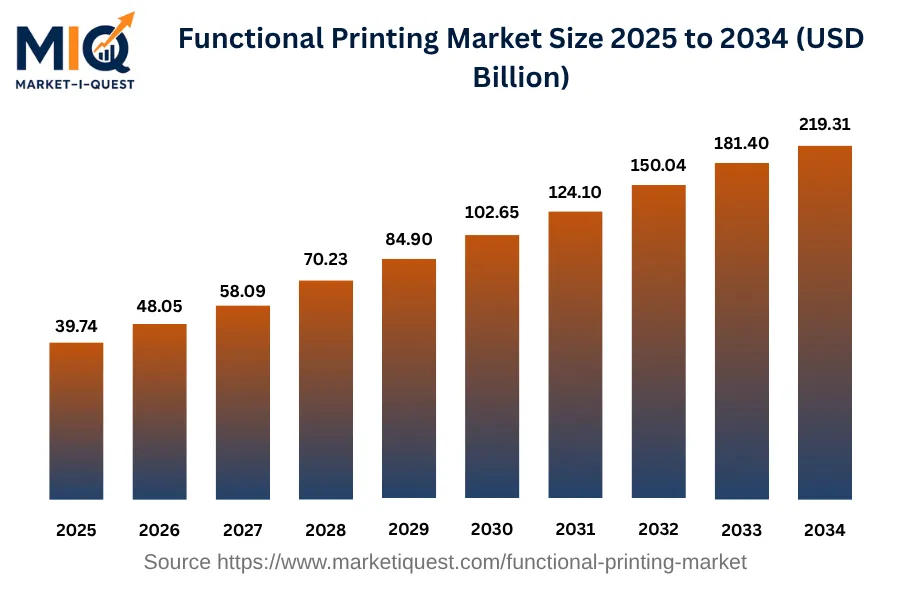
The Functional Printing Market, valued at 39.74 billion USD in 2025, is expected to grow to 219.31 billion USD by 2034, posting a CAGR of 20.9%. This growth signifies a significant expansion in the value of the market, more than quintupling within a span of 9 years. This expansive growth curve begins from the market value of 32.87 billion USD in 2024, indicating an initial sizable increase in value during the 2025 period. This progressive upswing between 2025 to 2034 depicts the accelerating opportunities and increasing demand noted within the Functional Printing field. In terms of regional share as of 2024, the majority is claimed by the Asia Pacific at 47.8%, followed by North America at 23.7% and Europe at 20.4%. LATAM and MEA regions collectively accounted for the smaller share of the market at 8%, with 4.4% and 3.7% respectively.

Key Takeaways

  • By Material - Substrate held a notable position accounting for the majority market share.
  • By Technology - Flexographic Printing emerged as the largest revenue subsegment of this segment.
  • By Application - Batteries holds the largest share of the market.
functional-printing-market market size

Key Driving Factors

Adoption in the Healthcare Sector

Functional printing, through its flexible and customizable manufacturing capabilities, introduces a series of applications in the dynamic healthcare sector. Adequate adoption of this technology within the healthcare sector could dramatically scale up new innovative solutions. For instance, applications like biosensors and lab-on-a-chip devices, produced using functional printing, can add significant value in managing chronic diseases or monitoring health statuses. Additionally, the need for personalized medicine is gaining recognition. Consequently, with the adaptation of functional printing, the healthcare sector can benefit from devices customized to individual patient's healthcare needs.

Inclination towards Sustainable Manufacturing

As industries wrestle with intense pressure to mitigate their environmental impact, the functional printing market is witnessing an upturn. This technology supports the shift toward cleaner and more efficient manufacturing practices. Notably, functional printing allows for direct printing on different substrates, limiting waste generation and energy consumption associated with traditional manufacturing processes. Moreover, it enables the use of renewable resources like bio-based inks. Industries, particularly in electronics and packaging, are capitalizing on these benefits to ensure regulatory compliance and promote sustainable business practices. Therefore, the drive towards environmental sustainability significantly fuels the growth of the functional printing market.

Market Evolution by Timeline

2019-2023
Significant purchasers of functional printing items were hardware manufacturers, particularly in Asia. China and Japan led the market in terms of demand, with consumer electronics as the primary application field. Major suppliers included companies like T-Ink and E Ink Holdings, while supply-side constraints were mostly related to quality control and lack of standardization. The US Standards for Functional Printing (US-SFP) launched in 2021 to address this issue. Pricing was component-based with long-term contracts typical, as buyers sought guaranteed supply. The primary risk was the shortage of skilled labor, which companies tried to alleviate with workforce development programs.
2024
In 2024, demand from the automotive sector grew, especially in Germany, with interactive interfaces being a popular application. Companies, such as Nano Dimension and Xaar, offered 3D functional printing solutions for improved product capacity and enhanced integration. However, the abrupt rise in material prices acted as a supply barrier. The Europe-standardized Functional Printing Protocol (FPP) was implemented this year, impacting market dynamics. Cost models included one-time licensing fees and supply-consignment contracts. The increasing counterfeit market posed a risk, prompting industry players to adopt secure packaging solutions.
2025-2029
The period witnessed a surge in demand for functional printing in healthcare applications worldwide. In particular, companies like Thin Film Electronics and PARC saw increased demand for wearables and biosensors. The development of high-speed functional printers reduced the major supply constraint of volume production. The World Standards Body's Universal Guidelines for Functional Printing helped streamline manufacturing procedures. Revenue-sharing partnerships and managed-service contract models emerged. The key risk was technology under performance in unpredictable conditions, resulting in suppliers offering better post-sale services.
2030-2034
By 2030–34, the sustainable packaging industry, particularly in Europe and North America, drove functional printing demand. Suppliers like GSI and Optomec capitalized on this shift by introducing eco-friendly inks and materials. However, the complex technology integration process posed as a supply constraint. The implementation of the Eco-friendly Functional Printing Regulation (EFPR) furthered adoption. A shift from straight procurement to service-based contracts was typical. The fluctuating raw material prices remained a risk; companies strategized by exploring alternative materials.

Future Market Outlook

Future Opportunities

Future opportunities in the functional printing market are largely driven by ongoing advancements and regulatory changes. Manufacturers are exploring eco-friendly materials, particularly in response to the European Union’s Green Deal presented in 2019, which aims to make Europe climate neutral by 2050. For instance, companies like TWI Ltd. have developed biodegradable inks that address waste concerns. In healthcare, the rising demand for personalized medicine has prompted collaborations between printing technology firms and pharmaceutical companies; a notable partnership emerged in 2022 between Holst Centre and Schmidt + Heinzel to develop printed drug delivery systems. Additionally, as governments introduce stricter regulations surrounding electronic waste, printed electronics that utilize organic materials present significant long-term growth potential. The integration of digital printing technologies within the Smart Packaging sector is also gaining traction as brands focus on consumer engagement and sustainability; in 2023, Avery Dennison launched its Smart Products label solutions in North America to enhance interactivity. Furthermore, advancements in 3D printing techniques suggest an expansion of functional printing applications in manufacturing; for example, companies like Materialise are currently exploring these technologies for producing customized components. With the push toward Industry 4.0, we can expect further convergence of IoT and functional printing technologies, creating opportunities to develop complex, interconnected systems. Overall, the evolving landscape underscores a favorable environment for innovation and application expansion within the functional printing market.

Segmentation Analysis

By Material

The market is divided into subsegments including Substrate and Inks. Of these, the Substrate subsegment accounted for the largest revenue share while Inks is expected to grow at the fastest CAGR during the forecast period.

Largest Revenue Share

Substrate

Market Share Leader

Of all the subsegments, the Substrate accounts for the largest share in revenue. This prominence is due, in large part, to its essential role in several industries, including electronics and packaging. High demand from these sectors combined with established supply chains underpin the Substrate subsegment's revenue leadership. The demand for Substrate is often driven by its properties like resilience and flexibility which make it suitable for an array of applications. Notably, geographically, the largest market for Substrate is observed in the Asia-Pacific region because of the presence of numerous electronics manufacturers and vendors. Regulatory frameworks supporting the adoption of Substrates, particularly in low-cost and environmentally friendly products, also bolster the subsegment's performance. Based on purchasing criteria, customers generally favor Substrate due to its high reliability and cost-efficiency compared with other materials. As such, any switching costs are mitigated.

Fastest CAGR

Inks

Forecast Period Growth Leader

The Inks subsegment, although smaller in current revenue relative to Substrate, is projected to witness the fastest CAGR over the forecast period. Drivers for this robust growth include development of advanced printing technologies and increasing demand for high-quality print jobs. While barriers to adoption largely centre on price sensitivity and relatively limited awareness about the advantages of more sophisticated Inks, significant catalysts exist that are likely to accelerate uptake. Technological improvements, especially in digital printing, are increasing the range of possible applications for various types of Inks, catalysing growth. In addition, the formation of strategic partnerships between Ink manufacturers and equipment suppliers is facilitating wider adoption. Capital expenditure in the printing industry, especially investments in next-generation technologies, is also supporting the expansion of the Inks subsegment. In the near-term, risks include potential supply chain disruptions, but the overall outlook remains positive.

By Technology

The market is divided into subsegments including Inkjet Printing, Gravure Printing, Screen Printing, Flexographic Printing and Others. Flexographic Printing accounted for the largest revenue share while Inkjet Printing is expected to grow at the fastest CAGR during the forecast period.

Largest Revenue Share

Flexographic Printing

Market Share Leader

Flexographic printing technology holds the largest market activity due to its wide range of advantages over other methods. Key drivers include its suitability for high-volume and long-run print jobs, flexibility in printing on a variety of substrates, and cost-effectiveness. Further, its versatility extends to graphical printing, packaging, and label printing, sectors that have witnessed robust growth in recent years. The appeal of flexographic printing is also enhanced by its environmental friendliness as it predominantly uses water-based inks. Geography-wise, this technology sees high adoption rates in developed markets where high-quality printing standards are required. However, switching costs from other printing technologies, appropriate channels for distributing and servicing the technology, and changing environmental regulations may affect its dominant position in the market.

Fastest CAGR

Inkjet Printing

Forecast Period Growth Leader

Although Flexographic printing has the largest market share, Inkjet Printing is poised for the faster growth rate in the market. Driving this development is the rapidly evolving technology, leading to improved print quality, speed, and versatility, thereby expanding its range of potential applications. The adoption of Inkjet Printing is being propelled by industries requiring high-quality and personalized print solutions, such as publishing, advertising, and direct mail. Inkjet Printing's capability of variable data printing enables businesses to personalize and customize printed materials, a prevalent trend in today's market. Furthermore, strategic partnerships between Inkjet printing machinery manufacturers and ink suppliers are becoming common, increasing the technology's accessibility. However, initial capital expenditure and the high cost of inks relative to other technologies pose as potential barriers to Entry. In the short term, these growth trends may be influenced by macroeconomic conditions and policies influencing the broader printing industry.

By Application

The market by application is divided into subsegments including Displays, Sensors, Photovoltaics, Lighting, Batteries, RFID Tags, and others. Batteries accounted for the largest revenue share in 2024 while Sensors is expected to grow at the fastest CAGR during the forecast period.

Largest Revenue Share

Batteries

Market Share Leader

Batteries stood as the dominant subsegment due to its wide range of applications across diverse industries. The increasing dependency on portable electronic gadgets like smartphones and laptops, which necessitate the use of high-performance batteries, contributes largely to this market share. Emerging trends in electric vehicles and renewable energy storage also fuel the growth of this market, given their significant battery requirements. Geographically, this growth is majorly driven by the Asia-Pacific region, where manufacturing and consumption of electronic devices is high. The regulatory environment is also favoring this growth, with many countries putting forth initiatives and policies that promote the use of renewable energy and electric vehicles, implicitly generating greater demand for batteries.

Fastest CAGR

Sensors

Forecast Period Growth Leader

Sensors subsegment is anticipated to grow at the fastest rate. Rapid technological advancements and the increasing trend of automation and IoT in various domains, coupled with the numerous applications they find in diverse industries from healthcare to automobile, are key drivers for this growth. High capital investment for advanced sensor technologies and research partnerships for evolving sensor applications are factors catalyzing this market's growth. However, the complexity and high cost of advanced sensor systems and privacy concerns related to data collection may serve as potential barriers for the wider adoption of sensors. Despite these challenges, near term risks are offset by the exponential increase in demand for smart and connected devices that extensively employ sensor technologies for optimizing operations.

Competitive Analysis

Key Market Players

Top Manufacturers / OEMs

Xerox Corporation
US
BASF SE
Germany
Eastman Kodak Company
US

Key Suppliers & Raw Materials

Sun Chemical
US
Flint Group
Luxembourg
Quad Graphics
US

Distributors, Integrators & Channel Partners

Agfa-Gevaert Group
Belgium
HP Inc.
US
Canon Inc.
Japan

Porter’s Five Forces Analysis

This analysis evaluates the competitive environment of the Functional Printing Market.

Supplier Bargaining Power

Medium

Suppliers have medium power due to the availability of multiple vendors offering similar raw materials.

Buyer Bargaining Power

High

Buyers, particularly larger corporations, hold significant bargaining power due to the variability in pricing and suppliers.

Threat of Substitutes

Low

The substitute threat is low due to the unique properties and applications of functional printing.

Threat of New Entrants

Medium

Modest investment barriers and technological advancements make market entry manageable for new competitors.

Competitive Rivalry

High

High competition prevails in the market, driven by numerous established players vying for market share.

Regional Analysis

Geographic market dynamics and growth opportunities across key regions

Global Market Outlook

functional-printing-market market regional share

North America

In 2024, North America witnessed substantial growth in the functional printing market, driven by various dynamics. The adoption of advanced technologies for manufacturing innovative products powered the market. The high degree of investment in research and development activities, particularly in the U.S., spurred the creation of more effective and cost-efficient functional printing methods. Moreover, stringent government regulations directed towards sustainable printing solutions were witnessed especially in Canada, pushing for the integration of eco-friendly functional printing commodities.

Significant trends observed in 2024 included a rise in demand for bespoke and personalized printing solutions by consumers, particularly in the retail sector. The need for efficient and low-cost electronic devices across sectors, from enterprise to healthcare, intensified the application of functional printing. There was a shift towards outsourced functional printing services, seen most in the manufacturing sector. Notably, mergers and acquisitions became more prevalent, with firms aiming to enhance their technological capabilities and market reach, as observed with key players in the U.S. and Mexico. Additionally, the implementation of stringent safety standards for printed electronics and sensors became more compelling – with companies increasingly aligning with policy enforcement in their operations.

Asia Pacific

In 2024, the Functional Printing Market demonstrated pronounced growth in the Asia Pacific region. Key drivers include increased adoption of innovative technology in India and China due to favorable government regulations that boost local manufacturing abilities. The surge in e-commerce and retail sectors in Australia and key ASEAN markets also flourished due to advancements in functional print technology. Furthermore, the high investment in Japan’s consumer electronics market contributed to the significant adoption of functional printing.

Trends witnessed include a remarkable shift towards conductive inks in manufacturing sectors across China and South Korea, due to their implications in electronics. The accelerated digitization observed across different sectors globally has seen an increased demand for printed electronic components in the region. In healthcare, the popularity for printed biosensors increased considerably, particularly in Australia. In government sectors across Asia Pacific, stricter policy enforcement on secure documentation fostered increased inclusion of functional printing in authentication procedures. The enterprises sector in India and Japan drove substantial growth due to the rise in smart packaging solutions. Overall, the Functional Printing Market in Asia Pacific was instrumental in advancing business operations across various sectors, driven by technological adoption, area-specific regulations, and shifting consumer behaviors.

Europe

In 2024, the European functional printing market exhibited significant expansion due to several drivers and emerging trends. On the drivers' side, increased demand for low cost and efficient manufacturing processes, particularly from the enterprise sector, fostered market growth. Government regulations aimed at reducing carbon emissions notably boosted the adoption of eco-friendly manufacturing processes like functional printing. In Germany and Benelux, comprehensive investment in technology R&D further amplified market expansion. Moreover, significant advancements in smart packaging technology, especially in the retail sector, resulted in increased demand across France, Italy, and Spain. Lastly, supply dynamics saw a positive shift due to lower raw material prices.

Trending in 2024, buyer behavior leaned towards goods produced using sustainable manufacturing methods. An evident shift towards smart labels and active packaging products was noticed in the retail and manufacturing industries. In terms of channel dynamics, e-commerce giants such as Amazon increasingly demanded functionally printed labels, bolstering the market. Notably, in the United Kingdom and Central Eastern Europe, M&A activities surged, signaling market consolidation. Enforcement of stricter environmental policies across the Nordics motivated shifts towards eco-friendly printers, further invigorating the market. In healthcare and utilities sectors, high utilization of functional printed sensors and batteries signified the technology's growing relevance.

Latin America

In 2024, the Functional Printing Market in Latin America presented an emerging ground of technological opportunity. Strong consumer electronics demand, fueled by the proliferation of IoT-enabled devices and growing disposable incomes in Brazil, Mexico, Argentina, Colombia, Chile, and Peru, encouraged manufacturers to innovate and diversify. Additionally, eco-conscious regulations amplified the adoption of green technologies like functional printing, allowing for energy-efficient manufacturing into different sectors such as healthcare, retail, and utilities.

Investment in research and development was evident, sparked by the strategic emphasis on advanced manufacturing technologies, fostering a conducive environment for market growth. Meanwhile, reductions in high-quality functional printing material costs contributed positively to the market's commercial feasibility.

Trends in 2024 included an increased integration of functional printing in packaging solutions throughout the retail sector and the adoption of cutting-edge technologies within the print supply chain, driven by smart manufacturing practices. Remarkably, the healthcare sector engaged in the market with applications in biosensors, medical packaging, and direct-to-patient communication tools. Partnerships and M&A activities marked the market landscape, allowing technology sharing and augmenting production capabilities. Finally, policy enforcement around electronic waste and sustainable production encouraged the drift toward eco-friendly functional printing, effectively shaping the market in Latin America in 2024.

Middle East & Africa

In 2024, the Functional Printing Market in the Middle East and Africa experienced steady growth driven by various factors. Regulatory push towards digital transformation, especially in Saudi Arabia, United Arab Emirates, and Qatar, fostered adoption of advanced printing technologies. Expansion of manufacturing and retail sectors in Nigeria, Egypt and South Africa heightened demand for flexible electronics and smart labeling, boosting this market. High investment in telecom sector in Kenya and Israel enabled application of functional printing for producing radio frequency identification devices.

Consumer preference for touch interfaces and smart packaging drove the trend for printed electronics and sensors. Growth of e-commerce in the region also shifted channel dynamics, increasing the need for packaging with functional printing. Partnerships between local firms and foreign entities, particularly in the oil and gas sector, spurred the development of printed batteries and photovoltaics. Israel's implementation of policy to ensure food safety standardized the use of smart packaging in food industry. Key consumers of the functional printing technologies included government for security applications, telecom sector for making functional antennas, healthcare sector for development of biosensors, manufacturing firms for printed circuit boards, and the retail sector for smart labels. This steady traction across various sectors in the Middle East and Africa constituted the functional printing market scenario in 2024.

Recent Industry Developments

Latest market innovations, product launches, and strategic initiatives

January 2026

The Mino Group demonstrated highly precise screen-printing tools designed to work with specialized inks for the nanotechnology sector.

November 2025

These companies released an artificial intelligence system that automatically corrects printing mistakes in real-time during the high-speed production of smart packaging and flexible circuits.

Frequently Asked Questions