
Untitled Report Snapshot

Key Players

  • Labconco Corporation (United States)
  • SP Scientific (United States)
  • GEA Group (Germany)
  • Azbil Corporation (Japan)
  • I.MA.R.C Group (India)
  • Cuddon Freeze Dry (New Zealand)
  • Martin Christ Gefriertrocknungsanlagen GmbH (Germany)
  • Shanghai Huzheng Nano Technology Co. Ltd. (China)
  • BERTHOLD Technologies GmbH & Co. KG (Germany)
  • FreeZone Freeze Dry Systems (United States)

Market Size

Base Year 2024
$2.34 Bn
CAGR
6.3%
Forecast 2034
$4.31 Bn

Market Segments

By Product
  • Bench Top Freeze Dryers
  • Mobile Freeze Dryers
By Type
  • Industrial Freeze Dryers
  • Laboratory Freeze Dryers
  • General Purpose Freeze Dryers
By End Use
  • Food Processing
  • Medical Surgical
  • Pharmaceuticals
  • Others

Market Dynamics

Drivers
  • Growing pharmaceutical industry
  • Technological advancements in equipment
Restraints
  • High equipment costs
  • Limited popular knowledge
Opportunities
  • Emerging pharmaceutical industries
  • Boost in biotechnology sector

Market Size

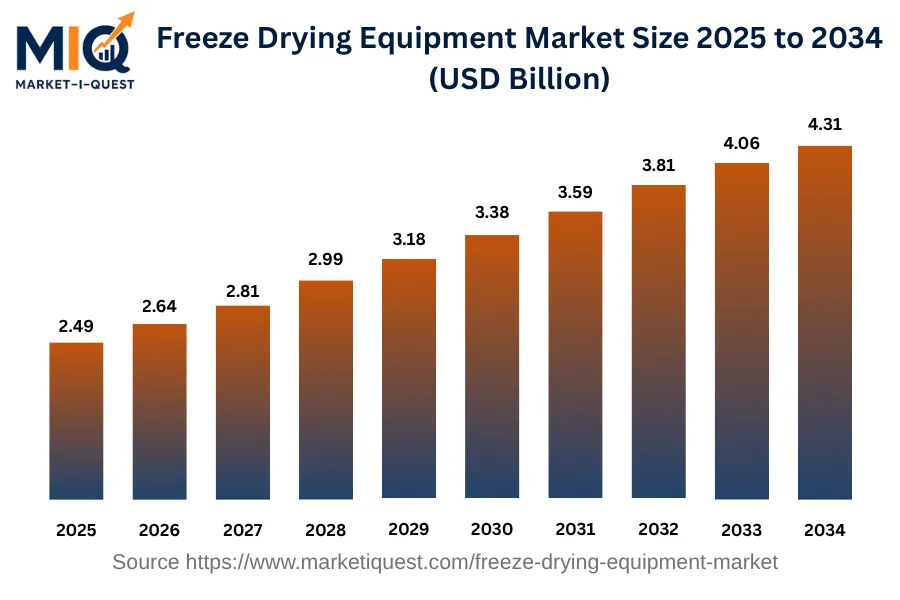
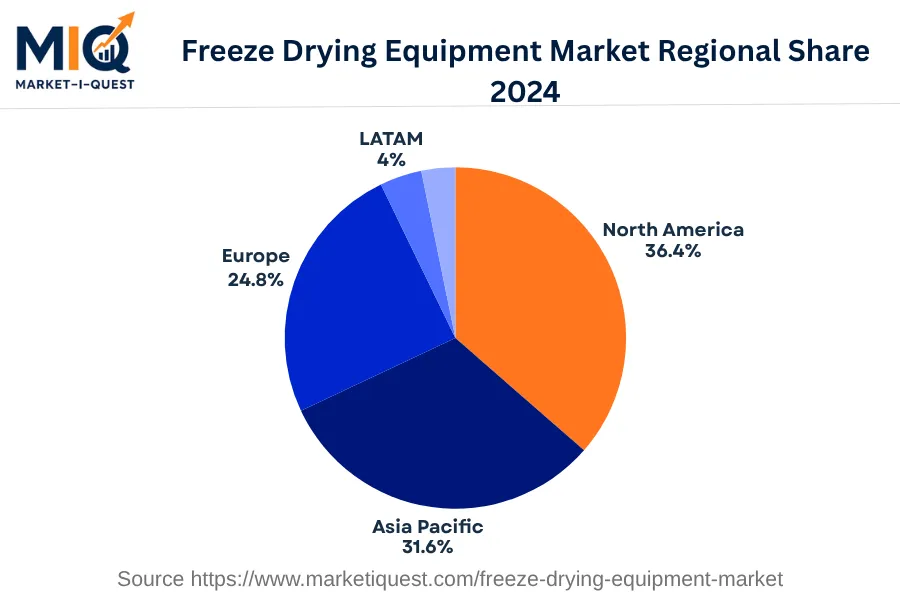
The Freeze Drying Equipment market size was USD 2.49 Billion in 2025 and it is expected to reach USD 4.31 Billion by 2034, growing at a CAGR of 6.3% between 2025 and 2034. Based on the market size in 2024, which was USD 2.34 Billion, the market had already experienced growth in 2025. The primary factor propelling the market's growth trajectory over these years is an increase in the demand for freeze drying equipment across various regions. As of 2024, the regional market share mix was as follows: North America held the highest share at 36.4%, followed by the Asia Pacific at 31.6%, and then Europe at 24.8%. LATAM and MEA held smaller shares at 4.0% and 3.2% respectively.

Key Takeaways

  • By Product - Bench Top Freeze Dryers held the lead with a significant market share in 2024.
  • By Type - Industrial Freeze Dryers dominated accounting for the major market segment.
  • By End Use - Food Processing emerged as the largest subsegment of this segment.
freeze-drying-equipment-market market size

Key Driving Factors

Implementation of the Food Safety Modernization Act (FSMA)

A significant driving factor for the Freeze Drying Equipment Market is the imposition of the Food Safety Modernization Act (FSMA) in the USA. Under this legislation, food manufacturing companies are obligated to comply with a series of preventive measures to ensure that their food products are safe for consumption. One of these measures is the incorporation of freeze-drying technology to increase the shelf life of food items while maintaining their nutritional content. This acts as a triggers procure Freeze Drying Equipment for those companies that require compliance with the Act. As the FSMA's reach is global, even affecting importers and exporters of food items, this is encouraging a global uptake of Freeze Drying Equipment to ensure regulatory compliance.
Increasing Demand for LYOPHILIZED Products in the Pharmaceutical Industry

Another influencer propelling the Freeze Drying Equipment Market is the growing need for lyophilized products in the pharmaceutical industry. Lyophilization is a process of freeze-drying used specifically to increase the stability and shelf life of pharmaceutical products like vaccines, antibodies and other biologics. With the uptick of biopharmaceuticals in therapeutic use and the continuing development of vaccines, the demand for freeze-drying equipment in this industry has increased significantly. This need to maintain product efficacy over long periods is leading to more spending directed toward freeze-drying equipment, hence driving the market growth.

Market Evolution by Timeline

2019-2023
In this period, pharmaceutical companies accounted for a significant portion of demand for freeze drying equipment globally, driven by requirements in biotech and molecular biology applications, primarily in North America and Europe. The supply was dominated by companies like Labconco and Yamato, producing benchtop models and large-capacity models respectively. However, product distribution faced constraint mainly in terms of high costs of import and logistics due to the bulky nature of the equipment. Meanwhile, FreezeTech and GE Healthcare engaged in strategic collaborations to boost sales. The chief risk was the fragile nature of the freezing units causing operational downtime.
2024
In 2024, adoption by the food processing sector played a crucial role in driving the demand for freeze drying equipment, affecting majorly in Asia Pacific region due to its expanding food & beverage industry. New contenders including SP Industries offered devices with advanced technology and operational efficiency in this year. As part of regulatory developments, the FDA rolled out more stringent guidelines for freeze-dried food products. The partnerships between original equipment manufacturers and local service providers flourished. Operational risk remained associated mainly with the handling and maintenance of the equipments.
2025-2029
The demand for freeze drying equipment was propelled between these years by smaller labs and research facilities globally, for sample storage. The supply side saw integration maturity with many companies like Telstar producing laboratory scale freeze dryer with better power efficiency and remote controllability. The introduction of EU's new regulatory framework, led to increased adoption of these equipments in the biopharmaceutical sector, offering sterile applications. The market saw a pattern of dedication services contracts in this period. The principal risk was associated with the high energy consumption of these equipments, especially in regions with expensive electricity tariffs.
2030-2034
In this epoch, the demand for freeze drying equipment was dominated by freeze-dried vaccine makers with Asia Pacific carrying an upper hand, driven mainly by global health programs. Supply constraints emerged as smaller manufacturers faced component sourcing challenges. Major market players Cuddon Freeze Dry met these challenges by launching advanced versions of freeze drying equipment with better component structures. Regulatory developments such as WHO's policy on Freeze-Dried Vaccines facilitated market expansion. In terms of commercial model, the popularity of rental agreements grew in this period. The upkeep of equipment parts and timely servicing posed a significant risk.

Future Market Outlook

Future Opportunities

With the global drive for sustainability and food security emphasized in various international frameworks, opportunities abound in the freeze drying equipment market. The 2023 United Nations conference on climate change initiated discussions that highlighted the importance of reduced food waste, encouraging sectors like food production to seek efficient preservation methods such as freeze drying. For instance, established players like GEA Group have started exploring partnerships with start-ups focusing on developing compact freeze drying solutions that cater to small-scale producers in regions like Southeast Asia, where local food preservation remains critical. Furthermore, the rise in online grocery shopping has spurred demand for longer shelf-life products, pushing manufacturers to optimize their freeze drying processes for better product longevity. The pharmaceutical sector is also ripe for growth, as companies align with the World Health Organization’s initiatives to ensure better drug quality and stability through advanced freeze drying technologies. Regulatory changes are expected to drive innovative solutions, particularly in compliance with the International Organization for Standardization standards aimed at improving freeze-drying practices in pharmaceuticals. Additionally, regions like North America and Europe are likely to see an increased demand for specialized freeze dryers capable of handling diverse biological samples as life sciences research expands. This multifaceted landscape creates many avenues for companies to explore, directing their focus toward efficiency, sustainability, and compliance with evolving industry standards.

Segmentation Analysis

By Product

The market is divided into subsegments including Bench Top Freeze Dryers and Mobile Freeze Dryers. Bench Top Freeze Dryers accounted for the largest revenue share, while Mobile Freeze Dryers is expected to grow at the fastest CAGR during the forecast period.

Largest Revenue Share

Bench Top Freeze Dryers

Market Share Leader

The revenue for Bench Top Freeze Dryers leads the market, primarily driven by its multifaceted applications across various industries. Bench Top Freeze Dryers garner high demand in medical laboratories, pharmaceutical companies, food processing industries, and other sectors requiring material dehydration. Their compact nature and ease of use coupled with their ability to maintain the quality and integrity of the product being dried boost their adoption rate. Additionally, they are preferred for small to medium scale operations, boosting their sales volumes. Bench Top Freeze Dryers offer a lower cost of ownership and minimal maintenance, further fuelling their market dominance. However, it's worth noting that the market's landscape is highly competitive, and continual innovation is a key factor in maintaining market share.

Fastest CAGR

Mobile Freeze Dryers

Forecast Period Growth Leader

The outlook for the CAGR of Mobile Freeze Dryers is the fastest among the subsegments. The market demand for Mobile Freeze Dryers is propelled by its adaptability, convenience, and efficiency in operations. Their key feature of mobility allows their use in various locations, making them particularly beneficial for enterprises with spatial constraints or shifting work environments. While initial capital expenditure on Mobile Freeze Dryers can be high, operational efficiency and flexibility can offset this over time. However, awareness and adoption can be a barrier, given the relatively new concept of mobile freeze drying. Market growth will depend on how quickly these units can demonstrate return on investment, and partnerships for technology and marketing can be crucial catalysts. Near-term risks include potential technical issues or component failures due to the complex mobile design.

By Type

The market is divided into subsegments including Industrial Freeze Dryers, Laboratory Freeze Dryers, and General Purpose Freeze Dryers, with Industrial Freeze Dryers accounting for the largest revenue share, while Laboratory Freeze Dryers are expected to grow at the fastest CAGR during the forecast period.

Largest Revenue Share

Industrial Freeze Dryers

Market Share Leader

Industrial Freeze Dryers are leading in revenue generation due to their application in many sectors, prominently in the food processing and pharmaceutical industries. These industries demand high capacity drying solutions, which industrial freeze dryers cater to effectively. Alongside, the need for preserving perishable items for long durations, especially in geographic locations with logistical challenges, has spurred the prevalence of industrial freeze dryers. The regulation landscape in some regions also necessitates the use of freeze-drying, particularly in the pharmaceutical sector, thereby driving demand. The growing emphasis on reducing food waste and increasing the shelf-life of pharmaceutical products further underpins the lions share of Industrial Freeze Dryers in the market. It's also important to mention about the robust supply chain, which effectively caters to purchasers' demand across geographies and is a key factor contributing to its large share in the market revenue.

Fastest CAGR

Laboratory Freeze Dryers

Forecast Period Growth Leader

Laboratory Freeze Dryers are projected to witness the fastest growth in the market. This can be attributed to the increasing demand driven by the expansion of research and development activities in various sectors including biotechnology, pharmaceuticals, and food technology. Laboratory Freeze Dryers are integral in preserving samples without changing their composition, which is a critical need in research labs. The decreasing cost and increasing availability of these dryers are also facilitating their wider adoption. However, High capital investments and technical proficiency required for their operation could act as barriers. A significant catalyst driving growth is tie-ups between dryer manufacturers and research institutions, ensuring product availability. Potential near-term risks include stringent regulations around laboratory equipment's and unfavorable economic conditions that might impact budget allocations on research institutions.

By End Use

The market is divided into subsegments including Food Processing, Medical Surgical, Pharmaceuticals, and Others, of which, Food Processing accounted for the largest revenue share while Medical Surgical is expected to grow at the fastest CAGR during the forecast period.

Largest Revenue Share

Food Processing

Market Share Leader

Food Processing emerged as the most significant segment in terms of revenue generation due to the increasing global demand for processed foods. This high demand can be attributed to the rise in global population, urbanization trends, and changing consumer preferences, as well as expanding middle-class population in developing economies with increased purchasing power. Further, growth in this segment is supported by advancements in food processing technologies that allow prolonged shelf life, better preservation of nutrients, and diverse product offerings, thus satisfying evolving consumer preferences. Regulatory norms that mandate certain standards in food safety and processing also play a vital role in the prosperity of this subsegment. Geographically, regions with strong food and beverages sectors, such as North America and Europe, significantly contribute to the robust performance of the Food Processing subsegment.

Fastest CAGR

Medical Surgical

Forecast Period Growth Leader

The Medical Surgical subsegment is projected to grow at the fastest CAGR. The primary growth drivers include the growing global healthcare sector, advancements in medical technologies, and the rising occurrence of chronic diseases. On account of major demographic changes, such as aging populations in developed economies and the increased accessibility to healthcare in developing markets, there is a heightened demand for surgical procedures. Additionally, the integration of technologies like robotics and artificial intelligence into surgical practices fosters innovation and boosts the growth of this subsegment. Partnerships among healthcare providers, insurance providers, and technology companies further propel the segment growth. However, potential barriers to growth could include the high investment required in developing these technologies and potential regulatory hurdles that accompany the rapid innovation.

Competitive Analysis

Key Market Players

Manufacturers / OEMs

Labconco Corporation
US
Thermo Fisher Scientific Inc.
US
GEA Group AG
Germany

Key Suppliers & Raw Materials

Bosch Packaging Technology
Germany
SP Industries, Inc.
US
MechaTech Systems Ltd
UK

Distributors, Integrators & Channel Partners

Beacon Laboratory Equipment
US
BioPharma Solutions
US
Sky Pharma Equipments
India

Porter’s Five Forces Analysis

This analysis explores the competitive intensity and attractiveness of the Freeze Drying Equipment Market.

Supplier Bargaining Power

Medium

Few suppliers for key components potentially leading to moderate pricing power.

Buyer Bargaining Power

Low

High switching costs and equipment specificity leave little room for price negotiation.

Threat of Substitutes

Low

Few alternatives to freeze drying exist, reducing the threat of substitutes.

Threat of New Entrants

Medium

High setup costs provide barriers, although technological advancements could allow new entrants.

Competitive Rivalry

High

Numerous global and regional players exist, leading to a high degree of competition.

Regional Analysis

Geographic market dynamics and growth opportunities across key regions

Global Market Outlook

freeze-drying-equipment-market market regional share

North America

In 2024, the North American market for freeze-drying equipment demonstrated significant growth. This surge was driven by increased R&D investment in biotechnology and pharmaceutical sectors, particularly in the U.S. and Canada, triggering a higher demand for advanced lyophilization technologies. The adoption of automated freeze-drying systems for food preservation notably rose in the face of strict FDA guidelines on food safety, boosting market growth. Influencing supply dynamics was the heightened production capacity from key equipment manufacturers based on cost-efficient production methods.

Trend-wise, consolidation prevailed among freeze-drying equipment manufacturers, with prominent partnerships and M&A activities aimed at expanding product portfolio and geographical reach. The rise of e-commerce as a preferred distribution channel was noteworthy, given its wide reach and cost-effective delivery. Stricter regulatory enforcement in healthcare regarding the proper preservation of pharmaceutical and biological samples marked a key trend, emphasizing the demand for high-end freeze-drying equipment. Diverse sectors such as food processing, pharmaceuticals, and biotechnology emerged as primary customers for freeze-drying equipment. The demand was particularly high in the U.S. healthcare sector for freeze-dryers suitable for preserving lab samples adequately. Meanwhile, in the food and beverage industry across North America, including Mexico, there was a growing inclination towards freeze-drying fruits, vegetables, and coffee.

Asia Pacific

The Asia Pacific Freeze Drying Equipment Market in 2024 comprised heightened demand and adoption primarily fueled by the pharmaceutical and biotechnology sectors. Key drivers included robust investment in cold chain logistics and biopharmaceutical research in China and Japan, buoyed by supportive government policies encouraging technological advancement. Regulatory standards, like China's updated cold chain logistics regulation, affected demand dynamics, while advances in technology, such as the shift towards automated lyophilization, addressed supply chain needs and contributed to competitive pricing.

Buyer behavior trends like the preference for high-quality, freeze-dried pharmaceuticals, underpinned by the growing healthcare sector in India and Australia, impacted the market. New partnerships and mergers, particularly in South Korea's biotech industry, revealed evolving market dynamics. Progressive policies, such as India's Biotechnology Industry Research Assistance Council initiatives, enforced quality standards and encouraged market transparency. In manufacturing, an increasing demand for high-quality preserved foods, primarily in key ASEAN markets, indicated a shift in channel dynamics, further affirming the freeze-drying equipment market's significant role in the region's economic framework in 2024.

Europe

In the base year of 2024, Europe's market for freeze-drying equipment, which works for various industries, showed distinct dynamics. A few primary drivers include increasing demand for preserved foods in countries like Germany, UK, France, Italy, Spain, and the Nordics; advances in technology adoption in the healthcare sector, particularly in the pharmaceutical industry driving investment in more efficient machines; rise in government regulations in the Benelux region promoting food safety, and supply dynamics reflecting the increase in regional manufacturing capacity. Economy, the Central & Eastern European countries, showed interest in freeze-drying equipment due to the growing trends in their respective retail sectors.

One salient trend observed was the shift towards more sustainable and energy-efficient units. The increasing digitalisation in the manufacturing sector implied a higher demand for sophisticated, tech-equipped units. Customers also showed preference for equipment vendors who offered comprehensive aftersales service. In the healthcare and pharmaceutical industry, it was noted that certain standards for equipment quality and safety were strictly enforced, often serving as a deciding factor for retail purchases. Mergers and acquisitions particularly dominated the enterprise sector, as players sought to enhance their market reach and product offerings. Additionally, we saw a heightened focus on policy enforcement, considerably impacting the production and sale of freeze-drying equipment.

Latin America

In 2024, the Latin American Freeze Drying Equipment market experienced dynamic growth, fueled by diverse factors. Impetus stemmed from enhanced investment in the pharmaceutical sector, notably in countries like Brazil and Mexico, consequently elevating demand for freeze-drying technology in drug production and preservation. Regulatory support for food safety in Argentina and Chile further propelled the market, driving adoption of these machines for preservation and quality maintenance of food products. Meanwhile, technological progress, marked by the escalating uptake of automated lyophilisation systems in Colombia and Peru, augmented supply-side dynamics.

Shifting trends painted a vibrant market picture. Heightened buyer inclination towards improved food quality and reduced wastage, realized through freeze drying, transformed consumer behavior across retail and food service. Similarly, robust shift towards advanced lyophilisation solutions for better efficiency and product integrity impacted product dynamics in manufacturing and healthcare industries. The market also witnessed strategic partnerships, with companies like Labconco and SP Scientific fortifying their LATAM positions through collaborations and service expansion. Strict enforcement of Good Manufacturing Practice standards significantly influenced policy adherence in enterprises and pharmaceutical sectors, underscoring the pivotal role of freeze drying equipment in quality control and assurance. In totality, 2024 was a remarkable year for freeze drying equipment market in Latin America.

Middle East & Africa

In 2024, the Freeze Drying Equipment Market in the Middle East and Africa was significantly driven by numerous factors. High demand in sectors such as pharmaceuticals, biotechnology, and food processing created robust market dynamics. Increased government regulations in Saudi Arabia and UAE, mandating the use of freeze drying in certain healthcare and food safety applications, instigated considerable market growth. Progressive technological adoption in countries like Qatar and Egypt, primarily in their burgeoning biotech industries, amplified this growth. Pricing and investment dynamics in Israel and South Africa, favoring locally based suppliers, further facilitated market expansion.

Emerging trends comprised shifts in buyer behavior, product technology, and policy enforcement. In Nigeria and Kenya, there was an observable preference for compact, energy-efficient freeze-drying machines over traditional models due to rising energy costs and environmental concerns. A developing trend in the region was the increased partnership between freeze drying equipment manufacturers and local pharmaceutical companies. Policy enforcement also played a key role, with new health and safety guidelines in Israel and South Africa mandating the use of freeze drying techniques in certain healthcare practices, particularly vaccine storage. Moreover, an influx in technology-related channel collaborations was increasing the accessibility of these equipment, thereby expanding the market reach.

Recent Industry Developments

Latest market innovations, product launches, and strategic initiatives

March 2026

These organizations initiated a 50 million euro expansion of their existing freeze-drying facility. The project is designed to drastically increase their manufacturing capacity for medicines within Europe.

February 2026

GEA opened a new 80 million euro freeze-drying technology center. The facility combines research, equipment production, and testing into a single building that is completely carbon-neutral and powered by solar panels.

January 2026

IMA Life supplied a fully automated freeze dryer system for Sharp’s 28 million dollar factory expansion. This specific equipment upgrade allowed the facility to double its total manufacturing capacity.

Frequently Asked Questions