
Food Service Equipment Market Snapshot

Key Players

  • Hobart Corporation (US)
  • Electrolux AB (Sweden)
  • Ali Group S.r.l. (Italy)
  • Manitowoc Foodservice (US)
  • Dover Corporation (US)
  • Fujimak Corporation (Japan)
  • Meiko International (Germany)
  • ITW Food Equipment Group (US)
  • Middleby Corporation (US)
  • THERMO-KOOL (US)

Market Size

Base Year 2024
$ 39.87 Bn
CAGR
6.4%
Forecast 2034
$ 74.14 Bn

Market Segments

By Product Type
  • Cooking & Preparation Equipment
  • Warewashing Equipment
  • Refrigeration Equipment
  • Storage & Handling Equipment
  • and Others
By End Use
  • Restaurants
  • Cafes
  • Catering Services
  • Institutional Food Services
  • Food Trucks

Market Dynamics

Drivers
  • Rising global food sales
  • Growing hospitality sector
Restraints
  • High initial investment
  • Technological complexity
Opportunities
  • Rising culinary tourism
  • Increasing home cooking trends

Market Size

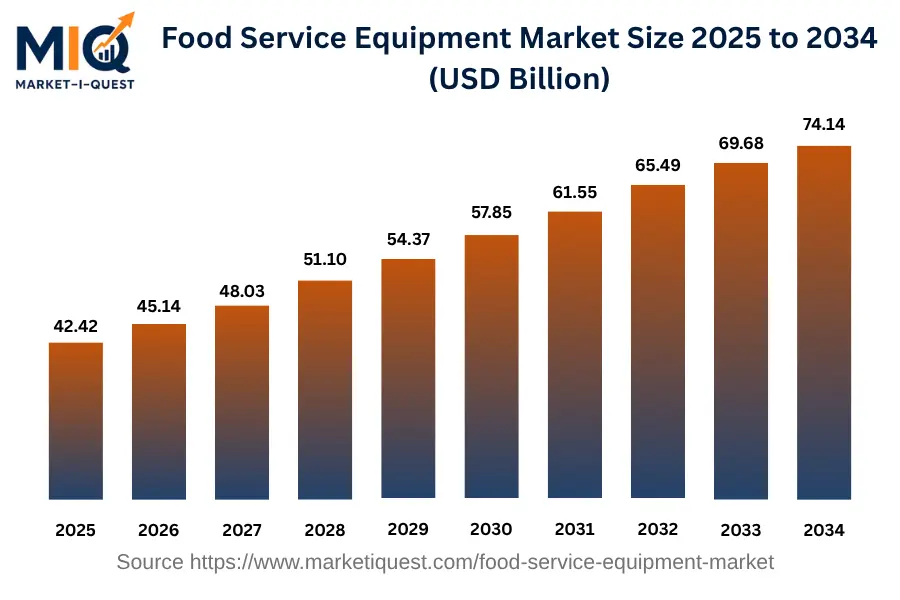
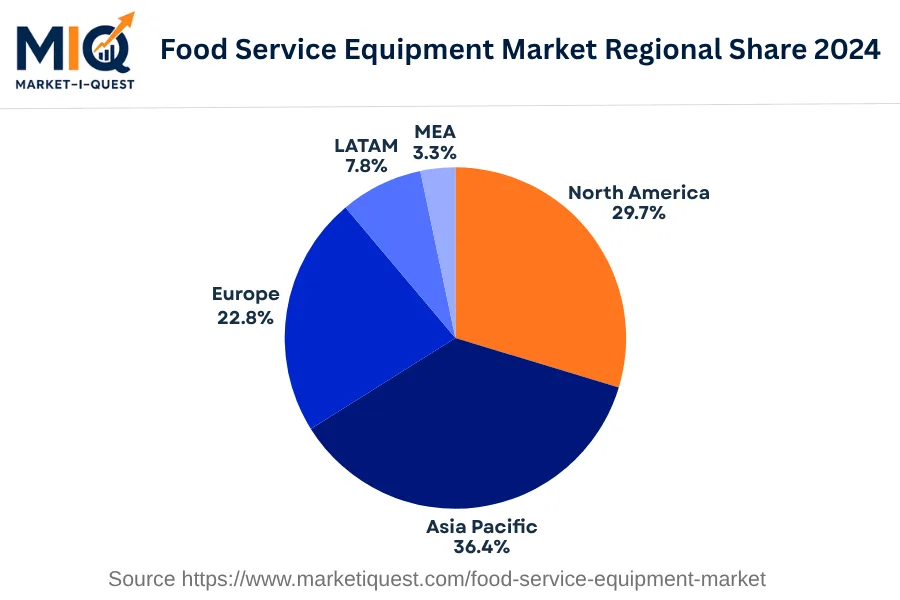
The food service equipment market share valued at 42.42 billion USD in 2025, expanded from 39.87 billion USD in 2024. The market is projected to reach a value of 74.14 billion USD in 2034 with a growing CAGR of 6.4%. The growth in market value is primarily driven due to the increasing adoption and demand of food service equipment to reduce time of food preparation and service processes. The continuous innovations and advancements within the equipment for improving the efficiency and effectiveness of food service operations, contributing in this development. Regional distribution, in 2024, with Asia Pacific holding the highest market share at 36.4%, followed by North America with 29.7%, Europe with 22.8%, Latin America with 7.8% and Middle East and Africa with 3.3% respectively.

Key Takeaways

  • By Product Type - Cooking & Preparation Equipment held a dominant position in the Food Service Equipment Market.
  • By End Use - Restaurants accounted for a significant portion of the market in the said year.
food-service-equipment-market market size

Key Driving Factors

Strict Food Safety and Quality Regulations

Major driving factor of the food service equipment market trends involves the impact of strict food safety and quality regulations. In many countries, health authorities such as the Food and Drug Administration in the United States and European Food Safety Authority in EU has enforced stringent regulations and guidelines for food businesses. These requirements are often focused on minimum hygiene requirements, controlled temperature ranges for food storage and preparation with waste disposal practices. For meeting with these standards, restaurants and other food businesses have to regularly improve their equipment and ensure using the ones that meet the required standards. Thus, this regulatory compliance creates a consistent demand for updated and compliant food service equipment.
Consumer Preference for Delivery or Takeaway Options

In recent years, a significant driving factor influencing the food service equipment market demand is the rising popularity of food delivery driven by the frequent usage of online platforms. Due to the shift in consumer preference the home dining, restaurants and eateries are now transforming their procedures according to the growing trend. In long delivery journeys the essential need for specialized equipment to prepare, package and preserve meals. The demand for such equipment including high-speed ovens. Thus, holding cabinets and advanced packaging machines is playing a significant role in expanding the food service equipment market.

Market Evolution by Timeline

2019-2023
In this period, buyer preferences majorly shifted towards restaurants, fast-food chains and hospitality sectors, focused by region such as North America and Europe were seen as key markets due to their high customer presence. Suppliers introduced high energy-saving equipment and IoT integrated systems driving the development level of integration. The regulatory environment like the zero landfill waste policies in San Francisco influenced businesses to shift from old to eco-friendly solutions. Pricing was often demand-driven and frequent partnerships between equipment manufacturers and supplies firms. Thus, making this a period of substantial growth.
2024
In 2024, the food service equipment market trends experienced surge due to the expansion of restaurants and quick-service restaurant chains. With the rising popularity in cloud kitchens and food delivery services. The rising adoption of energy-efficient and smart kitchen equipment is driving investments in the hospitality sector. Whereas, driving the consumer preferences due to increased urbanization and higher disposable incomes. Additionally, various developments in automation and connected kitchen technologies supported foodservice operators for improving their operational efficiency. Thus, further supporting market expansion.
2025-2029
By this period, a significant shift towards the home kitchen market emerged due to the increasing trend of cooking at home and online food blogging. Suppliers began offering more residential-friendly appliances with user-friendly interfaces. With the adoption of carbon neutrality rules in China and EU rose the encouragement for environmental friendly equipment. Thus, pricing models began to include subscription-based services.
2030-2034
In this period, rise in demand within the African and Middle Eastern markets due to increasing urbanization and expansion of the restaurant culture. The industry witnesses a rise of AI-enabled appliances reducing the cooking process. Partnerships between tech companies and equipment manufacturers are frequently addressing these challenges, with unified global standards. Thus, procurement becomes more streamlined driving further market expansion.

Future Market Outlook

Future Opportunities

The current landscape of the food service equipment market analysis is creating various opportunities for innovations in sustainability and health-related solutions. In 2023, several regions have introduced stricter waste management policies such as in New York City, which encourages food service organizations for adopting integrated systems, thus creating opportunities for specialized composting equipment manufacturers. Moreover, increased focus on plant-based cooking technologies driven by rising consumer interest in vegetarian and vegan diets. Companies like Miele have begun developing specialized appliances designed for serving plant-based cooking trends. Leading to increased market entries with shifting consumer preference. The intersection of convenience and technology is also presenting opportunities for mobile food service solutions. Due to the rise of food trucks and pop-up restaurants offering diverse cooking experiences. These businesses often utilize compact and multifunctional equipment that can support rapid food preparation and service. By designing portable and modular food service solutions whereas, companies could utilize this shift. Also, the integration of advanced monitoring systems in food preparation, integrated with recent safety regulations, creates opportunities for innovations in food handling and storage technology. Such advancements integrated with the efforts of agencies like the World Health Organization for promoting enhanced food safety protocols. Thus, indicating increased requirement for innovative solutions within the food service equipment market.

Segmentation Analysis

By Product Type

The market is divided into subsegments including Cooking & Preparation Equipment, Warewashing Equipment, Refrigeration Equipment, Storage & Handling Equipment and Others. Among these, Cooking & Preparation Equipment accounts for the largest revenue share, while Storage & Handling Equipment is expected to grow at the fastest CAGR during the forecast period.

Largest Revenue Share

Cooking & Preparation Equipment

Market Share Leader

The Cooking & Preparation Equipment subsegment emerged as the largest revenue share of this segment. Due to several reason such as frequent need for this equipment across all foodservice businesses subsequently increases its demand. While cooking and preparation equipment are required in food chain including restaurant, bakery, catering or any other type of food business, making it essential for the market. Additionally, the variety within this subsegment, from ovens, fryers, griddles and food processors to diverse customer needs, further driving the demand. The trend towards automated kitchens and the integration of advanced technologies into cooking equipment has been crucial factor in driving the market growth. With increasing automation efficiency and precision subsequently reducing human errors while cooking equipment with such features gains more demand. Thus, cooking and preparation held the largest market share of this segment.

Fastest CAGR

Storage & Handling Equipment

Forecast Period Growth Leader

The Storage & Handling Equipment subsegment is projected to witness the fastest growth in the forecasted period. This can be attributed to the increasing awareness regarding food safety with playing a crucial role maintaining food quality. While proper storage and handling systems supports in preventing microbial rise and cross-contamination. Which has become a significant concern for foodservice providers, especially in consideration of strict food safety regulations. Further motivation in the development of segment is provided by technological innovations like smart storage solutions that enhance efficiency and resulting in better preservation of food. Thus, with improving technology reach and expansion of smart solutions making the way for rapid segment growth.

By End Use

The market is divided into subsegments including Restaurants, Cafes, Catering Services, Institutional Food Services, and Food Trucks. In 2024, Restaurants accounted for the largest revenue share while Food Trucks are expected to grow at the fastest CAGR during the forecasted period.

Largest Revenue Share

Restaurants

Market Share Leader

The restaurant subsegment is emerged as the largest revenue of this segment. With increased number of individual and chain restaurants increases other establishments like cafes and food trucks. Therefore, even with moderate per-transaction sales, the cumulative revenue is significant. While restaurants aims to have higher transaction values compared to cafes and food trucks. They serve range of items including full meals, which are subsequently high priced. Various restaurants serves to a broad demographic for increasing the customer base. Regionally, while urban areas have densely populated restaurant networks and their presence in suburban and rural areas contributes substantially to their overall revenue. Thus, familiarity and the comfort of indoor dining have helped them maintain their lead in generating the most revenue.

Fastest CAGR

Food Trucks

Forecast Period Growth Leader

Food Trucks are forecasted to be the fastest-growing subsegment. Their rapid acceleration in the foodservice market is driven by multiple factors. Due to lower capital requirement to start a food truck is increasingly making it a preferred choice for entrepreneurs. Continued with flexibility to align operations according to consumer-demand pattern. For instance, location-based servicing, tailored menu as per local taste preference, serving during peak hours, resulting into high scalability. Major cities are implementing policies for supporting this growing trend and creating designated food truck parks with allocating licenses. Technologically, food trucks are majorly utilizing social media for broadcasting their locations, menus and as a source of interaction with customers. This support in several factors including marketing with also aimed to develop a loyal customer base. Partnerships with food delivery apps have also supported in expanding their delivery coverage. Thus, making it a subsegment growing with a fastest rate.

Competitive Analysis

Key Market Players

Manufacturers / OEMs

Middleby Corporation
US
ITW Food Equipment Group
US
Ali Group S.r.l.
Italy

Key Suppliers & Raw Materials

ArcelorMittal
Luxembourg
Nippon Steel
Japan
Rio Tinto
UK

Distributors, Integrators & Channel Partners

Clark Service Group, Inc.
US
TriMark USA, LLC
US
Edward Don & Company
US

Porter’s Five Forces Analysis

Analysis of the Food Service Equipment Market in relation to its competitive dynamics.

Supplier Bargaining Power

Medium

Due to moderate number of suppliers and cost differentiation, the supplier power is medium.

Buyer Bargaining Power

High

Buyers, being numerous and with various choices, have high bargaining power.

Threat of Substitutes

Low

Low threat due to lack of viable substitutes for specialized food service equipment.

Threat of New Entrants

Medium

Cost of capital and regulatory compliance creates barriers, but growth potential attracts new entrants.

Competitive Rivalry

High

Numerous established entities and aggressive pricing strategies result in high competitive rivalry.

Regional Analysis

Geographic market dynamics and growth opportunities across key regions

Global Market Outlook

food-service-equipment-market market regional share

North America

In 2024, the food service equipment market share in North America was predominantly fuelled by various driver for the expansion of fast food industry, strict health regulations and technological advancement in the sector. Regions with rapid growth in fast food chains such as U.S., Canada and Mexico with increasing requirements for efficient and advanced food service equipment. Moreover, stringent health regulations in these regions driving businesses for improving equipment with the assurance of safe and hygienic food preparation. Trend towards automation and smart appliances, where operations such as ordering, inventory management and cooking could be controlled remotely with contributing in market dynamics.

This year witnessed a growing consumer preference for locally produced organic food options, driving establishments in the commercial sector, such as hotels, restaurants and cafes for improving the cooking and storage equipment. The integration of evolving consumer behavior led to a preference for high-quality, durable equipment, encouraging partnerships and mergers between food service providers and equipment manufacturers to offer customized solutions. Moreover, sector-specific policies, like the food safety modernization act in the U.S., continued to impact equipment standards and operational practices. Thus, positioning compliance as a critical factors in procurement decisions, particularly for government and healthcare institutions.

Asia Pacific

The Asia Pacific food service equipment market opportunities made significant growth in 2024, driven by factors such as evolving cooking preference, stringent food safety standards and rapid urbanization. With rising consumer culture and increased demand for processed food, particularly in regions such as China, India and key ASEAN markets. Significantly driving the increased usage of efficient food service equipment. Technological adoption played a major role with digital transformations in Japan and South Korea fueling investments in smart kitchen appliances. Furthermore, this region saw expansion in food delivery services significantly boosting the demand for temperature-controlled storage and transportation equipment.

Trend of dining influencing the buyer behavior, with an increase in quick-service restaurants and cloud kitchens across major cities like Beijing, Mumbai, Tokyo and Sydney. This trend combined with the adoption of energy-efficient equipment driven by stringent government policies led to a shift in equipment preferences. High-tech, sustainable appliances became the standard for transforming the restaurant landscape. The demand primarily came from enterprise and retail sectors. However, the major usage of these equipment were common in healthcare facilities. Additionally, supplier partnerships and strategic mergers and acquisitions became common, especially within Australian wholesalers. In the pursuit of operational efficiency, these alliances transformed the channel dynamics by further integrating the market. Thus, the Asia Pacific region emerged as a major market for food service equipment manufacturers globally.

Europe

In 2024, the European Food Service Equipment market expansion was emerged due to significant demand. Driven by shifts in consumer preferences, market integrations and changes in regulatory standards. The increasing quick-service dining outlets, particularly in Germany and UK drove the demand for efficient cooking and refrigeration equipment. Furthermore, stringent hygiene regulations in France and Italy promoted investment in advanced sanitation equipment.

The market witnessed accelerated adoption of innovative technology such as IoT integrated appliances for remote monitoring. Further became predominant in Spain and Benelux for enhancing operational efficiency in foodservice establishments. Increased pricing dynamics were seen due to increased raw material costs. Majorly in Central & Eastern Europe, impacting the buying strategies of serving companies and restaurants.

While the key trends included an increased focus on sustainability, notable growth in demand for energy-efficient equipment within all sectors, particularly among enterprise and government buyers in the Nordic region. There was a noticeable shift in buyer preference towards modular kitchen equipment providing flexibility and space optimization, primarily noticed in retail food services.

Acquisition emerged as a common route for expansion among leading industry players, enabling access to technological capabilities and expanded customer base, representing market integration. Strict enforcement of food safety standards across Europe further shaped the market landscape. Thus, necessitating required improvements or replacement of equipment in several establishments.

Latin America

In 2024, the Latin American food service equipment market expansion continued with a reliable growth driven by various key factors. Including increasing need from Mexico and Brazil resulted from the rise in tourism and hospitality sectors, transforming the affordable quick service restaurant sector and increased dining. Regulatory standards in Argentina and Colombia, adopting hygienic practices in food service operations, driving investment in quality kitchen equipment. Innovative technology adoption, particularly bio-degradable and energy-efficient kitchen appliances, saw a significant rise in Chile towards environmental sustainability.

Consumer behavior shifted towards fast-casual dining experiences, particularly in Peru, reflecting a shift towards advancement in food service environment. In Brazil, the rise in partnerships between cooking institutions and equipment providers resulted in raising industry standards. The food services dynamics were reshaped by the rise in delivery apps, necessitating efficient in-house technology systems in restaurants, commonly in urbanized areas of Mexico and Colombia. Policy enforcement around waste management in Argentina resulted in more eateries investing in waste disposal equipment.

The market saw increasing purchases from various sectors. In retail sector, especially grocery chains in Brazil, made substantial investments in food service equipment for expanding their ready-to-eat product offerings. For instance growing hospitality industry in Mexico saw increased requirement for advanced kitchen equipment. Thus, government initiatives in Argentina and Chile to redeveloping school cafeterias boosted need for food service equipment.

Middle East & Africa

In 2024, the food service equipment market analysis in the Middle East and Africa showed dynamic patterns. Drivers included increasing frequency of fast-food chains and hospitality sectors in regions such as Saudi Arabia, UAE and Egypt driving demands for advanced equipment. Including the favorable government regulations promoting safety standards in food preparation. Mainly in regions such as Israel and South Africa driving the operators for improving their equipment. Furthermore, investments in innovative technology by major players in this sector like Saudi Arabia and UAE, promoted supply dynamics leading to market competitiveness.

Several trends shaping this landscape included buyer behavior and technology shifts. In countries like Kenya and Nigeria where socio-economic development is rising. Due to consumer preference increasingly shifting towards dining-out and takeaway services, driving need for various food service technologies. A major shift was witnessed towards energy-efficient and common equipment, especially in UAE and Qatar's growing hospitality sector. Moreover, boosting strategic partnerships and M&A among retailers and manufacturers. In nations like South Africa and Israel. Enforcement of strict health safety standards by regulatory bodies, particularly in UAE and Saudi Arabia. Thus, enforcing the use of compliant food service equipment in sectors such as healthcare and retail.

Recent Industry Developments

Latest market innovations, product launches, and strategic initiatives

March 2026

Ali Group, one of the largest global players in the foodservice equipment industry, completed its acquisition of Bunn Commercial LP (formerly Bunn-O-Matic Corporation). This corporate consolidation signals a tightening market where legacy beverage equipment operations are being absorbed into massive, diversified portfolios to scale global distribution and reduce overhead

October 2025

At the HOST 2025 exhibition, Welbilt officially debuted its next-generation suite of professional kitchen solutions, heavily emphasizing AI-driven technologies and connected cloud systems for the European market. This massive rollout reflects the industry's rapid pivot from standalone manual hardware to integrated, IoT-enabled smart kitchens designed specifically to combat hospitality labor shortages and minimize energy waste.

January 2025

Paramount launched a massive 60,000-square-foot state-of-the-art facility at Birkat Al Awameer. The complex isn't just a standard warehouse; it integrates a manufacturing unit, a central distribution hub, a customer experience center, and a culinary design lab to aggressively target the expanding HORECA (hotels, restaurants, and catering) sector across the MENA region.

Frequently Asked Questions