Fluoropolymer Films Market Snapshot

Key Players

  • Chemours Company (United States)
  • Saint-Gobain S.A. (France)
  • 3M Company (United States)
  • Daikin Industries Ltd. (Japan)
  • Gujarat Fluorochemicals Limited (India)
  • Arkema Group (France)
  • Solvay S.A. (Belgium)
  • Honeywell International Inc. (United States)
  • Kureha Corporation (Japan)
  • Asahi Glass Co. Ltd. (Japan)

Market Size

Base Year 2024
$2.86 Bn
CAGR
6.74%
Forecast 2034
$5.49 Bn

Market Segments

By Application
  • Electrical Insulation
  • Protective Coatings
  • Gaskets & Seals
  • Films for Medical Devices
By Type
  • Polytetrafluoroethylene (PTFE)
  • Polyvinylidene Fluoride (PVDF)
  • Fluorinated Ethylene Propylene (FEP)
  • Others
By End Use Industry
  • Automotive
  • Aerospace
  • Medical
  • Electronics
  • Construction
  • Others

Market Dynamics

Drivers
  • Increasing industrial applications
  • Rising demand in medical sector
Restraints
  • High production costs
  • Stringent environmental regulations
Opportunities
  • Growing electronics industry
  • Rise in solar energy applications

Market Size

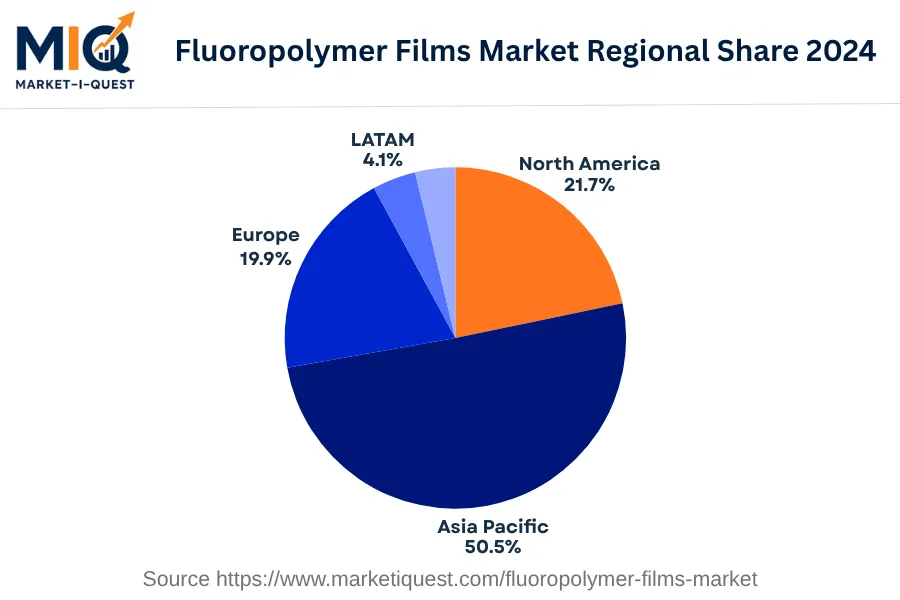
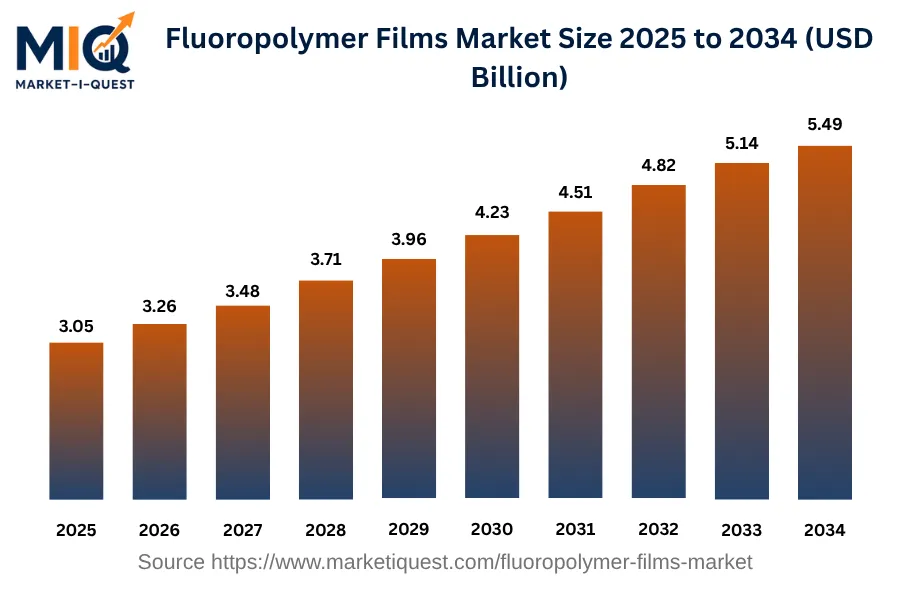
The Fluoropolymer Films Market size was USD 2.86 billion in 2024 and witnessed growth to command a market size of USD 3.05 billion in 2025. Over the next decade, the market is expected to grow substantially to reach a size of USD 5.49 billion in 2034, representing a Compound Annual Growth Rate (CAGR) of 6.74%. This growth is primarily attributable to the consistent development seen during these years. To specify, between the years 2025 and 2034, the market expanded progressively, capturing a greater value with each passing year. In 2024, the regional share mix of the Fluoropolymer Films Market was as follows: North America represented 21.7% of the market, Asia Pacific held a significant 50.48% share, Europe accounted for 19.86% of the market, LATAM composed 4.12%, and MEA made up the remaining 3.8%.

Key Takeaways

  • By Application - Electrical Insulation held the massive share in 2024.
  • By Type - Polytetrafluoroethylene (PTFE) accounted for the leading position in 2024.
  • By End Use Industry - Automotive sector was the largest accounting for a significant market share in 2024.
fluoropolymer-films-market market size

Key Driving Factors

Pharmaceutical Packaging Innovations

Innovations in pharmaceutical packaging constitute a specific driving factor in the fluoropolymer films market. Fluoropolymer films, with their exceptional chemical resistance and thermal stability, are increasingly utilized in pharmaceutical packaging to maintain the integrity and safety of medicinal products. For instance, these films are being used in the packaging of pre-filled syringes, blisters, and bags for intravenous (IV) fluids, thereby promoting their market growth. Growth in the pharmaceutical sector across regions like Asia and Europe due to factors such as aging populations and higher healthcare spends is increasing the demand for advanced, reliable packaging materials, directly impacting the fluoropolymer films market.

Popularity of Solar Energy

The popularity of solar energy constitutes another driving factor in the fluoropolymer films market. Solar panels extensively use fluoropolymer films due to their weather resistant characteristics and high transmittance rates. These properties allow maximum sunlight to reach the solar cells, ensuring high energy efficiency. The ongoing global shift toward renewable energy sources to counter climate change is triggering the adoption of solar power technologies. Nations like China and India are investing heavily in solar projects, nurturing a rising demand for fluoropolymer films. As such, the surge in solar energy adoption worldwide presents a concrete driving force for the fluoropolymer films market.

Market Evolution by Timeline

2019-2023
During this period, the Fluoropolymer Films Market was utilized extensively in sectors like automotive, electronics, and aviation. Asia-pacific was the dominant regional market due to large scale industrialization in countries like China and India. From the supply perspective, manufacturing remained key to the traditional thermal processes, although environmental constraints started to limit the use of certain types of Fluoropolymers. Policy-wise, European Union Regulation REACH (Registration, Evaluation, Authorization, and Restriction of Chemicals) affected the adoption by requiring more rigorous testing. Commercially, long-term contracts and strategic partnerships between manufacturers and buyers became prevalent. Practical risks included volatility in raw material pricing and environmental regulation compliance.
2024
In 2024, the Fluoropolymer Films Market observed an increase in demand from the PV solar module sector, predominantly in European nations driven by their renewable energy targets. Technologically, a new wave of manufacturing methods aimed at reducing their environmental footprint was seen. EU's further tightening of regulations under REACH compelled market players to adhere to stricter standards. Commercially, due to regulatory challenges and rising raw material costs, a trend of cost-plus pricing contracts became more common. Under risks, supply-chain disruptions triggered by geopolitical tensions impacted the market, pushing players to diversify their supply chains.
2025-2029
Between 2025 and 2029, major consumer markets like pharmaceuticals and food packaging drove an uptick in demand, especially in North America and Europe regions. On the supply side, technological advances in film-fabrication methods like rotational molding and injection molding aided in meeting growing demand more efficiently. Policy-wise, new ecological design directives in the EU placed further emphasis on environmentally-friendly production methods. Insurance-backed contracts signified a major shift in the commercial model for managing supply-chain risks. Real risks included potential firefighting issues in production facilities due to flammability of these films.
2030-2034
In 2030-2034, South American markets, primarily Brazil and Argentina, added noticeable demand due to expansion in their automotive and construction sectors. Supply-wise, integration of Internet of Things (IoT) into the production processes became commonplace, improving quality control and efficiency. Stringent industrial policies, like America's Clean Energy Standards, pushed for deployments of Fluoropolymer films in energy-efficient applications. Partnerships between suppliers and end-user industries, based on dynamic-pricing models, transformed commercial models. Potential business risks included increased trade protections, causing disruptions in global material supply.

Future Market Outlook

Future Opportunities

As the demand for specialized applications continues to rise, the fluoropolymer films market presents several future opportunities driven by current technological and regulatory developments. For example, the growing need for superior insulation in electronics has attracted companies like 3M, which introduced new fluoropolymer films that enhance electrical performance while complying with stringent UL standards. Another emerging area is the potential for fluoropolymer films in the medical sector, where companies like Gore Medical are exploring uses in surgical devices and implants, leveraging compliance with ISO 13485 standards. The push for energy-efficient solutions is also evident, with organizations such as the International Energy Agency advocating for improvements in energy performance standards. This creates a fertile ground for fluoropolymer films in energy applications, including solar and wind technologies, aiding in the shift towards renewable energy sources. Moreover, the implementation of tightening regulations on chemical emissions is prompting businesses to develop eco-friendly alternatives, such as those pursued by Chemours and its focus on sustainable practices. These evolving factors indicate a robust potential for growth and diversification, aligning with both industry standards and environmental imperatives, and suggesting that companies that harness these trends will position themselves advantageously in the global market.

Segmentation Analysis

By Application

The market is divided into subsegments including Electrical Insulation, Protective Coatings, Gaskets & Seals, and Films for Medical Devices. Electrical Insulation accounted for the largest revenue share, while Films for Medical Devices is expected to grow at the fastest CAGR during the forecast period

Largest Revenue Share

Electrical Insulation

Market Share Leader

Electrical insulation holds a dominant position primarily due to its widespread applicability across multiple industries. It is pivotal in the electrical and electronics industry, where it reduces the risk of short circuits, thereby increasing the lifespan of devices. Its critical role in managing electrical energy effectively makes it indispensable in developing high-performance equipment. Furthermore, the growth in the power sector demands better electrical infrastructure, resulting in a higher demand for electrical insulation materials. Furthermore, strict regulations and safety standards concerning electrical fire accidents in many countries have also bolstered the demand. Besides, rising awareness of the necessity for safe electricity usage has led to an increase in insulation material usage, particularly in residential and commercial buildings. The transition towards a more electrified world, driven by the global shift to renewable energy sources and electric vehicles, further accentuates the growth in this subsegment.

Fastest CAGR

Films for Medical Devices

Forecast Period Growth Leader

The Films for Medical Devices subsegment is predicted to witness the fastest growth rate. The rising demands in the healthcare sector, particularly due to the ongoing global pandemic, have been a significant growth catalyst. Furthermore, the need for better sterilization techniques in medical device manufacturing and the demand for enhanced patient safety have led to increased adoption of high-quality medical films. The increased investments in medical research and governmental initiatives across the globe are expected to fuel the innovation and development in this sector. However, the complexities associated with regulatory compliance could pose challenges for market players. On the other hand, partnerships among material developers and medical device manufacturers open up more significant opportunities for advanced medical film development, enabling this sector to be the fastest-growing in the market.

By Type

The market is divided into subsegments including Polytetrafluoroethylene (PTFE), Polyvinylidene Fluoride (PVDF), Fluorinated Ethylene Propylene (FEP), and others. In 2024, PTFE accounted for the largest revenue share, while PVDF is expected to grow at the fastest CAGR during the forecast period.

Largest Revenue Share

Polytetrafluoroethylene (PTFE)

Market Share Leader

Polytetrafluoroethylene (PTFE) dominated the market subsegment revenue in the base year 2024. This can be attributed to its exceptional chemical resistance, electrical properties, and high-temperature resistance, which finds wide applications across industries such as automotive, electrical & electronics, and chemical processing. Specifically, in the automotive industry – one with mature markets and predictable demand – PTFE is extensively used due to its ability to enhance the performance and longevity of auto components. Geographically, robust industrial growth in regions such as Asia-Pacific further fuels PTFE's revenue dominance. This is complemented by favorable regulatory norms across the globe that encourage the use of PTFE in various applications due to its less harmful impact on the environment, thus further driving its demand and contribution to the revenue share.

Fastest CAGR

Polyvinylidene Fluoride (PVDF)

Forecast Period Growth Leader

Polyvinylidene Fluoride (PVDF) shows the fastest CAGR in the forecast period. PVDF's growth can be primarily attributed to its unique properties of high purity, strength, and resistance to solvents, acids, and heat. These characteristics make it ideal for uses in the booming renewable energy sector, especially in solar photovoltaic and lithium-ion batteries. The global push towards sustainable energy and the subsequent policies favouring renewables, naturally creates an increased demand for materials like PVDF, driving its CAGR. While it may face adoption barriers due to higher costs compared to its counterparts, partnerships and joint ventures aimed at optimizing its production cost could serve as potential catalysts for its growth. However, one must keep a close eye on the volatility in raw material prices and the potential for supply chain disruptions posing near-term risks to PVDF's market growth.

By End Use Industry

The market is divided into subsegments including automotive, aerospace, medical, electronics, construction, and others. The automotive segment accounted for the largest revenue share, while the medical segment is expected to grow at the fastest CAGR during the forecast period.

Largest Revenue Share

Automotive

Market Share Leader

The prominence of the automotive sector in this market can be primarily attributed to the widespread use of the product in various vehicle parts over the base year 2024. Rapidly increasing vehicle production globally, driven by multi-region demand for personal and commercial transportation, significantly fuels automotive sector revenue. Further, the ongoing trend of vehicle light-weighting to improve fuel efficiency and reduce emissions under stringent regulations puts consistent growth pressure on this segment. The advanced economies host a saturated market with demand linked directly to replacement cycles and discretionary consumer spending. Meanwhile, developing economies showcase opportunity in nascent vehicle ownership rates coupled with growing middle-class population. Another contributing factor is the rise in purchasing power, meaning customers are more willing to spend on cars equipped with advanced features, driving demand for the product in automotive applications. High switching costs for alternative materials in well-established automotive material fabrication ecosystems also support the leading position.

Fastest CAGR

Medical

Forecast Period Growth Leader

The medical subsegment is projected to register the fastest growth over the forecast period. Greater adoption is being driven by increasing awareness about minimally invasive surgeries and technological advancements in the medical sector. Key growth catalysts include a globally ageing population, rising incidence of chronic illnesses, and subsequent requirements for advanced surgical and treatment options. A wider acceptance and integration of advanced manufacturing techniques and materials in medical devices, offering enhanced device functionality and patient safety, are effectively reducing adoption barriers. However, strict regulatory standards related to medical devices can pose short-term growth hurdles. Increased capital expenditure in the healthcare sector, reinforced by strategic partnerships between healthcare providers and manufacturers, is also expected to positively impact the market growth. Despite the immediate socio-economic uncertainties due to recent events, the longer-term growth prospects are not expected to be significantly affected.

Competitive Analysis

Key Market Players

Manufacturers and OEMs

DUPONT
US
Daikin Industries
Japan
Chemours Company
US

Key Suppliers and Raw Materials

3M
US
Guarniflon
Italy
Arkema Group
France

Distributors, Integrators and Channel Partners

Masterbond
US
Grainger
US
Fastenal
US

Porter’s Five Forces Analysis

This analysis identifies the competitive forces within the Fluoropolymer Films Market.

Supplier Bargaining Power

Medium

Variations in raw material prices may impact suppliers' influence over producers.

Buyer Bargaining Power

High

Buyers have various suppliers to choose from due to increasing market competition.

Threat of Substitutes

Low

The unique characteristics of fluoropolymer films limit the availability of substitutes.

Threat of New Entrants

Medium

High capital costs may be a deterrent, but the growing market provides opportunities for new entrants.

Competitive Rivalry

High

Many well-established companies are competing for market share in the fluoropolymer films industry.

Regional Analysis

Geographic market dynamics and growth opportunities across key regions

Global Market Outlook

fluoropolymer-films-market market regional share

North America

In 2024, the North American fluoropolymer films market experienced remarkable dynamics driven by various factors. The escalating demand from industrial segments such as electronics, construction, and the automotive industry propelled the market. Enhanced regulations emphasizing environmental sustainability and the use of high-performance materials in manufacturing enforced the incorporation of fluoropolymer films in diverse sectors. Technological adoption, particularly in the U.S, significantly contributed, with advanced manufacturing processes rendering these films more cost-effective and accessible. Trending shifts became evident in the fluoropolymer films market as consumers leaned more towards energy-efficient and durable materials, especially in the construction sector. As the automotive industry in Mexico and Canada transitioned towards electric vehicles, the demand for fluoropolymer films for battery insulation increased. Furthermore, an upsurge in strategic collaborations amongst market players promoted innovations and product diversification, ensuring compliance with stringent standards in North America.

Notably, policy enforcement centering on environmental sustainability and the reduction of greenhouse emissions boosted the adoption of fluoropolymer films in the energy sector. Enterprises adopted them in solar panels due to their weather resistance, contributing to a surge in market demand. Additionally, healthcare, a vital sector in the U.S, incorporated these films significantly, given their resistance to bacteria, chemical reactions, and extreme temperatures. In essence, 2024 marked substantial fluctuations in the North American fluoropolymer films market steered by diverse factors and trends.
Asia Pacific

The Asia Pacific Fluoropolymer Films Market in 2024 was marked by an increased demand for high-performance films in various end-use industries. Drivers in the region included a strong emphasis on renewable energy, where these films were heavily utilized in solar panels, particularly in China and Japan. A rise in electrical and electronics sector in South Korea and ASEAN markets also boosted the demand, given the films' application in wire and cable insulation. Additionally, India's booming construction industry increased the need for fluoropolymer films for their chemical resistance and weatherability properties. Key trends during this year involved a shift towards value-added offerings, with high-quality fluoropolymer films commanding premium pricing. In China, there was notable government enforcement of stringent regulations for operations of chemical industries, stipulating mandatory adherence to environmental safety standards, influencing the supply dynamics.

We also observed heightened product differentiation and innovation across major markets in an attempt to capture customer loyalty. Amongst sectors, automotive and aviation industries were significant consumers of these films due to their lightweight and durable properties. In the healthcare sector, fluoropolymer films found extensive use in medical equipment in Japan and Australia due to their superior thermal resistance. In retail, manufacturers prioritized eco-friendly packaging solutions, thus driving higher adoption of fluoropolymer films as an alternative to traditional packaging materials.

Europe

In 2024, the European Fluoropolymer Films Market emerged as a pivotal sector amid manufacturing industries. A demand surge was triggered by remarkable growth in the pharmaceutical sector, increasing investments in renewable energy, and advanced technological adoption in the automotive sector, with substantial deployment in Germany, the UK, and France. In the wake of more stringent environmental regulations, there was a preference shift towards Fluoropolymer films for their high-performance characteristics and environmentally friendly nature. Trending in the market were high-quality, durable Fluoropolymer films, which were appreciated for their temperature and chemical resistance in the processing industry, showcasing sector divergence across the UK and Italy. There was a noticeable shift towards online distribution channels, with a marked growth in e-commerce accelerating this shift. Existing Fluoropolymer film enterprises reinforced their positions through strategic partnerships and M&A, particularly witnessed in Spain and the Nordics.

The healthcare sector became a significant customer for the Fluoropolymer film market, with increased use in medical devices and equipment mainly in Central and Eastern Europe. Furthermore, the rise in the construction sector boosted the demand, as these films are extensively used in photovoltaic modules, fuel cells, and lithium-ion batteries in Benelux. The region also enjoyed high demand from the aerospace industry for these films due to their exceptional properties of insulation, weather resistance, and lightness.

Latin America

In 2024, the Fluoropolymer Films Market positioned itself as a robust industry in Latin America, influenced by diverse dynamics and trends. A rise in utilization in the Latin American pharmaceutical and automotive industries, favorable regulations supporting usage in food packaging, and robust technology adoption in aerospace and electronics sectors, boosted the market growth. Particularly in Brazil and Mexico, investments in infrastructure projects increased, catalyzing demand for the films due to their weather-resistant traits. Buyer behavior gravitated towards opting for more durable and efficient materials, thereby favoring fluoropolymer films, particularly in retail, healthcare, and manufacturing sectors. Innovative applications, such as solar panels in Chile and Argentina, created a shift towards higher functionality films.

Channel dynamics also altered as online trade portals gained prevalence in Peru and Colombia, offering a broader range and making procurement easier. A noteworthy trend was partnerships, majorly in Brazil and Argentina, aimed at sharing technological advancements to produce superior quality films. Strict policy enforcement in relation to health and safety standards manifested itself in preference for these films due to their non-reactivity and strong temperature tolerance. Thus, overall, the Fluoropolymer Films Market in LATAM in 2024 was influenced by diverse drivers and significant trends.

Middle East & Africa

In the base year of 2024, the Fluoropolymer Films Market showed significant activity in the Middle East and Africa. Influencing factors included heightened demand from the oil and gas sector, particularly in countries like Saudi Arabia and the United Arab Emirates, where these films were used extensively for chemical processing due to their chemical resistant properties. Additionally, rapid advances in technology and increased investment in sectors like telecommunications and healthcare drove market growth. In Egypt and Nigeria, government regulations endorsing the use of high-performance films for various industrial applications positively impacted the market. The observed trends in 2024 registered a shift towards sustainable and eco-friendly products. This influenced the manufacturing process of Fluoropolymer Films, particularly in South Africa where environment-friendly practices were strongly encouraged.

In Israel, increasing technological applications witnessed a surge in demand for technologically advanced Fluoropolymer Films due to their high dielectric properties and heat resistance. Mergers and Acquisitions trended in the region as a key strategy among businesses to increase their market footprint. There was increased adoption by the retail sector in countries like Kenya and Qatar, primarily driven by the superior weathering performance of these films, leading them to be largely used in retail infrastructure. Lastly, policy enforcement in these regions encouraged industry standards, contributing notably to market trends throughout the year.

Recent Industry Developments

Latest market innovations, product launches, and strategic initiatives

April 2026

Guarniflon® SpA agreed to purchase a share of Shanghai Martina Polymer Materials Co., Ltd. to expand its presence in the Chinese market, focusing on fluoropolymer and PTFE products. This marks the company's second M&A project in two years, following the establishment of Zhejiang Green Guarniflon Film Technology manufacturing operations in Quzhou for cast films.

September 2025

SRF Limited revised the capital expenditure for its fluoropolymer project from ₹595 crore to ₹745 crore, with completion of the final phase targeted by December 2026. The company also entered into a strategic collaboration with Chemours to advance opportunities in fluoropolymers and fluoroelastomers.

Frequently Asked Questions