Fluoroelastomer Market Snapshot

Key Players

  • 3M (US)
  • Chemours Company (US)
  • Daikin Industries (Japan)
  • Solvay (Belgium)
  • Shanghai 3F New Materials Co (China)
  • Gujarat Fluorochemicals (India)
  • Eagle Elastomer (US)
  • HaloPolymer (Russia)
  • Sinopec (China)
  • James Walker (UK)

Market Size

Base Year 2024
$2.58 Bn
CAGR
5.85%
Forecast 2034
$4.56 Bn

Market Segments

By Product Type
  • Fluorocarbon Elastomers
  • Fluorosilicone Elastomers (FVMQ)
  • Perfluoroelastomers (FFKM)
By Application
  • O-Rings
  • Seals & Gaskets
  • Hoses
  • Complex Molding Parts
  • Others
By End User
  • Automotive
  • Aerospace & Defense
  • Chemical Processing
  • Semiconductor
  • Oil & Gas
  • Medical
  • Others

Market Dynamics

Drivers
  • Increased industrial applications
  • Heightened chemical resistance needs
Restraints
  • High manufacturing cost
  • Restricted processing conditions
Opportunities
  • Emerging industrial sectors
  • Increased chemical production

Market Size

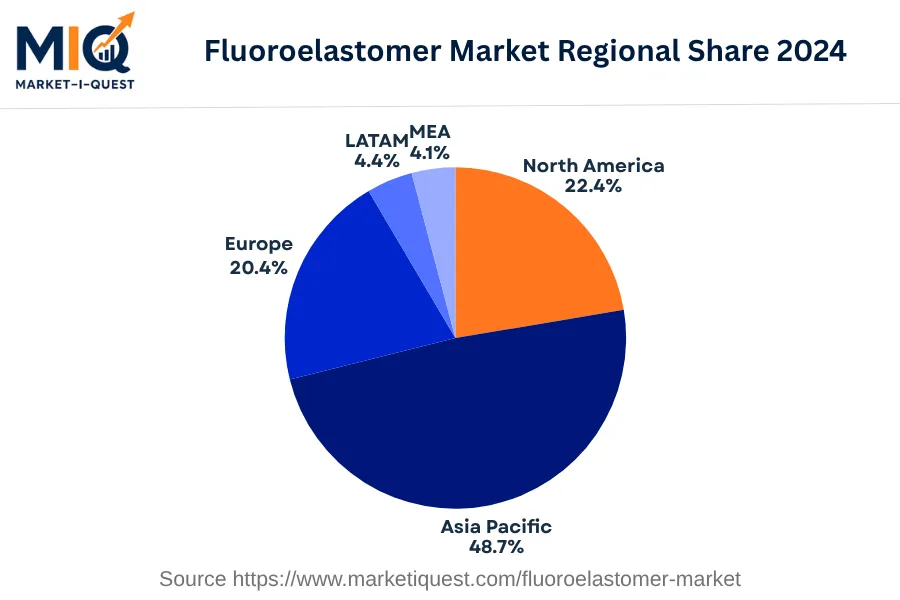
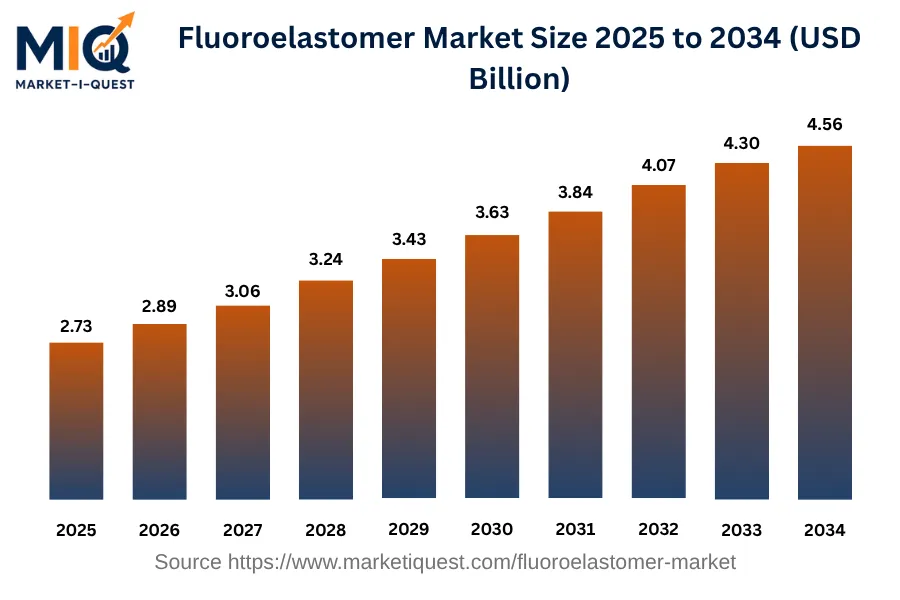
The Fluoroelastomer market size in 2025 is projected to be $2.73 billion, rising from $2.58 billion in 2024. By the end of 2034, the market is anticipated to reach $4.56 billion, given a Compound Annual Growth Rate (CAGR) of 5.85%. This reveals a consistent expansion over the 10-year period, with annual increases contributing to nearly doubling the market's total size. As seen in 2024, the share is divided among various regions: Asia Pacific leads with 48.7%, North America follows with 22.4%, and Europe represents 20.4%. Smaller shares are held by LATAM and MEA, with 4.4% and 4.1%, respectively. This geographical distribution highlights the predominance of the Asia Pacific and North America regions in the Fluoroelastomer market.

Key Takeaways

  • By Product Type - Fluorocarbon Elastomers held a significant position in the base year.
  • By Application - Seals & Gaskets led the Fluoroelastomer Market accounting for a significant share.
  • By End User - Automotive industry was the leading consumer of fluoroelastomers during the base period.
fluoroelastomer-market market size

Key Driving Factors

Increased Use in Automotive Industry for Fuel System and Sealing Applications

Fluoroelastomers are widely utilized in the automotive industry due to their superior resistance to heat, chemicals, and oil, making them ideal for applications such as fuel systems and various sealing needs. This material is central to maintaining the efficiency, safety, and longevity of vehicles, directly impacting the industry's quality standards. As automotive manufacturers continue to innovate and seek durable materials, the use of fluoroelastomers is expected to become more prevalent. Particularly, as electric and hybrid vehicle production grows, the need for fluoroelastomers in sealing high voltage and corrosive battery elements is a significant factor driving the market growth.

Stringent Emission Standards in Various Regions

In light of growing environmental concerns, many regions worldwide have implemented strict emission standards for industries, particularly those involving heavy machinery and chemical processing. Fluoroelastomers, having excellent chemical resistance properties, play a critical role in manufacturing components that help meet these emission standards. They are deployed in creating seals and gaskets, vital parts in containment and anti-leakage mechanisms, directly aiding in the reduction of harmful emissions. The need to adhere to these regulatory provisions is therefore another key factor driving the fluoroelastomer market. Demand is expected to increase as more regions potentially introduce stricter emission regulations.

Market Evolution by Timeline

2019-2023
In this time period, major Fluoroelastomer producers like Dupont and 3M expanded their production capacity. Automotive and aerospace sectors were major buyers due to Fluoroelastomers' heat resistance. The high purchase volume was typically seen in developed regions like the US and European Union, where sophisticated vehicle and aircraft manufacturing are prevalent. Pricing was largely based on long-term supply contracts, especially in the auto sector. However, production constraints arose due to the reliance on raw materials like vinylidene fluoride, which had fluctuating market prices. In response, producers explored synthetic alternatives. Regulations like EU's REACH pushed towards more eco-friendly fluoroelastomers, impacting the adoption of newer types like FEPM.
2024
This year marked a shift in demand towards the Asia-Pacific, largely driven by China's growing auto and electronics industries. Producers began integrating vertical operations to control raw material costs and secure supply. A series of partnerships emerged between major fluoroelastomer producers and local manufacturers in Asia, adopting a franchise model. However, stricter environmental regulations in China presented an operational challenge, prompting increased R&D for more eco-friendly manufacturing processes. The market instability due to trade tensions between China and the US gave rise to pricing volatility, pushing businesses towards short-term procurement contracts.
2025-2029
In these years, the fluoroelastomers' use cases expanded to cutting-edge applications like electric vehicles (EV) and renewable energy systems. Industrial standard IEEE P1547 started to recognise fluoroelastomer's temperature resilience in EV charging systems. Europe led the demand, attributing it to their aggressive renewable energy targets. High tech economies such as Japan and South Korea also increased their purchase, chiefly for their robust electronics industry. Continuous supply was ensured via capacity expansion from major producers, but raw material scarcity remained an issue. While long-term procurement was preferred, hike in raw material prices often led to contract renegotiation.
2030-2034
This period saw a rise in usage of fluoroelastomers in newer areas like offshore drilling and space exploration, following the adoption of advanced fluoroelastomer type FFKM in NASA's Mars Perseverance Rover. American and Middle Eastern buyers constituted the majority of demand due to their booming oil and gas, and space research sectors. Technological maturity in fluoroelastomer synthesis reduced reliance on raw materials, ensuring consistent supply. Production costs reduced as a result, allowing for some reduction in prices. However, uncertainty loomed due to lack of clear environmental regulations regarding synthetic fluoroelastomers, posing a potential risk to market stability.

Future Market Outlook

Future Opportunities

The fluoroelastomer market is positioned for multiple growth opportunities as global industry standards evolve. The 2021 Paris Agreement has set ambitious targets for carbon emissions, prompting industries relying on fluoroelastomers to seek sustainable alternatives. As a result, players like Solvay are developing low-temperature curing fluoroelastomers to meet stringent emissions norms while maintaining durability. In the energy sector, fluoroelastomers are increasingly utilized in critical applications such as leakage prevention in oil and gas exploration, where companies like ExxonMobil stress the importance of reliable sealing materials in harsh environments. Similarly, the 2022 International Energy Agency report underscores the need for robust materials in renewable energy technologies, with fluoroelastomers being ideal for high-performance applications in wind turbine sealing. The food and pharmaceutical industries are also exploring fluoroelastomers due to emerging regulations around food safety and hygiene, compelling manufacturers like Asahi Kasei to innovate compliant materials. Furthermore, the implementation of Industry 4.0 techniques in manufacturing processes presents opportunities to enhance the production efficiency of fluoroelastomers, allowing companies to meet rising demand while adhering to sustainability goals. Research institutions, such as the Fraunhofer Institute, are partnering with manufacturers to explore advanced fabrications that extend the lifespan and performance of fluoroelastomers, hence enabling their wider application across diverse fields.

Segmentation Analysis

By Product Type

The market is divided into subsegments including Fluorocarbon Elastomers, Fluorosilicone Elastomers (FVMQ), and Perfluoroelastomers (FFKM). Among these, Fluorocarbon Elastomers accounted for the largest revenue share while Perfluoroelastomers (FFKM) is expected to grow at the fastest CAGR during the forecast period.

Largest Revenue Share

Fluorocarbon Elastomers

Market Share Leader

With a sturdy industrial hold, Fluorocarbon Elastomers lay claim to the highest revenue share in the market. The lead in revenue primarily stems from their superior chemical and thermal resilience, which makes them ideal for a wide array of applications across industries like automotive, aerospace, and oil & gas. They are frequently used in seals and O-rings that are exposed to harsh or challenging environments, further broadening their customer base. Geographically, they perform particularly well in regions with substantial industrial progress, encompassing both developed and developing countries. Another relevant factor is the regulation and supply scenario. Fluorocarbon Elastomers are relatively easier and cheaper to produce and regulate, leading to a consistent supply chain. Their purchasing criteria rely heavily on their robust durabilities and resistance capabilities. Switching costs to alternatives are also higher owing to fewer materials matching their cost-to-performance ratio, thereby justifying their dominant position.

Fastest CAGR

Perfluoroelastomers (FFKM)

Forecast Period Growth Leader

Perfluoroelastomers (FFKM) are projected to witness the fastest growth rate in the coming years. Their growth is catalyzed by their unique characteristics such as exceptional chemical resistance and ability to withstand extreme temperature conditions. This makes them desirable in high-tech industries such as semiconductor manufacturing and aeronautics, where equipment reliability under severe circumstances is absolutely vital. FFKM products' usage in developing, newer applications like wave soldering and plasma etching also propels their advancement. The business environment's growing trend toward digitalization and technological advancements further fuels this growth. Despite the high initial cost of investment, industries are willing to adopt them due to the long-term benefits. However, procurement and productivity hurdles associated with FFKM may pose a risk in the short term. Still, the overall outlook for FFKM growth remains positive.

By Application

The market is divided into subsegments including O-Rings, Seals & Gaskets, Hoses, Complex Molding Parts, and Others. Among these, Seals & Gaskets accounted for the largest revenue share, while Complex Molding Parts is expected to grow at the fastest CAGR during the forecast period.

Largest Revenue Share

Seals & Gaskets

Market Share Leader

Seals & Gaskets occupy the largest market share due to their ubiquitous need in a range of industries, including automotive, construction, manufacturing, and electronics, to name a few. The ongoing emphasis on preventing harmful leaks and maintaining operational efficiency in these industries amplifies the demand for high-quality seals and gaskets. Furthermore, the constant need for maintenance and replacement in various equipment and machinery ensures the sustained demand for Seals & Gaskets. Despite economic downturns or market fluctuations, their demand remains relatively stable as they are essential components. This continual need and application versatility positions Seals & Gaskets as the subsegment with the largest revenue share. Regulations mandating the use and regular replacement of these parts in certain industries also bolster their market position. In conclusion, the central driving force behind their revenue lead arises from their cross-industry demand, obligatory usage, and indispensable role in operational efficiency.

Fastest CAGR

Complex Molding Parts

Forecast Period Growth Leader

The Complex Molding Parts subsegment is projected to showcase the fastest growth rate owing to continuous advancements in various end-user industries. From healthcare equipment to automotive integration, complex molding parts are gaining significant traction due to their ability to create detailed, precise, and efficient components. Their production leverages sophisticated technology, which, with rising investments in R&D, will accentuate the future growth of this segment. Furthermore, advances in material sciences and pressures to innovate in sectors such as automotive, aerospace, and medical technology are driving the demand for complex molding parts. These avant-garde parts facilitate the creation of lighter, yet stronger and more reliable components, which is a key market catalyst. Potential barriers to adoption might include initial high investment costs and a need for advanced technical knowledge. However, given their boundless potential to revolutionize product design and efficiency, Complex Molding Parts are undoubtedly set to experience the highest growth rate in the forthcoming years.

By End User

The market is divided into subsegments including Automotive, Aerospace & Defense, Chemical Processing, Semiconductor, Oil & Gas, Medical, and Others. In 2024, the Automotive segment accounted for the largest revenue share while the Semiconductor segment is expected to grow at the fastest CAGR during the forecast period.

Largest Revenue Share

Automotive

Market Share Leader

The automotive industry leads the pack in terms of revenue generation. A number of factors are at play here. To begin with, robust demand for passenger vehicles and commercial vehicles across the globe directly translates to increased revenues. Furthermore, intense competition within the sector drives continuous technological advancements and improvements in efficiency, safety features, and performance, ultimately leading to higher sales volumes. Regulation is another important driver, as policies around fuel efficiency and emission standards push automakers to develop and adopt new technologies. The role of geography should not be overlooked, either. Industry powerhouses such as China, the US and Germany continue to be major consumers. Lastly, the purchasing decisions in the automotive sector are increasingly driven by factors like brand value, design, and technological integration, each of which lends itself to higher pricing, and hence, higher revenues for the companies involved.

Fastest CAGR

Semiconductor

Forecast Period Growth Leader

The semiconductor segment is anticipated to be the fastest growing market subsegment over the forecast period. Multiple catalysts will contribute to this growth. Technological innovation underpins the semiconductor sector, with constant efforts towards miniaturization and optimization leading to new product ranges and, consequently, market expansion. Capital expenditure is another key factor: as businesses and governments strive to improve productivity and operational efficiency, expenditure on semiconductors will continue to rise. Barriers to adoption such as costs and compatibility issues are gradually eroding with standardization and economies of scale. Partnerships and collaborations will also help driving the growth by sharing knowledge, technology, and resources. However, near-term risks like fluctuations in demand, raw material prices and geopolitical tensions may act as a dampener to growth.

Competitive Analysis: Fluoroelastomer Market

Key Market Players

Manufacturers / OEMs

DowDupont Inc.
US
Solvay SA
Belgium
Asahi Glass Co.
Japan

Key Suppliers & Raw Materials

Guangzhou OTT New Materials Co., Ltd.
China
Arkema S.A.
France
Shin-Etsu Chemical Co., Ltd.
Japan

Distributors, Integrators & Channel Partners

3M Company
US
Avantor Performance Materials, Inc.
US
Brenntag North America, Inc.
US

Porter’s Five Forces Analysis

This analysis gauges the competitive dynamics and attractiveness of the Fluoroelastomer market.

Supplier Bargaining Power

Medium

Limited number of raw material suppliers, causing moderate dependency.

Buyer Bargaining Power

High

Buyers enjoy high power due to the variety of suppliers and comparable products.

Threat of Substitutes

Low

Scarcity of strong alternatives in the market strengthens Fluoroelastomer demand.

Threat of New Entrants

Low

The high capital investment and technical expertise required discourage market entry.

Competitive Rivalry

High

Intense competition driven by high level of industry concentration and similar product offerings.

Regional Analysis

Geographic market dynamics and growth opportunities across key regions

Global Market Outlook

fluoroelastomer-market market regional share

North America

The North American fluoroelastomer market in 2024 was positioned within a versatile and high-performance elastomer space, piggybacking on a range of industries from automotive to aerospace. Primary drivers included stringent regulations regarding emission reduction fueling demand from automakers, with improved fuel efficiency and durability offered by fluoroelastomer tubing. Investment in advanced materials across healthcare and utilities also spurred growth. In the US and Canada, increasing adoption of fluoroelastomer seals in the oil and gas industry, due to superior heat and chemical resistance, provided a decisive push. Conversely, supply dynamics were pressured by the volatile price of key inputs, particularly VF2 and HFP monomers.

Trends in 2024 centered around shifts in buyer behavior towards value-added, sustainable elastomer solutions, often leveraging partnerships, M&A, and product innovations. In automotive and industrial sectors, customers increasingly preferred fluoroelastomer over other materials because of longevity and performance under harsh conditions. High-end consumer electronics manufacturers, particularly in the US, turned to fluoroelastomers for enhanced protection. Lastly, regulatory compliance was crucial; stringent enforcement of emission standards across North America prompted wider adoption of fluoroelastomers by enterprise customers in manufacturing and transportation.

Asia Pacific

In the base year 2024, the Fluoroelastomer Market in the Asia Pacific region was a dynamic melding of demand surges and technological enhancement. Key contributors to market expansion included the growing demand for sealing solutions in the automotive, aerospace, and oil & gas industries, such as China's booming automotive sector. Rapid industrialization in India and ASEAN countries also led to increased consumption of fluoroelastomers. The market saw a surge after positive enforcement of stringent environmental regulations in Japan and South Korea in relation to emissions, stimulating demand for fluoroelastomers renowned for their thermal and chemical resistance.

Trends in 2024 pivoted around product innovation and application diversification. There was a clear shift towards green manufacturing using fluoroelastomers in China and Australia due to their energy efficiency potential. Additionally, partnerships and acquisitions were common as enterprises aimed to increase production capacity to meet the demand surge in the automotive and manufacturing sectors. In terms of buyer behaviour, industries such as utilities and oil & gas switched preference from traditional elastomers to fluoroelastomers to prolong machine lifespan. Lastly, technologies like digitalization and automation intersected with this market as manufacturers deployed these techniques to optimize production, promising a rapid response to customer requirements in countries like Japan, India, and key ASEAN markets.

Europe

In 2024, the Fluoroelastomer Market in Europe had shown significant activity across multiple sectors. Drivers included stringent European environmental regulations that prompted adoption of Fluoroelastomers in pollution control and emissions reduction systems. Investments in aerospace and automotive industries were high, with companies sourcing Fluoroelastomers for fuel systems and seals due to their resistance against harsh chemicals and extreme temperatures. Commendably, new production technology adoptions lowered manufacturing costs, fostering supply dynamics favourable to the market. Market trends revealed an increase in Fluoroelastomer use in healthcare sector, particularly in manufacturing surgical tools and medical devices, due to their biocompatible properties. In manufacturing, there was a shift towards Fluoroelastomer seals to increase the lifespan of machinery, reducing operation costs.

The UK and Germany saw significant M&A activity, with multinational companies acquiring several local Fluoroelastomer manufacturers, enhancing their market position. Additionally, stricter enforcement of ISO standards for Fluoroelastomer-based products boosted customer confidence and product quality. In the automotive sector, especially in France, Italy and Spain, the requirement for Fluoroelastomer parts in electric vehicles was more pronounced. This was driven by policy changes towards greener transport alternatives. In Benelux and Central & Eastern Europe, the utilities sector engaged Fluoroelastomers for gaskets and seals in water and power infrastructure, due to their superior resistance against challenging environments.

Latin America

In 2024, the Latin American (LATAM) Fluoroelastomer Market experienced notable expansion driven by escalating industrialization and regulatory adjustments. Dramatic gains were seen in Brazil and Mexico, primarily due to increasing demand from diverse manufacturing sectors that leverage these materials for their chemical resistance traits, including automotive, aerospace, and oil & gas industries. Argentina and Chile also saw investments rise as local governments actively pursued policies to attract further industrialization. Technological adoption of fluoroelastomers, especially in Peru, demonstrated significant growth due to improved supply dynamics and competitive pricing.

Trends in 2024 indicated the LATAM Fluoroelastomer Market's propensity for change. Increased buyer preference for high-quality, durable products positively impacted the market, particularly in Colombia, where robust demand was observed from the manufacturing and healthcare sectors. Larger entities have sought to integrate more fluoroelastomers into their operations to comply with stricter environmental and durability standards. Channel dynamics also experienced alterations, with a surge in online purchases. Partnership and M&A activities intensified, most notably in Brazil and Mexico, as companies pursued market-share consolidation. The enforcement of new industrial norms and standards streamlined and facilitated the fluoroelastomer supply chain in the LATAM region, enhancing product use and functionality.

Middle East & Africa

In 2024, the Fluoroelastomer Market in the Middle East and Africa (MEA) observed an increased demand mainly driven by a robust oil and gas sector, appreciable investment in technology adoption, and favorable regulations. In Saudi Arabia, United Arab Emirates, and Qatar, the thriving oil and gas industry significantly spurred the demand for fluoroelastomers that are used widely in sealing applications due to high chemical resistance. The tightened environmental regulations in countries like Kenya and Nigeria also stimulated the market as fluoroelastomers serve in the reduction of emissions in automotive applications. Egypt saw increased investment in advanced manufacturing processes and technology adoption, further propelling the market growth.

Regarding trends, a shift towards the use of fluoroelastomers in the healthcare sector was noted in South Africa and Israel, due to their unique properties enabling high-performance medical applications. Regulatory enforcement in the form of safety and quality standards in countries like the UAE and Saudi Arabia led to the increased adoption of fluoroelastomers in manufacturing and utilities. In addition, the MEA region, particularly Qatar and Egypt, witnessed strategic partnerships and M&A activity aimed at market expansion and product diversification. Demand in the telecom sector was boosted by a shift towards the application of fluoroelastomers in fiber-optic cables.

Recent Industry Developments

Latest market innovations, product launches, and strategic initiatives

July 2026

Swiss private equity firm Capmont acquired Dyneon, the Bavarian fluoropolymer subsidiary of 3M Group. Dyneon operates a plant at Gendorf Chemical Park with approximately 400 employees and annual production capacity of 18,000 tonnes. The company specializes in PTFE, FKM, and FFKM fluoroelastomers for semiconductors, medical technologies, EV batteries, aerospace, and energy applications. Capmont committed to keeping the Gendorf site operational and targeting revenues of over €300 million.

March 2025

Syensqo launched the Tecnoflon® FFKM NFS series, the industry's first commercial perfluoroelastomers made without fluorosurfactants. The initial grades include Tecnoflon® PFR 6055B for semiconductor dry applications and PFR 6265B for direct plasma applications. The company also announced plans to launch NFS grades with certified circular content via mass balance.

Frequently Asked Questions