
Fluid Dispensing Systems Market Snapshot

Key Players

  • Graco Inc. (US)
  • Nordson Corporation (US)
  • Atlas Copco AB (Sweden)
  • Becton Dickinson and Company (US)
  • Techcon Systems Inc. (US)
  • Hernon Manufacturing Inc. (US)
  • Henkel AG & Co. KGaA (Germany)
  • Fisnar Inc. (US)
  • Jensen Global Inc. (US)
  • Musashi Engineering Inc. (Japan)

Market Size

Base Year 2024
$14.96 Bn
CAGR
6.91%
Forecast 2034
$29.18 Bn

Market Segments

By Dispenser Technology
Time/Pressure Dispensing, Positive Displacement Dispensing, Jet Dispensing, Drop-on-Demand Dispensing, Micro-Metering Dispensing
By Fluid Type
Epoxies, Silicones, Polyurethanes, Acrylates, Anaerobics, Hot Melts
By Operation Mode
Manual, Semi-Automatic, Fully Automatic
By Application
Electronics Assembly, Medical Device Manufacturing, Automotive Assembly, Aerospace & Defense, Consumer Products, Others

Market Dynamics

Drivers
  • Increasing automation in industries
  • Advancements in dispensing technology
Restraints
  • High equipment costs
  • Technological complexities
Opportunities
  • Rising demand in automation processes
  • Increasing adhesive applications in various industries

Market Size

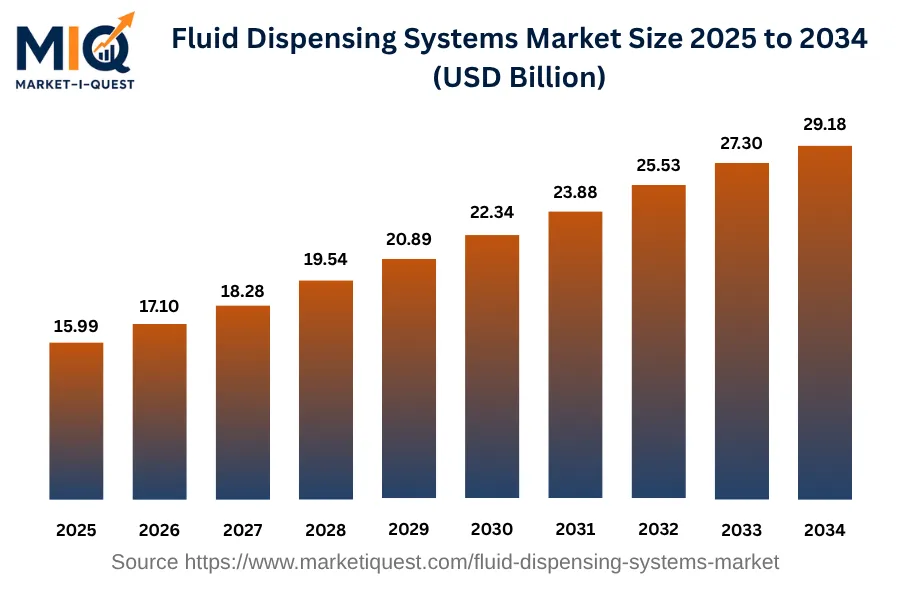
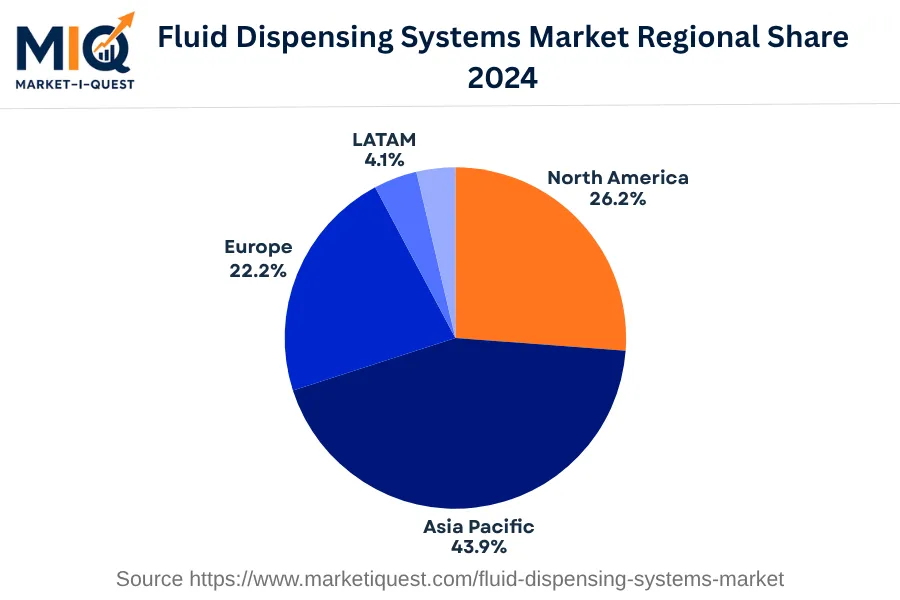
The Fluid Dispensing Systems Market was worth $14.96 billion in 2024 and increased to $15.99 billion in 2025. By the end of 2034, it is projected to expand to approximately $29.18 billion, representing a compound annual growth rate (CAGR) of 6.91%. The rise in the market size over this period may be linked to factors inherent to the information provided regarding the market. In terms of regional share during the start year in 2024, the Asia Pacific region led the market with 43.86%, closely followed by North America with a share of 26.18%, then Europe with 22.17%. The regions with the least shares were Latin America and the Middle East and Africa with 4.12% and 3.67% respectively.

Key Takeaways

  • By Dispenser Technology - Positive Displacement Dispensing led the Fluid Dispensing Systems Market.
  • By Fluid Type - Silicone based dispensing systems held a dominating position in 2024.
  • By Operation Mode - Fully Automatic systems led the market accounting for a predominant share in 2024.
  • By Application - Automotive Assembly expanded in this forecast period accounting for a considerable share.
fluid-dispensing-systems-market market size

Key Driving Factors

Automation in Manufacturing Industries

Manufacturing industries, particularly in areas such as electronics and automotive manufacturing, are increasingly turning to automated processes to improve efficiency and productivity. This trend is driving the demand for fluid dispensing systems, which are essential components of many automated manufacturing processes. These systems allow for precise and consistent application of fluids such as adhesives, coatings, and sealants, eliminating manual inconsistencies and reducing waste. Furthermore, these automated systems can be programmed to work round-the-clock, boosting overall factory output. Even though initial setup costs can be high, the long-term cost savings and returns from heightened productivity create a positive business case for incorporating fluid dispensing systems into manufacturing plants.
Stringent Quality Control & Compliance Regulations

In various sectors, especially the pharmaceutical and food & beverage industries, strict regulatory requirements demand high levels of precision and consistency in product manufacturing. These regulations, combined with consumer expectations for quality and consistency, necessitate the use of fluid dispensing systems. These systems provide a high level of accuracy in dispensing the exact required quantities of fluids, consequently ensuring compliance with regulations and maintaining product quality. For instance, in pharmaceutical production, even minor variations in drug dosage can have major implications - fluid dispensing systems can precisely apply doses, ensuring adherence to quality standards and regulations. Thus, the need for strict quality control and regulatory compliance propels the adoption of fluid dispensing systems.

Market Evolution by Timeline

2019-2023
In these years, manufacturers from chemical, automotive, and electrical industries were the primary buyers of fluid dispensing systems. In terms of geographical distribution, Asia-Pacific markets, particularly China and India, showed increased purchases. The shift towards automated precision dispensing systems was evident, yet integration maturity with other manufacturing processes remained moderate. Regulatory influence was seen chiefly through the ERSA, which ensured standards in soldering systems. Pricing leaned towards a cost-per-unit model favoured by high-volume industries. Some challenges included a limited pool of skilled operators and technicians, addressed by investments in workforce training.
2024
The adoption curve of fluid dispensing systems showed an uptake by smaller scale operations in food processing and pharmaceuticals. European Union's efforts for standardising operational measures, particularly productivity and safety standards, affected the supply dynamics. On the technology front, while desktop dispensing systems saw more customisable features and programmability, technologically advanced 4-axis & 5-axis dispensing systems were procured by major players fighting for a competitive edge. One major risk observed was the curve of learning and integrating with these technologically advanced dispensing systems.
2025-2029
Demand for fluid dispensing systems was noticeably driven by startups in biotechnology and 3D printing. In terms of technology, we observed increased adaptation of micro-dispensing systems providing more detailed and efficient operations. Across the board, integration maturity improved thanks to wider awareness and training programs. Policy influence was majorly driven by the requirement standards espoused by both FDA and ISO for industries involved in life sciences. Partnerships between producers and tech companies to develop advanced sensor system became prominent, while pricing became more flexible with various leasing options being introduced.
2030-2034
Emerging economies further escalated the demand during this period, with industries focusing on efficient production techniques. The technology saw significant advancements, notably the development and adoption of AI-managed systems, which enabled better alignment with existing production units. The core supply constraint was the availability of advanced components to produce these AI-managed systems. Regulatory bodies like ASTM International developed new norms keeping the AI-managed systems in fetch. Long-term usage contracts, service included, gained traction. Companies faced challenge to train personnel for managing and maintaining the AI-managed fluid dispensing systems.

Future Market Outlook

Future Opportunities

The current developments in regulations and standards present substantial growth avenues in the fluid dispensing systems market. For instance, the 2024 update of the ISO 10993 standard on biocompatibility will influence manufacturers to innovate and adapt their dispensing technologies for medical applications. This adaptation process will likely stimulate investments in R&D by companies like EFD, as they develop systems capable of handling new materials targeted at the healthcare sector. The increasing demand for precision-engineered products in industries such as aerospace and electronics further compels manufacturers to enhance their fluid dispensing capabilities. The introduction of the ASTM F3125 standard in 2023 for fluid delivery in aerospace applications emphasizes the need for improved reliability and accuracy. Furthermore, the push for automation within factories globally presents opportunities for partnerships between fluid dispensing technology providers and robotics manufacturers. For instance, in 2023, a partnership was formed between Dispensing Solutions and Universal Robots to integrate collaborative robots with dispensing technology for small-batch production lines. Additionally, sustainability initiatives worldwide will drive demand for more environmentally friendly fluid dispensing methods, with a focus on reducing waste and improving energy efficiency in production processes. This convergence of regulatory, technological, and market factors is expected to foster innovation and collaborative ventures that can redefine the future landscape of fluid dispensing solutions across multiple industries.

Segmentation Analysis

By Dispenser Technology

The market is divided into subsegments including Time/Pressure Dispensing, Positive Displacement Dispensing, Jet Dispensing, Drop-on-Demand Dispensing, and Micro-Metering Dispensing. Positive Displacement Dispensing accounted for the largest revenue share while Jet Dispensing is expected to grow at the fastest CAGR during the forecast period.

Largest Revenue Share

Positive Displacement Dispensing

Market Share Leader

Positive Displacement Dispensing occupies the largest revenue share amongst the other subsegments. This may be attributed to its wide-ranging functionality in diverse applications across the industry. It can consistently deposit a precise, repeatable amount of material independent of viscosity changes in the material over time, providing superior fluid control. Due to this characteristic, it is frequently chosen for critical applications such as sealing, coating, and potting operations. The surge in manufacturing activities due to the recovering economy is anticipated to drive the demand for this dispenser technology. The robust regulatory framework favoring precision, effectiveness, and safety in the manufacturing sector further bolsters the market for this subsegment. The avenue for this technique through direct distribution channel enhances the purchasing process, augmenting its revenue generation. Industries have high switching cost attached to change in dispensing technology which further helps in maintaining its market position.

Fastest CAGR

Jet Dispensing

Forecast Period Growth Leader

Jet Dispensing technology is projected to exhibit the fastest growth in the forecast period. Primarily, this is due to technological advancements leading to enhanced efficiency and effectiveness. These systems introduce automation and reduce human involvement, reducing errors and increasing throughput. However, the adoption of jet dispensing technology may face barriers due to high initial investment. Collaborations and partnerships with tech firms can further expedite its market penetration and adoption. Potential risks may be associated with apprehension around the transition to new technology and its corresponding teething problems. However, as these systems offer long-term benefits in terms of optimizing production, reduction in wastage, and increased speed, they are expected to overthrow these initial hiccups and witness significant growth in the near future. The growing emphasis on precision and quality assurance in manufacturing operations will act as a catalyst to this upward trend.

By Fluid Type

The market is divided into subsegments including Epoxies, Silicones, Polyurethanes, Acrylates, Anaerobics, and Hot Melts. In the base year of 2024, Silicones accounted for the largest revenue share while Epoxies is expected to grow at the fastest CAGR during the forecast period.

Largest Revenue Share

Silicones

Market Share Leader

Silicones dominated the market in 2024 due to their superior properties and wide-ranging applications. These materials exhibit excellent characteristics such as high thermal stability, resistance to weathering, and electrical properties, making them an ideal choice for various industries. The key drivers of silicone demand include the booming electronics sector, automotive industry, and construction sector. In the electronics industry, silicones are used in a plethora of applications such as encapsulants, sealants, thermal interface materials and others. The continuous innovation in electronics and the growing miniaturization trend have resulted in a surge in silicone demand. The automotive industry is also driving demand, as silicones play a crucial role in enhancing fuel efficiency and reducing emissions through lightweighting and heat resistance. The burgeoning construction industry, where silicones are used as sealants and adhesives, is also a significant contributor to the silicone segment's revenue. Increasing urbanization and infrastructural development, particularly in the emerging economies, have fuelled silicone demand.

Fastest CAGR

Epoxies

Forecast Period Growth Leader

Among the fluid types, the Epoxies segment is forecasted to grow at the fastest rate. This growth is fuelled by several factors including excellent mechanical strength, high heat resistance, and outstanding adhesion to a variety of substrates. Epoxies are increasingly adopted in numerous industries due to their versatile nature. The automotive industry, for example, is rapidly incorporating epoxy-based adhesives to replace traditional joining methods, such as welding, due to their superior bonding capabilities and weight reduction benefits. In the electronics industry, epoxies are used for encapsulating and potting applications to protect delicate components from environmental hazards. Astronomical growth in renewable energy, particularly wind energy, is also a significant driver. Here, epoxies are used in blade manufacture for their strength and durability. Barriers to adoption, such as the relatively higher cost of epoxies and the need for curing equipment, are gradually being overcome as industries recognize the long-term benefits of these materials. However, any disruption in the supply chain or sudden regulatory changes poses near-term risks to this growth.

By Operation Mode

The market is divided into subsegments including Manual, Semi-Automatic, and Fully Automatic operation modes. The Fully Automatic subsegment accounted for the largest revenue share while the Semi-Automatic segment is expected to grow at the fastest CAGR during the forecast period.

Largest Revenue Share

Fully Automatic

Market Share Leader

The fully automatic operation mode captures the lion's share of the market revenue in the base year 2024. It is behind this pole position because the market greatly values the efficiency, consistency, and reduced labor needs that fully automatic systems provide. Keeping in mind the global trend towards digitization and automation, many industries are making the switch to fully automated systems to boost their output and reduce operational costs. This trend has led to increased customer demand, especially within the geographies where higher labor costs drive companies to look for automated solutions. Additionally, regulatory measures favoring automation and industrial safety have also contributed to the subsegment's revenue superiority. As for purchasing criteria, customers favor equipment offering better productivity, cost-effectiveness, and less scope for human error - traits that make the fully automatic subsegment an obvious choice.

Fastest CAGR

Semi-Automatic

Forecast Period Growth Leader

Although the semi-automatic subsegment does not command the largest revenue as of now, it is predicted to be the fastest growing in the near term. It appeals to businesses looking to strike a balance between cost, control, and automation. The primary growth drivers for this segment include the need for increased productivity combined with the opportunity for workers to intervene when necessary. Semi-automatic systems help reduce potential issues related to fully automated systems, such as ineffective handling of unexpected events. Moreover, these semi-automatic systems are seeing rapid adoption due to easing of barriers like high initial capital expenditure and resistance to change. Technological advancements and innovative financing options such as leasing models are making it accessible to start-ups and SMEs. However, near-term risks include potential resistance from employees due to fears of job displacement and the need for training to handle these new systems.

By Application

The market is divided into subsegments including Electronics Assembly, Medical Device Manufacturing, Automotive Assembly, Aerospace & Defense, Consumer Products, and Others. In 2024, the Automotive Assembly subsegment accounted for the largest revenue share, while the Medical Device Manufacturing is expected to grow at the fastest CAGR during the forecast period.

Largest Revenue Share

Automotive Assembly

Market Share Leader

The Automotive Assembly segment generated the highest revenue in 2024. This dominance can be credited to the continuous rise in the global demand for automobiles, driven by the increasing urbanization and middle-class population in emerging economies. Also, advances in vehicle manufacturing technologies that demand sophisticated assembly lines further contribute to this segment's strong revenue. The automotive assembly sector is typically tied up with rich supply chains, which, coupled with high switching costs, bolsters this segment. Another important driver is the industry regulations which have made it mandatory for automakers to adhere to stringent production, safety and emission standards, leading them to heavily invest in their assembly practices. In terms of geography, Asia Pacific, a region with a massive automotive manufacturing base, significantly contributed to this segment's revenue.

Fastest CAGR

Medical Device Manufacturing

Forecast Period Growth Leader

On the other hand, Medical Device Manufacturing is projected to register the fastest CAGR. Several drivers are associated with this growth. First, health consciousness among the global populace is rising, along with the aging population in developed and developing countries. This has driven demand for medical devices, hence their manufacturing. Furthermore, technological advancements are catalyzing the adoption of more advanced medical devices. Policy regulations also serve as growth catalysts, necessitating the recurrent manufacturing of certified and compliant devices. However, high capital expenditures and the need for partnerships for research and development of new devices can pose as barriers. Additionally, evolving regulatory frameworks and ongoing healthcare reforms could be potential near-term risks to the pace of this segment's growth.

Competitive Analysis

Key Market Players

Manufacturers / OEMs

Nordson Corporation
US
Graco Inc.
US
Atlas Copco AB
Sweden

Key Suppliers & Raw Materials

Dymax Corporation
US
ViscoTec GmbH
Germany
Fisnar Inc.
US

Distributors, Integrators & Channel Partners

Techcon
US
GPD Global
US
Rotary Systems, Inc.
US

Porter’s Five Forces Analysis

An analysis of the competitive environment in the Fluid Dispensing Systems Market using Porter’s Five Forces methodology.

Supplier Bargaining Power

Medium

Few suppliers exist, but OEMs can choose from multiple hardware and software components.

Buyer Bargaining Power

High

Many alternatives exist, and switch costs are relatively low due to standardization.

Threat of Substitutes

High

Viable substitutes exist in the form of manual dispensing methods and traditional pipetting systems.

Threat of New Entrants

Medium

Capital requirements and technological expertise pose significant barriers to entry.

Competitive Rivalry

High

Numerous established competitors exist, leading to high competitive intensity.

Regional Analysis

Geographic market dynamics and growth opportunities across key regions

Global Market Outlook

fluid-dispensing-systems-market market regional share

North America

In 2024, the North American market for Fluid Dispensing Systems underwent considerable growth due to pivotal industry drivers and trends. Significant investment in automation across sectors like manufacturing, automotive, and electronics positively contributed to the uptake of fluid dispensing technologies. Mandated precision and quality standards, especially within the health care and pharmaceutical industries, created a high demand for these systems. Moreover, technological advancements in AI and IoT saw an increased adoption of smart, programmable dispensing units. Tangible shifts were visible in buying behaviors as businesses prioritized systems with multi-functionality features and energy-saving designs. There was a marked preference for manufacturers offering comprehensive aftersales services, due to the complexity of fluid dispensing systems; this also impacts the channel dynamics.

The increased emphasis on sustainability and environmental regulations catalyzed a move toward systems with fewer VOC emissions. Product-wise, the popularity grew significantly for non-contact dispensing structures in several sectors, including electronics and automotive. In terms of policy enforcement, the US Environmental Protection Agency’s guidelines regarding VOC emissions emerged as a standard setter, while in Canada, provincial regulations induced demand for energy-efficient fluid dispensing systems. In Mexico, heightened industrial expansion drove demand in the fluid dispensing systems market within manufacturing and automotive industries. These factors indicated the regional markets' strength in 2024 and underscored the broader industry's rapid transformation.

Asia Pacific

In 2024, the Fluid Dispensing Systems (FDS) market in the Asia Pacific displayed notable vibrancy primarily fuelled by increased adoption in regional industries. Driving the market, China's advance in semiconductors necessitated high-precision FDS, spurring demand. India's pharmaceutical sector, under the 'Make in India' initiative, also heightened the uptake of FDS for accurate dispensing needs. Additionally, government investments across the region in infrastructure, particularly South Korea's focus on renewable energy plants, amplified the market propulsion. Trending in the market was the widespread adoption of automated FDS in Japan's automotive and electronics sectors to enhance productivity and precision. In parallel, China witnessed a surge in demand for non-contact FDS amidst its restructuring semiconductor industry.

The ASEAN market grappled with a shift towards more environmentally friendly FDS under local sustainability regulations. Meanwhile, multiple partnerships flourished, notably between Australia's manufacturing sectors and system providers to streamline industrial processes. In a nutshell, the Asia Pacific FDS market in 2024 was stirred by government initiatives, industry-specific demand, and increased investment. Trends were characterized by shifts towards automation, environmentally conscious choices, and increased collaborations. Industries like pharmaceuticals, semiconductors, automobile, energy, and manufacturing stood as significant customers of the FDS market.

Europe

In 2024, the Fluid Dispensing Systems Market in Europe experienced significant growth due to various drivers and trends. Increasing demand for precision dispensing in industries such as automotive, electronics, and pharmaceuticals contributed to market expansion. Regulations mandating accurate dosage in pharmaceutical and chemical industries propelled the adoption of these systems. Significant investment in automation by manufacturing industries, particularly in Germany and the United Kingdom, spurred technological adoption. Resource constraint in terms of skilled labor in Spain and Central and Eastern Europe further boosted the preference for automated fluid dispensing systems.

Concerning trends, a clear shift was observable towards smart fluid dispensing systems capable of precise volume control and error detection. Customer preference leaned heavily towards programmable, efficient, and low-maintenance systems. Channel-wise, the demand for online purchasing escalated, fueled by the convenience factor and the pandemic-induced lockdowns. In terms of partnerships and M&A, companies sought to strengthen their market position through strategic alignments, notably evident in the Benelux region and Italy. Compliance with safety and environmental standards also influenced the market dynamics, particularly in highly regulated sectors like healthcare and utilities.

Latin America

In 2024, the Fluid Dispensing Systems Market in Latin America experienced substantial growth due to increased investment, demand, and technology adoption, particularly in Brazil, Mexico, Argentina, Colombia, Chile, and Peru. Demand was bolstered primarily by the manufacturing sector, where a greater focus on precision manufacturing necessitated the use of effective fluid dispensing systems. Additionally, stricter regulations on product quality and efficiency across multiple sectors promoted the use of technologically advanced dispensing systems. Simultaneously, key market drivers included increased foreign investment in Latin America's manufacturing industries, and new government policies favoring the domestic production of electronics and automobiles.

The latter significantly increased the adoption of advanced dispensing systems, mainly in Mexico and Brazil. Market performance in this base year also saw the escalation of innovative, digitally controlled fluid dispensing solutions. Market trends in 2024 highlighted a shift towards more energy-efficient dispensing systems driven by the region's focus on sustainable industrial practices. Moreover, a rising preference for locally produced goods influenced the increased adoption of fluid dispensing systems in sectors such as retail, electronics, and healthcare. Mergers and acquisitions, particularly in the healthcare sector of Brazil and Chile, also characterized the market dynamics of the period, as companies endeavored to broaden their reach, optimize productivity, and improve the precision of fluid application tasks.

Middle East & Africa

In 2024, the Fluid Dispensing Systems Market in the Middle East and Africa experienced significant activity due to various driving factors and trends. Heightened manufacturing activities across sectors such as oil and gas, telecom, and healthcare were key demand drivers. Regulatory incentives in countries like Saudi Arabia and the United Arab Emirates, designed to bolster domestic manufacturing capabilities, were a notable stimulator for market growth. Additionally, substantial investment in technological adoption in countries such as Israel, aimed at increasing manufacturing efficiency, also amplified the demand for fluid dispensing systems.

Consequently, a shift in buyer behavior was noticeable, with many opting for more advanced, automated fluid dispensing systems over traditional, manual ones. Particularly in Egypt and South Africa's manufacturing sectors, an emphasis on precision and reduced waste promoted this trend. Another significant trend observed was the increase in partnerships and M&A activities, specifically involving local and international players in the fluid dispensing industry in Nigeria and Kenya. Companies sought to leverage each other's strengths and expand their market penetration. Strict enforcement of standards to ensure quality and consistency in fluid dispensing also became a vital aspect across sectors in the region. This market environment promoted growth and technological advancement in the fluid dispensing systems market in the Middle East and Africa during the base year.

Recent Industry Developments

Latest market innovations, product launches, and strategic initiatives

June 2026

Carlisle Companies announced the acquisition of Ecco Finishing, a manufacturer of low and high pressure painting equipment and sealing applicators based in Skara, Sweden. Ecco Finishing became part of the Carlisle Fluid Technologies (CFT) operating segment.

March 2024

Nordson Corporation introduced two innovative automated fluid dispensing systems: the GVPlus and PROX. These systems enhance motion control, simplify setup, and include advanced vision capabilities, with a precision repeatability of 8 micrometers and a payload capacity of up to 4.5 kilograms.

Frequently Asked Questions