
Floating Solar Panels Market Snapshot

Key Players

  • Ciel & Terre International (France)
  • KYOCERA Corporation (Japan)
  • Yingli Solar (China)
  • Sharp Corporation (Japan)
  • Trina Solar (China)
  • Canadian Solar Inc. (Canada)
  • Solaris Float (Portugal)
  • Novaton AG (Switzerland)

Market Size

Base Year 2024
$0.764 Bn
CAGR
23.85%
Forecast 2034
$6.49 Bn

Market Segments

By Product
  • Stationary Floating Solar Panels
  • Tracking Floating Solar Panels
By Location
  • Onshore
  • Offshore

Market Dynamics

Drivers
  • Increasing demand for clean energy
  • Space optimization on water bodies
Restraints
  • High installation cost
  • Limited industrial applications
Opportunities
  • Untapped offshore potential
  • Emerging renewable energy demands

Market Size

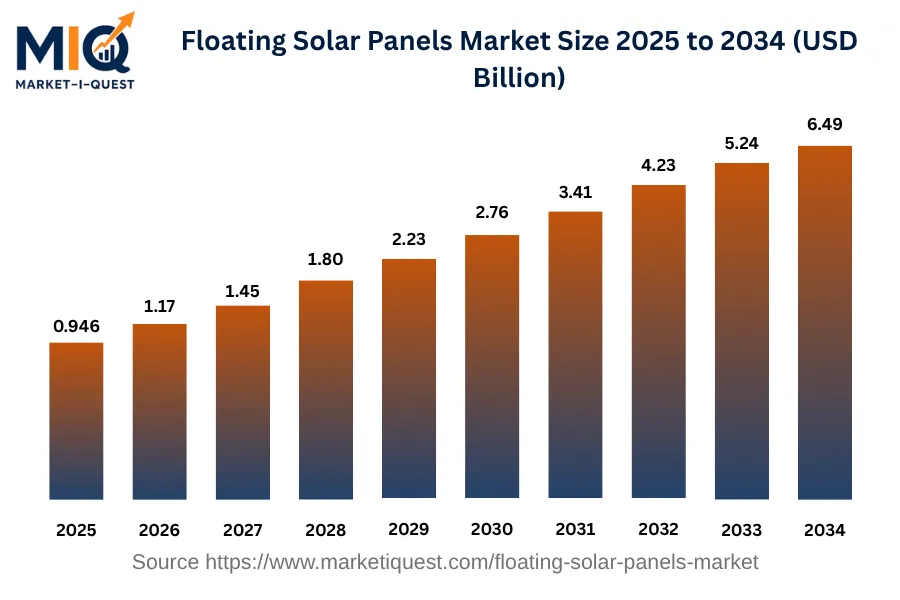
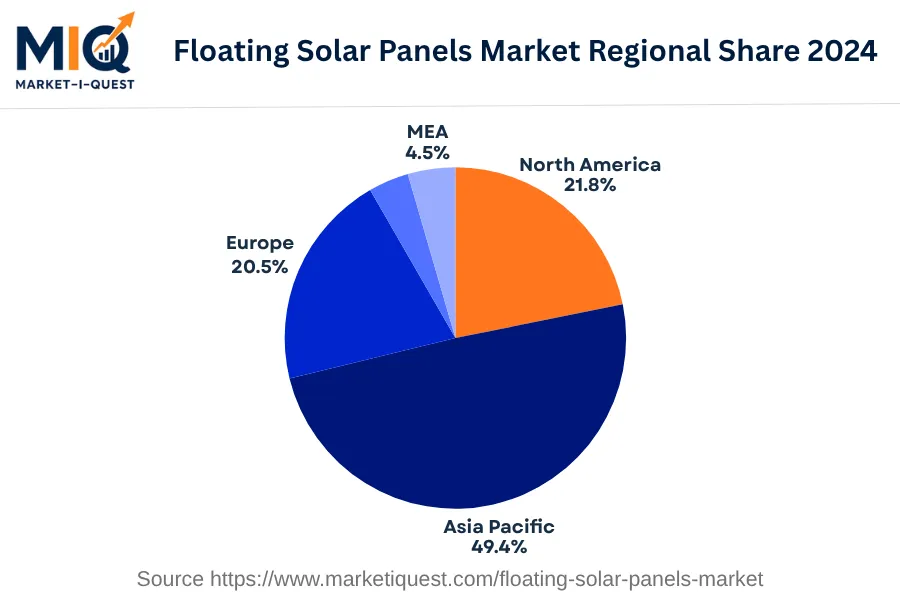
The Floating Solar Panels Market was worth USD 0.95 billion in 2025 and is set to expand to USD 6.49 billion by 2034, with a CAGR of 23.85%. This is due to the ongoing scaling up and successful deployment of these panels at multiple new locations. There is also uptick in their manufacturing rate. Moreover, investments in this subset of the renewable energy sector have seen a rise. On the regional front in 2024, the market share divided between North America, Asia Pacific, Europe, LATAM, and MEA was 21.84%, 49.36%, 20.48%, 3.82%, and 4.5% respectively.

Key Takeaways

  • By Product - Stationary Floating Solar Panels held the highest market share in 2024.
  • By Location - Onshore led the Floating Solar Panels Market accounting for a significant share in 2024.
floating-solar-panels-market market size

Key Driving Factors

Stringent Environmental Regulations

Countries across the world have been introducing rigorous environmental regulations to combat climate change. For instance, the Paris Agreement committed its 196 member countries to lower their greenhouse gas emissions. The rules for energy are strict now. So companies have to use renewable sources, like solar and wind power. These new rules are forcing energy companies to use sources. Floating solar panels have emerged as a viable solution, especially in regions with limited land availability or high land cost. Unlike conventional land-based solar farms, these floating structures can be installed on bodies of water such as reservoirs, lakes, or dams. Power companies are using this tech to follow the rules in their country and reduce their carbon footprint. Companies trying to meet the regulations set by government. This forces them to reduce their impact, on the environment. Carbon footprint is a still challenge for Power companies and they are trying to minimize it.
Water Conservation and Algal Bloom Prevention

In regions impacted by water shortage, conserving water is crucial. Floating solar panels are supporting with this project by stopping heavy water from evaporating from reservoirs. This is because the floating solar panels cover a part of the water. The floating solar panels also prevent algae from growing in the water by blocking the sunlight that the algae need to grow. The floating solar panels are very good, at stopping the algae from growing as they block the sunlight that the algae need to multiply. Utility companies and municipalities are inclined toward this dual benefit of floating solar panels - generation of renewable energy and protection of water resources. The combination bolsters the market. Floating solar panels are preferred choice over traditional land-based solar power installations in suitable areas.

Market Evolution by Timeline

2019-2023
During these years, buyers majorly included utility companies and corporations with extensive water bodies in Asia and Europe, hoping to leverage their assets for solar power generation. Alongside, pilot projects of floating solar panels were implemented on a large scale in industrial reservoirs and water treatment plants. There are still challenges with technology in where weather is not suitable. The International Electrotechnical Commission made some rules for floating PV systems, which are called IEC TS 62996. These rules were supreme for the floating PV system market as this rules support the floating PV system market and control it. A popular commercial practice involved turnkey contract models with fixed or power purchase agreement (PPA) pricing. The risk of waterborne damage and environmental impacts on aquatic life were key concerns.
2024
In 2024, surge in adoption was observed in North America following the success of similar programs in Asia and Europe. High-performance panels that could withstand harsh climates were introduced. Mitsubishi Corporation started a solar plant in Japan. It is a floating plant with 20 megawatt power and The company used advance technology for it. This year strict rules for the environment are there, under IEC TS 62996 standards. Mitsubishi Corporation is following these rules for their plant. The shift towards competitive bidding contracts was a significant commercial model change.
2025-2029
During these years, the use of large-scale floating solar panel systems in countries like the United States, India, and Brazil will increase significantly. Technological advancements will ensure optimized energy gains and lower maintenance costs. The revised IEC 62992 standard for floating PV safety will ensure safe installations by providing a framework. During this period will see hybrid contracts. These contracts will have both fixed pricing and Power Purchase Agreements or PPAs for short. The use of contract models, with fixed pricing and PPAs will increase. Despite the improvements, panel durability and weather resistance will remain the major risks, although manufacturers addressed these by offering high durability panels.
2030-2034
From 2030 to 2034, there will be expanded use of floating solar panels for power generation in marine and coastal regions. People admiring the lightweight panels that can bend easily. These panels can handle strong winds and big waves. The rules to get a certificate under the IEC 62992 standards are crucial as they will make sure that the IEC 62992 standards help to keep products in the market. The trend of joint ventures between solar panel manufacturers, project developers, and local utility providers will gain momentum.

Future Market Outlook

Future Opportunities

There is a growing opportunity for floating solar projects in regions facing land scarcity, such as Southeast Asia, where countries like Singapore have initiated programs to promote water-based solar arrays. As of 2023, governments in countries including Japan and Australia support pilot projects aimed at integrating floating solar with energy storage systems to improve grid reliability. Industry stakeholders are also recognizing the potential of partnerships between energy developers and water management organizations, exemplified by the collaboration between the World Bank and local governments in Brazil in 2022. Furthermore, sectors such as tourism and fisheries could leverage floating solar systems to generate renewable energy while minimizing the environmental impact of traditional land-based solar farms. Regulatory bodies are beginning to offer financial incentives for such projects, as demonstrated by various grants available in Canada to support floating solar trials. Companies including Sunseap Group are actively exploring opportunities in markets devoid of sufficient land for solar infrastructure. This collective movement towards harnessing floating solar solutions indicates that future projects may see significant policy backing and investment, encouraging more companies to enter the market. Overall, the convergence of regulations, partnerships, and technological advancements will likely foster the growth of floating solar energy initiatives globally in the coming years.

Segmentation Analysis

By Product

The market is divided into subsegments including Stationary Floating Solar Panels and Tracking Floating Solar Panels. The Stationary Floating Solar Panels subsegment accounted for the largest revenue share while the Tracking Floating Solar Panels subsegment is expected to grow at the fastest CAGR during the forecast period.

Largest Revenue Share

Stationary Floating Solar Panels

Market Share Leader

The Stationary Floating Solar Panels subsegment leads the market due to several key drivers. These drivers include simplicity in design, lower installation costs, and extensive application across geographies with calm water bodies. Their stationary nature means reduced complexity in operation and maintenance. It pushes commercial and industrial customers towards this technology. As a result, broader adoption across regions, including Asia-Pacific and Europe, has drove this product segment at the forefront. Moreover, regulation favoring renewable energy sources adds to its market power, though they do not track the sun’s path, their lower switching costs and easy deployment through direct channels like manufacturers and distributors have benefitted their market positioning. However, as industry progresses and more efficient solutions come into play. This segment may face serious competition in future.

Fastest CAGR

Tracking Floating Solar Panels

Forecast Period Growth Leader

Though Tracking Floating Solar Panels are not profitable right now but they are expected to grow drastically. Because of their ability to follow the suns movement for energy production. Tracking Floating Solar Panels have a growth rate because of this special ability. This unique feature positions them as a more efficient choice in comparison to stationary counterparts, subsequently resulting in their rapid adoption across several markets. However, their implementation comes with higher capital expenditure and technical complexity, which serve as adoption barriers. Nevertheless, with business policies gearing towards environmental sustainability and manufacturers opting for partnerships to offset initial installation and technical challenges, the adoption rate is set to increase. The only tangible near-term risk could be regulations limiting installations in sensitive water bodies. These drivers, barriers, and catalysts inform this subsegment's potential for rapid growth.

By Location

The market is divided into subsegments including Onshore and Offshore. In 2024, Onshore accounted for the largest revenue share while Offshore is expected to grow at the fastest CAGR during the forecast period.

Largest Revenue Share

Onshore

Market Share Leader

The Onshore subsegment leads in revenue due to several pertinent factors. Many businesses prefer onshore development due to less complex coordination and simpler outsourcing logistics compared to offshore. Good quality of communication, cultural compatibility, ease of collaboration, and better quality control are key aspects influencing this preference. Working in similar time zones also significantly reduces communication barriers, enhances customer service, and boosts the overall project execution. Additionally, due to tighter regulatory environments in many geographies, certain industries can only allocate their critical projects and sensitive data to onshore resources, fueling the market demand for Onshore. These aspects together make the Onshore subsegment a major contributor to the revenue of the location-based market segment.

Fastest CAGR

Offshore

Forecast Period Growth Leader

While ashore brings in most of the revenue today the Offshore market is expected to grow drastically. This is because businesses are trying to go global markets. Companies are seeing that offshore locations can save them money on labor and operations. Companies are using these locations to cut costs. Offshore market growth is driven by these cost benefits as it helps businesses to expand. Additionally, the possibility of round-the-clock operations due to varying time zones is perceived as a huge advantage. However, factors such as cultural differences, communication gaps, and time zone differences can serve as barriers, requiring effective management strategies. Businesses are working on their globalization strategies and policies, forming partnerships, investing in communication and management tools and leveraging technology effectively to drive the growth of the Offshore subsegment.

Competitive Analysis

Key Market Players

Manufacturers / OEMs

Kyocera Corporation
Japan
Yingli Solar
China
Sunpower Corporation
US

Key Suppliers and Raw Materials

Trina Solar Limited
China
First Solar Inc.
US
JinkoSolar Holding Co., Ltd.
China

Distributors, Integrators and Channel Partners

Sharp Corporation
Japan
Canadian Solar Inc.
Canada
Juwi AG
Germany

Porter’s Five Forces Analysis

This analysis provides insights into the competitive dynamics within the floating solar panels market.

Supplier Bargaining Power

Medium

Supply chain dominated by manufacturers of specialized components, enforcing moderate power.

Buyer Bargaining Power

High

Expanding green energy initiatives increase buyer options and bargaining power.

Threat of Substitutes

Low

Limited viable substitutes due to unique advantages of floating solar technology.

Threat of New Entrants

Medium

Established technical expertise and capital-intensive nature forms barrier, but favorable market growth invites new entrants.

Competitive Rivalry

High

Numerous existing players with technological advancements intensify competitive rivalry.

Regional Analysis

Geographic market dynamics and growth opportunities across key regions

Global Market Outlook

floating-solar-panels-market market regional share

North America

In 2024, the North American Floating Solar Panels Market experienced significant growth due to various driving factors and emerging trends. Green energy initiatives and favorable regulations in the U.S., Canada, and Mexico stimulated the adoption of floating solar panel technology. Increased investment from both private sectors especially from utilities and manufacturing industries helped the market grow. Additional money was invested by utilities and manufacturing industries. This investment, from private sectors drove market expansion. The market growth is linked to this increased investment. Technological advancements also played a critical role, as improved efficiency in floating solar panels enhanced their appeal for energy production. On the trends front, a shift towards sustainable energy sources was notable. More buyers are opting for floating solar panels due to their minimal land requirements and higher energy outputs.

The year saw some deals between major companies. Companies wanted to make stronger presence in the market, as they wanted to offer products to their customers. The government played a crucial role as this government rules encouraged people to use energy. For example the United States and Canada started using things like portfolio standards. This supports use of energy resources, like floating solar panels. In Mexico, amendments made to the Energy Transition Law complemented these market trends. Hence, 2024 marked a pivotal year in the North American Floating Solar Panels Market, influenced primarily by an increased focus on sustainability and advancements in technology.

Asia Pacific

In 2024, the Floating Solar Panels Market in the Asia Pacific demonstrated noteworthy progress. Primarily in nations like China, India, Japan, South Korea, and Australia. Key drivers included increased investment in solar energy technology, policy regulations favoring renewable resources, and an increasing demand for efficient, space-saving energy solutions. Floating panels are prominent in India and China. This is because India and China have major population living in their cities in compact space. When it comes to using technology, Japan and South Korea are leading, with floating solar panels. Australia is also using floating panels same as Japan and South Korea. Trends observed in 2024 involved shifts in buyer behavior, where enterprise, utilities, and governmental sectors showed increased preference for floating solar panels, owing to their ecological and economical benefits. Notable technological shifts included enhancement in panel efficiency and durability. Channel dynamics experienced a significant change with an increase in online procurement.

Regulatory enforcement has become a strict. As a result people have to follow safety standards closely while installing and maintaining floating solar systems. Major partnerships and mergers happening, especially in the ASEAN markets. Companies are working together and sharing resources and technology to make floating solar systems better and more efficient. They want to reach people and make floating solar systems more efficient.

Europe

In 2024, the European floating solar panels market saw significant traction across various sectors. Driven by favourable policies encouraging renewables, sales escalated, particularly in Germany, the UK, and France, where government-backed initiatives to reduce carbon footprints were in full force. Investment from utilities and private enterprises for efficient energy boosted the demand for energy. Scaling up technology adoption was another factor responsible for this. Governments across Europe, such as Italy and Spain made solar energy a priority in their strategies. In Central and Eastern Europe price of energy and the supply of energy played a crucial role in making people use floating panels for energy. The use of floating panels, for energy was driven by various factors such as how affordable energy was and how easily people could get it.

Pricing elevated by economies of scale also contributed to increased surge.
Several trends surfaced concurrently. Decentralization of power generation became increasingly evident, with a shift towards self-consumption in both the retail and manufacturing sectors. Partnerships and mergers and acquisitions significantly took off in the Nordics and Benelux regions. This supported the supply chain and lowered costs. The European Union and other groups started to push for quality standards, which helped to make the market stable. Partnerships and mergers and acquisitions were a part of this change as they helped the market, in the Nordics and Benelux regions. Lastly, the impact of policy enforcements ensuring compliance to reduce carbon emissions was significantly noted in countries like Germany and France, reflecting a broad dedication to sustainability across Europe.

Latin America

In the base year 2024, the Floating Solar Panels Market in Latin America (LATAM) exhibited continued growth primarily triggered by a surge in renewable energy adoption and government policies. Strong demand for cleaner energy is driven by a range of initiatives of companies such as the largest economy in Latin America, that are being further supported by government mandates to cut down on emissions. The Brazilian government along with governments of the states such as Mexico, Argentina, Colombia, Chile, Peru, and other LATAM countries create regulations conducive for floating solar in LATAM with significant amount of investments. Technology adopted at a rapid rate in Argentina, extreme lack of water makes Mexico adopt floating solar photovoltaic on reservoir, largest and numerous water surface area provide for a number of potential floating solar in Brazil, market trends indicate for an ever-growing inclination for customers toward economical and environmental-friendly sources of energy

Partnerships increased dramatically as companies like Eletrobras, the state-owned utility firm from Brazil, paired with solar manufacturers to bring green energy options. Companies have become quite disciplined about reducing carbon footprints due to the increased strictures across industries-with both manufacturers and retail firms seeking renewable energy alternatives. Mexico’s healthcare sector specifically led the charge as it contracted renewable energy for more than half of its total power requirements. There was an apparent market shift as customers begin looking to purchase larger panel units as an increased efficiency and capacity are available. In 2024, expect more and more interest in solar floating devices as sustainable energy solutions.

Middle East & Africa

In 2024, the Floating Solar Panels Market in the Middle East and Africa exhibited remarkable growth due to various influential factors. With demand for renewable resources increased, such as those by Saudi Arabia, United Arab Emirates, Qatar – countries were encouraging their governments to move away from conventional sources of power and shift away from carbon based resources. In contrast the growing field of innovation has seen countries like Israel increase investment in solar as land space has become limited. Egypt, South Africa saw solar technology take hold by means of an increase investment into the technology that is able to produce sufficient electricity as required and thus there has been an increase in the supply of good quality, affordable panels available by manufacturers. This in return was a determining factor for power and industrial companies to invest in the industry by means of the cost benefits.
Top trends noted in 2024 are that in 2024 the oil & gas sector especially of Nigeria and Kenya launched projects and plan to set up renewable energy units in their respective industries. Government implementation & regulations also gave major push by United Arab Emirates (UAE) and Saudi Arabia government for higher renewable energy targets. This was followed by the mergers & acquisitions and strategic collaborations, the objective was to build large-scale Floating Solar Panel array in UAE and other countries. Together all these factors contributed in a big way to increase the size of Floating Solar Panel Market MEA.

Recent Industry Developments

Latest market innovations, product launches, and strategic initiatives

June 2026

India's first comprehensive national assessment by the National Institute of Solar Energy (NISE) identified more than 102 GW of deployable floating solar photovoltaic potential across the country's reservoirs, with 134 active floating solar power projects representing a total investment value of US$17.98 billion.

June 2025

Enviro Infra Engineers' wholly-owned subsidiary EIE Renewables acquired Sunaxis Renewables, an SPV specializing in the development and full lifecycle management of ground-mounted and floating solar projects across India.

Frequently Asked Questions