Flight Simulator Market Snapshot

Key Players

  • Boeing (US)
  • Airbus (France)
  • Lockheed Martin (US)
  • CAE (Canada)
  • Thales Group (France)
  • L3Harris Technologies (US)
  • FlightSafety International (US)
  • Redbird Flight Simulations (US)
  • Entrol (Spain)
  • Frasca International (US)

Market Size

Base Year 2024
$5.98 Bn
CAGR
5.3%
Forecast 2034
$10.02 Bn

Market Segments

By Platform
  • Commercial Aerospace
  • Military Aerospace
By Simulator Type
  • Live Simulation
  • Virtual Simulation
By Aircraft Type
  • Fixed Wing Aircraft
  • Rotary Wing Aircraft
  • UAV

Market Dynamics

Drivers
  • Increasing demand for pilot training
  • Technological advancements in simulation
Restraints
  • High development costs
  • Stringent regulatory compliance
Opportunities
  • Emerging VR technology adoption
  • Increased military pilot training demand

Market Size

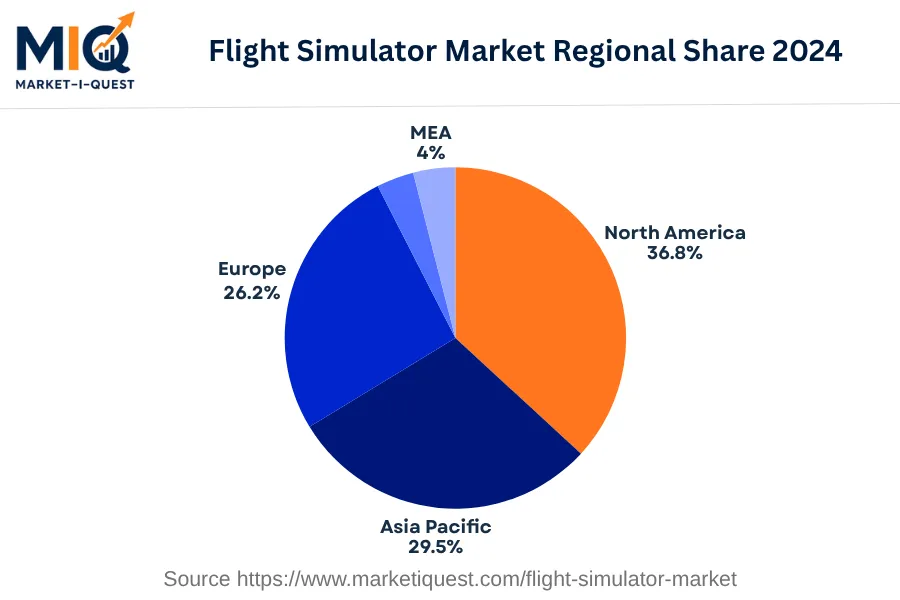
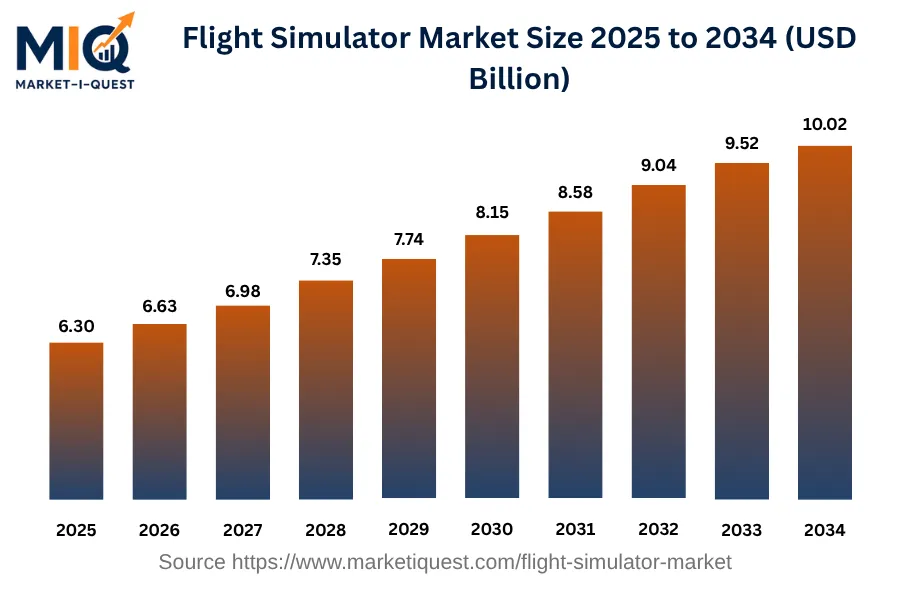
The Flight Simulator Market size was valued at 6.30 Billion USD in 2025 and is anticipated to reach a market size of 10.02 Billion USD by 2034 with a Compound Annual Growth Rate (CAGR) of 5.3%. Between the years of 2025 and 2034, the market is expected to see steady progress, going from its initial value to its projected value at the end of the period. This growth is underpinned by factors inherent in the data set. Stating regional shares as per the 2024 data, North America accounted for 36.8%, followed closely by Asia Pacific at 29.46%. Europe held a 26.18% share, while the combined share of Latin America and the Middle East & Africa equated to 7.52%, with the former constituting 3.54% and the latter making up the remaining 3.98% of the market share. This makes North America the largest regional contributor, followed by Asia Pacific and Europe respectively.

Key Takeaways

  • By Platform - Commercial Aerospace held a strong foothold in the Flight Simulator Market in 2025.
  • By Simulator Type - Live Simulation dominated accounting for a significant share in 2025.
  • By Aircraft Type - Fixed Wing Aircraft led the market garnering robust revenue numbers in 2025.
flight-simulator-market market size

Key Driving Factors

Increasing Need for Skilled Pilots

The global aviation industry is currently grappling with a shortage of skilled pilots. This is exacerbating the demand for high-quality flight training, a factor fueling an upsurge in the pilot training market. Flight simulators are essential training tools, especially for commercial airlines aiming to train their pilots in a controlled and safe environment. The use of flight simulators eliminates the risks associated with actual flight, offering scenarios for emergency responses, and other critical skills vital for pilots. In response to this, the airlines are heavily deploying flight simulators, thereby driving the growth of the flight simulator market.

Regulatory Requirements for Pilot Certification

Regulatory bodies such as the Federal Aviation Administration (FAA) and the European Union Aviation Safety Agency (EASA) have made it mandatory for pilots to undergo a specific number of training hours on flight simulators before they can obtain their flying licenses. This is in response to rising safety concerns following some high-profile aviation accidents. These regulations ensure that pilots acquire, maintain, and enhance their flying skills without putting lives at risk during the training process. In adherence to these regulations, flight schools and airline operators are investing in flight simulators, which is driving the flight simulator market growth.

Market Evolution by Timeline

2019-2023
During this period, the Flight Simulator Market saw an uptick in demand, particularly from commercial airlines and military training programs. In regions such as North America and Europe, buyers were increasingly attracted to the benefits of cost-effectiveness and safety that simulators offer for pilot training. High-fidelity devices were supplied by industry leaders like CAE, Rockwell Collins, and L3 Harris Technologies, which had a more mature integration with synthetic training environments compared to earlier models. However, the high acquisition cost remained a significant barrier to entry for many. Entry-level market prices hovered around $10M for a Full Flight Simulator. The International Civil Aviation Organization (ICAO) set training standards emphasized the use of these simulators, which positively contributed to the market's expansion. By 2023, most partnerships involved either a buy or lease model.
2024
For the year 2024, the demand for flight simulators remained high with higher interest from developing countries in Asia Pacific and Middle East regions. The market was populated with technological innovations aimed at providing enhanced realism, networking solutions and modular designs. These innovations were typically driven by companies like Boeing and Thales who continued offering a wide spectrum of flight simulators. The challenge remained in the high acquisition and maintenance cost, however, the trend of leasing simulators became popular, giving access to more buyers. Simulators took a more central role in meeting compliance for regulators. The risk was around technological proficiency as these simulators became more sophisticated.
2025-2029
Over the course of this period, the Flight Simulator Market experienced the growth from emerging economies like India, China, and Brazil, contributing to an increase in demand. Technological advancements included compact simulators, introduced by companies like Redbird and Frasca, which appealed to smaller organizations due to their lower price point. Disruptions were caused by increasing regulatory demands for specific training scenarios (such as upset recovery), which required simulator upgrades or replacements. Market prices continued a downward trend due to increased competition and advancements in technology, with the average price falling to around $9M for a high-fidelity model by 2029. More simulator training providers started to combine the purchase and leasing options into their operations.
2030-2034
During this period, the flight simulator market showed a steady demand pattern. The Middle East and Asia Pacific regions specifically demonstrated substantial growth in demand due to new airlines entering the market. New technology segments such as virtual reality (VR) and mixed reality (MR) started to integrate with traditional simulator platforms. Despite the pricing challenge, the viral simulator brands held the largest share in the market due to their established credibility. While the Federal Aviation Administration (FAA) continued to tighten regulatory requirements, forcing upgrades to existing simulators. It became common for flight schools and airlines to finance the acquisition of flight simulators through debt financing, due to the significant capital investment required.

Future Market Outlook

Future Opportunities

Looking ahead, the flight simulator market may find growth anchored in the increasing demand for pilot training driven by forecasted pilot shortages. As seen in 2023, airlines, including Southwest Airlines, are investing heavily in training infrastructure to accommodate the rising number of trainees needed. Virtual training environments, designed with platforms like Microsoft Flight Simulator, enable cost-effective and flexible training options, appealing to flight schools globally. Regulatory developments, such as the FAA's 2024 updates on Part 60 regulations, are likely to enhance simulator eligibility for pilot training, creating opportunities for simulation developers. Additionally, partnerships between technology firms and training institutions, like the collaboration between CAE and Embry-Riddle Aeronautical University, will likely foster innovation in simulation capabilities. The need for specialized training simulators for unmanned aerial vehicles has emerged, reflecting the shift towards drone technology, evidenced by policy actions in Europe that permit drone operations. Furthermore, in regions like Southeast Asia, there is increased interest in simulator-based training due to rapid growth in air travel. Anticipating changes in safety regulations and technology standards could lead developers to explore new user-friendly platforms that cater to diverse training needs. Consequently, these evolving factors indicate a vibrant future with significant opportunities geared towards enhancing flight simulation capabilities on a global scale.

Segmentation Analysis

By Platform

The market is divided into subsegments including Commercial Aerospace and Military Aerospace. Commercial Aerospace accounted for the largest revenue share while Military Aerospace is expected to grow at the fastest CAGR during the forecast period.

Largest Revenue Share

Commercial Aerospace

Market Share Leader

Commercial Aerospace leads the sector in terms of revenue generation for several reasons. The worldwide expansion of businesses and globalization has driven air cargo and passenger air traffic, thus increasing the revenue of this subsegment. Additionally, a substantial chunk of revenue comes from the servicing and maintenance of pre-existing commercial aircraft. These are critical because of the stringent regulations overseeing the aerospace industry. Maintenance is compulsory and must comply with each country's Civil Aviation Authority's standards and regulations, ensuring steady revenue growth. Coupled with that, the emergence of low-cost carriers has stimulated market growth, as they typically operate single-aisle short to medium-haul aircraft, which are less expensive to operate. On the purchasing side, consistent demand from airlines for new planes, either for expansion or replacement of older aircraft, also drives revenue. Switching costs are high in this industry, with heavy investments required in infrastructure, training, and certification for a different aircraft type, which promotes customer loyalty. Commercial Aerospace, therefore, has a solid revenue base from several diversified sources.

Fastest CAGR

Military Aerospace

Forecast Period Growth Leader

Despite contributing less to total revenue than Commercial Aerospace, the Military Aerospace subsegment is poised to grow at a higher rate. This growth may be attributed to numerous factors, such as political instability, military modernization programs, and increasing defense budgets across many countries, particularly in the Asia-Pacific region. Technology often drives innovation in this subsector, leading to the development of state-of-the-art military aircraft, UAVs, and UCAVs. Major investments in R&D by defense corporations, as well as substantial government funding, are fueling this evolution. Besides, collaborative efforts and partnerships among the major players have led to advancements in military aircraft technologies and systems. Still, the increasing costs of developing advanced military aircraft and components could act as a barrier to quick adoption. However, the projected rise in global defense expenditure is expected to offset this challenge, paving the way for rapid growth in the Military Aerospace subsegment.

By Simulator Type

The market is divided into subsegments including Live Simulation and Virtual Simulation, with the former accounting for the largest revenue share while Virtual Simulation projects the fastest growth.

Largest Revenue Share

Live Simulation

Market Share Leader

The live simulation subsegment dominates revenues in the market, influenced by a few principal factors. Live simulations provide a realistic, immersive training environment that allows participants to respond and interact as they would in real-life situations, making it a beneficial tool in various industries like military, aviation, and healthcare amongst others. These real-world scenarios contribute to the effectiveness of training, resulting in increased demand and hence, revenue. Education institutions and enterprises widely prefer this type of simulation due to the advanced experiential learning it offers. The maturing technology ecosystem, improvements in computer processing capabilities, and enhanced realism of live simulations have reduced the barriers to adoption, further boosting the subsegment's revenue generation capacity. Customer geographies also play a vital role. Regions with advanced infrastructure and robust funding mechanisms, mainly North America and Europe, have played a significant part in this subsegment's success.

Fastest CAGR

Virtual Simulation

Forecast Period Growth Leader

Although trailing behind in terms of revenue, the virtual simulation subsegment is experiencing the fastest growth rate. The virtual simulation demand is primarily driven by its versatility, cost-effectiveness, safety, and low resource consumption. With users gravitating towards technologically advanced and interactive solutions, the virtual simulations are penetrating many industries including but not limited to, gaming, education, healthcare, and military. Advancements in technology such as AI, VR, AR, and 3D graphics are further propelling its scalability and adoption. However, there are certain barriers including high initial investment required for virtual simulation that may impede the rapid growth. Partnerships across sectors for research and capital expenditure in developing more realistic and innovative solutions are likely to be key catalysts advancing the growth of this subsegment. Near term risks include technology deficits, and user resistance due to a different experience as compared to conventional methods.

By Aircraft Type

The market is divided into subsegments including Fixed Wing Aircraft, Rotary Wing Aircraft, and UAV. Fixed Wing Aircraft accounted for the largest revenue share while the UAV is expected to grow at the fastest CAGR during the forecast period.

Largest Revenue Share

Fixed Wing Aircraft

Market Share Leader

Fixed Wing Aircraft dominate the market in terms of revenue due to their extensive use in various sectors. This category encompasses airplanes used for commercial purposes, military operations, and private aviation. Their long range and large carrying capacity make them an attractive choice for transporting people and goods, giving them a broad customer base. Geographically, they're widely used on every continent and by almost every country, attesting their global market share. Furthermore, advancements in regulation have paved the way for the rise of more fuel-efficient and environmentally-friendly aircraft, which add to their popularity. The investment involved in switching from fixed-wing aircraft to other types is also significant, making it unlikely for the current situation to change rapidly. Predominant purchase criteria include reliability, range, and load capacity in which fixed-wing aircraft excel. The established supply chain and distribution channels also facilitate their market prevalence.

Fastest CAGR

UAV

Forecast Period Growth Leader

The Unmanned Aerial Vehicle (UAV) segment is expected to grow at the fastest CAGR during the forecast period. The increased adoption of UAVs can be attributed to their diverse applications ranging from surveying and reconnaissance to deliveries and wildlife monitoring. As the technology is relatively new, the potential for innovation and improvement is vast. Policy changes can act as a significant catalyst for this segment, with the relaxation of restrictions on UAV usage posing a significant growth opportunity. Developments such as increased battery life, reduced costs, and improved control systems are likely to drive future demand. The military sector is also increasingly adopting UAVs, strengthening the market outlook. Potential barriers include issues related to privacy and safety, but continuous advancements in technology are helping to mitigate these concerns. Partnerships between UAV manufacturers and application-specific businesses can also catalyze growth.

Competitive Analysis

Key Market Players

Manufacturers / OEMs

Boeing
US
Airbus
France
Lockheed Martin
US

Key Suppliers & Raw Materials

Honeywell International
US
Precision Flight Controls
US
Rockwell Collins
US

Distributors, Integrators & Channel Partners

Thales Group
France
Flight Safety International
US
CAE
Canada

Porter’s Five Forces Analysis

Analysis of the flight simulator market using Porter's five forces framework.

Supplier Bargaining Power

Medium

Due to proprietary technology and specialized knowledge, suppliers have moderate power.

Buyer Bargaining Power

High

The few numbers of buyers such as airlines & aviation academies results in high bargaining power.

Threat of Substitutes

Low

No perfect substitute for flight simulators exists, making the threat of substitutes low.

Threat of New Entrants

Low

High capital investments and required certifications pose a barrier to entry.

Competitive Rivalry

Medium

Largely dominated by a few big players, leading to moderate competitive rivalry.

Regional Analysis

Geographic market dynamics and growth opportunities across key regions

Global Market Outlook

flight-simulator-market market regional share

North America

In 2024, the North American flight simulator market showed vibrant dynamics driven mainly by advancements in technology and rising demand from various sectors. Notably, significant investments flooded into developing sophisticated flight simulator technologies, reflecting the increased focus on pilots' safety training in the aviation industry. Concurrently, the shift towards digitalization in the military sector spurred the demand for flight simulators, as defense organizations in the U.S., Canada, and Mexico sought solutions that can accurately replicate real-life scenarios for training purposes. Furthermore, regulatory changes, including the Federal Aviation Administration’s push for increased use of simulation for pilot training, specifically in the U.S., intensified the market churn.

In terms of trends, the year saw buyers leaning towards flight simulation systems with augmented reality and virtual reality features, marking a departure from traditional, physical systems. Not only aviation, but also retail and manufacturing sectors evidenced an increased uptake of flight simulation technologies. Another shift was the rise of partnerships and mergers within the market; tech providers increasingly sought to collaborate with educational institutions and aviation companies to broaden their reach. This collaborative approach was underpinned by the second wave of standardization in the industry, echoing a greater emphasis on ensuring consistent and improved system performance.

Asia Pacific

In 2024, the Flight Simulator Market in Asia Pacific experienced significant expansion. Demand was driven by increasing air travel in countries like China and India. Regulations in aviation safety and elevated investment in pilot training stimulated the market. Technological adoption, especially of Virtual Reality (VR), fortified supply dynamics, prompting more manufacturers to produce advanced flight simulators. Competitive pricing also boosted market growth. Trends observed include a shift towards digitization and automation in flight training methodologies. China's marked increase in purchasing flight simulators enhanced its pilot training capacity significantly. Key ASEAN markets, especially Singapore, saw more partnerships between airlines and flight simulator manufacturers, reinforcing the presence of flight simulators in training facilities. Japanese airlines strived to achieve international safety standards through enhancing pilot training programs, indirectly boosting the need for sophisticated flight simulators.

The flight simulator market catered to sectors like enterprise and government. Enterprise demand came primarily from airlines, flight schools and universities. Government clients included military and civil aviation bodies. India, with a growing commercial airline industry and robust military sector, leaned heavily on flight simulators for training. In contrast, Australia capitalized on VR technology for a simulated experience, reflecting the continent's focus on rationalizing costs. The flight simulator market in Asia Pacific thus observed significant growth and evolution in not only demand and technology, but also in utilization and application sectors.

Europe

In 2024, the European flight simulator market was significantly led by technological advancement in flight training. Major drivers behind the growth included stringent aircraft safety regulations pushing for more effective pilot training, enhanced investment by aviation industries in advanced flight simulating technologies, and growth in demand for newer, cost-effective virtual training methods over traditional real-time field training. For instance, Germany continued its strong reliance on simulators for pilot training, which is mandatory for Lufthansa's pilot licensing process, while British airlines augmented their investment in eco-friendly simulator technologies.

Alongside these drivers, several market trends were evident. The increased adoption of virtual reality (VR) and augmented reality (AR) technologies in simulators had begun to revolutionize flight training, steering away from the traditional full-flight simulators. For instance, Spain's Indra Sistemas developed advanced AR simulators, attracting interest from both aviation and defence-sector customers. Additionally, a rise in partnerships and acquisitions among aviation industries accelerated the development and spread of next-gen flight simulators; France's Thales Group and Airbus being prime examples. A parallel trend witnessed was the enforcement of stricter policies on airline safety standards across countries like Italy and across Central & Eastern Europe, further fueling the market's growth.

Latin America

The Flight Simulator Market in Latin America demonstrated a robust growth in 2024. A major driver was enhanced investment in military and civil aviation training, particularly in Argentina and Brazil. The adoption of superior technological trends such as virtual reality and augmented reality solutions further stimulated market growth. Regulatory compliance with International Civil Aviation Organization standards also necessitated an increased use of flight simulators in training, particularly in Mexico and Colombia. Buyer behavior shifted towards integrated training solutions, exemplified by the merger between major aviation training companies in Chile and Peru. A significant trend was the digital transformation among airline companies, leveraging flight simulators for pilot training to boost safety and operational efficiency. Moreover, the increased adoption of innovative flight simulators, characterized by high fidelity and advanced aerodynamic packages, was notable in both the military and commercial sectors across the region.

Government, enterprise, and military sectors were the leading customers in this market, with a significant focus on cost-effective and safe training solutions. Brazil's policies enforcing stringent pilot training protocols further aided in boosting demand for flight simulators. Consequently, the Flight Simulator Market in LATAM experienced substantial growth due to technological advancements, regulatory compliance, and increased investment in quality aviation training.

Middle East & Africa

In 2024, the flight simulator market in the Middle East and Africa gathered considerable momentum, fueled by needed pilot training due to aircraft purchases in the region's burgeoning aviation markets, particularly in Saudi Arabia, United Arab Emirates, and Qatar. These economies drove demand for sophisticated flight simulators with their ample investment in aviation infrastructure and quick adoption of cutting-edge technology. Firstly, the escalating air traffic in the region increased the need for intensive flight safety measures, thus pushing the demand for high-fidelity simulators. Secondly, regulatory tightening by aviation authorities precipitated a surge in the usage of flight simulation for pilot training and certification. Lastly, government investment and active encouragement for local manufacturing supplied the market with state-of-the-art simulators, affecting pricing dynamics positively.

In terms of trends, shifts towards technologically advanced simulators with Virtual Reality (VR) capabilities were evident in major aviation hubs like the UAE, accelerating product evolution. Partnerships between simulator manufacturers and regional airlines were also noted, fostering symbiotic growth. Lastly, the expectation of stringent policy enforcement regarding practice hours on simulators affirmed their importance. The customer base spanned across both the government and private sectors, including in airlines and aviation training schools. Over the given year, the flight simulator market in the Middle East and Africa showed a distinct uptick, responding to the critical driving factors and discernible trends.

Recent Industry Developments

Latest market innovations, product launches, and strategic initiatives

June 2026

Honeycomb Aeronautical announced the Echo Aviation Controller XPC, an Xbox and PC-compatible flight simulation controller featuring TMR sensors, Hall Effect sensors, and integrated throttle, trim, and rudder controls, expected to begin shipping in late 2026.

April 2026

The European Commission adopted Implementing Regulation (EU) 2026/781 on April 8, 2026, amending Regulations (EU) No 1178/2011 and (EU) No 965/2012 regarding requirements applicable to flight simulation training devices (FSTDs) and their use for pilot training, testing, and checking.

Frequently Asked Questions