
Flexible Packaging Market Snapshot

Key Players

  • Amcor Limited (Australia)
  • Berry Plastics Group Inc. (USA)
  • Sealed Air Corporation (USA)
  • Sonoco Products Company (USA)
  • Mondi Group (UK)
  • ProAmpac (USA)
  • Smurfit Kappa (Ireland)
  • Uflex Ltd. (India)
  • Coveris Holdings S.A. (Luxembourg)
  • Clondalkin Group (Netherlands)

Market Size

Base Year 2024
$226.83 Bn
CAGR
5.4%
Forecast 2034
$383.80 Bn

Market Segments

By Material
Plastic, Paper, Aluminum Foil, Others
By Product Type
Pouches, Bags, Wraps, Others
By Printing Technology
Flexography, Digital Printing, Others
By Application
Food & Beverage, Pharmaceutical, Personal Care, Others

Market Dynamics

Drivers
  • Growing consumer demand
  • Increased sustainability focus
Restraints
  • High production cost
  • Strict environmental regulations
Opportunities
  • Increasing sustainability demands
  • Shift toward convenience packaging

Market Size

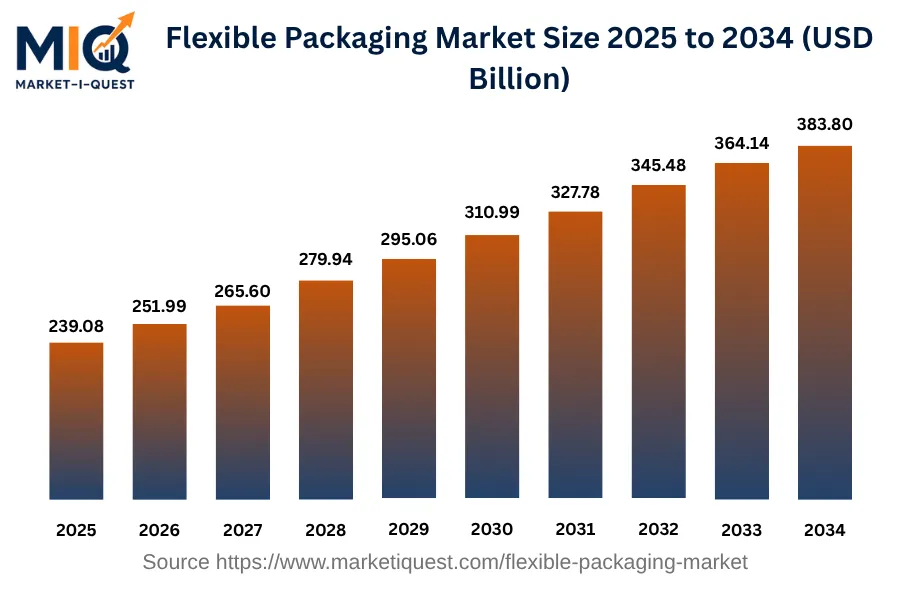
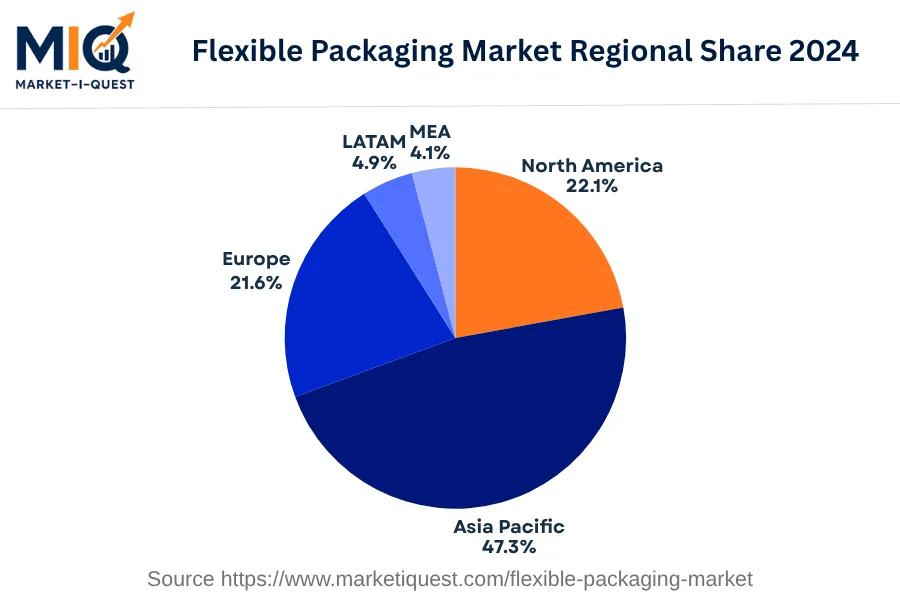
The Flexible Packaging Market had a value of USD 239.08 Billion in 2025, experiencing a Compound Annual Growth Rate (CAGR) of 5.4% from 2025 to 2034, with the market size reaching USD 383.80 Billion in 2034. Commencing from a value of USD 226.83 Billion in 2024, the market's progress can be seen through its continuous expansion in these years. The rise in the Flexible Packaging Market's size is largely attributed to the market's annual increment, guided by the CAGR. As for the regional shares in 2024, Asia Pacific held the majority share of 47.3%, followed by North America at 22.1% and Europe at 21.6%. The remaining regions, Latin America, and Middle East & Africa held a smaller proportion of the share at 4.9% and 4.1% respectively. The contribution from these regions collectively influences the overall growth of the Flexible Packaging Market from 2025 to 2034.

Key Takeaways

  • By Material - Plastic led the market accounting for a significant share in 2024.
  • By Product Type - bags held the dominant position in 2024.
  • By Printing Technology - Flexography accounted for the leading share in 2024.
  • By Application - Pharmaceutical sustained a competitive edge in 2024.
flexible-packaging-market market size

Key Driving Factors

Consumer Preference for Convenient Packaging Solutions

The flexible packaging market is experiencing growth through a strong push factor: the shift in consumer habits towards quick, convenient, and portable packaging. Customers, particularly those in bustling urban societies, are leaning towards packaging that can be easily carried and is resealable. This is further intensified by an increasing trend of home cooking and on-the-go eating habits. The lightweight, easy-to-open, and less space-consuming properties of flexible packaging align well with these consumer preferences. Additionally, the ability of flexible packaging to maintain product freshness for a longer period attracts buyers in the food and beverages sector, especially amidst a growing community of health-conscious customers.
Government Regulations Favoring Sustainable Packaging

Government regulations drive changes in the packaging industry, pushing for more sustainable solutions. Policy instruments such as the EU's Single-Use Plastics Directive, which aims to reduce the impact of certain plastic products in the environment, are changing industry dynamics. These policies force companies to rethink individual packaging design and overall packaging waste management strategies. Flexible packaging manufacturers are responding to these regulatory pressures by developing innovative materials with a reduced carbon footprint, such as bio-degradable and recyclable films. This complies with the global shift towards a greener economy and fosters an upswing in the demand for environmentally friendly flexible packaging solutions.

Market Evolution by Timeline

2019-2023
In this period, the driving buyers were predominantly food and beverage sectors, notably in North America and Asia-Pacific regions. This stemmed from increased consumer preference for conveniently packaged products. From the supply perspective, advancements like recyclable materials were introduced to counter constraints of sustainability concerns. Regulatory interventions, such as EU's Circular Economy Action Plan, started directing manufacturers towards eco-friendly packaging. Commercially, contracts typically linked to volumes and long-term associations began to redefine supplier-buyer dynamics. The pricing pressure from raw material price volatility remained a notable risk in this timespan.
2024
In this year, healthcare sector, especially in Europe, began to adopt flexible packaging significantly due to the rising need for tamper-evident and child-resistant packaging. There was a substantial progress in technology with the introduction of smart packaging solutions. These allowed traceability, hampering counterfeiting efforts. Policy-wise, initiatives like the EU Green Deal began to impact production processes and product designs. Vendors began offering more value-added services as an integral part of their commercial model. The instability of raw material prices and a vulnerability to counterfeit products prevailed as primary risks.
2025-2029
During these years, key buyers recorded were from both food and pharmaceutical industries. The reason was the accelerated demand across Africa due to increasing urbanization and preference for packaged goods. The introduction and adoption of biodegradable materials signified a significant shift in the supply side. The United Nations' Sustainable Development Goals influenced manufacturers to further adopt sustainable practices. Businesses saw the advantage of forming strategic alliances and merger undertakings. The unprecedented COVID-19 pandemic posed a significant risk to global supply chains and production capacities.
2030-2034
In this phase, e-commerce companies represented a promising buyer segment due to emerging online grocery shopping trends, especially in emerging markets like India and Southeast Asia. There was a continuous shift towards bio-based polymers in packaging, representing the market's focus on reducing carbon footprint. Policy-wise, globally recognized guidelines on circular economy practices affected packaging designs and production processes. Price fluctuations remained a constant risk, with businesses navigating with the focus on maintaining competitive pricing structures. Long-term supply contracts and collaborative partnerships became the norm for securing supply chain stability.

Future Market Outlook

Future Opportunities

Future opportunities in the flexible packaging market are closely linked to ongoing sustainability trends and regulatory changes. In 2022, the U.S. Environmental Protection Agency implemented the Sustainable Management of Food Basics initiative, urging companies to minimize food waste through better packaging solutions. This enhances prospects for companies specializing in vacuum-sealed and modified atmosphere packaging technologies to address the growing demand for shelf-life extension. Additionally, the focus on circular economy principles is compelling businesses to incorporate recyclable and compostable materials into their products, with firms like Amcor leading initiatives to create packaging that is recyclable by 2025. As end-user industries evolve, the health and wellness trend drives significant interest in flexible packaging solutions that highlight product freshness, with organizations such as the Food and Drug Administration advocating for clearer labeling and presentation. Partnerships are also developing, such as the collaboration between BASF and Sealed Air to innovate in sustainable packaging technologies that align with environmental goals. Moreover, emerging markets in Asia-Pacific are likely to see increased adoption of flexible packaging as urbanization accelerates and consumer buying behavior shifts toward convenience products. The combination of innovative materials, technological advancements, and regulatory support positions the flexible packaging market to capture a broader range of applications and channels, thereby expanding its impact across various sectors.

Segmentation Analysis

By Material

The market is divided into subsegments including Plastic, Paper, Aluminum Foil, and Others. Plastic accounted for the largest revenue share while Aluminum Foil is expected to grow at the fastest CAGR during the forecast period.

Largest Revenue Share

Plastic

Market Share Leader

The Plastic subsegment leads the market in terms of revenue. This is in large part due to its versatility and low-cost manufacturing process compared to other materials. Further, the global rise in consumption of convenience products, most of which are packaged in plastic, is driving demand. Plastic materials also benefit from being lightweight yet durable, comfortable to handle, resistant to moisture, and capable of retaining the freshness of the products packaged in them. However, constraints on the supply side, such as increasing raw material costs and environmental regulations, pose challenges to the segment's growth. Geographically, Asia Pacific accounts for a significant share due to the large consumer base and growth in end-use industries such as food and beverages, pharmaceuticals, and personal care. As per purchasing criteria, most clients prioritize cost-effectiveness, durability, and user-convenience, all of which are characteristics intrinsic to plastic materials. Moreover, changes in supply chains are unlikely to cause significant switching costs, as plastic is already widely realized as a universal packaging solution.

Fastest CAGR

Aluminum Foil

Forecast Period Growth Leader

Despite not being the largest revenue earner, the Aluminum Foil subsegment is poised to record the fastest growth. Several factors contribute to this outlook. Foremost among them is the increasing demand for preserving food and medicines over longer periods, where aluminum foil outperforms other materials due to its superior barrier properties against light, oxygen, and moisture. The shift towards sustainable packaging solutions also augurs well for aluminum foil as it is 100% recyclable and re-usable. Technological advancements enabling more robust and lightweight aluminium foils are poised to boost the subsegment further. However, the high price of aluminum relative to other materials is a barrier to adoption, potentially slowing down the pace of growth. Partnerships aimed at bulk purchasing and capex investments can potentially offset these costs. On the policy front, supportive regulations to encourage recycling could further stimulate growth, though, in the near term, global uncertainties could pose risks to aluminium supply, thus impacting prices.

By Product Type

The market is divided into subsegments including Pouches, Bags, Wraps, and Others. Of these, Bags accounted for the largest revenue share while Wraps are expected to grow at the fastest CAGR during the forecast period.

Largest Revenue Share

Bags

Market Share Leader

Bags emerged as the highest revenue generating subsegment in the product type category in 2024. This can be attributed to their widespread usage across a myriad of industries. The utility of bags across sectors like retail, grocery, and apparel owing to their utility and cost efficiency has contributed to their popularity. The consumer preference for bags is driven by their convenience for storing and carrying items. The proliferation of e-commerce has induced a surge in demand for packaging solutions which can protect the goods during transit, further escalating the demand for bags. Stringent regulations pertaining to the use of plastic bags has sparked a demand for eco friendly bags thereby augmenting the growth of bag segment. Other key contributing factors include innovation in design and lightweight nature of bags.

Fastest CAGR

Wraps

Forecast Period Growth Leader

Despite bags having the highest revenue, it is the 'Wraps' subsegment that is projected to experience the fastest growth rate. This is largely due to the rising consumer awareness about sustainable packaging and the increasing environmental concerns regarding plastic use. Wraps are often made of recyclable materials, making them a more eco-friendly option. Moreover, technological advancements have allowed for the development of wraps that improve product shelf-life, increasing their adoption in the food industry. Their effectiveness in safeguarding products from external pressures and temperature variations is another factor propelling their usage. However, the initial high costs associated with wrap production and consumer’s unfamiliarity with the product could pose challenges for its growth rate. As businesses and consumers alike become more eco-conscious, the market for wraps is set to witness exponential growth.

By Printing Technology

The market, analyzed by printing technology, is divided into subsegments including Flexography, Digital Printing, and Others. In 2024, Flexography accounted for the largest revenue share while Digital Printing is expected to grow at the fastest CAGR during the forecast period.

Largest Revenue Share

Flexography

Market Share Leader

Flexography, in 2024, held the largest share of the printing technology market in terms of revenue. This subsegment's dominance can be attributed to several factors. Primarily, the wide-scale adoption of flexography in various industries such as packaging, label, and newspaper printing contributes significantly to its leading position. The technology offers advantages including speed, versatility, and adaptability to many substrate types, making it the preferred choice of many industries. Additionally, the cost-effectiveness of flexography, especially for high-volume print runs, further bolsters its demand. Regulatory trends favoring eco-friendly printing practices also work in favor of flexography as this technology uses quick-drying, low-VOC inks. Moreover, key print purchasers in geographically diverse markets are attracted to the quality, consistency, and speed that flexography offers when compared with other printing technologies.

Fastest CAGR

Digital Printing

Forecast Period Growth Leader

Despite Flexography's large revenue share implication throughout 2024, Digital Printing was identified as the fastest growing subsegment in terms of CAGR during the forecast period. The rapid growth of digital printing can attributed to several growth drivers. The technology's ability to offer high-speed production and customization capabilities explains its appeal to various industries requiring individualized output on a mass scale. Digital printing's appeal can be seen in its ability to remove the need for plates or films in printing, which can be a time-consuming and costlier process. This not only results in quicker delivery times to customers, but also allows for the freedom of last minute design changes without incurring additional costs. However, near-term risks such as regulatory shifts affecting digital ink safety, high capex, and the requirement of specialized substrate for digital printing remain as potential barriers to adoption. Nonetheless, ongoing technological innovations coupled with strategic partnerships in the industry could potentially catalyze future growth.

By Application

The Application segment is divided into subsegments including Food & Beverage, Pharmaceutical, Personal Care, and Others. Pharmaceutical accounted for the largest revenue share whilst Personal Care is projected to grow at the fastest CAGR during the forecast period.

Largest Revenue Share

Pharmaceutical

Market Share Leader

The Pharmaceutical subsegment leads the market in terms of revenue generation in 2024. The surge in revenue could be attributed to the increased consumption, production of drugs and the high pricing associated with pharmaceutical products. Strict health regulations and growing health awareness among global consumers have driven the purchase up. The nature of the pharmaceutical industry, coupled with high regulatory barriers restricting new entrants, has further boosted the revenue share of this segment. The increasing incidence of chronic and lifestyle-related diseases worldwide compels considerable demand for pharmaceuticals. Furthermore, the expansion of the pharmaceutical industry into emerging market economies has increased the demand for related applications. Considering the supply chain, sophisticated and well-established distribution channels contribute to the voluminous sales of pharmaceutical products, thereby reinforcing the revenue growth of this subsegment.

Fastest CAGR

Personal Care

Forecast Period Growth Leader

Projected for the fastest CAGR, the Personal Care subsegment has shown promising signs of growth. Major factors contributing towards its growth are changing consumer preferences towards organic and natural products, along with increased attention to grooming and personal hygiene. There has been a recent shift in demand towards skin-care, hair-care, and other personal grooming products, particularly in developing economies due to rising disposable incomes and influence of western culture. Technological advancements such as e-commerce platforms provide a robust infrastructure for the extensive distribution of personal care products, projecting increased sales. Adoption barriers include consumer skepticism about product efficacy, potential allergic reactions, and the relatively high cost of natural ingredients. In the near term, uncertainties lie in the vulnerability of supply chains and the ability of companies to meet the high end-consumer demand consistently.

Competitive Analysis - Flexible Packaging Market

Key Market Players

Manufacturers / OEMs

Amcor Limited
Australia
Bemis Company, Inc.
US
Sealed Air Corporation
US

Key Suppliers & Raw Materials

Dow Inc.
US
BASF SE
Germany
ExxonMobil Chemical
US

Distributors, Integrators & Channel Partners

Sonoco Products Company
US
Uflex Ltd.
India
American Packaging Corporation
US

Porter’s Five Forces Analysis

This analysis evaluates the competitive intensity and attractiveness of the Flexible Packaging Market.

Supplier Bargaining Power

Medium

Suppliers are somewhat powerful due to the scarcity of high-quality raw materials.

Buyer Bargaining Power

High

Buyers possess high bargaining power due to the availability of multiple suppliers.

Threat of Substitutes

Low

Threat from substitutes is low due to the unique benefits of flexible packaging.

Threat of New Entrants

Medium

Entry barriers are moderate due to high capital investment and technology requirements.

Competitive Rivalry

High

The market is highly competitive with the presence of numerous established players.

Regional Analysis

Geographic market dynamics and growth opportunities across key regions

Global Market Outlook

flexible-packaging-market market regional share

North America

In 2024, the Flexible Packaging Market in North America exhibited substantial dynamics underpinned by multiple drivers. Enhanced demand from the food & beverage sector in the U.S., Canada, and Mexico due to the need for prolonging shelf life, paired with stringent food safety regulations, fueled the market. The increasing capital investments in the manufacturing sector to adopt eco-friendly and cost-effective technologies also propelled growth. Supply-side factors such as competitive pricing strategies, primarily driven by advancements in digital printing technologies, further bolstered the market.

Simultaneously, noticeable trends influenced the market landscape. Evolved consumer behavior towards convenient and sustainable packaging options underscored the need for innovation. Consequently, manufacturers shifted towards recyclable and biodegradable materials, triggering significant changes in product designs. This shift was particularly evident in the retail sector, mainly in fast-moving consumer goods. Notably, an increase in strategic partnerships and M&A activities enhanced the market consolidation and competitiveness in North America. Lastly, the tightening of policy enforcement surrounding plastic usage by various state governments, most notably California's Single-Use Plastic Waste Reduction Law, invigorated companies’ commitment towards more sustainable flexible packaging solutions.

Asia Pacific

In 2024, the flexible packaging market in the Asia Pacific region was characterized by robust growth and innovation. Widespread urbanization and expanding retail networks, particularly in China, India, and key ASEAN markets, drove demand for flexible packaging solutions. Notably, technological advances in Japan and South Korea - such as high-barrier materials and smart packaging - further fueled growth. The proliferation of e-commerce channels in Australia also necessitated efficient, lightweight packaging, catalyzing the flexible packaging market.

Among prevailing trends, a shift towards sustainable packaging was clear, with manufacturers prioritizing recyclable or biodegradable materials. This was in response to stringent solid waste management policies enforced predominantly in China and Japan. Moreover, the burgeoning health and wellness sector, specifically in India and ASEAN markets, gravitated towards flexible packaging due to its convenience and aesthetic appeal. Partnerships ensued between packaging manufacturers and health product retailers, fostering mutual growth. Despite a burgeoning market, counterfeit products posed severe challenges, necessitating technological adaptations such as IoT integration for product traceability. Key sectors included fast-moving consumer goods, pharmaceuticals, and e-commerce. The year was marked by regulatory shifts, technological breakthroughs, and strategic alliances, forging a competitive and vibrant flexible packaging market in the Asia Pacific.

Europe

In 2024, the flexible packaging market in Europe is driven by multiple factors, primarily the increase in environmental awareness and a shifting focus towards sustainability. This is evidenced by rigorous regulations such as the European Union's Green Deal that imposes a stringent framework for waste management, driving the demand for recyclable flexible packaging. The adoption of advanced manufacturing technology, leveraging innovations in material science, has also enhanced the market's supply capabilities. Noteworthy consumption trends include a surge in demand from the food and beverage sector, driven by firms in the United Kingdom, France, and Germany. Renowned retail giants like Tesco and Carrefour have unveiled sustainable packaging initiatives, accelerating the adoption of flexible packaging solutions. The healthcare industry across the region, especially in Nordics and Benelux, demonstrates a growing preference for sterile, single-use flexible packaging for a range of medical products.

In response to these surges in demand, strategic partnerships and M&A activities are prolific in the market, allowing firms to expand their reach and enhance their technological prowess. Moreover, the emphasis on policy enforcement and regulatory compliance is profound, with comprehensive quality and safety standards being employed by manufacturing, government and utilities sectors across soft packaging production in Italy, Spain, and Central & Eastern Europe.

Latin America

In 2024, the flexible packaging market in Latin America exhibited robust growth centered around key economies - Brazil, Mexico, Argentina, Colombia, Chile, and Peru. The growth drivers involved increasing consumer demand for convenient and sustainable packaging, governmental regulations prompting manufacturers to shift towards eco-friendly solutions, and substantial investments in advanced packaging technologies. Policies such as Brazil's National Solid Waste Policy accelerated this shift, stimulating the broader market dynamics.

Under the background of sustainable consumption, there was a marked trend towards utilization of bio-based materials and barrier films in packaging. Consumers showed heightened interest in flexible packaging with enhancements like resealability and improved shelf appeal. Various industries, including retail, food service, and cosmetics, capitalized on these trends to offer innovative, value-added packaging to their consumers. Channel dynamics shifted with the dominance of e-commerce, altering the distribution network for flexible packaging products. Partnerships and M&A activities, such as the strategic alliance of Amcor and Bemis, shaped industry competition. Certain policy enforcements, like Chile's extended producer responsibility law, set new standards in waste management dictating industry practices. Thus, the specific region's regulations, evolving customer preferences, technological advancements, and strategic industry activities shaped the dynamics of the LATAM flexible packaging market in 2024.

Middle East & Africa

In 2024, the Middle East and Africa's Flexible Packaging Market experienced a significant expansion driven by diverse factors. First, rapid urbanization in countries like Saudi Arabia, UAE and Nigeria led to higher demand for consumer goods, pushing for enhanced flexible packaging solutions. Simultaneously, regulations encouraging sustainability, prevalent in Kenya and Israel, drove companies to adopt more recyclable and environment-friendly packaging. Moreover, substantial technological advancement, specifically in South Africa and Egypt, optimized production processes, making flexible packaging a more affordable option.

Clear market trends were visible throughout the year. A shift towards eco-friendly packaging resonated with the behaviour of environmentally conscious buyers, following standards set by local governments. In Egypt and Israel, there was a noticeable move towards digital printing technologies in flexible packaging, producing high quality, cost-effective outcomes that appealed to retail and manufacturing sectors. The oil and gas industry in Saudi Arabia and UAE, showed increased interest in flexible packaging, especially in corrosion protection applications. There was also a surge in M&As across the region, exemplified by the partnership between Qatar’s leading food company, Baladna, and Amcor, a global leader in packaging, to establish sustainable packaging solutions. Amid these changes, strict policy enforcement increased quality and safety standards across sectors, pushing the market to innovate further.

Recent Industry Developments

Latest market innovations, product launches, and strategic initiatives

March 2026

Siegwerk signed a definitive agreement to acquire Hi-Tech Inks, creating the largest player in India's flexible packaging market with over 20% market share — Siegwerk's largest acquisition since 2005.

February 2026

China implemented nine new national standards for recycled plastics in packaging, taking effect on February 1, 2026, requiring significant reduction in non-recyclable elements and pushing flexible packaging manufacturers toward mono-material structures

Frequently Asked Questions