Flat Steel Market Snapshot

Key Players

  • ArcelorMittal (Luxembourg)
  • Nippon Steel Corporation (Japan)
  • United States Steel (USA)
  • JFE Steel Corporation (Japan)
  • Essar Steel India Limited (India)
  • Tata Steel Limited (India)
  • POSCO (South Korea)
  • Thyssenkrupp AG (Germany)
  • Baosteel Group Corporation (China)
  • Novolipetsk Steel (Russia)

Market Size

Base Year 2024
$923.69 Bn
CAGR
5.8%
Forecast 2034
$1623.24 Bn

Market Segments

By Product Type
  • Slabs
  • Hot-Rolled Coil
  • Cold-Rolled Coil
  • Sheets & Strips
  • Tinplate
  • Coated Steel
By End User Industry
  • Building & Construction
  • Automotive & Transportation
  • Machinery
  • Electronics
  • Consumer Goods & Appliances
  • Oil & Gas
  • Energy
  • Others

Market Dynamics

Drivers
  • Increasing construction activities
  • Rapid industrialization growth
Restraints
  • High raw material costs
  • Fluctuating market demand
Opportunities
  • Emerging automotive sectors
  • Growing construction industry

Market Size

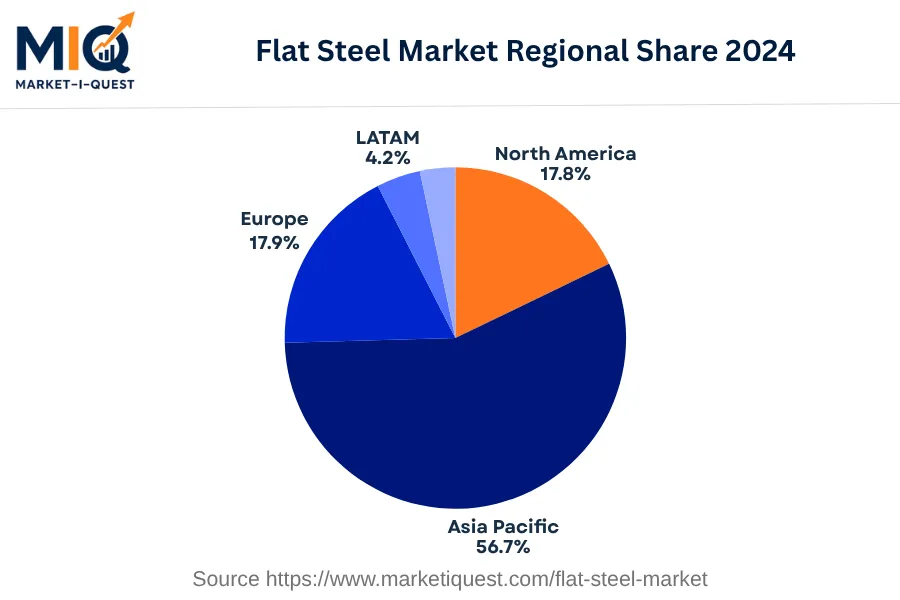
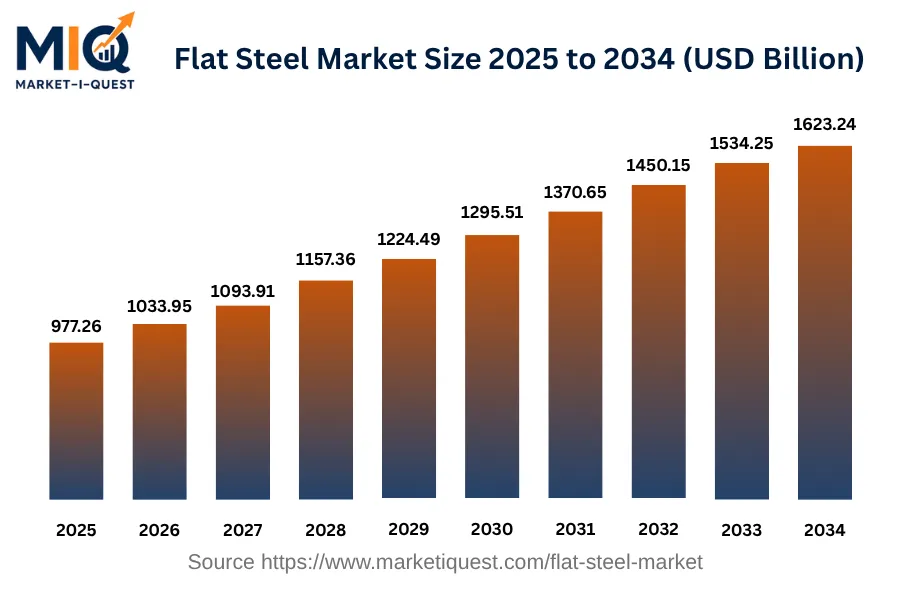
The Flat Steel Market size in 2025 is projected to reach $977.26 billion, up from $923.69 billion in 2024. By 2034, the market size is expected to grow further, attaining a value of $1623.24 billion. This growth path represents a compound annual growth rate (CAGR) of 5.8% from 2025 to 2034. This growth in the market size can be attributed to several reasons. An expanding construction industry which extensively uses flat steel, increasing infrastructural investments and growing demand for durable, lightweight materials in the automotive sector provide the push for growth. Finally, looking at the regional share mix in 2024, Asia Pacific led the market with 56.73%, followed closely by Europe and North America with market shares of 17.92% and 17.84% respectively. LATAM and MEA held smaller shares, at 4.16% and 3.35% respectively.

Key Takeaways

  • By Product Type - Hot-Rolled Coil held a major share in 2024.
  • By End User Industry - Building & Construction was leading in market share in 2024.
flat-steel-market market size

Key Driving Factors

Expansion of Infrastructure and Construction Industries

The flat steel market is experiencing a surge due to the expansion in the infrastructure and construction sectors. Especially in emerging economies like India, China, and Brazil, increasing government emphasis on infrastructure development is pushing the demand for flat steel products, primarily for their strength and durability. Examples include construction projects like roads, bridges, and buildings where the use of flat steel is fundamental. Moreover, due to urbanization and the accompanying growth of the housing market, the need for flat steel in residential constructions is also rising, contributing further to the upswing in the flat steel market.

Increasing Adoption in Automotive Production

Another key factor driving the flat steel market is its growing adoption in automotive manufacturing. Flat steel products are integral to vehicle production, being used in the body structure and other critical parts due to their high malleability and weldability. With the motor industry progressing towards lightweight and fuel-efficient automobiles to comply with stringent emission regulations like the Corporate Average Fuel Economy (CAFE) standards in the U.S., the demand for flat steel - known for its lightweight strength - is escalating. As automobile manufacturers globally increase their production capacity to meet the flourishing demand for vehicles, the flat steel market is consequently experiencing substantial growth.

Market Evolution by Timeline

2019-2023
During this period, the demand for flat steel was driven primarily by construction and automotive sectors, particularly in growing urban regions of Asia. Major steel suppliers like ArcelorMittal and POSCO were able to increase their production capacity to match the growing demand. The implementation of quality standards, such as ISO 9001 and ASTM A36, was also a recurring theme in flat steel manufacturing. Typically, wholesale transactions and long-term contracts dominated the commercial model of this sector. One significant risk observed was the imposition of steel import tariffs by various countries, prompting suppliers to diversify their procurement sources or potentially face higher costs.
2024
In 2024, the demand for flat steel saw an increase in North America, particularly for infrastructure development. Companies like United States Steel Corporation launched new, more efficient production technologies to keep up with the demand. The adoption of newer sustainability standards like LEED became more commonplace. The commercial model witnessed a rise in forward contracts to hedge against potential price fluctuations. However, environmental regulations pose a risk as emissions standards became stricter, forcing some factories to invest significantly in cleaner technologies, or face penalties.
2025-2029
From 2025 to 2029, demand for flat steel maintained a steady rate, with noticeable traction in renewable energy sectors, especially in Europe. Technology suppliers began to make headways into more sustainable and efficient production methods. Regulations continued to tighten, with policy initiatives such as the EU Green Deal influencing practices. Flat steel prices saw increased volatility, with auctions becoming a prominent means of procurement. The primary risks involved supply chain disruptions due to stricter environmental mandates, requiring alternate, likely more expensive, sources.
2030-2034
The global market for flat steel saw a slight decrease in traditional demand sectors but an increase in innovative applications like electric vehicle manufacturing. Advances in technology led to newer, greener methods of steel production becoming commonplace. Simultaneously, the growth of circular economy policies, like those in the EU, steered the industry towards recycling and reusing steel. Supply contracts become multi-faceted, with penalties for not meeting environmental standards. The risk of failing to meet these environmental standards emerged as a significant concern for the industry.

Future Market Outlook

Future Opportunities

As the flat steel market evolves, several future opportunities are emerging due to current industry dynamics. The transition towards electric vehicles is stimulating demand for high-quality flat steel, as seen with Ford's investment in new manufacturing facilities in North America in 2023. This push aligns with government initiatives, such as the United States’ Inflation Reduction Act, promoting sustainable production practices. Additionally, the ongoing urbanization in regions like Southeast Asia presents a heightened need for construction materials, including flat steel. In May 2023, the Philippine government announced multiple infrastructure projects that are projected to drive increased demand for construction-grade steel. The push for renewable energy sources, including solar and wind, necessitates the use of durable materials, and flat steel is anticipated to play a critical role in energy infrastructure development. The global expansion of electric vehicle charging stations, endorsed by the French government’s 2023 initiative to increase their numbers, underscores the growing synergy between flat steel usage and green technologies. There are also opportunities in circular economy practices, as industries explore ways to utilize recycled materials; the European Commission's 2023 Circular Economy Action Plan outlines strategies for enhancing recyclability in construction materials. As regulatory frameworks evolve and industries seek environmentally responsible solutions, the flat steel market stands poised for significant growth and diversification.

Segmentation Analysis

By Product Type

The market is divided into subsegments including Slabs, Hot-Rolled Coil, Cold-Rolled Coil, Sheets & Strips, Tinplate, and Coated Steel. Hot-Rolled Coil accounted for the largest revenue share while Coated Steel is expected to grow at the fastest CAGR during the forecast period.

Largest Revenue Share

Hot-Rolled Coil

Market Share Leader

The Hot-Rolled Coil subsegment has managed to grasp the most significant market share. Its leading position can be accredited to several factors. For one, hot-rolled coil steel is ubiquitous in construction, which remains one of the world's largest and most consistent industries. It is massively utilized in infrastructural projects including bridge and building construction. Its popularity within the automotive and transportation segment due to its malleability and ductility enhances its revenue position. Geographically, the rise in infrastructure in the Asia-Pacific region and the resurgence of residential construction in North America have also propelled demand. From a supply perspective, Hot-Rolled Coil has benefitted from considerable production capacities globally. Additionally, the availability of raw material and the economies of scale achieved by major producers allow for competitive pricing, which keeps the demand for this segment high.

Fastest CAGR

Coated Steel

Forecast Period Growth Leader

The fastest-growing subsegment appears to be Coated Steel. This growth could be attributed to high demand in industries like automotive, construction, and home appliances, where coated steel's durability, corrosion resistance, and superior aesthetics are highly valued. Technological advancements in coating methods have improved the quality and lowered the cost of production, which has also spurred growth. Furthermore, government policies worldwide encouraging infrastructure development tend to favor durable, cost-effective materials like coated steel. A significant capital investment in coated steel production lines by major producers, driven typically by strategic partnerships and consolidation, has removed capacity constraints. This trend is set for further acceleration. However, near-term risks may include fluctuating raw material prices and supply chain disruptions. It should be noted that this overview is based on the assumption that trends observed in related and auxiliary industries apply similarly to this subsegment.

By End User Industry

The market is divided into subsegments including Building & Construction, Automotive & Transportation, Machinery, Electronics, Consumer Goods & Appliances, Oil & Gas, Energy, and Others. The Building & Construction subsegment is dominating with the highest revenue generation and the Automotive & Transportation subsegment is expected to grow with the highest CAGR during the forecast period.

Largest Revenue Share

Building & Construction

Market Share Leader

The Building & Construction subsegment leads in terms of revenue generation mainly due to the ever-increasing need for infrastructure due to population growth and urbanization. This subsegment finds its legitimacy in almost every geographical segment due to the universal need for residence, commercial spaces, and public infrastructure. This demand is more pronounced in developing countries that are witnessing rapid urbanization and population growth. Strict guidelines and regulations imposed by the government in regards to sustainable infrastructure are driving the demand for more efficient and eco-friendly construction materials and machinery. Furthermore, increased emphasis on improving the energy efficiency of buildings and the renewed focus on housing projects have contributed to the growth in revenue. With regards to customer purchase criteria, typically, durability, cost-effectiveness and efficiency are among the most crucial factors considered.

Fastest CAGR

Automotive & Transportation

Forecast Period Growth Leader

The subsegment expected to grow at the fastest CAGR during the forecast period is Automotive & Transportation. This growth is attributed to the rapidly evolving automotive industry, marked by the development of electric and autonomous vehicles, and the expansion of public transportation systems in urban areas to combat high traffic congestion and environmental issues. Emerging nations are also witnessing a surge in their middle-class population, which directly translates into growing demands for vehicles, both for personal and commercial uses. In addition, the adoption barrier to cleaner and efficient transportation is decreasing due to technology advancements and policy regulations that support the adoption of renewables in the transport sector, thus acting as a catalyst for the segment's growth. However, near-term risks include possible global economic slowdown and the steep initial investment required for newer, cleaner transportation technologies.

Competitive Analysis

Key Market Players

Manufacturers / OEMs

ArcelorMittal
Luxembourg
Nippon Steel & Sumitomo Metal Corporation
Japan
Tata Steel
India

Key Suppliers & Raw Materials

Iron Ore Company of Canada
Canada
Cleveland-Cliffs Inc.
US
Rio Tinto
UK

Distributors, Integrators & Channel Partners

Reliance Steel & Aluminum Co.
US
Ryerson Holding Corporation
US
Kloeckner Metals Corporation
Germany

Porter’s Five Forces Analysis

This analysis investigates the competitive intensity and attractiveness of the Flat Steel Market.

Supplier Bargaining Power

Medium

Limited number of suppliers and high production costs influence supplier power.

Buyer Bargaining Power

High

Ample substitutes and low switching costs ensure high buyer power.

Threat of Substitutes

Medium

Availability of alternative materials like aluminum and plastics in certain applications.

Threat of New Entrants

Low

High capital investments and technical expertise act as strong entry barriers.

Competitive Rivalry

High

Many key players complicate the landscape, leading to intense competition.

Regional Analysis

Geographic market dynamics and growth opportunities across key regions

Global Market Outlook

flat-steel-market market regional share

North America

In 2024, the North American flat steel market was profoundly shaped by a diverse range of drivers and trends. Government regulations in the U.S. and Mexico supporting green manufacturing incentivized industry players to invest in low-emission technologies, catalyzing an uptick in sustainable steel production. Advanced automotive manufacturing, particularly in Canada, further spurred demand with its increasingly sophisticated requirements for high-strength, lightweight steel. Broad macroeconomic stability in the region also bolstered a positive investment climate, fueling capacity expansions and upgrades to modern, efficient production processes.

Trends within the market pointed toward a rapidly evolving landscape. Surging e-commerce in the retail sector influenced buying behavior, with end-users increasingly sourcing steel online. Progress in the construction industry's adoption of advanced, steel-intensive designs also marked a key shift toward innovative flat steel products. Meanwhile, proactive regulatory enforcement of carbon taxation frameworks by governments nudged manufacturing towards environment-friendly practices. The year also saw several high-profile partnerships, notably, between prominent U.S. steel producers and key clients in automotive and utilities sectors – a strategic response to emerging demands for specialized applications. In sum, 2024 was characterized by considerable dynamism within North America’s flat steel market, driven by regulatory tailwinds, robust demand from automotive and construction sectors, and a shifting operational landscape.

Asia Pacific

In 2024, the Asia Pacific flat steel market experienced significant activity. Robust demand from the construction, automotive, and manufacturing sectors fueled growth; particularly in India and China, where rapid urbanization and infrastructure development necessitated substantial steel inputs. Government regulations supporting domestic steel industries in Japan and South Korea, alongside strategic investments in technological advancements, accelerated supply dynamics, enabling superior quality and efficiency. Additionally, competitive pricing policies by flat steel producers in Australia and key ASEAN markets stimulated demand.

Major market trends include a shift towards high-tensile, lightweight flat steel, particularly in the automotive industry, led by India and Japan aiming to enhance fuel efficiency and comply with stringent emission standards. Change in purchasing behavior has also been evident, with an increased preference for eco-friendly and locally sourced steel products among buyers. In terms of channel dynamics, online sales gained momentum, driven by digital transformations in the retail sector. Notably, consolidation in the steel industry intensified, with several partnerships and acquisitions observed, especially in China's highly competitive market. Lastly, policies to improve labor conditions and enforce ethical production standards were strictly implemented across the Asia Pacific flat steel market, shaping overall market performance in 2024.

Europe

In 2024, the European flat steel market demonstrated robust resilience. A combination of factors drove this performance, including increased demand from the automotive sector in Germany due to stringent emission norms, spurring a shift towards lighter, steel-based automobiles. The United Kingdom witnessed considerable investment in infrastructure and recyclable construction materials, boosting the flat steel market. In addition, France and Italy saw a surge in flat steel consumption due to upticks in their respective manufacturing sectors. Emerging trends in the market indicated changing buyer behaviors and product shifts. Sustainability became more prominent, with both France and the Nordics emphasizing the use of recyclable materials, thereby bolstering flat steel demand. In Spain, Central & Eastern Europe, and the Benelux region, industrial growth aligned with preference for flat steel, buoyed by its affordability and versatility.

The rise of online sales channels also influenced the market. A notable merger between two steel giants in Germany underscored an inclination for consolidation in European industry. Yet, this trend also saw a pushback from regulatory authorities concerned about potential monopolistic practices. The European flat steel market in 2024, therefore, portrayed a complex interplay of economic and regulatory drivers, paving the way for a versatile and resilient steel industry across the region.

Latin America

In 2024, the flat steel market in Latin America (LATAM) reached a critical point of accelerated growth and dynamism. This momentum was driven by substantial investment in infrastructure projects across Brazil, Mexico, Argentina, Colombia, Chile, and Peru, creating high demand for flat steel products. In parallel, Mexico's robust manufacturing sector, particularly in automotive and construction industries, spurred increased consumption of flat steel. Nevertheless, volatile raw materials prices, especially iron ore and scrap metal, mirrored in fluctuations in flat steel pricing, impacting the overall LATAM market. Key trends, in 2024, included shifting buyer behavior in favor of sustainable and recycling-friendly steel products, especially in Brazil's manufacturing sector, and emerging digital transformation of supply channels, enhancing speed of ordering and delivery. Importantly, several LATAM governments enacted stricter environmental regulations on steel production, forcing manufacturers to innovate and adopt cleaner technologies, such as Electric Arc Furnaces. Sectors like utilities and healthcare also showed an increased preference towards flat steel products for their operations.

In terms of collaborations, 2024 saw major steel companies in Mexico and Argentina sealing strategic partnerships, enhancing their operational capacity to meet growing demand. Conversely, an uptick in policy enforcement around import/export rules shaped the market, with Brazil enforcing anti-dumping rules on certain flat steel importers. Consequently, the 2024 LATAM flat steel market is characterized by dynamic growth, underpinned by investment, demand, regulatory shifts, and technological advancements.

Middle East & Africa

In 2024, the Flat Steel Market in the Middle East and Africa experienced robust dynamics due to a variety of regional factors. Market drivers included increased demand from the construction sector, particularly in Saudi Arabia and the United Arab Emirates where significant investments were made in infrastructure projects. Regulatory initiatives in Egypt, aimed at revamping the country's steel production infrastructure, also stimulated industry growth. Moreover, the adoption of advanced steelmaking technologies in South Africa and Israel led to a surge in supply, positively impacting the market. Simultaneously, significant trends were observed such as a shift towards high-quality, sustainable flat steel products - chiefly seen in the automotive and manufacturing sectors in Nigeria and Kenya. Channel dynamics reflected stronger alliances between steel manufacturers and distributors in an effort to expand market reach, especially noticeable in Qatar's sprawling construction industry. Finally, heightened policy enforcement to reduce environmental impacts of steel production played out across the region, most notably via Saudi Arabia's Green Initiative.

In the commercial landscape, key customers were found in sectors such as construction, utilities, manufacturing, and oil and gas - the latter being particularly relevant in the Gulf states. For instance, Qatar’s liquefied natural gas (LNG) industry demonstrated increased demand for flat steel products, evidencing a resilient, diversified market in 2024.

Recent Industry Developments

Latest market innovations, product launches, and strategic initiatives

April 2026

JSW Steel and Japan's JFE Steel Corporation officially unveiled their 50:50 joint venture as JSW JFE Steel Ltd in Odisha, India, operating a full range of flat and long steel lines including hot-rolled coils, cold-rolled coils, and downstream value-added products for automotive, infrastructure, construction, and capital goods sectors.

February 2026

ArcelorMittal Nippon Steel India (AM/NS India) became the country's first integrated steel producer to receive Green Steel certification under the Ministry of Steel's new Green Steel Taxonomy for its flat steel products, helping customers reduce Scope 3 emissions.

Frequently Asked Questions