
Flat Glass Market Snapshot

Key Players

  • Saint-Gobain (France)
  • Asahi Glass (Japan)
  • NSG Group (Japan)
  • Corning (US)
  • AGC Glass Europe (Belgium)
  • Sisecam Group (Turkey)
  • Italmobiliare (Italy)
  • Guardian Industries (US)
  • Kyocera (Japan)
  • Fuyao Glass Industry Group (China)

Market Size

Base Year 2024
$315.94 Bn
CAGR
5.83%
Forecast 2034
$556.79 Bn

Market Segments

By Product Type
  • Clear Float Glass
  • Tempered Glass
  • Insulated Glass
  • Coated Glass
  • Annealed Glass
  • Laminated Glass
By End-Use Industry
  • Building & Construction
  • Automotive
  • Consumer Goods
  • Solar
  • Others

Market Dynamics

Drivers
  • Growing construction industry
  • Innovation in automotive sector
Restraints
  • High production costs
  • Environmental regulations
Opportunities
  • Increasing construction activities
  • Technological innovations in glass production

Market Size

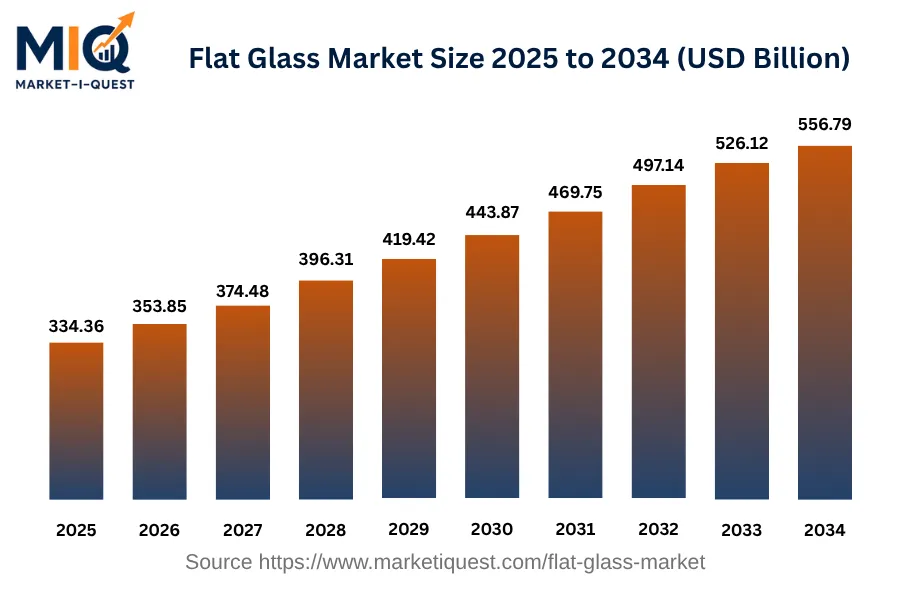
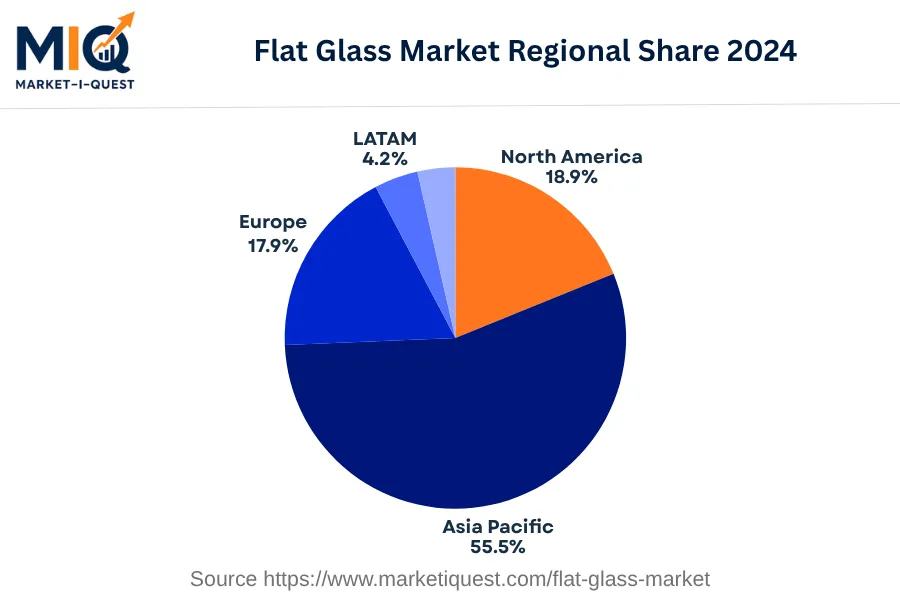
The Flat Glass Market size stood at 334.36 billion USD in 2025, with a noticeable growth from 315.94 billion USD in 2024. Over the course of a decade, from 2025 to 2034, the market expanded significantly to reach a value of 556.79 billion USD. The market showed a Compound Annual Growth Rate of 5.83% during this period, indicating a steady and consistent growth. The growth trajectory, reflected through specific anchor years, shows a strong market performance characterized by increasing demand and expanding consumer base. In terms of regional division, Asia Pacific held the major share in 2024 with 55.5% of the total market. This was followed by North America and Europe, accounting for 18.9% and 17.9% of the market share respectively. Meanwhile, Latin America and the Middle East & Africa held a smaller portion of the market, with 4.2% and 3.6% shares respectively.

Key Takeaways

  • By Product Type - Coated Glass expanded swiftly in the Flat Glass Market.
  • By End-Use Industry - Building & Construction held a notable position in the Flat Glass Market.
flat-glass-market market size

Key Driving Factors

Environmental Regulations on Building Energy Efficiency

Increasingly stringent environmental regulations across the globe are pushing toward constructing energy-efficient buildings, yielding a positive impact on the flat glass market. Regulations, such as Europe's Energy Performance of Buildings Directive and the US buildings energy code outlined by the Department of Energy, mandate a certain level of energy efficiency in residential and commercial buildings. To meet these standards, developers and builders resort to innovative solutions, one of which is the use of flat glass. Flat glasses, particularly those with low-emissivity coatings, aid in maintaining indoor temperatures and reduce energy consumption for HVAC systems. This regulatory environment has led to a growth in demand that manufacturers, contractors, and architects are capitalizing on, amplifying the expansion of the flat glass market.
Rise of Solar Energy Installations

The increasing adoption of renewable energy sources, notably solar energy, is another factor driving the flat glass market. Flat glass plays a significant role in photovoltaic (PV) panels – it's used as a protective, transparent cover that lets sunlight through while shielding the sensitive cells. The global transition to sustainable energy practices is seeing more countries, corporations, and households embracing solar panels. It's guided by government policies like China's 13th Five-Year Plan or the Renewable Energy Sources Act in Germany, promoting solar energy development. This trend consequently propels a surge in the flat glass market as manufacturers strive to meet the growing needs of PV panel producers.

Market Evolution by Timeline

2019-2023
Within this period, the primary demand for flat glass stemmed from the construction industry and the automotive industry, particularly in regions like China and Europe. Technological advances enabled the production of energy-saving flat glass, for example, through the integration of photovoltaic technology. Supply was slightly constrained due to stringent environmental regulations limiting natural gas usage in glass production. The prevalent commercial model involved direct sales contracts between manufacturers and entities in the construction and automotive industries. In terms of risks, industry players faced price volatility in raw materials, such as soda ash and silica sand, which they mitigated by entering multi-year supply agreements.
2024
In 2024, the flat glass market expanded into new application segments like solar energy and electronics, with heavy demand seen in the United States and emerging economies like India. On the supply side, manufacturers adopted electric furnaces for glass production as a greener and more energy-efficient alternative. Regulations incentivizing the use of renewable energy devices contributed to the demand increase in the solar energy segment. The typical commercial model employed was long-term contract sales, with flexibility in pricing to accommodate potential raw material cost fluctuations. Risk factors presented were mainly logistical, including disruptions in the supply chain due to unpredictable events.
2025-2029
During these years, demand was largely driven by the increasing adoption of smart glass in the architecture and automotive industries. This was especially pronounced in developed countries like Germany and Japan. In terms of supply, manufacturers leveraged advancements in nanotechnology for improved glass performance and functionality. However, high production costs posed a constraint. There was a rapid adoption of regulatory standards enhancing energy efficiency and reducing carbon emissions. The standard commercial model involved partnering with end-user companies in designing customized glass solutions. Risks included the possibility of new entrant competition, which companies navigated by focusing on innovative product development.
2030-2034
The flat glass market in this period saw increased demand from non-conventional sectors such as aerospace and defense, primarily in countries such as the U.S. and Russia. The supply side was characterized by the production of ultra-thin and flexible glass using advanced manufacturing processes. However, this innovation caused some difficulty in achieving economies of scale. Commercially, manufacturers inclined towards service-oriented models, providing after-sale services and maintenance. In terms of regulation, industries abided by stringent safety norms in the use of glass in aerospace and defense applications. Risks involved potential technology obsolescence, combated by continuous investment in research and development.

Future Market Outlook

Future Opportunities

Emerging applications such as photovoltaic glazing present compelling avenues for growth within the flat glass market. As of 2023, industry leaders like AGC Inc. have invested in building-integrated photovoltaics, integrating solar cells into window structures, thus catering to the increasing demand for renewable energy solutions in urban planning. Additionally, partnerships between technology firms and construction companies, such as the collaboration between Google and Saint-Gobain, emphasize the potential for smart building technologies. These efforts focus on developing glass products that enhance building automation and energy management systems, enabling smarter cities and improved energy consumption efficiencies. Geographically, markets in regions like North America are witnessing infrastructure revitalization, significantly increasing demand for high-performance flat glass in both residential and commercial spaces. Furthermore, regulatory frameworks like the California Energy Code of 2022 promote energy efficiency, motivating builders and developers to adopt advanced glazing technologies. The health-oriented market segment, prompted by a focus on air quality and natural light, is also encouraging innovations in triple-glazed windows and acoustic performance glass. As such, the flat glass industry is poised not only to respond to current regulatory and consumer expectations but also to shape future trends in building design and energy efficiency through continuous product development and collaboration across sectors.

Segmentation Analysis

By Product Type

The market is divided into subsegments including Clear Float Glass, Tempered Glass, Insulated Glass, Coated Glass, Annealed Glass, and Laminated Glass. Among these, the Coated Glass segment accounted for the largest revenue share while Tempered Glass is expected to grow at the fastest CAGR during the forecast period.

Largest Revenue Share

Coated Glass

Market Share Leader

Coated glass has emerged as the highest revenue-generating subsegment in 2024. This can be primarily attributed to the unique properties of coated glass, including enhanced energy efficiency, improved aesthetics, better safety protection, along with high durability and longevity. The demand for this type of glass has surged especially in industries like construction and automobiles where energy-saving, safety, and aesthetics are prioritized. Expanding urbanization and growth in the residential construction sector, particularly in emerging economies, also contribute to increase the demand. Moreover, rising environmental concerns drive the need for energy-saving products, further boosting coated glass adoption. The trend towards greener buildings and stringent government regulations on energy conservation also favor the coated glass market. While the initial investment is high, the long-term benefits in terms of energy saving provide a strong purchasing incentive. Distribution is typically direct from manufacturers or through specialty construction and automotive supply outlets.

Fastest CAGR

Tempered Glass

Forecast Period Growth Leader

Despite not being the largest segment in terms of revenue, the tempered glass tends to be the fastest-growing subsegment. Known for its strength and safety features, it has been increasingly utilized in various applications across industries, especially automotive and construction. The growth in these industries, particularly in developing regions, acts as a significant growth driver. Car manufacturers are looking to use more tempered glass due to its durability and resistance to damage, which is a crucial purchasing criterion given the increasing focus on vehicle safety. In the construction industry, tempered glass is becoming a popular choice for windows, doors, and partitions, given its resilience and breakage into small blunt pieces instead of sharp shards. Advances in glass manufacturing technology also aid in the wider adoption of tempered glass as it eases and speeds up the tempering process, thus reducing production costs. However, tempered glass can face adoption barriers, given its higher cost compared to standard glass options and the complexity of its installation and replacement process.

By End-Use Industry

The market is divided into subsegments including Building & Construction, Automotive, Consumer Goods, Solar, Others. The Building & Construction subsegment accounted for the largest revenue share while the Solar subsegment is expected to grow at the fastest CAGR during the forecast period.

Largest Revenue Share

Building & Construction

Market Share Leader

In the base year 2024, the Building & Construction subsegment of the market demonstrated the highest revenue. This is majorly attributed to the robust demand for buildings & infrastructures around the globe, particularly in developing economies. High growth in residential, non-residential, and infrastructure development projects are propelling the demand. The regulatory environment also plays a vital role, with more stringent building codes and standards coming into effect that encourage the purchase of higher-quality inputs. Purchasing criteria often revolve around durability, efficiency, and cost-effectiveness, giving an advantage to firms that can scale. Besides, the presence of established distribution channels helps the subsegment maintain its lead by ensuring a steady supply of the raw materials necessary for the construction industry.

Fastest CAGR

Solar

Forecast Period Growth Leader

The Solar subsegment of the market is projected to experience the highest CAGR currently. In terms of growth drivers, the urgent need to shift to renewable energy sources due to increasing environmental concerns is leading the way. Solar power generation is becoming increasingly popular as a renewable energy source, providing significant opportunities for future expansion. Despite initial adoption barriers such as high setup costs, advancements in solar technology, related policies, and substantial public and private sector capex are catalyzing the market's rapid growth. Partnerships among key players across the value chain are resulting in innovative and cost-effective solar energy solutions. However, near-term risks such as policy changes and potential raw material shortages could pose challenges to the sector's growth.

Competitive Analysis for Flat Glass Market

Key Market Players

Manufacturers / OEMs

AGC Inc.
Japan
Guardian Industries
US
Saint-Gobain
France

Key Suppliers & Raw Materials

Pilkington Group Limited
UK
Trakya Cam Sanayii A.Ş.
Turkey
Central Glass Co., Ltd.
Japan

Distributors, Integrators & Channel Partners

Nippon Sheet Glass Co., Ltd.
Japan
Cardinal Glass Industries, Inc.
US
Sisecam Group
Turkey

Porter’s Five Forces Analysis

This analysis represents a structured review of the competitive pressures within the Flat Glass Market.

Supplier Bargaining Power

Medium

Controlled by a few global manufacturers, the variance in raw material costs impacts prices.

Buyer Bargaining Power

High

Large-scale buyers like construction and automotive industries can influence prices due to their purchasing volume.

Threat of Substitutes

Low

Limited substitutes exist for flat glass due to its unique properties and widespread usage.

Threat of New Entrants

Low

High capex and stringent regulatory norms act as formidable barriers for newcomers.

Competitive Rivalry

High

Numerous global players compete fiercely on prices, quality, and innovation in the flat glass market.

Regional Analysis

Geographic market dynamics and growth opportunities across key regions

Global Market Outlook

flat-glass-market market regional share

North America

In 2024, the North American flat glass market was primarily influenced by increased construction activities, stringent regulations, and technological advancements. Demand surged due to the booming construction sector in the U.S., Canada, and Mexico, with substantial investment in both residential and non-residential projects. Regulatory pressures revolved around energy conservation; in particular, the U.S. Department of Energy's ENERGY STAR Program encouraged higher adoption rates of energy-efficient flat glass in building constructions. Technological innovation was also a key driver, as companies sought to incorporate smart glass technologies for enhanced functionality.

In terms of trends, changing buyer behavior significantly impacted the market, with consumers increasingly prioritizing sustainability and energy efficiency in their purchasing decisions. Furthermore, the steady shift towards smart home adoption amplified the utility of advanced flat glass technologies in the residential segment. In response, manufacturers started forming strategic partnerships and pursuing mergers and acquisitions to consolidate their positions and leverage shared technology. For instance, glassmaker Vitro's acquisition of PPG's flat glass business aimed at accessing their technology and expanding their customer base. Lastly, enforced policies like the Clean Energy Ministerial's Global Energy Efficiency Challenge directly influenced product standards and development strategies, pushing the entire industry towards more efficient, sustainable solutions.

Asia Pacific

In 2024, the Asia Pacific flat glass market experienced substantial growth driven by a surge in urbanization, infrastructural investments, and tech adoption. Strong demand from construction, specifically from China and India, reflected expanding urban living spaces and government-backed infrastructural projects. In Japan and South Korea, robust automotive markets drove flat glass use, particularly with the introduction of electric cars. Also, regulatory influences such as China's "Made in China 2025" initiative encouraged domestic production, stimulating investment and supply. Noteworthy trends in 2024 include a shift toward value-added glass for energy efficiency and luxury aesthetic. The rapid digitalization of retail channels especially in ASEAN region boosted glass use in interior and storefront construction. Simultaneously, an escalating environmental consciousness and stricter regulatory enforcement led to recycling partnerships among key players like Asahi Glass and Saint-Gobain.

Green building standards in Australia and Japan stress the use of energy-efficient flat glasses involving substantial glass surface area, leading to market growth. Sector-wise, increased flat glass adoption occurred in the healthcare sector for medical instrument and facility use. In the utility sector too, growth was spurred by the adoption of solar energy, which utilizes flat glass in photovoltaic modules. By 2024, the Asia Pacific flat glass market showed strong growth dynamics driven by regional economies, technology, and environment-centered regulations.

Europe

In 2024, the flat glass market in Europe exhibits substantial activity driven by diverse sectors across the continent. Key drivers include increased investment in construction and automotive sectors in Germany and the UK, adoption of solar energy in Spain and Italy stimulating demands for solar glass, and regulatory moves such as France's Grenelle II act prompting energy-efficient renovations. Supply dynamics are also shifting with Russia's increased flat glass production, satisfying Central and Eastern Europe's demand while impacting prices region-wide.

Consumer behavior has gravitated towards energy-saving and sustainable solutions, amplifying sales of low-emissivity and solar control glass. Technological advancements, specially in the UK and Germany, lean towards thin, lightweight glass in transport and consumer electronics sectors. M&A activities are visible, particularly with Saint-Gobain's acquisitions within the Benelux region reinforcing its market position. Enforced EU policies, like the Energy Performance of Buildings Directive, steer the industry towards energy-efficient flat glass. Within sectors, architectural glass remains dominant, followed by automotive and solar energy, while in retail, online channels gain popularity due to COVID-19 restrictions. Consequently, the European flat glass market of 2024 is shaped by a broad gamut of demand factors, regulatory influences, and evolving consumer trends.

Latin America

In 2024, the flat glass market in Latin America (LATAM) saw significant growth, fueled by strong demand and evolving industry dynamics. Drivers of this growth included increased spending in construction in countries such as Brazil, Argentina, and Mexico, due to rapid urbanization, escalating demand for aesthetically pleasing infrastructures, and favorable government regulations promoting infrastructural development. Additionally, significant investment in the automobile industry, especially in Mexico and Brazil, fueled demand for flat glass products due to their value in car manufacturing. Technological adoption further stimulated the market, as advanced manufacturing techniques provided more efficient and cost-effective production methods.

The year also saw shifting trends in the market, the most influential being the rising preference for energy-efficient, value-added glass products among consumers in sectors like housing, healthcare, and retail, due to growing environmental concerns. This consumer behavior led to increased product innovation and competition amongst manufacturers in LATAM, striving to deliver high-performance products catering to this demand. The incorporation of digital technology in glass production and sales channels also became more mainstream, enhancing product visibility and purchase convenience. Partnerships and mergers between local and international manufacturers were common, driven by the need to leverage each other's strengths and the motive to secure a larger market share. Increased scrutiny from regulatory bodies ensured adherence to safety standards, further impacting market dynamics.

Middle East & Africa

In 2024, the Middle East and Africa's flat glass market exhibited significant growth due to favourable market dynamics. Key drivers included escalating demand in construction and automotive sectors due to rapid urbanization, particularly in Saudi Arabia, UAE, and Qatar. Governments' supportive regulations, advancing investments in infrastructural developments, and accelerated technological adoption catalyzed this growth. Israel's embrace of energy-efficient buildings compelled the extensive use of flat glass, shifting market dynamics.

Market trends were shaped by shifting buyer behavior, notably the tilt towards sustainable and value-added solutions. Products underwent technology shifts, with smart glass and other energy-efficient varieties gaining traction. This shift strongly manifested in Egypt's expanding real estate sector, which adopted smart glass for its advantages over traditional products. South Africa, Nigeria, and Kenya observed an increased preference for domestic flat glass over foreign imports, promoting local manufacturing. Policy enforcement, particularly for eco-friendly production standards was another key trend, particularly in Saudi Arabia and UAE. Few significant partnerships or mergers and acquisitions were noted. Governments, construction, automotive, utilities, and manufacturing sectors were among the top customers. There was strong demand in the telecom and healthcare sectors of the UAE and Israel, due to rapid digitalization and advanced healthcare infrastructural developments respectively. Nigeria's growing retail sector also showed increased flat glass application. Overall, 2024 witnessed a booming Flat Glass market in Middle East and Africa.

Recent Industry Developments

Latest market innovations, product launches, and strategic initiatives

May 2026

Nemetschek Group India signed a three-year strategic MoU with New Consolidated Construction Company Ltd. (NCCCL) to embed high-velocity Building Information Modeling (BIM) and structured digital workflows into India's complex projects, with pilot projects launching with Runwal and L&T Realty.

April 2026

India's Environment (Construction and Demolition) Waste Management Rules, 2025 came into effect, mandating that processed waste shall be utilized in all construction activities having built-up area of 20,000 square meters or above

Frequently Asked Questions