Fire Resistant Glass Market Fire Safety Equipment Market Snapshot

Key Players

  • Honeywell International Inc. (US)
  • Johnson Controls (Ireland)
  • 3M Company (US)
  • Siemens AG (Germany)
  • Gentex Corporation (US)
  • Hochiki Corporation (Japan)
  • Halma plc (United Kingdom)
  • Securiton AG (Switzerland)

Market Size

Base Year 2024
$67.95 Bn
CAGR
6.75%
Forecast 2034
$130.58 Bn

Market Segments

By Solution
  • Detection
  • Suppression
By Application
  • Commercial
  • Industrial
  • Residential

Market Dynamics

Drivers
  • Increasing fire safety regulations
  • Enhanced consciousness about safety
Restraints
  • High installation costs
  • Lack of awareness
Opportunities
  • Rising industrial sector growth
  • Increasing fire safety regulations

Market Size

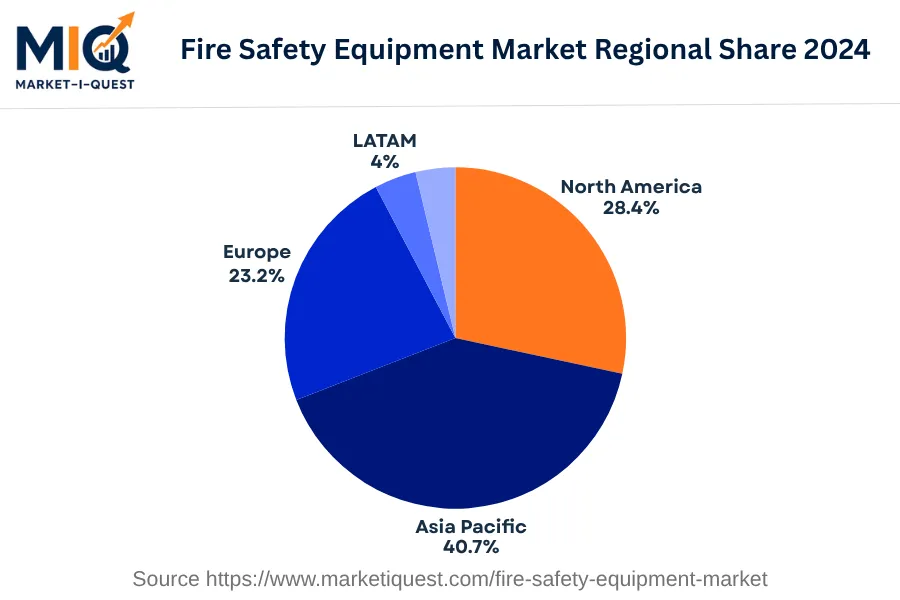
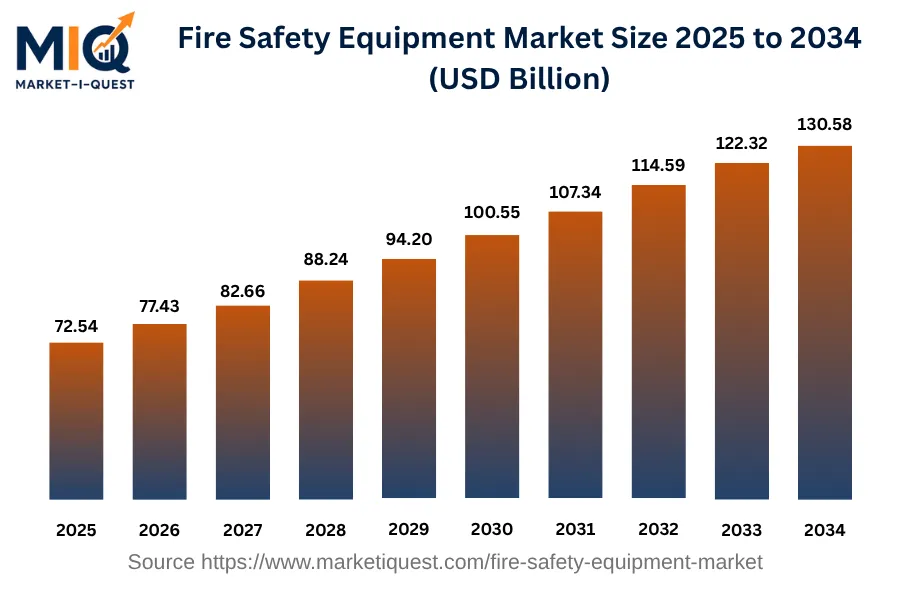
The Fire Safety Equipment Market is projected to grow from a size of USD 72.54 billion in 2025 to USD 130.58 billion in 2034, at a compound annual growth rate (CAGR) of 6.75%. Starting in 2024 when the market size was USD 67.95 billion, the market grew to USD 72.54 billion in 2025 and is anticipated to have a steady growth to reach its expected size of USD 130.58 billion by 2034. This growth is driven by the increasing demand and ongoing improvements in fire safety equipment to meet the rising safety concerns and regulations in industrial and commercial sectors. Another factor contributing to this growth is the large-scale deployment of technologically advanced fire safety equipment in buildings for ensuring their safety and mitigating financial losses in case of fires and related accidents. As of 2024, the greatest portion of the market share was held by Asia Pacific at 40.7%, followed by North America at 28.4%, and Europe at 23.2%. Moreover, Latin America and the Middle East and Africa held smaller shares of 4.0% and 3.8% respectively.

Key Takeaways

  • By Solution - Detection led the Fire Safety Equipment Market holding the most substantial share in base year.
  • By Application - Commercial segment dominated accounting for the highest market share in base year.
fire-safety-equipment-market market size

Key Driving Factors

Stringent Regulatory Compliances for Construction and Industrial Sectors

As per several global governments, it's mandatory for buildings, especially industrial and commercial ones, to meet strict fire safety standards. These regulations, such as the National Fire Protection Association (NFPA) codes in the US and the Regulatory Reform (Fire Safety) Order in the UK, require the installation and maintenance of fire safety systems, promoting the market for fire safety equipment. Therefore, with ongoing construction activities and the industrial sector's expansion, the need for fire safety equipment increases due to the existing regulations' strict protocols. Moreover, any negligence in compliance can lead to hefty fines or legal actions, compelling businesses to prioritize fire safety measures, thus driving the fire safety equipment market.

Rising Awareness and Education Programs on Fire Safety

Awareness and education programs organized by government bodies, institutions, and fire departments have significantly driven the market. These programs aim to enlighten people on the potential hazards of fire and the importance of having fire safety equipment at their workplace and homes. They emphasize the significance of precautionary measures like smoke detectors, fire extinguishers, and sprinkler systems to prevent, detect, and control fire incidents. These measures are enforced through regular checks, demonstration sessions, and mock drills. Consequently, the increase in fire safety awareness campaigns and the general public's proactive approach towards safety result in a higher demand for fire safety equipment, thereby driving the market.

Market Evolution by Timeline

2019-2023
In this period, increased regulations from authorities like the Occupational Safety and Health Administration (OSHA) and the National Fire Protection Association (NFPA) in the USA propelled demand for fire safety equipment in industrial zones and commercial facilities. Big buyers primarily included manufacturing businesses and educational institutions across North America and Europe. From the supply side, technologies like smart smoke detectors, fire sensors, and flame detectors were widely adopted. Suppliers faced challenges in integrating these technologies into older building infrastructures. Prices typically varied based on contract type, often long-term service agreements with annuity-based pricing models. Potential risks involved high installation costs for smart technologies.
2024
During 2024, there were notable shifts in procurement models, with companies favoring rental or leasing contracts for fire safety equipment due to capital expense concerns. Asia-Pacific buyers such as residential sectors and SMEs drove the market owing to improving safety standards. Suppliers started offering techno-commercially viable products like fire extinguishers, escape ladders, or integrated fire safety systems. Regulatory bodies introduced stringent safety norms, enhancing the adoption rate. However, lack of awareness and low penetration in resource-rich nations remained a roadblock to full market potential.
2025-2029
This phase saw a surge in demand from the Middle East and Africa due to large scale infrastructural development and aligned safety regulations. Commercial spaces, airports, and petrochemical industries emerged as dominant buying segments. Suppliers focused more on enhancing fire detection capabilities with Artificial Intelligence technology in detection systems. Green fire suppression systems became popular, complying with environmental safety regulations mandated by entities like the Environmental Protection Agency. Subscription-based maintenace contracts started prevailing. Though many were keen to adopt these tech advancements, they faced limitations in their implementation due to a lack of skilled professionals.
2030-2034
In this period, the market likely witnessed increased demand from emerging economies like India, Brazil, and South Africa propelled by rapid urbanization and stringent fire safety norms. Suppliers probably focused on leveraging Internet of Things (IoT) technology for remote monitoring and control of fire safety systems. Regulatory frameworks likely evolved to incorporate and encourage IoT-based fire safety solutions. Cost for fire safety equipment might have dropped due to an increase in suppliers and competitive pricing, making the equipment more accessible to the masses. The obstacle remained in the form of lack of reliable and high-speed internet connectivity in some target buyer regions.

Future Market Outlook

Future Opportunities

As fire safety regulations evolve, opportunities for growth in the fire safety equipment market are emerging, particularly with the integration of Internet of Things solutions. For example, the adoption of connected devices is expanding, as seen in recent partnerships in Europe between SmartFire and various municipalities aiming to enhance community-wide safety systems. With the increasing enforcement of regulations like the Fire Safety Act of 2021 in the UK, there is a growing demand for robust compliance-driven fire safety solutions. In Asia, countries like India are recognizing the urgent need for fire safety upgrades in commercial buildings, which presents significant potential for companies specializing in fire suppression technologies. The development of fire-resistant materials is also gaining momentum, particularly with ongoing research from institutions like the National Institute of Standards and Technology, highlighting advancements that can better withstand extreme temperatures. Additionally, the rising focus on sustainability is prompting organizations to explore eco-friendly fire safety products, creating openings for companies to innovate with green materials. The emphasis on training and education in fire safety is underlined by directives from bodies like the National Fire Academy, indicating a parallel market for educational tools and resources. As these factors converge, companies strategically focusing on compliance, innovation, and education are likely to capture a responsive market that seeks safety assurance in increasingly complex environments.

Segmentation Analysis

By Solution

The market is divided into subsegments including Detection and Suppression. Among these, the Detection subsegment accounted for the largest revenue share, while the Suppression subsegment is expected to grow at the fastest CAGR during the forecast period.

Largest Revenue Share

Detection

Market Share Leader

The Detection subsegment currently leads the market in terms of revenue. This dominance is primarily driven by the critical importance of early identification of issues to prevent significant impacts. Technologies under this subsegment like sensors and alarm systems are fundamental for industrial and commercial applications. They are widely adopted across a multitude of industries, such as manufacturing, healthcare, and real estate, in order to ensure safety and operational efficiency. Especially in geographies with strict regulatory requirements for safety standards, the uptake is significant, further expanding this subsegment's customer base. The value offered in terms of disaster prevention and the associated reduction in potential damages and losses, creates a high willingness to invest in these solutions. High switching costs also reinforce the dominance of this subsegment as customers want to avoid the risks and financial burdens associated with changing systems. Stable distribution channels also contribute to the continued strength of the Detection subsegment.

Fastest CAGR

Suppression

Forecast Period Growth Leader

On the other hand, the Suppression subsegment is expected to experience the fastest growth. This expected surge could be influenced by emerging technologies that offer improved efficiency and effectiveness in responding to detected issues. As the focus on preventive safety practices heightens, integration of sophisticated suppression systems such as automatic fire extinguishers and advanced chemical suppressants is gaining momentum. Companies are increasingly recognising the importance of not just detecting but also quickly countering threats to minimise damage. This shift underscores the heightened attention towards investment in suppression solutions, thereby driving its growth. However, barriers to adoption such as high initial capital expenditure enduring old infrastructure, might pose risks in the short-term. Strategic partnerships and policy changes to mandate the implementation of such technologies could serve as potential catalysts for this subsegment's growth.

By Application

The market is divided into subsegments including Commercial, Industrial, and Residential applications. Of these, the Commercial sector accounted for the largest revenue share, while the Residential sector is expected to grow at the fastest CAGR during the forecast period.

Largest Revenue Share

Commercial

Market Share Leader

In the base year 2024, the Commercial sector dominated the market in terms of revenue. Key drivers for this include the steady stream of new and upgrade projects emanating from various industries including retail, healthcare, and hospitality, among others. These businesses demand high-quality and efficient systems to meet their operational requirements including temperature control and energy efficiency, creating a continuous demand. Another factor is the regulatory environment that encourages commercial entities to invest in energy-efficient technology, which adds to the demand in this segment. Purchasing criteria often revolve around the reliability and longevity of these systems, as downtime can directly impact business operations and profitability. This creates a high switching cost, solidifying the commercial sector's revenue lead. A more intangible factor is the influence of location. Commercial entities often operate in urban areas, where access to and demand for this market's offerings are typically higher compared to more rural areas.

Fastest CAGR

Residential

Forecast Period Growth Leader

While the Residential sector does not command the largest revenue share, it is growing at an accelerated pace and holds promissory signs of being the fastest-growing subsegment. A major catalyst of this is the increasing focus on home automation and smart home technology, as more residents adopt high-tech, energy-efficient appliances to reduce expenses and increase convenience. Furthermore, government regulations and incentives promoting energy-efficient appliances also drive growth in this segment. However, adoption barriers do exist, such as higher up-front costs and the need for technical know-how to install and operate such appliances, which may moderate the growth rate. In the shorter term, the ongoing trend of urbanization and the consequent growth in construction of residential apartments should offer a robust demand landscape for the subsegment. However, changes in policy or economic downturns might pose risks of slowing down the otherwise high CAGR in this sector.

Competitive Analysis

Key Market Players

Manufacturers / OEMs

Honeywell International Inc.
US
Johnson Controls
Ireland
United Technologies Corporation
US

Key Suppliers & Raw Materials

BASF SE
Germany
3M Company
US
Sumitomo Wiring Systems
Japan

Distributors, Integrators & Channel Partners

Anixter International
US
WESCO International
US
Rexel Group
France

Porter’s Five Forces Analysis

This is a comprehensive analysis of the competitive dynamics within the Fire Safety Equipment Market.

Supplier Bargaining Power

Medium

Limited supplier concentration, but specialized manufacturing processes raise bargaining power.

Buyer Bargaining Power

High

Buyers have flexibility due to the presence of numerous suppliers and standardized products.

Threat of Substitutes

Low

Few substitutes exist due to fire safety regulations imposing unique product requirements.

Threat of New Entrants

Medium

High entry barriers due to regulatory certifications but the growing demand welcomes newcomers.

Competitive Rivalry

High

Several well-established companies compete on price, quality, and innovation within the market.

Regional Analysis

Geographic market dynamics and growth opportunities across key regions

Global Market Outlook

fire-safety-equipment-market market regional share

North America

In 2024, the North American fire safety equipment market was shaped by a combination of demand factors, regulatory compliance, technology adoption, and pricing strategies. Enhanced safety standards drove the demand, especially from the healthcare and manufacturing sectors in the U.S. and Canada. Regulatory requirements motivated increased investment in fire safety equipment by the government in Mexico. Advances in smart technology, such as IoT-integrated systems, saw a rise in adoption across all three countries, with the commercial sector leading the way.

Trends were characterized by a shift towards automated and integrated fire detection systems. This resulted from increased recognition of their value for early detection and control, particularly within the enterprise and utility sectors. In the retail industry, there was a noticeable preference for portable equipment due to space constraints and mobility needs. Consolidation through M&A activities was also witnessed aiming to expand product offerings and strengthen market share. There was an amplified focus on policy enforcement in 2024, with healthcare facilities in the U.S. showing significant compliance following the revised Life Safety Code by the National Fire Protection Association (NFPA). This adherence demonstrated the effect of stringent policy enforcement on the fire safety equipment market in North America.

Asia Pacific

In 2024, the fire safety equipment market in the Asia Pacific was met with a robust demand due to a variety of factors particularly revolving around drivers like regulatory policies, investment in safety infrastructure, and advancements in technology. Regulatory bodies in major economies such as China, India, and Japan imposed strict fire safety compliance norms to businesses, prompting increased adoption of high-quality fire safety equipment. Investment in safety infrastructure, specifically in Australia and key ASEAN markets, also led to the proliferation of advanced fire safety solutions. Moreover, rapid technology adoption infused the industry with innovative emergency response systems and automated fire prevention tools, further powered by strong supply dynamics and competitive pricing. For instance, smart smoke detectors and IoT-enabled safety systems became prevalent across various sectors including manufacturing, healthcare, and utilities.

Trends witnessed in 2024 underscored a shift towards integrated safety solutions and technology-driven products. Companies started seeking comprehensive security systems that would offer multi-faceted protection, accelerating partnerships and M&As in the sector. Offline to online sales channel dynamics were also evident, with buyers turning towards e-commerce platforms for ease of accessibility and variety. Importantly, the enforcement of regional and national standards for fire safety equipment acted as a major factor guiding product development and manufacturing processes in the region, in an effort to meet the stringent quality criteria.

Europe

In 2024, Europe's fire safety equipment market experienced significant acceleration, driven by various key factors. Sustainability concerns prompted rigorous updates to legislation and safety regulations across Germany, the United Kingdom, France, and Italy, stimulating increased investment in high-tech, environmentally friendly equipment. Spain, Nordic nations, and Benelux countries experienced heightened demand owing to widespread adaptation towards smart infrastructure, incorporating advanced fire safety systems in public buildings, healthcare facilities, and manufacturing units. The remarkably competitive pricing further propelled the market dynamics.

Additionally, buyer behavior demonstrated a noticeable shift towards better quality, more reliable systems, reflecting in the sales of widely respected brands. Central and Eastern Europe emerged as significant markets with the adoption of advanced technology as they modernized their older structures. Partnerships and M&As characterized channel dynamics as companies persistently endeavored to enhance the versatility of their offerings, such as France's prominent marriage of utility suppliers with fire safety equipment businesses. Implementation of stringent safety standards and strict policy enforcement by enterprise and government sectors led to substantial growth in the market demand. Overall, the market landscape in 2024 was characterized by a proactive regulatory environment and amplified demand for innovative technology.

Latin America

In 2024, the Fire Safety Equipment Market in Latin America (LATAM) showed strong activity due to several crucial factors. Increased investment in public safety initiatives by governments of countries like Brazil, Mexico, and Argentina drove demand for technologically advanced fire safety equipment. Regulatory developments, particularly in Brazil and Mexico which hold significant market shares, further compelled industries to upgrade their fire safety measures. Influential trends were seen in buyer behavior and adoption of technology. The healthcare and utilities sectors, for instance, increasingly prioritized automated fire detection and suppression systems due to their efficiency. Businesses in the retail and manufacturing sectors in Colombia and Chile, motivated by a stronger policy enforcement, moved towards more comprehensive fire safety solutions involving advanced detection systems, fire extinguishers, and protective clothing.

Channel dynamics within LATAM also evolved, with growing emphasis on partnerships and Merger and Acquisition (M&A) activities to expand geographical reach and product portfolio. For example, M&A became a common strategy in Peru's fire safety equipment distribution. Also noteworthy was the growing standardization of fire safety equipment across LATAM, making it easier for customers to rely on the quality and effectiveness of the products. This reinforced the trust between manufacturers, distributors, and end-users, further strengthening LATAM's Fire Safety Equipment Market.

Middle East & Africa

In 2024, the fire safety equipment market in the Middle East and Africa was significantly impacted by several key drivers and trends. Regulatory authorities across countries like Saudi Arabia, UAE, Qatar, and Kenya made solid strides to strengthen their fire safety norms, stimulating demand for fire suppressing equipment and fire detection systems. Increased investment in infrastructural development, especially in sectors like utilities, healthcare, and telecom, also bolstered market growth. Additionally, rapid technology adoption contributed to supply dynamics, with innovative fire safety equipment, including smart smoke detectors and advanced fire extinguishing systems, gaining traction.

Shifting buyer behavior stimulated a market trend towards digital, multifunctional fire safety solutions, particularly in Egypt, Nigeria, and South Africa, where growing emphasis on smart homes and industrial automation was evident. In Israel, channel dynamics were shaped by both direct and indirect sales of fire safety equipment due to the presence of a wide range of retailers and distributors. Collaborations and strategic partnerships also emerged as reliable growth strategies, helping companies to tap into new market segments and expand their customer base. Compliance to international fire safety standards and policy enforcement, specifically in robust economies like UAE and Saudi Arabia, was evident and strongly encouraged adherence to quality in production and installation of fire safety equipment.

Recent Industry Developments

Latest market innovations, product launches, and strategic initiatives

March 2026

3M (NYSE: MMM) entered into a definitive agreement to acquire Madison Fire & Rescue from Madison Industries for **$1.95 billion**, in partnership with Bain Capital. 3M will contribute its Scott Safety business to a new joint venture, receive $700 million in cash proceeds, and own 50.1% of the new company, with Bain Capital owning 49.9%. The transaction is expected to close in the second half of 2026.

May 2025

Total Safety U.S., Inc. (a portfolio company of Littlejohn & Co.) acquired Dooley Tackaberry, Inc. , a Texas-based distributor of fire and safety equipment to the oil and gas industry and municipal fire service market, founded in 1925. Dooley combined with Total Safety's Industrial Fire and Safety Division.

Frequently Asked Questions