Fire Resistant Glass Market Snapshot

Key Players

  • AGC Inc. (Japan)
  • Promat International NV (Belgium)
  • Glassolutions Saint-Gobain (France)
  • Fuso Glass India (India)
  • Nippon Sheet Glass Co. Ltd. (Japan)
  • Central Glass Co. Ltd. (Japan)
  • CGI International Limited (US)
  • Schott AG (Germany)
  • Youghiogheny & Ohio Glass Co. (US)

Market Size

Base Year 2024
$5.27 Bn
CAGR
8.24%
Forecast 2034
$11.63 Bn

Market Segments

By Material Type
  • Glass-Ceramic
  • Intumescent Paint
  • Laminated Glass
  • Wired Glass
  • Transparent Glazing Materials
By Fire Resistance Rating
  • 30 Minutes
  • 60 Minutes
  • 90 Minutes
  • 120 Minutes
  • 180 Minutes
By End User
  • Commercial Buildings
  • Residential Buildings
  • Government Facilities
  • Educational Institutions
  • Healthcare Facilities
  • Others

Market Dynamics

Drivers
  • Increasing urbanization
  • Stringent safety regulations
Restraints
  • High manufacturing costs
  • Stringent regulations
Opportunities
  • Increased construction safety regulations
  • Growing demand in industrial sector

Market Size

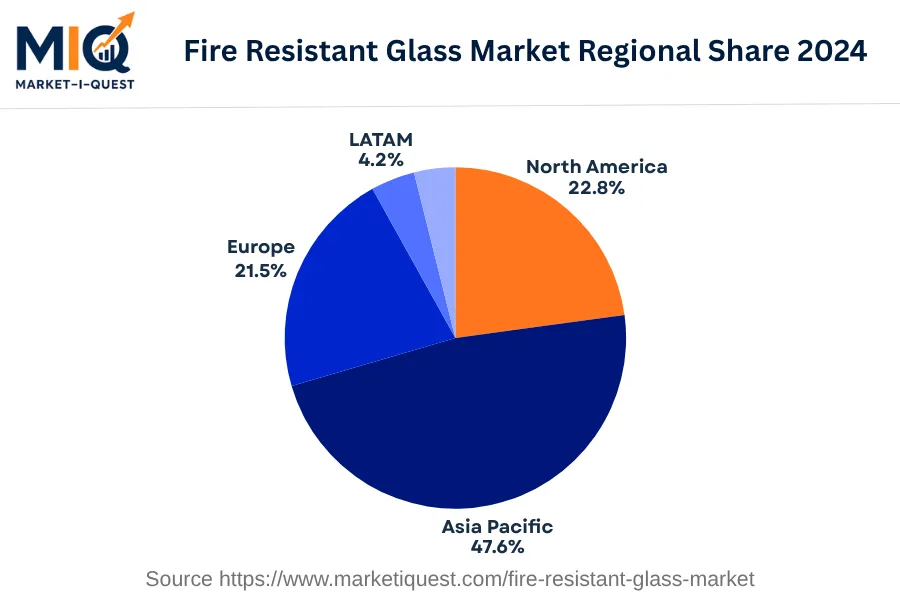
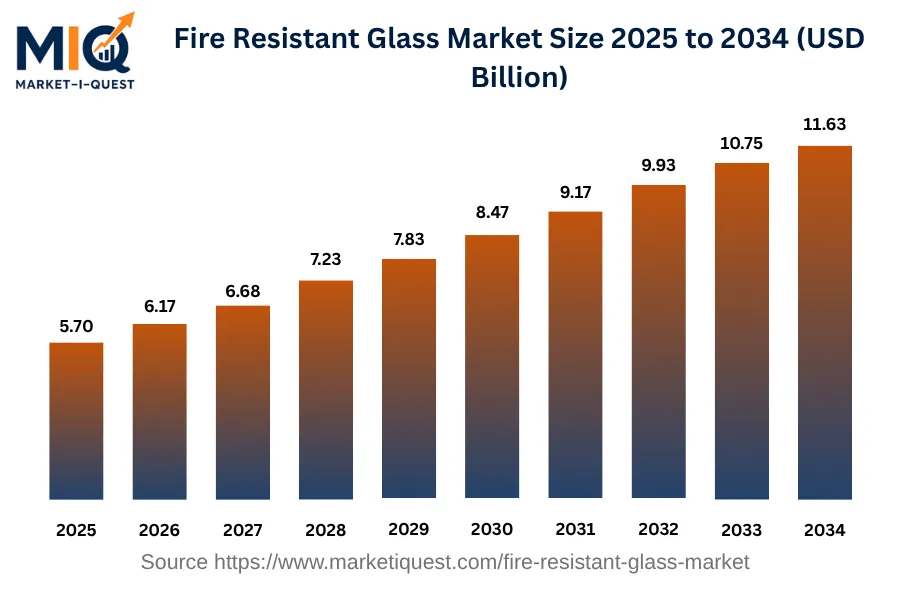
The Fire Resistant Glass Market, which stood at USD 5.27 billion in 2024, grew to a size of USD 5.70 billion in 2025. In the following years, the industry underwent steady growth, culminating in a market size of USD 11.63 billion by 2034. This represents a compound annual growth rate (CAGR) of 8.24% over the span of ten years. The increase in market size can be attributed to demand for fire resistant glass, which offers protection grade against the spread of fire and heat in cases of structural fires, thereby ensuring greater security and reducing damage. A regional breakdown of the market in 2024 indicates that the Asia Pacific region held the largest share of market at 47.6%. It was followed by North America and Europe with 22.8% and 21.5% respectively. Meanwhile, the shares of Latin America (LATAM) and the Middle East and Africa (MEA) were relatively low at 4.2% and 3.9% respectively.

Key Takeaways

  • By Material Type - Laminated Glass held the major share accounting for a significant position in this market.
  • By Fire Resistance Rating - 60 Minutes segment led the race indicating a rising demand for longer protection duration.
  • By End User - Commercial Buildings reigned showing a high demand for fire safety measures in business establishments.
fire-resistant-glass-market market size

Key Driving Factors

Enforcement of Stringent Building Safety Codes

A key driving factor in the Fire Resistant Glass Market is the increasingly strict enforcement of building safety codes across the globe. In regions with high-risk fire zones, from urban parts of North America to bushfire-prone areas of Australia, the legal requirement to use fire resistant materials in construction, particularly for major commercial and residential projects, has dramatically boosted the adoption of fire-resistant glass. Beyond its incorporation in the initial build, it often must be used in renovations or extensions as an adherence to safety standards.

Surge in High-Rise and Smart Building Projects

Another distinct driving factor is the global surge in the construction of high-rise and smart buildings. With urbanization on the rise, cities across the world are seeking to manage their limited space by commissioning taller structures. Moreover, the trend towards integrating smart technologies into buildings also fuels this demand. Fire resistant glass plays a crucial role in these structures because it provides the essential dual function of providing natural light while meeting stringent safety standards. Therefore, architects, property developers, and urban planners are considerably opting for fire resistant glass, setting a robust momentum for the growth of this market.

Market Evolution by Timeline

2019-2023
In these early years, the main buyers of the fire-resistant glass are commercial sectors due to regulation requirements and safety standards. The main regions driving demand are the U.S., Germany, and China due to infrastructure expansion and renovations. Swedese Glas, Schott, and Saint-Gobain are major supply players. The technology in this period becomes advanced with improved fire resistance. Yet, high manufacturing costs pose significant constraints. Policing, often local, dictates the use of fire-resistant glass in certain buildings and construction projects. Prime examples are the building regulations in the UK. The pricing model is cost-intensive, often resulting in longer-term contracts to spread the costs. Risks include slow adoption because of its high cost compared to regular glass.
2024
By 2024, growth in industrial and residential sectors start to increase fire-resistant glass adoption. The Asia-Pacific region, led by Japan and South Korea, becomes a major demand driver due to rapid urbanization. New players, such as Nippon Sheet Glass and Asahi Glass, emerge in the market. Fire and acoustic rated products become a standard offering. High manufacturing costs remain an issue but are gradually being offset by economy of scale. Building codes and regulations continue to influence purchase decisions. The trend towards collaboration between manufacturers and local construction companies solidifies in order to overcome cost barriers.
2025-2029
In this period, demand sees noticeable growth from developing countries like India and Brazil due to improved building regulations. Furthermore, the need for energy-efficient windows in both residential and industrial sectors fuels demand. Glass technology advances with the emergence of more durable and longer fire-resistant glasses. Despite advancements, the costs remain high due to the complex manufacturing process. Stricter fire safety regulations become a key driver for adoption. The increase in public-private partnerships in infrastructure projects fosters long-term supply contracts. High costs and installation complexities remain the main risks faced.
2030-2034
The 2030s witness a surge in demand from evolving markets such as the Middle East and Africa. Growing demand from the high-rise buildings segment in these regions pushes forward innovations in fire-resistant glass technology. The market witnesses an increase in mergers and acquisitions, unveiling a trend of consolidation. The launch of energy-saving fire-resistant glass products opens a new segment. Regulations remain stringent, with global pushes for safer and more energy-efficient buildings. Anticipating further cost reduction contributes to increased competitiveness among suppliers. Despite these trends, risks surrounding installation and human resources capability pose new challenges.

Future Market Outlook

Future Opportunities

Future opportunities in the fire resistant glass market are poised for growth as regulations surrounding fire safety continue to tighten. The National Fire Protection Association has proposed further updates in its codes, particularly within healthcare and educational facilities, creating demand for advanced fire resistant glass products. In 2022, governments in regions like North America and Europe emphasized retrofitting older buildings to conform with modern fire safety standards, thereby driving up the need for compliant materials like fire resistant glass. Simultaneously, the demand for green building solutions is on the rise, with LEED certification increasingly favoring the use of sustainable materials that include fire rated glass options. Manufacturers are also exploring partnerships with smart technology providers to integrate fire resistant glass into smart building systems, particularly relevant as more cities worldwide adopt the Internet of Things to enhance building safety. In 2023, the global push for energy-efficient construction techniques has further incentivized the development of multi-functional fire resistant glass, which can also provide insulation benefits. This trend is particularly significant in emerging markets, where urban development projects must adhere to stringent building codes while remaining cost-effective. Overall, the convergence of regulatory pressures, sustainability initiatives, and technological advancements creates a robust platform for growth and innovation in fire resistant glass applications.

Segmentation Analysis

By Material Type

The market is divided into subsegments including Glass-Ceramic, Intumescent Paint, Laminated Glass, Wired Glass, and Transparent Glazing Materials. Out of these, Laminated Glass accounted for the largest revenue share while Transparent Glazing Materials is expected to grow at the fastest CAGR during the forecast period.

Largest Revenue Share

Laminated Glass

Market Share Leader

The Laminated Glass subsegment emerged dominant thanks to several driving factors. Key among these is its superior safety features, reducing the risk of injury upon breakage - a distinguishing feature that has heightened its demand particularly in sectors like construction and automobile. Geographically, regions with regulation favoring safety glass in construction, such as Europe and North America, have contributed significantly to its revenue share. Notably, Laminated Glass offers advantages over alternatives like wired glass in terms of aesthetic appeal and security, making it a preferred choice for modern infrastructural projects. In terms of purchasing criteria, consumers often consider factors such as safety, design versatility, and sound reduction capabilities – all of which tip the scale in favor of Laminated Glass. Lastly, tight supply chains and high switching costs associated with replacement and reform have further consolidated the leading position of this subsegment in the market.

Fastest CAGR

Transparent Glazing Materials

Forecast Period Growth Leader

Transparent Glazing Materials is projected to stand out as the fastest growing subsegment. Successful advancements in technology, particularly nanotechnology, have acted as a significant catalyst in this growth. Transparent glazing materials now come with improved thermal insulation and light transmittance, thus energy efficiency, lowering users' overall costs and supporting global sustainability initiatives. Policymakers' emphasis on energy-efficient construction and retrofitting existing buildings with energy-efficient alternatives boosts this subsegment's growth. Moreover, increased capital expenditure on research & development and partnerships for technological advancements have accelerated the adoption of Transparent Glazing Materials. Despite this promising outlook, near-term risks include potential regulatory changes affecting the supply of raw materials and price volatility in the market, due to its dependency on the global economy.

By Fire Resistance Rating

The market is divided into subsegments including 30 Minutes, 60 Minutes, 90 Minutes, 120 Minutes, and 180 Minutes fire resistance ratings. The 60 Minutes fire resistance rated segment accounted for the largest revenue share, while the 180 Minutes segment is expected to grow at the fastest compound annual growth rate (CAGR) during the forecast period.

Largest Revenue Share

60 Minutes

Market Share Leader

The 60 Minutes fire resistance rating leads the market as the largest revenue-generating subsegment. It's primarily driven by its optimal balance between cost-effectiveness and functional superiority. The duration of 60 Minutes is substantial enough for most residential and commercial requirements, providing an ideal fire protection solution that suits a broad range of applications. The regulation standards in many regions, considering both safety and economic factors, recommend or require this level of fire resistance. Such mandates from regulatory bodies subsequently result in strong demand. Aside from regulation, there's a high degree of customer awareness and preference for this category due to its proven effectiveness in a variety of scenarios. Its widespread acceptance and use across building and construction sectors have also fostered stable supply chains and distribution networks, further improving its market viability.

Fastest CAGR

180 Minutes

Forecast Period Growth Leader

Although the 180 Minutes fire resistance rating segment accounts for a smaller portion in the current market, its remarkable potential for growth can't be overlooked. The driving factor for this growth is an increasing demand for advanced fire protection solutions in industries where a higher level of protection is crucial. For example, industries with high-risk fire hazards and extensive capital investments such as data centers, power plants, and chemical processing facilities. It's also relevant in densely populated or high-occupancy buildings like hospitals or high-rise residential structures where prolonged evacuation time is required. However, the high purchase and installation cost of 180 Minutes rated materials could act as an adoption barrier. Technological advancements aimed at reducing costs, partnered with increasing regulatory stringency for high-risk environments, are expected to provide a significant boost to the growth of this segment.

By End User

The market is divided into subsegments including Commercial Buildings, Residential Buildings, Government Facilities, Educational Institutions, Healthcare Facilities and Others. Commercial Buildings accounted for the largest revenue share while Educational Institutions is expected to grow at the fastest CAGR during the forecast period.

Largest Revenue Share

Commercial Buildings

Market Share Leader

Commercial buildings, as a subsegment, leads in revenue generation with the backing of a booming commercial real estate sector. The rise in urbanization, coupled with business expansion and development activities, are primary drivers. Commercial entities mainly rely on having facilities in strategic, heavily frequented locations, thus demand for commercial buildings remains high. Large metropolis areas see a higher concentration of revenue, thanks to higher rent prices and increased demand. It's also worth noting that commercial buildings encompass a broad definition, ranging from office buildings, retail stores, to warehouses which increases their prominence as a major revenue contributor. Regulation-wise, government policies promoting commercial establishments in new urban regions as growth accelerators too play a pivotal role in the revenue pie. From the purchasing standpoint, commercial entities prioritize location, space, and cost-efficiency as key criteria driving decision making in this segment. Moreover, due to high initial investment and switching costs related to relocation, entities tend to stick with chosen properties for an extensive period contributing to sector stability.

Fastest CAGR

Educational Institutions

Forecast Period Growth Leader

The Educational Institutions subsegment showcases the fastest Compound Annual Growth Rate (CAGR). This growth is primarily led by the increasing emphasis on education and the consequent swell in enrollment numbers. Technological advancements serve as a significant driver, with institutions investing in modern infrastructure to offer a conducive learning environment and stay competitive. Policy reforms advocating for educational institutional growth and public-private partnerships in the education sector fuel this upward trajectory. However, there are considerable expenses involved, generally related to construction, maintenance, and the implementation of advanced technologies. Such capital expenditure requirements could potentially act as a barrier to speedy adoption. Also, near-term uncertainties induced by policies or geopolitical situations might pose risks to the exponential growth of this segment. The continuous pursuit of academic excellence, achieved by offering superior facilities, drives the institutions to overcome these obstacles and further accelerates growth.

Competitive Analysis

Key Market Players

Manufacturers / OEMs

NSG Group
Japan
Asahi Glass co. ltd.
Japan
Vetrotech Saint-Gobain
France

Key Suppliers & Raw Materials

Pilkington Group Limited
UK
SCHOTT AG
Germany
Ravensby Glass Company Ltd
UK

Distributors, Integrators & Channel Partners

Romag
UK
Technical Glass Products
US
Rayotek Scientific Inc.
US

Porter’s Five Forces Analysis

An evaluation of the competitive dynamics in the Fire Resistant Glass Market.

Supplier Bargaining Power

High

Limited suppliers and high input costs significantly boost supplier power.

Buyer Bargaining Power

Medium

Differentiated products but potential for use of alternative materials limits buyer power.

Threat of Substitutes

Low

Strict safety regulations and unique properties minimize threat of substitutes.

Threat of New Entrants

Low

Capital-intensive industry and high barriers to entry discourage potential entrants.

Competitive Rivalry

High

Intense competition with several large firms and aggressive pricing policies.

Regional Analysis

Geographic market dynamics and growth opportunities across key regions

Global Market Outlook

fire-resistant-glass-market market regional share

North America

In 2024, North America stood as an key player for the Fire Resistant Glass (FRG) market due to the increased demand in several sectors and strict safety regulations. Regulatory guidelines, such as the U.S. General Services Administration's fire safety standards, demand the usage of FRGs in public buildings, driving market growth. Increasing investment in construction, particularly in the U.S. and Canada, has spurred the demand for FRGs. Adoption of advanced technologies in the manufacturing process has improved the quality of glass, contributing to supply dynamics. Pricing patterns have been predominantly determined by the cost of raw material and production cost.

Several trends marked the FRG market. As safety concerns grow, buyers have shown preference for technologically superior products, including wireless glass break detectors and smart FRGs. The major shift towards online channels for retail has impacted the distribution dynamics in the market. Moreover, partnerships and mergers became crucial for expansion strategies, like the noteworthy alliance between NSG Group and Solaria in the U.S. Stricter policy enforcement in sectors such as government, retail and healthcare mandated the use of FRGs to ensure security and protection. This sharper focus on safety standards, combined with technological advancements and changes in distribution channels, played significant roles in shaping the North American Fire Resistant Glass market.

Asia Pacific

In 2024, the Fire Resistant Glass market in Asia Pacific witnessed noticeable growth, steered by drivers including demand and regulatory requirements, and notable trends in the region. Increasing urbanization and massive construction projects, particularly in China and India, propelled the demand for fire-resistant glass. Both these markets saw stringent regulatory norms for safety and fire resistance in construction projects, affecting the need for fire-resistant glass. Australia, Japan, and South Korea followed suit. High investment levels in infrastructural development, specifically in government, commercial, and residential buildings, also significantly contributed to the impetus. Simultaneously, new and emergent technologies for fire-resistant glass were being adopted speedily across Asia Pacific. China, being the major manufacturing hub, leveraged its supply dynamics, despite complex pricing fluctuations.

Several interesting trends were noted: the buyer preference was getting inclined towards green construction methods leading to higher demand for efficient, fire-resistant options. Product innovation, such as thermally broken glass units, gained momentum to meet this demand. In terms of channel dynamics, the e-commerce platform witnessed tremendous growth, primarily among retail consumers in populous countries like India and China. Further, there was increased policy enforcement in key ASEAN markets as safety regulations tightened. Partnerships and Mergers & Acquisitions between manufacturers and construction companies were witnessed, primarily to fulfill rising demand and regulatory standards.

Europe

In 2024, the Fire Resistant Glass Market in Europe is characterized by its steady growth and increasing adoption across various sectors. The robust demand is driven by stringent safety regulations in various European economies and the commitment of businesses to uphold the highest safety standards. For instance, improvements in building safety codes in Germany and the United Kingdom have spurred installations of fire-resistant glass. Prominent factors driving demand include increasing investment in infrastructure development and greater adoption of advanced technologies. Further, a surge in retrofitting and renovation projects particularly in residential and commercial buildings have led to an increased use of fire-resistant glass in countries such as France, Italy, Spain, and Benelux. Trends shaping the market include a shift in buyer preferences towards aesthetically appealing fire-resistant glass. Notably, fire-resistant glass partnerships and mergers have also intensified, as seen with entities in Central & Eastern Europe and the Nordics, leading to an enriched product range.

Additionally, industry standards, such as EN 1363-1 in Germany, requiring specific fire resistance levels have further fueled the market. The most evident end-user sectors include manufacturing, retail, and healthcare demonstrating an increased commitment to safety and compliance to stringent government regulations. The trend underscores a wider recognition of the protective benefits offered by fire-resistant glass.

Latin America

In 2024, the Latin American market for fire-resistant glass experienced significant growth driven by increased demand and evolving regulations. Brazil's stringent safety regulations in the construction sector, combined with Mexico’s robust investment in infrastructure development, significantly drove demand. Adoption of advanced fire-resistant technology was prevalent, particularly in Argentina, supported by favorable governmental policies. High supply dynamics in Colombia due to the presence of several key manufacturers, coupled with competitive pricing strategies in Chile, further propelled the market. In terms of trends, consumer behavior shifted towards high-quality, durable fire-resistant glass, notably seen in Peru's commercial and residential construction sectors. Technological advancements in fire-resistance increased, influencing preferred product choices across the region. Consolidation and partnerships also characterized the market, with numerous M&A agreements occurring amongst manufacturing companies. In regions like Brazil and Mexico, stricter enforcement of fire safety standards became visible, triggering a surge in the usage of fire-resistant glass.

Key sectors driving this market were predominantly construction, healthcare, and manufacturing. The rapid expansion of retail infrastructures and government buildings also played a vital role. With cities in LATAM focusing on growing vertically, government regulations emphasized the safety of high-rise structures, subsequently skyrocketing the demand for fire-resistant glass products in 2024. Demand was particularly prominent in industries where fire safety was paramount, marking a significant uptake in the usage of fire-resistant glass.

Middle East & Africa

In 2024, the Fire Resistant Glass Market in the Middle East and Africa depicted a promising outlook primarily driven by growing safety regulations and investment from sectors like oil and gas, construction, and manufacturing. First, increased emphasis on safety standards driven by governments, as seen in Saudi Arabia and Qatar, generated substantial demand for fire-resistant glass. Second, rising investment in infrastructure projects, evidenced by the United Arab Emirates' rapid urban development, significantly boosted the market. Finally, the adoption of advanced safety technologies by manufacturing and construction industries in Egypt and South Africa factored into the market growth.

Trends exhibited in the market involved changing buyer behavior and a pinch of technology shifts. A noticeable trend was the shifting preference of buyers, with sectors such as healthcare, telecom, and utilities in Nigeria and Kenya increasingly opting for fire-resistant glass due to enhanced safety needs. Additionally, there was a technological shift towards more durable and heat-resistant glass variants, primarily in Israel, driven by a heightened focus on building safety. Lastly, partnerships and mergers were prevalent as companies sought to consolidate market share and expand their footprints, especially in countries like South Africa and Egypt, reflecting the competitive dynamics of the fire-resistant glass market in the region.

Recent Industry Developments

Latest market innovations, product launches, and strategic initiatives

April 2026

Nippon Electric Glass (NEG) launched FireLite® F Airity™, a new fire-rated glass created by applying posica™ kukkiri™ film to FireLite® glass-ceramic. The product achieves both fire protection and natural color reproduction, with exceptional thermal shock resistance (withstands heating to 800°C followed by water application). It is available in sizes up to 1,200 mm × 3,000 mm.

October 2025

Pyroguard launched the Pyroguard Balustrades Evo range, a thinner, lighter fire-rated glass specifically for balustrades that achieves A2 fire-rated performance. The new range reduces interlayer thickness from 3 mm to 1.5 mm, offers weight savings of up to 6%, and improves embodied carbon by up to 7.5%.

Frequently Asked Questions