
Untitled Report Snapshot

Key Players

  • Honeywell International Inc. (United States)
  • Siemens AG (Germany)
  • Johnson Controls (Ireland)
  • Schneider Electric (France)
  • Gentex Corporation (United States)
  • Robert Bosch GmbH (Germany)
  • Nittan Company (Japan)
  • Assa Abloy (Sweden)

Market Size

Base Year 2024
$34.74 Bn
CAGR
6.5%
Forecast 2034
$65.21 Bn

Market Segments

By Detector Type
  • Flame
  • Smoke
  • Heat
By Alarm Type
  • Audible
  • Visual
  • Manual Call-points
By Application
  • Commercial
  • Industrial
  • Residential

Market Dynamics

Drivers
  • Increasing safety concerns
  • Rapid urbanization and industrialization
Restraints
  • High installation costs
  • Regulatory compliance challenges
Opportunities
  • Rising safety concerns
  • Technological advancements in detection systems

Market Size

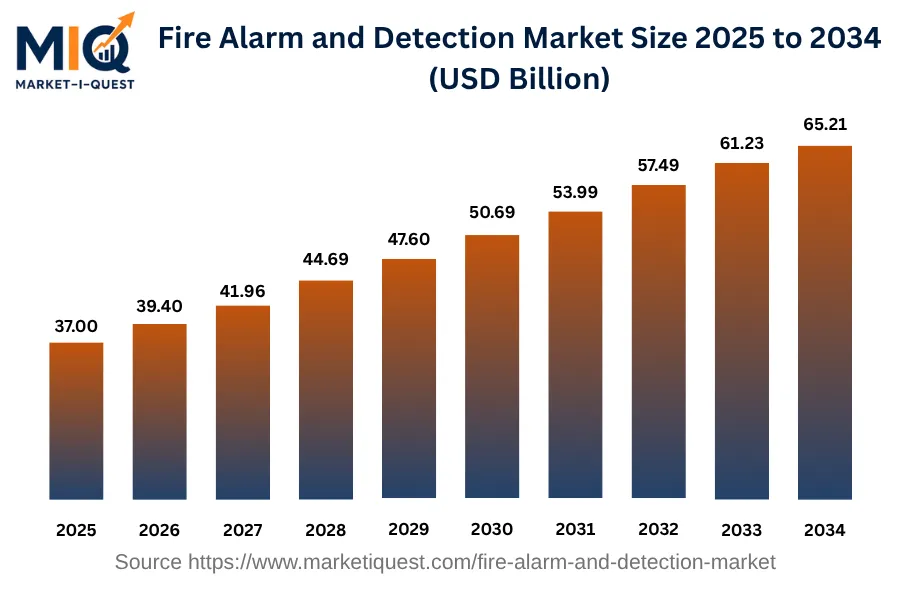
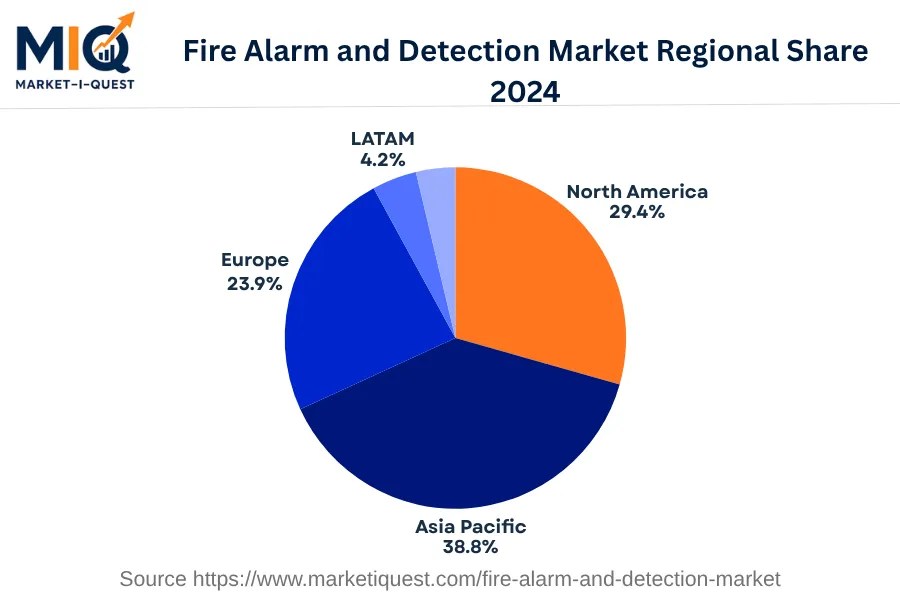
The Fire Alarm and Detection Market was valued at 36.9981 Billion USD in 2025, rising from 34.74 Billion USD in 2024. By 2034, it is projected to reach a value of 65.21 Billion USD, following a CAGR of 6.5%. The market growth is characterized by expansion at consistent rates across the decade from 2025 to 2034. In 2024, the market had a distinctive regional share mix as follows: The Asia Pacific dominated the market with a share of 38.76%, followed by North America at 29.38%, and Europe holding 23.91%. Meanwhile, remaining regions, Latin America and the Middle East and Africa (MEA), contributed with smaller shares, 4.23%, and 3.72% respectively. The data implies a clear dominance by Asia Pacific, North America, and Europe regions in the Fire Alarm and Detection Market.

Key Takeaways

  • By Detector Type - Smoke detectors led the market in terms of installation base across segments in 2024.
  • By Alarm Type - Audible alarms held the majority share with widespread applications across commercial and residential spaces in 2024.
  • By Application - Commercial segment accounted for the largest market share with increased adoption in workplaces and public areas in 2024.
fire-alarm-and-detection-market market size

Key Driving Factors

Enforcement of Strict Building Safety Regulations

The fire alarm and detection market is currently experiencing a surge, significantly driven by the progressive enforcement of strict building safety regulations. These rules are imposed by government bodies such as the International Code Council (ICC) and Occupational Safety and Health Administration (OSHA) in the U.S., which mandate the installation of fire alarms and detection systems in all residential, commercial, and industrial buildings. Non-compliance can result in severe penalties, spurring constructors, property owners, and managers towards the quick adoption of these systems. Such regulatory pressure is prevalent across developed and developing countries alike, pushing the rapid expansion of the market on global scale.
Insurance Companies' Requirement for Risk Mitigation

Insurance providers are a significant driving force for the fire alarm and detection market. Their need to mitigate risk and reduce potential payouts related to fire damage has led them to stipulate the installation of fire detection systems as a primary requirement in their insurance agreements. Property owners seeking to acquire or renew property and building insurance policies are, therefore, compelled to invest in these systems. Additionally, many insurance providers offer premium discounts for buildings equipped with advanced fire detection solutions, further incentivising their implementation. As such, the insurance industry is actively fuelling the growth of the fire alarm and detection market.

Market Evolution by Timeline

2019-2023
During this period, Europe represented the core buyer market due to local regulations enforcing use of upgraded fire detection systems in commercial spaces. US suppliers dominated shipments. Noteworthy new technology included IoT-enabled systems designed for easier integration with existing home and building management systems. Significant policy incentives came from the European Union's EN 54 Fire Detection and Fire Alarm Systems standards requiring certain product specifications. Pricing structures were marked by front-loaded cost models, with large initial system setup fees followed by smaller maintenance costs. The principal risk was the lack of skilled installers.
2024
In 2024, the emerging markets in Asia showed increased buyer demand influenced by rising awareness of fire safety measures. Wireless fire detection technology experienced a surge in shipments from technology-heavy countries like Japan and South Korea. In the US, new regulations built upon NFPA 72 encouraged further adoption of sophisticated detection systems. Buying trends saw a shift towards service-based pricing models where system providers also took up maintenance roles. The lack of a universal technological standard posed a challenge to product interoperability, slowing market penetration.
2025-2029
The demand for Fire Alarm and Detection systems expanded into South American countries from 2025–2029. Multi-sensor detection technology that reduces false alarms became popular among buyers. The development of UL 217 standard in the US focused on improving detection speed and accuracy. Commoditized hardware led to increased competition, forcing suppliers to include value-added services in their pricing models. The prevalent risk was a surge in counterfeit products, resulting in collaboration between manufacturers and regulatory bodies to assure quality standards.
2030-2034
From 2030 to 2034, the Middle East and North Africa accounted for a noteworthy share of the buyer market, owing to extensive infrastructure development. The trend toward integration of artificial intelligence in fire detection systems became prominent. An important development in policy was the reinforcement of the EN 54 Fire Detection and Fire Alarm Systems standards in Europe. As an outcome, most contracts included long-term maintenance and servicing agreements. The increasing compatibility issues among different manufacturer devices was a common market risk.

Future Market Outlook

Future Opportunities

As the landscape of fire alarm and detection systems continues to evolve, several future opportunities present themselves to stakeholders. Currently, regulatory bodies like the NFPA and the European Committee for Standardization (CEN) are actively revising standards to address emerging technologies. For example, the NFPA announced plans for updates to its Life Safety Code in 2024, encouraging industry players to adopt the latest technologies such as smart sensors and advanced analytics. Companies are now exploring partnerships; for instance, in 2022, Schneider Electric began collaborating with cybersecurity firms to enhance the secure integration of fire and security systems. The rising focus on sustainability opens avenues for eco-friendly and energy-efficient fire detection solutions, as seen in initiatives launched in Australia that seek to reduce carbon emissions from building systems. Moreover, the increasing incidence of urbanization presents substantial opportunities, particularly in regions like Southeast Asia, where new building constructions are on the rise. Governments worldwide are investing in public safety measures, reinforcing the need for comprehensive fire detection systems in both residential and commercial properties. Furthermore, the adoption of Industry 4.0 technologies, such as robotics and automation in fire safety inspections, presents new business prospects. Engaging with local communities to understand specific safety concerns will also shape future product development strategies. Thus, the interplay of regulatory activity, technological advancement, and market demands will create a dynamic environment for future innovation in this sector.

Segmentation Analysis

By Detector Type

The market is divided into subsegments including Flame, Smoke, and Heat detectors. Smoke detectors accounted for the largest revenue share while flame detectors are expected to grow at the fastest CAGR during the forecast period.

Largest Revenue Share

Smoke

Market Share Leader

Smoke detectors are leading in terms of revenue, which can be attributed to several factors. Firstly, smoke detectors are a requisite in a majority of buildings, both residential and commercial, driven by regulatory mandates encouraging the deployment of these devices for safety purposes. These regulations are particularly stringent in developed countries with advanced fire safety norms. Secondly, regarding purchasing criteria, smoke detectors tend to be more affordable and easier to install compared to other types of detectors, making them an appealing investment for budget-conscious consumers. Geographically, regions with dense urban populations such as North America and Europe contribute significantly to the segments' revenue, given their rigid safety regulations and a high number of buildings requiring such devices. Lastly, given that fires often produce smoke before heat or flames, smoke detectors are often preferred for their early detection capabilities, thereby reducing switching costs and placing them in a favorable position in the market.

Fastest CAGR

Flame

Forecast Period Growth Leader

Flame detectors are projected to see the fastest CAGR during the forecast period. A substantial growth catalyst in this sector is technological advancements. Modern flame detectors come with enhanced capabilities such as infrared flame detection technology, which offers highly precise and faster detection as opposed to conventional flame detectors. This positive evolution is boosting adoption rates. On the regulatory side, stringent governmental regulations and increased emphasis on workplace safety are enforcing the installation of such devices in various industrial sectors including, but not limited to, automotive, oil & gas, and manufacturing. These industries have high risks of rapid flame-based fires and thus require quick response systems. However, the high installation and maintenance costs associated with flame detectors can serve as an adoption barrier. To overcome this, manufacturers are forming strategic partnerships, offering flame detection solutions at cost-effective prices. Despite these barriers, the desire for advanced safety measures should continue to drive demand for this subsegment.

By Alarm Type

The market is divided into subsegments including Audible, Visual, and Manual Call-points. Audible alarms accounted for the largest revenue share while Visual alarms are expected to grow at the fastest CAGR during the forecast period.

Largest Revenue Share

Audible

Market Share Leader

In 2024, the Audible segment emerged as the leading revenue generator in the alarm market. This can be attributed to its widespread usage across multiple industries such as manufacturing, healthcare, and real estate. The reliability and immediacy of audible alarms in warning individuals of potential hazards have earned them high preference. They are particularly useful in environments with high noise levels, where visual signals might go unnoticed. In addition, the implementation of stringent safety regulations across industries worldwide has mandated the inclusion of audible systems for hazard communication, further propelling its demand. Furthermore, the increasing investment in infrastructure development projects globally has expanded the scope for the audible alarm segment. Another driving factor for this segment is the high switching cost associated with shifting to other alarm types, thereby securing the segment's hold on the market.

Fastest CAGR

Visual

Forecast Period Growth Leader

Visual alarms are expected to witness the fastest growth rate during the forecast period. Future growth is likely to be fueled by advancements in technology that cater to diverse communication needs, especially for individuals with auditory limitations. Moreover, the increasing adoption of visual alarms in quiet environments like hospitals, libraries, and workplaces where noise pollution needs to be minimized is another major growth driver. Additionally, the desire for better safety measures in high-risk industries like construction and mining is pushing for the adoption of visual alarms. Further impetus comes from regulatory bodies advocating for enhanced safety standards, thereby encouraging greater integration of these alarms. The market might face adoption barriers due to higher initial setup costs, however, partnerships with manufacturers to develop cost-effective solutions could potentially ease this constraint. One foreseeable risk is the dependency on visibility conditions for the efficacy of visual alarms, which companies need to account for in their growth strategies.

By Application

The market is divided into subsegments including Commercial, Industrial, and Residential. Commercial accounted for the largest revenue share while Industrial is expected to grow at the fastest CAGR during the forecast period.

Largest Revenue Share

Commercial

Market Share Leader

The Commercial segment currently leads in terms of revenue share. There are several key reasons for this. To start, businesses, offices, and other commercial entities typically have the budget to invest in more expensive, higher-quality products and services than individual households do. Moreover, commercial entities often require a larger quantity and variety of products due to their size and scale, further driving up demand and revenue. The commercial sector is also more likely to invest in up-to-date technology and upgrades at a more frequent pace, contributing to steady revenue. Geographically, urban clusters - often characterized by a high density of commercial activities - are the primary drivers of commercial market revenue. However, rapidly expanding mid-sized cities are expected to contribute significantly in the near future. From a regulatory standpoint, stricter building codes, environmental standards, and business operation guidelines may encourage the commercial sector to spend more in this segment to ensure compliance, hence driving revenue growth.

Fastest CAGR

Industrial

Forecast Period Growth Leader

While the Industrial segment does not currently have the largest market share, it is expected to grow at the fastest rate. This anticipated growth can be attributed to numerous factors. Technological advancements are a significant driving factor, with innovations in automation and digitization likely to spur adoption within industrial operations. Governmental policies promoting industrialization, especially in developing and emerging economies, will also catalyze growth. Furthermore, capital expenditure (capex) in the industrial sector, often tied to sector health and economic conditions, is on an upward swing, potentially resulting in increased investment in this segment. However, high initial setup costs and complexity of integration are potential barriers to adoption, slightly tempering the speed of growth. Partnerships between service providers and industrial businesses can help overcome these hurdles, further propelling growth in this sub-segment.

Competitive Analysis: Fire Alarm and Detection Market

Key Market Players

Manufacturers / OEMs

Hochiki Corporation
Japan
Gentex Corporation
US
Siemens AG
Germany

Key Suppliers & Raw Materials

Honeywell International
US
Robert Bosch GmbH
Germany
United Technologies Corporation
US

Distributors, Integrators & Channel Partners

Johnson Controls International
Ireland
Rollins Inc
US
Vector Security
US

Porter’s Five Forces Analysis

A comprehensive analytical evaluation of the competitive environment within the Fire Alarm and Detection Market.

Supplier Bargaining Power

Medium

Suppliers power moderated by OEM domination, multiple source options, but specialized component requirements.

Buyer Bargaining Power

High

Buyers have considerable power due to high competition, wide product availability and low switching costs.

Threat of Substitutes

Low

Low threat due to stringent safety standards and regulations reducing viable alternative options.

Threat of New Entrants

Medium

Entry barriers moderate due to strict regulatory compliance, high R&D and setup costs.

Competitive Rivalry

High

Highly competitive due to numerous competitors, technological advancements, and price-based competition.

Regional Analysis

Geographic market dynamics and growth opportunities across key regions

Global Market Outlook

fire-alarm-and-detection-market market regional share

North America

In 2024, the North American fire alarm and detection market witnessed considerable growth, driven by a myriad of factors. Regulatory influence was a significant driver as strict building codes in the U.S., Canada, and Mexico necessitated the installation of fire alarm and detection systems to ensure safety. Adoption of advanced technologies in the sector like Internet of Things (IoT) and Artificial Intelligence (AI) was another driver, as these brought about improvements in response times and accuracy. Investment in the market ramped up, primarily in the industrial and residential sectors, in response to the increasing incidents of fire hazards.

Several key trends emerged in the sector. There was a shift towards integrated systems in various sectors including healthcare, manufacturing, and retail. This was due to the growing realization of the benefits of centralized control and real-time monitoring abilities. Partnerships and mergers increased notably as companies sought to leverage each other's technological capabilities. There was also greater enforcement of safety policies, specifically in the government and utility sectors. For instance, the U.S. federal enforcement of the Public Safety DAS (Distributed Antenna System) mandate acts influenced the trend towards a more stringent adherence to fire safety precautions. These key drivers and trends shaped North America’s fire alarm and detection market in 2024.

Asia Pacific

In the base year of 2024, the Asia Pacific Fire Alarm and Detection Market saw notable development, predominantly fueled by increased investment and technological advancement. High demand for fire safety equipment arose mainly due to stringent government regulations imposed in populous nations such as China and India, mandating the installment of fire prevention systems across various sectors. Moreover, rapid industrialization and Urbanization in these countries and the ASEAN markets led to higher risk profiles, prompting additional investment in fire detection technology.

Market trends showed a significant shift towards smart integrated systems with increased adoption seen in enterprise, government, utilities, and manufacturing sectors. For instance, Japan demonstrated significant progress in the utilization of Internet of Things (IoT) for fire detection. Furthermore, Chinese and Korean manufacturers actively pursued partnerships and M&A activities to create advanced, cost-effective technology, with China being particularly influenced by its government's 'Made in China 2025' industrial policy. Also, stringent enforcement of fire safety standards, aided by government initiatives and policy enforcement, were pivotal in driving growth. Customer preference trended towards cloud-based fire alarm systems, primarily in Australia and key ASEAN markets, highlighting the increasing prominence of digital solutions in the sector. The base year represented a period of substantial evolution and shift in user preference and technical advancements in the Asia Pacific Fire Alarm and Detection Market.

Europe

In 2024, the European Fire Alarm and Detection Market demonstrated robust growth driven by diverse demand from government regulations, substantial investment in infrastructure development, and technological advancements. Adoption of advanced technologies such as wireless connectivity and IoT in fire alarm and detection systems escalated in Germany due to the government's stringent safety protocols and regulations. Equally, the rise in construction activities, both residential and commercial, in the United Kingdom spurred a significant investment injection into fire safety measures, thus bolstering the market.

Trends that took center stage in 2024 included a shift towards smart fire alarms, especially in tech-oriented nations like France and Italy. The increasing penetration of internet services and prevalent use of smartphones compelled fire alarm manufacturers to align their solutions accordingly. Emphasis on partnerships and mergers to expand geographical reach was particularly evident in Spain and the Nordics. In the utilities sector, industry standards emphasizing employee safety led to fire alarm adoption in Central & Eastern Europe. There was also a noticeable shift in buyer behavior towards comprehensive fire detection systems in sectors such as healthcare, manufacturing, and retail in the Benelux region, reflecting the growing consciousness about fire safety in these domains. This underscored the overarching narrative of the fire alarm and detection market in Europe for 2024.

Latin America

In 2024, the Fire Alarm and Detection Market in Latin America exhibited significant growth influenced by several drivers and trends. Stringent safety regulations across several sectors such as enterprise, retail, healthcare, government, and manufacturing, bolstered market demand. The adoption of advanced technologies for better fire detection and prevention in industrially expanding nations like Brazil and Mexico boosted market dynamics. Further, the implementation of new national regulations in Argentina and Chile pushed considerable investment into this sector, enhancing its growth trajectory.

Consumer behavior displayed an increasing preference for sophisticated, wireless detection systems. The penetration of IoT technology in fire safety solutions was a key trend identified in the region, especially in Peru and Colombia. An upsurge was observed in partnerships between local enterprises and international industry leaders, aiming to get a competitive edge in the market. While providing an effective strategy for business expansion, these alliances promoted adherence to international fire safety standards across the LATAM region.

Emerging policy enforcement towards mandating fire safety installations in new construction projects became evident in 2024. Brazil, for example, tightened its Building Fire Safety Regulations, compelling developers to invest in modern fire detection systems. This shift in market landscape reflected a proactive approach to fire safety, acting as a catalyst for more robust growth in LATAM's Fire Alarm and Detection Market. The market’s development was not only propelled by necessity, but also innovation and regulatory compliance.

Middle East & Africa

In the base year 2024, the Fire Alarm and Detection Market in the Middle East and Africa witnessed serious transformation, driven by an array of factors and trends across countries like Saudi Arabia, United Arab Emirates, Qatar, Egypt, South Africa, Nigeria, Kenya, and Israel. Market growth was primarily driven by increasing demand due to heightened safety concerns, augmentation in safety and security infrastructure across industries, robust regulatory frameworks and a surge in investments. Notable are Saudi Arabia's stricter regulations on fire safety technology installation in high-occupancy buildings and Nigeria's increased investment in its oil and gas sector. These boosted demand for advanced fire detection systems, ensuring the market’s steady growth.

Trends shaping the market included changes in buyer behavior because of increasing preference for integrated safety solutions, a shift towards the adoption of advanced detection technologies such as IoT and AI-based systems, and an uptick in strategic partnerships. Cases in point are UAE-based telecom firms integrating IoT with fire detection mechanisms and Egypt witnessing extensive M&A activity to strength safety measures in healthcare and financial services. Government authorities, utilities, and sectors such as oil and gas, telecommunications, healthcare, manufacturing, retail, and financial services were key customers, driven by the need to align with policy enforcement, improve safety standards, and protect assets and personnel.

Recent Industry Developments

Latest market innovations, product launches, and strategic initiatives

January 2026

Sciens Building Solutions acquired Southern Fire Control, marking its eighth purchase in the state to increase its local fire protection business.

August 2025

Summit Fire & Security finalized its purchase of Performance Systems Integration to expand its fire alarm operations across multiple states.

Frequently Asked Questions