Untitled Report Snapshot

Key Players

  • ASSA ABLOY (Sweden)
  • IDEMIA (France)
  • NEC Corporation (Japan)
  • Fujitsu Limited (Japan)
  • Anviz Global (United States)
  • BIO-key International (United States)
  • HID Global (United States)
  • FingerTec USA Inc. (United States)
  • Suprema Inc. (South Korea)
  • Virdi (South Korea)

Market Size

Base Year 2024
$4.97 Bn
CAGR
11.4%
Forecast 2034
$14.63 Bn

Market Segments

By Technology
  • Optical
  • Capacitive
  • Pressure
  • Ultrasonic
  • Thermal
By Authentication Mode
  • Single Factor Authentication
  • Multi Factor Authentication
By Application
  • Commercial
  • Consumer electronics
  • Government
  • Military & defense
  • Banking & finance
  • Healthcare
  • Others

Market Dynamics

Drivers
  • Growing security concerns
  • Technological advancements in biometrics
Restraints
  • High installation costs
  • Data privacy concerns
Opportunities
  • Increasing security demand
  • Smart city projects expansion

Market Size

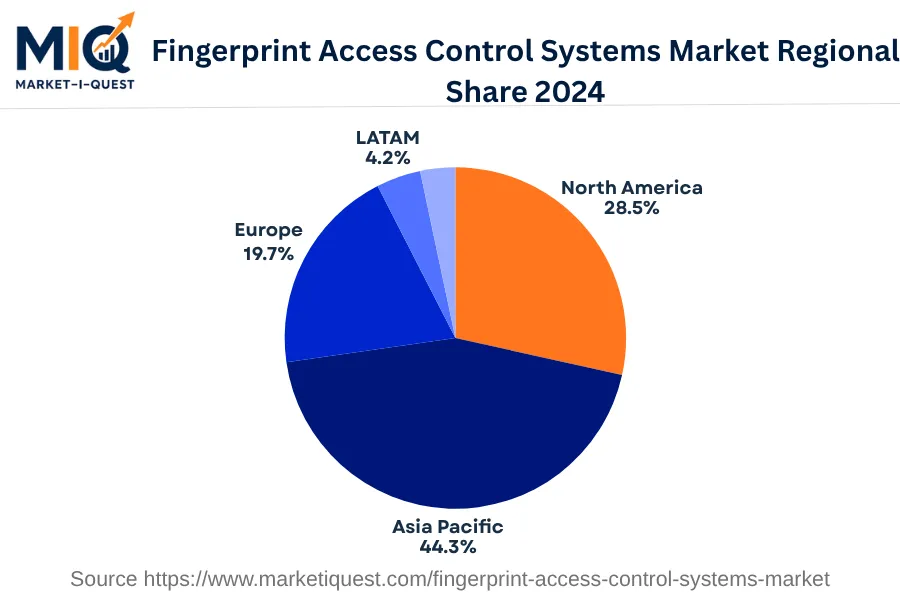
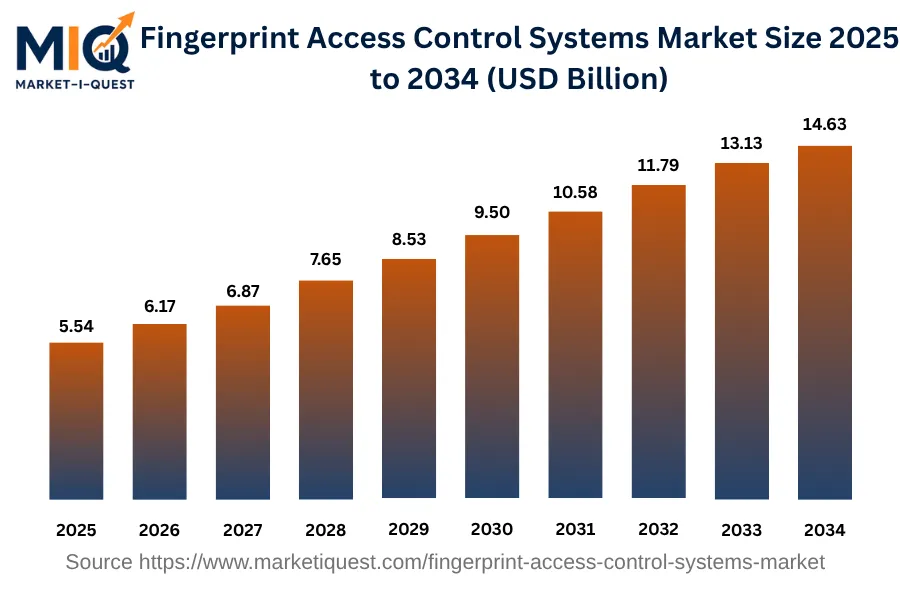
The Fingerprint Access Control Systems market was worth USD 5.54 billion in 2025 and is projected to grow to USD 14.63 billion by 2034, expanding at a compound annual growth rate of 11.4%. This substantial increase in market value over a decade indicates a strong positive trend in the industry. There are multiple factors attributing this better-than-anticipated growth. An upswing in consumer demand, continued advancements in technology, and wider market integration are the key factors propelling this market's rapid growth. Regionally, in 2024, the largest share of the Fingerprint Access Control Systems market was held by Asia Pacific at 44.3%, followed by North America at 28.5%, Europe at 19.7%, while Latin America and Middle East and Africa held smaller shares of 4.2% and 3.3% respectively.

Key Takeaways

  • By Technology - Capcitive held a dominant position in 2024 accounting for the highest market share.
  • By Authentication Mode - Single Factor Authentication led holding the largest market percentage in 2024.
  • By Application - Banking & finance sector accounted for the majority share in 2024.
fingerprint-access-control-systems-market market size

Key Driving Factors

Facility Security Upgrades Amid Pandemic Workforce Shifts

Many enterprises and organizations are taking proactive steps to physically secure their properties due to the changing nature of workforce distribution amid the health pandemic. With an increased number of employees practicing flexible or remote work, organizations need stronger control over access to their facilities to prevent unauthorized entry. Fingerprint access control systems offer this higher level of security without inconvenience, as no extra access tools like keycards are required. Employees' unique fingerprints eliminate shared surface contact, reducing the risk of viral transmission—a pressing concern in the current health environment.

Mandatory Compliance with Data Protection Laws

Global businesses are often required to comply with various data protection laws, such as the General Data Protection Regulation (GDPR) in Europe. As these regulations call for stringent data protection measures, companies often incorporate advanced biometric systems, like fingerprint access control systems, into their security infrastructure. These systems not only limit physical access to sensitive information but also keep documented logs of access attempts—helping businesses maintain compliance with regulatory requirements. Thus, the need for regulatory adherence is a significant driver for the fingerprint access control systems market.

Market Evolution by Timeline

2019-2023
During this period, primary demand within the Fingerprint Access Control Systems Market came from corporate offices and government institutions. Buyers in developed regions, notably North America and Europe, led acquisitions, seeking enhanced security measures against identity theft. Suppliers, specifically biotech firms, shipped products ranging from standalone devices to integrated systems. Integration into existing security systems, however, posed challenges due to interoperability concerns. On the policy front, the General Data Protection Regulation (GDPR) in Europe put emphasis on data privacy, influencing adoption practices. Pricing leaned towards a per-unit model with optional maintenance contracts. Typical contracts included installation, maintenance, and updates as separate costs. The primary risk factor was data breaches, counteracted by suppliers investing in advanced encryption technologies.
2024
In 2024, the Asian market, especially China, spotted an increased uptake of Fingerprint Access Control Systems in commercial buildings and residential communities. This was largely driven by the Chinese government's 'Safe City' initiative. Wider usage prompted improvements in system integration, with technology companies developing advanced and compatible firmware. No notable policy changes occurred this year, but existing regulations such as China's Personal Information Protection Law (PIPL) continued to have an impact. The pricing trend migrated towards all-inclusive bundled contracts, and partnerships formed between hardware manufacturers and security service providers. The limitations of fingerprint readers in recognizing aged or worn-out fingerprints surfaced as a risk, prompting suppliers to explore multi-factor authentication systems.
2025-2029
Major demand between 2025-2029 originated from emerging markets in Africa and Southeast Asia, pushed by an increased need for public safety. Key suppliers were tech startups that piloted portable and low-cost devices suitable for diverse environments. The UN's Sustainable Development Goals (SDG) program, which emphasizes safe cities, influenced market dynamics on a global scale. Prices saw a downward trend with the advent of affordable technologies and competitive bidding. PPP (Public-Private Partnership) model became common, teaming governments with tech firms to deploy systems in public spaces. Occasional system failures due to harsh climate conditions posed a risk, leading to strenuous product testing and sturdy design adaptations.
2030-2034
The focus of demand in this period shifted to developing nations catching up to global security standards. Mostly, education institutions and public transit systems sourced systems. Suppliers comprised of globally established security firms providing customizable solutions. By 2034, comprehensive integration became the norm, with system tie-ups with surveillance and alarm setups. Notably, the International Organization for Standardization (ISO) issued a series of standards on biometric data protection impacting adoption regulations. Package deals including complete setup, maintenance, updates, and replacements became prevalent. Open competition among suppliers helped reduce prices significantly. The most common challenge was the prevention of spoofing attempts, tackled by introducing advanced recognition algorithms and use of liveness detection.

Future Market Outlook

Future Opportunities

In the coming years, the demand for fingerprint access control systems is expected to rise due to tightening regulations surrounding data privacy and access security. For instance, the European Union's General Data Protection Regulation, enacted in 2018, imposes strict guidelines on biometric data handling, prompting organizations to adopt secure authentication technologies such as fingerprint systems. As businesses face increasing pressure to comply with these regulations, partnerships with biometric technology providers are anticipated to grow. In 2022, the National Institute of Standards and Technology published new guidelines aimed at improving the reliability of biometric systems, signaling the increasing importance of standardization in the industry. Furthermore, the integration of artificial intelligence and machine learning in biometric systems is opening new avenues for enhancing security protocols. In 2020, the U.S. Department of Homeland Security initiated studies on the application of AI in biometric systems to enhance border security, indicating a potential market expansion. Additionally, residential security is becoming a focus, with companies like August Home introducing fingerprint-enabled smart locks to address consumer demand for convenient yet secure home access solutions. As remote and hybrid work models continue to gain traction, the need for robust security measures in workplace environments is likely to drive further adoption. This confluence of regulatory requirements and consumer demand for advanced security measures presents numerous opportunities for stakeholders in the fingerprint access control systems market.

Segmentation Analysis

By Technology

The market is divided into different technological facets including Optical, Capacitive, Pressure, Ultrasonic, and Thermal with Capacitive accounting for the largest revenue share, while Ultrasonic is predicted to experience the fastest growth during the forecast period.

Largest Revenue Share

Capacitive

Market Share Leader

The Capacitive subsegment leads the market based on revenue generation. This dominance can be attributed to its widespread application across the consumer electronics sector, particularly in smartphones and computing devices. The continual rise in the adoption of these devices puts the Capacitive subsegment at an advantage. Given the drive towards technological innovation and increased functionality in devices, the demand for capacitive touch sensor technology has surged. Moreover, the fact that capacitive sensors offer a more seamless and responsive user experience than its counterparts heightens its desirability among both manufacturers and consumers alike. Geographically, Asia-Pacific occupies a large share due to the substantial presence of consumer electronics manufacturers. Recent technological improvements, such as the ability to work with gloves and operate in harsh environmental conditions, have further widened its application scope, thus driving the segment's revenue growth.

Fastest CAGR

Ultrasonic

Forecast Period Growth Leader

Ultrasonic technology, on the other hand, is projected to register the highest growth in the coming years. This growth is motivated by its unique strengths, such as its ability to operate over a greater distance and in different lighting or atmospheric conditions compared to other technologies. It has found increasing applications in the automotive and manufacturing sectors, owing to its superior object detection and measurement capabilities. While the initial capital expenditure can be a barrier to adoption, the enduring benefits in terms of accuracy and operational efficiency make a compelling case for its adoption. Beyond the automotive and manufacturing sectors, advancements in ultrasonic technology are rendering it compelling for applications in healthcare and defense, opening new avenues and contributing to the overall growth rate. The adoption of this technology might be hindered momentarily by global economic conditions, but in the long run, its unique capabilities will catalyze its growth.

By Authentication Mode

The market is divided into subsegments including Single Factor Authentication and Multi Factor Authentication. Single Factor Authentication accounted for the largest revenue share while Multi Factor Authentication is expected to grow at the fastest CAGR during the forecast period.

Largest Revenue Share

Single Factor Authentication

Market Share Leader

Single Factor Authentication, typically a simple username-password, has been the conventional method of access control and thus holds the majority market share. The base year of 2024 shows its dominating position owing primarily to the ubiquity and simplicity of this mode across various sectors, making it the front-runner in revenue generation. Most systems, especially consumer-based applications, employ single-factor authentication due to its easier user interface, lower implementation costs, and minimal complexity. This subsegment leverages its high acceptance rate and market penetration that make this solution not only cost-effective, but also efficient. However, with growing security concerns and advancement in technologies, more sectors are now slowly transitioning towards more secure modes of authentication. Yet, given the sheer volume of single-factor systems, this subsegment continues to maintain a significant revenue share.

Fastest CAGR

Multi Factor Authentication

Forecast Period Growth Leader

Multi Factor Authentication (MFA) is set to grow at the fastest rate. The prime reason propelling this growth is a stark increase in cyber threats and data breaches. This has led organizations to re-evaluate the efficacy of single factor methods, catalyzing the shift towards MFA, despite initial adoption barriers such as higher costs and complexity in implementation. Regulatory mandates by government bodies to fortify data security, and evolving consumer consciousness towards data privacy, have fueled the acceptance of more secure authentication methods. Technological disruptions, such as the integration of AI and machine learning, are enhancing the practicality and effectiveness of MFA, further spurring adoption. The increasing adoption of cloud-based services and the foreseeable boom in IoT also serve as major growth catalysts. However, near-term risks may include resistance from users due to the perceived inconvenience and technical glitches during the transition phase.

By Application

The market is divided into subsegments including Commercial, Consumer electronics, Government, Military & defense, Banking & finance, Healthcare, and Others. The Banking & finance subsegment accounted for the largest revenue share while the Healthcare subsegment is expected to grow at the fastest CAGR during the forecast period.

Largest Revenue Share

Banking & finance

Market Share Leader

The banking and finance sector is leading in revenue generation due to several factors. The financial sector, being a backbone of any economy, constantly requires advanced technology for its operations, driving demand for products in this market. The necessity for robust security measures, policy enforcement, risk management, and regulatory compliance in financial institutions further accelerates the demand in this subsegment. Additionally, emerging technologies, such as artificial intelligence and data analytics, have been widely adopted by financial institutions to offer personalized experiences, thereby boosting market growth. Geographic expansion of banking services in developing regions where penetration is yet to reach optimal levels acts as a further stimulus for sustained growth. However, factors such as complex regulatory landscapes could pose potential challenges.

Fastest CAGR

Healthcare

Forecast Period Growth Leader

The Healthcare subsegment is projected to have the fastest growth, driven by several catalysts. Most notably, the increase in the utilization of advanced technology for diagnostics and treatment, as well as for data management and patient care, fuels the growth in this sector. The ongoing technological revolution in the healthcare sector, including advancements in AI, IoT, and big data analytics, encourage rapid adoption. Government policies promoting digital health and substantial investments to upgrade healthcare facilities also spur growth. Moreover, telemedicine demand has surged due to the ongoing pandemic situation, setting the stage for exponential growth in the near-term. However, concerns surrounding data privacy and the lack of skilled professionals could potentially slow down the pace of adoption.

Competitive Analysis

Key Market Players

Manufacturers / OEMs

Apple Inc.
US
Synaptics Incorporated
US
LG Innotek
South Korea

Key Suppliers & Raw Materials

Infineon Technologies AG
Germany
AU Optronics Corp
Taiwan
Bosch Security Systems
Germany

Distributors, Integrators & Channel Partners

Matrix Comsec
India
Gemalto N.V.
Netherlands
Honeywell International Inc.
US

Porter’s Five Forces Analysis

This analysis reveals the competitive landscape and market dynamics of the Fingerprint Access Control Systems Market.

Supplier Bargaining Power

Medium

Component diversity moderates power, but OEM lock-ins and proprietary technologies raise it.

Buyer Bargaining Power

High

Numerous vendors, global access, and adjustable requirements give buyers high bargaining power.

Threat of Substitutes

Low

High switching costs and robust security aspects lower substitution threat.

Threat of New Entrants

Medium

Tech advancements lower barriers, but certification and compliance requirements add complexity.

Competitive Rivalry

High

Numerous vendors, constant technological innovations and price-based competition create high rivalry.

Regional Analysis

Geographic market dynamics and growth opportunities across key regions

Global Market Outlook

fingerprint-access-control-systems-market market regional share

North America

In 2024, the Fingerprint Access Control Systems Market in North America aids in providing essential security across numerous sectors. A chief driver originates from an upsurge in demand for enhanced security measures across sectors like enterprise, government, and healthcare due to an increase in data breaches and cyber threats. The mandatory implementation of stringent regulations such as HIPAA in USA's healthcare sector played a noteworthy role in propelling demand, while Canada's PIPEDA drove the necessity for such systems in businesses to prevent unauthorized access. The significant investment in technological advancements credited for adoption by utility firms, that needed to supplement or replace obsolete access mechanisms.

Trends reveal a shift in buyer behavior towards biometrics-based systems, specifically fingerprint authentication due to its uniqueness and difficulty in replication. Technological advancements in fingerprint sensors and related software fuel these changes. Concurrently, the increasing partnerships and mergers between companies like Honeywell and Morpho, further broadened the application scope. Among other enforcement policies, Mexico implemented the General Law on the Protection of Personal Data, ensuring the retention and disposal of personal data are secured. Primary customers sourcing these systems ranged from manufacturing and retail enterprises seeking to fortify their data centers' security to government agencies enforcing stringent access controls.

Asia Pacific

In 2024, the Asia Pacific Fingerprint Access Control Systems Market showed substantial dynamism induced by evolving security mandates, technological sophistication, and end-user demand. Heightened security needs due to increased cyber potential threats in China and India catalyzed the demand. Additionally, government regulations in these countries facilitated a conducive environment for market growth. The technological advancement and implementation of high-capacity, low-cost access control systems in Japan and South Korea were pivotal demand drivers.

Conversely, consumer trends displayed a proclivity towards seamless and efficient security systems. China's leading manufacturers launched novel biometric access controls, incorporating AI and IoT, which received wide acceptance. This was followed by partnerships and M&A activities across Australia, Japan, and key ASEAN markets as businesses seek to consolidate their position and expand their offerings. Enterprise and government sectors, with their immense need for data protection, remained the dominant customer segments across Asia Pacific, while healthcare and manufacturing sectors showed growing interest. Driven by policy enforcement, Australia witnessed a considerable uptake of fingerprint access control systems in utilities and retail industries. In conclusion, the market was shaped by diverse forces including technological innovation, rigorous policy frameworks, and end-use sector dynamics throughout Asia-Pacific in 2024.

Europe

In 2024, the European Fingerprint Access Control Systems market saw significant development owing to various factors and trends. The prevalent drivers include increased digitization of businesses across sectors such as enterprise, healthcare, utilities, and retail. The adoption of robust, biometric security measures due to privacy regulations like General Data Protection Regulation (GDPR) and the vast governmental investments in public security infrastructures, particularly in countries like Germany, the UK, and France improved demand. Notably, technological advancements and more cost-effective solutions also led to an upsurge in market expansion.

Among the observed trends, enhanced buyer preference towards security systems with user-friendly interfaces and seamless integration surfaces as vital. There's a distinct shift towards cloud-based access control systems due to their flexibility and scalability. The prominent tech shift is evident in innovations, such as sophisticated multi-modal systems, which offer higher identification accuracy. Notably, Italy and Spain, with their fast-growing tech start-up scenes, have been witnessing a surge in strategic partnerships and mergers, favouring the expansion and diversification of product offerings. Policy enforcement, such as the UK's Biometric Data Protection Act, is being enacted to regulate and ensure the responsible use of biometric tech, contributing to the market's maturity and long-term sustainability.

Latin America

In 2024, the Fingerprint Access Control Systems (FACS) market in Latin America presented significant advancement due to its increased security demands and technological evolution. Key contributors driving the market include Brazil's adoption of FACS in governmental buildings, and Mexico's implementation in the retail sector for secure transaction authorization. In Argentina and Colombia, well-funded cyber-security investments encouraged FACS adoption in the enterprise segment, which increased market demand. In Chile and Peru, favorable regulations promoting digital technology in healthcare and utilities compelled industries to implement FACS for secure access, pushing supply dynamics.

On the trends front, LATAM markets exhibited a shift towards contactless FACS due to pandemic-related hygiene concerns. Partnership dynamics in LATAM also evolved, such as the alliance between Brazil-based Polsec and US firm Bio-key in FACS deployment, bolstering product penetration. Standards also trended towards firming up, with Mexico enforcing rigorous quality norms for FACS manufacturers, ensuring superior product availability. Brazil's healthcare sector displayed notable policy enforcement, mandating FACS across all healthcare institutions for secure data access. Simultaneously, enterprises in Argentina and Colombia leaned heavily on FACS to safeguard confidential data, further influencing buyer behavior and product adoption.

Middle East & Africa

In 2024, the Fingerprint Access Control Systems Market in the Middle East and Africa demonstrated robust demand and growth. Key drivers included heightened security needs in sectors such as government and oil & gas, alongside technology adoption in telecom and financial services. For example, in Saudi Arabia and the UAE, the implementation of stricter government regulations led to a higher reliance on advanced security systems. In Egypt and Nigeria, extensive investments in healthcare and manufacturing sectors ignited the rapid adoption of biometric access control systems, demonstrating a commitment to security enhancements.

Trends in the market were shaped by several factors. Buying behavior leaned towards the integration of AI in fingerprint access systems, particularly in South Africa and Israel's tech-savvy markets. An increase in joint ventures and partnerships like those in Kenya's telecom sector was observed, driving the development of comprehensive fingerprint-based solutions. In both Qatar and Saudi Arabia, the enforcement of stringent data privacy policies shifted the preference towards fingerprint access control systems in retail and utility sectors, ensuring secure access and combating fraudulent activities. These overall trends underscored the combined emphasis on security, technological integration, and regulatory adherence in the Fingerprint Access Control Systems Market for the Middle East and Africa in 2024.

Recent Industry Developments

Latest market innovations, product launches, and strategic initiatives

February 2026

ActChip officially launched a specialized fingerprint access control system designed specifically to secure individual data center server racks, utilizing the FPC AllKey sensor to bring biometric security directly to physical IT hardware.

October 2025

The European Union officially rolled out its Entry/Exit System (EES), creating a massive new government access control standard that mandates fingerprint capture for all non-EU citizens crossing external Schengen borders.

Frequently Asked Questions