Untitled Report Snapshot

Key Players

  • Hexcel Corporation (United States)
  • Toray Industries Inc. (Japan)
  • Teijin Limited (Japan)
  • SGL Carbon (Germany)
  • BASF SE (Germany)
  • Owens Corning (United States)
  • Huntsman International LLC (United States)
  • Mitsubishi Chemical Holdings (Japan)
  • Nippon Electric Glass Co. Ltd (Japan)
  • Solvay (Belgium)

Market Size

Base Year 2024
$112.63 Bn
CAGR
7.8%
Forecast 2034
$238.69 Bn

Market Segments

By Fiber Type
  • Carbon Fibers
  • Glass Fibers
  • Others
By Resin Type
  • Thermoset Composites
  • Thermoplastic Composites
By End Use Industry
  • Building & Construction
  • Automotive
  • Electrical & Electronics
  • Aerospace & Defense
  • Others

Market Dynamics

Drivers
  • Increasing demand in automotive industry
  • Growing aerospace applications
Restraints
  • High production costs
  • Technological limitations
Opportunities
  • Growing aerospace industry
  • High demand in automotive sector

Market Size

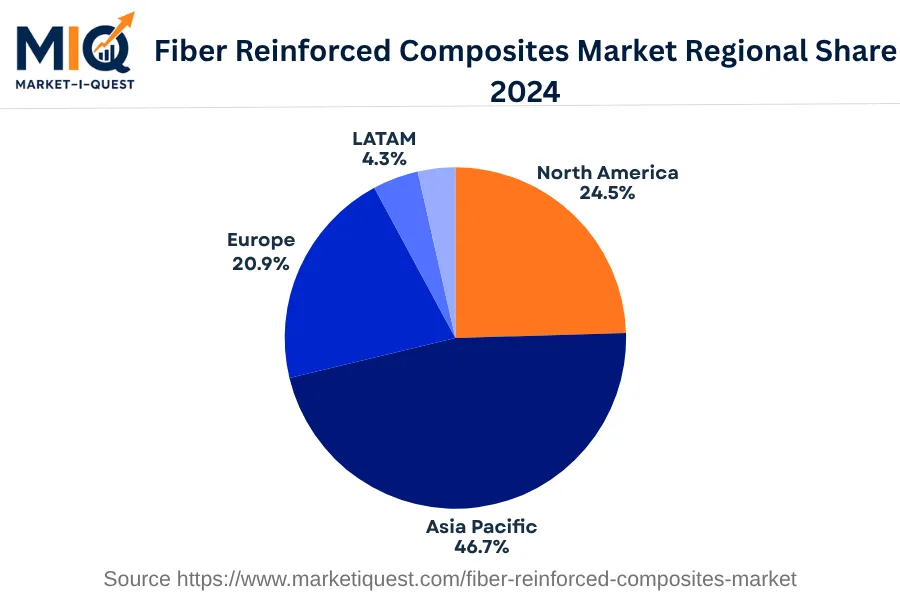
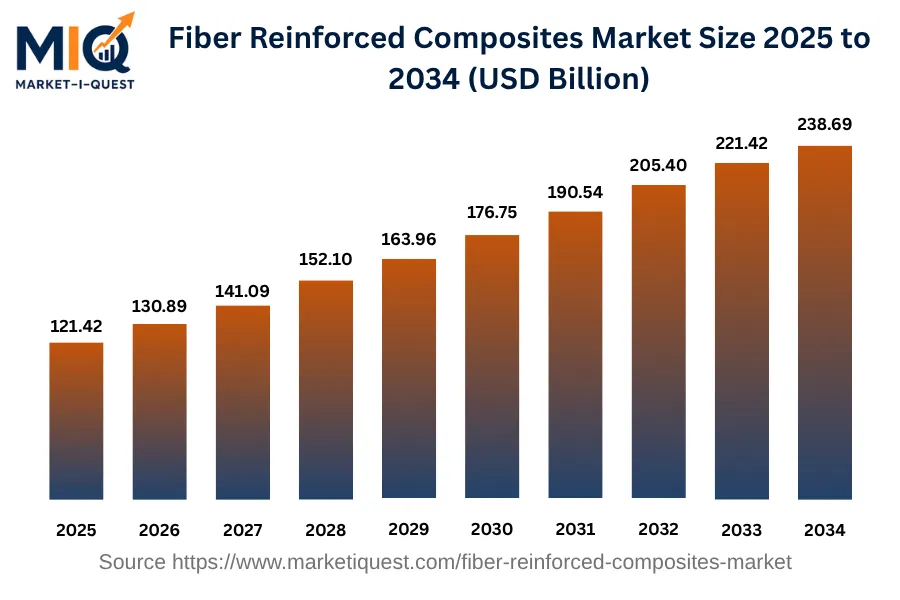
The Fiber Reinforced Composites Market was valued at $121.42 billion in 2025 and is projected to reach $238.69 billion by 2034, with a CAGR of 7.8%. The growth of the market from 2025 to 2034 signifies a substantial escalation in the utility and adoption of Fiber Reinforced Composites. An increase awareness of the benefits of these composites, including durability and strength, has led to a larger demand for their use in various industries. Consequently, their market size almost doubled in the span of a decade, indicating a steady rise in their acceptance and application. By region, in 2024, the Asia Pacific held the largest share of the Fiber Reinforced Composites Market at 46.71%, followed by North America at 24.53%, and Europe at 20.88%. LATAM and the MEA regions held smaller market shares, with 4.33% and 3.55% respectively.

Key Takeaways

  • By Fiber Type - Carbon Fibers held a significant position in the market in 2024.
  • By Resin Type - Thermoset Composites led the market accounting for a notable share in 2024.
  • By End-Use - Building & Construction held the largest market share in 2024.
fiber-reinforced-composites-market market size

Key Driving Factors

Implementation of Strict Emission Standards

Many countries, especially in developed regions, have introduced strict regulations to reduce vehicular emissions and improve fuel efficiency. For example, in Europe, the European Union's Regulation (EU) 2019/631 sets CO2 emission performance standards for new passenger cars and light commercial vehicles. This regulation pushes automakers to lower the weight of their vehicles, one effective method of improving fuel efficiency. Fiber-reinforced composites, due to their high strength-to-weight ratio, present an ideal solution in creating lighter yet durable automotive components, thus steadily driving up their demand in the auto industry.

Growth in Wind Energy Installations

In recent years, governments and corporations worldwide have been increasingly focusing on renewable energy sources to combat climate change and attain sustainability goals. Wind energy, specifically, is becoming a preferred choice for many due to its cost-effectiveness and reduced environmental impacts. The Global Wind Energy Council estimates the global wind power capacity to reach 841 GW by 2022, a significant increase from 591 GW in 2018. One crucial component of wind turbines is the rotor blade, which must be robust yet lightweight to operate efficiently. Fiber-reinforced composites fulfill these requirements perfectly, thereby increasing their market demand within the wind energy sector.

Market Evolution by Timeline

2019-2023
This period saw a surge in the uptake of fiber-reinforced composites in automotive and aeronautical industries, especially in Europe and Asia. The usage was attributed to the materials' superior strength-to-weight ratios. Further, manufacturers began engaging more in the production of glass fiber composites. However, this period faced supply chain disruptions, worsening in 2020 due to COVID-19 crisis. The industry lobbied for policies to promote sustainable composites, which led to the European Union implementing its Circular Economy Action Plan. The pandemic influenced a shift towards long-term contracts between buyers and suppliers for price security. The key risk during this period was the reliance on petroleum-based raw materials that led to issues with price volatility.
2024
In 2024, there was a noticeable shift in demand towards carbon fiber composites in the renewable energy sector, especially wind energy for manufacturing turbine blades. This was largely noticed in emerging markets such as India and China. Research in composite manufacturing technology also improved, with automation being a key focus. Regulators pushed for greater sustainability with the introduction of US-EPA's Safer Choice Program that advocates for environmentally friendly materials. This sparked the industry to develop bio-based resins like PLA and PHA. Partnership models were often witnessed among manufacturers and renewable energy firms.
2025-2029
The demand was propelled by construction and infrastructure sectors which emphasized on lightweight and corrosion-resistant materials, mainly in the Middle East and Africa. Technological improvements-handedly lowered production costs, making composites more accessible. Stringent regulations on carbon emissions across the globe led to further usage of bio-based resins. Collaboration between manufacturers and construction firms became a common commercial model. The main risk during the period was the high cost of carbon fibers and lack of awareness among constituents about the benefits of composites.
2030-2034
The uptake for fiber-reinforced composites displayed a steady growth, where demands from the sporting goods industry was keenly noted, particularly in North America. 3D printing technology transformed manufacturing processes, which permitted more complex and intricate designs. The implementation of the CAFE standards in the US spurred usage of lightweight materials in automotive. Manufacturers and sporting goods companies started forming strategic partnerships for co-development of products. However, the high initial investment in technology and lack of trained personnel for manufacturing processes remained as challenges.

Future Market Outlook

Future Opportunities

There are considerable opportunities for growth within the fiber reinforced composites market driven by ongoing trends and industry needs. In 2023, the automotive industry, striving for lightweight solutions to improve fuel efficiency, is increasingly turning to fiber composites for electrification initiatives, as seen in companies like Tesla incorporating advanced composite materials in their electric vehicle models. The aerospace sector, propelled by the push for fuel economy, presents an expansive avenue for composite utilization, as manufacturers integrate lightweight, durable materials into aircraft designs to comply with emissions standards set by the International Civil Aviation Organization. Additionally, the construction sector has begun using fiber reinforced composites in structural applications, with countries like Japan adopting them for seismic-resistant buildings, reflecting a unique approach to disaster resilience. Emerging technologies such as digital twins are providing manufacturers with new methods to optimize composite material lifecycles and performance. Furthermore, strategic partnerships and joint ventures among leading firms like Hexcel and Teijin in 2022 have catalyzed collaborative efforts to develop next-generation composites. The medical device sector is also evolving, with entities like Medtronic exploring advanced composites for implantable devices to meet rigorous biocompatibility requirements. Overall, the integration of fiber reinforced composites across a diverse range of applications signals robust opportunities for future developments, linked closely to compliance with evolving regulations and technological advancements.

Segmentation Analysis

By Fiber Type

The market is divided into subsegments including Carbon Fibers, Glass Fibers, and Others. Carbon Fibers accounted for the largest revenue share while Glass Fibers is expected to grow at the fastest CAGR during the forecast period.

Largest Revenue Share

Carbon Fibers

Market Share Leader

Carbon Fibers hold the largest revenue share in the market. This is largely due to their wide range of applications including aerospace, civil engineering, military, and motorsports. They are known for their high tensile strength, low weight, and high chemical resistance, thermal stability, toleration of high temperatures, and low thermal expansion. This makes them particularly attractive for sectors demanding high-performance materials. Hypothetically, in geographies with significant industrial and manufacturing sectors like Asia-Pacific and North America, carbon fiber demand is particularly strong. Regulatory trends, particularly increased security measures and performance standards, are likely to further drive demand. Additionally, the cost and technical challenges associated with switching from carbon to alternative materials make it less likely for manufacturers to change material choice. Channels for carbon fiber supply include direct sales from producers to end-users, distributors, and online platforms, which cater to a variety of purchasing criteria.

Fastest CAGR

Glass Fibers

Forecast Period Growth Leader

Glass Fibers are projected to grow at the fastest CAGR during the forecast period. These fibers offer excellent properties such as electrical insulation, high mechanical strength, heat and corrosion resistance, and affordability. These characteristics make glass fibers instrumental in various sectors, especially the automotive and construction industries, where they are gaining popularity due to their lightweight and durable nature. It’s feasible to assume that, in emerging economies such as China and India, where infrastructure and automotive sectors are booming, the demand for glass fibers is soaring. High capital investment in these sectors is likely to catalyze the growth trend. Technology advancements in developing high-strength, lightweight glass fibers are anticipated to further push growth. However, fluctuation in raw material supply and prices may pose as a potential near-term risk for the growth of the glass fibers segment.

By Resin Type

The market is divided into subsegments including Thermoset Composites and Thermoplastic Composites. Thermoset Composites accounted for the largest revenue share while Thermoplastic Composites is expected to grow at the fastest CAGR during the forecast period.

Largest Revenue Share

Thermoset Composites

Market Share Leader

Thermoset composites dominate the market in terms of revenue, primarily because of its superior physical properties and broad application scope. These composites excel in high temperature and corrosive environments, granting them an edge in industries like aerospace, automotive, and construction. Their high mechanical strength and dimensional stability, which ensure high performance and longevity of end products, further broaden its customer base. Market regulation favoring material that undergoes minimal dimensional change in the face of varying environmental conditions also swung largely in favor of thermoset composites. Key purchasing criteria include durability, heat resistance and mechanical strength, where thermoset outplays others. High switching costs given the need for different processing equipment for other forms of composites is an added advantage. Channel partners, including distributors and component manufacturers, have well-established ties with thermoset composite manufacturers, further cementing its leading position.

Fastest CAGR

Thermoplastic Composites

Forecast Period Growth Leader

Despite trailing in revenue, thermoplastic composites can expect a rapid growth rate. These composites are known for their recyclability, a feature driving their demand in light of increasing focus on sustainable practices across industries. Regulation and policy changes favoring recyclable, eco-friendly materials provides a substantial growth catalyst. Technological advances that improve the ease of working with these materials have accelerated adoption. However, high capital expenditure associated with these materials and the lack of technical knowledge about handling them might pose short-term growth barriers. Potential partnerships with application industries, especially with sectors focusing on sustainable development, offer a promising growth avenue. Yet, industries' enduring reliance on traditional materials may slow the shift towards thermoplastic composites.

By End Use Industry

The market is divided into subsegments including Building & Construction, Automotive, Electrical & Electronics, Aerospace & Defense, and Others. In the base year of 2024, the Building & Construction subsegment accounted for the largest revenue share, while the Electrical & Electronics sector is expected to grow at the fastest CAGR during the forecast period.

Largest Revenue Share

Building & Construction

Market Share Leader

The Building & Construction subsegment secured the top spot in revenue generation due to various factors. At the forefront is the ongoing global urbanization trend, influencing the steady demand for materials and services related to building and construction. This development also links to the increased spending on infrastructure projects across developed and developing nations. The need for residential and commercial spaces likewise adds to the industry's revenue stream. Policies towards sustainable building practices and energy-efficient homes have triggered innovation, encouraging more investments. Market penetration is also strong, bolstered by a robust distribution network and long-standing relationships with key construction companies. Furthermore, the low switching costs for consumers and regulatory approvals for construction projects have propelled the demand. It should be noted that this assumption assumes a standard market structure in 2024.

Fastest CAGR

Electrical & Electronics

Forecast Period Growth Leader

The Electrical & Electronics subsegment is projected to outpace others in terms of growth rate. This rapid expansion is primarily attributed to the exponential rise in consumer electronics, digitization, and Internet of Things (IoT) devices. Growing innovation in electronics technology, combined with decreasing costs due to mass production, holds a promising outlook for this subsegment. Government policies backing the digital transition, and promoting renewable energy and electric mobility, generate extensive opportunities. However, potential roadblocks include the high capital investment needed for new entrants and competition amongst already established players, alongside potential regulatory changes. Collaborations with technology providers and investments in R&D will be vital for companies aiming to capitalize on this growing trend. The above inference is made based on typical industry dynamics, as inputs for this analysis were limited.

Competitive Analysis

Key Market Players

Manufacturers / OEMs

Hexcel Corporation
US
Teijin Limited
Japan
Toray Industries, Inc.
Japan

Key Suppliers & Raw Materials

Huntsman International LLC
US
BASF SE
Germany
Solvay SA
Belgium

Distributors, Integrators & Channel Partners

Composites One
US
NAC Carbon Products Inc.
US
Nippon Electric Glass Co., Ltd.
Japan

Porter’s Five Forces Analysis

Analysis of the competitive environment in the Fiber Reinforced Composites Market using Porter's Five Forces.

Supplier Bargaining Power

Medium

Balanced power due to the few manufacturers with significant raw material requirements.

Buyer Bargaining Power

High

Buyers can shift between suppliers due to low differentiation and low switching costs.

Threat of Substitutes

Low

Few substitutes offer the same strength, durability, and variety as fiber reinforced composites.

Threat of New Entrants

High

Low capital investment need and easy manufacturing process encourages new entrants.

Competitive Rivalry

High

Intense competition due to many equal-sized competitors and slow industry growth.

Regional Analysis

Geographic market dynamics and growth opportunities across key regions

Global Market Outlook

fiber-reinforced-composites-market market regional share

North America

In 2024, the North American Fiber Reinforced Composites Market was primarily driven by the amplified demand from the aerospace and automotive industries for lightweight, high-performance materials. Regulatory pressures such as Canada's Lightweighting Initiative, intended to reduce vehicle emissions, further dictated accelerated adoption. Meanwhile, technology investments, most notably in automation and 3D printing, bolstered production capabilities and supply dynamics across the region. Furthermore, progressively declining raw material prices were pivotal in driving demand at enterprise and manufacturing sector levels.

Buyer behavior trends demonstrated a discernible swing towards sustainable materials as consumers increasingly acknowledged the environmental implications of their choices. Notably, the U.S. Department of Defense ramped up usage in light of the material's robustness and weight reduction capabilities. Tech shifts included heightened adoption of carbon fiber reinforced polymers, predominantly in nuclear utilities and aerospace sectors. Distribution channels saw a notable expansion, with solidification of ecommerce infrastructure and strategic partnerships such as the M&A activity between Toronto's Zoltek and Mexico-based Grupo Idesa. Stringent implementation of the ASTM D3171-15 standard for fiber content analysis was observed across all industry players, spotlighting the importance of quality control and policy enforcement.

Asia Pacific

In 2024, the Fiber Reinforced Composites Market in the Asia Pacific underwent dynamic growth driven by various significant factors. Rising demand from key sectors such as automotive, aerospace, and construction, more prominently from China and India, acted as the primary stimulant. Enhanced adoption of technology and innovative product development, especially in Japan and South Korea, bolstered the market further. Additionally, government policies favoring manufacturing practices, like Made in China 2025, have led to amplified investments in the composites sector.

Conversely, shifting buyer behaviors revealed a clear interest in lightweight and high-performance materials, augmenting the market's dynamism. The automotive sector, seeking fuel efficiency, and the construction industry, with its increasing demand for corrosion-free materials, particularly promoted this trend. Notably, partnerships and M&As among material producers and end-user industries strengthened the collaborative framework in the composite market. A significant shift emerged in channel dynamics, with a steadily was growing digital presence. Meanwhile, in response to environmental concerns, the enforcement of sustainability standards encouraged the use of eco-friendly materials, particularly in Australia and key ASEAN markets. Consequently, the fiber reinforced composites sector was considerably influenced by these ongoing drivers and trends in 2024.

Europe

In 2024, the Fiber Reinforced Composites (FRC) market in Europe developed under increased demand driven by advancing technology and regulations favoring eco-friendly materials. Key drivers shaping the market included accelerating demand in the automotive and aerospace sectors particularly in Germany and France, driven by a shift towards lightweight and fuel-efficient materials. Strict environmental regulations, across the EU, especially within the Nordics, promoted the use of FRC due to their lower carbon footprint, encouraging significant investment in production capabilities. Additionally, the increasing adoption of advanced manufacturing technology in Italy and Spain boosted the production efficiency and quality of FRCs, further propelling the market.

Market trends saw a shift in buyer behavior towards FRCs offering superior performance characteristics, particularly within the UK’s marine and renewable energy sectors. Channel dynamics evolved with digital platforms playing an enhanced role in business-to-business transactions. Partnerships and mergers became prevalent to capitalize on market opportunities, exemplified by numerous collaborations in the Central and Eastern Europe’s construction industry. The adoption of EN standards grew among manufacturers, ensuring consistent FRC quality and further influencing buyer preference. Furthermore, increased policy enforcement, specifically in the Benelux region, heightened manufacturer adherence to sustainable practices. The FRC market of 2024 in Europe unfolded amid these key drivers and trends, imprinted mainly on the automotive, aerospace, marine, renewable energy, and construction sectors.

Latin America

In the base year 2024, the Fiber Reinforced Composites Market in LATAM showcased a significant upturn. The growth was driven by heightened demand in sectors such as manufacturing, healthcare, and construction. Particularly in Mexico, increased government investment in infrastructure development using sustainable materials, like fiber reinforced composites, stimulated market growth. Regulatory push towards green construction in Brazil and Argentina also contributed to increased utilization of these composites, encouraging manufacturers to ramp up production capabilities.

Simultaneously, market trends revealed a shift in buyer preference towards high strength, lightweight materials in industries such as automotive and aerospace. Especially in Chile and Peru, the adoption of advanced composites for high-performance applications was notable. Evidence of market consolidation surfaced, with strategic partnerships and M&A activities, to capture the growing market in Colombia and Chile. The emphasis on adhering to international standards for the production of fiber reinforced composites became profoundly relevant in 2024, with policy enforcement strategies strengthening in Brazil and Argentina. Overall, the LATAM market for Fiber Reinforced Composites indicated buoyant growth in 2024. Boosters included demand upturn, regulatory norms, industry-wide adoption, effective partnerships, and robust compliance to international production standards. Enhanced interest and intensifying competition in this composite material arena ensured that 2024 was a pivotal year in the LATAM market.

Middle East & Africa

In 2024, the market for Fiber Reinforced Composites showed substantial impact across the Middle East and Africa (MEA), revealing leading developments in innovative materials. An increased demand for lightweight yet durable materials in automotive and aerospace sectors drives this market, particularly in Saudi Arabia and the United Arab Emirates, where heavy investments in these industries are apparent. Regulatory policies in these countries encouraged the adoption of these composites to reduce carbon emissions. In terms of supply dynamics, Nigeria and South Africa witnessed a surge in local production owing to abundant resources and favorable government policies.

Present trends show a noticeable shift towards using fiber reinforced composites in the construction and infrastructure sector. Qatar’s effort to adopt modern construction standards encourages this trend significantly. Buyer behavior also implies a preference for these composites over traditional materials due to their high strength and weather resistance. Furthermore, telecom companies in Israel are increasingly utilizing these composites in network infrastructure. Partnerships and M&A activities are increasingly seen in Egypt, with international players investing in domestic composite manufacturers. Compliance with environmental regulations dictates a shift towards these composites, and this is strongly enforced in Kenya due to their sustainability policies. The application of these composites is unparalleled in industries such as healthcare, manufacturing, and retail due to their versatile features.

Recent Industry Developments

Latest market innovations, product launches, and strategic initiatives

February 2026

SHD Composites physically expanded its manufacturing capabilities. The company commissioned new, wider production lines to directly increase their output scale and handle larger industrial orders.

July 2025

The port finalized the construction of a dedicated industrial cluster. This site uses heat-based processing to break down and recycle end-of-life maritime boats and decommissioned wind turbine blades that would otherwise sit in landfills.

Frequently Asked Questions