
Enterprise Data Management Market Snapshot

Key Players

  • SAP SE (Germany)
  • Oracle Corporation (United States)
  • IBM Corporation (United States)
  • Talend (United States)
  • Teradata (United States)
  • SAS Institute (United States)
  • Informatica LLC (United States)
  • Symantec Corporation (United States)
  • Ataccama (Canada)
  • Hitachi Vantara (Japan)

Market Size

Base Year 2024
$115.85 Bn
CAGR
12.13%
Forecast 2034
$364.01 Bn

Market Segments

By Data Type
Structured Data, Unstructured Data, Semi-Structured Data, Metadata
By Component
Software, Hardware, Services
By Deployment Type
On-Premises, Cloud-Based, Hybrid
By End User
BFSI, Healthcare, Retail, Manufacturing, Telecommunications, Others

Market Dynamics

Drivers
  • Increasing data volume
  • Rising demand for data security
Restraints
  • High implementation costs
  • Data security concerns
Opportunities
  • Rising Demand for Data Analysis
  • Increasing Digital Transformation Initiatives

Market Size

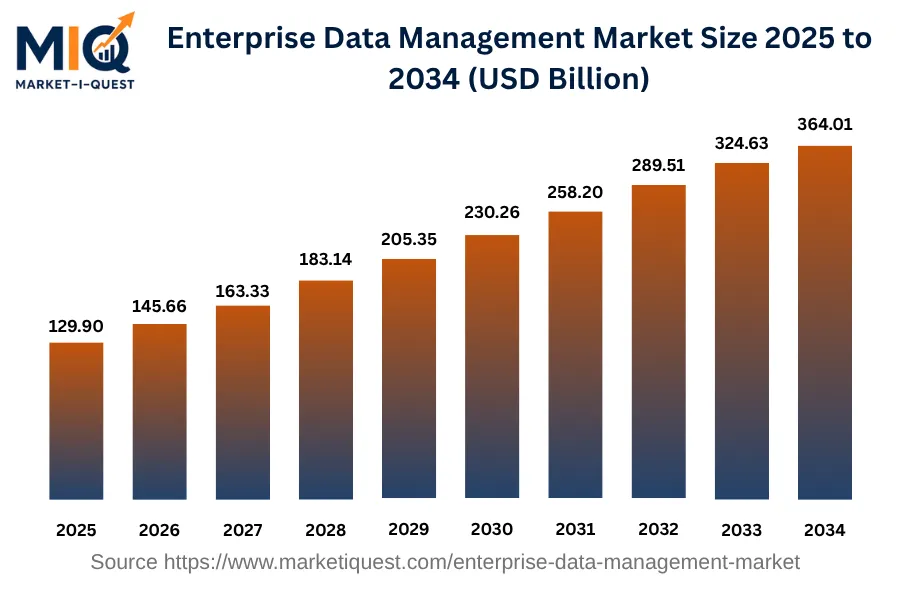
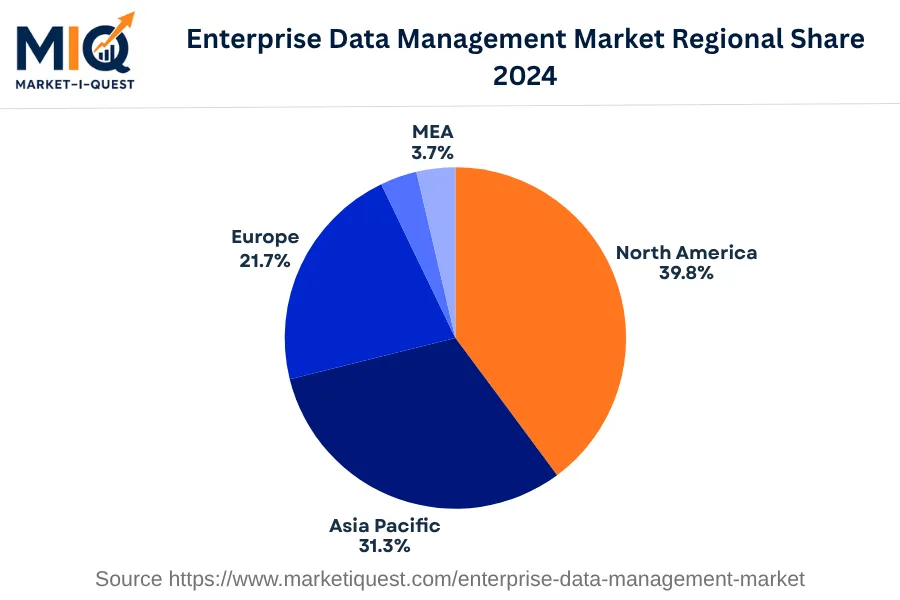
The Enterprise Data Management Market size was USD 129.90 Billion in 2025, a noticeable increase from USD 115.85 Billion in 2024. By the year 2034, the market is expected to grow and reach USD 364.01 Billion, evolving at a CAGR of 12.13%. This growth could be due to the increasing focus on enterprise data management across different industries around the globe. This includes the need to systematically gather, store, manage, and distribute data for important operations, data security, and decision-making processes within different enterprises. Regionally market share in 2024, North America accounted for 39.8%, followed by Asia Pacific at 31.3%, Europe at 21.7%, Latin America at 3.5%, and the Middle East and Africa at 3.7%.

Key Takeaways

  • By Data Type - Structured Data held the lead accounting for the highest share in the base year.
  • By Component - Software was the dominant segment leading the market in terms of overall share.
  • By Deployment Type - On-Premises deployments expanded rapidly marking the fastest growth rate.
  • By End User - Telecommunications took a notable position in enterprise data management services.
enterprise-data-management-market market size

Key Driving Factors

Compliance with Data Regulations

The rapid expansion of digital engagement across industries has led to various data privacy regulations such as General Data Protection Regulation (GDPR) and California Consumer Privacy Act (CCPA). These regulations strictly mandate the protection of consumer data and enforce heavy penalties for non-compliance. This has greatly influenced companies worldwide to integrate systematic data management practices and solutions in their businesses. Specifically, enterprises are implementing data management systems to control data accessibility, ensure data secrecy, and conduct regular audits. By precisely managing data through enterprise data management, organizations can prevent data leaks and subsequent legal complications, thus driving the market for these solutions.
Adoption of Real-Time Analytics

Enterprises across sectors such as retail, finance, and healthcare are increasingly adopting real-time analytics for informed decision-making and improved customer experience. However, the effectiveness of real-time analytics largely depends on the quality and accuracy of underlying data. This brings the focus onto structured data management practices to prevent data duplication or corruption, ensure consistency. It also enables successfully drawing data-driven insights. As such, the demand for comprehensive enterprise data management solutions is elevated. These solutions enable organizations to manage vast volumes of varying data types, streamline data quality, and optimize their real-time analytics capabilities, by driving their market expansion.

Market Evolution by Timeline

2019-2023
This period of the Enterprise Data Management Market was majorly taken by the mass adoption of cloud computing. Buyers were primarily the large corporations and SMBs from North America due to increasing data volume. The market was further supplied by service integrators, such as Amazon AWS and Google Cloud, due to mature cloud infrastructure. The adoption was primarily influenced by the General Data Protection Regulation (GDPR) which mandates stringent data protection rules. The procurement typically involved subscription-based models and the common block was security concerns, which prompted cloud service providers to reinforce data encryption methods.
2024
2024 witnessed an increasing demand for Enterprise Data Management within Healthcare and BFSI sectors in Europe, due to strict data regulations in these industries. Technology providers with advanced AI algorithms for data analysis started gaining popularity. This supply shift was driven by improved data integration maturity and rising AI applications, but was tested with lack of skilled workforce. GDPR and the EU's Artificial Intelligence Act continued to influence the data management policies and adoption. Most companies preferred customized, pay-as-you-go pricing models.
2025-2029
This period will see a rise in high demand due to growing digital transformation in the Asia-Pacific region, especially in sectors such as eCommerce, Logistics, and Manufacturing. Supply will be majorly drive by tech-giants like Microsoft, IBM, and Oracle who provide robust data security and analytics solutions. Compatibility will be a major concern for companies as they struggled with coordinated functioning across multiple platforms. Regulations such as China's Personal Information Protection Law (PIPL) will began to shape data management practices. Performance-based contracts gained popularity.
2030-2034
In this period, there will be an upsurge in demand from emerging technology sectors like IoT and Quantum Computing, largely from countries leading technological innovation like USA and China. There will be a notable surge in supply from companies providing decentralized data management solutions leveraging blockchain technology. The advancement in edge computing and 5G technology however, posed some integration issues. The UN's policy on International Internet Governance will hugely impact the market policies. Companies will typically enter into long-term partnerships in order to share resources and reduce costs.

Future Market Outlook

Future Opportunities

Future opportunities in the enterprise data management market are closely tied to the rising adoption of artificial intelligence and automation technologies. Since the introduction of AI-driven data processing tools in 2021, more enterprises, including Google and Oracle, are looking towards automated solutions to enhance efficiency and reduce manual errors in data handling. Policymakers worldwide are also shaping the landscape; for example, the U.S. Federal Trade Commission is focusing on regulations for data privacy that may invite increased investments in compliance-oriented data management systems. As the landscape evolves, companies may seek partnerships with academic institutions, such as the collaboration between universities in the UK and tech firms, to foster innovation in data management practices. Additionally, organizations are increasingly recognizing the value of data democratization strategies, facilitating broader access to data insights across all organizational levels. This trend could lead companies to invest in user-friendly data management platforms that empower non-technical staff by 2024. Furthermore, the need for enhanced cybersecurity measures due to rising data breaches will result in opportunities in security-focused data management solutions, as seen with recent investments by cybersecurity firms to integrate protection features within data management offerings. As a result, enterprises will likely transition towards solutions that not only ensure data integrity but also address compliance and security concerns, ultimately shaping future business strategies in data management.

Segmentation Analysis

By Data Type

The market is divided into subsegments including Structured Data, Unstructured Data, Semi-Structured Data, and Metadata. Structured Data accounted for the largest revenue share while Unstructured Data is expected to grow at the fastest CAGR during the forecast period.

Largest Revenue Share

Structured Data

Market Share Leader

Structured data continues to account for the largest share of revenue within this market segment. This can largely be attributed to the fact that structured data is easier to analyze using traditional data analysis tools and is therefore more preferably usable by businesses in their decision-making processes. It fits into predefined models, such as spreadsheets and relational databases, and can thus be easily processed and analyzed for trends and insights. From an industry perspective, sectors such as finance, healthcare, and retail, heavily rely on structured data for operation optimization, risk management, and strategic planning. Geographic regions that boast a high concentration of these industries, such as North America and Western Europe, likely contribute to a significant share of this subsegment's revenue. Various regulations that mandate record-keeping in predefined formats further booming demand for structured data solutions.

Fastest CAGR

Unstructured Data

Forecast Period Growth Leader

Unstructured data represents a rapidly growing subsegment within the market. The key driver behind its growth is the explosive increase in data generated from non-traditional sources such as social media, emails, blogs, and web content, which require robust tools and techniques for effective management and analysis. Technological advancements are contributing to lower the barriers to adoption, with artificial intelligence and machine learning being increasingly employed for processing and analyzing unstructured data. Furthermore, strategic partnerships and collaborations among tech firms to integrate unstructured data with structured datasets are creating new opportunities for revenue growth. However, challenges exist, including the high cost associated with processing unstructured data, privacy concerns, and potential issues with data interoperability and standardization. Amid these factors, the unstructured data subsegment is projected to grow at the fastest CAGR within the forecast period, assuming an increasingly important role in data-driven decision-making processes across industries.

By Component

The market is divided into subsegments including Software, Hardware, and Services. The Software subsegment accounted for the largest revenue share, while the Services subsegment is expected to grow at the fastest CAGR during the forecast period.

Largest Revenue Share

Software

Market Share Leader

The dominant revenue share of the Software subsegment is largely an outcome of the rise in demand for cloud-based solutions and business intelligence applications. Among industries, Software provides the core muscles for businesses, enabling them to streamline their processes, boosting efficiency in a cost-effective manner. A significant part of this growth is driven by geographies with strong IT sectors, such as North America and Asia Pacific. Shifting regulations towards data protection, and the demand for business continuity planning further fuel the demand for software solutions. Moreover, the sales channel is no longer limited to direct sales, but has expanded to a variety of online platforms, removing previous geographical limitations and reducing switching costs.

Fastest CAGR

Services

Forecast Period Growth Leader

Services is anticipated to register the fastest growth rate, primarily driven by the increasing complexity of operations and the need for companies to keep up with technological updates. Barriers to the adoption of new technologies necessitate the assistance of professional services for smooth integration within existing systems. Additionally, policy changes in the fields of data security and privacy act as catalysts for growth in service demand. Organizations are increasingly partnering with service providers for better system management and to mitigate potential cybersecurity risks. However, the cost associated with professional services and the lack of skilled professionals are the key challenges that could hinder the growth rate in the near term.

By Deployment Type

The market is mainly divided into subsegments including On-Premises, Cloud-Based and Hybrid. In the base year 2024, On-Premises accounted for the largest revenue share while the Cloud-Based segment is expected to grow with the fastest CAGR during the forecast period.

Largest Revenue Share

On-Premises

Market Share Leader

The On-Premises deployment type holds the largest market share, on account of the degree of control and security it offers. Majority of established companies and government organizations still prefer the On-Premises deployment because it allows them to maintain control over their own infrastructure, data and security. This is especially critical in industries where data sensitivity is supreme, such as finance and healthcare. Furthermore, it eliminates the need for ongoing monthly or yearly subscription costs, making it a more predictable and manageable expenditure in the long term. However, this is not to say On-Premises doesn't face competition. Increasingly, companies are looking to take advantage of the flexibility and scalability provided by Cloud-Based and Hybrid models. But until data ownership norms and enterprise readiness evolve further, On-Premises is expected to command the largest market share.

Fastest CAGR

Cloud-Based

Forecast Period Growth Leader

The Cloud-Based segment is expected to register the fastest growth. This can be referred to easy scalability, cost-effectiveness, and operational efficiencies offered by cloud technologies. With an increasing number of businesses transitioning towards digital transformation, reduced capital expenditure, and operational cost benefits offered by cloud-based deployment models are driving its adoption. In addition, the recent surge in remote working arrangements demanded by global situations like the Covid-19 pandemic has further accelerated demand for cloud-based solutions. Emerging technologies like Artificial Intelligence, Machine Learning, and Big Data are also booming cloud adoption. However, considerations regarding data privacy and security remain a significant barrier to cloud adoption, especially in certain highly regulated sectors. Overcoming these challenges and establishing robust security measures will be crucial in maintaining the high CAGR of this market segment.

By End User

The market is divided into subsegments including BFSI, Healthcare, Retail, Manufacturing, Telecommunications, and others. In the base year of 2024, Telecommunications accounted for the largest revenue share while Healthcare is expected to grow at the fastest CAGR during the forecast period.

Largest Revenue Share

Telecommunications

Market Share Leader

The Telecommunications subsegment has shown robust growth and leads the market in terms of revenue. This can be linked to several factors. A significant factor is the near frequent need for telecommunications services in modern society. The widespread demand scope includes not just large urban centers, but also remote areas where connecting infrastructure is essential. The increasing integration of Internet of Things devices across sectors has only increased this demand, as all require reliable and consistent telecommunication services to function effectively. Government regulations too promote the telecommunication sector, providing favorable conditions for its growth. Furthermore, switching from existing telecommunication services to alternatives frequently comes with high costs, which tends to favor maintainance of existing service contracts. This has resulted in consistent revenue generation for the sector. Sales channels, both offline and online, are efficient and wide-ranging, covering the diverse customer base effectively.

Fastest CAGR

Healthcare

Forecast Period Growth Leader

Healthcare is the subsegment that is projected to grow at the highest compound annual growth rate. The primary growth drivers include technological advances, policy changes, and partnerships. The adoption of technologies such as artificial intelligence, telehealth services and big data analytics has dramatically transformed the healthcare sector, making it more efficient and far-reaching. Regulatory changes have also played a major role in accelerating the growth of the healthcare segment, with increased healthcare spending and favorable reforms. Strategic collaborations and partnerships within the healthcare industry, such as between hospitals and technology firms, are promoting innovation and expansion

Competitive Analysis

Key Market Players

Manufacturers / OEMs

IBM Corporation
US
Oracle Corporation
US
SAP SE
Germany

Key Suppliers & Raw Materials

AWS
US
Google Cloud
US
Microsoft Azure
US

Distributors, Integrators & Channel Partners

Accenture
Ireland
Deloitte
UK
Infosys
India

Porter’s Five Forces Analysis

Analysis of Enterprise Data Management Market using Porter's five forces framework.

Supplier Bargaining Power

Medium

Purchase of proprietary databases and analytics tools increase suppliers' bargaining power.

Buyer Bargaining Power

High

Several vendors provide similar services, strengthening the position of the buyers.

Threat of Substitutes

Low

Switching costs and complexities of data migration reduce the threat of substitutes.

Threat of New Entrants

Medium

Cloud-based solutions lower barriers to entry, increasing new entrant threats.

Competitive Rivalry

High

The presence of several large vendors leads to high competitive rivalry.

Regional Analysis

Geographic market dynamics and growth opportunities across key regions

Global Market Outlook

enterprise-data-management-market market regional share

North America

In 2024, North America's enterprise data management market was driven by the mandatory need for implementing Comprehensive data governance, majorly in the U.S., Canada, and Mexico. Factors such as the increase in data leaks incidents, strict compliance regulations like GDPR and CCPA, and significant investment in data management tools drove this ascension. Rapid adoption of digital transformation across industries, such as healthcare, retail, and manufacturing, enhanced this push, breaking traditional data handling methods. Trends shaping the North American landscape involved a marked shift towards the cloud, basically by government organisations and enterprises seeking cost-effective solutions for data storage and management.

Further, AI integration in data management tools was adopted on a broad scale for predictive analysis and decision making. Additionally, partnerships and M&A activities were constantly present, indicating a highly competitive market aiming at technology enhancement and customer base expansion. The push for standards enforcement, particularly in Canada, encouraged companies to adopt data management best practices, boosting market growth. Significant sectors engaging in enterprise data management were not limited to financial institutions alert of data breaches, but also included health systems managing patient records, and manufacturing industries leveraging big data for production efficiency. This shows the far-reaching necessity for effective data management in businesses across different sectors.

Asia Pacific

In 2024, the Enterprise Data Management (EDM) market in the Asia Pacific exhibited solid growth momentum anchored by digitization across key sectors. For example, increasing e-commerce penetration in countries like China and India drove companies to choose EDM for its data management functions. Support from government toward data governance standard-e.g. The PIPA Act in South Korea accelerated the growth of EDM. Major players like Toyota and Hitachi had significantly invested in technologies for the EDM solutions adoption. The Australian government's cloud migration initiatives-specifically government data centers migration – had also driven market growth.
Among trends, the market witnessed growing demand for a consolidated data platform as the companies are leveraging integrated systems. Aliyun, Alibaba's cloud platform saw a phenomenal growth. Indian SMEs embraced open-source EDM solutions for their lower implementation cost. China experienced considerable increase in M&A activities like Tencent acquiring Sogou in order to merge their customer data. Enforcement of stringent data governance laws for the market across Australia and ASEAN regions also influenced product purchase decision. The market witnessed EDM adoption across the sectors including enterprise, government, utilities, manufacturing, healthcare, and retail.

Europe

In 2024, Europe's Enterprise Data Management Market go through considerable evolution. The market witnessed increased demand as corporations expanded their data capabilities due to digitization, with Germany and the United Kingdom leading the trend. Rigorous General Data Protection Regulation (GDPR) enforcement ignited a surge in creating robust data governance procedures in France and Italy, initiating extensive investment in data management systems. Meanwhile, adoption of advanced technologies like cloud-based data management in Spain, the Nordics and Benelux added to the market's dynamics, influencing supply chains significantly. Trends pointed towards a shift in buyer behavior, with organizations prioritizing data management solutions capable of handling large volumes of structured and unstructured data.

Notable technological shifts included a higher adoption rate of Artificial Intelligence (AI) and Machine Learning (ML) to enhance data management. In a search for market dominance, multiple strategic partnerships and mergers & acquisitions were reported, particularly in the United Kingdom and Germany. The market's major consumers consisted of large-scale enterprises, government agencies, and healthcare providers. The utilities sector in Eastern Europe shown an elevated interest in data management solutions, aiming for efficient data utilization. Additionally, retail and manufacturing sectors were significant contributors to the market demand, leveraging data management for enhanced productivity and operational efficiency.

Latin America

In 2024, the Enterprise Data Management (EDM) market in Latin America (LATAM) illuminates a dynamic landscape shaped by various factors. Two significant drivers include increased investment in technological adoption and robust regulatory policies. Brazil and Mexico, in particular, have seen an accelerated uptake of AI and cloud services for data management, drove by both foreign and domestic investors. Concurrently, strict data protection regulations, like Brazil's General Data Protection Law (LGPD), have demanded effective EDM systems,by stimulating market growth. On the trends front, a marked pivot towards data analytics was noticeable across sectors like retail, healthcare, and manufacturing. In Argentina, for instance, retail businesses significantly leveraged customer data analytics to enhance personalization and consumer engagement.

A similar trend emerged in Chile's manufacturing sector, with firms capitalizing on operational data to optimize processes. Meanwhile, the trend of strategic partnerships and mergers was conventional, such as the alliance between Colombia's Grupo de Inversiones Suramericana and Peru's Intercorp Financial Services to boost data management capabilities. Although the government and enterprises are the primary customers, the rising focus on EDM in LATAM's healthcare, utilities, and manufacturing sectors indicates to their evident role in the market's landscape. Thus, the EDM market in 2024, drived by increased investment, regulations, and technological shifts, describes a vibrant LATAM focus on data-driven decisions.

Middle East & Africa

In 2024, the Enterprise Data Management (EDM) market in the Middle East and Africa exhibited high dynamism, drove by diverse drivers. The scenario was dominated by greater need for efficient data management as governments and telecom and financial services companies were speeding up adoption, particularly in markets like Saudi Arabia and United Arab Emirates. Digitisation, spurred by increased investment in digital infrastructure in, for instance, Saudi Arabia's Qatar National Vision 2030, or South Africa's Broad-Based Black Economic Empowerment policy, forced the wide adoption of new technologies. Data governance, also driven by stringent regulations such as Egypt's Personal Data Protection Law, also drove EDM adoption.

Key trends in the market were influenced by changing buyers' behavior. The rising focus on data security, particularly among healthcare and manufacturing sectors in countries like Nigeria and Kenya, prompted the shift towards encrypted EDM solutions. With increasing digitization, retailers across Israel displayed a significant transition to cloud-based EDM systems, enhancing real-time data accessibility. The growth of strategic alliances, like the Qatar-France tech partnership, advanced technology transfer and EDM system implementations. Furthermore, policy enforcement, primarily in financial services across the Middle East, led to more rigorous compliance checks and balances within EDM systems.

Recent Industry Developments

Latest market innovations, product launches, and strategic initiatives

January 2026

STG completed its acquisition of S&P Global's Enterprise Data Management (EDM) business and integrated it into Gresham Technologies. The EDM platform supports over $12 trillion in assets under management. The transaction significantly expands Gresham's EDM footprint in the global financial services sector. Concurrently, thinkFolio will operate as an independent company.

September 2025

Quest Software launched the next-generation erwin Data Management Platform. The platform leverages generative AI to unify data quality, modeling, metadata management, and data governance, aiming to break down data silos. This launch followed Quest's $350 million investment to enhance AI R&D.

Frequently Asked Questions