Enterprise Content Management Market Snapshot

Key Players

  • Microsoft Corporation (US)
  • IBM Corporation (US)
  • OpenText Corporation (Canada)
  • Oracle Corporation (US)
  • Alfresco Software (United Kingdom)
  • Newgen Software Technologies (India)
  • DocuWare (Germany)
  • M-Files (Finland)
  • Laserfiche (US)
  • Hyland Software (US)

Market Size

Base Year 2024
$47.93 Bn
CAGR
15.12%
Forecast 2034
$195.94 Bn

Market Segments

By Solution Type
  • Content Management
  • Document Management
  • Case Management
  • Workflow Management
  • Digital Asset Management
By Deployment Mode
  • On-Premises
  • Cloud
By End-User Industry
  • BFSI
  • Healthcare
  • Telecom & IT
  • Retail & E-Commerce
  • Government
  • Manufacturing
  • Others

Market Dynamics

Drivers
  • Growing regulatory compliance
  • Increasing digitalization demand
Restraints
  • High implementation costs
  • Rigid data privacy regulations
Opportunities
  • Rising remote workforce
  • Growing demand for cloud-based solutions

Market Size

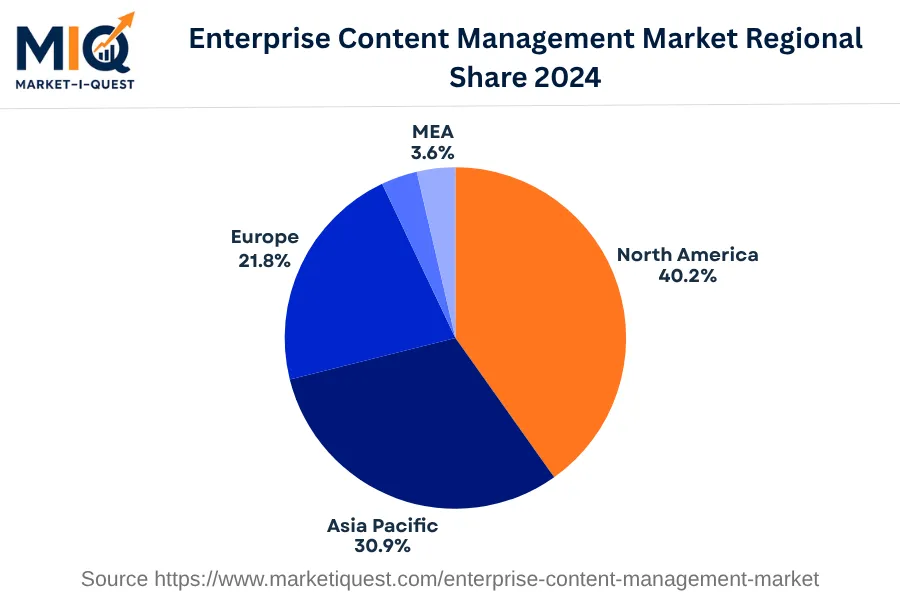
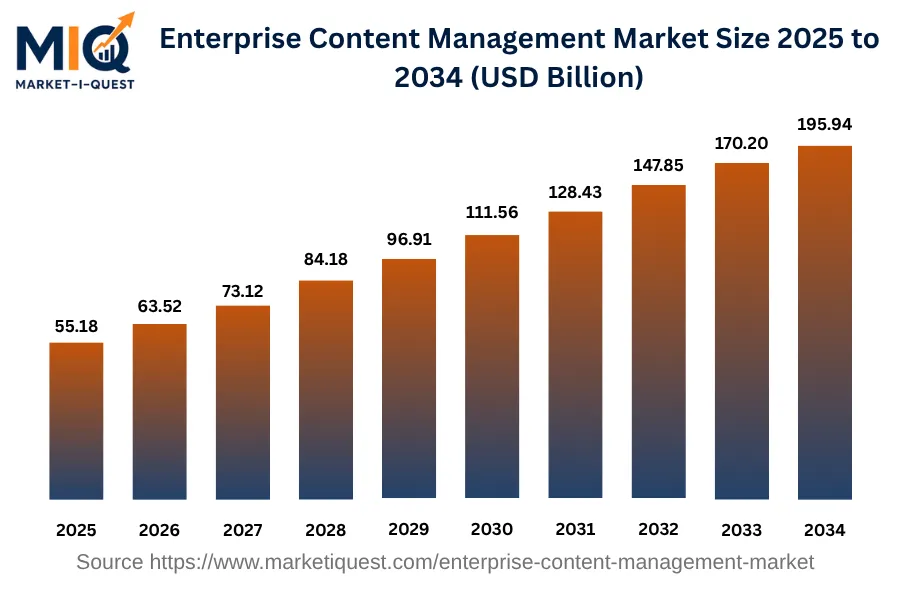
The Enterprise Content Management Market is slated to witness substantial growth from 2025 to 2034. The market, valued at USD 55.18 billion in 2025, is anticipated to expand dramatically over the next decade to reach a size of USD 195.94 billion by 2034. This progression corresponds to a CAGR of 15.1%. This growth trajectory can primarily be attributed to the increasing digitization and automation in enterprises worldwide. Further contributing to the market's expansion is the rising need for cost-effective solutions to organize, categorize, and structurally manage information. Remarkably, the market share as of 2024 demonstrates a geographical spread with North America leading at a 40.2%, closely followed by Asia Pacific at a 30.9%. Europe follows behind with a 21.8%, while LATAM represents 3.4% and MEA contributes 3.6% to the total market share.

Key Takeaways

  • By Solution Type - Document Management held the dominant position in the Enterprise Content Management Market.
  • By Deployment Mode - Cloud achieved the fastest growth indicating a shift from traditional on-premise models.
  • By End-User Industry - Telecom & IT emerged as the leader in utilizing Enterprise Content Management solutions in 2024.
enterprise-content-management-market market size

Key Driving Factors

Strict Regulatory Compliance in Healthcare Sector

Healthcare organizations deal with highly sensitive data: patient records, medical history, and billing information. These data are carefully scrutinized under laws like the Health Insurance Portability and Accountability Act (HIPAA) in the U.S. and the General Data Protection Regulation (GDPR) in Europe, requiring the safeguarding of personal data. Using enterprise content management (ECM) systems help these organizations securely store, retrieve, and manage such critical information. The software also keeps track of data modifications, providing a clear audit trail. Violations of these regulations result in substantial fines, legal consequences, and loss of reputation, coercing the sector to implement efficient ECM systems to ensure compliance.

Increasing Need for Document Management among Small and Medium Enterprises

Small and Medium Enterprises (SMEs) often have a sizeable volume of data. As these businesses grow, their data storage requirements expand significantly. The manual handling of physical documents becomes time-consuming and prone to errors. The implementation of an ECM system allows streamlined document management by categorizing and classifying documents, enabling rapid, reliable retrieval, and reducing the physical storage space required. An ECM system also enhances security by allowing role-based access to specific documents, minimizing the risk of unauthorized access. These systems also facilitate business continuity planning amidst disasters by creating electronic data backups. The need for efficiency, security enhancements, and contingency preparedness drives SMEs towards the adoption of ECM systems.

Market Evolution by Timeline

2019-2023
During this period, the primary buyers of ECM were medium and large-scale firms across North America and Western Europe, necessitated by remote work and digitizing traditional paper processes. Supply primarily entailed matured SaaS ECM solutions with on-premise options for organizations requiring strict data control. Microsoft SharePoint and OpenText were leading providers, with strong integration capacities with existing systems. Nonetheless, a common constraint was high implementation costs. Regulations like GDPR across Europe and similar policies in other regions led to a rise in interest in ECM for data protection. Commercial models leaned towards subscription-based plans, often bundled within broader business suite offerings, e.g., Office 365. The paramount risk was data security during storage and transit, with strategies including encryption and secure access management.
2024
In 2024, a surge of ECM demand came from emerging markets, such as India and China, facilitated by increased internet penetration and growing digitization. To meet this demand, local suppliers such as Alibaba and TATA developed custom-fit solutions. Also, mobile-friendly ECM solutions were emphasized. Concerning policies, China's Personal Information Protection Law influenced a focus on data privacy features in ECM solutions. The commercial model saw a rise in pay-as-you-go models, allowing flexibility and scalability to businesses. Risks of non-compliance with regional data regulations increased, hence businesses started outsourcing data compliance to third-party vendors.
2025-2029
Between 2025 and 2029, demand for ECM in small and medium-sized businesses surged globally, particularly in e-commerce and healthcare sectors, thanks to greater affordable options from providers such as Box and DocuWare. Major tech advancements included AI-powered ECM solutions that improved automated document management and information retrieval. Policy-wise, stringent data sovereignty laws led to the rise of region-specific and industry-specific ECM solutions. Pay-per-user pricing models became more prevalent. The main risk was device-specific security breaches, with firms adopting advanced verification measures like multifactor authentication.
2030-2034
From 2030 to 2034, a notable demand for ECM came from the public sector and non-profit organizations in regions like the Middle East and Africa, driven by progress in digital governance reforms. Major ECM vendors piloted tailored public sector solutions with specific compliance checks and audit features. The data minimization principle of regulations such as CCPA in the USA influenced data lifecycle management features in ECM solutions. A shift towards dynamic pricing models was noticed, accommodating different budget plans. The implemented risk response was making digital literacy and security training a part of ECM onboarding.

Future Market Outlook

Future Opportunities

The future of the enterprise content management market presents numerous opportunities tied to current trends and organizational needs. One evident opportunity lies in enhancing compliance management, particularly as regulations like the California Consumer Privacy Act are evolving since its enactment in 2018, creating challenges for data governance. Companies are increasingly seeking integrated ECM solutions that address these compliance requirements efficiently. In 2023, Adobe announced new features for its Document Cloud to aid enterprises in ensuring regulatory conformity, demonstrating the proactive development in response to market demands. Another opportunity exists within the realm of remote work; organizations are prioritizing seamless collaboration tools integrated with ECM systems. In 2022, Zoom and Dropbox formed a partnership to improve content sharing during virtual meetings, highlighting the market's shift towards collaborative capabilities. The healthcare sector, notably in the United States, is focusing on ECM tools to manage sensitive patient records, spurred by recent updates to HIPAA regulations that call for more robust data protection measures. Additionally, machine learning capabilities are expected to open avenues for advanced data categorization and retrieval, allowing enterprises to leverage their content more effectively. As user experiences become critical, designing customized workflows could significantly enhance employee productivity, presenting ECM vendors with potential for innovation and improved customer retention strategies across various industries.

Segmentation Analysis

By Solution Type

The market is divided into subsegments including Content Management, Document Management, Case Management, Workflow Management, and Digital Asset Management, with Document Management accounting for the largest revenue share and Content Management expected to grow at the fastest CAGR during the forecast period.

Largest Revenue Share

Document Management

Market Share Leader

Document management has generated the highest revenues in the base year 2024 largely owing to the increasing need for customer and business information storage. Given the efficiency, security, and productivity benefits, organizations across different industries are investing significantly in document management software. In particular, the surge in remote working conditions due to recent global circumstances has necessitated the need to access critical documents remotely, further driving the demand for these solutions. Regulatory compliance requirements and data security concerns also fuel the growth. Hospitals, financial institutions, and government agencies bear heavy data regulation burdens. Avoidance of hefty penalties has led companies to invest in cost-effective document management solutions, thereby contributing to its leading market share. Assuming typical market structure, this trend is expected to continue, driven by sectors with high compliance requirements and transactions.

Fastest CAGR

Content Management

Forecast Period Growth Leader

Content Management is expected to grow with the fastest CAGR. The key behind its rapid growth lies in the increasing digitalization of content and the rising need for omnichannel experiences. As businesses increasingly shift their operations online, there is a growing need to manage web content effectively to maintain a strong online presence. Businesses are betting on content management systems not just for organizing and storing digital content, but also to streamline workflow and provide better customer experiences. Additionally, the rising popularity of e-commerce and digital marketing has necessitated businesses to maintain updated and engaging content. Despite this potential, adoption barriers exist for industries with traditional business models or lack digital maturity. Technical advancements, partnerships for technology transfer, and demand from consumers for interactive digital experiences are expected to act as catalysts for growth within this sub-segment. Thus, while recognizing the potential switching costs and adoption barriers, it's safe to predict Content Management as the sub-segment anticipated to grow at the fastest rate in the near future.

By Deployment Mode

The market, organised by deployment mode, is divided into subsegments including On-Premises and Cloud. Today, On-Premises generates the largest revenue, while Cloud is expected to grow at the fastest CAGR during the forecast period.

Largest Revenue Share

On-Premises

Market Share Leader

Amid a wide array of industries, the On-Premises subsegment dominates because of persistent businesses concern about data security, system control, and high system optimization. Despite the moving trend to more flexible and remote working systems, companies are cautious about cloud adoption, primarily concerning data protection and transactions. In particular, highly regulated industries, such as finance and healthcare, prefer On-Premises solutions, which allow them to enforce strict information access and control regulations. On-Premises solutions also entail a gradual learning curve for employees without drastic changes in IT environments. Geographically, regions with existing infrastructure and mature markets, such as North America and Europe, continue to favor On-Premises solutions. By sticking to traditional systems, enterprises can avoid the investment required for a complete shift to cloud solutions. While this means stability and security on one hand, it also represents a lack of adaptability on the other.

Fastest CAGR

Cloud

Forecast Period Growth Leader

Although On-Premises continues to hold the largest portion of the market, Cloud is the fastest-growing subsegment. This rapid growth can be attributed to various factors. First, with the rise in remote working and global collaborations, accessing data and applications from anywhere at any time has become a critical business operation. Cloud deployment models, providing agility and instant scaling of resources, offer businesses an ideal solution to this trend. Alongside this, the reduction in capital expenses and maintenance costs are vital drivers behind the increasing adoption rate. Being a relatively new offering, Cloud also provides ample room for innovative technological integrations, giving it an edge over traditional On-Premises solutions. Policy developments promoting digital transformation and increased investments in IT infrastructure, particularly in emerging economies, are expected to further accelerate the growth of Cloud deployment model. Despite these catalysts, concerns over data security and privacy pose short-term risks for its growth.

By End-User Industry

The market is divided into subsegments including BFSI, Healthcare, Telecom & IT, Retail & E-commerce, Government, Manufacturing, and Others. In the base year of 2024, the Telecom & IT subsegment accounted for the largest revenue share while the Healthcare segment is projected to grow at the fastest CAGR in the upcoming years.

Largest Revenue Share

Telecom & IT

Market Share Leader

The Telecom & IT subsegment leads the market in revenue share due to a combination of key drivers. The mobile and internet revolution continues to expand, increasing demand for telecom and IT services globally. Both mature and emerging markets have demonstrated sustained growth in the digital economy, contributing to a significant rise in demand for IT services. Increased digitalization and technological advancements like cloud computing and the Internet of Things (IoT) have brought a paradigm shift in how businesses operate, giving a substantial boost to the sector. Government policies promoting digital connectivity and smart cities have also positively influenced the sector. Lastly, the penetration of smart devices, combined with improved internet infrastructure, has transformed consumer behavior, driving demand for telecommunications services. It’s crucial to note that the continuous innovation in this sector, aligned with driving customer experience and operational efficiency, contributes to the largest revenue share.

Fastest CAGR

Healthcare

Forecast Period Growth Leader

Projected to grow with the fastest CAGR, the Healthcare sector is incentivized by a convergence of factors. The onset of the digital health age, hastened by pandemic-induced needs, has paved the way for rapid digitization and adoption of advanced technologies in healthcare. The industry is experiencing an influx of med-tech startups and ventures seeking to capitalize on emerging opportunities. Advanced data analytics and AI are catalyzing a shift towards predictive healthcare, personalization, and improved patient care. Moreover, increasing investments, government initiatives for digital health, and partnerships between tech giants and health institutions are stimulating growth. However, cybersecurity risks, privacy concerns, and regulatory uncertainties may be potential barriers. As telehealth, remote patient monitoring, and AI-driven diagnostics gain traction, the healthcare subsegment stands to grow at an exponential rate in the coming years.

Competitive Analysis

Key Market Players

Manufacturers / OEMs

Microsoft Corporation
US
IBM Corporation
US
OpenText Corporation
Canada

Key Suppliers & Raw Materials

SAP SE
Germany
Oracle Corporation
US
HP Inc.
US

Distributors, Integrators & Channel Partners

Alfresco Software, Inc.
UK
Hyland Software Inc.
US
M-Files Corporation
Finland

Porter’s Five Forces Analysis

This analysis assesses the competitive dynamics in the Enterprise Content Management Market.

Supplier Bargaining Power

Medium

Dependence on sophisticated technology boosts suppliers' power, though market competition limits it.

Buyer Bargaining Power

High

Buyers have high power due to the availability of many ECM solutions and low switching costs.

Threat of Substitutes

Medium

Potential substitutes like decentralized file storage systems pose moderate threat.

Threat of New Entrants

Low

High development costs, technology expertise, and regulatory compliance form barriers to entry.

Competitive Rivalry

High

Intense competition among leading players like Oracle, IBM, and Microsoft dominates the market.

Regional Analysis

Geographic market dynamics and growth opportunities across key regions

Global Market Outlook

enterprise-content-management-market market regional share

North America

In 2024, North America's Enterprise Content Management (ECM) market saw substantial growth propelled by multiple drivers and evolving trends. Technological advancements led to a boost in ECM adoption across businesses of varying scales. Tightened regulatory measures, especially dealing with data protection and privacy such as the California Consumer Privacy Act (CCPA) in the U.S., mounted pressure on companies, increasingly driving ECM demand. Increased investment in digital infrastructure across enterprises also contributed to overall market growth. In trends, a shift was evident in buyer behaviors, with a heightened preference for cloud-based ECM solutions due to its scalability and cost-effectiveness. Mergers and acquisitions, like Open Text's acquisition of Carbonite, underscored the strategy to broaden ECM capabilities. Standards bolstered the market, like NIST's Special Publication 800-53, which laid the groundwork for secure content management.

Particularly in the sectors of healthcare and retail, the need for efficient content handling and data confidentiality regulations resulted in higher ECM uptake. Government bodies leaned towards ECM solutions for robust public data management, while the manufacturing sector saw ECM implementation for streamlined operational content management. With such driving factors and trends, the ECM market in North America in 2024 demonstrated strong momentum.

Asia Pacific

In 2024, the Enterprise Content Management (ECM) market in the Asia Pacific region evidenced considerable traction. Market vigor was spurred by escalating digital transformation across diverse industries, stringent regulatory compliances stimulating document retention requirement, and substantial influx of investments in cloud-based solutions. Markedly, increasing adoption of ECM in industries such as enterprise, government, healthcare, utilities, manufacturing, retail ignited the market growth in key economies like China, India, Japan, South Korea, Australia, and ASEAN markets.

Emerging trends exhibited a synergy between advancing technology and buyer behavior, accelerating market evolution. The amalgamation of ECM with AI and Machine Learning in enterprises was a significant trend, optimizing the workflow management. The surge in strategic alliances coupled with M&A activities was evident, especially in China and Australia, fostering the strength and reach of key market players. The shift towards cloud-based ECM solutions was prevalent, largely driven by flexible cost structure and high scalability. Policy enforcement was another observable trend, particularly in India and Japan, with governments implementing robust security standards to mitigate data privacy concerns. These tendencies spotlighted a lean towards high-tech, regulation-driven, and strategic partnership-driven growth in the Asia Pacific's ECM domain in 2024.

Europe

In 2024, the European Enterprise Content Management (ECM) market underwent a significant pivot towards digital solutions in several premier economies. Drivers included regulatory pushes for digitisation, like Germany's Industry 4.0, increased investment in ECM technology by companies in the United Kingdom, Italy, and the Nordics seeking to streamline processes and strengthen data security. Additionally, cloud adoption in France, Spain, and Benelux expedited the surge in demand for ECM software among enterprises and government sectors.

Trends wise, observed behavior pointed to a preference for ECM systems offering integrated artificial intelligence (AI) capabilities, particularly noted in the Central and Eastern European regions. Healthcare and retail sectors in the United Kingdom and Spain were key adopters of such technologies, substantiating the shift. Partnerships and M&As became more prevalent as firms sought to complement in-house expertise, as witnessed in Italy's Ferrovie dello Stato Italiane acquiring an ECM solution from Hyland. Policy enforcements also influenced the trend, with the EU's General Data Protection Regulation (GDPR) bolstering the need for ECM to manage and protect customer data in sectors like utilities and manufacturing, notably in France and Germany.

Latin America

In 2024, the Enterprise Content Management (ECM) market in Latin America witnessed a substantial growth. The drivers propelling this development included new government regulations requiring higher data management standards, notably in Brazil and Mexico. These demands combined with the widespread adoption of cloud-based services and AI technology across multiple sectors led to streamlined content access and secure data storage, expediting market growth. The increase in foreign direct investments, particularly in the IT sectors of Argentina and Colombia, triggered the infrastructure required for ECM expansion.

In terms of trends, there was a noticeable shift towards customer-centric ECM systems rather than traditional document-centric versions to enhance user experiences. This was observed in sectors like healthcare and utilities in Chile and Peru. Mergers and acquisitions became a common strategy for enterprise businesses to consolidate their position in the market, with an increased emphasis on employing ECM for agile decision-making. In retail and manufacturing industries, there was a marked preference for mobile ECM solutions ensuring seamless process flows and higher efficiency. Policy enforcement aimed at data protection and privacy continued to reshape the market dynamics, with organizations prioritizing compliant ECM system providers. Overall, 2024 saw an amalgamation of technological, regulatory and business factors shaping the ECM landscape in Latin America.

Middle East & Africa

In 2024, the Enterprise Content Management (ECM) market signaled strength in the Middle East and Africa led by evolving digitalization initiatives. Drivers underpinning the market's vitality consisted of escalating cybersecurity concerns, burgeoning technology adoption by key industry sectors, and strategic investments. Government-led 'Digital Transformation' plans in countries like Saudi Arabia and UAE witnessed increased adoption of ECM solutions in sectors including oil and gas, finance, and healthcare. Similarly, Israel's staunch cybersecurity policies necessitated ECM among critical sectors like telecom and banking.

The market trends highlighted the pervasive shift towards cloud-based ECM services, the rise of AI-based content management, and growing partnerships between multinational firms and regional tech startups. The implementation of cloud technology across major sectors, spearheaded by entities like Emirates NBD and Qatar’s Ministry of Transport and Communications, reflected a robust preference for 'cloud-first' strategies. AI-powered ECM tools also gained traction, as evidenced by the partnership of Oracle with South Africa-based startup, BrandsEye, to provide sentiment analysis services. Amidst heightened policy enforcement, tighter data protection laws in countries like Egypt, Nigeria, and Kenya led to demand surge in secure ECM services by banking and retail sectors. The year 2024 was characterized by enhanced digitization efforts and technological advancements in the ECM market across the Middle East and Africa.

Recent Industry Developments

Latest market innovations, product launches, and strategic initiatives

June 2026

Hyland announced a strategic partnership with Microsoft to power the agentic enterprise with the Content Innovation Cloud on Microsoft Azure, uniting Hyland's governed enterprise content platform with the Microsoft Azure ecosystem.

October 2025

Box and Tata Consultancy Services (TCS) announced a strategic partnership to deliver integrated, end-to-end solutions bringing content and AI together across financial services, healthcare, manufacturing, retail, and the public sector.

Frequently Asked Questions