
Engineering Adhesives Market Snapshot

Key Players

  • 3M (US)
  • Huntsman International LLC (US)
  • Bostik SA (France)
  • Dow Chemical Company (US)
  • Henkel AG & Co. (Germany)
  • Sika AG (Switzerland)
  • H.B. Fuller (US)
  • Loctite (Ireland)
  • Ashland Inc. (US)

Market Size

Base Year 2024
$24.36 Bn
CAGR
6.38%
Forecast 2034
$45.21 Bn

Market Segments

By Product
  • Epoxies
  • Polyurethanes
  • Cyanoacrylates
  • Methacrylates
  • Others
By Application
  • Transportation
  • Construction
  • Electrical & Electronics
  • Energy
  • Others

Market Dynamics

Drivers
  • Rising automotive industry demand
  • Increasing product innovation necessity
Restraints
  • High Production Costs
  • Stringent Environmental Regulations
Opportunities
  • Increasing industrial automation
  • Advancements in adhesive technologies

Market Size

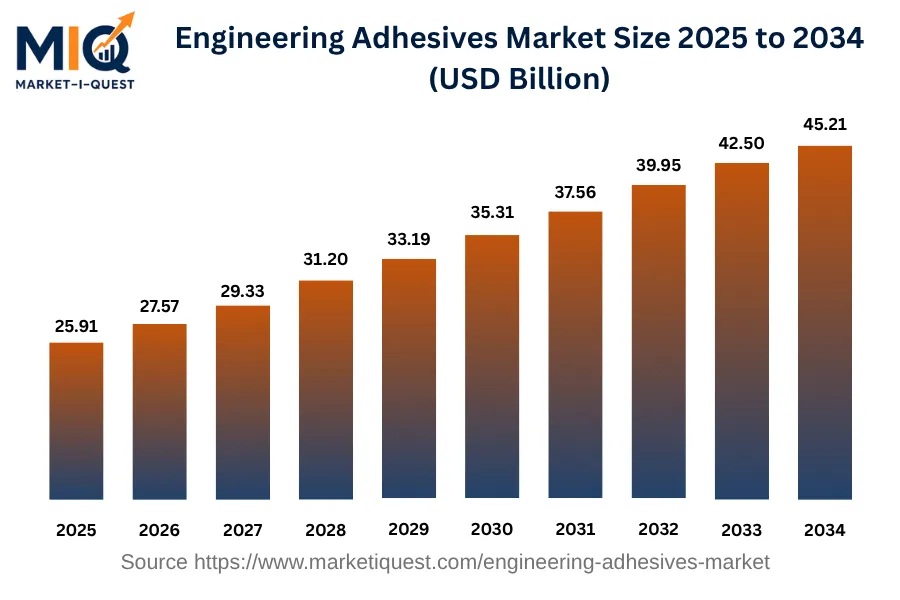
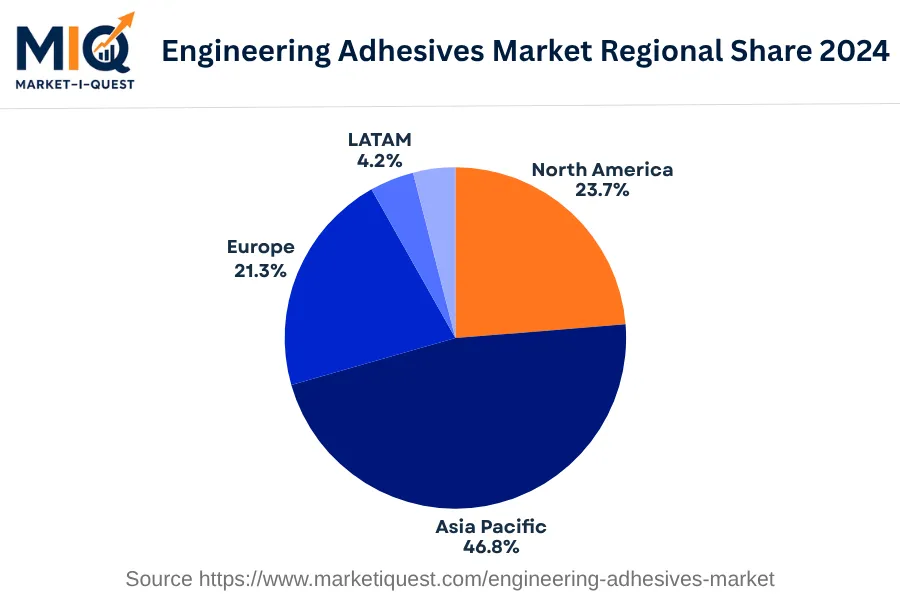
The Engineering Adhesives Market, sized at $25.91 billion in 2025, will grow to attain a market value of $45.21 billion by 2034, at a compound annual growth rate (CAGR) of 6.4%. This growth trajectory for the decade between 2025 and 2034 clearly indicates an organic expansion in the market that nearly doubles the starting value. One prominent factor contributing to the growth of this market is the steady year-on-year increase reflecting a positive trend over the long term. In terms of regional market shares in the base year 2024, Asia Pacific commanded the largest slice of the Engineering Adhesives Market at 46.8%, followed by North America at 23.7%, and Europe at 21.3%. The remaining market share, approximating 8.1%, was equally divided between Latin America and the Middle East and Africa regions, with each holding a nearly 4% share.

Key Takeaways

  • By Product - Epoxies held the leading position in the Engineering Adhesives Market in 2024.
  • By Application - Electrical & Electronics led the market accounting for a significant share in 2024.
engineering-adhesives-market market size

Key Driving Factors

Adoption of Lightweight and Low CO2 Emitting Vehicles

Government regulations on greenhouse gas emissions have led to the automotive industry's shift toward manufacturing lightweight and low CO2 emitting vehicles. These regulations place immense pressure on automobile manufacturers to reduce the overall weight of vehicles and subsequently, their fuel consumption. Engineering adhesives are ideal for these applications, due to their strength and capability to bond different materials without adding substantial weight. Used in replacing traditional methods like welding and mechanical fastening, they aid in achieving vehicle weight reduction while maintaining structural integrity. Therefore, stringent environmental regulations compelling automakers to switch to lightweight and low-emission models are pushing the adoption of engineering adhesives in the automotive industry.
Consumer Electronics Miniaturization

The trend of miniaturization in the consumer electronics industry is another driver for the engineering adhesives market. Manufacturers continually aim to produce smaller, more compact devices without compromising functionality. This requires components to be packed tightly together, which necessitates adhesives with high bonding strength in small volumes. Engineering adhesives serve this purpose effectively. They deliver reliable performance under high pressure and temperature conditions typical within miniaturized electronic devices. They also resist thermal and electrical conductivity, a necessary attribute in devices with compact design to prevent short circuits. This continued push for smaller, more efficient electronic devices drives the demand for engineering adhesives in the consumer electronics sector.

Market Evolution by Timeline

2019-2023
During this period, the Engineering Adhesives Market sees significant demand from industries like automotive, construction and consumer goods due to its increasing applications in these sectors. Asia-Pacific seems to dominate the market with increasing infrastructural activities. Market supply started adapting to water-based adhesive technologies due to its environmental benefits. However, technical integration with existing manufacturing systems emerges as a major constraint. Policy regulations like REACH (Registration, Evaluation, Authorization, and Restriction of Chemicals) by European Union demands manufacturers to limit the use of hazardous substances in adhesives. Price-wise, purchasers prefer value- and volume-based contracts over spot buys. The major risk this market faces is the fluctuating raw material prices which manufacturers tackle by diversifying their supplier base.
2024
In the year 2024, automotive industry continues to be a major buyer of engineering adhesives due to their increasing use in lightweight vehicle production. The most imported type includes epoxies and acrylics, commonly from China and India. The supply chain is moderately affected due to the global pandemic, with minor disruptions in shipping and inventory management. Pressure-sensitive adhesive technology continues to be an interest among manufacturers but faces constraints in large scale implementation. No major change in regulation noticed during this year. Pricing dynamics remain same. The risk predominantly persists from unstable raw material prices and manufacturers are likely to explore alternative sources.
2025-2029
This era sees an upsurge in biobased engineering adhesives. Automotive, aerospace, and energy sectors with their stringent sustainability objectives drive this demand, particularly in North America and Europe. Major producers like 3M pivot to biobased variants due to its wide acceptability. Due to the shift towards sustainability, ISO 14000 environmental management standards get strictly implemented. Commercially, volume-based contracts with long term supplier agreements are common to ensure a stable supply of biobased adhesives. Risks involve the battle between production cost and market price for these new variants, likely to be managed through market skimming strategy.
2030-2034
The key trend is the wide adoption of biobased engineering adhesives market worldwide, majorly spurred by sustainable manufacturing goals. Demand from sectors like automobile and consumer goods is at all time high with Asia-Pacific and North America leading the way. Supply-wise, R&D intensifies for advent of more efficient and resilient biobased adhesives. The market abides by ISO 14000 standards and suppliers strategically partner with biobased raw material providers. The procurement is generally done through long term contracts to hedge against the likely fluctuation in green raw material prices. The risk is from the potential gap in demand and supply of these raw materials.

Future Market Outlook

Future Opportunities

Future opportunities within the engineering adhesives market are closely tied to ongoing advancements in manufacturing processes and regulatory frameworks. The expansion of electric vehicle production is prompting manufacturers to explore high-performance adhesives that can withstand harsher conditions. Companies such as Lord Corporation are already acquiring smaller firms specializing in automotive adhesives, indicating a consolidation trend aimed at enhancing capabilities in this sector. Moreover, as the construction industry faces increased pressure to meet LEED certification requirements, there's a rising interest in low-VOC and eco-friendly adhesives. The construction market trends, particularly seen in U.S. projects compliant with the 2021 International Energy Conservation Code, are influencing the demand for high-performance adhesive solutions that align with these stringent environmental guidelines. Additionally, the rise of 3D printing technologies is creating new applications for adhesives, prompting firms like Sika to develop specialized products that cater to this niche. Furthermore, with rising global partnerships focusing on infrastructure projects in regions such as Southeast Asia, there's an expected surge in the demand for durable bonding solutions. This landscape is intensified by evolving safety regulations issued by bodies such as OSHA, which necessitate the use of reliable adhesive solutions in various industries. Hence, the coming years present a wealth of untapped avenues for innovation and growth as companies navigate these emerging trends and align their products with regulatory expectations.

Segmentation Analysis

By Product

The market is divided into subsegments including Epoxies, Polyurethanes, Cyanoacrylates, Methacrylates, and Others. Among these, Epoxies accounted for the largest revenue share while Polyurethanes are expected to grow at the fastest CAGR during the forecast period.

Largest Revenue Share

Epoxies

Market Share Leader

Epoxies held the largest revenue share due to their extensive usage across multiple industries. Epoxies are noted for their excellent adhesion, high heat resistance, and superior chemical resistance. Their broad-spectrum utilisation extends across the automotive, construction, food, and aerospace industries among others, with the durable and resistant properties of this adhesive type being the primary drivers for this demand. Additionally, the regulatory landscape supports their use. Environmentally friendly and low-VOC emitting epoxies are promoted by regulations, further driving adoption. Furthermore, geographical diversity in terms of customer base also contributes to its leading position. Countries with robust manufacturing sectors, such as China, U.S., and Germany, command significant use of epoxies. In terms of purchasing criteria, performance and price are critical, and given its high-performing characteristics, epoxies remain a primary choice despite the relative higher cost.

Fastest CAGR

Polyurethanes

Forecast Period Growth Leader

Polyurethanes are projected to be the fastest-growing sub-segment in this market. They offer an ideal combination of flexibility and strength, making them suitable for a range of applications, especially in the automotive and construction sectors. Technological advancements have led to improved formulations, pushing polyurethanes' performance beyond traditional materials. Regulatory shifts towards energy efficiency also act as a catalyst for the market. Polyurethanes are excellent insulators, making them indispensable for energy-efficient buildings and vehicles. However, adoption barriers exist in the form of higher initial cost compared to other adhesives and sensitivities around application environments. High capital expenditure is required for developing production capacities which may slow down the growth rate. Potential near-term risks include fluctuating raw material prices and stringent environmental regulations. Nevertheless, ongoing research, investment in new facilities, and strategic partnerships continue to drive the adoption and growth of polyurethanes.

By Application

The market is divided into subsegments including Transportation, Construction, Electrical & Electronics, Energy, and Others. Among these, the Electrical & Electronics subsegment accounted for the largest revenue share in 2024, while the Energy segment is forecasted to experience the fastest CAGR growth during the forecast period.

Largest Revenue Share

Electrical & Electronics

Market Share Leader

The Electrical & Electronics subsegment achieved the highest revenue share in 2024. This can be attributed to several factors. Demand for electronic devices, both consumer and industrial, has seen a continual rise, largely driven by advances in technology and reduced prices. Emerging markets, especially in Asia, have been fueling this demand as well. On a global scale, growing economies are experiencing rapid urbanization and higher disposable incomes, further accelerating the growth of the electronics industry. Furthermore, regulatory factors play a significant role. Increased environmental consciousness has led to regulations promoting energy-efficient devices, thereby spurring demand in the electrical & electronics segment. In terms of supply, the widespread accessibility of raw materials and the growing pool of skilled labor in developing economies have helped manufacturers meet this soaring demand. Lastly, modern distribution channels, like e-commerce, allow more consumers to access these electronic products, thereby driving the growth.

Fastest CAGR

Energy

Forecast Period Growth Leader

The Energy segment is projected to yield the fastest Compound Annual Growth Rate (CAGR). The primary driver for this trend is the urgent global need for energy, especially renewable sources, aligned with growing environmental consciousness and the need for sustainability. Advancements in technology have significantly reduced the prices of renewable energy production, making it a more viable option. Also, regulations promoting renewable energy harnessing and imposing penalties for excessive carbon footprints are acting as catalysts for this segment. However, two primary challenges exist - initial capital expenditure and need for significant infrastructure. Both could potentially impede its swift adoption. In the short term, volatile commodity prices may pose a risk. However, partnerships and alliances between stakeholders across the supply chain can mitigate these challenges and spur growth, making this segment poised for high growth in the upcoming years.

Competitive Analysis for Engineering Adhesives Market

Key Market Players

Manufacturers / OEMs

3M Company
US
Henkel AG
Germany
Huntsman International LLC
US

Key Suppliers & Raw Materials

Dow Chemical Company
US
Arkema Group
France
BASF SE
Germany

Distributors, Integrators & Channel Partners

Grainger
US
McMaster-Carr
US
Würth Group
Germany

Porter’s Five Forces Analysis

An analysis of the competitive landscape in the Engineering Adhesives Market using Porter's Five Forces model.

Supplier Bargaining Power

Medium

Chemical suppliers hold some power due to limited sourcing alternatives, yet competition restricts excessive pricing.

Buyer Bargaining Power

High

Buyers, including large construction and manufacturing firms, hold significant power due to the availability of alternatives.

Threat of Substitutes

Low

Few viable substitutes exist due to the specific performance characteristics of engineering adhesives.

Threat of New Entrants

Low

High capital expenses, regulatory hurdles, and established supply-chain relationships deter new entrants.

Competitive Rivalry

High

Market is fiercely competitive with many players vying for market share, leading to aggressive pricing strategies.

Regional Analysis

Geographic market dynamics and growth opportunities across key regions

Global Market Outlook

engineering-adhesives-market market regional share

North America

In 2024, North America's engineering adhesives market experienced a period of steady vibrancy, prompted by several significant drivers and trends. Drivers included escalating demand from the automotive and aerospace industries, where lightweight and durable adhesives were in high demand for manufacturing processes. Stringent government regulations, particularly in the US, served to bolster the marketplace, prompting investment in environmentally-friendly adhesive formulations. Furthermore, technological advancements saw a rise in demand for high-performance adhesives across industries, particularly in manufacturing and utilities, directly influencing supply dynamics.

Trends in 2024 signaled a shift toward enhanced product performance, with major manufacturers investing in R&D to develop stronger, quicker setting adhesives. In retail, customer preference was clearly moving towards easy-to-use consumer products, driving manufacturers towards more user-friendly packaging designs. The year witnessed strategic partnerships and mergers with an aim of expanding product portfolios and regional footprint—particularly notable were activities between U.S. and Mexican companies, taking advantage of Mexico’s burgeoning industrial growth. In terms of policy enforcement, both government and enterprises were focused on the adoption of stricter environmental standards, encouraging development of sustainable and less volatile organic compound (VOC) adhesives. This confluence of drivers and trends underscored the market's robustness in 2024.

Asia Pacific

In 2024, the Engineering Adhesives Market in Asia Pacific exhibited a striking dynamism due to various factors. Increased demand arose from key industries like manufacturing, construction, and automotive, spurred by rising infrastructural developments in countries like China, India, and Japan. More stringent environmental regulations, especially in China and Japan, enforced the adoption of high-performance, eco-friendly adhesives, while technological advancements in adhesive manufacturing increased supply diversity. The adoption of innovative adhesive technologies, particularly in South Korea and Japan, emerged as a prominent trend, along with an increasing focus on renewable materials. India's Make-in-India campaign led to enhanced domestic production capabilities for adhesives, impacting supply dynamics regionally. Furthermore, price competitiveness was increasingly observed, particularly in ASEAN markets due to China's aggressive product pricing.

Customer behaviour revealed a preference for high-quality, durable engineering adhesives in sectors such as electronics, automotive, and construction. The rise of e-commerce channels, especially in China, altered the market dynamics and enabled easier access to a wider variety of adhesive products. Mergers and acquisitions increased in Australia and key ASEAN countries, creating significant changes in market leadership and competitive dynamics. Meanwhile, stricter standards for adhesive products and their application, primarily enforced in Japan and South Korea, began driving higher product quality across the region.

Europe

In 2024, the European engineering adhesives market exhibited a resilient ecosystem kickstarted by technological innovations and industry-specific demands. Driving growth, regulations such as REACH (Registration, Evaluation, Authorization, and Restriction of Chemicals) urged industries to adopt eco-friendly alternatives, coupled with increased investments in R&D, leading to the rise of bio-based engineering adhesives in France and Germany. Technological adoption accelerated with European manufacturers of aeronautics, automotive, and high-tech electronics leveraging high-performance adhesives. Fluctuating raw material prices also influenced the supply dynamics, particularly in Germany and the United Kingdom. However, notable trends marked more profound effects on the market. Increased product customization expectations from enterprise customers in the United Kingdom and Benelux led manufacturers to explore novel adhesive solutions.

Digital transformation in Spain's and Italy's manufacturing sectors spearheaded a shift to smart adhesives, offering real-time monitoring and self-healing features. Furthermore, the Nordic countries saw an uptick in M&A activity among adhesive manufacturers, seeking to bolster their product portfolio and market reach. Regulating bodies strengthened the enforcement of health and safety standards, compelling manufacturers to ensure the safety and efficacy of their adhesive products. This became particularly pertinent in utilities and construction sectors across Central and Eastern Europe due to the extensive use of adhesives in infrastructural projects in these regions.

Latin America

In 2024, the Engineering Adhesives Market in Latin America (LATAM) witnessed significant activity, with key dynamics shaping its landscape. A surge in industrial manufacturing, particularly in Brazil and Mexico, played a major role in driving the market. Demand was primarily stimulated by increased production in the automobile, electronic, and industrial assembly sectors. Higher adoption of technologically advanced adhesives in these industries, coupled with increasing investment in product development, enhanced the market growth. Regulatory factors also contributed to the market dynamics - countries like Argentina and Colombia implemented stricter regulations on material safety, pushing manufacturers towards eco-friendly adhesive options. In addition, a rise in infrastructure projects in Chile and Peru increased demand for high-performance adhesives.

From the trends perspective, sustainability became a key factor influencing buyer behavior across the region. Demand for biodegradable and recyclable adhesives picked up pace. There was a noticeable shift towards adhesives that had a minimal environmental footprint with an increased focus on circular economy principles. In terms of product, there was a shift towards the adoption of hot melt adhesives due to their faster setting times and bonding strength. Furthermore, channel dynamics displayed a significant shift towards online sales platforms, led by retailers expanding their online presence amidst the digital transformation wave sweeping the region. Interestingly, there were a handful of strategic partnerships and M&A, especially among local and international manufacturers, aiming to increase their footprint and cater to the growing demand in the region.

Middle East & Africa

In the base year 2024, the engineering adhesives market in the Middle East and Africa displayed strong growth dynamics. The market thrived due to increased demand for high-performance adhesives in diverse sectors such as automotive, construction, and manufacturing. Developments in technology within Saudi Arabia, United Arab Emirates, Qatar, Egypt, South Africa, Nigeria, Kenya, and Israel fostered the adoption of superior engineering adhesives, enhancing product quality and sustainability. Meanwhile, substantial investments in infrastructure and manufacturing projects, particularly in Saudi Arabia, United Arab Emirates, and Qatar, drove up demand for these adhesives.

On trends, there was an evident shift in customer preference towards environmentally-friendly adhesives, seen primarily in South Africa and Israel, prompting companies to align their product offerings. The market also witnessed burgeoning partnerships and M&As especially in Kenya and Nigeria to expand product portfolios and customer reach. Regulatory compliance gained prominence across regions, with governments enforcing stricter safety and quality standards in adhesive production, evident in Egypt's construction and manufacturing sectors. Lastly, rising digitalization influenced distribution channels, boosting online sales of engineering adhesives across the region.

Recent Industry Developments

Latest market innovations, product launches, and strategic initiatives

March 2026

Henkel's strategic collaboration with Synthomer launched high-performance hot-melt adhesives using the mass balance approach, linking renewable feedstocks to product lifecycles. As of March 2026, these adhesives have been applied in packaging and automotive sectors.

August 2025

Avery Dennison acquired Meridian Adhesives Group's flooring adhesives business from American Securities for approximately $390 million. The business includes brands such as Taylor Adhesives, Polycom, and Frontier Products.

Frequently Asked Questions