
Endpoint Security Market Snapshot

Key Players

  • Symantec Corporation (US)
  • McAfee LLC (US)
  • Sophos Group plc (UK)
  • Trend Micro Incorporated (Japan)
  • Palo Alto Networks (US)
  • Kaspersky Lab (Russia)
  • Fortinet Inc. (US)
  • Avast (Czech Republic)
  • Bitdefender (Romania)
  • Check Point Software Technologies (Israel)

Market Size

Base Year 2024
$17.93 Bn
CAGR
11.85%
Forecast 2034
$54.95 Bn

Market Segments

By Component
Solutions, Services
By Deployment
Cloud, On-Premise
By Application
BFSI, Healthcare, Retail, IT & Telecom, Government & Defense, Industrial, Education, Others

Market Dynamics

Drivers
  • Increasing cyber threats
  • Adoption of remote working
Restraints
  • High implementation cost
  • Lack of cybersecurity awareness
Opportunities
  • Growing cyber threat landscape
  • Remote working trends

Market Size

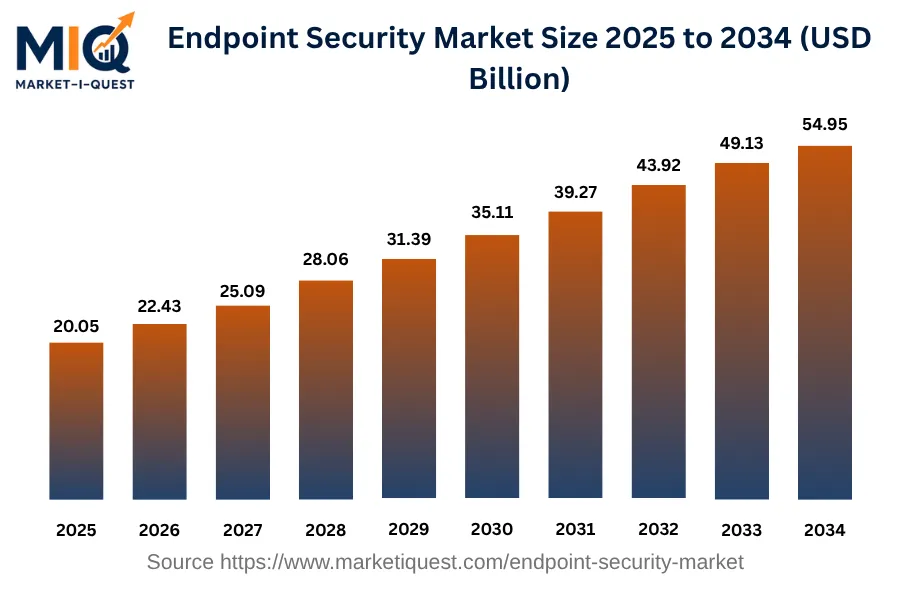
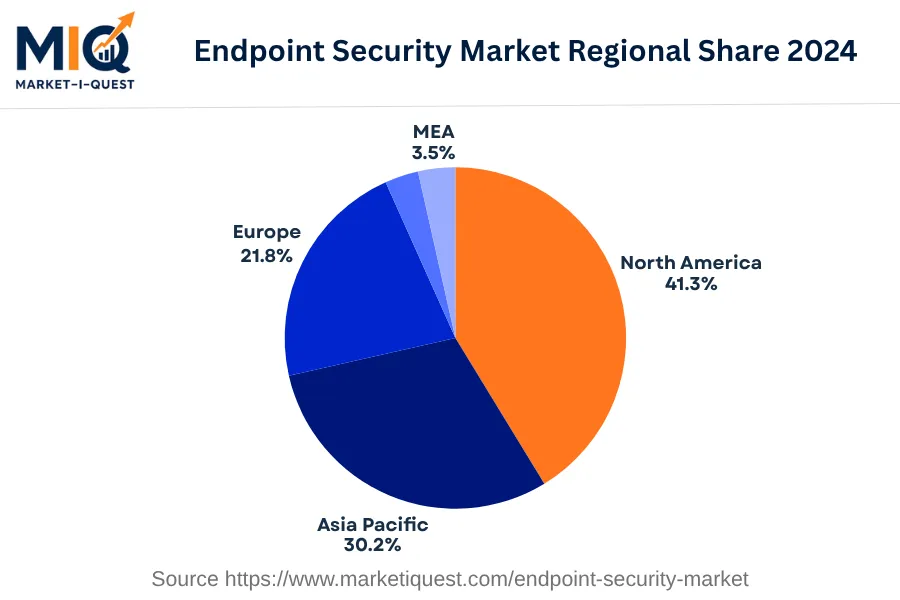
The Endpoint Security Market was worth USD 20.05 billion in 2025 and is projected to reach USD 54.95 billion by 2034, with a CAGR of 11.85%. This growth begun in 2024, with a market value of USD 17.93 billion. It then proceeded to exceed the 20 billion mark in 2025 and is predicted to surpass 50 billion by 2034. This growth is due to the consistent rise in the complexity and frequency of cyber attacks and the heightened need for secure endpoints in the digital era. In 2024, the regional share was distributed with North America leading at 41.3%, followed by Asia Pacific at 30.2% and Europe at 21.8%. The shares of LATAM and MEA were significantly lesser, with 3.2% and 3.5% respectively.

Key Takeaways

  • By Component - Services held a dominant position accounting for the largest market share in 2024.
  • By Deployment - Cloud saw the fastest growth and held a significant market share in 2024.
  • By Application - BFSI segment took the lead accounting for the major share in 2024.
endpoint-security-market market size

Key Driving Factors

Data Protection Regulatory Compliance Requirements

One of the significant drivers for the Endpoint Security Market is the rigorous data protection regulatory requirements from bodies such as the European Union's General Data Protection Regulation (GDPR) and the California Consumer Privacy Act (CCPA). These regulations have mandated businesses to adopt strict data privacy practices, where a secure endpoint becomes a necessity for compliance. Failure to do so can result in heavy penalties and loss of customer trust. Hence, organizations are focusing more on securing their endpoints to protect them from any potential data breaches and fulfill their compliance requirements, accelerating the demand for endpoint security solutions.
Increase in Remote Workforce

A second critical driver is the dramatic rise in the remote workforce due to recent global events like the COVID-19 pandemic. With employees working from various locations and on different networks, maintaining the security of digital assets has become extremely challenging for organizations. Each remote device represents a vulnerable endpoint that could potentially allow cybercriminals access to a company's network. Therefore, the need for robust endpoint security solutions to protect each employee's device, regardless of its location, has become a priority for many businesses. This trend of remote work shows no sign of significantly receding in the near future, which means the demand for effective endpoint security systems will continue to increase.

Market Evolution by Timeline

2019-2023
The Endpoint Security Market in this period saw businesses and organizations as the primary buyers recognizing threat protection as their main purchasing reason. Most demands were from established markets in North America and Western Europe. Cloud-based solutions became prominent, along with more integration with existing IT systems. GDPR standards heavily influenced the policy landscape. Businesses typically opted for subscription-based pricing models and tended to form partnerships with IT service providers for effective implementation. Supply constraints were mainly due to a dearth of skilled workforce. Cybersecurity threats posed a substantial risk, and the response generally involved increasing awareness and training programs.
2024
In 2024, the demand growth of Endpoint Security Market was likely driven by the healthcare industry in Asian markets, primarily for data protection. AI-based solutions started to gain recognition. The introduction of the Cybersecurity Maturity Model Certification (CMMC) in the USA impacted the market environment. Organizations commonly preferred per user licensing pricing models and multi-vendor approach was a typical partnership pattern. The risk of vendor lock-in started to emerge and businesses tried to circumvent it by opting for standardized solutions when possible.
2025-2029
This period saw a surge in demand from SMEs globally for Endpoint Security with a major focus on preventing data breaches. Hybrid solutions proliferated the market, combining on-premise and cloud-based securities. The implementation of the California Privacy Rights Act (CPRA) was a notable policy development. Flat rate pricing dominated the commercial model and partnerships with cybersecurity consultants were common. There were concerns about the sustainability of separately managed endpoint solutions, and integrated solutions emerged as the frequent response.
2030-2034
Demand from individual users and IoT-focused industries significantly grew in Africa and the Middle-East regions. Quantum-resistant algorithms became a significant trend in the Endpoint Security technology sphere. The recommendation of Secure software development practices by NIST impacted the policy setting. Flexible and customizable pricing models came to the fore and collaborations with data scientists grew. The risk of quantum computing breaking encryption methods forced the industry to innovate and digital identity-based securities saw increased popularity.

Future Market Outlook

Future Opportunities

The shift toward remote and hybrid work environments is fundamentally changing the paradigm of endpoint security strategies. Organizations are increasingly aware that endpoint devices, particularly personal laptops and mobile devices, pose significant risks to their networks. In June 2023, the World Economic Forum published a report highlighting that 83% of companies are prioritizing endpoint security as part of their digital transformation efforts. Consequently, service providers have begun enhancing their managed security services to address the unique requirements of hybrid workforces. There is also a surge in interest for endpoint detection and response (EDR) solutions that provide real-time insights. For instance, in August 2023, the release of VMware's EDR solution showcased new features aimed at identifying and neutralizing threats with minimal downtime. Additionally, the growing awareness regarding data privacy concerns is prompting organizations to reconsider their compliance frameworks. The implementation of the General Data Protection Regulation (GDPR) across Europe and similar regulations in regions like California with the California Consumer Privacy Act (CCPA) are driving enterprises to invest in endpoint security solutions that not only detect threats but also ensure compliance. This evolving regulatory landscape, coupled with the heightened focus on data privacy, represents a substantial opportunity for companies to further innovate their security offerings and capitalize on compliance-driven investments in endpoint security infrastructure.

Segmentation Analysis

By Component

The market is segmented into Solutions and Services. The Services subsegment accounted for the largest revenue share while the Solutions subsegment is projected to grow at the fastest CAGR during the forecast period.

Largest Revenue Share

Services

Market Share Leader

Services dominate revenue generation due to their critical role in implementing and maintaining any solution product. Their high revenue generation can be attributed to the perpetual need for assistance in installation, training, regular maintenance, and troubleshooting, generating a constant revenue stream. Often, these services carry annual or multi-year contracts ensuring a steady flow of income. They appeal to large corporations because they reduce the risk of critical system breakdowns and associated downtime costs. Geographic qualities also play a part in the predominance of services, with urban areas in developed regions requiring higher levels of maintenance assistance due to their sophisticated infrastructures. Services also benefit significantly from new regulations or changing industry standards that necessitate upgrades or modifications to existing systems. Moreover, frequent service interaction means customers face high switching costs due to the risk of unanticipated technical issues. Finally, services often sell via direct channels, cementing relationships and making it hard for competitors to undercut them based on price alone, ensuring the Services subsegment's continued revenue lead.

Fastest CAGR

Solutions

Forecast Period Growth Leader

Solutions are projected to be the fastest-growing subsegment. Their growth prospects can be attributed to technological advancements and improved integration with existing systems. Companies are increasingly looking for comprehensive solutions that offer an all-in-one package of advanced features, ease-of-use, and value for money. This approach eliminates the need for multiple standalone systems, thereby saving costs and simplifying operations. The emergence of cost-effective, scalable, and customizable cloud-based solutions has significantly contributed to the rapid adoption of solution products. Strategic collaborations and partnerships between solution providers also facilitate faster penetration into the market. However, the segment does face barriers to adoption like upfront capital expenditure, perceived risk of radical changes, and users' resistance to change. Nevertheless, the continuous improvements in solution's ease of use and functionality, coupled with aggressive marketing and clear demonstration of ROI, can overcome these barriers. Hence, the forecast period is expected to see the highest CAGR growth in the Solutions subsegment.

By Deployment

The market is divided into subsegments including Cloud and On-Premises deployments. In 2024, the On-Premises deployment accounted for the largest revenue share, while the Cloud deployment is expected to grow at the fastest rate in the coming years.

Largest Revenue Share

On-Premise

Market Share Leader

The On-Premise segment leads in terms of revenue owing to several factors. Principal among these is the increased control and security provided by On-Premise deployments. For organizations operating on sensitive or confidential data, On-Premise solutions present an attractive proposal as it allows them to maintain strict control over their data and operations. Additionally, the traditional business models are more accustomed to the On-Premise methodology, creating less resistance and complications in adoption. Geographically, markets with well-established infrastructure such as North America and Europe tend to favor On-Premise solutions. However, this does not negate the existence of certain purchasing criteria such as the cost and complexity of installation and maintenance, which tend to be higher for On-Premise solutions. These factors have sustained the On-Premise deployment's leading position in revenue generation.

Fastest CAGR

Cloud

Forecast Period Growth Leader

The Cloud deployment is shaping up to be the fastest-growing sub-segment. Shifting business model towards cloud computing serves as the main catalyst for this growth. The benefits offered by Cloud deployment, most importantly, scalability, accessibility, and cost-effectiveness, make it an attractive alternative to traditional On-Premise deployments. Policy changes allowing remote work due to recent global events have brought forward cloud solutions as a viable and efficient means for businesses to continue operations without physical boundaries. Despite some barriers like security concerns and initial adoption resistance, strategic partnerships with reputable cloud service providers and advancements in security measures are rapidly minimizing these challenges. However, fluctuation in internet connection and service downtime represents near-term risks for the Cloud deployment growth.

By Application

The market is divided into subsegments including BFSI, Healthcare, Retail, IT & Telecom, Government & Defense, Industrial, Education, Others. In 2024, BFSI accounted for the largest revenue share while Healthcare is expected to grow at the fastest CAGR during the forecast period.

Largest Revenue Share

BFSI

Market Share Leader

The BFSI segment drives the most commercial value in the market due to its indispensable importance in the economy. With increasing digitalization, businesses in the BFSI sector are leveraging advanced technologies to reach a larger consumer base and streamline operations. For instance, banks are constantly simplifying their processes by digitizing their operations and providing easy access to banking facilities through mobile applications and online banking, driving the demand for sophisticated IT solutions. Moreover, the need for data security in BFSI sectors has exponentially increased due to increased cases of cyber-attacks, subsequently leading to a hike in IT spend, ultimately reflecting in higher revenues for the market. Demand from emerging markets is another driving factor as increasing disposable incomes and rapid urbanization trends necessitate advanced banking and finance solutions.

Fastest CAGR

Healthcare

Forecast Period Growth Leader

As for the fastest-growing segment, it is anticipated to be the Healthcare. The emergence of advanced digital technologies and the need to optimize healthcare services are key drivers. The pressure to lower healthcare costs while simultaneously improving patient outcomes has led to a shift towards digitalization in the sector. The use of IT and telecom services in healthcare has facilitated the smooth and efficient exchange of patient-related information among healthcare professionals. Another crucial driver is the growing focus on data security in the healthcare sector due to the highly sensitive nature of patient information. Emerging technologies such as Artificial Intelligence, Machine Learning, and Big Data are expected to act as catalysts, accelerating the pace of innovation and growth in this sector. However, challenges such as high adoption costs and potential cyber threats could act as restraining factors in the short-term adding containment to this otherwise rapid growth rate.

Competitive Analysis

Key Market Players

Manufacturers / OEMs

Symantec Corporation
US
McAfee, LLC
US
Trend Micro Incorporated
Japan

Key Suppliers & Raw Materials

Microsoft Corporation
US
Cisco Systems, Inc.
US
Palo Alto Networks, Inc.
US

Distributors, Integrators & Channel Partners

Fortinet, Inc.
US
Check Point Software Technologies Ltd.
Israel
Sophos Ltd.
UK

Porter’s Five Forces Analysis

Summary analysis of the Endpoint Security Market using Porter's Five Forces Framework.

Supplier Bargaining Power

Low

Suppliers have low power due to a competitive software development landscape and ease of switching.

Buyer Bargaining Power

Medium

Buyers leverage competition to secure favorable pricing, but face switching costs.

Threat of Substitutes

High

The proliferation of free security software provides a high threat of substitute products.

Threat of New Entrants

Medium

Rapid technology advancements lower entry barriers, offset by strict security standards and trust.

Competitive Rivalry

High

Strong rivalry exists among global and local companies due to rapid tech innovation.

Regional Analysis

Geographic market dynamics and growth opportunities across key regions

Global Market Outlook

endpoint-security-market market regional share

North America

In 2024, the North American endpoint security market has experienced significant activity due to increasing cyber threats and the growing significance of cybersecurity. The demand was driven primarily by corporations and government entities investing heavily in endpoint security solutions to safeguard sensitive data. Regulatory requirements like the California Consumer Privacy Act enforced data protection, pushing businesses towards endpoint security solutions in the U.S. In Canada, the adoption of advanced technology like AI and Machine Learning has substantially influenced endpoint security market dynamics. Significant trends shaping the market included a surge in remote working, accelerating the need for reliable endpoint security. Cloud-based solutions gained popularity, showing a shift from traditional software. Notably, there were several strategic partnerships and mergers and acquisitions involving key players like Microsoft and Symantec, aiming to enhance their endpoint security portfolio.

In terms of sectors, enterprise and government remained the largest customers due to their extensive data and susceptibility to breaches. However, sectors like healthcare and retail also significantly contributed due to their need for protecting patient and consumer information. With the rise in industrial IoT, the manufacturing sector showed increased interest. Overall, this intensified battle against cyber threats pushed the endpoint security market in North America into a pivotal position in 2024.

Asia Pacific

In the base year of 2024, the Endpoint Security Market demonstrated notable growth throughout Asia Pacific, particularly in China, India, Japan, South Korea, Australia, and key ASEAN markets. Several drivers fed this growth. Regulating the cybersecurity landscape, Beijing's Multi-Level Protection Scheme 2.0 catalyzed demand for endpoint security in China. In India, advancing digitization across sectors such as healthcare and retail induced heightened need for data security, supplemented by considerable investments in cyber infrastructure. A substantial adoption of cloud technology in Japan also amplified endpoint security adoption. Notable trends shaped the market dynamics. Stringent policy enforcement in Australia to safeguard critical infrastructure resulted in a surge in endpoint security solutions.

Enterprises in South Korea increasingly centralized their security portfolios, driving a growing demand for comprehensive endpoint protection platforms. We observed a significant shift towards Managed Detection and Response services in ASEAN markets. Furthermore, with cases like the SoftBank-Arm deal in Japan, partnerships and mergers have emerged as a strategy to help organizations stay adept with technological updates within the security landscape, thus influencing endpoint security procurement increasingly. As more businesses became reliant on digital networks, the demand for effective endpoint security solutions was reinforced in sectors including government, manufacturing, and utilities.

Europe

In 2024, the Endpoint Security Market in Europe experienced significant dynamism. Drivers of this dynamism included heightened regulatory enforcement in data privacy, which notably led many organisations in sectors such as healthcare, retail, and manufacturing to upsurge their investments in secure endpoint solutions. Moreover, the urgency of digital transformation escalated technology adoption, pushing enterprises to emphasize endpoint protection to secure their remote-work infrastructure. Furthermore, supply dynamics witnessed a substantial shift, with major suppliers increasing their offering due to rising demands, thereby resulting in competitive pricing.

Conversely, trends in the endpoint security market were also noteworthy. Customer preference began leaning toward integrated solutions, bringing together antivirus, firewall, and intrusion detection capabilities into a single platform. This shift was further fostered by the increasing number of partnerships and M&A among endpoint security providers intending to broaden their service scope. On the policy enforcement front, GDPR continued to be a standard bearer, influencing enterprises' choice of endpoint security products. Meanwhile, in the public sector, especially in heavily regulated environments such as Germany, the UK, and France, SCPs (Secure Cloud Providers) became the norm, reinforcing the need for required protocols, enhancing the endpoint security market's resilience.

Latin America

In 2024, the endpoint security market in Latin America reflected a steadfast adoption of advanced security solutions among organizations in Brazil, Mexico, Argentina, Colombia, Chile, and Peru. In terms of drivers, increased cyber-attacks motivated investments in endpoint security, especially by enterprises and governments. Added to this, regulations influencing higher standards of data protection, enforced particularly in Argentina and Chile, ignited the market further. The wider adoption of technologies such as cloud computing, notably by sectors like healthcare and retail in Mexico and Brazil, surged the demand for endpoint security services. Regarding trends, a marked shift towards integrated security platforms was clearly observed among large-scale utility and manufacturing firms in the region, prioritizing comprehensive and efficient systems. Furthermore, in Peru and Colombia, there was a tendency towards collaborative partnerships and mergers within the endpoint security sector to leverage shared competencies and broaden market reach.

Policy enforcement, especially in government and enterprise sectors, increasingly focused on stringent implementation of end-user security protocols. End-users across LATAM, especially in Brazil and Mexico, displayed a significant inclination towards vendors who offered personalized endpoint security solutions, indicative of a growing preference towards customization in order to address unique organizational challenges. All in all, the LATAM endpoint security market in 2024 showcased a vigorous demand for robust, personalized, and regulation-compliant security solutions.

Middle East & Africa

In 2024, the Endpoint Security Market in the Middle East and Africa intensified its focus on countering pervasive cybersecurity threats. Drivers for this included escalating demand for superior data protection in emerging digital economies, such as Saudi Arabia, and United Arab Emirates, where the adoption of advanced technologies in sectors like oil and gas, telecom, and healthcare triggered the necessary investment in endpoint security solutions. Likewise, stringent regulatory policies in countries like Israel necessitated robust cybersecurity measures. In Nigeria and South Africa, large-scale digital transformation in the financial services sector accelerated supply dynamics.

Trends within this year saw a shift towards integrating artificial intelligence in endpoint security measures for predictive threat intelligence, particularly in tech-forward markets like Qatar. In Egypt, Kenya, increased prominence was noted for partnerships, most notably between cybersecurity firms and manufacturing industries to secure complex industrial control systems. A noticeable development was also the enforcement of the Personal Data Protection Law in Saudi Arabia, which significantly impacted buyer behaviour and made businesses more cautious about their data security practices. Moreover, the expanded use of cloud-based solutions was observed across industries, including retail, to meet the growing need for scalable and flexible security solutions. This year evidently marked an intensified focus on endpoint security, triggered by technological advancement and regulatory landscapes.

Recent Industry Developments

Latest market innovations, product launches, and strategic initiatives

April 2026

Belgian cybersecurity company Aikido Security launched Endpoint, a lightweight security agent designed to secure AI use on developer workstations and address supply chain attacks targeting open-source software. The agent checks software packages, IDE extensions, browser plugins, and AI tools before installation.

June 2025

Huawei launched HiSec Endpoint at the Huawei Data Communication Innovation Summit 2025 in Hong Kong. The three-in-one terminal security system integrates EDR (Endpoint Detection and Response), NAC (Network Access Control), and ZTNA (Zero Trust Network Access) into a single agent. Independent testing by Tolly Group showed a 96.7% malware detection rate and 100% ransomware detection.

Frequently Asked Questions