Empty Capsules Market Snapshot

Key Players

  • Capsugel (US)
  • Qualicaps (Japan)
  • ACG Worldwide (India)
  • Suheung Capsule Co. Ltd. (South Korea)
  • Sunil Healthcare Ltd(India)
  • Roxlor (US)
  • CapsCanada (Canada)
  • Medicine Valley Pharmaceutics Company (Taiwan)
  • Snail Pharma Industry Co. Ltd. (China)
  • Natural Capsules Limited (India)

Market Size

Base Year 2024
$3.98 Bn
CAGR
8.37%
Forecast 2034
$8.89 Bn

Market Segments

By Product
Gelatin, Non-Gelatin
By Therapeutic Application
Antibiotic and Antibacterial Drugs, Vitamins and Dietary Supplements, Antacid and Antiflatulent Preparations, Antianemic Preparations (Hematenic Preparations), Anti-Inflammatory Drugs, Cardiovascular Therapy Drugs, Cough and Cold Preparations, Others
By End Use
Pharmaceutical, Nutraceutical, Cosmeceutical, Research Laboratories, Others

Market Dynamics

Drivers
  • Increasing pharmaceutical demand
  • Rising health awareness
Restraints
  • Regulation complexity
  • High capital investment
Opportunities
  • Rising pharmaceutical demand
  • Increasing dietary supplement usage

Market Size

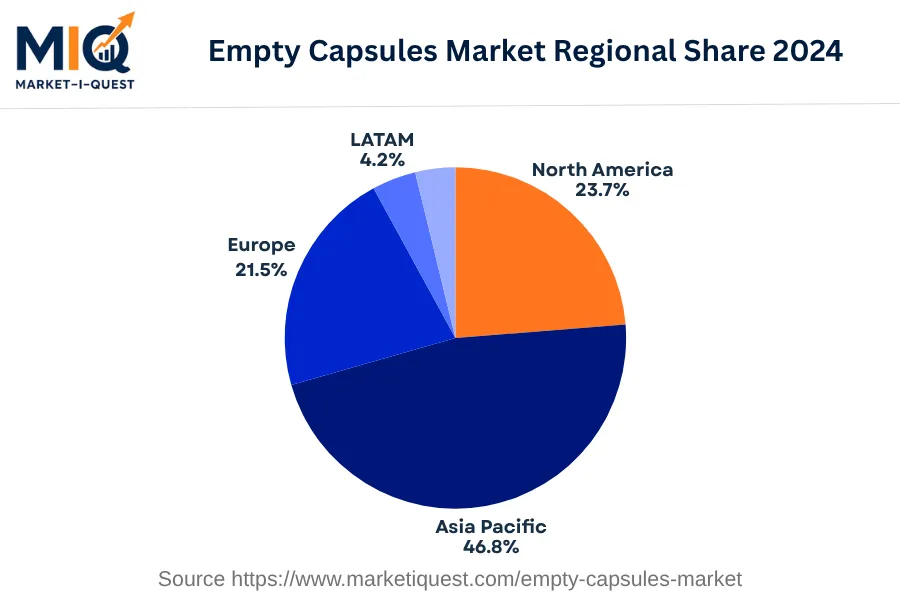
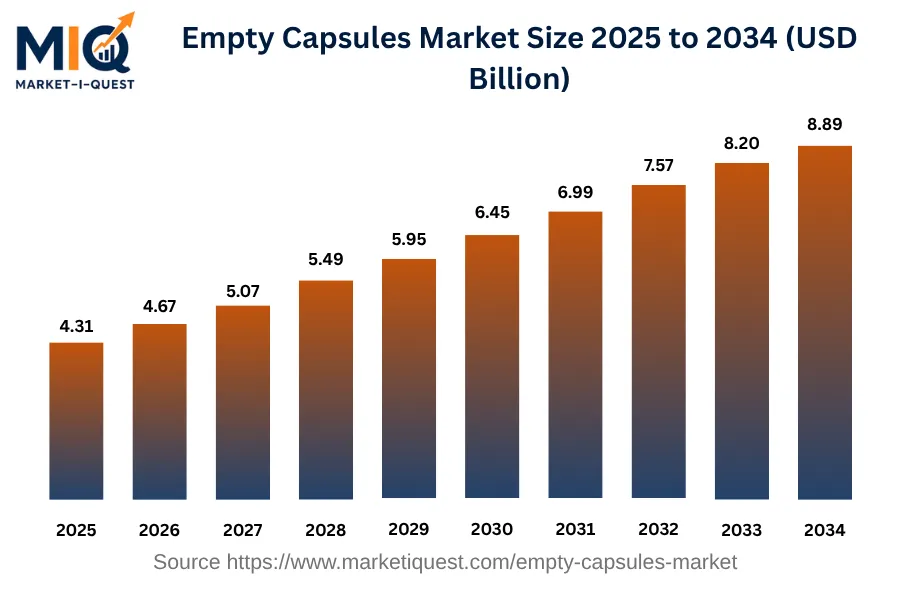
The Empty Capsules Market size was $4.31 billion in 2025 and is set to almost double, reaching an estimated $8.89 billion by 2034. This represents a Compound Annual Growth Rate (CAGR) of 8.37% over the forecast period. Starting at $3.98 billion in 2024, the market size had seen a noticeable increase by 2025, following a trajectory of consistent growth year over year. The growth was primarily fueled by the ascending demand in various pharmaceutical and nutraceutical applications that utilize empty capsules. On a regional scale, in 2024, the Asia Pacific had the majority market share with 46.82%, followed by North America at 23.74%, Europe with 21.48%, LATAM with 4.17% and MEA with 3.79%. These figures illustrate the global scale of the Empty Capsules Market and hints at the varying regional demands and consumption rates within this market across the globe.

Key Takeaways

  • By Product - Gelatin held the leading position accounting for a significant market share in 2024.
  • By Therapeutic Application - Cardiovascular Therapy Drugs grew rapidly marking a substantial share in 2024.
  • By End Use - Pharmaceutical segment accounted for a leading share in 2024.
empty-capsules-market market size

Key Driving Factors

Adoption of Clean-Label Capsules

The push towards transparency in product contents is driving the shift in the empty capsules market towards the manufacture of clean-label capsules. Increasing consciousness about health and wellness among consumers has heightened interest in dietary supplements. This has compelled manufacturers to eliminate synthetic ingredients from capsules and focus on plant-based versions instead. The appeal of these non-GMO, gluten-free, and vegan capsules in developed markets like North America and Europe is pushing the adoption of this more pricey, but perceived healthier, alternative. Consumers and regulatory bodies are also increasingly vigilant about allergens, prompting the industry to realign their process towards hypoallergenic empty capsules.

Increasing Use of Pullulan and HPMC Capsules

The pharmaceutical sector, along with nutraceutical firms, are increasingly utilizing Pullulan and Hydroxypropyl Methylcellulose (HPMC) capsules for their products. HPMC capsules are made from natural polymers, are organic, and mesh well with the demand for non-animal capsules that is growing because of cultural and dietary restrictions in diverse markets. Pullulan capsules, on the other hand, are appreciated for their oxygen barrier properties useful for preserving the stability of sensitive ingredients. The switch towards these types of capsules is significantly contributing to the expansion of the empty capsules market.

Market Evolution by Timeline

2019-2023
In 2019–2023, demand for empty capsules gained velocity among pharmaceutical and nutraceutical companies predominantly in North America and Europe. Compliance of patients to capsules in these areas, especially among pediatric and geriatric patients, was the major reason for this demand. Asian countries, particularly China and India, substantially contributed to its supply, owing to ample availability of raw materials. Geographical expansion by key manufacturers, such as Capsugel and ACG Worldwide, also added to the supply side. Regulatory bodies, including the FDA and EMA, implemented stringent parameters for quality control, influencing market dynamics. Contracts followed a volume-based pricing model with long-term agreements being common. The Risk of vegan capsules, a potential alternative, impacting market growth was quite low due to pricing difference and limited supply.
2024
In 2024, the empty capsules market saw a material shift with the advent of advanced capsule filling machines. The pharmaceutical industry in South-East Asia appeared as a significant buyer segment due to the robust development of their healthcare sectors. Producers still thrived in China and India, but manufacturers in the USA and Europe began to explore other raw materials. Introduction of the ISO 9001:2015 influenced market practices with greater emphasis on quality management. The price per unit continued with a slight deflation due to increased competition. The increased cost associated with regulatory compliance posed as a primary risk.
2025-2029
Between 2025–2029, the market saw a surge in demand from emerging economies including Latin America, Middle-east, and Africa. With advancements in drug delivery systems, the pharmaceutical and nutraceutical companies started adopting capsules in more diverse applications. Manufacturers further diversified their sourcing, lessening dependence on China and India. This period also saw stricter FDA policies on drug safety, impacting the types of materials used in capsules. The pricing model shifted towards customized contracts based on client requirements. A prevalent risk involved legislative changes aimed at limiting pharmaceutical imports in some regions, necessitating strategic partnerships to maintain market reach.
2030-2034
In the 2030-2034 period, demand continued to rise, particularly in the nutraceutical sector worldwide as dietary supplements became mainstream. Countries apart from China and India, such as Brazil and Nigeria, emerged as major suppliers, triggered by low production costs. Regulation strengthened, with the introduction of the European Pharmacopeia 2030 standard for Capsule quality. The pricing continued towards customized contracts, with a notable drift towards sustainable, yet cost-efficient options. The challenge of delivering these stringent quality standards amidst the rising tide of cheaper alternatives loomed as a major risk.

Future Market Outlook

Future Opportunities

Looking ahead, the empty capsules market presents several promising opportunities based on current market dynamics. The shift towards biocompatible materials, highlighted by efforts from firms like Suheung Co., limited to developing non-gelatin capsules for enhanced safety and accessibility, marks substantial growth potential within regions such as South America and Europe. The growing trend of personalized medicine also heralds new avenues for businesses, particularly as pharmaceutical companies increase their focus on individual patient needs, evident from partnerships announced in 2023 between major firms and biotech innovators. The aging population in Japan and Europe is anticipated to drive demand for new formulations targeting chronic conditions, prompting increased investment in capsule technology and improved drug delivery systems. Furthermore, the formulation of biodegradable capsules is emerging as a significant opportunity, with industry stakeholders like Ginkgo BioWorks actively participating in research aimed at sustainable materials and practices. Regulatory shifts in markets such as the European Union, emphasizing sustainability, are also likely to shape the landscape, creating openings for innovative products. As more companies embrace eco-friendly operations, the demand for plant-based capsules is projected to rise, reinforcing the need for manufacturers to enhance their R&D capabilities, specifically targeting niche markets such as dietary supplements and herbal medicines. This evolving landscape reflects a deeper integration of environmental considerations with health-focused innovations in the empty capsules market.

Segmentation Analysis

By Product

The market is divided into subsegments including Gelatin and Non-Gelatin. Out of these, Gelatin accounted for the largest revenue share while Non-Gelatin is expected to grow at the fastest CAGR during the forecast period.

Largest Revenue Share

Gelatin

Market Share Leader

Gelatin as a product has a long-standing presence and wide acceptance in the market, contributing significantly towards its largest revenue share. The superior properties of gelatin such as versatility, natural sourcing, and digestibility play a key role in driving its demand. Gelatin is extensively used in industries such as food, pharmaceutical, and cosmetics due to its functionalities including its ability to form strong, transparent, and flexible gels along with emulsification. Its demand is greatly influenced by increasing health consciousness among consumers, who now prefer natural and clean-label products more than ever before. Its wide availability and favorable regulatory support further reinforce its position in the market. In addition, the demand is expected to rise in emerging economies due to increasing disposable income, lifestyle changes, and evolving food preferences. Moreover, its established supply chain and ease of access through various channels strengthen its footprint.

Fastest CAGR

Non-Gelatin

Forecast Period Growth Leader

Although currently at a lesser revenue position, the non-gelatin segment is expected to grow at an accelerated rate in the upcoming years. This can be attributed to the increasing adoption of vegetarian and vegan diets, along with religious restrictions related to the consumption of animal-derived products. As non-gelatin products are typically derived from plant-based sources, they gain preference among the said consumer base. Additionally, advancements in technology are leading to the development of non-gelatin alternatives with comparable functionality, thus breaking the traditional adoption barriers. On the policy front, heightened scrutiny and regulations around animal welfare and usage can potentially catalyze the shift towards non-gelatin based products. Nevertheless, the transition towards non-gelatin products requires substantial capital investment which can act as a near-term risk. Furthermore, forging partnerships with players in the segments of food, pharmaceutical, and cosmetics can provide lucrative growth opportunities for this segment.

By Therapeutic Application

The Therapeutic Application market is divided into subsegments including Antibiotic and Antibacterial Drugs, Vitamins and Dietary Supplements, Antacid and Antiflatulent Preparations, Antianemic Preparations (Hematenic Preparations), Anti-Inflammatory Drugs, Cardiovascular Therapy Drugs, Cough and Cold Preparations, and Others. In 2024, Cardiovascular Therapy Drugs accounted for the largest revenue share while Vitamins and Dietary Supplements are expected to grow at the fastest CAGR during the forecast period.

Largest Revenue Share

Cardiovascular Therapy Drugs

Market Share Leader

Cardiovascular Therapy Drugs recorded the highest revenue in 2024 due to the rising prevalence of cardiovascular diseases globally, owing to factors like sedentary lifestyles, unhealthy dietary habits, and aging populations especially in developed countries. Regulatory authorities' emphasis on timely diagnosis and treatment of heart conditions coupled with technological advancements in drug discovery and targeted therapies is boosting the demand for cardiovascular therapy drugs. Additionally, the increase in health care spending and prioritization of cardiac health by individuals act as key purchasing criteria. No switching costs thus high competition and availability across channels enhances buying frequency and volume. Geographically, North America due to a significant aging population and high prevalence of heart diseases absorbs largest shares from this subsegment.

Fastest CAGR

Vitamins and Dietary Supplements

Forecast Period Growth Leader

The Vitamins and Dietary Supplements subsegment is projected to witness the fastest growth. Key drivers include the increasing awareness about preventive health care and self-management among consumers, coupled with a rising prevalence of lifestyle diseases. Technological innovations in product formulations and delivery methods drive adoption and break adoption barriers. Capital investments in research and development activities for producing high-quality, efficient, and personalized supplements propel the growth further. Regulatory policies promoting self-care and preventive health are acting as catalysts. However, near-term risks may involve growing regulatory scrutiny and the risk of misuse due to self-prescription. Partnerships with fitness and wellness firms bolster sales through cross-promotion. Despite a growing trend towards natural and organic dietary supplements, false claims and authenticity concerns can impede the growth rate.

By End Use

The market is divided into subsegments including Pharmaceutical, Nutraceutical, Cosmeceutical, Research Laboratories, Others. Of these, the Pharmaceutical sector accounted for the largest revenue share while the Nutraceutical subsegment is expected to grow at the fastest CAGR during the forecast period.

Largest Revenue Share

Pharmaceutical

Market Share Leader

The pharmaceutical subsegment leads in revenue terms, driven primarily by increasing public and private healthcare expenditure globally. This industry continues to harness the benefits of modern technology, harnessing research and development (R&D) to produce effective, profitable drugs. The ability of pharmaceutical companies to steadily increase prices on existing drugs, coupled with the high revenue potential of new, innovative medications, provides a robust base for generating significant income. Geographic spaces like North America, with substantial healthcare spending and a high burden of disease, contribute significantly to segment revenues. Regulatory environments in developed markets also typically favor pharmaceutical profitability: patent-protected drugs can demand high prices without immediate generic competition. Customer loyalty is also high, as switching costs can be prohibitive due to the life-saving nature of many pharmaceuticals. In essence, a combination of strong demand-side dynamics and favorable supply-side factors position pharmaceuticals strongly in revenue terms.

Fastest CAGR

Nutraceutical

Forecast Period Growth Leader

The Nutraceutical subsegment is projected to grow at the fastest rate, spurred by increasing consumer appetite for health and wellness products and a growing emphasis on preventive healthcare. While the nutraceutical marketplace faces competition from pharmaceuticals, the less-regulated nature, perceived safety, and affordability of these products make them popular choices, particularly in newer markets. Progressive advancements in technology are enabling manufacturers to create diverse portfolios, which cater to specific health needs, further driving adoption. Barriers to the adoption of Nutraceuticals include scepticism about efficacy and the lack of standard regulatory frameworks. However, strategic partnerships between major food and pharmaceutical companies to formulate effective nutraceuticals, coupled with substantial investments in educational marketing strategies, promise to catalyze growth. Near-term risks include potential supply chain disruptions and regulatory upheavals, but the outlook remains promising for the Nutraceutical sector.

Competitive Analysis

Key Market Players

Manufacturers / OEMs

Capsugel
US
ACG Worldwide
India
Qualicaps
Japan

Key Suppliers & Raw Materials

Rousselot SAS
France
Suheung Co. Ltd.
South Korea
CapsCanada
Canada

Distributors, Integrators & Channel Partners

Nelum Sciences LLC.
US
Erkang Pharma
China
Farmacapsulas S.A
Colombia

Porter’s Five Forces Analysis

The analysis summarizes the competitive intensity and attractiveness of the Empty Capsules Market.

Supplier Bargaining Power

Medium

Constrained by the limited number of manufacturers and high setup costs.

Buyer Bargaining Power

High

Buyers could switch between capsule types and manufacturers to get favorable pricing.

Threat of Substitutes

Low

Substitute products like tablets have less desirability due to lack of tamper resistance.

Threat of New Entrants

Low

Significant capital investment and regulatory barriers act as entry hurdles.

Competitive Rivalry

Medium

Competition is between a few key players, with a focus on quality and pricing.

Regional Analysis

Geographic market dynamics and growth opportunities across key regions

Global Market Outlook

empty-capsules-market market regional share

North America

In 2024, North America's Empty Capsules Market experienced substantial growth driven by several key factors. An increase in geriatric population led to heightened demand for health supplement consumption in the United States, Canada, and Mexico, necessitating more empty capsules. Moreover, regulations in North American healthcare sectors positively impacted the market. For instance, guidelines developed by Health Canada facilitated a safe and efficient process for capsule production. Further, investments in advanced manufacturing technologies accelerated the production of high-quality capsules, ensuring adequate supply.

Market trends in 2024 also shaped the Empty Capsules Market in North America. For instance, consumer preference shifted towards capsules made from non-animal sources. This led to manufacturers investing in plant-derived empty capsules to cater to this growing demand. Retail and online channels experienced a surge in demand for empty capsules due to consumers' increased health consciousness and the convenience of at-home capsule filling. Furthermore, partnerships among pharmaceutical and nutraceutical companies had been a noticeable trend, aiming to expand production capacities and enabling market consolidation. However, stringent policy enforcement in the healthcare sectors across North America ensured the manufacturing and distribution of empty capsules adhered to necessary safety and purity standards. Therefore, both drivers and trends created a dynamic environment for the Empty Capsules Market in North America in 2024.

Asia Pacific

In 2024, the Asia Pacific market for empty capsules saw noteworthy changes in its dynamics, which was largely consumer-driven. Increasing awareness of nutritional supplements, especially in densely populated markets such as India and China, led to heightened demand for empty capsules. Regulatory norms in these markets also loosened, attracting more manufacturers and thus intensifying competition. Moreover, manufacturers in Japan and South Korea had notably higher investments in technology transitions to reduce production costs and maintain quality standards. These transitions dramatically reshaped supply dynamics and pricing activities in 2024.

Consumer behavior in Australia deviated, with strong preference for vegetarian capsules. This shift prompted many manufacturers to diversify their portfolio. Notably, several partnerships between manufacturers and pharmaceutical companies in China and ASEAN markets evolved throughout the year, accelerating the demand for empty capsules. Digital platforms became the primary distribution channels as more customers adopted online purchasing. China, Japan, and South Korea's stringent pharmaceutical safety and quality standards also came into sharper focus in 2024, with ASEAN countries gradually following suit. This increase in regulatory benchmarking was perceived positively by healthcare providers and pharmaceutical companies, as it reduced the risk of counterfeits disrupting supply chains. By and large, the Asia Pacific empty capsules market in 2024 was characterized by increased consumer consciousness, shifts in distribution channels, and elevated quality expectations, all amplifying competition among manufacturers.

Europe

In the base year 2024, the Empty Capsules Market in Europe displayed significant growth across several key regions including Germany, the United Kingdom, France, Italy, Spain, the Nordics, Benelux, and Central & Eastern Europe. Demand factors driving this growth included an increase in aging populations and chronic diseases, coupled with broader adoption of capsule-based formulations by pharmaceutical manufacturers. Moreover, stringent regulations in patient safety added an impetus for pharmaceutical companies to favor empty capsules, contributing to the market development in the health sector. Advancements in production technologies also had a positive impact on supply dynamics resulting in competitive pricing.

Trend-wise, there were marked shifts in buyer behaviour with a growing preference towards gelatin-based capsules due to their ease of consumption and digestibility. Additionally, an influx of strategic partnerships and M&A activities among key players in the manufacturing and pharmaceutical sectors were seen, aimed at capacity expansion and product portfolio diversification. A strong regulatory enforcement ensured high production standards contributing to the overall attractiveness of the market. Some major customers of the market in 2024 encompassed enterprises in the pharmaceutical and healthcare sectors, responding to the growing consumer demand for easily consumable and digestible medication alternatives.

Latin America

In the base year 2024, the Latin American empty capsules market exhibited solid growth, influenced by key drivers and trends. The market's expansion is attributable to mounting demand for dietary supplements, especially in Brazil and Mexico, and an escalating geriatric population throughout LATAM. Shifts in consumer lifestyle and health consciousness, coupled with rising disposable incomes in Argentina, Chile, and Peru, have also escalated the demand. Moreover, regulatory approvals for capsule formulations by government health bodies have prompted increased investment in research and development efforts. Concerning technology adoption, Colombia has demonstrated notable uptake, striving to automate the manufacturing process to ensure superior quality and consistency in capsule production. However, fluctuations in gelatin prices have disrupted the supply dynamics, presenting a significant challenge to market growth.

Regarding trends, buyer behavior heavily leans towards customizable capsules that offer varying sizes, colors, and flavors. Tech shifts have witnessed Nitrogen Flushing, a technology that extends capsule shelf-life, gain prominence. Channel dynamics have been altered by boosted online purchases amid COVID-19, consolidating e-commerce as a thriving platform for dietary supplements. Partnerships focused on expanding capsule production capacities have also gained traction. Finally, stricter enforcement of good manufacturing practices (GMP) standards across all sectors, particularly healthcare, pharmaceutical, and manufacturing, bolstered market health.

Middle East & Africa

In 2024, the Empty Capsules Market showed considerable growth in the Middle East and Africa, with Saudi Arabia and South Africa as prominent players. Increased health awareness, the pharmaceutical sector's growth, and advancements in capsule technology largely drove this development. The mushrooming of pharmaceutical manufacturers necessitated substantial quantities of empty capsules, lighting the demand spark. Simultaneously, there was a progressive inclination of regional governments, especially Qatar and the United Arab Emirates, towards fostering policies advocating healthier societies, inadvertently backing the empty capsules market growth. Israel's notable adoption of advanced capsule technology underscored this dynamic.

Consumer behavior in these regions also morphed, with a perceptible shift towards therapeutic and nutraceutical products encapsulated in aesthetically appealing, easy-to-consume capsules. Investment in innovative capsule manufacture became a trend for companies in Nigeria, Kenya, and Egypt, facilitating partnerships and technology transfers within the healthcare production ecosystem. There was a discernible consolidation in the market, augmented by strengthened policy enforcement across the pharmaceutical sector in these regions. Furthermore, healthcare sectors in these regions were seen moving towards an increased use of vegan and halal-certified capsules, a trend strongly supported by the major religious sentiments prevailing in Middle East and African countries. This market landscape, only the beginning of the unfolding story of empty capsules, certainly anticipates interesting times ahead.

Recent Industry Developments

Latest market innovations, product launches, and strategic initiatives

May 2026

CapsCanada announced its transition to the Lyfe Group brand identity, establishing a unified corporate structure while continuing its leadership in two-piece empty capsules and advanced drug delivery solutions.

January 2025

Lonza announced the expansion of its capsule manufacturing capacity in India and China, with lines at its Suzhou (China) and Rewari (India) sites operational since Q4 2024 and additional lines expected to start operations in Q3 2025.

Frequently Asked Questions