
Emission Monitoring Systems Market Snapshot

Key Players

  • ABB Ltd. (Switzerland)
  • Siemens AG (Germany)
  • General Electric (US)
  • Emerson Electric Co. (US)
  • Rockwell Automation Inc. (US)
  • Teledyne Technologies Inc. (US)
  • Thermo Fisher Scientific (US)
  • Fuji Electric (Japan)
  • Sick AG (Germany)
  • Environnement SA (France)

Market Size

Base Year 2024
$4.45 Bn
CAGR
7.25%
Forecast 2034
$8.96 Bn

Market Segments

By Component
  • Hardware
  • Software
  • Services
By System Type
  • CEMS
  • PEMS
By Vertical
  • Oil & Gas
  • Chemicals & Petrochemicals
  • Metal & Mining
  • Pulp & Paper
  • Energy & Power
  • Others

Market Dynamics

Drivers
  • Stringent environmental regulations
  • Rapid industrialization in developing countries
Restraints
  • High implementation cost
  • Lack of skilled personnel
Opportunities
  • Stringent environmental regulations
  • Emerging industrial growth in APAC

Market Size

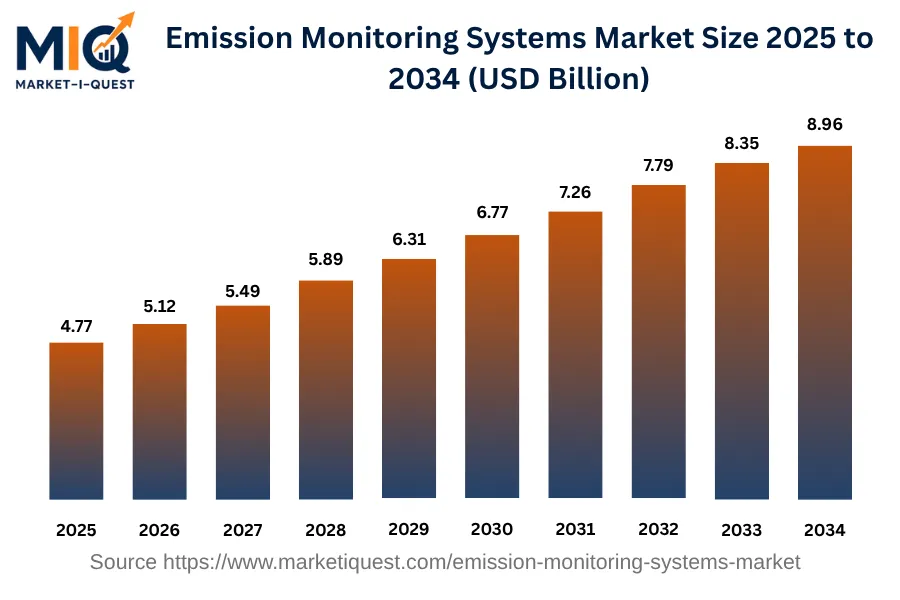
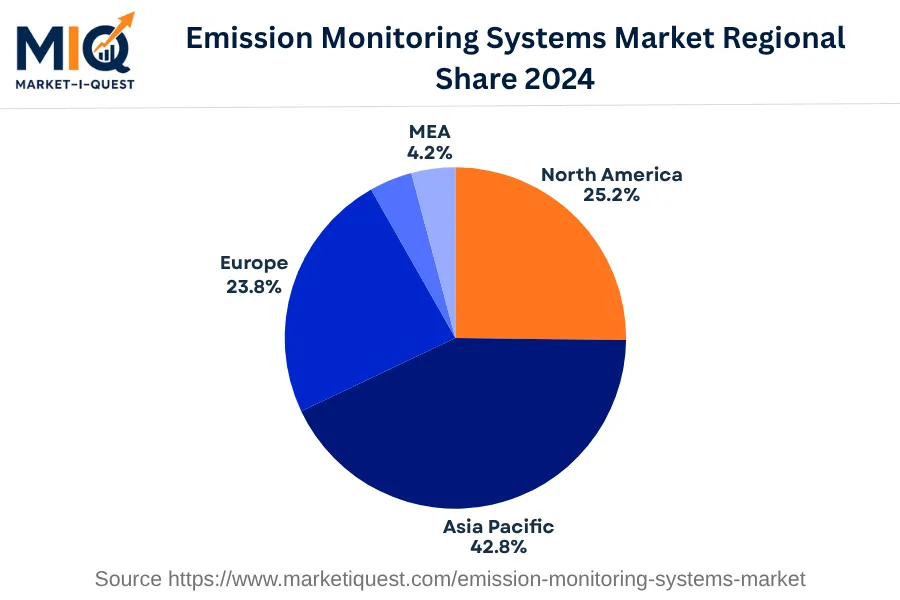
The Emission Monitoring Systems Market, with a value of $4.77 billion in 2025, is projected to reach $8.96 billion by 2034, growing at a CAGR of 7.25%. This considerable increase over nine years demonstrates a consistent ascension in adoption and development of such systems across various industries. Intense regulations from global environmental organizations demanding consistent monitoring and reduction of harmful emissions fuel this surge in adoption, fortified by technological advancements that facilitate easier integration and use of these systems. Consistent investment in research and development, coupled with active efforts to adhere to safer, environmentally responsible operational practices also boost the market growth trajectory. Exploring regional share differences, as of 2024, the largest stake in the market is held by Asia Pacific with 42.76%, followed by North America at 25.18% and Europe at 23.84%. The LATAM and MEA regions contribute smaller shares of 4.06% and 4.16% respectively.

Key Takeaways

  • By Component - Hardware held majority share in emission monitoring systems market in 2024.
  • By System Type - CEMS led accounting for a significant market share in 2024.
  • By Vertical - Energy & Power segment demonstrated robust dominance in 2024.
emission-monitoring-systems-market market size

Key Driving Factors

Enforcement of Stringent Environmental Regulations

A prominent driver for the Emission Monitoring Systems (EMS) market is the strict enforcement of environmental regulations worldwide. For instance, both the Clean Air Act in the United States and the European Union's Industrial Emissions Directive mandate the continuous monitoring of hazardous emissions from industrial sources. These regulations are pushing industries such as energy, oil and gas, and manufacturing to install EMS in their facilities. The systems allow organizations to timely and accurately measure the level of emissions, ensuring compliance with environmental standards. Failure to align with these regulations can lead to substantial fines and legal implications. Therefore, the forceful implementation of environmental laws is compelling industries to adopt EMS, contributing to the growth of the market.
Increasing Public Awareness of Air Quality Issues

A second crucial factor driving the Emission Monitoring Systems market is the heightened public awareness of air quality issues, mainly due to harrowing evidence of climate change and its health risks. An increasingly educated and environmentally conscious public are demanding transparency from corporations regarding environmental responsibility, which is accelerating the installation of EMS in industrial processes. These systems enable corporations to keep track of their emission levels and display their commitment to reducing environmental harm. From a public relations perspective, demonstrating such commitment can enhance a company's image, leading to increased consumer loyalty and potential market growth. As such, public pressure for accountability in emission levels is also fuelling the Emission Monitoring Systems market expansion.

Market Evolution by Timeline

2019-2023
During this period, industrial segments such as power plants, oil & gas, and cement along with countries like China and India with high pollutant levels fueled the demand for emission monitoring systems (EMS). Due to increasing environmental concerns, suppliers increasingly integrated EMS with Continuous Emission Monitoring Systems (CEMS) for effective emission management. The European Union's Industrial Emissions Directive (2010/75/EU) acted as a regulatory force accelerating EMS adoption. Pricing was generally volume-based, with longer contracts offering discounts. Strategic collaboration between suppliers and end-users was a typical supply side strategy. A major challenge during this era was customization requirements in accordance to site-specific needs.
2024
In 2024, rising CO2 levels worldwide led to an augmenting demand from developing nations to mitigate hazardous emissions. Predominantly, Emission Monitoring Systems with sophisticated controlling capabilities were shipped. The 'Best Available Technique Reference' established by European Integrated Pollution Prevention and Control continued to guide the regulatory framework. Adoption was mainly driven by fixed-price contracts due to their predictable cost structure. Operational issues due to harsh climatic conditions presented considerable risks, and suppliers responded with robust product designs and preventive maintenance practices.
2025-2029
Post-2024, the demand for EMS was substantially driven by widening regulations regarding air pollution control, globally. The supply was dominated by providers offering integrated and predictive EMS. The United Nations Sustainable Development Goals played a significant role in formulating environmental regulations. Nuclear power plants needing real-time radioactive emission monitoring also joined the buyer's list. Fixed-price contracts continued with more emphasis on service-level agreements. Computer-hardware-related issues were widespread, prompting suppliers to prioritise in-house operational capabilities and user-friendly interfaces.
2030-2034
By this period, EMS transitioned from a 'nice-to-have' to a 'must-have' for industries due to stricter global emission regulations. Demand peaked from regions like Southeast Asia, driven by rapid industrialization. Technological evolvement revamped the supply landscape as Artificial Intelligence became an integral feature, fostering real-time decision making. Regulations such as 'Clean Air Act' by the US became stringent, obliging industries to adopt EMS. The pricing model saw a shift towards 'pay-as-you-go', facilitating affordability for SMEs. Quality and reliability issues persisted, leading to manufacturers adopting robust testing methods.

Future Market Outlook

Future Opportunities

Future opportunities in the Emission Monitoring Systems market are largely shaped by ongoing regulatory changes and technological integrations. As governments worldwide, particularly those in the Asia-Pacific region, push for sustainable practices, industries will increasingly need to adopt EMS to ensure compliance. In May 2023, the United Nations Environment Programme highlighted the urgency of emissions reductions, resulting in forthcoming policies that will demand more robust monitoring solutions. Countries like China and India are expanding their regulatory frameworks to include stricter emissions monitoring mandates, which companies will have to navigate. Collaborations between tech companies and environmental agencies, as evidenced by Microsoft's partnership with the Environmental Defense Fund in 2022, indicate a trend towards developing more precise and expansive monitoring technologies. Additionally, as sectors like aviation and shipping face stringent regulations under frameworks such as the International Maritime Organization's Initial GHG Strategy, there will be a growing requirement for real-time emissions tracking systems. The increasing acceptance of voluntary carbon markets represents another opportunity; firms are investing in EMS that can facilitate emissions trading and reporting. As systems become more integrated with data analytics and artificial intelligence, the market will see a surge in demand for next-generation solutions that provide comprehensive insights. The shift towards sustainability will ultimately drive innovation, creating avenues for expansive development within the EMS landscape.

Segmentation Analysis

By Component

The market is divided into subsegments including Hardware, Software, and Services. The Hardware subsegment accounted for the largest revenue share while the Services subsegment is expected to grow at the fastest CAGR during the forecast period.

Largest Revenue Share

Hardware

Market Share Leader

The Hardware subsegment currently leads the market, driven by a multitude of factors. With the constant advancement in technology, there is an incremental demand for updated and efficient hardware components in several tech-driven applications, thereby leading to a higher share of this subsegment. Additionally, customer demands have been leaning more towards smarter and faster devices, pushing the market penetration further for the Hardware subsegment. Certain geographies such as North America and Asia Pacific, having a burgeoning tech industry, contribute a larger chunk to the hardware revenue. Moreover, mandatory regulatory standards in these regions engage manufacturers in a continuous cycle of upgrades, which also serves as a significant reason for the high sales volume. As for the purchasing criteria, customers usually opt for trusted and innovative brands, with durability as a crucial decision-making factor. As a result, switching costs are reasonably high, providing a sort of revenue assurance for the hardware manufacturers. Lastly, most of the hardware sales are driven through direct distribution channels, which gives manufacturers better control over their marketing strategies.

Fastest CAGR

Services

Forecast Period Growth Leader

The Services subsegment is projected to grow at the fastest pace. The growth drivers for this subsegment include the advancing technology trends that demand intricate solutions, which only specialised service providers can deliver. Overcoming adoption barriers is a critical contributor to the fast growth of Services sector. These barriers can primarily be attributed to a lack of technical knowledge, which is where the service providers step in, therefore increasing the demand for their services. Several tech catalysts like AI, machine learning, and data science also act as phenomenal transformational elements, causing the Services sector to grow at a rapid pace. In terms of near-term risks, the absence of skilled professionals and the ever-increasing nature of technological transformation pose major challenges. However, the creation of strategic partnerships with major tech manufacturers can substantially contribute to overcoming obstacles and further accelerate the growth of the Services subsegment.

By System Type

The market is divided into subsegments including Continuous Emissions Monitoring Systems (CEMS) and Predictive Emissions Monitoring Systems (PEMS). CEMS accounted for the largest revenue share while PEMS is anticipated to grow at the fastest CAGR during the forecast period.

Largest Revenue Share

CEMS

Market Share Leader

Continuous Emissions Monitoring Systems (CEMS) hold the largest share of the market revenues in the base year 2024, primarily driven by their widespread adoption due to stringent government regulations regarding emissions. CEMS provides highly precise and time-sensitive data on emission levels, enabling companies to react promptly and reduce emissions effectively. Emission standards have been getting increasingly stringent in most regions, hence driving demand for reliable, accurate monitoring systems, which is where CEMS plays a crucial role. Relative to PEMS, CEMS are viewed as a more trustworthy tool for regulatory reporting primarily due to the method of operation being directly applicable to emission sources, contributing to their dominance in the market. Furthermore, CEMS are primarily utilized in industries with high-volume emission sources like power plants, cement manufacturing, petrochemical companies where accuracy in monitoring is critical.

Fastest CAGR

PEMS

Forecast Period Growth Leader

While the Predictive Emissions Monitoring Systems (PEMS) segmented registered a smaller share of the market revenues compared to CEMS, it is expected to witness the highest Compound Annual Growth Rate (CAGR) during the forecast period. This growth trajectory can be attributed to the rising focus on cost optimization and digitization in industries. The implementation of PEMS over traditional CEMS can result in significant cost-saving, as PEMS generally require less maintenance, less calibration and has no consumables. Furthermore, technological advancements in the field of Artificial Intelligence and Machine Learning are expanding the capabilities of PEMS, enabling them to predict overall system behavior as well as emission rates, which aids in proactive decision making. However, the perceived accuracy and trust factor could be potential barriers to rapid adoption of PEMS. Its growth could also be propelled by new stringent environmental policies in developing countries where cost-effectiveness is a key consideration.

By Vertical

The market is divided into subsegments including Oil & Gas, Chemicals & Petrochemicals, Metal & Mining, Pulp & Paper, Energy & Power, and Others. In 2024, the Energy & Power subsegment accounted for the largest revenue share while the Oil & Gas subsegment is expected to grow at the fastest CAGR during the forecast period.

Largest Revenue Share

Energy & Power

Market Share Leader

The Energy & Power sector dominates the market primarily due to the increasing dependence on power for a myriad of applications ranging from residential to industrial. As demand for power, thermal and electric, continues to rise worldwide, especially in developing regions like Africa, Southeast Asia, and Latin America, the growth of the Energy & Power subsegment is inevitable. The shift towards renewable energy sources due to environmental concerns further solidifies its leading position. This transformation leads to an increase in the number of projects for power generation, in turn, raising the procuring of machinery and services. Additionally, government regulations and policies concerning carbon emissions and energy efficiency are driving the growth for more renewable and efficient energy projects. Hence, considering these factors, it would only be logical to project the Energy & Power segment as the one with the highest revenue.

Fastest CAGR

Oil & Gas

Forecast Period Growth Leader

The Oil & Gas subsegment is expected to exhibit the fastest growth during the forecast period. The primary drivers for this growth include rising global energy demand, new exploration of oil and gas fields, and increasing drilling activities, particularly in developing economies. Technological advancements enabling cost-effective and efficient discovery and extraction of oil and gas reserves also act as catalysts for this subsegment's growth. Partnerships, investments into R&D, and new policies favouring the exploration and production of oil and gas further facilitate the expected growth. Additionally, the recent volatility in the global energy markets could be a growth opportunity as many oil and companies are keen to ramp up their production capabilities to capitalize on any future price increases. Though the shift towards clean and renewable energy poses a risk, the demand for oil and gas is projected to remain strong in the near term due to its vast application spectrum, thus leading to the faster growth of this subsegment compared to others.

Competitive Analysis

Key Market Players

Manufacturers / OEMs

ABB Ltd
Switzerland
Sick AG
Germany
Rockwell Automation
US

Key Suppliers & Raw Materials

Honeywell International Inc.
US
Buhler Technologies GmbH
Germany
E Instruments International LLC
US

Distributors, Integrators & Channel Partners

Thermo Fisher Scientific Inc.
US
Durag Group
Germany
Opsis AB
Sweden

Porter’s Five Forces Analysis

Analysis of the Emission Monitoring Systems Market through the lens of Porter’s Five Forces.

Supplier Bargaining Power

High

OEM lock-ins and specialized component manufacture enhance suppliers' power.

Buyer Bargaining Power

Medium

Growing environmental regulatory compliance provides buyers with limited negotiation power.

Threat of Substitutes

Low

Low threat due to lack of effective and regulatory-accepted alternative emissions monitoring systems.

Threat of New Entrants

Medium

R&D costs and regulatory barriers block new entrants, but rapid technology evolution may offer opportunities.

Competitive Rivalry

High

Strong rivalry due to numerous international players vying for market share.

Regional Analysis

Geographic market dynamics and growth opportunities across key regions

Global Market Outlook

emission-monitoring-systems-market market regional share

North America

In the base year 2024, North America's Emission Monitoring Systems Market demonstrated strong growth dynamics. Government environmental regulations in the United States, Canada, and Mexico became stringent, spurring demand for sophisticated emission control technology. These regulations, coupled with companies' increased commitment to limit their carbon footprint, motivated investment in high-quality emission monitoring systems. Technological progress in the sector facilitated swift adoption of advanced systems, highlighting an increasing focus on real-time data collection for improved emission management.

Trends emerged in buyer behavior, with sectors such as manufacturing, utilities, and government increasingly purchasing integrated systems for comprehensive control of emissions. Technological advancements drove shifts towards remote operability and AI-supported monitoring systems. The market observed noteworthy channel dynamics, with online sales largely dominating traditional offline channels. The year also witnessed strategic partnerships and mergers and acquisitions, particularly in the US, as companies sought to strengthen their market position and expand their product portfolio. A classic example would be the adoption of the “Clean Air Act” in the U.S., reinforcing a strict policy enforcement framework affecting several sectors including healthcare, enterprise, and retail. The aforementioned policies bolstered standards and protocols associated with emission monitoring, further shaping the industry landscape in North America.

Asia Pacific

In 2024, the Emission Monitoring Systems Market in Asia Pacific observed substantial traction with China, India, Japan, South Korea, and Australia being key players. Stringent environmental regulations, rising awareness about air pollution, and increasing investment in environment-friendly technologies acted as primary drivers for the market. Countries like China and India witnessed a surge in demand due to rigorous government mandates on emission controls. Technological adoption was prominent in developed nations of Japan and Australia, enhancing the market dynamics.

Shifting buyer behavior inclined towards sustainable products, redefined the market trends. Implementation of Real-time Emission Monitoring Systems in enterprises and government sectors as a part of their environmental responsibilities gained momentum. Large manufacturing plants and utilities in Asia Pacific, particularly China, embraced this trend extensively. The channel dynamics shifted to online platforms for efficient and quick procurement of these systems. Active M&As, like that of ASEAN markets and higher-end manufacturers, furthered the diversification and expansion in the market. An increase in the enforcement of environmental policies, such as China's Blue Sky Protection Plan, significantly influenced market trends. In summary, 2024 marked an era of environmental consciousness and technological adoption in the Asia Pacific Emission Monitoring Systems Market.

Europe

In 2024, Europe's Emission Monitoring Systems (EMS) market was undergirded by increasing environmental regulatory scrutiny. A robust European Union legislation aiming for a reduction in harmful gases in the atmosphere and emissions directly led to an upsurge in demand for advanced EMS in sectors including manufacturing, utilities, and retail. Increasing investments in green technologies, particularly in Germany and the United Kingdom, also catalyzed the uptake of these systems, with wide-scale adoption in enterprise sectors as operators sought to comply with stringent emissions standards.

Meanwhile, several notable trends flagged significant shifts in market dynamics. High compliance rates especially in France, Benelux, and the Nordics fostered an escalating demand for next-generation EMS adopting IoT integration. This shift was palpable particularly among large-scale manufacturers. In the realm of partnerships, Central and Eastern Europe saw a rising tide of alliances between technology providers and native enterprises; adding ESC, CO2 and NOx monitoring capabilities to their solutions portfolio. Lastly, the policy enforcement mechanisms became tougher across the continent, indexed by an uptick in penalties for non-compliance in Italy and Spain. Consequently, this regulatory rigor fostered the demand for EMS in government and healthcare sectors as well - instilling a mechanism for transparency and aligning the corporate objectives with sustainable growth imperatives.

Latin America

In 2024, the Latin American Emission Monitoring Systems (EMS) market demonstrated considerable dynamism, driven largely by environmental regulation, technological adoption, and ongoing industrialization. To that end, Brazil and Mexico adopted stricter emission standards which necessitated the use of EMS in critical sectors like healthcare, utilities, and manufacturing. As such, demand for EMS spiked in these sectors as enterprises scrambled to comply with the new regulations. Simultaneously, these countries also saw significant investment in cleaner technologies, stimulating EMS adoption.

Meanwhile, key trends in Argentina, Colombia, Chile, and Peru have centered around buyer behavior and tech shifts. Increasing awareness of environmental issues led to a greater demand for EMS in these countries, particularly from the government and retail sectors. As technological innovation enabled more affordable and efficient products, the affordability and accessibility of EMS proportionately increased. In addition, the push for digitization led to greater incorporation of EMS in the manufacturing and utilities sectors. Concurrently, partnerships arose between tech developers and environmental consultancies, solidifying the EMS supply chain in these economies. Lastly, government policy enforcement tightened with a focus on the mining industry in Peru and Colombia, leading to rising demand for EMS to ensure liabilities are minimized.

Middle East & Africa

In 2024, the Emission Monitoring Systems Market in the Middle East and Africa exhibited significant growth due to various influencing factors. Regulatory changes, increased investment, and the adoption of advanced technology solutions served as key drivers. For instance, strict environmental regulations in Saudi Arabia and the United Arab Emirates necessitated the usage of emission monitoring systems in sectors like oil and gas, manufacturing, and utilities. Simultaneously, heavy investments in infrastructure projects in Qatar and robust technology adoption in countries like South Africa, Nigeria, Kenya, and Israel fuelled the demand for these systems.

Market trends primarily revolved around changes in buyer behavior, technological advancements, and strategic collaborations. There was a noticeable shift toward eco-friendly operations across industries, augmenting the need for efficient monitoring systems. Technological enhancements, such as the integration of IoT and AI in these systems, further dominated the market landscape in countries like Egypt and Nigeria. Strategic partnerships, as seen in the collaboration between major oil corporations and tech companies in Saudi Arabia and United Arab Emirates, also shaped market dynamics. Furthermore, the implementation of stricter enforcement policies was evident, especially in the government and healthcare sectors. The Emission Monitoring Systems Market thus reflected a focused shift towards environment-friendly solutions and tech-integration in 2024.

Recent Industry Developments

Latest market innovations, product launches, and strategic initiatives

January 2026

The Rajasthan State Pollution Control Board (RSPCB) issued an Office Order clarifying OCEMS installation applicability for Lead Recycling units in Rajasthan's NCR region. Furnaces using wood charcoal or gas must monitor only Particulate Matter (PM), while those using Low Sulphur Heavy Stock must monitor PM, SO₂, and NOx.

September 2025

India's Central Pollution Control Board (CPCB) issued a notification mandating certification of all CEMS equipment by CSIR-NPL (National Physical Laboratory) for installation in Delhi-NCR. All manufacturers of CEMS instruments must apply under the NPL India Certification Scheme within one week, with non‑compliance potentially resulting in systems being denied installation and disconnected from the CPCB central server.

Frequently Asked Questions