Electrophoresis Market Snapshot

Key Players

  • Bio-Rad Laboratories (US)
  • Agilent Technologies (US)
  • Thermo Fisher Scientific (US)
  • GE Healthcare (UK)
  • Merck Group (Germany)
  • PerkinElmer (US)
  • Sebia (France)
  • Shimadzu Corporation (Japan)
  • C.B.S. Scientific (US)
  • Harvard Bioscience (US)

Market Size

Base Year 2024
$2.76 Bn
CAGR
5.2%
Forecast 2034
$4.58 Bn

Market Segments

By Product
  • Electrophoresis Reagents
  • Electrophoresis Systems
  • Gel Documentation Systems
  • Electrophoresis Software
By Application
  • Research Application
  • Diagnostic Applications
  • Quality Control & Process Validation
By End User
  • Academic & Research Institutes
  • Pharmaceutical & Biotechnology Companies
  • Hospitals & Diagnostic Centers

Market Dynamics

Drivers
  • Increasing prevalence of genetic disorders
  • Advanced therapeutic biotechnology research
Restraints
  • High equipment costs
  • Lack of skilled professionals
Opportunities
  • Technological advancements in electrophoresis
  • Increased demand for personalized medicine

Market Size

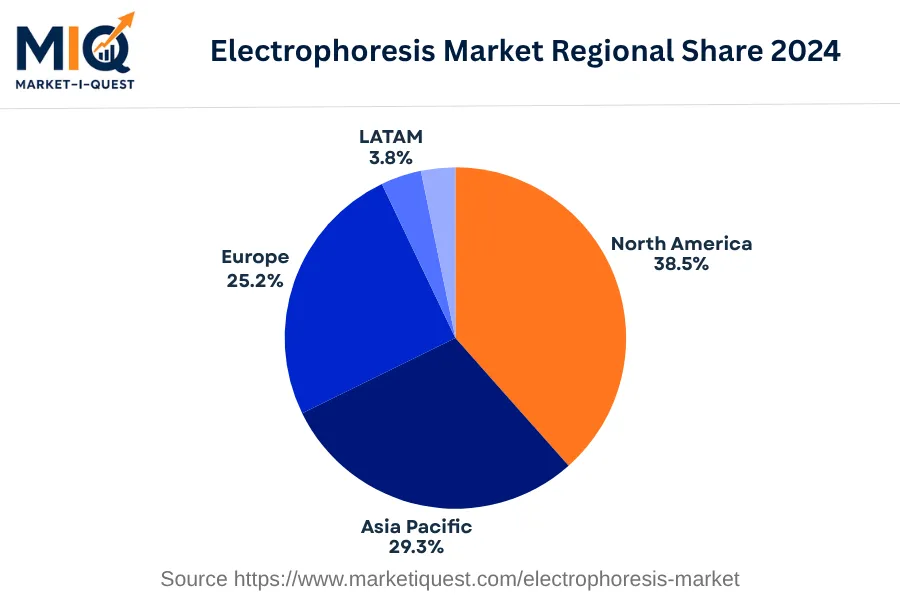
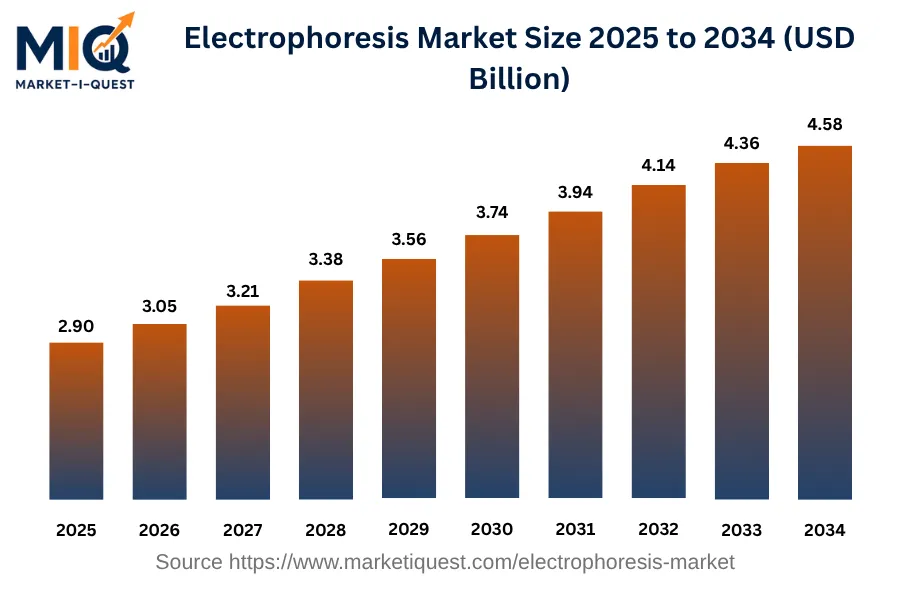
The Electrophoresis Market, sized at USD 2.90 billion in 2025, is projected to reach USD 4.58 billion by 2034, implying a compound annual growth rate (CAGR) of 5.2%. This steady growth trajectory was initiated from a market valuation of USD 2.76 billion in 2024. Over the entire decade, the market size is increasing steadily year-over-year, indicative of the consistent demand for electrophoresis across various applications. The regional distribution of the Electrophoresis Market in 2024 outlines a clear share division across geographies. North America held the major chunk with 38.5% of the market share. The Asia Pacific and Europe followed with sizable shares of 29.3% and 25.2% respectively. The remaining market was shared by Latin America and the Middle East & Africa, accounting for 3.8% and 3.3% market shares respectively.

Key Takeaways

  • By Product - Electrophoresis Reagents held the leading share in 2024.
  • By Application - Diagnostic Applications was the dominant sector in the Electrophoresis Market for 2024.
  • By End User - Pharmaceutical & Biotechnology Companies outpaced other sectors in the market in terms of growth in 2024.
electrophoresis-market market size

Key Driving Factors

Stricter Forensic Standards

In the field of forensic investigation, the demand for adopting high-precision techniques is higher than ever. Crucial law enforcement bodies are now heavily relying on molecular techniques like electrophoresis for DNA fingerprinting, and the handling of such sensitive data requires superior detection and analytical methods. There has been substantial growth in the use of electrophoresis in forensics due to its capacity for detailed profiling, high reproducibility, and downstream data analysis. With an increasing number of criminal cases requiring DNA evidence worldwide, the demand for electrophoresis in forensic science is propelling the market forward.

Adoption in Genetic Research & Biotechnology

The expansion of cutting-edge fields like genetic research and biotechnology is playing a significant role in driving the electrophoresis market. These sectors often need comprehensive molecular analyses - for example, in identifying specific genes related to certain diseases or developing new biologic drugs. Here electrophoresis comes into play - allowing specialists to separate, identify, and analyze the molecules, and thus accelerating the development of novel genetic-based diagnostics or treatments. The intensifying research activities towards personalized medicine and genomic study further heightens the demand for electrophoresis, synergistically pushing the market's expansion.

Market Evolution by Timeline

2019-2023
During this period, the key buyers in the Electrophoresis market were predominantly hospitals, diagnostic centers, and pharmaceutical and biotechnology companies, mainly from regions in North America and Europe. The demand mostly arose due to the necessity for protein separation for diagnostics and research purposes. Electrophoresis machines with better precision and high throughput were predominant, though integration with other equipment was a challenge. The introduction of the ISO 17025 standard influenced the industry greatly in terms of quality assurance. The contractual arrangement mostly involved direct acquisitions, with a few leasing models too. Pricing during this period saw a slight increase due to the higher cost of innovation and materials. Chip-based electrophoresis posed a risk due to its novel technology and higher cost, although it was mitigated by its prospect of precise separation and higher efficiency.
2024
In 2024, the demand from hospitals and diagnostic centers in Asia saw an uptick, signaling a significant market expansion. Simultaneously, research institutions aligned to green chemistry began exploring biodegradable materials for electrophoresis gels, a trend encouraged by stringent environmental regulations. The performance of chip-based electrophoresis technology improved considerably in this year, reducing adoption risk. However, integration of these systems with other laboratory tools remained problematic. The price variability decreased somewhat, indicating a market maturing around the cost factors. Sales were predominantly direct, with few businesses opting for Equipment as a Service (EaaS) contracts.
2025-2029
This period saw the emergence of South America as a major buyer, driven by increasing biotech investments. There was a significant decline in the use of traditional agarose gels, replaced by newer, more efficient materials. Integration with other lab systems had improved due to better ICT implementation, although anomalies remained. The 'Green Chemistry' regulations advanced, ensuring the use of ecologically conventional materials for gels. The market started getting competitive with new entrants, leading to a trend of strategic partnerships. The pricing underwent a fit of stability with minor fluctuations, and leasing models started gaining momentum. Despite these advances, power supply inconsistency for electrophoresis machines surfaced as a new risk in regions lacking robust infrastructure.
2030-2034
By this time, Africa had emerged as the new frontier for the Electrophoresis market due to increased healthcare funding. Biologically-derived materials had become the norm for gel creations, reducing ecological impact. Chip-based electrophoresis had matured, finding application in more labs and enabling smoother integrations. Policies regarding safety in electrophoresis — like Occupational Safety and Health Administration's OSHA 29 CFR 1910.145, specifying safety color codes — became stringent, pushing labs to adopt safer equipment. The trend of strategic partnerships continued, and the introduction of subscription-based procurement models became common. Power supply inconsistency remained a risk, though it was managed better with the use of reliable power sources and backup systems.

Future Market Outlook

Future Opportunities

The future of the electrophoresis market is growing increasingly interlinked with developments in relevant regulatory frameworks and technological innovations. The ongoing collaboration between biotech firms and regulatory agencies, exemplified by the European Medicines Agency's 2022 initiative to streamline the validation process for electrophoretic methods, is likely to foster a more robust market landscape. Additionally, the rise of personalized medicine is creating demand for tailored electrophoresis solutions to analyze patient-specific biomolecular profiles. Companies like Thermo Fisher Scientific have already begun investing in technologies that support this shift towards personalized diagnostics, further solidifying their market position. Implementing these advanced electrophoretic systems in clinical labs could enhance their service capabilities and efficiency. The increasing penetration of artificial intelligence within laboratory processes is also driving future opportunities, as data-driven approaches will lead to elevated accuracy in separation methodologies. Research institutions, such as MIT, are currently exploring AI-based systems to improve the interpretation of complex electrophoretic data. Furthermore, greater emphasis on sustainable materials and practices will allow companies to address growing environmental concerns while maintaining efficiency and performance. As regulations on environmental impact become stricter, companies that invest in sustainable electrophoresis practices now may find themselves at a competitive advantage in the coming years.

Segmentation Analysis

By Product

The market is divided into subsegments including Electrophoresis Reagents, Electrophoresis Systems, Gel Documentation Systems, and Electrophoresis Software. Electrophoresis Reagents accounted for the largest revenue share while Electrophoresis Systems is expected to grow at the fastest CAGR during the forecast period.

Largest Revenue Share

Electrophoresis Reagents

Market Share Leader

In 2024, Electrophoresis Reagents held the largest market share by revenue. Declining genetic testing costs and widespread laboratory testing appear to drive this leading position. As electrophoresis reagents are vital for DNA, RNA, and protein analysis, these are widely used across biochemistry, genetic research, medical diagnostics, and drug testing, the demand is consistently high. High-quality reagents enable researchers to derive precise and speedy results, making them an integral part of academic research, vital forensic procedures, and essential biomedical industries. Moreover, the commoditization of genetic testing encouraged the widespread use of Electrophoresis Reagents, contributing to their leading market position. For this reason, developed markets—those with comprehensive health coverage, innovative biotech clusters, and strong academic-industrial partnerships—generally account for a large share of the global demand for Electrophoresis Reagents.

Fastest CAGR

Electrophoresis Systems

Forecast Period Growth Leader

Electrophoresis Systems, while not the leading subsegment, is showing the highest growth potential. Electrophoresis systems visualize DNA, RNA, or proteins separated by electrophoresis, hence, the growing investments in genomics and proteomics researches are acting as major catalysts for this subsegment's growth. Furthermore, advancements in technology, specifically in lab automation, are also driving demand. Improvements in technology are making these systems faster, more accurate, and easier to use, which is increasing their adoption in labs. However, the high cost of advanced electrophoresis systems could act as a barrier to entry for some markets, especially those in developing regions. Despite this, partnerships between research institutes and technical enterprises are enabling developed markets to leverage capital and expertise in the field to further spur growth. Nonetheless, near-term risks could include shifts in research funding or the regulatory landscape that may affect the demand for this product.

By Application

The market's application can be segmented into research application, diagnostic applications, and quality control & process validation. Diagnostic applications account for the largest revenue share, while research application is projected to grow at the most rapid pace over the forecast period.

Largest Revenue Share

Diagnostic Applications

Market Share Leader

Diagnostic applications represent the sub-segment contributing the most significant revenue in the market. This is driven by the increasing prevalence of various diseases requiring diagnosis, the advent of sophisticated and efficient diagnostic technologies, and the growing use of diagnostic applications in hospitals, clinics, and healthcare centers. Emerging markets offer abundant opportunities for expansion, where the adoption rate of diagnostic applications is on the rise due to growing healthcare infrastructure and rising health awareness. Furthermore, governments worldwide are increasing their healthcare expenditure, which aids the growth of the diagnostic applications segment. In addition to this, the manufacturing of evermore precise diagnostic equipment has propelled the market growth. Strict regulations and standards imposed by regulatory bodies for the approval and marketing of diagnostic applications assure the quality and safety of products, which further boosts trust among end-users and drives demand.

Fastest CAGR

Research Application

Forecast Period Growth Leader

The research application subsegment is expected to reach the highest CAGR in the market. This growth can be attributed to the rising investment in life sciences research where applications play a crucial role in drug discovery and development. Improvements in technology have accelerated the speed and accuracy of research applications, encouraging their adoption in laboratories across the globe. In addition, the prevalence of chronic diseases is increasing the need for new drug development, leading to a surge in demand for research applications. While there are adoption barriers such as the high cost of advanced research applications and a lack of skilled professionals to operate them, strategic partnerships between research institutions and manufacturers and increased government funding are expected to mitigate these issues. It is also imperative to consider potential near-term risks such as policy changes, economic downturns, and technological disruptions that could impact growth.

By End User

The market is divided into subsegments including Academic & Research Institutes, Pharmaceutical & Biotechnology Companies, and Hospitals & Diagnostic Centers. Pharmaceutical & Biotechnology Companies accounted for the largest revenue share while Hospitals & Diagnostic Centers are expected to grow at the fastest CAGR during the forecast period.

Largest Revenue Share

Pharmaceutical & Biotechnology Companies

Market Share Leader

Pharmaceutical and biotechnology companies have remained the supreme leaders in terms of revenue generation in 2024, primarily due to their extensive market penetration and innovation capabilities. These companies invest heavily in research and development activities, contributing to a significant share of their revenues. The ongoing drive for biotechnology firms to discover and develop unique, targeted therapies for various diseases reinforces this segment's dominant position. Pharmaceutical firms are equally aggressive, focusing on product differentiation and pipeline development to stay competitive. Robust supply chains also feature prominently among these companies, ensuring a steady stream of income. The necessity of these companies' products and services, given their pivotal role in healthcare, secures consistent demand. Furthermore, strict regulatory frameworks around the world ensure a high barrier to entry for potential competitors, preserving the market share of established pharmaceutical and biotechnology companies.

Fastest CAGR

Hospitals & Diagnostic Centers

Forecast Period Growth Leader

Forecasted to grow at the highest CAGR, Hospitals & Diagnostic Centers are quickly catching up. Key drivers for this growth include an aging global population, increasing prevalence of chronic diseases, rising healthcare expenditure, and growing recognition of the importance of early diagnosis. Rapid technological advancements, such as the advent and adoption of more efficient, reliable, and precise diagnostic technologies, play a significant role in this subsegment's forward momentum. Progressive healthcare policies also incentivize these institutions to constantly update and expand their range of services. However, there are notable barriers to adoption, including the high cost of advanced diagnostic equipment, necessitating substantial capital expenditure. Additionally, this subsegment's growth might be affected by stringent regulatory procedures for equipment approval and potential risks related to data privacy and security in the era of digital healthcare.

Competitive Analysis

Key Market Players

Manufacturers / OEMs

Agilent Technologies
US
Thermo Fisher Scientific
US
Bio-Rad Laboratories
US

Key Suppliers & Raw Materials

Sigma-Aldrich
US
Merck KGaA
Germany
Mitsui Chemicals
Japan

Distributors, Integrators & Channel Partners

VWR International
US
GE Healthcare
US
Fisher Scientific
US

Porter’s Five Forces Analysis

This analysis highlights the competitive dynamics in the Electrophoresis Market.

Supplier Bargaining Power

Medium

Suppliers have some power due to the specificity of equipment and reagents used in electrophoresis.

Buyer Bargaining Power

High

Buyers have high bargaining power due to available options and standardization of electrophoresis procedures.

Threat of Substitutes

Low

Limited substitutes due to the specificity of electrophoresis in various scientific applications.

Threat of New Entrants

Medium

High initial investment and technical expertise required limit the threat of new entrants.

Competitive Rivalry

High

High competition among established companies with diversified product portfolios.

Regional Analysis

Geographic market dynamics and growth opportunities across key regions

Global Market Outlook

electrophoresis-market market regional share

North America

In 2024, the North American electrophoresis market continued to thrive as a major segment in the life science industry. Drivers included technological advancements that enhanced the efficacy and accuracy of electrophoresis, strong demand for personalized medicine and genetic testing, and increased academic and commercial research investments. Regulations such as the Genetic Information Nondiscrimination Act in the U.S. spurred usage, while the critical role electrophoresis played in diagnostics and drug discovery stimulated supply.

Trends witnessed in the base year included increased preference for automated electrophoresis systems, which improved speed and accuracy while reducing manual intervention. Partnerships among key players concentrated on equipment enhancement and cost reduction. For instance, a significant number of Original Equipment Manufacturers (OEMs) in the U.S. and Canada entered alliances to improve R&D and supply chain efficiency. The rise of robust online distribution channels facilitated wider market accessibility for electrophoresis products. The primary customers spanned sectors including healthcare, for genetic testing and disease diagnosis; biotechnology for protein separation & DNA sequencing; and academia for research purposes. Among these, the healthcare sector, particularly hospitals and diagnostic centers, constituted the major share of the market due to the direct correlation between electrophoresis and effective disease diagnosis and patient management.

Asia Pacific

In 2024, the Asia Pacific electrophoresis market witnessed vigorous growth due to various demand drivers and evolving trends. Increasing investment in healthcare and life science research primarily in China, India, and Japan catalyzed market growth. Mirroring global trends, adoption of technologically advanced electrophoresis systems, notably automated devices and chip-based systems, flourished. Growth was also dictated by stringent regulatory standards enacted particularly in India and Australia, compelling laboratories to use superior quality electrophoresis apparatus for diagnostic and research purposes.

Simultaneously, we observed notable shifts in buyer behavior, with increased preference for integrated and applications-specific systems—particularly from research institutes and pharmaceutical companies. There was an evident rise in strategic partnerships, with key players in China and South Korea joining forces to leverage their combined technical expertise. This facilitated innovations, driving customer attraction and retention. Standards for electrophoresis systems, especially in Japan and key ASEAN markets, saw rigorous enforcement, enhancing the overall quality of products available. A move toward digitization was discernible, with a surge in e-commerce channel sales; online retailers provided a wider range of electrophoresis products, offering a unique competitive advantage. The year also witnessed robust demand from public healthcare entities and private diagnostic centers, signaling a market ripe for growth.

Europe

In 2024, the Electrophoresis Market in Europe gained traction due to numerous driving factors and prevailing trends. Innovation and technological advancements in genomics, proteomics and biotechnology industries surged demand for high-grade electrophoresis equipment, particularly in principal markets such as Germany, France, and the UK. Furthermore, increased government investments predominantly in the healthcare sector, combined with stringent European regulations, pushed manufacturers to elevate their product quality and standard. Founder-effect trends started to emerge in countries like Italy, Spain, and the Nordics, where Indigenous biotechnology startups are gaining prominence. Their collaborative initiatives, M&A activities, primarily with established pharmaceutical and healthcare organizations, are invigorating the market dynamics. The extensive adoption of capillary electrophoresis technology across multiple sectors, including enterprise, government, utilities, manufacturing, and retail, brought changes in buyer behavior, tilting towards cost-effective yet technologically superior solutions.

The Central & Eastern Europe and Benelux regions have seen considerable growth in academic and research institutions. These sectors show a stimulated interest in advanced electrophoresis equipment that complies with the strict enforcement of EU policies. Consequently, this has expanded consumer base and catalyzed the introduction of boutique suppliers into the market, sparking strategic partnerships and increased competition among the existing market participants.

Latin America

In 2024, the Electrophoresis Market in Latin America (LATAM) demonstrated considerable dynamism, fueled primarily by increasing clinical diagnostics demand, adoption of advanced technologies, and rising investments in medical and healthcare sectors. Countries such as Brazil, Mexico, Argentina, Colombia, Chile, and Peru were key contributors, with healthcare and enterprise sectors being significant consumers. Growth drivers included the surge in demand for protein separation techniques in healthcare, reflecting an increasing need for diagnostic data accuracy. In addition, the adoption of advanced biomolecular techniques for disease diagnosis and treatment in major hospitals fueled market growth. Increased government investments in healthcare infrastructure and research facilities were prominent, particularly in Brazil and Mexico, pushing up demand for electrophoresis technology.

Shifting market trends were observed, notably the quantifiable shift in preference towards automated electrophoresis systems to improve efficiency and accuracy alongside a growing application in drug discovery and development processes. Industry collaborations and mergers aimed at broadening technological capabilities were pronounced, such as strategic alliances between leading LATAM healthcare providers and global biomedical companies. Finally, stricter enforcement of regulatory policies for product approvals motivated businesses to invest in high-quality, compliant electrophoresis equipment, supporting overall market development.

Middle East & Africa

In the base year of 2024, the Electrophoresis market in the Middle East and Africa demonstrated significant growth, particularly in countries such as Saudi Arabia, United Arab Emirates, Qatar, Egypt, South Africa, Nigeria, Kenya, and Israel. Several drivers contributed to this market expansion. Increased funding in life sciences research, especially in Saudi Arabia and Israel, boosted demand for electrophoresis techniques. Regulatory initiatives such as the Egypt Vision 2030 boosted healthcare infrastructure investments, promoting technology adoption. Furthermore, innovative product advancements led to an improved supply of advanced electrophoresis products, enhancing adoption rates.

Trends shaping this market included a shift towards digitization and automation in line with global practices, particularly seen in South Africa and UAE's healthcare sector. There was a significant increase in partnerships between regional healthcare institutions and global electrophoresis equipment providers, most notably in Nigeria and Kenya, accelerating technology transfer. Enforcement of strict quality control standards in the healthcare and pharmaceutical sectors, especially in Saudi Arabia and Qatar, also spurred the use of electrophoresis for impurity analysis and quality control. The principal sectors contributing to this market growth were research and development, healthcare, and pharmaceutical manufacturing, with prominent customers being government-funded research institutions, public and private hospitals, and multinational pharmaceutical companies.

Recent Industry Developments

Latest market innovations, product launches, and strategic initiatives

June 2026

Thermo Fisher Scientific launched a new integrated DNA and RNA electrophoresis system designed to simplify routine verification by combining gel electrophoresis and imaging into a single device, eliminating manual gel casting and buffer preparation

March 2026

Shimadzu released the MultiNA II MCE-301 microchip electrophoresis system, featuring high-sensitivity detection, improved analysis functionality, and full automation of the electrophoresis process.

Frequently Asked Questions